Ezekiel 34:21

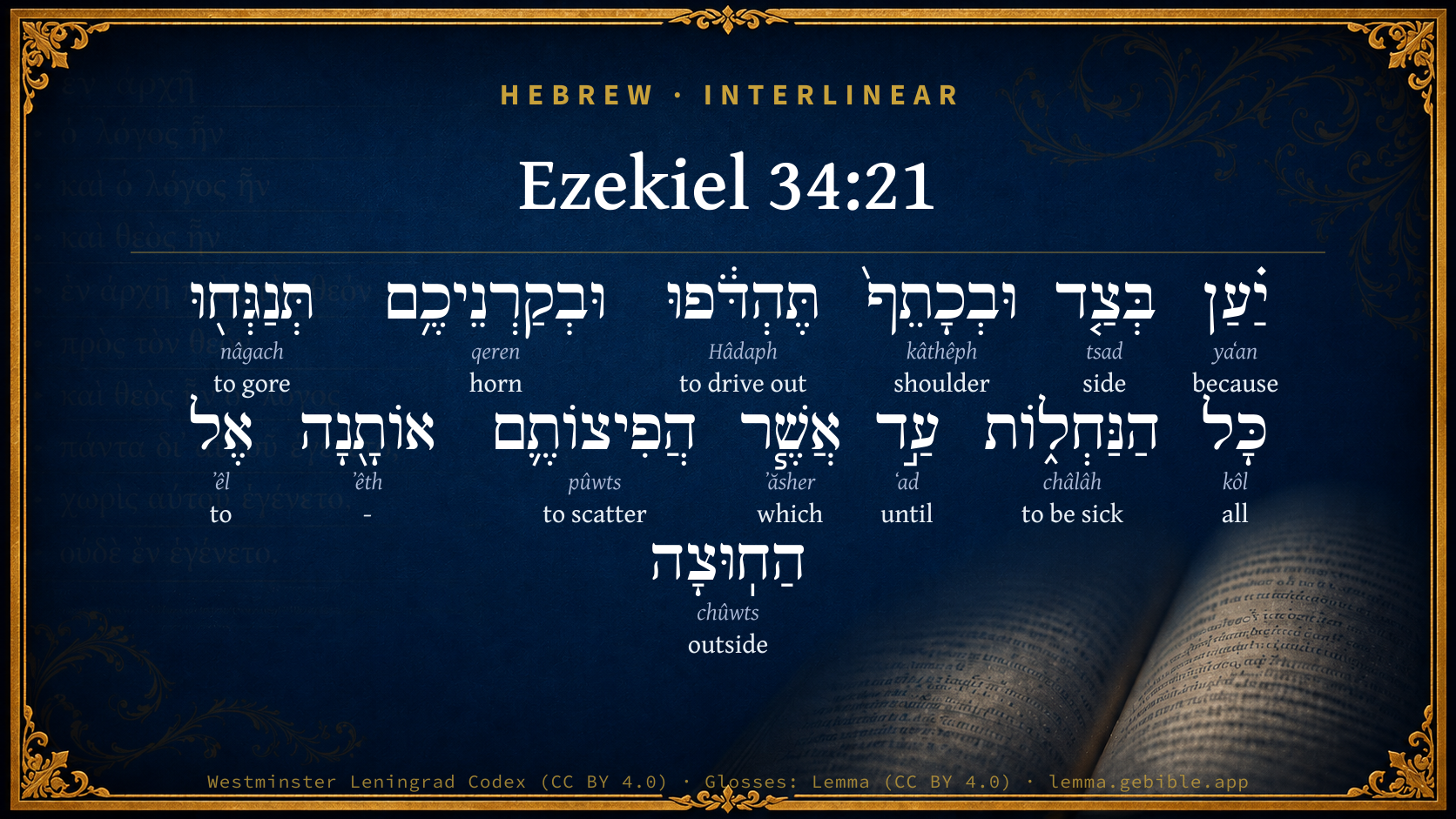
Hebrew (Westminster Leningrad Codex) Ezekiel 34:21 appears in the Hebrew Old Testament. The text above is from the Westminster Leningrad Codex. Each word links to its Strong’s number, a concise gloss, and parsing drawn from the Open Scriptures Hebrew Bible morphology. Click any word for its full Brown-Driver-Briggs (BDB) entry.
Download image
Cite this verse

Ezekiel 34:21 (World English Bible). Public Domain. Lemma interlinear Bible study tool, https://lemma.gebible.app/v/ezekiel/34/21.

Show BibTeX & RIS
BibTeX
RIS
English Translation
Because you thrust with side and with shoulder, and push all the diseased with your horns, until you have scattered them abroad;
World English Bible · Public Domain
Download a study sheet

One document with this verse’s original text, its word-by-word gloss line, the meaning frame, cross-references with their text, attributed commentary, and full source and license credits — printable, and it pastes into notes with its structure intact.

This verse Autodidact and up

Study sheet (.html) Plain text (.txt)

A passage Seminary Student

Up to 50 verses in one chapter. A passage sheet keeps up to 6 commentary sources and 12 cross-references per verse, in the order this page ranks them, and says so on the sheet whenever that leaves anything out. Ask for a single verse and you get the Autodidact verse sheet above.

Everything on this page stays free to read, with no account — the sheet is a download of what is already on screen, not access to it.

Want to remove ads? Support Godless Engineer
Compare translations 3

The same verse in 3 English versions, stacked beneath the original-language interlinear above. Click any original word for its lexicon entry.

Each is an independent rendering of the whole verse — the interlinear is not word-aligned to these translations.

Highlighted words mark where these versions differ — a whole-verse word diff, not a word-by-word alignment.

  • World English Bible Public Domain
    Because you thrust with side and with shoulder, and push all the diseased with your horns, until you have scattered them abroad;
  • King James Version Public Domain
    Because ye have thrust with side and with shoulder, and pushed all the diseased with your horns, till ye have scattered them abroad;
  • unfoldingWord Literal Text CC BY-SA 4.0
    for you have pushed them with your sides and shoulders, and you have gored all of the weak ones with your horns until you have scattered them away from the land.

unfoldingWord Literal Text — © unfoldingWord, licensed CC BY-SA 4.0. Word-aligned USFM3 via Door43 (git.door43.org/unfoldingWord/en_ult).

Versions to compare (up to 4)

3 of 4 selected

Show all 18 translations

Every available English version of this verse, each an independent rendering of the whole verse.

  • World English Bible Public Domain
    Because you thrust with side and with shoulder, and push all the diseased with your horns, until you have scattered them abroad;
  • Berean Standard Bible Public Domain
    Since you shove with flank and shoulder, butting all the weak ones with your horns until you have scattered them abroad,
  • Majority Standard Bible Public Domain
    Since you shove with flank and shoulder, butting all the weak ones with your horns until you have scattered them abroad,
  • King James Version Public Domain
    Because ye have thrust with side and with shoulder, and pushed all the diseased with your horns, till ye have scattered them abroad;
  • American Standard Version (1901) Public Domain
    Because ye thrust with side and with shoulder, and push all the diseased with your horns, till ye have scattered them abroad;
  • Revised Version (1885) Public Domain
    Because ye thrust with side and with shoulder, and push all the diseased with your horns, till ye have scattered them abroad;
  • Geneva Bible (1599) Public Domain
    Because ye haue thrust with side and with shoulder, and pusht al the weake with your hornes, till ye haue scattered them abroade,
  • Douay-Rheims (1899) Public Domain
    Because you thrusted with sides and shoulders, and struck all the weak cattle with your horns, till they were scattered abroad:
  • Young's Literal Translation Public Domain
    Because with side and with shoulder ye thrust away, And with your horns push all the diseased, Till ye have scattered them to the out-place,
  • Literal Standard Version CC BY-SA 4.0
    Because you thrust away with side and with shoulder, || And push all the diseased with your horns, || Until you have scattered them to the out-place,
  • Unlocked Literal Bible CC BY-SA 4.0
    for you have pushed them with your sides and shoulders, and you have gored all of the weak ones with your horns until you have scattered them away from the land.
  • unfoldingWord Literal Text CC BY-SA 4.0
    for you have pushed them with your sides and shoulders, and you have gored all of the weak ones with your horns until you have scattered them away from the land.
  • Darby Bible Public Domain
    Because ye thrust with side and with shoulder, and push all the weak ones with your horns, till ye have scattered them abroad,
  • World Messianic Bible Public Domain
    Because you thrust with side and with shoulder, and push all the diseased with your horns, until you have scattered them abroad,
  • Webster's Bible Public Domain
    Because ye have thrust with side and with shoulder, and pushed all the diseased with your horns, till ye have scattered them abroad;
  • Free Bible Version CC BY-SA 4.0
    Since you push others around with your sides and your shoulders, and use your horns to attack all the weak ones until you have chased them away,
  • Bible in Basic English Public Domain
    Because you have been pushing with side and leg, pushing the diseased with your horns till they were sent away in every direction;
  • JPS Tanakh (1917) Public Domain
    Because ye thrust with side and with shoulder, and push all the weak with your horns, till ye have scattered them abroad;

Literal Standard Version (2020), Covenant Press — licensed CC BY-SA 4.0. Text via the HelloAO Bible API (eBible.org). Unlocked Literal Bible (unfoldingWord) — licensed CC BY-SA 4.0. Text via the HelloAO Bible API (eBible.org). unfoldingWord Literal Text — © unfoldingWord, licensed CC BY-SA 4.0. Word-aligned USFM3 via Door43 (git.door43.org/unfoldingWord/en_ult). Free Bible Version, Dr. Jonathan Gallagher — licensed CC BY-SA 4.0. Text via the HelloAO Bible API (eBible.org).

Word by word

More ways to search: Search by grammar → Find every occurrence → Compare this word →

Practice this passage: Drill this verse → Learn its vocabulary →

תֶּהְדֹּ֔פוּ
Hâdaph
H1920
“to drive out”
Verb, Qal, Imperfect, 2nd Person, Masculine, Plural
Part of Speech
Verb
Stem
Qal
Form
Imperfect
Person
2nd Person
Gender
Masculine
Number
Plural
Full BDB Definition

Origin: a primitive root

TWOT: 476

to thrust, push, drive, cast away, cast out, expel, thrust away - (Qal) - to thrust, push - to drive out, thrust out - to depose
  1. יַ֗עַן yaʻan H3282 “because” Conjunction
  2. בְּצַ֤ד tsad H6654 “in/at · side” Preposition + Noun, Common, Masculine, Singular, Absolute
  3. וּבְכָתֵף֙ kâthêph H3802 “and · in/at · shoulder” Conjunction + Preposition + Noun, Common, Feminine, Singular, Absolute
  4. וּבְקַרְנֵיכֶ֥ם qeren H7161 “and · in/at · horns · your” Conjunction + Preposition + Noun, Common, Both, Dual, Construct + Suffix, Personal, 2nd Person, Masculine, Plural
  5. תְּנַגְּח֖וּ nâgach H5055 “to gore” Verb, Piel, Imperfect, 2nd Person, Masculine, Plural
  6. כָּל kôl H3605 “all of” Noun, Common, Masculine, Singular, Construct
  7. הַנַּחְל֑וֹת châlâh H2470 “the · sick” Particle, Definite Article + Verb, Niphal, Participle Passive, Feminine, Plural, Absolute
  8. עַ֣ד ʻad H5704 “until” Preposition
  9. אֲשֶׁ֧ר ʼăsher H834 “which” Particle, Relative
  10. הֲפִיצוֹתֶ֛ם pûwts H6327 “to scatter” Verb, Hiphil, Perfect, 2nd Person, Masculine, Plural
  11. אוֹתָ֖נָה ʼêth H853 “- · them” Particle, Direct Object + Suffix, Personal, 3rd Person, Feminine, Plural
  12. אֶל ʼêl H413 “to” Preposition
  13. הַחֽוּצָה chûwts H2351 “the · outside · toward” Particle, Definite Article + Noun, Common, Masculine, Singular, Absolute + Suffix, Demonstrative

About this verse

These counts appear in no published source. They are computed here, from the morphology-tagged text and Lemma’s own curated glosses. What Lemma adds →

14
words
14
distinct lemmas
Prophets
section

Notable vocabulary

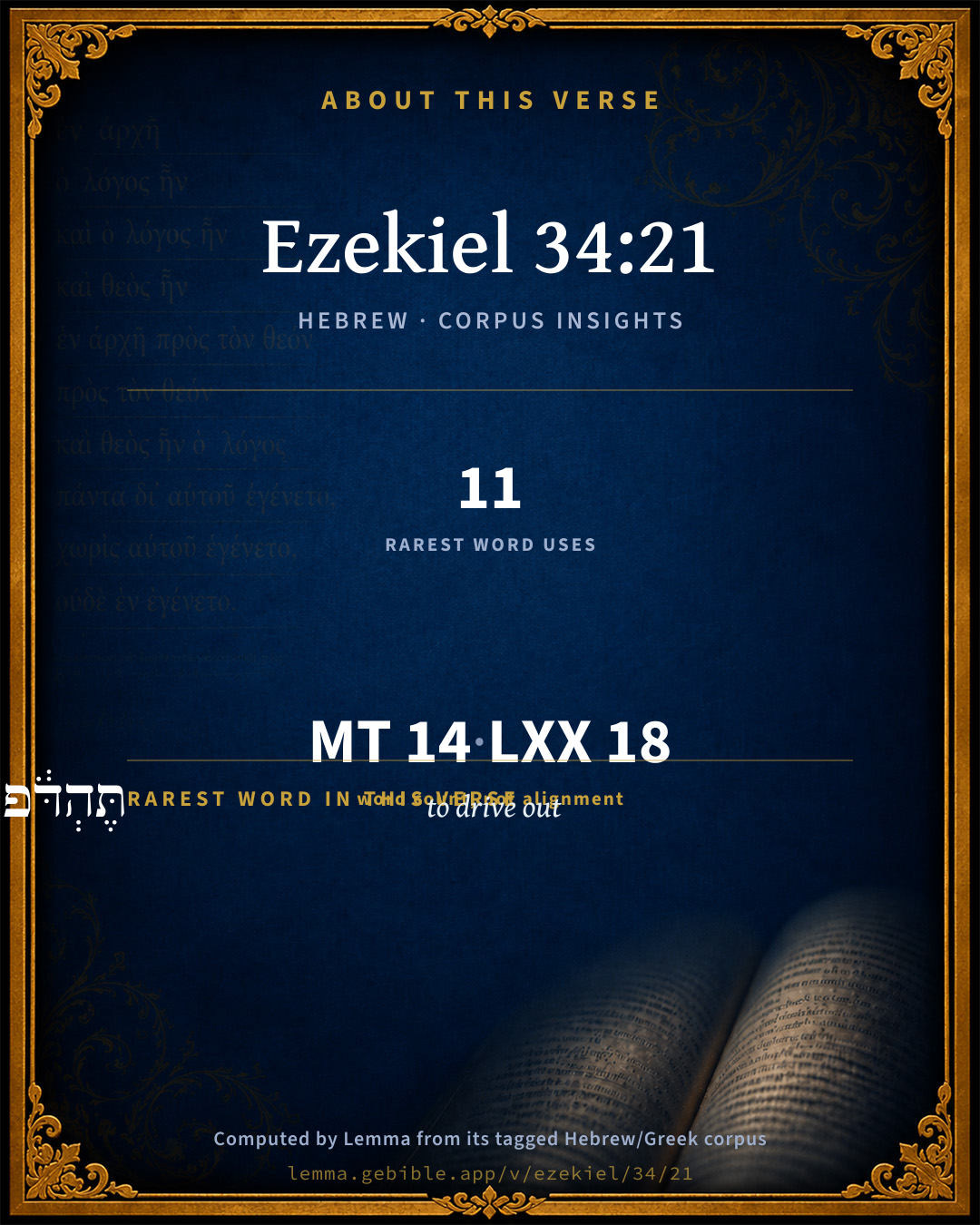
The rarest word here is תֶּהְדֹּ֔פוּ to drive out H1920 — appearing just 11 times in the whole Hebrew Bible.

Shared distinctive vocabulary

תֶּהְדֹּ֔פוּ to drive out H1920 occurs in 11 verses of the Hebrew Bible. Also found in:

Grammatical profile

  • 4 verbs
  • 5 nouns
  • 2 prepositions
  • 1 conjunction
  • 2 particles

Verb forms

  • תֶּהְדֹּ֔פוּ Qal · Imperfect
  • תְּנַגְּח֖וּ Piel · Imperfect
  • הַנַּחְל֑וֹת Niphal · Participle Passive
  • הֲפִיצוֹתֶ֛ם Hiphil · Perfect

Hebrew & Septuagint length

In English translation the verse runs 22 words from the Hebrew and 20 from the Septuagint (LXX English) — closely comparable.

A rough comparison of the two English renderings, which tokenize alike — not a word-level alignment.

Word counts can differ between the Hebrew and the Greek without any difference in meaning — e.g. the Hebrew direct-object marker אֵת has no separate Greek word, and Greek often adds the article ὁ.

In the original languages it is 14 Hebrew tokens and 18 Greek tokens — but the two are counted differently (Hebrew bundles its prefixes and suffixes into one token; the Greek is in lemma form), so that isn’t a like-for-like length.

Cross-references

6

Topical passages linked to Ezekiel 34:21 in the Treasury of Scripture Knowledge — connected by theme and wording, ordered by reader-vote popularity; previews shown in the World English Bible.

  • Deuteronomy 33:17 The firstborn of his herd, majesty is his; His horns are the horns of the wild-ox: With them he shall push the peoples all of them, [even] the ends of the earth: They are the ten thousands of Ephraim, They are the thousands of Manasseh.
  • Ezekiel 34:3–5 You eat the fat, and you clothe you with the wool, you kill the fatlings; but you don't feed the sheep.
  • Zechariah 11:5 Their buyers slaughter them, and go unpunished. Those who sell them say, 'Blessed be Yahweh, for I am rich;' and their own shepherds don't pity them.
  • Zechariah 11:16–17 For, behold, I will raise up a shepherd in the land, who will not visit those who are cut off, neither will seek those who are scattered, nor heal that which is broken, nor feed that which is sound; but he will eat the flesh of the fat sheep, and will tear their hoofs in pieces.
  • Luke 13:14–16 The ruler of the synagogue, being indignant because Jesus had healed on the Sabbath, said to the multitude, "There are six days in which men ought to work. Therefore come on those days and be healed, and not on the Sabbath day!"
  • Daniel 8:3–10 Then I lifted up my eyes, and saw, and, behold, there stood before the river a ram which had two horns: and the two horns were high; but one was higher than the other, and the higher came up last.

Cross-references courtesy of OpenBible.info (CC BY 4.0).

Hebrew and Greek witnesses Masoretic Hebrew ↔ Greek Septuagint

The same verse in the two great witnesses to the Old Testament, shown verse-for-verse.

These are two independent witnesses, not word-aligned to each other, and the Septuagint is shown in lemma (dictionary) form.

Hebrew Ezekiel 34:21 Masoretic · Westminster Leningrad Codex

יַ֗עַן בְּצַ֤ד וּבְכָתֵף֙ תֶּהְדֹּ֔פוּ וּבְקַרְנֵיכֶ֥ם תְּנַגְּח֖וּ כָּל הַנַּחְל֑וֹת עַ֣ד אֲשֶׁ֧ר הֲפִיצוֹתֶ֛ם אוֹתָ֖נָה אֶל הַחֽוּצָה

Because you thrust with side and with shoulder, and push all the diseased with your horns, until you have scattered them abroad;

World English Bible · Public Domain

Greek LXX Ezekiel 34:21 Septuagint · lemma form

ἐπί ὁ πλευρά καί ὁ ὦμος σύ διαὠθέω καί ὁ κέρας σύ κερατίζω καί πᾶς ὁ ἐκλείπω ἐκθλίβω

You⌃ did thrust with your sides and shoulders, and pushed with your horns, and you⌃ cruelly treated all the sick.

LXX2012 (modern English Septuagint) · Public Domain

Hebrew: Westminster Leningrad Codex (CC BY 4.0). Greek: Septuagint (public domain); English from LXX2012 (modern English Septuagint) (Public Domain). How the Septuagint differs from the Hebrew →

Targum (Aramaic paraphrase)

1

The Targum is the ancient Jewish Aramaic paraphrase of the Hebrew Scriptures — an interpretive translation, not the Hebrew text itself. Onkelos (literal) and Pseudo-Jonathan (expansive) render the Torah, and Jonathan the Prophets. Coverage is partial: where no permissively-licensed English translation exists for a verse, only the Aramaic is shown. This is verse-level text, not a word-by-word alignment to the Hebrew.

  1. Targum Jonathan Prophets (Joshua–Malachi)
    חֲלַף דְבִרְשַׁע וּבִדְרַע דְחֵיקְתּוּן וּבְתוּקְפָא תְבַרְתּוּן כָּל כְּאַיבַיָא עַד דְבַדַרְתּוּן יַתְהוֹן לְבֵינֵי מְדִינָתָא:

    (no public-domain English translation for this verse)

    Targum Jonathan — Aramaic: “Mikraot Gedolot” (public domain). English: “Sefaria Community Translation” (CC0 1.0 (public-domain dedication)); “London "Chaldee Paraphrase," 1871” (public domain). Text via Sefaria.

Commentary

Notes on Ezekiel 34:21 from classic Christian and Jewish commentators (each source and its license shown beneath its notes). The classic Christian expositions comment on the surrounding passage and are grouped to its opening verse, so a note may address several verses; the Jewish commentaries on the Tanakh (Rashi and others) are per-verse, so they appear only where the commentator wrote on this verse.

Lemma curates 59 commentaries, every one of them public domain or Creative Commons licensed, each selected and text-cleaned for this edition rather than reprinted as found. About our sources →

Trapp's Complete Commentary

John Trapp

Eze 34:21 Because ye have thrust with side and with shoulder, and pushed all the diseased with your horns, till ye have scattered them abroad;

Ver. 21. Because ye have thrust with side and with shoulder,] {a} i.e., With pretence of law on your side, and with power in your hand to do what you list; for who can withstand you?

And pushed all the diseased with your horns,] i.e., With your excommunications and persecutions. See Isa 66:5.

Till ye have scattered them abroad.] For how should they abide it? They drive them out of the fold, flock, pasture, so that they must either fly or die.

{a} Toto corpore et conatu.

John Trapp, A Commentary or Exposition upon All the Books of the Old and New Testament (1647–1656) — public domain. Text from a community e-Sword module.

Joseph Benson's Commentary

Eze 34:21-22. Because ye have thrust with side and shoulder, &c. — Have molested and vexed the poor and weak by your unjust and violent dealings; therefore will I save my flock — I will interpose, and rescue the poor of my people from violence and oppression. The reader will easily observe that the metaphors used in these verses are taken from two sorts of cattle, the one of the larger and stronger kind, the other of the smaller and weaker sort, which the larger ones are wont to thrust aside and push at with their horns.

Joseph Benson's Commentary on the Old and New Testaments (1811–1818) — public domain. Text from a community e-Sword module.

Jamieson, Fausset & Brown

Robert Jamieson, A. R. Fausset & David Brown

scattered them abroad--down to the time of the carrying away to Babylon [GROTIUS].

Jamieson, Fausset & Brown — Commentary Critical and Explanatory on the Whole Bible (1871) — public domain (CC PDM 1.0). Text via the HelloAO Bible API.

John Gill's Exposition

Therefore will I save my flock,.... Or redeem my people, as the Targum; that is, by his son, after described, as his shepherd and servant:

and they shall no more be a prey: to Satan the roaring lion; nor to such horned cattle, their persecutors; nor to false teachers, who lie in wait to deceive; nor shall they ever perish, being the sheep of Christ, hand, and under the care of him the shepherd, spoken of in the next verse:

and I will judge between cattle and cattle; between man and man, as the Targum; that is, between good and bad men, the persecutors and the persecuted. See Gill on Eze 34:17. See Gill on Eze 34:20.

John Gill's Exposition of the Whole Bible (1746–1763) — public domain (CC PDM 1.0). Text via the HelloAO Bible API.

Lesson kit

Teaching starters — assembled from the data on this page, not authored interpretation. Every prompt links to the verse data it draws on. Edit before teaching.

Ezekiel, in the Prophets, opens this verse with 14 words (14 distinct Hebrew lemmas). Its most distinctive word is Hâdaph (“to drive out”). A historical commentator’s framing appears above. Read the whole chapter for the surrounding context.

Discussion questions

  1. How does “to drive out” (Hâdaph) shape what this verse is saying?
  2. How does Numbers 35:20, which shares the word «to drive out», read alongside this verse?
  3. These translations render this verse differently. What is at stake in choosing one wording over another?
  4. «תֶּהְדֹּ֔פוּ» is a Qal Imperfect verb. How does that grammatical form shape the action described?
  5. Compare how Trapp's Complete Commentary and Joseph Benson's Commentary read this verse. Where do they agree or differ?

Things to notice

Reading settings

Reading text

Shown beneath each verse's original-language words.

Old Testament
Old Testament edition

Read the OT as the Masoretic Hebrew (MT) or the Greek Septuagint (LXX).

English shown for the Greek Septuagint (in the Hebrew ↔ Greek comparison).

Comparing translations? Open the Compare panel on any verse page to stack up to four side by side.