
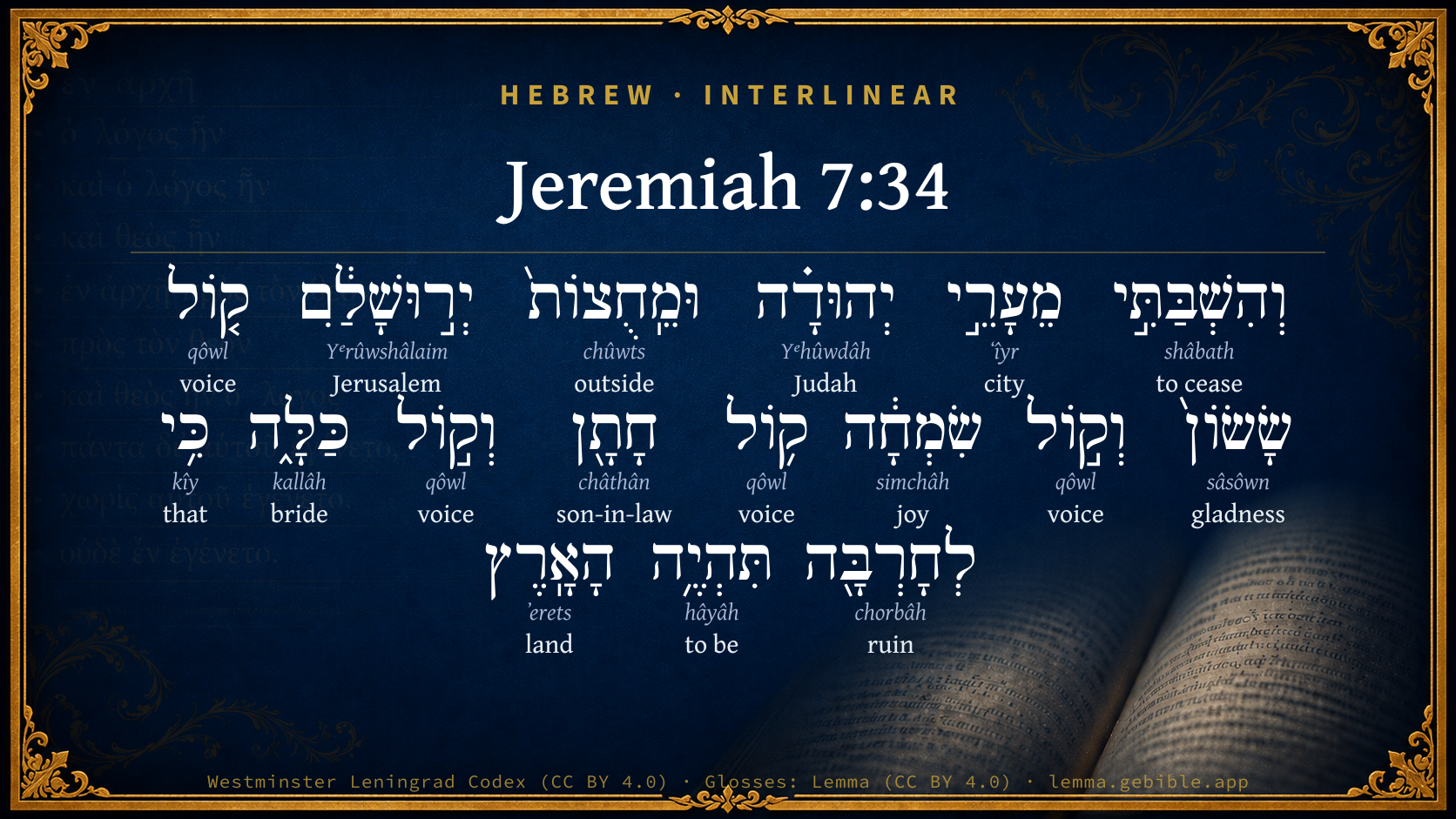
Jeremiah 7:34

Hebrew (Westminster Leningrad Codex) Jeremiah 7:34 appears in the Hebrew Old Testament. The text above is from the Westminster Leningrad Codex. Each word links to its Strong’s number, a concise gloss, and parsing drawn from the Open Scriptures Hebrew Bible morphology. Click any word for its full Brown-Driver-Briggs (BDB) entry.
Download image
Cite this verse

Jeremiah 7:34 (World English Bible). Public Domain. Lemma interlinear Bible study tool, https://lemma.gebible.app/v/jeremiah/7/34.

Show BibTeX & RIS
BibTeX
RIS
English Translation
Then will I cause to cease from the cities of Judah, and from the streets of Jerusalem, the voice of mirth and the voice of gladness, the voice of the bridegroom and the voice of the bride; for the land shall become a waste.
World English Bible · Public Domain
Download a study sheet

One document with this verse’s original text, its word-by-word gloss line, the meaning frame, cross-references with their text, attributed commentary, and full source and license credits — printable, and it pastes into notes with its structure intact.

This verse Autodidact and up

Study sheet (.html) Plain text (.txt)

A passage Seminary Student

Up to 50 verses in one chapter. A passage sheet keeps up to 6 commentary sources and 12 cross-references per verse, in the order this page ranks them, and says so on the sheet whenever that leaves anything out. Ask for a single verse and you get the Autodidact verse sheet above.

Everything on this page stays free to read, with no account — the sheet is a download of what is already on screen, not access to it.

Want to remove ads? Support Godless Engineer
Compare translations 3

The same verse in 3 English versions, stacked beneath the original-language interlinear above. Click any original word for its lexicon entry.

Each is an independent rendering of the whole verse — the interlinear is not word-aligned to these translations.

Highlighted words mark where these versions differ — a whole-verse word diff, not a word-by-word alignment.

  • World English Bible Public Domain
    Then will I cause to cease from the cities of Judah, and from the streets of Jerusalem, the voice of mirth and the voice of gladness, the voice of the bridegroom and the voice of the bride; for the land shall become a waste.
  • King James Version Public Domain
    Then will I cause to cease from the cities of Judah, and from the streets of Jerusalem, the voice of mirth, and the voice of gladness, the voice of the bridegroom, and the voice of the bride: for the land shall be desolate.
  • unfoldingWord Literal Text CC BY-SA 4.0
    And I shall cause to cease from the cities of Judah and from the streets of Jerusalem: the sound of joy and the sound of gladness, the voice of the bridegroom and the voice of the bride. For the land will be desolate.”

unfoldingWord Literal Text — © unfoldingWord, licensed CC BY-SA 4.0. Word-aligned USFM3 via Door43 (git.door43.org/unfoldingWord/en_ult).

Versions to compare (up to 4)

3 of 4 selected

Show all 18 translations

Every available English version of this verse, each an independent rendering of the whole verse.

  • World English Bible Public Domain
    Then will I cause to cease from the cities of Judah, and from the streets of Jerusalem, the voice of mirth and the voice of gladness, the voice of the bridegroom and the voice of the bride; for the land shall become a waste.
  • Berean Standard Bible Public Domain
    I will remove from the cities of Judah and the streets of Jerusalem the sounds of joy and gladness and the voices of the bride and bridegroom, for the land will become a wasteland.”
  • Majority Standard Bible Public Domain
    I will remove from the cities of Judah and the streets of Jerusalem the sounds of joy and gladness and the voices of the bride and bridegroom, for the land will become a wasteland.”
  • King James Version Public Domain
    Then will I cause to cease from the cities of Judah, and from the streets of Jerusalem, the voice of mirth, and the voice of gladness, the voice of the bridegroom, and the voice of the bride: for the land shall be desolate.
  • American Standard Version (1901) Public Domain
    Then will I cause to cease from the cities of Judah, and from the streets of Jerusalem, the voice of mirth and the voice of gladness, the voice of the bridegroom and the voice of the bride; for the land shall become a waste.
  • Revised Version (1885) Public Domain
    Then will I cause to cease from the cities of Judah, and from the streets of Jerusalem, the voice of mirth and the voice of gladness, the voice of the bridegroom and the voice of the bride: for the land shall become a waste.
  • Geneva Bible (1599) Public Domain
    Then I will cause to cease from the cities of Iudah and from the streetes of Ierusalem the voice of mirth and the voice of gladnesse, the voice of the bridegrom and the voice of the bride: for the lande shalbe desolate.
  • Douay-Rheims (1899) Public Domain
    And I will cause ot cease out of the cities of Juda, and out of the streets of Jerusalem, the voice of joy, and the coice of gladness, the voice of the bridegroom and the voice of the bride: for the land shall be desolate.
  • Young's Literal Translation Public Domain
    And I have caused to cease from cities of Judah, And from streets of Jerusalem, The voice of joy, and the voice of gladness, Voice of bridegroom, and voice of bride, For the land doth become a desolation!
  • Literal Standard Version CC BY-SA 4.0
    And I have caused to cease from cities of Judah, || And from streets of Jerusalem, || The voice of joy, and the voice of gladness, || Voice of bridegroom, and voice of bride, || For the land becomes a desolation!”
  • Unlocked Literal Bible CC BY-SA 4.0
    I will put an end to the cities of Judah and the streets of Jerusalem, the sound of joy and the sound of gladness, the sound of the groom and the sound of the bride, for the land will become a desolation.”
  • unfoldingWord Literal Text CC BY-SA 4.0
    And I shall cause to cease from the cities of Judah and from the streets of Jerusalem: the sound of joy and the sound of gladness, the voice of the bridegroom and the voice of the bride. For the land will be desolate.”
  • Darby Bible Public Domain
    And I will cause to cease from the cities of Judah, and from the streets of Jerusalem, the voice of mirth and the voice of joy, the voice of the bridegroom and the voice of the bride; for the land shall become a waste.
  • World Messianic Bible Public Domain
    Then I will cause to cease from the cities of Judah and from the streets of Jerusalem the voice of mirth and the voice of gladness, the voice of the bridegroom and the voice of the bride; for the land will become a waste.”
  • Webster's Bible Public Domain
    Then will I cause to cease from the cities of Judah, and from the streets of Jerusalem, the voice of mirth, and the voice of gladness, the voice of the bridegroom, and the voice of the bride: for the land shall be desolate.
  • Free Bible Version CC BY-SA 4.0
    I will put a stop to the cheerful sounds of celebration and the happy voices of the bride and bridegroom from the cities of Judah and the streets of Jerusalem, for the country will be turned into a wasteland.
  • Bible in Basic English Public Domain
    And in the towns of Judah and in the streets of Jerusalem, I will put an end to the laughing voices, the voice of joy and the voice of the newly-married man and the voice of the bride: for the land will become a waste.
  • JPS Tanakh (1917) Public Domain
    Then will I cause to cease from the cities of Judah, and from the streets of Jerusalem, the voice of mirth and the voice of gladness, the voice of the bridegroom and the voice of the bride; for the land shall be desolate.

Literal Standard Version (2020), Covenant Press — licensed CC BY-SA 4.0. Text via the HelloAO Bible API (eBible.org). Unlocked Literal Bible (unfoldingWord) — licensed CC BY-SA 4.0. Text via the HelloAO Bible API (eBible.org). unfoldingWord Literal Text — © unfoldingWord, licensed CC BY-SA 4.0. Word-aligned USFM3 via Door43 (git.door43.org/unfoldingWord/en_ult). Free Bible Version, Dr. Jonathan Gallagher — licensed CC BY-SA 4.0. Text via the HelloAO Bible API (eBible.org).

Word by word

More ways to search: Search by grammar → Find every occurrence → Compare this word →

Practice this passage: Drill this verse → Learn its vocabulary →

חָתָ֖ן
châthân
H2860
“son-in-law”
Noun, Common, Masculine, Singular, Absolute
Part of Speech
Noun
Type
Common
Gender
Masculine
Number
Singular
State
Absolute
Full BDB Definition

Origin: from H2859

TWOT: 781c

son-in-law, daughter's husband, bridegroom, husband
  1. וְהִשְׁבַּתִּ֣י shâbath H7673 “and · to cease” Conjunction + Verb, Hiphil, Sequential Perfect, 1st Person, Common, Singular
  2. מֵעָרֵ֣י ʻîyr H5892 “from · cities of” Preposition + Noun, Common, Feminine, Plural, Construct
  3. יְהוּדָ֗ה Yᵉhûwdâh H3063 “Judah” Noun, Proper
  4. וּמֵֽחֻצוֹת֙ chûwts H2351 “and · from · streets of” Conjunction + Preposition + Noun, Common, Masculine, Plural, Construct
  5. יְר֣וּשָׁלִַ֔ם Yᵉrûwshâlaim H3389 “Jerusalem” Noun, Proper
  6. ק֤וֹל qôwl H6963 “voice of” Noun, Common, Masculine, Singular, Construct
  7. שָׂשׂוֹן֙ sâsôwn H8342 “gladness” Noun, Common, Masculine, Singular, Absolute
  8. וְק֣וֹל qôwl H6963 “and · voice of” Conjunction + Noun, Common, Masculine, Singular, Construct
  9. שִׂמְחָ֔ה simchâh H8057 “joy” Noun, Common, Feminine, Singular, Absolute
  10. ק֥וֹל qôwl H6963 “voice of” Noun, Common, Masculine, Singular, Construct
  11. וְק֣וֹל qôwl H6963 “and · voice of” Conjunction + Noun, Common, Masculine, Singular, Construct
  12. כַּלָּ֑ה kallâh H3618 “bride” Noun, Common, Feminine, Singular, Absolute
  13. כִּ֥י kîy H3588 “that” Conjunction
  14. לְחָרְבָּ֖ה chorbâh H2723 “to/for · ruin” Preposition + Noun, Common, Feminine, Singular, Absolute
  15. תִּהְיֶ֥ה hâyâh H1961 “to be” Verb, Qal, Imperfect, 3rd Person, Feminine, Singular
  16. הָאָֽרֶץ ʼerets H776 “the · land” Particle, Definite Article + Noun, Common, Both, Singular, Absolute

About this verse

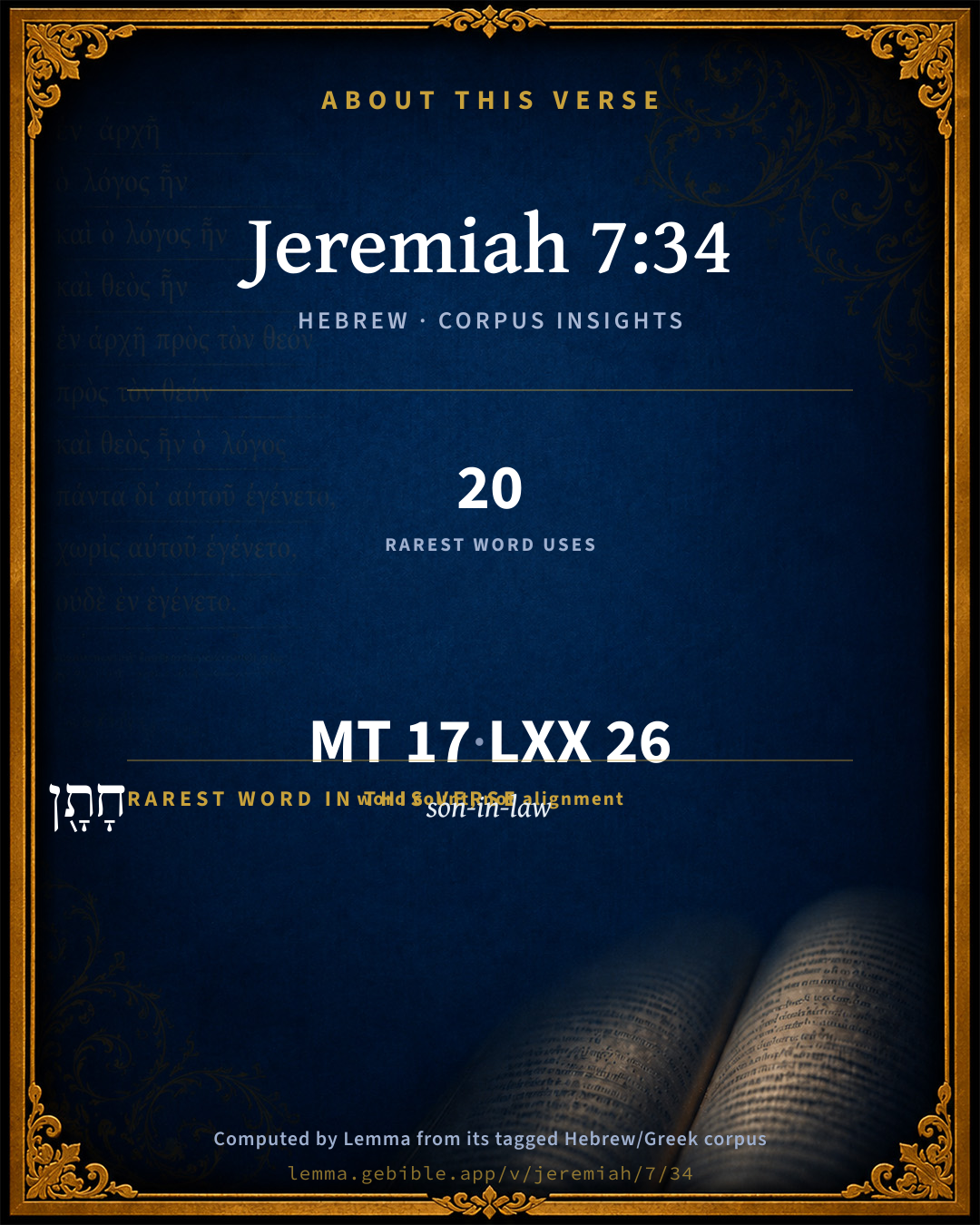
These counts appear in no published source. They are computed here, from the morphology-tagged text and Lemma’s own curated glosses. What Lemma adds →

17
words
14
distinct lemmas
Prophets
section

Notable vocabulary

The rarest word here is חָתָ֖ן son-in-law H2860 — appearing just 20 times in the whole Hebrew Bible.

Shared distinctive vocabulary

חָתָ֖ן son-in-law H2860 occurs in 19 verses of the Hebrew Bible. Also found in:

Grammatical profile

  • 2 verbs
  • 14 nouns
  • 1 conjunction

Verb forms

  • וְהִשְׁבַּתִּ֣י Hiphil · Sequential Perfect
  • תִּהְיֶ֥ה Qal · Imperfect

Repetition

A word recurs within this verse — often emphatic in Hebrew:

  • ק֤וֹל voice H6963 ×4

Hebrew & Septuagint length

In the original languages it is 17 Hebrew tokens and 26 Greek tokens — but the two are counted differently (Hebrew bundles its prefixes and suffixes into one token; the Greek is in lemma form), so that isn’t a like-for-like length.

Cross-references

13

Topical passages linked to Jeremiah 7:34 in the Treasury of Scripture Knowledge — connected by theme and wording, ordered by reader-vote popularity; previews shown in the World English Bible.

  • Ezekiel 26:13 I will cause the noise of your songs to cease; and the sound of your harps shall be no more heard.
  • Hosea 2:11 I will also cause all her celebrations to cease: Her feasts, her new moons, her Sabbaths, and all her solemn assemblies.
  • Revelation 18:23 The light of a lamp will shine no more at all in you. The voice of the bridegroom and of the bride will be heard no more at all in you; for your merchants were the princes of the earth; for with your sorcery all the nations were deceived.
  • Leviticus 26:33 I will scatter you among the nations, and I will draw out the sword after you: and your land will be a desolation, and your cities shall be a waste.
  • Isaiah 1:7 Your country is desolate. Your cities are burned with fire. Strangers devour your land in your presence, And it is desolate, As overthrown by strangers.
  • Isaiah 24:7–8 The new wine mourns, the vine languishes, all the merry-hearted do sigh.
  • Jeremiah 25:10 Moreover I will take from them the voice of mirth and the voice of gladness, the voice of the bridegroom and the voice of the bride, the sound of the millstones, and the light of the lamp.
  • Isaiah 3:26 Her gates shall lament and mourn; And she shall be desolate and sit on the ground.
  • Jeremiah 4:27 For thus says Yahweh, The whole land shall be a desolation; yet will I not make a full end.
  • Jeremiah 16:9 For thus says Yahweh of Hosts, the God of Israel: Behold, I will cause to cease out of this place, before your eyes and in your days, the voice of mirth and the voice of gladness, the voice of the bridegroom and the voice of the bride.
  • Micah 7:13 Yet the land will be desolate because of those who dwell therein, For the fruit of their doings.
  • Isaiah 6:11 Then I said, "Lord, how long?" He answered, "Until cities are waste without inhabitant, And houses without man, And the land becomes utterly waste,
  • Jeremiah 33:10 Thus says Yahweh: Yet again there shall be heard in this place, about which you say, It is waste, without man and without animal, even in the cities of Judah, and in the streets of Jerusalem, that are desolate, without man and without inhabitant and without animal,

Cross-references courtesy of OpenBible.info (CC BY 4.0).

Hebrew and Greek witnesses Masoretic Hebrew ↔ Greek Septuagint

The same verse in the two great witnesses to the Old Testament, shown verse-for-verse.

These are two independent witnesses, not word-aligned to each other, and the Septuagint is shown in lemma (dictionary) form.

Hebrew Jeremiah 7:34 Masoretic · Westminster Leningrad Codex

וְהִשְׁבַּתִּ֣י מֵעָרֵ֣י יְהוּדָ֗ה וּמֵֽחֻצוֹת֙ יְר֣וּשָׁלִַ֔ם ק֤וֹל שָׂשׂוֹן֙ וְק֣וֹל שִׂמְחָ֔ה ק֥וֹל חָתָ֖ן וְק֣וֹל כַּלָּ֑ה כִּ֥י לְחָרְבָּ֖ה תִּהְיֶ֥ה הָאָֽרֶץ

Then will I cause to cease from the cities of Judah, and from the streets of Jerusalem, the voice of mirth and the voice of gladness, the voice of the bridegroom and the voice of the bride; for the land shall become a waste.

World English Bible · Public Domain

Greek LXX Structure differs

In the Septuagint, Jeremiah is about an eighth shorter than the Hebrew and arranges its material differently — the Oracles Against the Nations (Hebrew chapters 46–51) appear in the middle of the Greek book, after 25:13. Because the chapter and verse boundaries do not line up, a verse-for-verse comparison with the Hebrew is not shown.

A verse-for-verse comparison isn’t shown here because the chapters and verses don’t line up. Switch to the LXX edition with the MT / LXX toggle above to read the Greek directly.

On this verse, John Gill's Exposition discusses the Septuagint’s reading. Read the note in Commentary ↓

Hebrew: Westminster Leningrad Codex (CC BY 4.0). Greek: Septuagint (public domain); English from a public-domain English Septuagint. How the Septuagint differs from the Hebrew →

Targum (Aramaic paraphrase)

1

The Targum is the ancient Jewish Aramaic paraphrase of the Hebrew Scriptures — an interpretive translation, not the Hebrew text itself. Onkelos (literal) and Pseudo-Jonathan (expansive) render the Torah, and Jonathan the Prophets. Coverage is partial: where no permissively-licensed English translation exists for a verse, only the Aramaic is shown. This is verse-level text, not a word-by-word alignment to the Hebrew.

  1. Targum Jonathan Prophets (Joshua–Malachi)
    וָאֱבַטֵיל מִקִרְוַיָא דְבֵּית יְהוּדָה וּמִשׁוֹקֵי יְרוּשְׁלֵם קַל בִּיעַ וְקַל חֶדְוָא קַל חַתְנוּן וְקַל כַּלָן אֲרֵי לְחוּרְבָּא תְּהֵי אַרְעָא:

    (no public-domain English translation for this verse)

    Targum Jonathan — Aramaic: “Mikraot Gedolot” (public domain). English: “Sefaria Community Translation” (CC0 1.0 (public-domain dedication)); “London "Chaldee Paraphrase," 1871” (public domain). Text via Sefaria.

Commentary

Notes on Jeremiah 7:34 from classic Christian and Jewish commentators (each source and its license shown beneath its notes). The classic Christian expositions comment on the surrounding passage and are grouped to its opening verse, so a note may address several verses; the Jewish commentaries on the Tanakh (Rashi and others) are per-verse, so they appear only where the commentator wrote on this verse.

Lemma curates 59 commentaries, every one of them public domain or Creative Commons licensed, each selected and text-cleaned for this edition rather than reprinted as found. About our sources →

Trapp's Complete Commentary

John Trapp

Jer 7:34 Then will I cause to cease from the cities of Judah, and from the streets of Jerusalem, the voice of mirth, and the voice of gladness, the voice of the bridegroom, and the voice of the bride: for the land shall be desolate.

Ver. 34. Then will I cause to cease.] Laetitia in luctum convertetur, plausus in planctum, &c. Their singing shall be turned into sighing, their hollowing into howling, &c.

The voice of the bridegroom.] No catches or canzonets shall be sung at weddings; no Epithalamia.

John Trapp, A Commentary or Exposition upon All the Books of the Old and New Testament (1647–1656) — public domain. Text from a community e-Sword module.

Jamieson, Fausset & Brown

Robert Jamieson, A. R. Fausset & David Brown

Referring to the joyous songs and music with which the bride and bridegroom were escorted in the procession to the home of the latter from that of the former; a custom still prevalent in the East (Jer 16:9; Isa 24:7-8; Rev 18:23).

Next: Jeremiah Chapter 8

Jamieson, Fausset & Brown — Commentary Critical and Explanatory on the Whole Bible (1871) — public domain (CC PDM 1.0). Text via the HelloAO Bible API.

Adam Clarke's Commentary

Verse 34. Then will I cause to cease - the voice of mirth] There shall no longer be in Jerusalem any cause of joy; they shall neither marry nor be given in marriage, for the land shall be totally desolated. Such horrible sins required such a horrible punishment. And they must be horrible, when they move God to destroy the work of his own hands.

Adam Clarke's Commentary on the Bible (1810–1826) — public domain. Text from a community e-Sword/MySword module.

John Calvin's Commentaries

He still continues the same subject; for he denounces on the Jews the punishment which they had deserved. He more fully expresses what he mentioned in the last verse respecting the shameful and dreadful barbarity that would follow the slaughter; for the whole country would not only be harassed by the enemy, but wholly laid waste: for when sounds of joy and gladness cease, all places are filled with lamentations; and when no marriages are celebrated, it is a sign of devastation.

But by marriage, the Prophet, stating a part for the whole, understands whatever was necessary for the preservation of society; it is the same as though he had said, “There shall be now no marrying:” for without marriages the human race cannot continue. Hence this cessation would be the same, as though he had said, that they would be wholly regardless of all those things necessary to perpetuate mankind. He thus adds nothing new, but expands what we have before observed, — that the whole land would be filled with dead bodies, and that there would be such lamentation as to deter men from all their usual and ordinary habits: he afterwards shews more fully the same thing.

John Calvin's Commentaries (1540-1563) — public domain. Text from the Calvin Translation Society English edition (1840s-50s) via the Christian Classics Ethereal Library (ccel.org). Calvin's coverage is partial (roughly two-thirds of the Bible); uncommented books and verses are honest gaps, never fabricated. The 19th-century editor's footnotes and remarks are omitted so the notes are faithfully Calvin's own voice.

Ellicott's Commentary for English Readers

(34) Then will I cause to cease . . . the voice of mirth.—The special imagery of the picture of desolation is characteristic of Jeremiah (Jer_16:9; Jer_25:10; Jer_33:11). No words could paint the utter break-up of the life of the nation more forcibly. Nothing is heard but wailing and lamentation, or, more terrible even than that, there is the utter silence of solitude. The capacity for joy and the occasions for rejoicing (comp. 1Ma_9:39 for the bridal rejoicings of Israel) belong alike to the past.

Shall be desolate.—The same word as in the “waste places” of Isa_51:3; Isa_58:12; it is used in Eze_13:4 for the haunts of the “foxes,” or rather the “jackals” of the “deserts,” but always of places that, having been once inhabited, have fallen into ruins (Lev_26:31).

A Bible Commentary for English Readers, edited by Charles John Ellicott (1878–1897) — public domain. Text from a community e-Sword module.

The Cambridge Bible for Schools and Colleges

gen. ed. J. J. S. Perowne

34. the voice of the bridegroom, etc.] Cp. Jer_16:9, Jer_25:10.

The Cambridge Bible for Schools and Colleges (gen. ed. J. J. S. Perowne; Cambridge University Press, 1878–1918) — public domain. Text from a community e-Sword module.

John Gill's Exposition

Then will I cause to cease from the cities of Judah, and from the streets of Jerusalem,.... Signifying that the devastation should not only be in and about Jerusalem, but should reach all over the land of Judea; since in all cities, towns, and villages, would cease

the voice of mirth, and the voice of gladness; upon any account whatever; and, instead of that, mourning, weeping, and lamentation:

the voice of the bridegroom, and the voice of the bride; no marrying, and giving in marriage, and so no expressions of joy on such occasions; and consequently no likelihood, at present, of repeopling the city of Jerusalem, and the other cities of Judah:

for the land shall be desolate; without people to dwell in it, and till it. The Septuagint, Syriac, and Arabic versions, read, "the whole land".

Next: Jeremiah Chapter 8

John Gill's Exposition of the Whole Bible (1746–1763) — public domain (CC PDM 1.0). Text via the HelloAO Bible API.

Albert Barnes' Notes on the Bible

Silence and desolation are to settle upon the whole land.

Albert Barnes' Notes on the Bible (1834–1885) — public domain. Text from a community e-Sword/MySword module.

Haydock's Catholic Bible Commentary

Bride. None shall think of marrying, (chap. xvi. 9., and xxv. 10.; Calmet) all being filled with lamentation. (Menochius)

George Leo Haydock (1774–1849), Haydock's Catholic Family Bible and Commentary, 1859 edition — public domain. Excludes Psalms (Douay-Rheims chapter numbering differs from Protestant) and Deuterocanonical books (Catholic canon only).

Matthew Poole's English Annotations

All kind and degrees of mirth shall cease, Rev 18:23, all places shall be filled with lamentations and woe; their singing shall be turned into sighing; they shall lay aside all things that are for the comfort of Human society, which is to be understood in this expression.

For the land shall be desolate; there shall be such an utter devastation, that there shall be neither season nor place for these things, Isa 64:10,11; Jer 25:10; where marrying shall cease, without which mankind cannot subsist, there must needs be desolation.

Matthew Poole's English Annotations on the Holy Bible (1683–1685) — public domain. Text from a community e-Sword/MySword module.

Whedon's Commentary on the Bible

Daniel D. Whedon

34. Cause to cease… the voice of mirth — Gloom and desolation shall cover the land. The joyfulness of life shall be gone. It shall be a dread carnival of death!

Daniel D. Whedon (gen. ed.), Commentary on the Old and New Testaments (1874–1909) — public domain. Text from a community e-Sword module.

The Pulpit Commentary

The land shall be desolate; rather, shall become a waste. The curse denounced upon the disobedient people in Lev_26:31, 33 (for another parallel between this chapter and Leviticus 26, see ver. 23). In both passages the word for "waste" is khorbah, which, as Dr. Payne Smith remarks, is "used only of places which, having once been inhabited, have then fallen into ruin." Hebrew is rich in synonyms for the idea of "desolation."

The Pulpit Commentary (1880–1919), ed. H.D.M. Spence-Jones & Joseph S. Exell — public domain. Text from a community e-Sword module.

Lesson kit

Teaching starters — assembled from the data on this page, not authored interpretation. Every prompt links to the verse data it draws on. Edit before teaching.

Jeremiah, in the Prophets, opens this verse with 17 words (14 distinct Hebrew lemmas). Its most distinctive word is châthân (“son-in-law”). A historical commentator’s framing appears above. Read the whole chapter for the surrounding context.

Discussion questions

  1. The word châthân carries the sense “son-in-law.” How does it shape the verse?
  2. How does Genesis 19:12, which shares the word «son-in-law», read alongside this verse?
  3. What does the repetition of “voice” (4× in this one verse) do in this verse?
  4. These translations render this verse differently; the difference is in the English rendering, not the original. What questions does that raise?
  5. «וְהִשְׁבַּתִּ֣י» is a Hiphil Sequential Perfect verb. How does that grammatical form shape the action described?
  6. Compare how Trapp's Complete Commentary and Jamieson, Fausset & Brown read this verse. Where do they agree or differ?

Things to notice

Reading settings

Reading text

Shown beneath each verse's original-language words.

Old Testament
Old Testament edition

Read the OT as the Masoretic Hebrew (MT) or the Greek Septuagint (LXX).

English shown for the Greek Septuagint (in the Hebrew ↔ Greek comparison).

Comparing translations? Open the Compare panel on any verse page to stack up to four side by side.