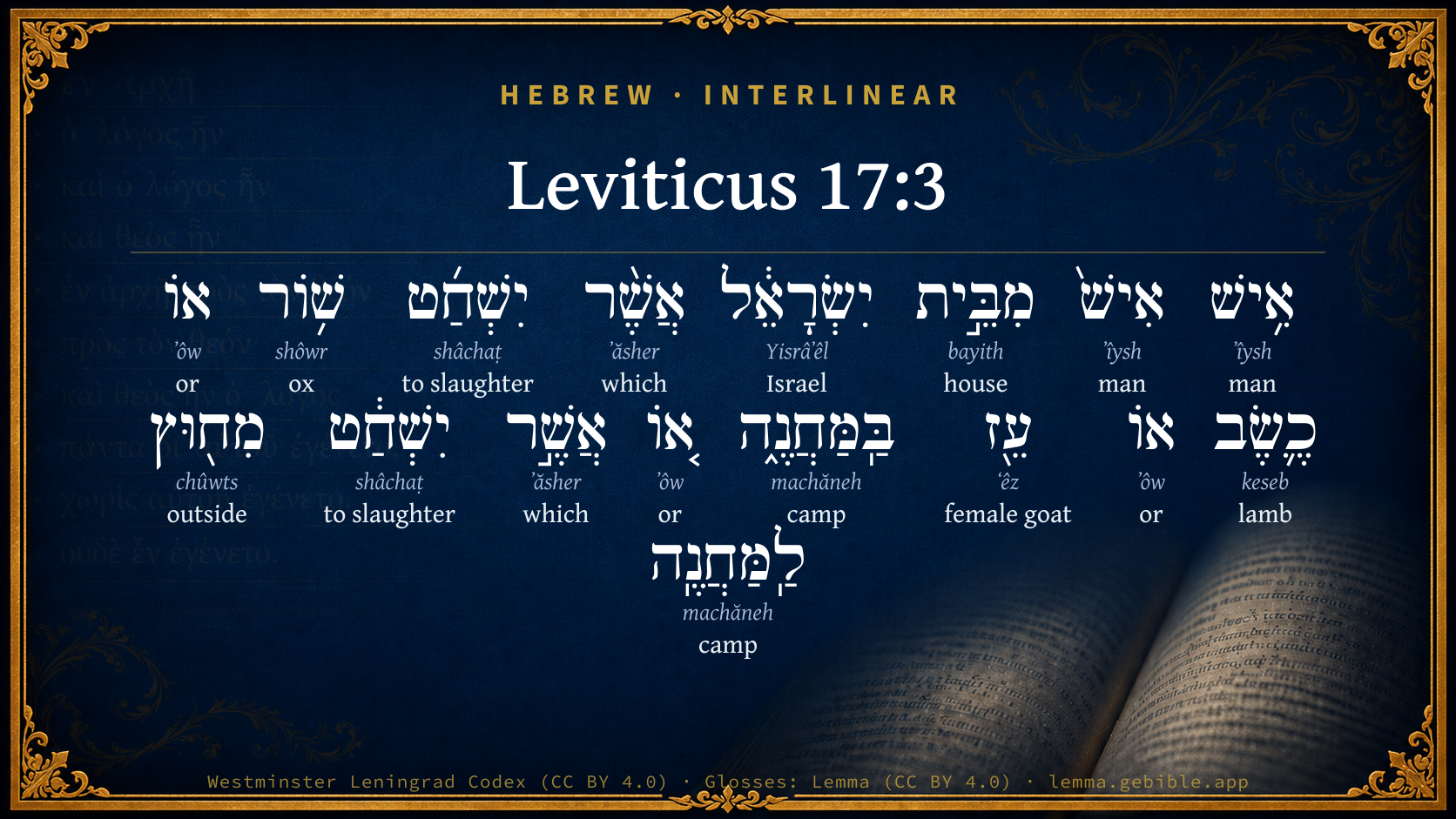
Leviticus 17:3

Hebrew (Westminster Leningrad Codex) Leviticus 17:3 appears in the Hebrew Old Testament. The text above is from the Westminster Leningrad Codex. Each word links to its Strong’s number, a concise gloss, and parsing drawn from the Open Scriptures Hebrew Bible morphology. Click any word for its full Brown-Driver-Briggs (BDB) entry.
Download image
Cite this verse

Leviticus 17:3 (World English Bible). Public Domain. Lemma interlinear Bible study tool, https://lemma.gebible.app/v/leviticus/17/3.

Show BibTeX & RIS
BibTeX
RIS
English Translation
Whatever man there is of the house of Israel, who kills an ox, or lamb, or goat, in the camp, or who kills it outside the camp,
World English Bible · Public Domain
Download a study sheet

One document with this verse’s original text, its word-by-word gloss line, the meaning frame, cross-references with their text, attributed commentary, and full source and license credits — printable, and it pastes into notes with its structure intact.

This verse Autodidact and up

Study sheet (.html) Plain text (.txt)

A passage Seminary Student

Up to 50 verses in one chapter. A passage sheet keeps up to 6 commentary sources and 12 cross-references per verse, in the order this page ranks them, and says so on the sheet whenever that leaves anything out. Ask for a single verse and you get the Autodidact verse sheet above.

Everything on this page stays free to read, with no account — the sheet is a download of what is already on screen, not access to it.

Want to remove ads? Support Godless Engineer
Compare translations 3

The same verse in 3 English versions, stacked beneath the original-language interlinear above. Click any original word for its lexicon entry.

Each is an independent rendering of the whole verse — the interlinear is not word-aligned to these translations.

Highlighted words mark where these versions differ — a whole-verse word diff, not a word-by-word alignment.

  • World English Bible Public Domain
    Whatever man there is of the house of Israel, who kills an ox, or lamb, or goat, in the camp, or who kills it outside the camp,
  • King James Version Public Domain
    What man soever there be of the house of Israel, that killeth an ox, or lamb, or goat, in the camp, or that killeth it out of the camp,
  • unfoldingWord Literal Text CC BY-SA 4.0
    “A man, a man from the house of Israel who slaughters an ox or a lamb or a goat in the camp or who slaughters outside of the camp,

unfoldingWord Literal Text — © unfoldingWord, licensed CC BY-SA 4.0. Word-aligned USFM3 via Door43 (git.door43.org/unfoldingWord/en_ult).

Versions to compare (up to 4)

3 of 4 selected

Show all 18 translations

Every available English version of this verse, each an independent rendering of the whole verse.

  • World English Bible Public Domain
    Whatever man there is of the house of Israel, who kills an ox, or lamb, or goat, in the camp, or who kills it outside the camp,
  • Berean Standard Bible Public Domain
    ‘Anyone from the house of Israel who slaughters an ox, a lamb, or a goat in the camp or outside of it
  • Majority Standard Bible Public Domain
    ‘Anyone from the house of Israel who slaughters an ox, a lamb, or a goat in the camp or outside of it
  • King James Version Public Domain
    What man soever there be of the house of Israel, that killeth an ox, or lamb, or goat, in the camp, or that killeth it out of the camp,
  • American Standard Version (1901) Public Domain
    What man soever there be of the house of Israel, that killeth an ox, or lamb, or goat, in the camp, or that killeth it without the camp,
  • Revised Version (1885) Public Domain
    What man soever there be of the house of Israel, that killeth an ox, or lamb, or goat, in the camp, or that killeth it without the camp,
  • Geneva Bible (1599) Public Domain
    Whosoeuer he be of the house of Israel that killeth a bullocke, or lambe, or goate in the hoste, or that killeth it out of the hoste,
  • Douay-Rheims (1899) Public Domain
    Any man whosoever of the house of Israel if he kill an ox, or a sheep, or a goat in the camp, or without the camp,
  • Young's Literal Translation Public Domain
    Any man of the house of Israel who slaughtereth ox, or lamb, or goat, in the camp, or who slaughtereth at the outside of the camp,
  • Literal Standard Version CC BY-SA 4.0
    Any man of the house of Israel who slaughters ox, or lamb, or goat in the camp, or who slaughters [it] at the outside of the camp,
  • Unlocked Literal Bible CC BY-SA 4.0
    'Any man from Israel who kills an ox, lamb, or goat in the camp, or who kills it outside the camp, in order to sacrifice it—
  • unfoldingWord Literal Text CC BY-SA 4.0
    “A man, a man from the house of Israel who slaughters an ox or a lamb or a goat in the camp or who slaughters outside of the camp,
  • Darby Bible Public Domain
    Every one of the house of Israel that slaughtereth an ox, or sheep, or goat, in the camp, or that slaughtereth it out of the camp,
  • World Messianic Bible Public Domain
    Whatever man there is of the house of Israel who kills a bull, or lamb, or goat in the camp, or who kills it outside the camp,
  • Webster's Bible Public Domain
    Whatever man there may be of the house of Israel, that killeth an ox, or lamb, or goat in the camp, or that killeth it out of the camp,
  • Free Bible Version CC BY-SA 4.0
    Any Israelite who kills a bull, a lamb, or a goat, whether inside the camp or outside of it,
  • Bible in Basic English Public Domain
    If any man of Israel puts to death an ox or a lamb or a goat, in or outside the tent-circle;
  • JPS Tanakh (1917) Public Domain
    What man soever there be of the house of Israel, that killeth an ox, or lamb, or goat, in the camp, or that killeth it without the camp,

Literal Standard Version (2020), Covenant Press — licensed CC BY-SA 4.0. Text via the HelloAO Bible API (eBible.org). Unlocked Literal Bible (unfoldingWord) — licensed CC BY-SA 4.0. Text via the HelloAO Bible API (eBible.org). unfoldingWord Literal Text — © unfoldingWord, licensed CC BY-SA 4.0. Word-aligned USFM3 via Door43 (git.door43.org/unfoldingWord/en_ult). Free Bible Version, Dr. Jonathan Gallagher — licensed CC BY-SA 4.0. Text via the HelloAO Bible API (eBible.org).

Word by word

More ways to search: Search by grammar → Find every occurrence → Compare this word →

Practice this passage: Drill this verse → Learn its vocabulary →

כֶ֛שֶׂב
keseb
H3775
“lamb”
Noun, Common, Masculine, Singular, Absolute
Part of Speech
Noun
Type
Common
Gender
Masculine
Number
Singular
State
Absolute
Full BDB Definition

Origin: apparently by transposition for H3532

TWOT: 949

lamb, young ram, sheep
  1. אִ֥ישׁ ʼîysh H376 “man” Noun, Common, Masculine, Singular, Absolute
  2. אִישׁ֙ ʼîysh H376 “man” Noun, Common, Masculine, Singular, Absolute
  3. מִבֵּ֣ית bayith H1004 “from · house of” Preposition + Noun, Common, Masculine, Singular, Construct
  4. יִשְׂרָאֵ֔ל Yisrâʼêl H3478 “Israel” Noun, Proper
  5. אֲשֶׁ֨ר ʼăsher H834 “which” Particle, Relative
  6. יִשְׁחַ֜ט shâchaṭ H7819 “to slaughter” Verb, Qal, Imperfect, 3rd Person, Masculine, Singular
  7. שׁ֥וֹר shôwr H7794 “ox” Noun, Common, Masculine, Singular, Absolute
  8. אוֹ ʼôw H176 “or” Conjunction
  9. אוֹ ʼôw H176 “or” Conjunction
  10. עֵ֖ז ʻêz H5795 “female goat” Noun, Common, Feminine, Singular, Absolute
  11. בַּֽמַּחֲנֶ֑ה machăneh H4264 “in/at the · camp” Preposition, Determined + Noun, Common, Both, Singular, Absolute
  12. א֚וֹ ʼôw H176 “or” Conjunction
  13. אֲשֶׁ֣ר ʼăsher H834 “which” Particle, Relative
  14. יִשְׁחַ֔ט shâchaṭ H7819 “to slaughter” Verb, Qal, Imperfect, 3rd Person, Masculine, Singular
  15. מִח֖וּץ chûwts H2351 “from · outside” Preposition + Noun, Common, Masculine, Singular, Absolute
  16. לַֽמַּחֲנֶֽה machăneh H4264 “to/for the · camp” Preposition, Determined + Noun, Common, Both, Singular, Absolute

About this verse

These counts appear in no published source. They are computed here, from the morphology-tagged text and Lemma’s own curated glosses. What Lemma adds →

17
words
11
distinct lemmas
Pentateuch
section

Notable vocabulary

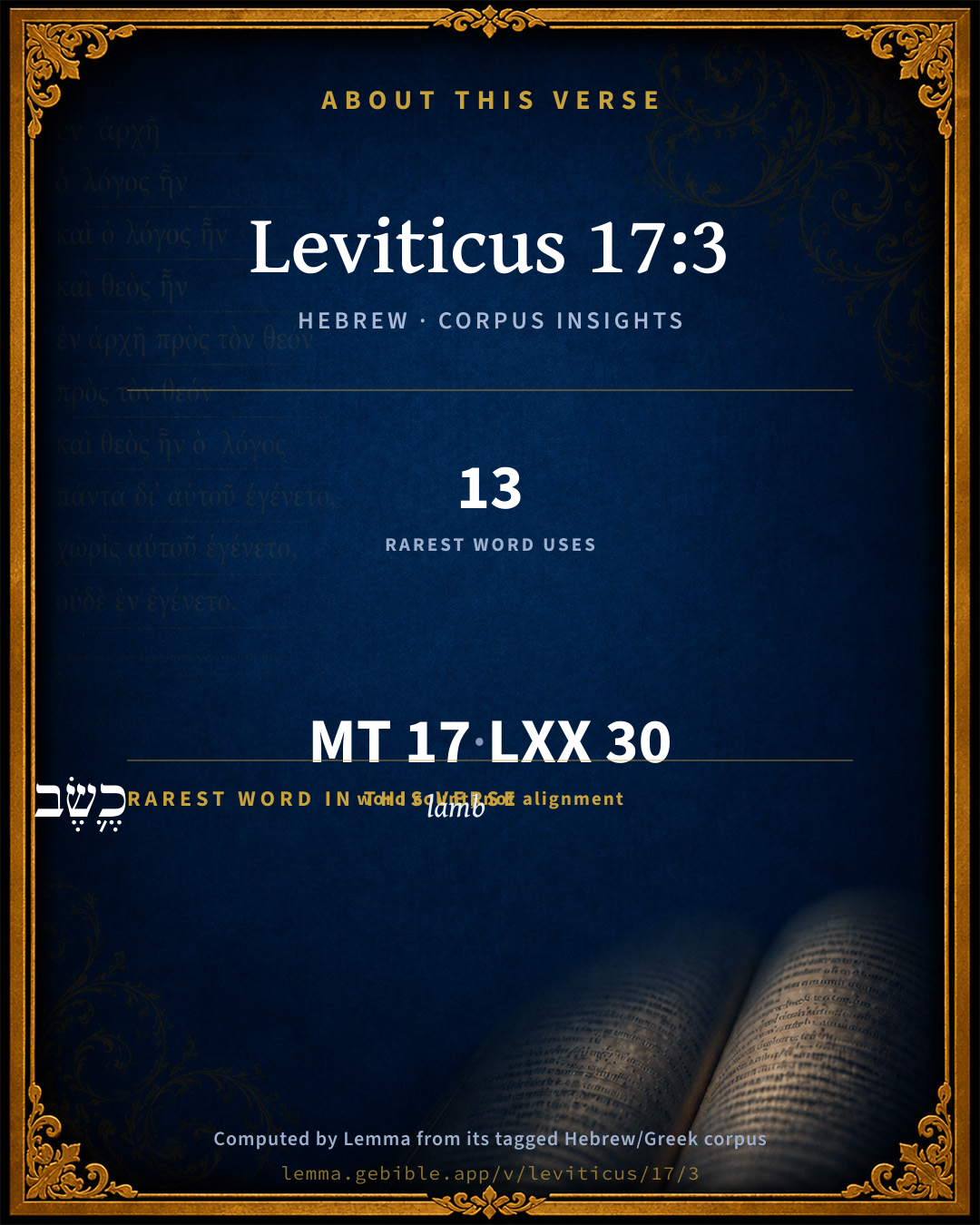
The rarest word here is כֶ֛שֶׂב lamb H3775 — appearing just 13 times in the whole Hebrew Bible.

Shared distinctive vocabulary

כֶ֛שֶׂב lamb H3775 occurs in 13 verses of the Hebrew Bible. Also found in:

Grammatical profile

  • 2 verbs
  • 10 nouns
  • 3 conjunctions
  • 2 particles

Verb forms

  • יִשְׁחַ֜ט Qal · Imperfect
  • יִשְׁחַ֔ט Qal · Imperfect

Repetition

Words recur within this verse — often emphatic in Hebrew:

  • אִ֥ישׁ man H376 ×2
  • יִשְׁחַ֜ט to slaughter H7819 ×2
  • בַּֽמַּחֲנֶ֑ה camp H4264 ×2
  • אוֹ or H176 ×3
  • אֲשֶׁ֨ר which H834 ×2

Hebrew & Septuagint length

In English translation the verse runs 27 words from the Hebrew and 37 from the Septuagint (LXX English) — closely comparable.

A rough comparison of the two English renderings, which tokenize alike — not a word-level alignment.

Word counts can differ between the Hebrew and the Greek without any difference in meaning — e.g. the Hebrew direct-object marker אֵת has no separate Greek word, and Greek often adds the article ὁ.

In the original languages it is 17 Hebrew tokens and 30 Greek tokens — but the two are counted differently (Hebrew bundles its prefixes and suffixes into one token; the Greek is in lemma form), so that isn’t a like-for-like length.

Cross-references

7

Topical passages linked to Leviticus 17:3 in the Treasury of Scripture Knowledge — connected by theme and wording, ordered by reader-vote popularity; previews shown in the World English Bible.

  • Leviticus 17:8 "You shall say to them, 'Any man there is of the house of Israel, or of the strangers who live as foreigners among them, who offers a burnt offering or sacrifice,
  • Leviticus 17:12–13 Therefore I have said to the children of Israel, "No person among you shall eat blood, neither shall any stranger who lives as a foreigner among you eat blood."
  • Leviticus 17:15 "'Every person that eats what dies of itself, or that which is torn by animals, whether he is native-born or a foreigner, he shall wash his clothes, and bathe himself in water, and be unclean until the evening: then he shall be clean.
  • Deuteronomy 12:5–7 But to the place which Yahweh your God shall choose out of all your tribes, to put his name there, even to his habitation shall you seek, and there you shall come;
  • Deuteronomy 12:11–15 then it shall happen that to the place which Yahweh your God shall choose, to cause his name to dwell there, there shall you bring all that I command you: your burnt offerings, and your sacrifices, your tithes, and the heave-offering of your hand, and all your choice vows which you vow to Yahweh.
  • Deuteronomy 12:20–22 When Yahweh your God shall enlarge your border, as he has promised you, and you shall say, I will eat flesh, because your soul desires to eat flesh; you may eat flesh, after all the desire of your soul.
  • Deuteronomy 12:26–27 Only your holy things which you have, and your vows, you shall take, and go to the place which Yahweh shall choose:

Cross-references courtesy of OpenBible.info (CC BY 4.0).

Hebrew and Greek witnesses Masoretic Hebrew ↔ Greek Septuagint

The same verse in the two great witnesses to the Old Testament, shown verse-for-verse.

These are two independent witnesses, not word-aligned to each other, and the Septuagint is shown in lemma (dictionary) form.

Hebrew Leviticus 17:3 Masoretic · Westminster Leningrad Codex

אִ֥ישׁ אִישׁ֙ מִבֵּ֣ית יִשְׂרָאֵ֔ל אֲשֶׁ֨ר יִשְׁחַ֜ט שׁ֥וֹר אוֹ כֶ֛שֶׂב אוֹ עֵ֖ז בַּֽמַּחֲנֶ֑ה א֚וֹ אֲשֶׁ֣ר יִשְׁחַ֔ט מִח֖וּץ לַֽמַּחֲנֶֽה

Whatever man there is of the house of Israel, who kills an ox, or lamb, or goat, in the camp, or who kills it outside the camp,

World English Bible · Public Domain

Greek LXX Leviticus 17:3 Septuagint · lemma form

ἄνθρωπος ἄνθρωπος ὁ υἱός ἰσραήλ ἤ ὁ προσήλυτος ὁ προςκεῖμαι ἐν σύ ὅς ἄν σφάζω μόσχος ἤ πρόβατον ἤ αἴξ ἐν ὁ παρεμβολή καί ὅς ἄν σφάζω ἔξω ὁ παρεμβολή

Every man of the children of Israel, or of the strangers dwelling among you, who shall kill a calf, or a sheep, or a goat in the camp, or who shall kill it out of the camp,

LXX2012 (modern English Septuagint) · Public Domain

Hebrew: Westminster Leningrad Codex (CC BY 4.0). Greek: Septuagint (public domain); English from LXX2012 (modern English Septuagint) (Public Domain). How the Septuagint differs from the Hebrew →

Targum (Aramaic paraphrase)

2

The Targum is the ancient Jewish Aramaic paraphrase of the Hebrew Scriptures — an interpretive translation, not the Hebrew text itself. Onkelos (literal) and Pseudo-Jonathan (expansive) render the Torah, and Jonathan the Prophets. Coverage is partial: where no permissively-licensed English translation exists for a verse, only the Aramaic is shown. This is verse-level text, not a word-by-word alignment to the Hebrew.

  1. Targum Onkelos Torah (Genesis–Deuteronomy)
    גְבַר גְבַר מִבֵּית יִשְׂרָאֵל דִי יִכּוֹס תּוֹר אוֹ אִמַר אוֹ עִזָא בְּמַשְׁרִיתָא אוֹ דִי יִכּוֹס מִבָּרָא לְמַשְׁרִיתָא

    (no public-domain English translation for this verse)

    Targum Onkelos — Aramaic: “Onkelos Genesis” (public domain); “Onkelos Exodus” (public domain); “Onkelos Leviticus” (public domain); “Onkelos Numbers” (public domain); “Onkelos Deuteronomy” (public domain). English: “Sefaria Community Translation” (CC0 1.0 (public-domain dedication)); “J.W. Etheridge. The Targums of Onkelos and Jonathan Ben Uzziel on the Pentateuch. London: Longmans, Green, 1862” (public domain). Text via Sefaria.

  2. Targum Pseudo-Jonathan Torah (Genesis–Deuteronomy)
    גְבַר טְלֵי אוֹ סִיב מִבֵּית גְנִיסַת יִשְרָאֵל דִי יִכּוֹס נִכְסַת תּוֹר אוֹ אִימַר אוֹ עִיזָא בְּמַשְׁרִיתָא אוֹ דִי יִכּוֹס מִבָּרָא לְמַשְׁרִיתָא

    A man of the house of Israel, young or old, who shall kill as a sacrifice a bullock, or lamb, or goat in the camp, or who killeth it without the camp,

    Targum Pseudo-Jonathan — Aramaic: “Targum Jonathan on Genesis” (public domain); “Targum Jonathan on Exodus” (public domain); “Targum Jonathan on Leviticus” (public domain); “Targum Jonathan on Numbers” (public domain); “Targum Jonathan on Deuteronomy” (public domain). English: “The Targum of Jonathan ben Uzziel, trans. J. W. Etheridge, London, 1862” (public domain). Text via Sefaria.

Commentary

Notes on Leviticus 17:3 from classic Christian and Jewish commentators (each source and its license shown beneath its notes). The classic Christian expositions comment on the surrounding passage and are grouped to its opening verse, so a note may address several verses; the Jewish commentaries on the Tanakh (Rashi and others) are per-verse, so they appear only where the commentator wrote on this verse.

Lemma curates 59 commentaries, every one of them public domain or Creative Commons licensed, each selected and text-cleaned for this edition rather than reprinted as found. About our sources →

Ellicott's Commentary for English Readers

(3) That killeth an ox, or lamb, or goat.—The law which is thus solemnly laid down is that when one of the three kinds of the sacrificial quadrupeds (see Lev_7:23) are intended for private use, they must not be slaughtered within or outside the camp. That the injunction here refers to the domestic animals in question, and not to the ordinary sacrifices, is not only evident from the expression “killeth,” instead of “sacrificeth,” but more especially from a comparison of Lev_17:3-4 with Lev_17:8-9.

A Bible Commentary for English Readers, edited by Charles John Ellicott (1878–1897) — public domain. Text from a community e-Sword module.

Trapp's Complete Commentary

John Trapp

Lev 17:3 What man soever [there be] of the house of Israel, that killeth an ox, or lamb, or goat, in the camp, or that killeth [it] out of the camp,

Ver. 3. What man soever.] Whether Israelite or proselyte, {Lev 17:8} unless by special dispensation from the lawgiver, as 1Sa 7:9; 1Sa 11:15 2Sa 24:18 1Ki 18:22; and then they were to offer upon altars of earth, or rough stone, that might be soon and easily thrown down. {Exo 20:24-25}

John Trapp, A Commentary or Exposition upon All the Books of the Old and New Testament (1647–1656) — public domain. Text from a community e-Sword module.

Joseph Benson's Commentary

Lev 17:3. That killeth — Not for common use, for such beasts might be killed by any person or in any place, (Deu 12:5-14; Deu 12:26-27,) but for sacrifice, as the sense is limited, Lev 17:5, where the reason of the injunction is given. It is true, some suppose that the Israelites were forbidden by this law, while they were in the wilderness, to kill, even for food, any of the animals that were wont to be sacrificed, elsewhere than in the door of the tabernacle, where the blood and the fat were to be offered to God upon the altar, and the flesh returned to the offerer to be eaten as a peace-offering according to the law. And the statute is so worded in Lev 17:3-4, as to favour this opinion. The learned Dr. Cudworth understands if in this sense, and thinks that while they had their tabernacle so near them, in the midst of their camp, they ate no flesh but what had first been offered to God; but that when they were about to enter Canaan, this constitution was altered, and they were allowed to kill their beasts of the flock and herd at home, as well as the roe-buck and the hart, (Deu 12:21,) only that thrice a year they were to see God at his tabernacle, and to eat and drink before him. It is indeed probable, that in the wilderness they did not eat much flesh but that of their peace- offerings, preserving what cattle they had for breed, against they came to Canaan. And yet it is hard to construe into a mere temporary law, what is expressly said to be a statute for ever, Lev 17:7. And, therefore, it seems rather to forbid only the killing beasts for sacrifice anywhere but at God’s altar. They must not offer a sacrifice as they had done in the open field, (Lev 17:5,) no, not to the true God; but their sacrifices must be brought to the priest, to be offered on the altar of the Lord. And the mighty solemnity they had lately seen of consecrating both the priests and the altar, would serve for a good reason why they should confine themselves to both these which God had so signally appointed and owned.

Joseph Benson's Commentary on the Old and New Testaments (1811–1818) — public domain. Text from a community e-Sword module.

Tyndale Open Study Notes

Tyndale Open Resources

17:3-9 These regulations (see also Deut 12:15-21) indicate that unsupervised sacrifice could easily lead to the integration of pagan elements into the true worship of the Lord (Lev 17:7). Israel was camped around the Tabernacle (Num 2:2-34), so it was not inconvenient to bring an animal to the sanctuary for slaughter. Deuteronomy 12:20-24 anticipates Israel’s settlement in the land and the hardship imposed by this regulation. It permitted slaughtering and eating meat without bringing it to the sanctuary, as long as the blood was not consumed.

Tyndale Open Study Notes — © Tyndale Open Resources, licensed CC BY-SA 4.0. Text via the HelloAO Bible API.

Geneva Bible (1599)

Geneva Bible translators

To make a sacrifice of offering thereof.

Geneva Bible (1599) marginal notes — public domain. Text via Bolls.life.

The Cambridge Bible for Schools and Colleges

gen. ed. J. J. S. Perowne

3. killeth an ox, or lamb, or goat] The animals mentioned are those which are suitable for sacrifice, ‘of which men offer an offering made by fire unto the Lord’ (Lev_7:25), and the verb, though used of sacrificial slaughter (Lev_1:5, Lev_9:8, etc.), also has the sense of ordinary killing for food. This is its meaning here. The act of killing a beast included in the category of those admissible for sacrifice must be accompanied by certain other religious rites, viz. (1) bringing it before the Lord, (2) bringing it to one special place.

The Cambridge Bible for Schools and Colleges (gen. ed. J. J. S. Perowne; Cambridge University Press, 1878–1918) — public domain. Text from a community e-Sword module.

John Gill's Exposition

What man soever there be of the house of Israel,.... Whether high or low, rich or poor:

that killeth an ox, or lamb, or goat in the camp; which are particularly mentioned, as Gersom observes, because of these the offerings were; for the law respects the killing of them not for common food, but for sacrifice, as appears from the following verses; for this law was to be a statute for ever, whereas in that sense it was not, and could not be observed, especially when they were come into the land of Canaan; nor would it have been decent or convenient to have brought such vast numbers of cattle every day to be killed at the door of the tabernacle, and must have made the service of the priests extremely laborious to kill them, or even to see that they were killed aright:

or that killeth it out of the camp; which furnishes out another reason against the same notion, since it was not usual to kill for common food without the camp, but in their own tents within it; whereas to sacrifice without the camp was commonly done.

John Gill's Exposition of the Whole Bible (1746–1763) — public domain (CC PDM 1.0). Text via the HelloAO Bible API.

Albert Barnes' Notes on the Bible

Every domesticated animal that was slain for food was a sort of peace-offering Lev 17:5. This law could only be kept as long as the children of Israel dwelt in their camp in the wilderness. The restriction was removed before they settled in the holy land, where their numbers and diffusion over the country would have rendered its strict observance impossible. See Deu 12:15-16, Deu 12:20-24.

Lev 17:4

Blood shall be imputed unto that man - i. e. he has incurred guilt in shedding blood in an unlawful manner.

Cut off - See Exo 31:14 note.

Lev 17:5

Rather, May bring their beasts for slaughter, which they (now) slaughter in the open field. even that they may bring them before Yahweh to the entrance of the tent of meeting unto the priests, and slaughter them as peace-offerings to Yahweh.

Lev 17:7

Devils - The word in the original is the “shaggy goat” of Lev 4:23. But it is sometimes employed, as here, to denote an object of pagan worship or a demon dwelling in the deserts 2Ch 11:15; Isa 13:21; Isa 34:14. The worship of the goat, accompanied by the foulest rites, prevailed in Lower Egypt; and the Israelites may have been led into this snare while they dwelt in Egypt.

This law for the slaughtering of animals was not merely to exclude idolatry from the chosen nation. It had a more positive and permanent purpose. It bore witness to the sanctity of life: it served to remind the people of the solemnity of the grant of the lives of all inferior creatures made to Noah Gen 9:2-3; it purged and directed toward Yahweh the feelings in respect to animal food which seem to be common to man’s nature; and it connected a habit of thanksgiving with the maintenance of our human life by means of daily food. 1Ti 4:3-5. Having acknowledged that the animal belonged to Yahweh the devout Hebrew received back its flesh as Yahweh’s gift.

Albert Barnes' Notes on the Bible (1834–1885) — public domain. Text from a community e-Sword/MySword module.

Haydock's Catholic Bible Commentary

If he kill, &c. That is, in order to sacrifice. The law of God forbids sacrifices to be offered in any other place but at the tabernacle or temple of the Lord: to signify that no sacrifice would be acceptable to God, out of his true temple, the one, holy, Catholic Apostolic Church. (Challoner) --- On other occasions, many believe that the blood of oxen, sheep, and goats, was to be poured out in honour of God by the priest, who received a part of each. (Deuteronomy xviii. 3; xii. 15, 22.; Theodoret, q. 23.) Perhaps this law regards the time when the Hebrews sojourned in the desert; and that of Deuteronomy has a reference to those times when they should obtain possession of Chanaan. (Calmet) --- We read of some private people like Manue and Elias, who offered sacrifice at a distance from the tabernacle. But this was done by a particular inspiration of God, who dispensed with his own law. (St. Augustine, q. 56.; 3 Kings xviii. 23; Judges xiii. 19.) (Menochius) See Josue viii. 31.

George Leo Haydock (1774–1849), Haydock's Catholic Family Bible and Commentary, 1859 edition — public domain. Excludes Psalms (Douay-Rheims chapter numbering differs from Protestant) and Deuterocanonical books (Catholic canon only).

Matthew Poole's English Annotations

That killeth, not for common use or eating, for such beasts might be killed by any person or in any place, but for sacrifice, as manifestly appears both from Lev 17:4, where that is expressed, and from the reason of this law, which is peculiar to sacrifices, Lev 17:5, and from Deu 12:5,15,21. in the camp, or out of the camp: in Canaan, the city answered to the camp, and so it forbids any man doing this either in the city or in the country.

Matthew Poole's English Annotations on the Holy Bible (1683–1685) — public domain. Text from a community e-Sword/MySword module.

The Pulpit Commentary

What man soever there be of the house of Israel, that killeth an ox, or lamb, or goat. The use of the word killeth, instead of sacrificeth, is one of the chief causes of the error referred to above, which represents this command as applying to the slaughter of domestic animals. But it is always permissible to use a generic in place of a specific term, and its use proves nothing.

Probably the sacred writer uses it as a less sacred term, and therefore more suitable to sacrifices offered to the spirits of the fields and woods. If ordinary slaughtering were meant, there is no reason why pigeons and turtle-doves should not be added to the ox, or lamb, or goat. That every ox, or lamb, or goat, to be killed in the camp, or... out of the camp, for the food of more than 600, 000 men, should be brought to so confined a space as the court of the tabernacle for slaughter, where the animals for the daily, weekly, annual, and innumerable private sacrifices were also killed, appears almost credible in itself. How would the drivers have made their way into it? and what would have soon been the state of the court? It is true that animal food was not the staple sustenance of the Israelites in the wilderness; but not unfrequently, after a successful war or raid, there must have been a vast number of cattle killed for feasting or reserved for subsequent eating.

The Pulpit Commentary (1880–1919), ed. H.D.M. Spence-Jones & Joseph S. Exell — public domain. Text from a community e-Sword module.

John Wesley's Explanatory Notes

That killeth-Not for common use, for such beasts might be killed by any person or in any place but for sacrifice. In the camp, or out of the camp - That is, anywhere.

John Wesley, Explanatory Notes Upon the Whole Bible (1754–1765) — public domain. Text via the GEBible commentary corpus.

Keil & Delitzsch

C. F. Keil & F. Delitzsch

Whoever of the house of Israel slaughtered an ox, sheep, or goat, either within or outside the camp, without bringing the animal to the tabernacle, to offer a sacrifice therefrom to the Lord, "blood was to be reckoned to him;" that is to say, as the following expression, "he hath shed blood," shows, such slaughtering was to be reckoned as the shedding of blood, or blood-guiltiness, and punished with extermination (see Gen 17:14). The severity of this prohibition required some explanation, and this is given in the reason assigned in Lev 17:5-7, viz., "that the Israelites may bring their slain-offerings, which they slay in the open field, before the door of the tabernacle, as peace-offerings to Jehovah," and "no more offer their sacrifices to the שׂעירים, after whom they go a whoring" (Lev 17:7). This reason presupposes that the custom of dedicating the slain animals as sacrifices to some deity, to which a portion of them was offered, was then widely spread among the Israelites. It had probably been adopted from the Egyptians; though this is not expressly stated by ancient writers: Herodotus (i. 132) and Strabo (xv. 732) simply mentioning it as a Persian custom, whilst the law book of Manu ascribes it to the Indians. To root out this idolatrous custom from among the Israelites, they were commanded to slay every animal before the tabernacle, as a sacrificial gift to Jehovah, and to bring the slain-offerings, which they would have slain in the open field, to the priest at the tabernacle, as shelamim (praise-offerings and thank-offerings), that he might sprinkle the blood upon the altar, and burn the fat as a sweet-smelling savour for Jehovah (see Lev 3:2-5). "The face of the field" (Lev 17:5, as in Lev 14:7, Lev 14:53): the open field, in distinction from the enclosed space of the court of Jehovah's dwelling. "The altar of Jehovah" is spoken of in Lev 17:6 instead of "the altar" only (Lev 1:5; Lev 11:15, etc.), on account of the contrast drawn between it and the altars upon which they offered sacrifice to Seirim. שׂעירים, literally goats, is here used to signify daemones (Vulg.), "field-devils" (Luther), demons, like the שׂדים in Deu 32:17, who were supposed to inhabit the desert (Isa 13:21; Isa 34:14), and whose pernicious influence they sought to avert by sacrifices. The Israelites had brought this superstition, and the idolatry to which it gave rise, from Egypt. The Seirim were the gods whom the Israelites worshipped and went a whoring after in Egypt (Jos 24:14; Eze 20:7; Eze 23:3, Eze 23:8, Eze 23:19, Eze 23:21, Eze 23:27). Both the thing and the name were derived from the Egyptians, who worshipped goats as gods (Josephus c. Ap. 2, 7), particularly Pan, who was represented in the form of a goat, a personification of the male and fertilizing principle in nature, whom they called Mendes and reckoned among the eight leading gods, and to whom they had built a splendid and celebrated temple in Thmuis, the capital of the Mendesian Nomos in Lower Egypt, and erected statues in the temples in all directions (cf. Herod. 2, 42, 46; Strabo, xvii. 802; Diod. Sic. i. 18). The expression "a statute for ever" refers to the principle of the law, that sacrifices were to be offered to Jehovah alone, and not to the law that every animal was to be slain before the tabernacle, which was afterwards repealed by Moses, when they were about to enter Canaan, where it could no longer be carried out (Deu 12:15).

Keil & Delitzsch — Biblical Commentary on the Old Testament (1861–1891) — public domain (CC PDM 1.0). Text via the HelloAO Bible API. (Old Testament only.)

Rashi

Rabbi Shlomo Yitzchaki (Rashi)

ישחט שור או כשב‎ ‎‎‏ אשר [WHAT MAN SOEVER] THAT SLAUGHTERETH AN OX, OR A LAMB — Scripture is speaking here of consecrated animals since it says (v. 4) "and bringeth it not unto the appointed tent to offer an offering" (cf. Sifra, Acharei Mot, Section 6 3; Zevachim 106a).

במחנה [WHAT MAN SOEVER SLAUGHTERETH …] IN THE CAMP — i. e. outside the forecourt (cf. Sifra, Acharei Mot, Section 6 5; Zevachim 107b).

Rashi on the Tanakh — English translations: “The Judaica Press complete Tanach with Rashi, translated by A. J. Rosenberg” (CC BY 4.0); “Pentateuch with Rashi's commentary by M. Rosenbaum and A.M. Silbermann, 1929-1934” (public domain); “The Metsudah Tanach series, Lakewood, N.J” (CC BY 4.0); and “The Book of Joshua, Metsudah Publications, 1997” (CC BY 4.0). Text via Sefaria.

Lesson kit

Teaching starters — assembled from the data on this page, not authored interpretation. Every prompt links to the verse data it draws on. Edit before teaching.

Leviticus, in the Pentateuch, opens this verse with 17 words (11 distinct Hebrew lemmas). Its most distinctive word is keseb (“lamb”). A historical commentator’s framing appears above. Read the whole chapter for the surrounding context.

Discussion questions

  1. How does “lamb” (keseb) shape what this verse is saying?
  2. How does Genesis 30:32, which shares the word «lamb», read alongside this verse?
  3. What does the repetition of “man” (2× in this one verse) do in this verse?
  4. These translations render this verse differently. What is at stake in choosing one wording over another?
  5. «יִשְׁחַ֜ט» is a Qal Imperfect verb. How does that grammatical form shape the action described?
  6. Compare how Ellicott's Commentary for English Readers and Trapp's Complete Commentary read this verse. Where do they agree or differ?

Things to notice

Reading settings

Reading text

Shown beneath each verse's original-language words.

Old Testament
Old Testament edition

Read the OT as the Masoretic Hebrew (MT) or the Greek Septuagint (LXX).

English shown for the Greek Septuagint (in the Hebrew ↔ Greek comparison).

Comparing translations? Open the Compare panel on any verse page to stack up to four side by side.