
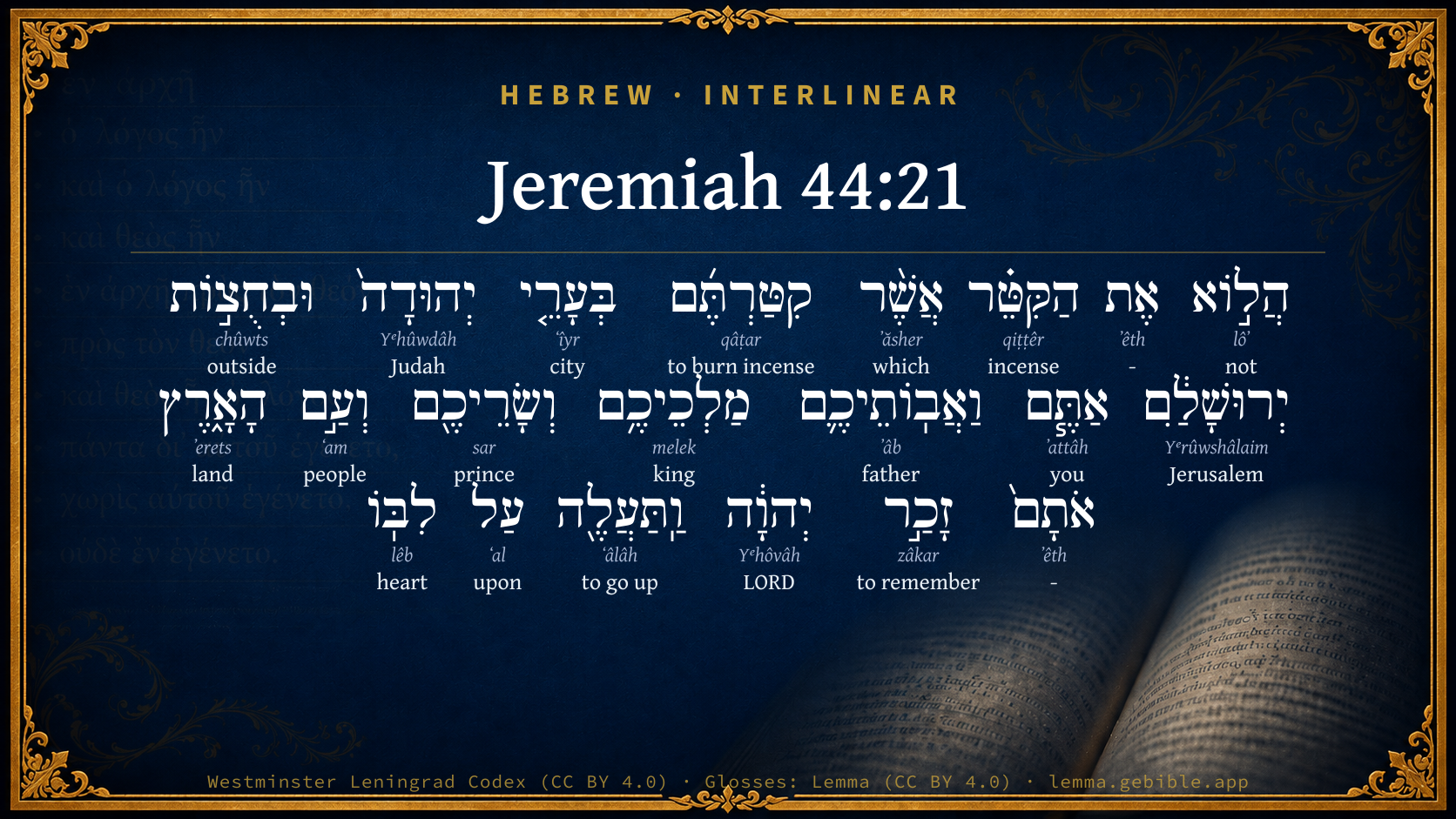
Jeremiah 44:21

Hebrew (Westminster Leningrad Codex) Jeremiah 44:21 appears in the Hebrew Old Testament. The text above is from the Westminster Leningrad Codex. Each word links to its Strong’s number, a concise gloss, and parsing drawn from the Open Scriptures Hebrew Bible morphology. Click any word for its full Brown-Driver-Briggs (BDB) entry.
Download image
Cite this verse

Jeremiah 44:21 (World English Bible). Public Domain. Lemma interlinear Bible study tool, https://lemma.gebible.app/v/jeremiah/44/21.

Show BibTeX & RIS
BibTeX
RIS
English Translation
The incense that you burned in the cities of Judah, and in the streets of Jerusalem, you and your fathers, your kings and your princes, and the people of the land, didn't Yahweh remember them, and didn't it come into his mind?
World English Bible · Public Domain
Highlights
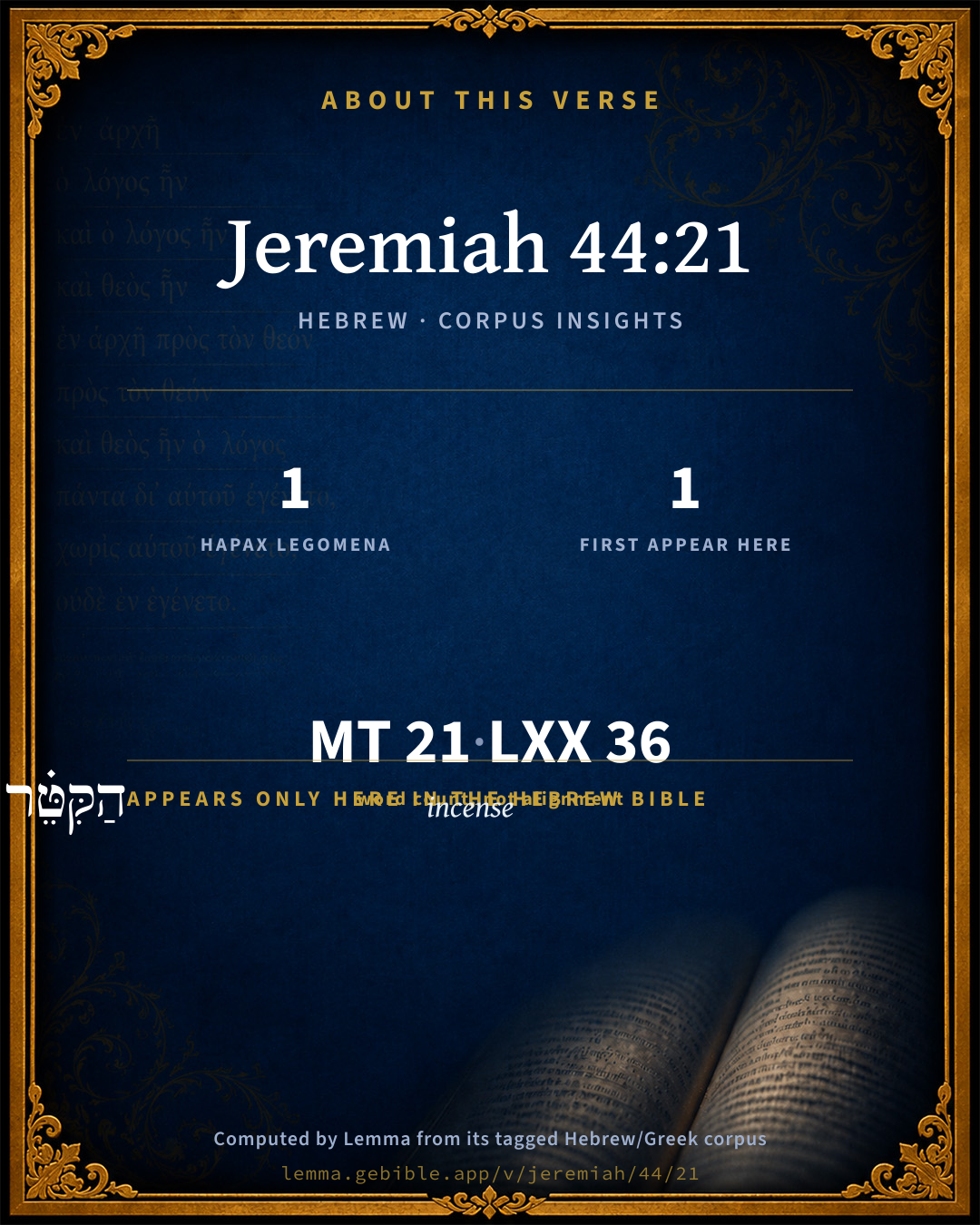
  • 1 hapax legomenon — only here in the Hebrew Bible
  • 1 first appearance in the Hebrew Bible
Full analysis ↓
Download a study sheet

One document with this verse’s original text, its word-by-word gloss line, the meaning frame, cross-references with their text, attributed commentary, and full source and license credits — printable, and it pastes into notes with its structure intact.

This verse Autodidact and up

Study sheet (.html) Plain text (.txt)

A passage Seminary Student

Up to 50 verses in one chapter. A passage sheet keeps up to 6 commentary sources and 12 cross-references per verse, in the order this page ranks them, and says so on the sheet whenever that leaves anything out. Ask for a single verse and you get the Autodidact verse sheet above.

Everything on this page stays free to read, with no account — the sheet is a download of what is already on screen, not access to it.

Want to remove ads? Support Godless Engineer
Compare translations 3

The same verse in 3 English versions, stacked beneath the original-language interlinear above. Click any original word for its lexicon entry.

Each is an independent rendering of the whole verse — the interlinear is not word-aligned to these translations.

Highlighted words mark where these versions differ — a whole-verse word diff, not a word-by-word alignment.

  • World English Bible Public Domain
    The incense that you burned in the cities of Judah, and in the streets of Jerusalem, you and your fathers, your kings and your princes, and the people of the land, didn't Yahweh remember them, and didn't it come into his mind?
  • King James Version Public Domain
    The incense that ye burned in the cities of Judah, and in the streets of Jerusalem, ye, and your fathers, your kings, and your princes, and the people of the land, did not the LORD remember them, and came it not into his mind?
  • unfoldingWord Literal Text CC BY-SA 4.0
    “Did not Yahweh remember the incense that you burned in the cities of Judah and the streets of Jerusalem—you and your ancestors, your kings and leaders, and the people of the land? For Yahweh calls this to mind; it comes to his thoughts.

unfoldingWord Literal Text — © unfoldingWord, licensed CC BY-SA 4.0. Word-aligned USFM3 via Door43 (git.door43.org/unfoldingWord/en_ult).

Versions to compare (up to 4)

3 of 4 selected

Show all 18 translations

Every available English version of this verse, each an independent rendering of the whole verse.

  • World English Bible Public Domain
    The incense that you burned in the cities of Judah, and in the streets of Jerusalem, you and your fathers, your kings and your princes, and the people of the land, didn't Yahweh remember them, and didn't it come into his mind?
  • Berean Standard Bible Public Domain
    “As for the incense you burned in the cities of Judah and in the streets of Jerusalem—you, your fathers, your kings, your officials, and the people of the land—did the LORD not remember and bring this to mind?
  • Majority Standard Bible Public Domain
    “As for the incense you burned in the cities of Judah and in the streets of Jerusalem—you, your fathers, your kings, your officials, and the people of the land—did the LORD not remember and bring this to mind?
  • King James Version Public Domain
    The incense that ye burned in the cities of Judah, and in the streets of Jerusalem, ye, and your fathers, your kings, and your princes, and the people of the land, did not the LORD remember them, and came it not into his mind?
  • American Standard Version (1901) Public Domain
    The incense that ye burned in the cities of Judah, and in the streets of Jerusalem, ye and your fathers, your kings and your princes, and the people of the land, did not Jehovah remember them, and came it not into his mind?
  • Revised Version (1885) Public Domain
    The incense that ye burned in the cities of Judah, and in the streets of Jerusalem, ye and your fathers, your kings and your princes, and the people of the land, did not the LORD remember them, and came it not into his mind?
  • Geneva Bible (1599) Public Domain
    Did not the Lord remember the incense, that yee burnt in the cities of Iudah, and in the streetes of Ierusalem, both you, and your fathers, your Kinges, and your princes, and the people of the land, and hath he not considered it?
  • Douay-Rheims (1899) Public Domain
    Was it not the sacrifice that you offered in the cities of Juda, and in the streets of Jerusalem, you and Sour fathers, your kings, and your princes, and the people of the land, which the Lord hath remembered, and hath it not entered into his heart?
  • Young's Literal Translation Public Domain
    `The perfume that ye made in the cities of Judah, and in the streets of Jerusalem, ye, and your fathers, your kings, and your heads, and the people of the land, hath not Jehovah remembered it? yea, it cometh up on His heart.
  • Literal Standard Version CC BY-SA 4.0
    “The incense that you made in the cities of Judah, and in the streets of Jerusalem, you, and your fathers, your kings, and your heads, and the people of the land, has YHWH not remembered it? Indeed, it comes up on His heart.
  • Unlocked Literal Bible CC BY-SA 4.0
    “Did not Yahweh remember the incense that you burned in the cities of Judah and the streets of Jerusalem—you and your ancestors, your kings and leaders, and the people of the land? For Yahweh calls this to mind; it comes to his thoughts.
  • unfoldingWord Literal Text CC BY-SA 4.0
    “Did not Yahweh remember the incense that you burned in the cities of Judah and the streets of Jerusalem—you and your ancestors, your kings and leaders, and the people of the land? For Yahweh calls this to mind; it comes to his thoughts.
  • Darby Bible Public Domain
    Is it not the incense that ye burned in the cities of Judah and in the streets of Jerusalem, ye and your fathers, your kings and your princes and the people of the land, that Jehovah remembered, and that came into his mind?
  • World Messianic Bible Public Domain
    “The incense that you burned in the cities of Judah, and in the streets of Jerusalem, you and your fathers, your kings and your princes, and the people of the land, didn’t the LORD remember them, and didn’t it come into his mind?
  • Webster's Bible Public Domain
    The incense that ye burned in the cities of Judah, and in the streets of Jerusalem, ye and your fathers, your kings and your princes, and the people of the land, did not the LORD remember them, and came it not into his mind?
  • Free Bible Version CC BY-SA 4.0
    “About that incense you burned to other gods in the towns of Judah and in the streets of Jerusalem, as well as your fathers, your kings, your officials, and the ordinary people—don't you think the Lord wouldn't remember and think about it?
  • Bible in Basic English Public Domain
    The perfumes which you have been burning in the towns of Judah and in the streets of Jerusalem, you and your fathers and your kings and your rulers and the people of the land, had the Lord no memory of them, and did he not keep them in mind?
  • JPS Tanakh (1917) Public Domain
    'The offering that ye offered in the cities of Judah, and in the streets of Jerusalem, ye and your fathers, your kings and your princes, and the people of the land, did not the LORD remember them, and came it not into His mind?

Literal Standard Version (2020), Covenant Press — licensed CC BY-SA 4.0. Text via the HelloAO Bible API (eBible.org). Unlocked Literal Bible (unfoldingWord) — licensed CC BY-SA 4.0. Text via the HelloAO Bible API (eBible.org). unfoldingWord Literal Text — © unfoldingWord, licensed CC BY-SA 4.0. Word-aligned USFM3 via Door43 (git.door43.org/unfoldingWord/en_ult). Free Bible Version, Dr. Jonathan Gallagher — licensed CC BY-SA 4.0. Text via the HelloAO Bible API (eBible.org).

Word by word

More ways to search: Search by grammar → Find every occurrence → Compare this word →

Practice this passage: Drill this verse → Learn its vocabulary →

הַקִּטֵּ֗ר
qiṭṭêr
H7002
“the · incense”
Particle, Definite Article + Noun, Common, Feminine, Singular, Absolute
Part of Speech
Particle + Noun
Type
Common
Gender
Feminine
Number
Singular
State
Absolute
Full BDB Definition

Origin: from H6999

TWOT: 2011c

incense
  1. הֲל֣וֹא lôʼ H3808 “not” Particle, Interrogative + Particle, Negative
  2. אֶת ʼêth H853 “-” Particle, Direct Object
  3. אֲשֶׁ֨ר ʼăsher H834 “which” Particle, Relative
  4. קִטַּרְתֶּ֜ם qâṭar H6999 “to burn incense” Verb, Piel, Perfect, 2nd Person, Masculine, Plural
  5. בְּעָרֵ֤י ʻîyr H5892 “in/at · cities of” Preposition + Noun, Common, Feminine, Plural, Construct
  6. יְהוּדָה֙ Yᵉhûwdâh H3063 “Judah” Noun, Proper
  7. וּבְחֻצ֣וֹת chûwts H2351 “and · in/at · streets of” Conjunction + Preposition + Noun, Common, Masculine, Plural, Construct
  8. יְרוּשָׁלִַ֔ם Yᵉrûwshâlaim H3389 “Jerusalem” Noun, Proper
  9. אַתֶּ֧ם ʼattâh H859 “you” Pronoun, Personal, 2nd Person, Masculine, Plural
  10. וַאֲבֽוֹתֵיכֶ֛ם ʼâb H1 “and · fathers · your” Conjunction + Noun, Common, Masculine, Plural, Construct + Suffix, Personal, 2nd Person, Masculine, Plural
  11. מַלְכֵיכֶ֥ם melek H4428 “kings · your” Noun, Common, Masculine, Plural, Construct + Suffix, Personal, 2nd Person, Masculine, Plural
  12. וְשָׂרֵיכֶ֖ם sar H8269 “and · princes · your” Conjunction + Noun, Common, Masculine, Plural, Construct + Suffix, Personal, 2nd Person, Masculine, Plural
  13. וְעַ֣ם ʻam H5971 “and · people of” Conjunction + Noun, Common, Masculine, Singular, Construct
  14. הָאָ֑רֶץ ʼerets H776 “the · land” Particle, Definite Article + Noun, Common, Both, Singular, Absolute
  15. אֹתָם֙ ʼêth H853 “- · them” Particle, Direct Object + Suffix, Personal, 3rd Person, Masculine, Plural
  16. זָכַ֣ר zâkar H2142 “to remember” Verb, Qal, Perfect, 3rd Person, Masculine, Singular
  17. יְהוָ֔ה Yᵉhôvâh H3068 “LORD” Noun, Proper
  18. וַֽתַּעֲלֶ֖ה ʻâlâh H5927 “and · to go up” Conjunction + Verb, Qal, Sequential Imperfect, 3rd Person, Feminine, Singular
  19. עַל ʻal H5921 “upon” Preposition
  20. לִבּֽוֹ lêb H3820 “heart · his” Noun, Common, Masculine, Singular, Construct + Suffix, Personal, 3rd Person, Masculine, Singular

About this verse

These counts appear in no published source. They are computed here, from the morphology-tagged text and Lemma’s own curated glosses. What Lemma adds →

21
words
20
distinct lemmas
Prophets
section

Notable vocabulary

1 hapax legomenon — a word that appears only here in the entire Hebrew Bible:

  • הַקִּטֵּ֗ר incense H7002

First appearance in Scripture

This word makes its first canonical appearance in the Hebrew Bible here:

  • הַקִּטֵּ֗ר incense H7002

Grammatical profile

  • 3 verbs
  • 12 nouns
  • 1 pronoun
  • 1 preposition
  • 4 particles

Verb forms

  • קִטַּרְתֶּ֜ם Piel · Perfect
  • זָכַ֣ר Qal · Perfect
  • וַֽתַּעֲלֶ֖ה Qal · Sequential Imperfect

Hebrew & Septuagint length

In the original languages it is 21 Hebrew tokens and 36 Greek tokens — but the two are counted differently (Hebrew bundles its prefixes and suffixes into one token; the Greek is in lemma form), so that isn’t a like-for-like length.

Cross-references

15

Topical passages linked to Jeremiah 44:21 in the Treasury of Scripture Knowledge — connected by theme and wording, ordered by reader-vote popularity; previews shown in the World English Bible.

  • Jeremiah 44:17 But we will certainly perform every word that is gone forth out of our mouth, to burn incense to the queen of the sky, and to pour out drink-offerings to her, as we have done, we and our fathers, our kings and our princes, in the cities of Judah, and in the streets of Jerusalem; for then had we plenty of food, and were well, and saw no evil.
  • Psalms 79:8 Don't hold the iniquities of our forefathers against us. Let your tender mercies speedily meet us, For we are in desperate need.
  • Isaiah 64:9 Don't be angry very sore, Yahweh, neither remember iniquity forever: see, look, we beg you, we are all your people.
  • Jeremiah 11:13 For according to the number of your cities are your gods, Judah; and according to the number of the streets of Jerusalem have you set up altars to the shameful thing, even altars to burn incense to Baal.
  • Jeremiah 14:10 Thus says Yahweh to this people, Even so have they loved to wander; they have not refrained their feet: therefore Yahweh does not accept them; now will he remember their iniquity, and visit their sins.
  • Jeremiah 44:9 Have you forgotten the wickedness of your fathers, and the wickedness of the kings of Judah, and the wickedness of their wives, and your own wickedness, and the wickedness of your wives which they committed in the land of Judah, and in the streets of Jerusalem?
  • Hosea 7:2 They don't consider in their hearts that I remember all their wickedness. Now their own deeds have engulfed them. They are before my face.
  • Amos 8:7 Yahweh has sworn by the pride of Jacob, "Surely I will never forget any of their works.
  • 1 Samuel 15:3 Now go and strike Amalek, and utterly destroy all that they have, and don't spare them; but kill both man and woman, infant and suckling, ox and sheep, camel and donkey.
  • 1 Kings 17:18 She said to Elijah, What have I to do with you, you man of God? You have come to me to bring my sin to memory, and to kill my son!
  • Ezekiel 8:10–11 So I went in and saw; and see, every form of creeping things, and abominable animals, and all the idols of the house of Israel, portrayed on the wall round about.
  • Ezekiel 16:24 that you have built to you a vaulted place, and have made you a lofty place in every street.
  • Ezekiel 21:23–24 It shall be to them as a false divination in their sight, who have sworn oaths to them; but he brings iniquity to memory, that they may be taken.
  • Revelation 16:19 The great city was divided into three parts, and the cities of the nations fell. Babylon the great was remembered in the sight of God, to give to her the cup of the wine of the fierceness of his wrath.
  • Revelation 18:5 for her sins have reached to the sky, and God has remembered her iniquities.

Cross-references courtesy of OpenBible.info (CC BY 4.0).

Hebrew and Greek witnesses Masoretic Hebrew ↔ Greek Septuagint

The same verse in the two great witnesses to the Old Testament, shown verse-for-verse.

These are two independent witnesses, not word-aligned to each other, and the Septuagint is shown in lemma (dictionary) form.

Hebrew Jeremiah 44:21 Masoretic · Westminster Leningrad Codex

הֲל֣וֹא אֶת הַקִּטֵּ֗ר אֲשֶׁ֨ר קִטַּרְתֶּ֜ם בְּעָרֵ֤י יְהוּדָה֙ וּבְחֻצ֣וֹת יְרוּשָׁלִַ֔ם אַתֶּ֧ם וַאֲבֽוֹתֵיכֶ֛ם מַלְכֵיכֶ֥ם וְשָׂרֵיכֶ֖ם וְעַ֣ם הָאָ֑רֶץ אֹתָם֙ זָכַ֣ר יְהוָ֔ה וַֽתַּעֲלֶ֖ה עַל לִבּֽוֹ

The incense that you burned in the cities of Judah, and in the streets of Jerusalem, you and your fathers, your kings and your princes, and the people of the land, didn't Yahweh remember them, and didn't it come into his mind?

World English Bible · Public Domain

Greek LXX Structure differs

In the Septuagint, Jeremiah is about an eighth shorter than the Hebrew and arranges its material differently — the Oracles Against the Nations (Hebrew chapters 46–51) appear in the middle of the Greek book, after 25:13. Because the chapter and verse boundaries do not line up, a verse-for-verse comparison with the Hebrew is not shown.

A verse-for-verse comparison isn’t shown here because the chapters and verses don’t line up. Switch to the LXX edition with the MT / LXX toggle above to read the Greek directly.

Hebrew: Westminster Leningrad Codex (CC BY 4.0). Greek: Septuagint (public domain); English from a public-domain English Septuagint. How the Septuagint differs from the Hebrew →

Targum (Aramaic paraphrase)

1

The Targum is the ancient Jewish Aramaic paraphrase of the Hebrew Scriptures — an interpretive translation, not the Hebrew text itself. Onkelos (literal) and Pseudo-Jonathan (expansive) render the Torah, and Jonathan the Prophets. Coverage is partial: where no permissively-licensed English translation exists for a verse, only the Aramaic is shown. This is verse-level text, not a word-by-word alignment to the Hebrew.

  1. Targum Jonathan Prophets (Joshua–Malachi)
    הֲלָא יַת בּוּסְמְנַיָא דְאַסֵיקְתּוּן בְּקִרְוַיָא דְבֵית יְהוּדָה וּבְשׁוּקֵי יְרוּשְׁלֵם אַתּוּן וַאֲבָהָתְכוֹן מַלְכֵּיכוֹן וְרַבְרְבֵיכוֹן וְעַמָא דְאַרְעָא יַתְהוֹן דְכַר יְיָ וּגְלֵי קָדָמוֹהִי:

    (no public-domain English translation for this verse)

    Targum Jonathan — Aramaic: “Mikraot Gedolot” (public domain). English: “Sefaria Community Translation” (CC0 1.0 (public-domain dedication)); “London "Chaldee Paraphrase," 1871” (public domain). Text via Sefaria.

Commentary

Notes on Jeremiah 44:21 from classic Christian and Jewish commentators (each source and its license shown beneath its notes). The classic Christian expositions comment on the surrounding passage and are grouped to its opening verse, so a note may address several verses; the Jewish commentaries on the Tanakh (Rashi and others) are per-verse, so they appear only where the commentator wrote on this verse.

Lemma curates 59 commentaries, every one of them public domain or Creative Commons licensed, each selected and text-cleaned for this edition rather than reprinted as found. About our sources →

Trapp's Complete Commentary

John Trapp

Jer 44:21 The incense that ye burned in the cities of Judah, and in the streets of Jerusalem, ye, and your fathers, your kings, and your princes, and the people of the land, did not the LORD remember them, and came it [not] into his mind?

Ver. 21. Ye, and your fathers, your kings, and your princes.] This was another thing they stood much upon, that their fathers had done it: so had their grandees. If men can say, "We have sinned with our fathers," they think it is enough. The heretic Dioscurus cried out, I hold with the fathers, I am cast out with the fathers, &c. Yea, Jerome once desired leave of Augustine to err with seven fathers whom he found of his opinion. But what saith the Scripture? "Be not ye the servants of men." {1Co 7:23} And what said a great politician? I will not live by example, but by rule; neither will I pin my faith on another’s sleeve, because I know not whither he may carry it.

Did not the Lord remember them?] When you thought he had forgot them. Sin may sleep a long time, like a sleeping debt, not called for of many years, &c.

John Trapp, A Commentary or Exposition upon All the Books of the Old and New Testament (1647–1656) — public domain. Text from a community e-Sword module.

Whedon's Commentary on the Bible

Daniel D. Whedon

JEREMIAH MAINTAINS THAT IDOLATRY WAS THE REAL CAUSE OF THE PEOPLE’S MISERY, Jer_44:21-23.

21. Incense that ye burned… did not the Lord remember — Certainly he did: and because it was in his mind, it incited his just displeasure.

Daniel D. Whedon (gen. ed.), Commentary on the Old and New Testaments (1874–1909) — public domain. Text from a community e-Sword module.

Geneva Bible (1599)

Geneva Bible translators

Hebrew, is it not come up into his heart?

Geneva Bible (1599) marginal notes — public domain. Text via Bolls.life.

Jamieson, Fausset & Brown

Robert Jamieson, A. R. Fausset & David Brown

The incense . . . did not the Lord remember--Jeremiah owns that they did as they said, but in retort asks, did not God repay their own evil-doing? Their very land in its present desolation attests this (Jer 44:22), as was foretold (Jer 25:11, Jer 25:18, Jer 25:38).

Jamieson, Fausset & Brown — Commentary Critical and Explanatory on the Whole Bible (1871) — public domain (CC PDM 1.0). Text via the HelloAO Bible API.

John Calvin's Commentaries

The incense, he says, which ye have burnt in the cities of Judah and the streets of Jerusalem, ye and your fathers, your kings, and your princes, and the whole people of the land, has not Jehovah remembered them? Whence, he says, has this dreadful calamity proceeded, which has destroyed all your race? Even from the wrath of God, for it has not happened to you by chance, for God had by his servants predicted what afterwards has been really fulfilled. It then follows, that your city has been destroyed through the righteous judgment of God. And what has been the cause of so great and so grievous a vengeance? Even your incense.

John Calvin's Commentaries (1540-1563) — public domain. Text from the Calvin Translation Society English edition (1840s-50s) via the Christian Classics Ethereal Library (ccel.org). Calvin's coverage is partial (roughly two-thirds of the Bible); uncommented books and verses are honest gaps, never fabricated. The 19th-century editor's footnotes and remarks are omitted so the notes are faithfully Calvin's own voice.

The Cambridge Bible for Schools and Colleges

gen. ed. J. J. S. Perowne

21. The incense] See on Jer_44:3; also on Jer_6:20.

The Cambridge Bible for Schools and Colleges (gen. ed. J. J. S. Perowne; Cambridge University Press, 1878–1918) — public domain. Text from a community e-Sword module.

John Gill's Exposition

That incense that ye burnt in the cities of Judah, and in the streets of Jerusalem,.... To false gods, to the queen of heaven, to the host thereof:

ye, and your fathers, your kings, and your princes, and the people of the land; on which account they pleaded antiquity, authority, and the general consent of the people, as on their side, which the prophet allows; but it all signified nothing:

did not the Lord remember them, and came it not into his mind? either the incense they offered up to strange gods, or the persons that did it? did he take no notice of these idolatrous practices, and of these idolaters? he did; he laid up these things in his mind; he showed a proper resentment of them, and in due time punished for them.

John Gill's Exposition of the Whole Bible (1746–1763) — public domain (CC PDM 1.0). Text via the HelloAO Bible API.

Albert Barnes' Notes on the Bible

Them - The various acts of idolatry involved in burning incense to an image.

Albert Barnes' Notes on the Bible (1834–1885) — public domain. Text from a community e-Sword/MySword module.

Haydock's Catholic Bible Commentary

Heart, or mind to punish you for idolatry. Sacrifices could be offered to the Lord only in his temple. (Haydock)

George Leo Haydock (1774–1849), Haydock's Catholic Family Bible and Commentary, 1859 edition — public domain. Excludes Psalms (Douay-Rheims chapter numbering differs from Protestant) and Deuterocanonical books (Catholic canon only).

The Pulpit Commentary

Remember them; i.e. the repeated acts of idolatry.

The Pulpit Commentary (1880–1919), ed. H.D.M. Spence-Jones & Joseph S. Exell — public domain. Text from a community e-Sword module.

Lesson kit

Teaching starters — assembled from the data on this page, not authored interpretation. Every prompt links to the verse data it draws on. Edit before teaching.

Jeremiah, in the Prophets, opens this verse with 21 words (20 distinct Hebrew lemmas). Its most distinctive word is qiṭṭêr (“incense”). A historical commentator’s framing appears above. Read the whole chapter for the surrounding context.

Discussion questions

  1. The word qiṭṭêr carries the sense “incense.” How does it shape the verse?
  2. This verse holds 1 word here found nowhere else in the Hebrew Bible. What might the rare word draw attention to?
  3. The word “incense” first appears here in Scripture. What is being introduced at this debut?
  4. Jeremiah 44:17 shares this passage’s theme. How do the two illuminate each other?
  5. The translations on this page render this verse differently — a whole-verse word diff, not a word-by-word alignment. What might account for the different wordings?
  6. The verb «קִטַּרְתֶּ֜ם» is Piel Perfect. How does its form color the action?
  7. Reading how Trapp's Complete Commentary and Whedon's Commentary on the Bible read this verse, where do the two commentators agree and where do they part?

Things to notice

Reading settings

Reading text

Shown beneath each verse's original-language words.

Old Testament
Old Testament edition

Read the OT as the Masoretic Hebrew (MT) or the Greek Septuagint (LXX).

English shown for the Greek Septuagint (in the Hebrew ↔ Greek comparison).

Comparing translations? Open the Compare panel on any verse page to stack up to four side by side.