Nahum 2:4

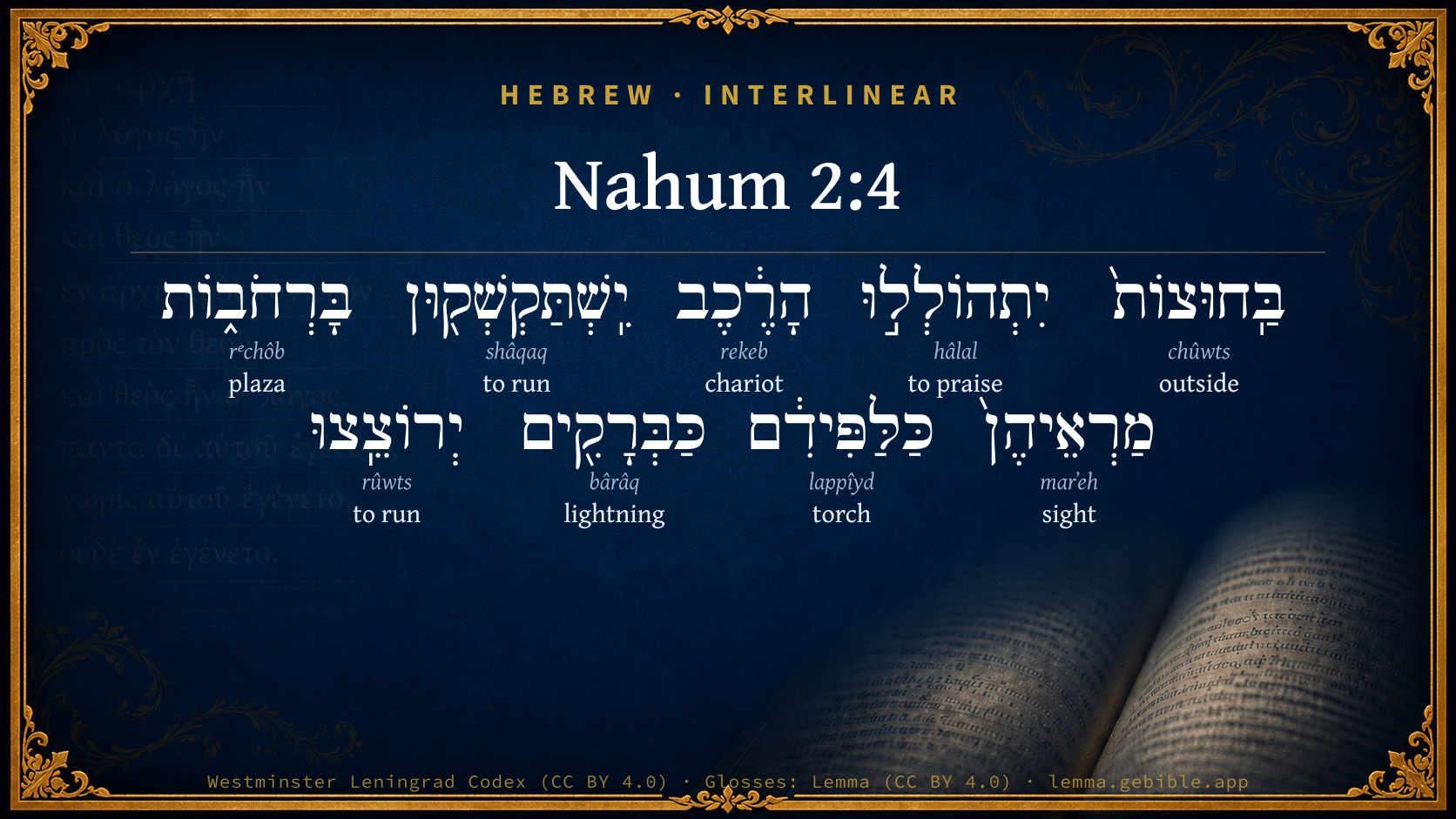
Hebrew (Westminster Leningrad Codex) Nahum 2:4 appears in the Hebrew Old Testament. The text above is from the Westminster Leningrad Codex. Each word links to its Strong’s number, a concise gloss, and parsing drawn from the Open Scriptures Hebrew Bible morphology. Click any word for its full Brown-Driver-Briggs (BDB) entry.
Download image
Cite this verse

Nahum 2:4 (World English Bible). Public Domain. Lemma interlinear Bible study tool, https://lemma.gebible.app/v/nahum/2/4.

Show BibTeX & RIS
BibTeX
RIS
English Translation
The chariots rage in the streets. They rush back and forth in the broad ways. Their appearance is like torches. They run like the lightnings.
World English Bible · Public Domain
Download a study sheet

One document with this verse’s original text, its word-by-word gloss line, the meaning frame, cross-references with their text, attributed commentary, and full source and license credits — printable, and it pastes into notes with its structure intact.

This verse Autodidact and up

Study sheet (.html) Plain text (.txt)

A passage Seminary Student

Up to 50 verses in one chapter. A passage sheet keeps up to 6 commentary sources and 12 cross-references per verse, in the order this page ranks them, and says so on the sheet whenever that leaves anything out. Ask for a single verse and you get the Autodidact verse sheet above.

Everything on this page stays free to read, with no account — the sheet is a download of what is already on screen, not access to it.

Want to remove ads? Support Godless Engineer
Compare translations 3

The same verse in 3 English versions, stacked beneath the original-language interlinear above. Click any original word for its lexicon entry.

Each is an independent rendering of the whole verse — the interlinear is not word-aligned to these translations.

Highlighted words mark where these versions differ — a whole-verse word diff, not a word-by-word alignment.

  • World English Bible Public Domain
    The chariots rage in the streets. They rush back and forth in the broad ways. Their appearance is like torches. They run like the lightnings.
  • King James Version Public Domain
    The chariots shall rage in the streets, they shall justle one against another in the broad ways: they shall seem like torches, they shall run like the lightnings.
  • unfoldingWord Literal Text CC BY-SA 4.0
    The chariots race madly through the streets; they rush back and forth in the squares. Their appearance like torches; they run like lightning.

unfoldingWord Literal Text — © unfoldingWord, licensed CC BY-SA 4.0. Word-aligned USFM3 via Door43 (git.door43.org/unfoldingWord/en_ult).

Versions to compare (up to 4)

3 of 4 selected

Show all 18 translations

Every available English version of this verse, each an independent rendering of the whole verse.

  • World English Bible Public Domain
    The chariots rage in the streets. They rush back and forth in the broad ways. Their appearance is like torches. They run like the lightnings.
  • Berean Standard Bible Public Domain
    The chariots dash through the streets; they rush around the plazas, appearing like torches, darting about like lightning.
  • Majority Standard Bible Public Domain
    The chariots dash through the streets; they rush around the plazas, appearing like torches, darting about like lightning.
  • King James Version Public Domain
    The chariots shall rage in the streets, they shall justle one against another in the broad ways: they shall seem like torches, they shall run like the lightnings.
  • American Standard Version (1901) Public Domain
    The chariots rage in the streets; they rush to and fro in the broad ways: the appearance of them is like torches; they run like the lightnings.
  • Revised Version (1885) Public Domain
    The chariots rage in the streets, they justle one against another in the broad ways: the appearance of them is like torches, they run like the lightnings.
  • Geneva Bible (1599) Public Domain
    The charets shall rage in the streetes: they shall runne to and from in the hie wayes: they shall seeme like lampes: they shall shoote like the lightning.
  • Douay-Rheims (1899) Public Domain
    They are in confusion in the ways, the chariots jostle one against another in the streets: their looks are like torches, like lightning running to and fro.
  • Young's Literal Translation Public Domain
    In out-places shine do the chariots, They go to and fro in broad places, Their appearances `are' like torches, As lightnings they run.
  • Literal Standard Version CC BY-SA 4.0
    In out-places the chariots shine, || They go to and fro in broad places, || Their appearances [are] like torches, || As lightnings they run.
  • Unlocked Literal Bible CC BY-SA 4.0
    The chariots speed through the streets; they rush back and forth in the wide streets. They look like torches, and they run like lightning.
  • unfoldingWord Literal Text CC BY-SA 4.0
    The chariots race madly through the streets; they rush back and forth in the squares. Their appearance like torches; they run like lightning.
  • Darby Bible Public Domain
    The chariots rush madly in the streets, they justle one against another in the broad ways: the appearance of them is like torches, they run like lightnings.
  • World Messianic Bible Public Domain
    The chariots rage in the streets. They rush back and forth in the wide ways. Their appearance is like torches. They run like the lightnings.
  • Webster's Bible Public Domain
    \\2:3\\The shield of his mighty men is made red, the valiant men are in scarlet: the chariots shall be with flaming torches in the day of his preparation, and the fir-trees shall be terribly shaken.
  • Free Bible Version CC BY-SA 4.0
    Chariots race madly through the streets, rushing back and forth across the town squares. Bright as torches, they dash like lightning flashes.
  • Bible in Basic English Public Domain
    The body-covers of his fighting men have been made red, the men of war are clothed in bright red: the war-carriages are like flames of fire in the day when he gets ready, the horses are shaking.
  • JPS Tanakh (1917) Public Domain
    (2-5) The chariots rush madly in the streets, they jostle one against another in the broad places; the appearance of them is like torches, they run to and fro like the lightnings.

Literal Standard Version (2020), Covenant Press — licensed CC BY-SA 4.0. Text via the HelloAO Bible API (eBible.org). Unlocked Literal Bible (unfoldingWord) — licensed CC BY-SA 4.0. Text via the HelloAO Bible API (eBible.org). unfoldingWord Literal Text — © unfoldingWord, licensed CC BY-SA 4.0. Word-aligned USFM3 via Door43 (git.door43.org/unfoldingWord/en_ult). Free Bible Version, Dr. Jonathan Gallagher — licensed CC BY-SA 4.0. Text via the HelloAO Bible API (eBible.org).

Word by word

More ways to search: Search by grammar → Find every occurrence → Compare this word →

Practice this passage: Drill this verse → Learn its vocabulary →

יִֽשְׁתַּקְשְׁק֖וּן
shâqaq
H8264
“to run”
Verb, Hithpalpel, Imperfect, 3rd Person, Masculine, Plural + Suffix, n
Part of Speech
Verb
Stem
Hithpalpel
Form
Imperfect
Person
3rd Person
Gender
Masculine
Number
Plural
Full BDB Definition

Origin: a primitive root

TWOT: 2460

to run, run about, rush, run to and fro, be eager or greedy or thirsty - (Qal) roving, ranging, longing, rush out upon (participle) - (Hithpalpel) to rush to and fro, rush back and forth
  1. בַּֽחוּצוֹת֙ chûwts H2351 “in/at the · streets” Preposition, Determined + Noun, Common, Masculine, Plural, Absolute
  2. יִתְהוֹלְל֣וּ hâlal H1984 “to praise” Verb, Hithpolel, Imperfect, 3rd Person, Masculine, Plural
  3. הָרֶ֔כֶב rekeb H7393 “the · chariot” Particle, Definite Article + Noun, Common, Masculine, Singular, Absolute
  4. בָּרְחֹב֑וֹת rᵉchôb H7339 “in/at the · plazas” Preposition, Determined + Noun, Common, Feminine, Plural, Absolute
  5. מַרְאֵיהֶן֙ marʼeh H4758 “sight · their” Noun, Common, Masculine, Singular, Construct + Suffix, Personal, 3rd Person, Feminine, Plural
  6. כַּלַּפִּידִ֔ם lappîyd H3940 “like/as the · torches” Preposition, Determined + Noun, Common, Masculine, Plural, Absolute
  7. כַּבְּרָקִ֖ים bârâq H1300 “like/as the · lightnings” Preposition, Determined + Noun, Common, Masculine, Plural, Absolute
  8. יְרוֹצֵֽצוּ rûwts H7323 “to run” Verb, Polel, Imperfect, 3rd Person, Masculine, Plural

About this verse

These counts appear in no published source. They are computed here, from the morphology-tagged text and Lemma’s own curated glosses. What Lemma adds →

9
words
9
distinct lemmas
Prophets
section

Notable vocabulary

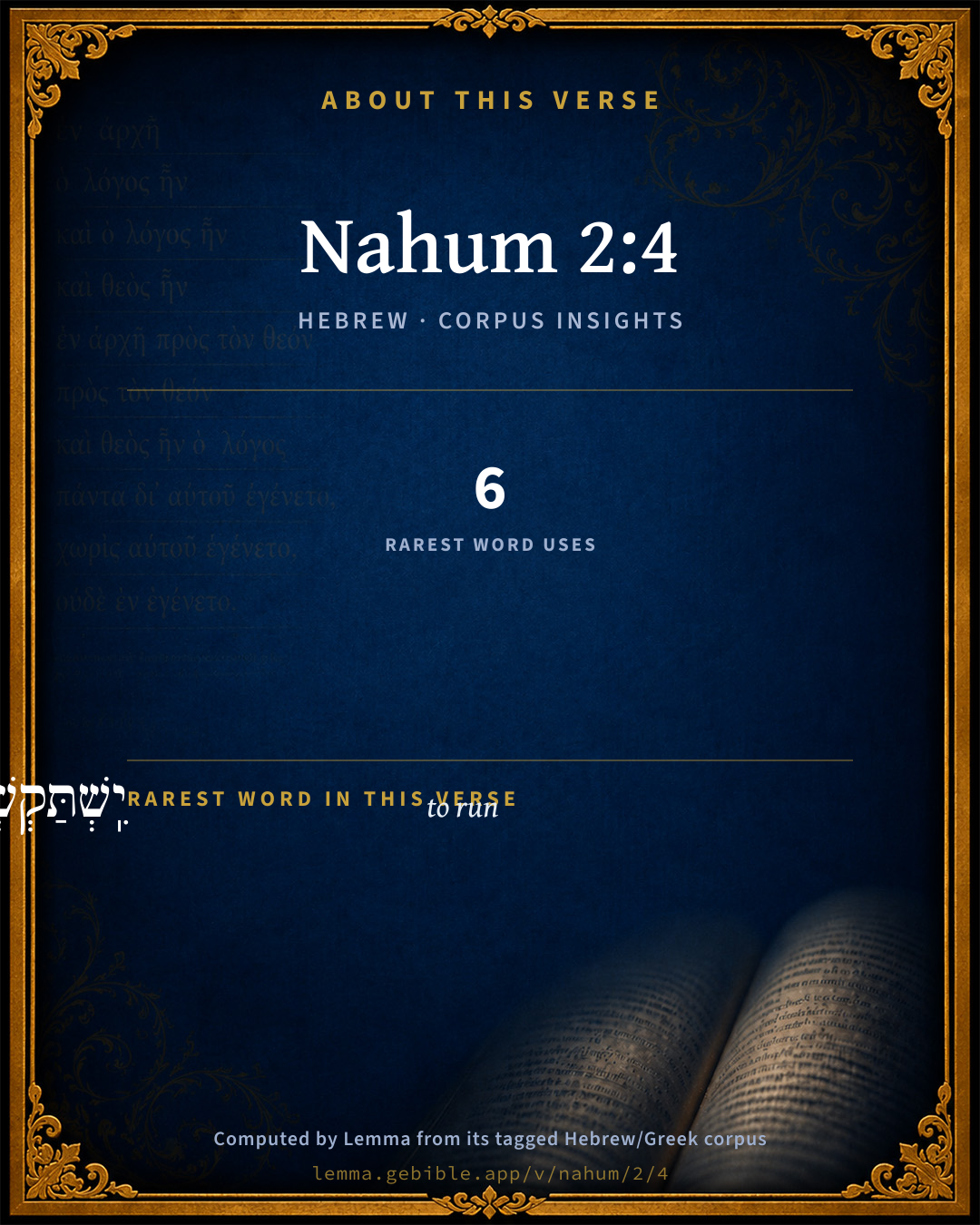
The rarest word here is יִֽשְׁתַּקְשְׁק֖וּן to run H8264 — appearing just 6 times in the whole Hebrew Bible.

Shared distinctive vocabulary

יִֽשְׁתַּקְשְׁק֖וּן to run H8264 occurs in 6 verses of the Hebrew Bible. Also found in:

Grammatical profile

  • 3 verbs
  • 6 nouns

Verb forms

  • יִתְהוֹלְל֣וּ Hithpolel · Imperfect
  • יִֽשְׁתַּקְשְׁק֖וּן Hithpalpel · Imperfect
  • יְרוֹצֵֽצוּ Polel · Imperfect

Hebrew & Septuagint length

In English translation the verse runs 25 words from the Hebrew and 31 from the Septuagint (LXX English) — closely comparable.

A rough comparison of the two English renderings, which tokenize alike — not a word-level alignment.

Word counts can differ between the Hebrew and the Greek without any difference in meaning — e.g. the Hebrew direct-object marker אֵת has no separate Greek word, and Greek often adds the article ὁ.

Cross-references

6

Topical passages linked to Nahum 2:4 in the Treasury of Scripture Knowledge — connected by theme and wording, ordered by reader-vote popularity; previews shown in the World English Bible.

  • Jeremiah 4:13 Behold, he shall come up as clouds, and his chariots [shall be] as the whirlwind: his horses are swifter than eagles. Woe to us! for we are ruined.
  • Isaiah 66:15 For, behold, Yahweh will come with fire, and his chariots shall be like the whirlwind; to render his anger with fierceness, and his rebuke with flames of fire.
  • Ezekiel 26:10 By reason of the abundance of his horses their dust shall cover you: your walls shall shake at the noise of the horsemen, and of the wagons, and of the chariots, when he shall enter into your gates, as men enter into a city in which is made a breach.
  • Nahum 3:2–3 The noise of the whip, the noise of the rattling of wheels, prancing horses, and bounding chariots,
  • Isaiah 37:24 By your servants have you defied the Lord, and have said, With the multitude of my chariots am I come up to the height of the mountains, to the innermost parts of Lebanon; and I will cut down the tall cedars of it, and the choice fir trees of it; and I will enter into its farthest height, the forest of its fruitful field;
  • Daniel 11:40 At the time of the end shall the king of the south contend with him; and the king of the north shall come against him like a whirlwind, with chariots, and with horsemen, and with many ships; and he shall enter into the countries, and shall overflow and pass through.

Cross-references courtesy of OpenBible.info (CC BY 4.0).

Hebrew and Greek witnesses Masoretic Hebrew ↔ Greek Septuagint

The same verse in the two great witnesses to the Old Testament, shown verse-for-verse.

These are two independent witnesses, not word-aligned to each other, and the Septuagint is shown in lemma (dictionary) form.

Hebrew Nahum 2:4 Masoretic · Westminster Leningrad Codex

בַּֽחוּצוֹת֙ יִתְהוֹלְל֣וּ הָרֶ֔כֶב יִֽשְׁתַּקְשְׁק֖וּן בָּרְחֹב֑וֹת מַרְאֵיהֶן֙ כַּלַּפִּידִ֔ם כַּבְּרָקִ֖ים יְרוֹצֵֽצוּ

The chariots rage in the streets. They rush back and forth in the broad ways. Their appearance is like torches. They run like the lightnings.

World English Bible · Public Domain

Greek LXX Nahum 2:4 Septuagint · lemma form

ὅπλον δυναστεία αὐτός ἐκ ἄνθρωπος ἀνήρ δυνατός ἐνπαίζω ἐν πῦρ ὁ ἡνία ὁ ἅρμα αὐτός ἐν ἡμέρα ἑτοιμασία αὐτός καί ὁ ἱππεύς θορυβέω

in the ways, and the chariots shall clash together, and shall be entangled in each other in the broad ways: their appearance is as lamps of fire, and as gleaming lightnings.

LXX2012 (modern English Septuagint) · Public Domain

Hebrew: Westminster Leningrad Codex (CC BY 4.0). Greek: Septuagint (public domain); English from LXX2012 (modern English Septuagint) (Public Domain). How the Septuagint differs from the Hebrew →

Targum (Aramaic paraphrase)

1

The Targum is the ancient Jewish Aramaic paraphrase of the Hebrew Scriptures — an interpretive translation, not the Hebrew text itself. Onkelos (literal) and Pseudo-Jonathan (expansive) render the Torah, and Jonathan the Prophets. Coverage is partial: where no permissively-licensed English translation exists for a verse, only the Aramaic is shown. This is verse-level text, not a word-by-word alignment to the Hebrew.

  1. Targum Jonathan Prophets (Joshua–Malachi)
    תְּרִיסֵי גִבָּרֵיהוֹן מְסַמְקִין גַבְרֵי עָבְדֵי קְרָבָא לְבִישִׁין דְזָהֲרִיתָא בְּאֶשְׁתָּא פִּילֵי רְתִיכֵיהוֹן זַמִינִין לְיוֹם קִשׁוּטֵיהוֹן וְרַבָּנֵי מַשִׁרְיָתְהוֹן מְסַרְבְּלִין בְּצִבְעוֹנִין:

    (no public-domain English translation for this verse)

    Targum Jonathan — Aramaic: “Mikraot Gedolot” (public domain). English: “Sefaria Community Translation” (CC0 1.0 (public-domain dedication)); “London "Chaldee Paraphrase," 1871” (public domain). Text via Sefaria.

Commentary

Notes on Nahum 2:4 from classic Christian and Jewish commentators (each source and its license shown beneath its notes). The classic Christian expositions comment on the surrounding passage and are grouped to its opening verse, so a note may address several verses; the Jewish commentaries on the Tanakh (Rashi and others) are per-verse, so they appear only where the commentator wrote on this verse.

Lemma curates 59 commentaries, every one of them public domain or Creative Commons licensed, each selected and text-cleaned for this edition rather than reprinted as found. About our sources →

The Cambridge Bible for Schools and Colleges

gen. ed. J. J. S. Perowne

4. Nah_2:3 referred to the aspect of the assailing army in the day of preparation; Nah_2:4 appears to describe an actual conflict before the city.

shall rage in the streets] rage in the outplaces. The reference is certainly to what is taking place outside the walls, not within the town. The term “streets” often means fields (Job_5:10), or what lies outside or abroad; it is parallel to “broad places” next clause, i.e. open ground in front of the walled city.

A suburb or outskirt of Nineveh called ribit Nina (broad place of Nineveh) lay probably on the N.E. of the city, or on the east, the side on which the great road to Arbela left the city. In such places there would no doubt be forts here and there and around these the battle would rage, for the defenders would not retreat within the walls without a conflict. Jer_46:9 also uses the word “rage” of the racing of chariots. Chariots were employed in sieges. Lay., Nineveh, II. 349.

They shall seem like torches] the appearance of them is like torches. The glitter of the mailed chariots and their furious racing is compared to torches and lightnings.

The Cambridge Bible for Schools and Colleges (gen. ed. J. J. S. Perowne; Cambridge University Press, 1878–1918) — public domain. Text from a community e-Sword module.

Trapp's Complete Commentary

John Trapp

Nah 2:4 The chariots shall rage in the streets, they shall justle one against another in the broad ways: they shall seem like torches, they shall run like the lightnings.

Ver. 4. The chariots shall rage in the streets] Shall run so fast, as if they were mad that drove them.

They shall jostle one against another] Coxabunt, they shall smite side to side, through haste and heat of fighting.

They shall seem like torches] Heb. Their aspect is as of torches; fire sparkleth out of their eyes that are in them; they look upon the Assyrians, as if they would look through them.

They shall run like the lightnings] Heb. They shall break through as the lightnings; that is, with incredible swiftness; as lightning in an instant cometh out of the east and shineth even to the west, Mat 24:27 Luk 10:18.

John Trapp, A Commentary or Exposition upon All the Books of the Old and New Testament (1647–1656) — public domain. Text from a community e-Sword module.

Tyndale Open Study Notes

Tyndale Open Resources

2:4 Chariots were virtually unstoppable in battle because of their maneuverability and power.

Tyndale Open Study Notes — © Tyndale Open Resources, licensed CC BY-SA 4.0. Text via the HelloAO Bible API.

Jamieson, Fausset & Brown

Robert Jamieson, A. R. Fausset & David Brown

rage--are driven in furious haste (Jer 46:9).

justle one against another--run to and fro [MAURER].

in the broad ways-- (Ch2 32:6). Large open spaces in the suburbs of Nineveh.

they shall seem like torches--literally, "their (feminine in Hebrew) appearance (is)": namely, the appearance of the broad places is like that of torches, through the numbers of chariots in them flashing in the sun (Pro 8:26, Margin).

run like the lightnings--with rapid violence (Mat 24:27; Luk 10:18).

Jamieson, Fausset & Brown — Commentary Critical and Explanatory on the Whole Bible (1871) — public domain (CC PDM 1.0). Text via the HelloAO Bible API.

Adam Clarke's Commentary

Verse 4. The chariots shall rage] Those of the besiegers and the besieged, meeting in the streets, producing universal confusion and carnage.

Adam Clarke's Commentary on the Bible (1810–1826) — public domain. Text from a community e-Sword/MySword module.

John Calvin's Commentaries

He still goes on with the same subject, — that they shall be furious in the streets that is, that they shall he so turbulent, as though they were out of their minds: as furious men are wont to be who are impetuously carried away beyond all reason and moderation, so shall they also become mad in their tumult. He then says, They shall hasten. The verb is derived from the hips; for he who hastens shakes the hips, and moves them with a quick motion; and if it be lawful to coin a word, it is, they shall hip; Ils remueront les hanches. This is what the Prophet meant. And then, Their appearance shall be as lamps. He refers here to the chariots. They shall then be like lamps; that is they shall dazzle the eyes of beholders with their brightness. All these things are intended to set forth what is terrific. He says also, as lightning they shall run here and there.

In short, he intimates, that the impetuosity of the Chaldeans would be so violent as to surpass what is commonly witnessed among men, that it would be, as it were, a species of fury and madness sent down from above. Thus, then, they were to be like lightning and flames of fire, that they might exceed every thing human. But these forms of speech, though they are hyperbolical, were not yet used without reason; for we may easily conjecture how great was then the security of the city Nineveh, and how incredible was the event of its ruin. That monarchy was then preeminent over every other in the whole world, and no one could have thought that it could ever be assailed. Since then it was difficult to persuade the Jews that ruin was nigh the Assyrians, it was necessary for the Prophet to accumulate these various forms of expressions, by which he sets forth the power of God in the destruction of the Assyrians. It afterwards follows —

John Calvin's Commentaries (1540-1563) — public domain. Text from the Calvin Translation Society English edition (1840s-50s) via the Christian Classics Ethereal Library (ccel.org). Calvin's coverage is partial (roughly two-thirds of the Bible); uncommented books and verses are honest gaps, never fabricated. The 19th-century editor's footnotes and remarks are omitted so the notes are faithfully Calvin's own voice.

John Gill's Exposition

The chariots shall rage in the streets,.... In the streets of Nineveh when taken; where they shall be drove in a furious manner from place to place, the men in them breathing out slaughter and death wherever they came. Kimchi understands this of the chariots of the Ninevites; who shall drive about in them in the streets of the city like madmen; not daring to go out to fight the enemy, being mightier and more numerous than they.

They shall justle one against another in the broad ways; because of their numbers, and the haste they shall make to spoil and plunder the city; or the Ninevites shall justle one against another, in their hurry and confusion to make their escape.

They shall seem like torches; either the chariots of the Medes and Chaldeans, for the reasons given in the preceding verse Nah 2:3; or they themselves, because of their fierceness and cruelty; or the faces of the Ninevites, being covered with shame, so Kimchi; see Isa 13:8.

They shall run like the lightnings; exceeding swiftly, with irresistible force and power; the above writer interprets this of the Ninevites also, running from one end of their city to the other in the utmost confusion, not knowing what to do; but the whole of these two verses Nah 2:3 seem to be a description of their enemies.

John Gill's Exposition of the Whole Bible (1746–1763) — public domain (CC PDM 1.0). Text via the HelloAO Bible API.

Haydock's Catholic Bible Commentary

Streets. The Ninivites are disordered at the enemy’s approach. (St. Jerome)

George Leo Haydock (1774–1849), Haydock's Catholic Family Bible and Commentary, 1859 edition — public domain. Excludes Psalms (Douay-Rheims chapter numbering differs from Protestant) and Deuterocanonical books (Catholic canon only).

Matthew Poole's English Annotations

The chariots of the Chaldean army, or the riders in the chariots, by their fierceness and carriage, by their cries and calls, heartening one another, and threatening the Assyrians.

Shall rage; shall seem to be more like madmen than well-ordered soldiers, and act as if they avert possessed with fruits, do more than man can do.

In the streets, either of the towns they pass through, or rather of Nineveh when taken.

They shall justle; by reason of their multitude, haste, and fury, they shall hit one against another.

In the broad ways; where is most room, shall be most of these chariots, and yet scarce room for them to move in.

They shall seem like torches; what with sparkling fire, caused by their horses and chariots shod with iron, and what with the glittering of the polished irons about the chariots, and what with the light of flaming torches carried in them, the chariots shall look like so malay great flambeaus, very dangerous and terrible.

They shall run like the lightnings, both for speed, irresistibleness, and terror, against which no defence, from which no flight or hiding.

Matthew Poole's English Annotations on the Holy Bible (1683–1685) — public domain. Text from a community e-Sword/MySword module.

The Pulpit Commentary

The chariots shall rage in the streets. The chariots rave, dash (Jer_46:9) about the open ways in the suburbs, or in the plains of the country. The description still appertains to the besiegers, who are so numerous that to the Ninevites, looking from their walls, their chariots seem to dash against one another. They shall seem their appearance is like torches. Thus is described the gleaming of the chariots and the armour (see on ver. 3 /RAPC 1Ma 6:39, "Now when the sun shone upon the shields of gold and brass, the mountains glistered therewith, and shined like lamps of fire").

The Pulpit Commentary (1880–1919), ed. H.D.M. Spence-Jones & Joseph S. Exell — public domain. Text from a community e-Sword module.

John Wesley's Explanatory Notes

In the streets - Of Nineveh, when taken. Justle - By reason of their multitude and fury. In the broad ways - Where is most room, and yet scarce enough for them to move. Like torches - What with sparkling fire caused by their horses and chariots, what with the glittering of the polished irons about them, and what with the light of flaming torches carried in them. Like the lightnings - Both for speed, irrestibleness and terror.

John Wesley, Explanatory Notes Upon the Whole Bible (1754–1765) — public domain. Text via the GEBible commentary corpus.

Rashi

Rabbi Shlomo Yitzchaki (Rashi)

The shields of his mighty men—The mighty of Nebuchadnezzar, who lay siege to Assyria.

are dyed red—They are dyed red, and the men of their army are in crimson, dressed in crimson.

the chariots are in the fire of torches on the day of his preparation Heb. פְּלָדֹת. On the day that he [Nebuchadnezzar] is prepared to go out in the army, he polishes his iron chariots, but I do not know what פְּלָדֹת means. I say that it is a material that polishes iron well. And some interpret פְּלָדֹת as an expression of a fiery torch (לַפִּיד), by transposing the letters.

and the cypresses are enwrapped—Jonathan renders: And the heads of the [Babylonian] camps are enwrapped in colored garments.

are enwrapped Heb. הַרְעָלוּ, enwrapped. Similar is (Isa. 3:19) “The necklaces and the bracelets and the shawls (הָרְעָלוֹת).” In the language of the Mishnah we learned “shawled (רְעוּלוֹת) Arabian women” in tractate Shabbath (65a).

Rashi on the Tanakh — English translations: “The Judaica Press complete Tanach with Rashi, translated by A. J. Rosenberg” (CC BY 4.0); “Pentateuch with Rashi's commentary by M. Rosenbaum and A.M. Silbermann, 1929-1934” (public domain); “The Metsudah Tanach series, Lakewood, N.J” (CC BY 4.0); and “The Book of Joshua, Metsudah Publications, 1997” (CC BY 4.0). Text via Sefaria.

Lesson kit

Teaching starters — assembled from the data on this page, not authored interpretation. Every prompt links to the verse data it draws on. Edit before teaching.

Nahum, in the Prophets, opens this verse with 9 words (9 distinct Hebrew lemmas). Its most distinctive word is shâqaq (“to run”). A historical commentator’s framing appears above. Read the whole chapter for the surrounding context.

Discussion questions

  1. The word shâqaq carries the sense “to run.” How does it shape the verse?
  2. How does Psalms 107:9, which shares the word «to run», read alongside this verse?
  3. These translations render this verse differently; the difference is in the English rendering, not the original. What questions does that raise?
  4. «יִתְהוֹלְל֣וּ» is a Hithpolel Imperfect verb. How does that grammatical form shape the action described?
  5. Compare how The Cambridge Bible for Schools and Colleges and Trapp's Complete Commentary read this verse. Where do they agree or differ?

Things to notice

Reading settings

Reading text

Shown beneath each verse's original-language words.

Old Testament
Old Testament edition

Read the OT as the Masoretic Hebrew (MT) or the Greek Septuagint (LXX).

English shown for the Greek Septuagint (in the Hebrew ↔ Greek comparison).

Comparing translations? Open the Compare panel on any verse page to stack up to four side by side.