
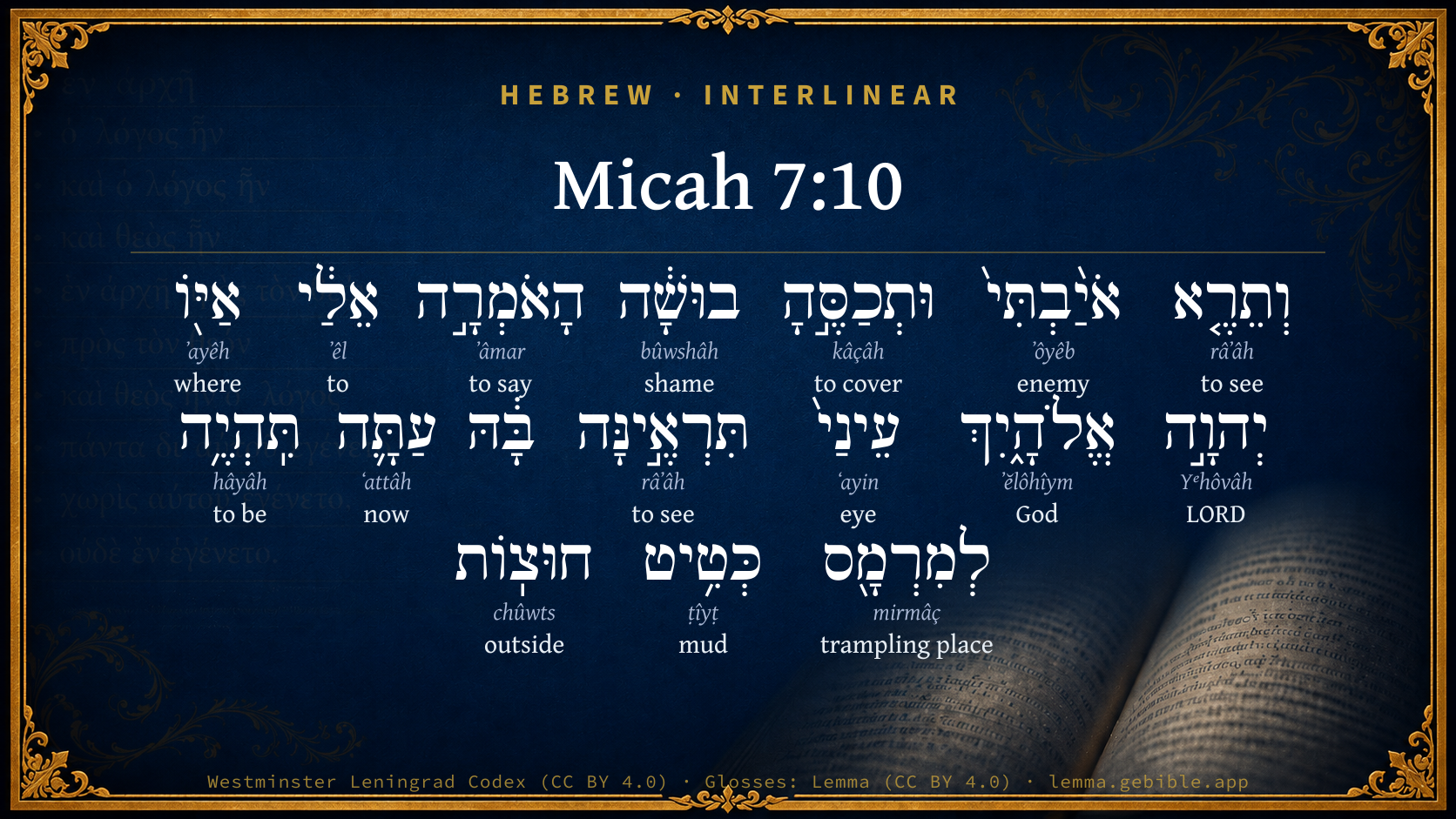
Micah 7:10

Hebrew (Westminster Leningrad Codex) Micah 7:10 appears in the Hebrew Old Testament. The text above is from the Westminster Leningrad Codex. Each word links to its Strong’s number, a concise gloss, and parsing drawn from the Open Scriptures Hebrew Bible morphology. Click any word for its full Brown-Driver-Briggs (BDB) entry.
Download image
Cite this verse

Micah 7:10 (World English Bible). Public Domain. Lemma interlinear Bible study tool, https://lemma.gebible.app/v/micah/7/10.

Show BibTeX & RIS
BibTeX
RIS
English Translation
Then my enemy will see it, And shame will cover her who said to me, Where is Yahweh your God? Then my enemy will see me and will cover her shame. Now she will be trodden down like the mire of the streets.
World English Bible · Public Domain
Download a study sheet

One document with this verse’s original text, its word-by-word gloss line, the meaning frame, cross-references with their text, attributed commentary, and full source and license credits — printable, and it pastes into notes with its structure intact.

This verse Autodidact and up

Study sheet (.html) Plain text (.txt)

A passage Seminary Student

Up to 50 verses in one chapter. A passage sheet keeps up to 6 commentary sources and 12 cross-references per verse, in the order this page ranks them, and says so on the sheet whenever that leaves anything out. Ask for a single verse and you get the Autodidact verse sheet above.

Everything on this page stays free to read, with no account — the sheet is a download of what is already on screen, not access to it.

Want to remove ads? Support Godless Engineer
Compare translations 3

The same verse in 3 English versions, stacked beneath the original-language interlinear above. Click any original word for its lexicon entry.

Each is an independent rendering of the whole verse — the interlinear is not word-aligned to these translations.

Highlighted words mark where these versions differ — a whole-verse word diff, not a word-by-word alignment.

  • World English Bible Public Domain
    Then my enemy will see it, And shame will cover her who said to me, Where is Yahweh your God? Then my enemy will see me and will cover her shame. Now she will be trodden down like the mire of the streets.
  • King James Version Public Domain
    Then she that is mine enemy shall see it, and shame shall cover her which said unto me, Where is the LORD thy God? mine eyes shall behold her: now shall she be trodden down as the mire of the streets.
  • unfoldingWord Literal Text CC BY-SA 4.0
    Then my enemy will see it, and shame will cover the one who said to me, “Where is Yahweh your God?” My eyes will look at her; she will be trampled down like the mud in the streets.

unfoldingWord Literal Text — © unfoldingWord, licensed CC BY-SA 4.0. Word-aligned USFM3 via Door43 (git.door43.org/unfoldingWord/en_ult).

Versions to compare (up to 4)

3 of 4 selected

Show all 18 translations

Every available English version of this verse, each an independent rendering of the whole verse.

  • World English Bible Public Domain
    Then my enemy will see it, And shame will cover her who said to me, Where is Yahweh your God? Then my enemy will see me and will cover her shame. Now she will be trodden down like the mire of the streets.
  • Berean Standard Bible Public Domain
    Then my enemy will see and will be covered with shame—she who said to me, “Where is the LORD your God?” My eyes will see her; at that time she will be trampled like mud in the streets.
  • Majority Standard Bible Public Domain
    Then my enemy will see and will be covered with shame—she who said to me, “Where is the LORD your God?” My eyes will see her; at that time she will be trampled like mud in the streets.
  • King James Version Public Domain
    Then she that is mine enemy shall see it, and shame shall cover her which said unto me, Where is the LORD thy God? mine eyes shall behold her: now shall she be trodden down as the mire of the streets.
  • American Standard Version (1901) Public Domain
    Then mine enemy shall see it, and shame shall cover her who said unto me, Where is Jehovah thy God? Mine eyes shall see `my desire' upon her; now shall she be trodden down as the mire of the streets.
  • Revised Version (1885) Public Domain
    Then mine enemy shall see it, and shame shall cover her; which said unto me, Where is the LORD thy God? Mine eyes shall behold her; now shall she be trodden down as the mire of the streets.
  • Geneva Bible (1599) Public Domain
    Then she that is mine enemie, shall looke vpon it, and shame shall couer her, which said vnto me, Where is the Lord thy God? Mine eyes shall behold her: now shall she be troden downe as the myre of the streetes.
  • Douay-Rheims (1899) Public Domain
    And my enemy shall behold, and she shall be covered with shame, who saith to me: Where is the Lord thy God? My eyes shall look down upon her: now shall she be trodden under foot as the mire of the streets.
  • Young's Literal Translation Public Domain
    And see doth mine enemy, And cover her doth shame, Who saith unto me, `Where `is' Jehovah thy God?' Mine eyes do look on her, Now she is for a treading-place, As mire of the out-places.
  • Literal Standard Version CC BY-SA 4.0
    And my enemy sees, || And shame covers her, || Who says to me, “Where [is] your God YHWH?” My eyes look on her, || Now she is for a treading-place, || As mire of the out-places.
  • Unlocked Literal Bible CC BY-SA 4.0
    Then my enemy will see it, and shame will cover the one who said to me, “Where is Yahweh your God?” My eyes will look at her; she will be trampled down like the mud in the streets.
  • unfoldingWord Literal Text CC BY-SA 4.0
    Then my enemy will see it, and shame will cover the one who said to me, “Where is Yahweh your God?” My eyes will look at her; she will be trampled down like the mud in the streets.
  • Darby Bible Public Domain
    And mine enemy shall see [it], and shame shall cover her which said unto me, Where is Jehovah thy God? Mine eyes shall behold her; now shall she be trodden down, as the mire of the streets.
  • World Messianic Bible Public Domain
    Then my enemy will see it, and shame will cover her who said to me, “Where is the LORD your God?” My eyes will see her. Now she will be trodden down like the mire of the streets.
  • Webster's Bible Public Domain
    Then she that is my enemy shall see it, and shame shall cover her who said to me, Where is the LORD thy God? my eyes shall behold her: now shall she be trodden down as the mire of the streets.
  • Free Bible Version CC BY-SA 4.0
    Then my enemies will see it and cover their faces in shame for taunting me, asking, “Where is the Lord your God?” With my own eyes I will see what happens to them; they will be trodden down like mud in the streets.
  • Bible in Basic English Public Domain
    And my hater will see it and be covered with shame; she who said to me, Where is the Lord your God? my eyes will see their desire effected on her, now she will be crushed under foot like the dust of the streets.
  • JPS Tanakh (1917) Public Domain
    Then mine enemy shall see it, and shame shall cover her; who said unto me: Where is the LORD thy God? Mine eyes shall gaze upon her; now shall she be trodden down as the mire of the streets.'

Literal Standard Version (2020), Covenant Press — licensed CC BY-SA 4.0. Text via the HelloAO Bible API (eBible.org). Unlocked Literal Bible (unfoldingWord) — licensed CC BY-SA 4.0. Text via the HelloAO Bible API (eBible.org). unfoldingWord Literal Text — © unfoldingWord, licensed CC BY-SA 4.0. Word-aligned USFM3 via Door43 (git.door43.org/unfoldingWord/en_ult). Free Bible Version, Dr. Jonathan Gallagher — licensed CC BY-SA 4.0. Text via the HelloAO Bible API (eBible.org).

Word by word

More ways to search: Search by grammar → Find every occurrence → Compare this word →

Practice this passage: Drill this verse → Learn its vocabulary →

בוּשָׁ֔ה
bûwshâh
H955
“shame”
Noun, Common, Feminine, Singular, Absolute
Part of Speech
Noun
Type
Common
Gender
Feminine
Number
Singular
State
Absolute
Full BDB Definition

Origin: participle passive of H954

TWOT: 222a

shame
  1. וְתֵרֶ֤א râʼâh H7200 “and · to see” Conjunction + Verb, Qal, Imperfect, 3rd Person, Feminine, Singular
  2. אֹיַ֨בְתִּי֙ ʼôyêb H341 “enemy · me” Verb, Qal, Participle Active, Feminine, Singular, Construct + Suffix, Personal, 1st Person, Common, Singular
  3. וּתְכַסֶּ֣הָ kâçâh H3680 “and · to cover · her” Conjunction + Verb, Piel, Imperfect, 3rd Person, Feminine, Singular + Suffix, Personal, 3rd Person, Feminine, Singular
  4. הָאֹמְרָ֣ה ʼâmar H559 “the · saying” Particle, Definite Article + Verb, Qal, Participle Active, Feminine, Singular, Absolute
  5. אֵלַ֔י ʼêl H413 “to · me” Preposition + Suffix, Personal, 1st Person, Common, Singular
  6. אַיּ֖וֹ ʼayêh H346 “where · him” Particle, Interrogative + Suffix, Personal, 3rd Person, Masculine, Singular
  7. יְהוָ֣ה Yᵉhôvâh H3068 “LORD” Noun, Proper
  8. אֱלֹהָ֑יִךְ ʼĕlôhîym H430 “God(s) · your” Noun, Common, Masculine, Plural, Construct + Suffix, Personal, 2nd Person, Feminine, Singular
  9. עֵינַי֙ ʻayin H5869 “eyes · my” Noun, Common, Both, Dual, Construct + Suffix, Personal, 1st Person, Common, Singular
  10. תִּרְאֶ֣ינָּה râʼâh H7200 “to see” Verb, Qal, Imperfect, 3rd Person, Feminine, Plural
  11. עַתָּ֛ה ʻattâh H6258 “now” Adverb
  12. תִּֽהְיֶ֥ה hâyâh H1961 “to be” Verb, Qal, Imperfect, 3rd Person, Feminine, Singular
  13. לְמִרְמָ֖ס mirmâç H4823 “to/for · trampling place” Preposition + Noun, Common, Masculine, Singular, Absolute
  14. כְּטִ֥יט ṭîyṭ H2916 “like/as · mud of” Preposition + Noun, Common, Masculine, Singular, Construct
  15. חוּצֽוֹת chûwts H2351 “streets” Noun, Common, Masculine, Plural, Absolute

About this verse

These counts appear in no published source. They are computed here, from the morphology-tagged text and Lemma’s own curated glosses. What Lemma adds →

17
words
15
distinct lemmas
Prophets
section

Notable vocabulary

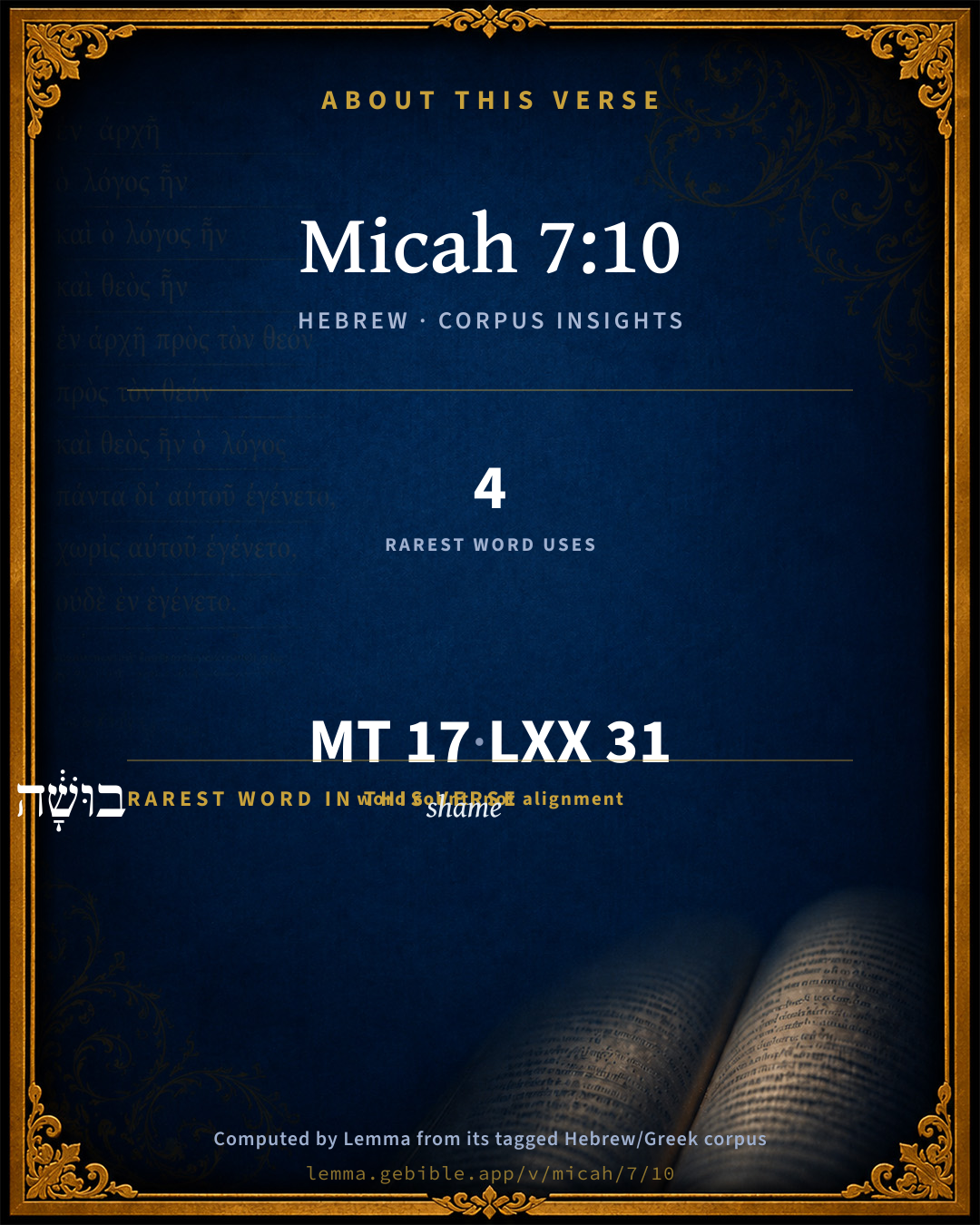
The rarest word here is בוּשָׁ֔ה shame H955 — appearing just 4 times in the whole Hebrew Bible.

Shared distinctive vocabulary

בוּשָׁ֔ה shame H955 occurs in 4 verses of the Hebrew Bible. Also found in:

Grammatical profile

  • 6 verbs
  • 7 nouns
  • 2 prepositions
  • 1 adverb
  • 1 particle

Verb forms

  • וְתֵרֶ֤א Qal · Imperfect
  • אֹיַ֨בְתִּי֙ Qal · Participle Active
  • וּתְכַסֶּ֣הָ Piel · Imperfect
  • הָאֹמְרָ֣ה Qal · Participle Active
  • תִּרְאֶ֣ינָּה Qal · Imperfect
  • תִּֽהְיֶ֥ה Qal · Imperfect

Repetition

A word recurs within this verse — often emphatic in Hebrew:

  • וְתֵרֶ֤א to see H7200 ×2

Hebrew & Septuagint length

In English translation the verse runs 43 words from the Hebrew and 40 from the Septuagint (LXX English) — closely comparable.

A rough comparison of the two English renderings, which tokenize alike — not a word-level alignment.

Word counts can differ between the Hebrew and the Greek without any difference in meaning — e.g. the Hebrew direct-object marker אֵת has no separate Greek word, and Greek often adds the article ὁ.

In the original languages it is 17 Hebrew tokens and 31 Greek tokens — but the two are counted differently (Hebrew bundles its prefixes and suffixes into one token; the Greek is in lemma form), so that isn’t a like-for-like length.

Cross-references

34

Topical passages linked to Micah 7:10 in the Treasury of Scripture Knowledge — connected by theme and wording, ordered by reader-vote popularity; previews shown in the World English Bible.

  • Psalms 42:10 As with a sword in my bones, my adversaries reproach me, While they continually ask me, "Where is your God?"
  • Jeremiah 50:33–34 Thus says Yahweh of hosts: The children of Israel and the children of Judah are oppressed together; and all who took them captive hold them fast; they refuse to let them go.
  • Zechariah 10:5 They shall be as mighty men, Treading down muddy streets in the battle; And they shall fight, because Yahweh is with them; And the riders on horses will be confounded.
  • 2 Samuel 22:43 Then did I beat them small as the dust of the earth, I did crush them as the mire of the streets, and did spread them abroad.
  • Psalms 18:42 Then I beat them small as the dust before the wind. I cast them out as the mire of the streets.
  • Psalms 35:26 Let them be disappointed and confounded together who rejoice at my calamity. Let them be clothed with shame and dishonor who magnify themselves against me.
  • Joel 2:17 Let the priests, the ministers of Yahweh, weep between the porch and the altar, And let them say, "Spare your people, Yahweh, And don't give your heritage to reproach, That the nations should rule over them. Why should they say among the peoples, 'Where is their God?'"
  • Revelation 18:20 Rejoice over her, O heaven, you saints, apostles, and prophets; for God has judged your judgment on her."
  • 2 Kings 9:33–37 He said, Throw her down. So they threw her down; and some of her blood was sprinkled on the wall, and on the horses: and he trod her under foot.
  • Psalms 79:10 Why should the nations say, "Where is their God?" Let it be known among the nations, before our eyes, That vengeance for your servants' blood is being poured out.
  • Jeremiah 51:51 We are confounded, because we have heard reproach; confusion has covered our faces: for strangers are come into the sanctuaries of Yahweh's house.
  • Micah 4:11 Now many nations have assembled against you, that say, 'Let her be defiled, And let our eye gloat over Zion.'
  • Psalms 42:3 My tears have been my food day and night, While they continually ask me, "Where is your God?"
  • Psalms 58:10 The righteous shall rejoice when he sees the vengeance. He shall wash his feet in the blood of the wicked;
  • Psalms 109:29 Let my adversaries be clothed with dishonor. Let them cover themselves with their own shame as with a robe.
  • Psalms 115:2 Why should the nations say, "Where is their God, now?"
  • Psalms 137:8–9 Daughter of Babylon, doomed to destruction, He will be happy who rewards you, As you have served us.
  • Isaiah 25:10–12 For in this mountain will the hand of Yahweh rest; and Moab shall be trodden down in his place, even as straw is trodden down in the water of the dung-hill.
  • Isaiah 26:5–6 For he has brought down those who dwell on high, the lofty city: he lays it low, he lays it low even to the ground; he brings it even to the dust.
  • Isaiah 37:10–11 Thus shall you speak to Hezekiah king of Judah, saying, Don't let your God in whom you trust deceive you, saying, Jerusalem shall not be given into the hand of the king of Assyria.
  • Isaiah 41:15–16 Behold, I have made you [to be] a new sharp threshing instrument having teeth; you shall thresh the mountains, and beat them small, and shall make the hills as chaff.
  • Isaiah 47:5–9 Sit you silent, and get you into darkness, daughter of the Chaldeans; for you shall no more be called The mistress of kingdoms.
  • Isaiah 51:22–23 Thus says your Lord Yahweh, and your God who pleads the cause of his people, Behold, I have taken out of your hand the cup of staggering, even the bowl of the cup of my wrath; you shall no more drink it again:
  • Isaiah 63:2–3 Why are you red in your clothing, and your garments like him who treads in the wine vat?
  • Jeremiah 51:8–10 Babylon is suddenly fallen and destroyed: wail for her; take balm for her pain, if so be she may be healed.
  • Jeremiah 51:24 I will render to Babylon and to all the inhabitants of Chaldea all their evil that they have done in Zion in your sight, says Yahweh.
  • Daniel 3:15 Now if you are ready whenever you hear the sound of the horn, flute, zither, lyre, harp, pipe, and all kinds of music to you fall down and worship the image which I have made, [well]: but if you don't worship, you shall be cast the same hour into the midst of a burning fiery furnace; and who is that god that shall deliver you out of my hands?
  • Obadiah 1:10 For the violence done to your brother Jacob, shame will cover you, and you will be cut off forever.
  • Nahum 2:1–3 He who dashes in pieces has come up against you. Keep the fortress! Watch the way! Strengthen your loins! Fortify your power mightily!
  • Malachi 1:5 Your eyes will see, and you will say, "Yahweh is great--even beyond the border of Israel!"
  • Malachi 4:3 You shall tread down the wicked; for they will be ashes under the soles of your feet in the day that I make," says Yahweh of Hosts.
  • Matthew 27:43 He trusts in God. Let God deliver him now, if he wants him; for he said, 'I am the Son of God.'"
  • Ezekiel 7:18 They shall also gird themselves with sackcloth, and horror shall cover them; and shame shall be on all faces, and baldness on all their heads.
  • Revelation 17:1–7 One of the seven angels who had the seven bowls came and spoke with me, saying, "Come here. I will show you the judgment of the great prostitute who sits on many waters,

Cross-references courtesy of OpenBible.info (CC BY 4.0).

Hebrew and Greek witnesses Masoretic Hebrew ↔ Greek Septuagint

The same verse in the two great witnesses to the Old Testament, shown verse-for-verse.

These are two independent witnesses, not word-aligned to each other, and the Septuagint is shown in lemma (dictionary) form.

Hebrew Micah 7:10 Masoretic · Westminster Leningrad Codex

וְתֵרֶ֤א אֹיַ֨בְתִּי֙ וּתְכַסֶּ֣הָ בוּשָׁ֔ה הָאֹמְרָ֣ה אֵלַ֔י אַיּ֖וֹ יְהוָ֣ה אֱלֹהָ֑יִךְ עֵינַי֙ תִּרְאֶ֣ינָּה בָּ֔הּ עַתָּ֛ה תִּֽהְיֶ֥ה לְמִרְמָ֖ס כְּטִ֥יט חוּצֽוֹת

Then my enemy will see it, And shame will cover her who said to me, Where is Yahweh your God? Then my enemy will see me and will cover her shame. Now she will be trodden down like the mire of the streets.

World English Bible · Public Domain

Greek LXX Micah 7:10 Septuagint · lemma form

καί ὁράω ὁ ἔχθρα ἐγώ καί περιβάλλω αἰσχύνη ὁ λέγω πρός ἐγώ ποῦ κύριος ὁ θεός σύ ὁ ὀφθαλμός ἐγώ ἐπιὁράω αὐτός νῦν εἰμί εἰς καταπάτημα ὡς πηλός ἐν ὁ ὁδός

And she that is my enemy shall see it, and shall clothe herself with shame, who says, Where is the Lord your God? my eyes shall look upon her: now shall she be for trampling as mire in the ways.

LXX2012 (modern English Septuagint) · Public Domain

Hebrew: Westminster Leningrad Codex (CC BY 4.0). Greek: Septuagint (public domain); English from LXX2012 (modern English Septuagint) (Public Domain). How the Septuagint differs from the Hebrew →

Targum (Aramaic paraphrase)

1

The Targum is the ancient Jewish Aramaic paraphrase of the Hebrew Scriptures — an interpretive translation, not the Hebrew text itself. Onkelos (literal) and Pseudo-Jonathan (expansive) render the Torah, and Jonathan the Prophets. Coverage is partial: where no permissively-licensed English translation exists for a verse, only the Aramaic is shown. This is verse-level text, not a word-by-word alignment to the Hebrew.

  1. Targum Jonathan Prophets (Joshua–Malachi)
    וְתֶחֱזֵי בְּעֵיל דְבָבוּתִי וְתַחֲפִינָהּ בַּהֲתָא דַהֲוַת אָמְרָה לִי אָן דְאִתְפְּרֵיקְתָּא בְּמֵימְרָא דַייָ אֱלָהָךְ עֵינַי יֶחֶזְיָן בְּמַפַּלְתְּהוֹן כְּעַן תְּהֵי לְדָיִשׁ כְּטִין שׁוּקִין:

    (no public-domain English translation for this verse)

    Targum Jonathan — Aramaic: “Mikraot Gedolot” (public domain). English: “Sefaria Community Translation” (CC0 1.0 (public-domain dedication)); “London "Chaldee Paraphrase," 1871” (public domain). Text via Sefaria.

Commentary

Notes on Micah 7:10 from classic Christian and Jewish commentators (each source and its license shown beneath its notes). The classic Christian expositions comment on the surrounding passage and are grouped to its opening verse, so a note may address several verses; the Jewish commentaries on the Tanakh (Rashi and others) are per-verse, so they appear only where the commentator wrote on this verse.

Lemma curates 59 commentaries, every one of them public domain or Creative Commons licensed, each selected and text-cleaned for this edition rather than reprinted as found. About our sources →

Trapp's Complete Commentary

John Trapp

Mic 7:10 Then [she that is] mine enemy shall see [it], and shame shall cover her which said unto me, Where is the LORD thy God? mine eyes shall behold her: now shall she be trodden down as the mire of the streets.

Ver. 10. Then she that is mine enemy shall see it, &c.] Not only shall I behold his righteousness (as before), but mine enemy shall see it, and feel it too, to her small comfort. They shall see it when it is too late to remedy it; as they say the mole never opens her eyes till pangs of death are upon her.

And shame shall cover her] When she shall see that thou hast showed me a token for good; that thou hast helped me, and comforted me, Psa 86:17.

Which said unto me, Where is the Lord thy God?] So laying her religion in her dish, whereby God became interested in her cause, and concerned in point of honour to appear for her. The Church is no less beholden to her enemies’ insolence for help than to her own devotions; for God will right himself and her together. See Joe 2:17. {See Trapp on "Joe 2:17"}

Mine eyes shall behold her] And feed upon her misery, not as mine enemy, but as God’s; nor out of private revenge, but out of zeal for his glory.

Now shall she be trodden down as the mire of the streets] Exit infra omnes infimos: she shall be as mean as may be. Nineveh, that great city, is now a little town of small trade; Babylon is nothing else but a sepulture of herself. Those four monarchies that so heavily oppressed the Church are now laid in the dust, and live by fame only; so shall the Romish hierarchy and Turkish empire. All Christ’s enemies shall shortly be in that place that is fittest for them; sc. under his feet, as was before noted; he will dung his Church with the carcases of all those wild boars and bulls of Bashan that have trod it down.

John Trapp, A Commentary or Exposition upon All the Books of the Old and New Testament (1647–1656) — public domain. Text from a community e-Sword module.

Joseph Benson's Commentary

Mic 7:10-13. Then she that is mine enemy — Namely, the Chaldean nation. Which said unto me, (namely, when she held me captive,) Where is the Lord thy God? — Where is now Jehovah, whom thou worshippest, and sayest is the only God? Why does he not now deliver thee? Why does he not free thee from my hands, who am not his worshipper? Mine eyes shall behold her: now shall she be trodden down, &c. — As the heathen beheld the desolations of God’s church and temple with delight, (see Mic 4:11,) so it shall come to my turn to see God’s judgments executed upon the Babylonish empire, which shall be brought down to as low a condition as ever they had reduced God’s people. In the day that thy walls shall be built, &c. — When God shall visit his people, and repair their decayed estate, (compare Amo 9:11,) then the tyrannical edicts of their persecutors shall be utterly abolished. This may partly relate to the recalling those edicts, which put a stop to the rebuilding of the city and temple of Jerusalem: see Ezr 4:23-24; Ezr 6:14; Neh 2:8; Neh 2:17. In that day — At that time also; he shall come even to thee from Assyria, &c. — This may be rendered, They shall come, &c.; that is, thy restored inhabitants; and from the fortress — Or rather, from Egypt, even unto the river — That is, the Euphrates; for the word מצור, which we translate fortress, likewise means Egypt. All this signifies the return of the Jews from the various parts to which they had been scattered. Notwithstanding, the land shall be desolate, &c. — Nevertheless the land shall, before this, be reduced to a state of desolation, on account of the heinous wickedness of those who at present inhabit it.

Joseph Benson's Commentary on the Old and New Testaments (1811–1818) — public domain. Text from a community e-Sword module.

Tyndale Open Study Notes

Tyndale Open Resources

7:10 where is the Lord? This taunt rebuked God and those who trusted him. God had promised always to be with his people and their leaders (Gen 46:3-4; Exod 3:12). God was dishonored by these taunts, and he would act to clear his name (cp. Ezek 20:9; 36:19-26).

Tyndale Open Study Notes — © Tyndale Open Resources, licensed CC BY-SA 4.0. Text via the HelloAO Bible API.

Jamieson, Fausset & Brown

Robert Jamieson, A. R. Fausset & David Brown

shame shall cover her--in seeing how utterly mistaken she was in supposing that I was utterly ruined.

Where is . . . thy God-- (Psa 42:3, Psa 42:10). If He be "thy God," as thou sayest, let Him come now and deliver thee. So as to Israel's representative, Messiah (Mat 27:43).

mine eyes shall behold her--a just retribution in kind upon the foe who had said, "Let our eye look upon Zion." Zion shall behold her foe prostrate, not with the carnal joy of revenge, but with spiritual joy in God's vindicating His own righteousness (Isa 66:24; Rev 16:5-7).

shall she be trodden down--herself, who had trodden down me.

Jamieson, Fausset & Brown — Commentary Critical and Explanatory on the Whole Bible (1871) — public domain (CC PDM 1.0). Text via the HelloAO Bible API.

Adam Clarke's Commentary

Verse 10. Then she that is mine enemy] This may refer particularly to the city of Babylon.

Shall she be trodden down] Literally fulfilled in the sackage of that city by the Persians, and its consequent total ruin. It became as mire; its walls, formed of brick kneaded with straw and baked in the sun, becoming exposed to the wet, dissolved, so that a vestige of the city remains not, except a few bricks digged from under the rubbish, several pieces of which now lie before me, and show the perishing materials of which the head of this proud empire was composed.

Adam Clarke's Commentary on the Bible (1810–1826) — public domain. Text from a community e-Sword/MySword module.

John Calvin's Commentaries

In the last lecture I repeated the tenth verse of the last chapter, in which the prophet adds, as a cause of the greatest joy, that the enemies of the Church shall see granted, to their great mortification, the wonderful favor of which the Prophet had been speaking. But he describes these enemies, under the character of an envious woman, as the Church of God is also compared to a woman: and this mode of speaking is common in Scripture. He then calls Jerusalem his rival, or Babylon, or some city of his enemies.

And he says, Covered shall she be with shame We know that the ungodly grow insolent when fortune smiles on them: hence in prosperity they keep within no bounds, for they think that God is under their feet. If prosperity most commonly has the effect of making the godly to forget God and even themselves, it is no wonder that the unbelieving become more and more hardened, when God is indulgent to them. With regard then to such a pride, the Prophet now says, When my enemy shall see, shame shall cover her; that is, she will not continue in her usual manner, to elate herself with her own boastings: nay, she will be compelled for shame to hide herself; for she will see that she had been greatly deceived, in thinking that I should be wholly ruined.

He afterwards adds, Who said to me, Where is Jehovah thy God? The Church of God in her turn triumphs here over the unbelieving, having been delivered by divine power; nor does she do this for her own sake, but because the ungodly expose the holy name of God to reproach, which is very common: for whenever God afflicts his people, the unbelieving immediately raise their crests, and pour forth their blasphemies against God, when yet they ought, on the contrary, to humble themselves under his hand. But since God executes his judgments on the faithful, what can be expected by his ungodly despisers? If God’s vengeance be manifested in a dreadful manner with regard to the green tree, what will become of the dry wood? And the ungodly are like the dry wood. But as they are blind as to God’s judgments, they petulantly deride his name, whenever they see the Church afflicted, as though adversities were not the evidences of God’s displeasure: for he chastises his own children, to show that he is the judge of the world. But, as I have already said, the ungodly so harden themselves in their stupor, that they are wholly thoughtless. The faithful, therefore, after having found God to be their deliverer, do here undertake his cause; they do not regard themselves nor their own character, but defend the righteousness of God. Such is this triumphant language, Who said, Where is now Jehovah thy God? “I can really show that I worship the true God, who deserts not his people in extreme necessity: after he has assisted me, my enemy, who dared to rise up against God, now seeks hiding-places.”

She shall now, he says, be trodden under foot as the mire of the streets; and my eyes shall see her. What the Prophet declares in the name of the Church, that the unbelieving shall be like mire, is connected with the promise, which we already noticed; for God so appears as the deliverer of his Church, as not to leave its enemies unpunished. God then, while he aids his own people, leads the ungodly to punishment. Hence the Church, while embracing the deliverance offered to her, at the same time sees the near ruin, which impends on all the despisers of God. But what is stated, See shall my eyes, ought not to be so taken, as though the faithful exult with carnal joy, when they see the ungodly suffering the punishment which they have deserved; for the word to see is to be taken metaphorically, as signifying a pleasant and joyful sight, according to what it means in many other places; and as it is a phrase which often occurs, its meaning must be well known. See then shall my eyes, that is, “I shall enjoy to look on that calamity, which now impends over all the ungodly.” But, as I have already said, carnal joy is not what is here intended, which intemperately exults, but that pure joy which the faithful experience on seeing the grace of God displayed and also his judgment. But this joy cannot enter into our hearts until they be cleansed from unruly passions; for we are ever excessive in fear and sorrow, as well as in hope and joy, except the Lord holds us in, as it were, with a bridle. We shall therefore be only then capable of this spiritual joy, of which the Prophet speaks, when we shall put off all disordered feelings, and God shall subdue us by his Spirit: then only shall we be able to retain moderation in our joy. The Prophet proceeds —

John Calvin's Commentaries (1540-1563) — public domain. Text from the Calvin Translation Society English edition (1840s-50s) via the Christian Classics Ethereal Library (ccel.org). Calvin's coverage is partial (roughly two-thirds of the Bible); uncommented books and verses are honest gaps, never fabricated. The 19th-century editor's footnotes and remarks are omitted so the notes are faithfully Calvin's own voice.

Ellicott's Commentary for English Readers

(10) Now shall she be trodden down.—The enemy that had taunted the Jews with the powerlessness of Jehovah should be trodden down when the Jews were delivered. Such was the experience of Sennacherib, who inquired contemptuously whether the Lord could deliver Jerusalem out of his hand.

A Bible Commentary for English Readers, edited by Charles John Ellicott (1878–1897) — public domain. Text from a community e-Sword module.

John Gill's Exposition

Then she that is mine enemy shall see it,.... The Chaldeans and Edomites shall see people of the Jews rising out of their calamities, brought out of the darkness of their captivity in Babylon, and enjoying the light of peace and prosperity in their own land. Some editions of the Targum, and Jarchi and Kimchi, have, in their glosses on this verse and Mic 7:9, Rome, of whom they interpret this enemy, as Mr. Pocock observes; and so R. Elias (d) says the Targum is, "then shall Rome see"; by which they mean the Christians, in opposition to the Jews; otherwise it would not be amiss to interpret it of Rome Papal, or antichrist, in opposition to the church of God; seeing the antichristian party will see witnesses of Christ, slain for his sake, rise again, and ascend to heaven, or be brought into a glorious and comfortable state; see Rev 11:12; and may be applied to any age of the church, and to any particular saints raised out of a state of darkness and affliction into a prosperous one, in the sight of their enemies, and in spite of them, to their great mortification; see Psa 23:4;

and shame shall cover her which said unto me, where is the Lord thy God? as the Heathens; the Chaldeans, did to the Jews, Psa 115:2; and which must be very cutting to them, as it was to David, Psa 42:10; when they flouting and jeering said, where is thy God thou boastedst of, and didst put thy trust and confidence in, that he would deliver and save thee? what is become of him, and of thy confidence in him? The Targum is,

"where art thou that art redeemed by the Word of the Lord thy God?"

but when they shall see that the Lord God has returned unto them, and wrought salvation for them, they will be ashamed of their flouts and jeers; and by reason of their sad disappointment, add the change of things for the worse to them, who now will be brought into calamity and distress themselves:

mine eyes shall behold her; the enemy: their fall, as the Targum; being in a most despicable and ruinous condition, under the vengeance of the Almighty; and that with pleasure and satisfaction, not from a private spirit of revenge, but because of the glory of divine justice, which will be displayed in their righteous destruction; see Psa 58:10;

now shall she be trodden down as the mire of the streets; that is, entirely conquered, and utterly destroyed; reduced to, the utmost meanness, and had in the greatest contempt: this was fulfilled when Babylon was taken by the Medea and Persians; and when the Edomites were conquered and brought into subjection to the Jews by the Maccabees; and will be the case of all the enemies of Christ and his church, of all the antichristian states, one day.

(d) In Tishbi, p. 227.

John Gill's Exposition of the Whole Bible (1746–1763) — public domain (CC PDM 1.0). Text via the HelloAO Bible API.

Albert Barnes' Notes on the Bible

Then - (And) she that is mine enemy shall see it, and shame shall cover her which said unto me, Where is He, He of whom thou boastest, the Lord thy God? The cause of her gladness then is, that the blasphemies of the enemy of God were to cease. This was the bitterest portion of her cup, that they said daily, “Where is now thy God? let Him come and save thee;” as though He could not, or as though He loved her not, and she vainly presumed on His help. Even when fallen, it was for His sake that she was hated, who seemed to be overcome in her: as He was hated in His Martyrs, and they asked, , “Where is the God of the Christians?” Now the taunt was closed, and turned back on those who used it. The wheel, which they had turned against her, rolled round on themselves. They who had said, Let our eye look on Zion, now were ashamed that their hope had failed. They had longed to feed their sight on her miseries; Zion had her reverent gladness in gazing on the righteous hess of God. Babylon was trodden down by the Medes and Persians, and they whom she had let captive beheld it. Daniel was in the palace, when Belshazzar was slain.

The soul of one, who has known the chastening of God, cannot but read its own history here. The sinful soul is at once the object of the love of God and hath that about it which God hates. God hates the evil in us, even while lie loves us, being, or having been, evil. He forgives, but chastens. His displeasure is the channel of His goodpleasure. Nathan said to David, “The Lord hath put away thy sin” 2Sa 12:10, 2Sa 12:13, but also, “the sword shall never depart from thy house”. It is part of His forgiveness to cleanse the soul with a “spirit of burning” Isa 4:4. “It seemeth to me,” says Jerome, “that Jerusalem is every soul, which had been the temple of the Lord, and had had the vision of peace and the knowledge of Scripture, and which afterward, overcome by sins, hath fallen captive by its own consent, parting from that which is right in the sight of God, and allowing itself’ to sink among the pleasures of the world.”

So then “captive, and tortured, she saith to Babylon, that is, the confusion of this world and the power of the enemy which ruleth over the world, and sin who lordeth it over her, Rejoice not against me, O mine enemy; when I fall, I shall arise;” Dionysius: “from sin by repentance, and from tribulation by the consolation of the Holy Spirit, who, after weeping, poureth in joy. “For the Lord helpeth them that are fallen” Psa 146:8, and saith by the prophet, “Shall they fall and not arise”? Jer 8:4. and, “I have no pleasure in the death of the wicked; but that the wicked turn from his way and live. If I walk in darkness, the Lord is my light”! Eze 33:11. For although “the rulers of the darkness of this world” Eph 6:12 have deceived me, and I “sit in darkness and in the shadow of death” Psa 107:10, and “my feet stumble upon the dark mountains” Jer 13:16, yet “to them who sit in the region and shadow of death, light is sprung up” Isa 9:2, and “light shineth in darkness” Joh 1:5, and “the Lord is my light, and my salvation; whom then shall I fear”? Psa 27:1. and I will speak to Him and will say, “Thy word is a lamp unto my feet, and a light unto my path” Psa 119:105 “He draweth me from the darkness of ignorance and from the black night of sin, and giveth a clear view of future bliss, and brighteneth the very inmost soul within.”

Dionysius: “Even if a mist have come upon me and I have been in darkness, I too shall find the light, that is, Christ; and the Sun of Righteousness arising on my mind shall make it white.” I will betty patiently, yet gladly, the indignation of the Lord, (Dionysius): “all adversity, trial, tribulation, persecution, which can happen in this life;” because I have sinned against Him, “and such is the enormity of sin, offered to the Majesty and dishonoring the Holiness of God, and such punishment doth it deserve in the world to come, that if we weigh it well, we shall bear with joy whatever adversity can befall us.” Cyril: “For although for a short time I be out of His Presence, and be; “given to an undistinguishing mind” Rom 1:28, yet, seeing I suffer this rejection justly, I will bear the judgment, for I am not chastened in vain.” “All chastening for the present seemeth not to be joyous but grievous, nevertheless afterward it yieldeth the peaceable fruit of righteousncss unto them who are exercised thereby” Heb 12:11.

Jerome: “The soul, feeling that it hath sinned, and hath the wounds of sins and is living in dead flesh and needs the cautery, says firmly to the Physician, ‘Burn my flesh, cut open my wounds, all my imposthumes. It was my fault, that I was wounded; be it my pain, to endure such sufferings and to regain health.’ And the true Physician shews to her, when whole, the cause of His treatment, and that He did rightly what He did. Then after these sufferings, the soul, being brought out of outer darkness, saith, I shall behold His Righteousness, and say, “Thou, O Lord, art upright; Rightous are Thy judgments, O God” Psa 119:137. But if Christ is “made unto us wisdom and righteousness and sanctification and redemption” 1Co 1:30, he who, after the indignation of God, saith that He shall see His Righteousness, promiseth to himself the sight of Christ.” Cyril: “Then, having considered in her mind the grace of the righteousness in Christ and the overthrow of sin, the soul, in full possession of herself, crieth out, Mine enemy shall see it, etc. For, after that Christ came unto us, justifying sinners through faith, the mouth of the ungodly One is stopped, and the Author of sin is put to shame. He hath lost his rule over us, and sin is trodden down, “like mire in the streets”, being subjected to the feet of the saints. But the blotting-out of sin is the Day of Christ.” Jerome: “And, because the end of all punishment is the beginning of good,” God saith to the poor, penitent, tossed, soul, “the walls of virtues shall be built up in thee, and thou shalt be guarded on all sides, and the rule of thine oppressors shall be far removed, and thy King and God shall come unto thee, and all the ends of the earth shall see the salvation of God.” Dionysius: “All this shall be most fully seen in the Day of Judgment.”

Albert Barnes' Notes on the Bible (1834–1885) — public domain. Text from a community e-Sword/MySword module.

Haydock's Catholic Bible Commentary

She; Babylon, my enemy. (Challoner) --- It was taken by the Medes and Persians, who set the Jews at liberty, to the great mortification of their enemies. (Worthington) --- God thus displayed his justice or mercy, rescuing his people from the nigh[night?] of misery. --- Streets. Cyrus treated the fallen city with contempt. It stood for some time afterwards. (Calmet)

George Leo Haydock (1774–1849), Haydock's Catholic Family Bible and Commentary, 1859 edition — public domain. Excludes Psalms (Douay-Rheims chapter numbering differs from Protestant) and Deuterocanonical books (Catholic canon only).

Matthew Poole's English Annotations

Then; in the time of this hoped deliverance, when God shall, as I expect he will, plead my cause.

Mine enemy; what nation or people soever, whether Assyria, Edom, or Babylon, or whoever.

Shall see; as they did when Hezekiah was miraculously saved, and Jerusalem with him, out of the hand of the Assyrian, and as in the return out of Babylon, when the heathen said among themselves,

The Lord hath done great things for them, Psa 126:2.

Shame, reproach and confusion, self-condemning reflections,

shall cover her; shall on all sides be cast upon her for her pride, cruelty, and inhumanity against the Israel of God.

Which said unto me, Where is the Lord thy God? which with insulting pride and atheism derided my faith and my God. So the heathen either denied the omnipresence and omnipotence of the true God, or preferred their idols above him, and as if he had been a conquered and captived God, as well as his people were a captive people. So Psa 115:2; Joe 2:17.

Mine eyes: the church speaketh assured of the truth of God’s avenging her upon her enemies.

Shall behold her; with delight, or well-pleasedness, the people of God shall see their enemies laid as low for their cruelty against them, as ever God suffered the enemy to lay his people low for their sins against him and his mercies. See the like expression, Psa 59:10; Mic 4:11.

Now shall she; either shortly she shall; or else, when that time of full deliverance is come, the church shall in that day rejoice in her God, and say

Now. Be trodden down as the mire of the streets; be accounted and used as most contemptible and useless, the conquering enemy shall then tread the Babylonians in the dirt, and use them despitefully, and without more regard than that we have for the dirt under our feet; and this was accomplished by the Medes and Persians in their conquest of Babylon.

Matthew Poole's English Annotations on the Holy Bible (1683–1685) — public domain. Text from a community e-Sword/MySword module.

The Pulpit Commentary

She that is mine enemy. The worldly power is here personified, as so often "the daughter of Jerusalem." Shall see it. She shall see that Israel was not conquered because God was powerless to save. Where is the Lord thy God? The Assyrians always attributed their success in arms to the assistance, of their gods and the superiority of their deities to those of the conquered nations. (comp. Isa_10:9-11 Isa_37:10-13) Thus the inscription of the palace of Khorsabad begins, "The gods Assur, Nebo, and Merodach have conferred on me the royalty of the nations.... By the grace and power of the great gods, my masters, I have flung my arms, by my force I have defeated my enemies" ("Records of the Past," vol. 9.). (For taunts like that in the text, see Psa_42:3 Psa_79:10 Psa 115:2Jo Psa 2:17) Mine eyes shall behold her. Israel shall behold the destruction of the enemy. As the mire of the streets. (Isa_10:6 Zec_10:5)

Religious persecutors.

"Then she that is mine enemy shall see it, and shame shall cover her which said unto me, Where is the Lord thy God? mine eyes shall behold her: now shall she be trodden down as the mire of the streets." "And may mine enemy see it, and shame cover her who hath said to me, Where is Jehovah thy God? Mine eyes will see it; now will she be for a treading down like mire in the streets" (Delitzsch). "Although, for example, God had given up his nation to the power of its enemies, the nations of the world, on account of its sins, so that they accomplished the will of God by destroying the kingdoms of Israel and Judah and carrying away the people into exile; yet they grew proud of their own might in so doing, and did not recognize themselves as instruments of punishment in the hand of the Lord, but attributed their victories to the power of their own arm, and even amidst the destruction of Israel with scornful defiance of the living God. Thus they violated the rights of Israel, so that the Lord was obliged to conduct the contest of his people with the heathen, and secure the rights of Israel by the overthrow of the heathen power of the world" (ibid.). The words present to us a few thoughts concerning

I THEIR HUMILIATING VISION. "Then she that is mine enemy shall see it, and shame shall cover her." "See" what? The deliverance, the exaltation which God wrought for the victims. Few things are more painful to a malign nature than to witness the prosperity and happiness of the object of its intense aversion. Every beam of delight in the hated one falls as fire on the soul nerves of the hater. Witness Haman and Mordecai. It is destined that every ungodly persecutor shall witness one day the happiness of the godly whom he has tormented. The songs of the martyr shall fall on the ears of the human demons that forged his chains, kindled his fires, and tortured him when living. "There shall be weeping and gnashing of teeth, when ye shall see Abraham, and Isaac, and Jacob, and all the prophets, in the kingdom of God, and you yourselves thrust out." Another thing in the passage presented to us concerning religious persecutors is

II THEIR TAUNTING SPIRIT. "Where is the Lord thy God?" Scorn is one of the leading dements in the soul of the persecutor. "My tears," said David, "have been my food day and night, while mine enemies continually say, Where is now thy God?" Again, "Mine enemies reproach, saying daily unto me, Where is thy God?" Again, "Wherefore should the heathen say, Where is their God?" How this taunting spirit was shown in those who persecuted and put to death the Son of God! "They that passed by reviled him, wagging their heads, and saying, Thou that destroyest the temple, and buildest it in three days, save thyself. If thou be the Son of God, come down from the cross". (Mat_27:40) The taunting spirit is generally malific. It is fiendish, has in it the venom of hell. The taunting spirit is generally haughty. "Proud and haughty scorner is his name". (Pro_21:24) The taunting spirit is generally ignorant. He who deals in ridicule generally lacks the power of information and argument.

III THEIR UTTER RUIN. "Now shall she be trodden down as the mire of the streets." There is a God that judges on the earth, and his retributive forces are ever on the heels of crime. The blood of martyrs cries to heaven, and stirs these forces to action. "How long, O Lord, holy and true, dost thou not judge and avenge our blood on them that dwell on the earth?". (Rev_6:10) "Avenge, O Lord, thy slaughtered saints, whose bones Lie scattered on the Alpine mountains cold; Ev"n them who kept thy truth so pure of old, When all our fathers worshipped stocks and stones, Forget not: in thy book record their groans Who were thy sheep, and in their ancient fold Slain by the bloody Piedmontese that rolled Mother with infant down the rooks. Their moans The vales redoubled to the hills, and they To heaven. Their martyr"d blood and ashes sow O"er all th" Italian fields, where still doth sway The triple tyrant; that from these may grow A hundredfold, who, having learned thy way, Early may fly the Babylonian woe. (Milton.) D.T.

The Pulpit Commentary (1880–1919), ed. H.D.M. Spence-Jones & Joseph S. Exell — public domain. Text from a community e-Sword module.

John Wesley's Explanatory Notes

She - What nation or people soever. Shall behold - The people of God shall see their enemies laid low.

John Wesley, Explanatory Notes Upon the Whole Bible (1754–1765) — public domain. Text via the GEBible commentary corpus.

unfoldingWord translationNotes

Door43 World Missions Community

General Information:

Micah continues and ends the poem that began in Micah 7:8, speaking as if he were one woman speaking to her enemy, another woman. This is perhaps the daughter of Zion (Micah 1:13), who represents the people of Israel, speaking to the "daughter of soldiers" (Micah 5:1), who represents the nations which attacked Israel. (See: Metaphor)

my enemy ... the one who said ... your God ... My eyes

The words "enemy," "one," "your," and "my" here refer to the women in the poem and so are feminine singular.

Where is Yahweh your God?

The enemy uses a question to mock the people of Israel. It can be translated as a statement. AT: "Yahweh your God cannot help you" (See: Rhetorical Question)

My eyes

This phrase here refers to the whole person. AT: "I" or "We" (See: Synecdoche)

she will be trampled down

This can be stated in active form. AT: "her enemies will trample her down" (See: Active or Passive)

like the mud in the streets

People who walk on mud without thinking they are doing anything bad are compared with those who will destroy Israel's enemies without thinking they are doing anything evil. (See: Simile)

translationWords

adversary

shame

Yahweh

God

unfoldingWord translationNotes — © Distant Shores Media and the Door43 World Missions Community, licensed CC BY-SA 4.0. Source: git.door43.org/Door43/en_tn.

Lesson kit

Teaching starters — assembled from the data on this page, not authored interpretation. Every prompt links to the verse data it draws on. Edit before teaching.

Micah, in the Prophets, opens this verse with 17 words (15 distinct Hebrew lemmas). Its most distinctive word is bûwshâh (“shame”). A historical commentator’s framing appears above. Read the whole chapter for the surrounding context.

Discussion questions

  1. The word bûwshâh carries the sense “shame.” How does it shape the verse?
  2. Psalms 89:45 shares the word «shame» with this verse. How do the two illuminate each other?
  3. “to see” occurs 2× in this one verse. What is the effect of the repetition?
  4. The translations on this page render this verse differently — a whole-verse word diff, not a word-by-word alignment. What might account for the different wordings?
  5. The verb «וְתֵרֶ֤א» is Qal Imperfect. How does its form color the action?
  6. Reading how Trapp's Complete Commentary and Joseph Benson's Commentary read this verse, where do the two commentators agree and where do they part?

Things to notice

Reading settings

Reading text

Shown beneath each verse's original-language words.

Old Testament
Old Testament edition

Read the OT as the Masoretic Hebrew (MT) or the Greek Septuagint (LXX).

English shown for the Greek Septuagint (in the Hebrew ↔ Greek comparison).

Comparing translations? Open the Compare panel on any verse page to stack up to four side by side.