
Leviticus 24:23

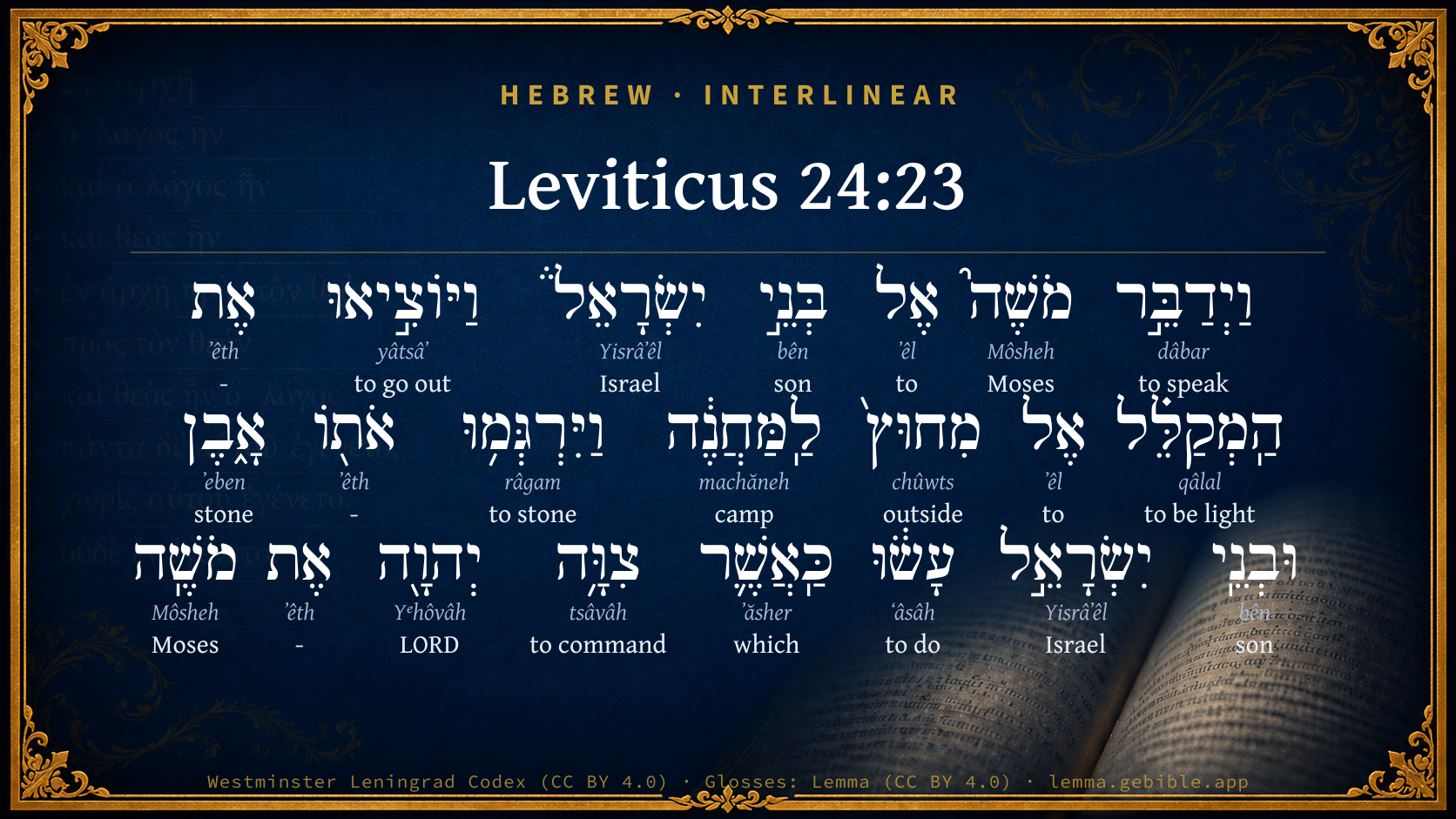
Hebrew (Westminster Leningrad Codex) Leviticus 24:23 appears in the Hebrew Old Testament. The text above is from the Westminster Leningrad Codex. Each word links to its Strong’s number, a concise gloss, and parsing drawn from the Open Scriptures Hebrew Bible morphology. Click any word for its full Brown-Driver-Briggs (BDB) entry.
Download image
Cite this verse

Leviticus 24:23 (World English Bible). Public Domain. Lemma interlinear Bible study tool, https://lemma.gebible.app/v/leviticus/24/23.

Show BibTeX & RIS
BibTeX
RIS
English Translation
Moses spoke to the children of Israel; and they brought forth him who had cursed out of the camp, and stoned him with stones. The children of Israel did as Yahweh commanded Moses.
World English Bible · Public Domain
Download a study sheet

One document with this verse’s original text, its word-by-word gloss line, the meaning frame, cross-references with their text, attributed commentary, and full source and license credits — printable, and it pastes into notes with its structure intact.

This verse Autodidact and up

Study sheet (.html) Plain text (.txt)

A passage Seminary Student

Up to 50 verses in one chapter. A passage sheet keeps up to 6 commentary sources and 12 cross-references per verse, in the order this page ranks them, and says so on the sheet whenever that leaves anything out. Ask for a single verse and you get the Autodidact verse sheet above.

Everything on this page stays free to read, with no account — the sheet is a download of what is already on screen, not access to it.

Want to remove ads? Support Godless Engineer
Compare translations 3

The same verse in 3 English versions, stacked beneath the original-language interlinear above. Click any original word for its lexicon entry.

Each is an independent rendering of the whole verse — the interlinear is not word-aligned to these translations.

Highlighted words mark where these versions differ — a whole-verse word diff, not a word-by-word alignment.

  • World English Bible Public Domain
    Moses spoke to the children of Israel; and they brought forth him who had cursed out of the camp, and stoned him with stones. The children of Israel did as Yahweh commanded Moses.
  • King James Version Public Domain
    And Moses spake to the children of Israel, that they should bring forth him that had cursed out of the camp, and stone him with stones. And the children of Israel did as the LORD commanded Moses.
  • unfoldingWord Literal Text CC BY-SA 4.0
    And Moses spoke to the sons of Israel, and they brought out the curser to outside of the camp, and they stoned him stone. And the sons of Israel did just as Yahweh commanded Moses.

unfoldingWord Literal Text — © unfoldingWord, licensed CC BY-SA 4.0. Word-aligned USFM3 via Door43 (git.door43.org/unfoldingWord/en_ult).

Versions to compare (up to 4)

3 of 4 selected

Show all 18 translations

Every available English version of this verse, each an independent rendering of the whole verse.

  • World English Bible Public Domain
    Moses spoke to the children of Israel; and they brought forth him who had cursed out of the camp, and stoned him with stones. The children of Israel did as Yahweh commanded Moses.
  • Berean Standard Bible Public Domain
    Then Moses spoke to the Israelites, and they took the blasphemer outside the camp and stoned him. So the Israelites did as the LORD had commanded Moses.
  • Majority Standard Bible Public Domain
    Then Moses spoke to the Israelites, and they took the blasphemer outside the camp and stoned him. So the Israelites did as the LORD had commanded Moses.
  • King James Version Public Domain
    And Moses spake to the children of Israel, that they should bring forth him that had cursed out of the camp, and stone him with stones. And the children of Israel did as the LORD commanded Moses.
  • American Standard Version (1901) Public Domain
    And Moses spake to the children of Israel; and they brought forth him that had cursed out of the camp, and stoned him with stones. And the children of Israel did as Jehovah commanded Moses.
  • Revised Version (1885) Public Domain
    And Moses spake to the children of Israel, and they brought forth him that had cursed out of the camp, and stoned him with stones. And the children of Israel did as the LORD commanded Moses.
  • Geneva Bible (1599) Public Domain
    Then Moses tolde the children of Israel, and they brought the blasphemer out of the hoste, and stoned him with stones: so the children of Israel did as the Lord had commanded Moses.
  • Douay-Rheims (1899) Public Domain
    And Moses spoke to the children of Israel: and they brought forth him that had blasphemed, without the camp, and they stoned him. And the children of Israel did as the Lord had commanded Moses.
  • Young's Literal Translation Public Domain
    And Moses speaketh unto the sons of Israel, and they bring out the reviler unto the outside of the camp, and stone him with stones; and the sons of Israel have done as Jehovah hath commanded Moses.
  • Literal Standard Version CC BY-SA 4.0
    And Moses speaks to the sons of Israel, and they bring out the reviler to the outside of the camp, and stone him [with] stone; and the sons of Israel have done as YHWH has commanded Moses.
  • Unlocked Literal Bible CC BY-SA 4.0
    So Moses spoke to the people of Israel, and the people brought the man outside the camp, the one who had cursed Yahweh. They stoned him with stones. The people of Israel carried out the command of Yahweh to Moses.
  • unfoldingWord Literal Text CC BY-SA 4.0
    And Moses spoke to the sons of Israel, and they brought out the curser to outside of the camp, and they stoned him stone. And the sons of Israel did just as Yahweh commanded Moses.
  • Darby Bible Public Domain
    And Moses spoke to the children of Israel; and they led the reviler outside the camp and stoned him with stones. And the children of Israel did as Jehovah had commanded Moses.
  • World Messianic Bible Public Domain
    Moses spoke to the children of Israel; and they brought him who had cursed out of the camp, and stoned him with stones. The children of Israel did as the LORD commanded Moses.
  • Webster's Bible Public Domain
    And Moses spoke to the children of Israel, that they should bring forth him that had cursed out of the camp, and stone him with stones: and the children of Israel did as the LORD commanded Moses.
  • Free Bible Version CC BY-SA 4.0
    Moses told this to the Israelites, and they took the man who cursed the Lord outside the camp and stoned him to death. The Israelites did what the Lord ordered Moses to do.
  • Bible in Basic English Public Domain
    And Moses said these words to the children of Israel, and they took the man who had been cursing outside the tent-circle and had him stoned. The children of Israel did as the Lord gave orders to Moses.
  • JPS Tanakh (1917) Public Domain
    And Moses spoke to the children of Israel, and they brought forth him that had cursed out of the camp, and stoned him with stones. And the children of Israel did as the LORD commanded Moses.

Literal Standard Version (2020), Covenant Press — licensed CC BY-SA 4.0. Text via the HelloAO Bible API (eBible.org). Unlocked Literal Bible (unfoldingWord) — licensed CC BY-SA 4.0. Text via the HelloAO Bible API (eBible.org). unfoldingWord Literal Text — © unfoldingWord, licensed CC BY-SA 4.0. Word-aligned USFM3 via Door43 (git.door43.org/unfoldingWord/en_ult). Free Bible Version, Dr. Jonathan Gallagher — licensed CC BY-SA 4.0. Text via the HelloAO Bible API (eBible.org).

Word by word

More ways to search: Search by grammar → Find every occurrence → Compare this word →

Practice this passage: Drill this verse → Learn its vocabulary →

וַיִּרְגְּמ֥וּ
râgam
H7275
“and · to stone”
Conjunction + Verb, Qal, Sequential Imperfect, 3rd Person, Masculine, Plural
Part of Speech
Conjunction + Verb
Stem
Qal
Form
Sequential Imperfect
Person
3rd Person
Gender
Masculine
Number
Plural
Full BDB Definition

Origin: a primitive root [compare H7263 , H7321 , H7551 ]

TWOT: 2114

to stone, slay or kill by stoning - (Qal) to stone
  1. וַיְדַבֵּ֣ר dâbar H1696 “and · to speak” Conjunction + Verb, Piel, Sequential Imperfect, 3rd Person, Masculine, Singular
  2. מֹשֶׁה֮ Môsheh H4872 “Moses” Noun, Proper
  3. אֶל ʼêl H413 “to” Preposition
  4. בְּנֵ֣י bên H1121 “sons of” Noun, Common, Masculine, Plural, Construct
  5. יִשְׂרָאֵל֒ Yisrâʼêl H3478 “Israel” Noun, Proper
  6. וַיּוֹצִ֣יאוּ yâtsâʼ H3318 “and · to go out” Conjunction + Verb, Hiphil, Sequential Imperfect, 3rd Person, Masculine, Plural
  7. אֶת ʼêth H853 “-” Particle, Direct Object
  8. הַֽמְקַלֵּ֗ל qâlal H7043 “the · being light” Particle, Definite Article + Verb, Piel, Participle Active, Masculine, Singular, Absolute
  9. אֶל ʼêl H413 “to” Preposition
  10. מִחוּץ֙ chûwts H2351 “from · outside” Preposition + Noun, Common, Masculine, Singular, Absolute
  11. לַֽמַּחֲנֶ֔ה machăneh H4264 “to/for the · camp” Preposition, Determined + Noun, Common, Both, Singular, Absolute
  12. אֹת֖וֹ ʼêth H853 “- · him” Particle, Direct Object + Suffix, Personal, 3rd Person, Masculine, Singular
  13. אָ֑בֶן ʼeben H68 “stone” Noun, Common, Feminine, Singular, Absolute
  14. וּבְנֵֽי bên H1121 “and · sons of” Conjunction + Noun, Common, Masculine, Plural, Construct
  15. יִשְׂרָאֵ֣ל Yisrâʼêl H3478 “Israel” Noun, Proper
  16. עָשׂ֔וּ ʻâsâh H6213 “to do” Verb, Qal, Perfect, 3rd Person, Common, Plural
  17. כַּֽאֲשֶׁ֛ר ʼăsher H834 “like/as · which” Preposition + Particle, Relative
  18. צִוָּ֥ה tsâvâh H6680 “to command” Verb, Piel, Perfect, 3rd Person, Masculine, Singular
  19. יְהוָ֖ה Yᵉhôvâh H3068 “LORD” Noun, Proper
  20. אֶת ʼêth H853 “-” Particle, Direct Object
  21. מֹשֶֽׁה Môsheh H4872 “Moses” Noun, Proper

About this verse

These counts appear in no published source. They are computed here, from the morphology-tagged text and Lemma’s own curated glosses. What Lemma adds →

22
words
16
distinct lemmas
Pentateuch
section

Notable vocabulary

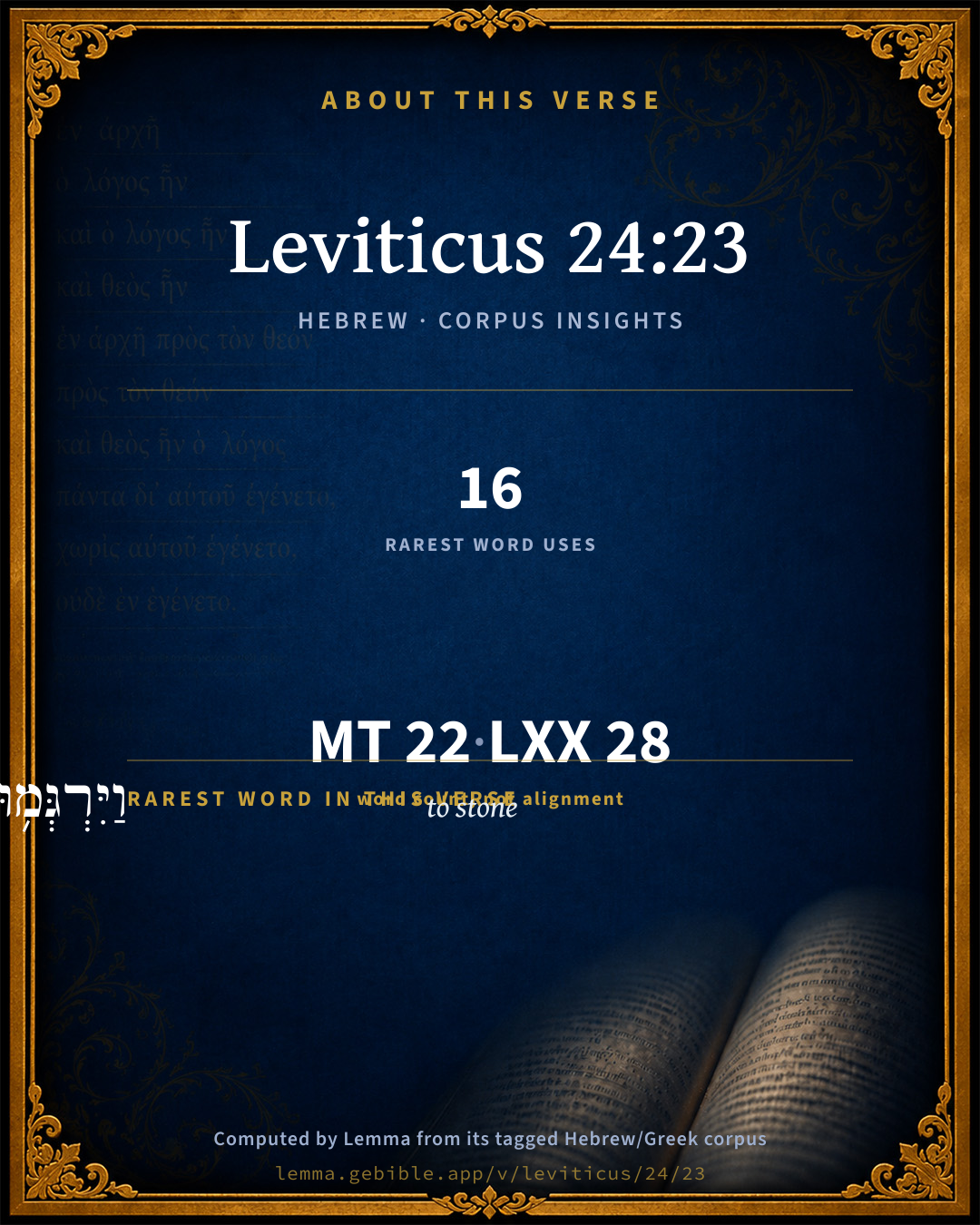
The rarest word here is וַיִּרְגְּמ֥וּ to stone H7275 — appearing just 16 times in the whole Hebrew Bible.

Shared distinctive vocabulary

וַיִּרְגְּמ֥וּ to stone H7275 occurs in 15 verses of the Hebrew Bible. Also found in:

Grammatical profile

  • 6 verbs
  • 10 nouns
  • 2 prepositions
  • 4 particles

Verb forms

  • וַיְדַבֵּ֣ר Piel · Sequential Imperfect
  • וַיּוֹצִ֣יאוּ Hiphil · Sequential Imperfect
  • הַֽמְקַלֵּ֗ל Piel · Participle Active
  • וַיִּרְגְּמ֥וּ Qal · Sequential Imperfect
  • עָשׂ֔וּ Qal · Perfect
  • צִוָּ֥ה Piel · Perfect

Repetition

Words recur within this verse — often emphatic in Hebrew:

  • מֹשֶׁה֮ Moses H4872 ×2
  • בְּנֵ֣י son H1121 ×2
  • יִשְׂרָאֵל֒ Israel H3478 ×2
  • אֶל to H413 ×2

Hebrew & Septuagint length

In English translation the verse runs 33 words from the Hebrew and 35 from the Septuagint (LXX English) — closely comparable.

A rough comparison of the two English renderings, which tokenize alike — not a word-level alignment.

Word counts can differ between the Hebrew and the Greek without any difference in meaning — e.g. the Hebrew direct-object marker אֵת has no separate Greek word, and Greek often adds the article ὁ.

In the original languages it is 22 Hebrew tokens and 28 Greek tokens — but the two are counted differently (Hebrew bundles its prefixes and suffixes into one token; the Greek is in lemma form), so that isn’t a like-for-like length.

Cross-references

4

Topical passages linked to Leviticus 24:23 in the Treasury of Scripture Knowledge — connected by theme and wording, ordered by reader-vote popularity; previews shown in the World English Bible.

  • Leviticus 24:14–16 "Bring out of the camp him who cursed; and let all who heard him lay their hands on his head, and let all the congregation stone him.
  • Numbers 15:35–36 Yahweh said to Moses, The man shall surely be put to death: all the congregation shall stone him with stones outside of the camp.
  • Hebrews 2:2–3 For if the word spoken through angels proved steadfast, and every transgression and disobedience received a just recompense;
  • Hebrews 10:28–29 A man who disregards Moses' law dies without compassion on the word of two or three witnesses.

Cross-references courtesy of OpenBible.info (CC BY 4.0).

Hebrew and Greek witnesses Masoretic Hebrew ↔ Greek Septuagint

The same verse in the two great witnesses to the Old Testament, shown verse-for-verse.

These are two independent witnesses, not word-aligned to each other, and the Septuagint is shown in lemma (dictionary) form.

Hebrew Leviticus 24:23 Masoretic · Westminster Leningrad Codex

וַיְדַבֵּ֣ר מֹשֶׁה֮ אֶל בְּנֵ֣י יִשְׂרָאֵל֒ וַיּוֹצִ֣יאוּ אֶת הַֽמְקַלֵּ֗ל אֶל מִחוּץ֙ לַֽמַּחֲנֶ֔ה וַיִּרְגְּמ֥וּ אֹת֖וֹ אָ֑בֶן וּבְנֵֽי יִשְׂרָאֵ֣ל עָשׂ֔וּ כַּֽאֲשֶׁ֛ר צִוָּ֥ה יְהוָ֖ה אֶת מֹשֶֽׁה

Moses spoke to the children of Israel; and they brought forth him who had cursed out of the camp, and stoned him with stones. The children of Israel did as Yahweh commanded Moses.

World English Bible · Public Domain

Greek LXX Leviticus 24:23 Septuagint · lemma form

καί λαλέω μωυσῆς ὁ υἱός ἰσραήλ καί ἐκἄγω ὁ καταἀράομαι ἔξω ὁ παρεμβολή καί λιθοβολέω αὐτός ἐν λίθος καί ὁ υἱός ἰσραήλ ποιέω καθά συντάσσω κύριος ὁ μωυσῆς

And Moses spoke to the children of Israel, and they brought him that had cursed out of the camp, and stoned him with stones: and the children of Israel did as the Lord commanded Moses.

LXX2012 (modern English Septuagint) · Public Domain

Hebrew: Westminster Leningrad Codex (CC BY 4.0). Greek: Septuagint (public domain); English from LXX2012 (modern English Septuagint) (Public Domain). How the Septuagint differs from the Hebrew →

Targum (Aramaic paraphrase)

2

The Targum is the ancient Jewish Aramaic paraphrase of the Hebrew Scriptures — an interpretive translation, not the Hebrew text itself. Onkelos (literal) and Pseudo-Jonathan (expansive) render the Torah, and Jonathan the Prophets. Coverage is partial: where no permissively-licensed English translation exists for a verse, only the Aramaic is shown. This is verse-level text, not a word-by-word alignment to the Hebrew.

  1. Targum Onkelos Torah (Genesis–Deuteronomy)
    וּמַלִיל מֹשֶׁה עִם בְּנֵי יִשְׂרָאֵל וְאַפִּיקוּ יָת דְאַרְגֵז לְמִבָּרָא לְמַשְׁרִיתָא וּרְגָמוּ יָתֵהּ אַבְנָא וּבְנֵי יִשְׂרָאֵל עֲבָדוּ כְּמָא דִי פַּקֵיד יְיָ יָת מֹשֶׁה

    (no public-domain English translation for this verse)

    Targum Onkelos — Aramaic: “Onkelos Genesis” (public domain); “Onkelos Exodus” (public domain); “Onkelos Leviticus” (public domain); “Onkelos Numbers” (public domain); “Onkelos Deuteronomy” (public domain). English: “Sefaria Community Translation” (CC0 1.0 (public-domain dedication)); “J.W. Etheridge. The Targums of Onkelos and Jonathan Ben Uzziel on the Pentateuch. London: Longmans, Green, 1862” (public domain). Text via Sefaria.

  2. Targum Pseudo-Jonathan Torah (Genesis–Deuteronomy)
    וּמַלֵיל משֶׁה עִם בְּנֵי יִשְרָאֵל וְאַפִּיקוּ יַת מַרְגְזָא לְמִבָּרָא לְמַשְׁרִיתָא וְאַטְלוּ יָתֵיהּ אַבְנִין וּבְנֵי יִשְרָאֵל עָבָדוּ לְמִסְמַךְ יְדֵיהוֹן וּלְמִדְחַף וּלְמִצְלַב וּלְמִקְבּוֹר הֵיכְמָא דְפַקֵיד יְיָ יַת משֶׁה

    And Mosheh spake with the sons of Israel, and they brought forth the blasphemer without the camp, and stoned him with stones; and the sons of Israel did it, by laying their hands upon, leading him away hanging, and burying him, as the Lord had commanded Mosheh.

    Targum Pseudo-Jonathan — Aramaic: “Targum Jonathan on Genesis” (public domain); “Targum Jonathan on Exodus” (public domain); “Targum Jonathan on Leviticus” (public domain); “Targum Jonathan on Numbers” (public domain); “Targum Jonathan on Deuteronomy” (public domain). English: “The Targum of Jonathan ben Uzziel, trans. J. W. Etheridge, London, 1862” (public domain). Text via Sefaria.

Commentary

Notes on Leviticus 24:23 from classic Christian and Jewish commentators (each source and its license shown beneath its notes). The classic Christian expositions comment on the surrounding passage and are grouped to its opening verse, so a note may address several verses; the Jewish commentaries on the Tanakh (Rashi and others) are per-verse, so they appear only where the commentator wrote on this verse.

Lemma curates 59 commentaries, every one of them public domain or Creative Commons licensed, each selected and text-cleaned for this edition rather than reprinted as found. About our sources →

Geneva Bible (1599)

Geneva Bible translators

Because the punishment was not yet appointed by the law for the blasphemer, Moses consulted with the Lord, and told the people what God commanded.

Geneva Bible (1599) marginal notes — public domain. Text via Bolls.life.

Jamieson, Fausset & Brown

Robert Jamieson, A. R. Fausset & David Brown

the children of Israel did as the Lord's commanded--The chapter closes with the execution of Shelomith's son [Lev 24:14] --and stoning having afterwards become the established punishment in all cases of blasphemy, it illustrates the fate of Stephen, who suffered under a false imputation of that crime [Act 7:58-59].

Next: Leviticus Chapter 25

Jamieson, Fausset & Brown — Commentary Critical and Explanatory on the Whole Bible (1871) — public domain (CC PDM 1.0). Text via the HelloAO Bible API.

Adam Clarke's Commentary

Verse 23. And stone him with stones.] We are not to suppose that the culprit was exposed to the unbridled fury of the thousands of Israel; this would be brutality, not justice, for the very worst of tempers and passions might be produced and fostered by such a procedure. The Jews themselves tell us that their manner of stoning was this: they brought the condemned person without the camp, because his crime had rendered him unclean, and whatever was unclean must be put without the camp. When they came within four cubits of the place of execution, they stripped the criminal, if a man, leaving him nothing but a cloth about the waist. The place on which he was to be executed was elevated, and the witnesses went up with him to it, and laid their hands upon him, for the purposes mentioned Le 24:14. Then one of the witnesses struck him with a stone upon the loins; if he was not killed with that blow, then the witnesses took up a great stone, as much as two men could lift, and threw it upon his breast. This was the coup de grace, and finished the tragedy. When a man was stoned by the mob, then brutal rage armed every man, justice was set aside, and the will and fury of the people were law, judge, jury, and executioner. Such disgraceful stonings as these were, no doubt, frequent among the Jews. See Calmet's Dict., article STONING, and Ainsworth on this place.

WHAT the crime of Shelomith's son was, we cannot distinctly say; doubtless it was some species of blasphemy: however, we find it was a new and unprecedented case; and as there was no law by which the quantum of guilt could be ascertained, nor consequently the degree of punishment, it was necessary to consult the great Lawgiver on the occasion; the man was therefore secured till the mind of the Lord should be known. Moses, no doubt, had recourse to the tabernacle, and received the directions afterward mentioned from Him who dwelt between the cherubim. In what way the answer of the Lord was communicated we know not, (probably by Urim and Thummim,) but it came in such a manner as to preclude all doubt upon the subject: the man was declared to be guilty, and was sentenced to be stoned to death; and on this occasion a law is made relative to blasphemy in general. However sinful the Jews might have been at this time, we have reason to believe they did not take the name of the Lord in vain, and blasphemy was not known among them. But what shall we say of Christians, so called, whose mouths are full of cursing and bitterness? Were every blasphemer among us to be stoned to death, how many of the people would fall in every corner of the land! God is longsuffering; may this lead them to repentance! We have excellent laws against all profaneness, but, alas, for our country! they are not enforced; and he who attempts to put the laws in force against profane swearers, Sabbath breakers, &c., is considered a litigious man, and a disturber of the peace of society. Will not God visit for these things? This is not only contempt of God's holy word and commandments, but rebellion against the laws.

Adam Clarke's Commentary on the Bible (1810–1826) — public domain. Text from a community e-Sword/MySword module.

Ellicott's Commentary for English Readers

(23) And Moses spake to the children of Israel.—Having recited the laws which were promulgated in consequence of the appeal made to God, Moses now calls upon the people to execute the sentence which the Lord pronounced against the blasphemer.

A Bible Commentary for English Readers, edited by Charles John Ellicott (1878–1897) — public domain. Text from a community e-Sword module.

The Pulpit Commentary

The penalty is inflicted on the offender solemnly as an act of the Law, not of mob fury. So it was by a judicial or semi-judicial proceeding that St. Stephen was stoned: "They brought him to the council, and set up false witnesses, which said, This man ceaseth not to speak blasphemous words against this holy place, and the Law". (Act_6:12, Act_6:13) And in spite of the violence exhibited, there was still some form of law, according to Jewish practice, observed in his stoning. (Act_7:58) In the case of our Lord, on the other hand. when they regarded him as guilty of blasphemy on his saying, "Before Abraham was, I am", (Joh_8:58) and "I and my Father are one", (Joh_10:30) the Jews "took up stones to cast at him," not waiting for a judicial condemnation, but, as they supposed, taking the law into their own hands. Had his death been by Jewish hands, it would at the last have been by stoning under this law. But the power of life and death had been taken away from the Jews by the Romans, "that the saying of Jesus might be fulfilled, which he spake, signifying what death he should die". (Joh_18:32)

The Pulpit Commentary (1880–1919), ed. H.D.M. Spence-Jones & Joseph S. Exell — public domain. Text from a community e-Sword module.

John Wesley's Explanatory Notes

Stone him with stones - This blasphemer was the first that died by the law of Moses. Stephen the first that died for the gospel, died by the abuse of the law. The martyr and the malefactor suffered the same death; but how vast the difference between them.

John Wesley, Explanatory Notes Upon the Whole Bible (1754–1765) — public domain. Text via the GEBible commentary corpus.

Keil & Delitzsch

C. F. Keil & F. Delitzsch

After these laws had been issued, the punishment was inflicted upon the blasphemer.

Keil & Delitzsch — Biblical Commentary on the Old Testament (1861–1891) — public domain (CC PDM 1.0). Text via the HelloAO Bible API. (Old Testament only.)

Rashi

Rabbi Shlomo Yitzchaki (Rashi)

ובני ישראל עשו AND THE CHILDREN OF ISRAEL DID [AS THE LORD COMMANDED MOSES] every prescription mentioned in respect to the stoning-penalty in another place, viz., the casting down of the culprit from a height, the heaping of stones upon him, and the hanging him after the execution has taken place (cf. Sifra, Emor, Chapter 19 10; Sanhedrin 43a).

Rashi on the Tanakh — English translations: “The Judaica Press complete Tanach with Rashi, translated by A. J. Rosenberg” (CC BY 4.0); “Pentateuch with Rashi's commentary by M. Rosenbaum and A.M. Silbermann, 1929-1934” (public domain); “The Metsudah Tanach series, Lakewood, N.J” (CC BY 4.0); and “The Book of Joshua, Metsudah Publications, 1997” (CC BY 4.0). Text via Sefaria.

Ramban (Nachmanides)

Rabbi Moshe ben Nachman (Ramban / Nachmanides)

AND THE CHILDREN OF ISRAEL DID AS THE ETERNAL COMMANDED MOSES. “This includes the leaning of hands, casting from a height, and hanging the dead body, as well as the regulation, his body shall not remain all night upon the tree.” [This is the language of the] Torath Kohanim.. And Rabbi Abraham ibn Ezra wrote that the plain meaning thereof is that from that day onwards they acted in accordance with the law concerning one who wounds [a fellowman or causes him damage, mentioned here above in Verses 17-21]. But it is not a correct [explanation] that this verse be referring to the future. The plain meaning thereof is as follows: “and they stoned him with stones because the children of Israel did according to the commandment which the Eternal commanded Moses.” Such a repetition of expressions is found with respect to all those who keep the commandments of G-d, just as it is said in the section of the Passover, and as He stated in the section of the census, Thus did the children of Israel; according to all that the Eternal commanded Moses, so did they; and so also with regards to the rods of the princes: Thus did Moses; as the Eternal commanded him, so did he., 17:26.The correct interpretation here appears to me to be that since Scripture mentioned first the stoning, it went back afterwards and stated, and the children of Israel did etc., for the meaning of Scripture is to declare that when Moses spoke to the children of Israel they immediately brought forth him that had cursed, and they stoned him; and all the children of Israel did so in order to keep and fulfill [the commandment] as the Eternal commanded Moses, but not out of hatred to the son of the Egyptian who had striven with the Israelite, for [they did it] in order to remove the unworthy one from their midst.Behar

Ramban (Nachmanides) on the Tanakh — English translation: “Commentary on the Torah by Ramban (Nachmanides). Translated and annotated by Charles B. Chavel. New York, Shilo Pub. House, 1971-1976” (CC BY 4.0). Text via Sefaria.

Lesson kit

Teaching starters — assembled from the data on this page, not authored interpretation. Every prompt links to the verse data it draws on. Edit before teaching.

Leviticus, in the Pentateuch, opens this verse with 22 words (16 distinct Hebrew lemmas). Its most distinctive word is râgam (“to stone”). A historical commentator’s framing appears above. Read the whole chapter for the surrounding context.

Discussion questions

  1. How does “to stone” (râgam) shape what this verse is saying?
  2. How does Leviticus 20:2, which shares the word «to stone», read alongside this verse?
  3. What does the repetition of “Moses” (2× in this one verse) do in this verse?
  4. These translations render this verse differently. What is at stake in choosing one wording over another?
  5. «וַיְדַבֵּ֣ר» is a Piel Sequential Imperfect verb. How does that grammatical form shape the action described?
  6. Compare how Geneva Bible (1599) and Jamieson, Fausset & Brown read this verse. Where do they agree or differ?

Things to notice

Reading settings

Reading text

Shown beneath each verse's original-language words.

Old Testament
Old Testament edition

Read the OT as the Masoretic Hebrew (MT) or the Greek Septuagint (LXX).

English shown for the Greek Septuagint (in the Hebrew ↔ Greek comparison).

Comparing translations? Open the Compare panel on any verse page to stack up to four side by side.