Leviticus 14:40

Hebrew (Westminster Leningrad Codex) Leviticus 14:40 appears in the Hebrew Old Testament. The text above is from the Westminster Leningrad Codex. Each word links to its Strong’s number, a concise gloss, and parsing drawn from the Open Scriptures Hebrew Bible morphology. Click any word for its full Brown-Driver-Briggs (BDB) entry.
Download image
Cite this verse

Leviticus 14:40 (World English Bible). Public Domain. Lemma interlinear Bible study tool, https://lemma.gebible.app/v/leviticus/14/40.

Show BibTeX & RIS
BibTeX
RIS
English Translation
then the priest shall command that they take out the stones in which is the plague, and cast them into an unclean place outside of the city:
World English Bible · Public Domain
Highlights
  • 1 first appearance in the Hebrew Bible
Full analysis ↓
Download a study sheet

One document with this verse’s original text, its word-by-word gloss line, the meaning frame, cross-references with their text, attributed commentary, and full source and license credits — printable, and it pastes into notes with its structure intact.

This verse Autodidact and up

Study sheet (.html) Plain text (.txt)

A passage Seminary Student

Up to 50 verses in one chapter. A passage sheet keeps up to 6 commentary sources and 12 cross-references per verse, in the order this page ranks them, and says so on the sheet whenever that leaves anything out. Ask for a single verse and you get the Autodidact verse sheet above.

Everything on this page stays free to read, with no account — the sheet is a download of what is already on screen, not access to it.

Want to remove ads? Support Godless Engineer
Compare translations 3

The same verse in 3 English versions, stacked beneath the original-language interlinear above. Click any original word for its lexicon entry.

Each is an independent rendering of the whole verse — the interlinear is not word-aligned to these translations.

Highlighted words mark where these versions differ — a whole-verse word diff, not a word-by-word alignment.

  • World English Bible Public Domain
    then the priest shall command that they take out the stones in which is the plague, and cast them into an unclean place outside of the city:
  • King James Version Public Domain
    Then the priest shall command that they take away the stones in which the plague is, and they shall cast them into an unclean place without the city:
  • unfoldingWord Literal Text CC BY-SA 4.0
    And the priest shall command, and they shall pull out the stones that the infection on them, and they shall cast them to on the outside of the city, to an unclean place.

unfoldingWord Literal Text — © unfoldingWord, licensed CC BY-SA 4.0. Word-aligned USFM3 via Door43 (git.door43.org/unfoldingWord/en_ult).

Versions to compare (up to 4)

3 of 4 selected

Show all 18 translations

Every available English version of this verse, each an independent rendering of the whole verse.

  • World English Bible Public Domain
    then the priest shall command that they take out the stones in which is the plague, and cast them into an unclean place outside of the city:
  • Berean Standard Bible Public Domain
    he must order that the contaminated stones be pulled out and thrown into an unclean place outside the city.
  • Majority Standard Bible Public Domain
    he must order that the contaminated stones be pulled out and thrown into an unclean place outside the city.
  • King James Version Public Domain
    Then the priest shall command that they take away the stones in which the plague is, and they shall cast them into an unclean place without the city:
  • American Standard Version (1901) Public Domain
    then the priest shall command that they take out the stones in which the plague is, and cast them into an unclean place without the city:
  • Revised Version (1885) Public Domain
    then the priest shall command that they take out the stones in which the plague is, and cast them into an unclean place without the city:
  • Geneva Bible (1599) Public Domain
    Then the Priest shall commande them to take away the stones wherein the plague is, and they shall cast them into a foule place without the citie.
  • Douay-Rheims (1899) Public Domain
    He shall command, that the stones wherein the leprosy is, be taken out, and cast without the city into an unclean place:
  • Young's Literal Translation Public Domain
    and the priest hath commanded, and they have drawn out the stones in which the plague `is', and have cast them unto the outside of the city, unto an unclean place;
  • Literal Standard Version CC BY-SA 4.0
    and the priest has commanded, and they have drawn out the stones in which the plague [is], and have cast them to the outside of the city, to an unclean place;
  • Unlocked Literal Bible CC BY-SA 4.0
    If it has, then the priest will command that they take out the stones in which the mildew has been found and throw them into an unclean place outside the city.
  • unfoldingWord Literal Text CC BY-SA 4.0
    And the priest shall command, and they shall pull out the stones that the infection on them, and they shall cast them to on the outside of the city, to an unclean place.
  • Darby Bible Public Domain
    then the priest shall command that they take away the stones in which the plague is, and they shall cast them out of the city, in an unclean place.
  • World Messianic Bible Public Domain
    then the priest shall command that they take out the stones in which is the plague, and cast them into an unclean place outside of the city.
  • Webster's Bible Public Domain
    Then the priest shall command that they take away the stones in which the plague is, and they shall cast them into an unclean place without the city:
  • Free Bible Version CC BY-SA 4.0
    he will order the affected stones to be removed and disposed of in an unclean area outside the town.
  • Bible in Basic English Public Domain
    Then the priest will give orders to them to take out the stones in which the disease is seen, and put them out into an unclean place outside the town:
  • JPS Tanakh (1917) Public Domain
    then the priest shall command that they take out the stones in which the plague is, and cast them into an unclean place without the city.

Literal Standard Version (2020), Covenant Press — licensed CC BY-SA 4.0. Text via the HelloAO Bible API (eBible.org). Unlocked Literal Bible (unfoldingWord) — licensed CC BY-SA 4.0. Text via the HelloAO Bible API (eBible.org). unfoldingWord Literal Text — © unfoldingWord, licensed CC BY-SA 4.0. Word-aligned USFM3 via Door43 (git.door43.org/unfoldingWord/en_ult). Free Bible Version, Dr. Jonathan Gallagher — licensed CC BY-SA 4.0. Text via the HelloAO Bible API (eBible.org).

Word by word

More ways to search: Search by grammar → Find every occurrence → Compare this word →

Practice this passage: Drill this verse → Learn its vocabulary →

וְחִלְּצוּ֙
châlats
H2502
“and · to arm”
Conjunction + Verb, Piel, Sequential Perfect, 3rd Person, Common, Plural
Part of Speech
Conjunction + Verb
Stem
Piel
Form
Sequential Perfect
Person
3rd Person
Gender
Common
Number
Plural
Full BDB Definition

Origin: a primitive root

TWOT: 667 , 668

to remove, draw out, draw off, take off, withdraw, equip (for war), arm for war, rescue, be rescued - (Qal) equipped (participle) - (Niphal) - to be equipped - to go equipped - to be armed - (Hiphil) - to make strong, brace up - to invigorate - to draw off or out, withdraw - (Qal) - to draw, draw off - to withdraw - (Niphal) - to be delivered - to be saved - (Piel) - to pull out, tear out - to rescue, deliver, set free - to take away, plunder
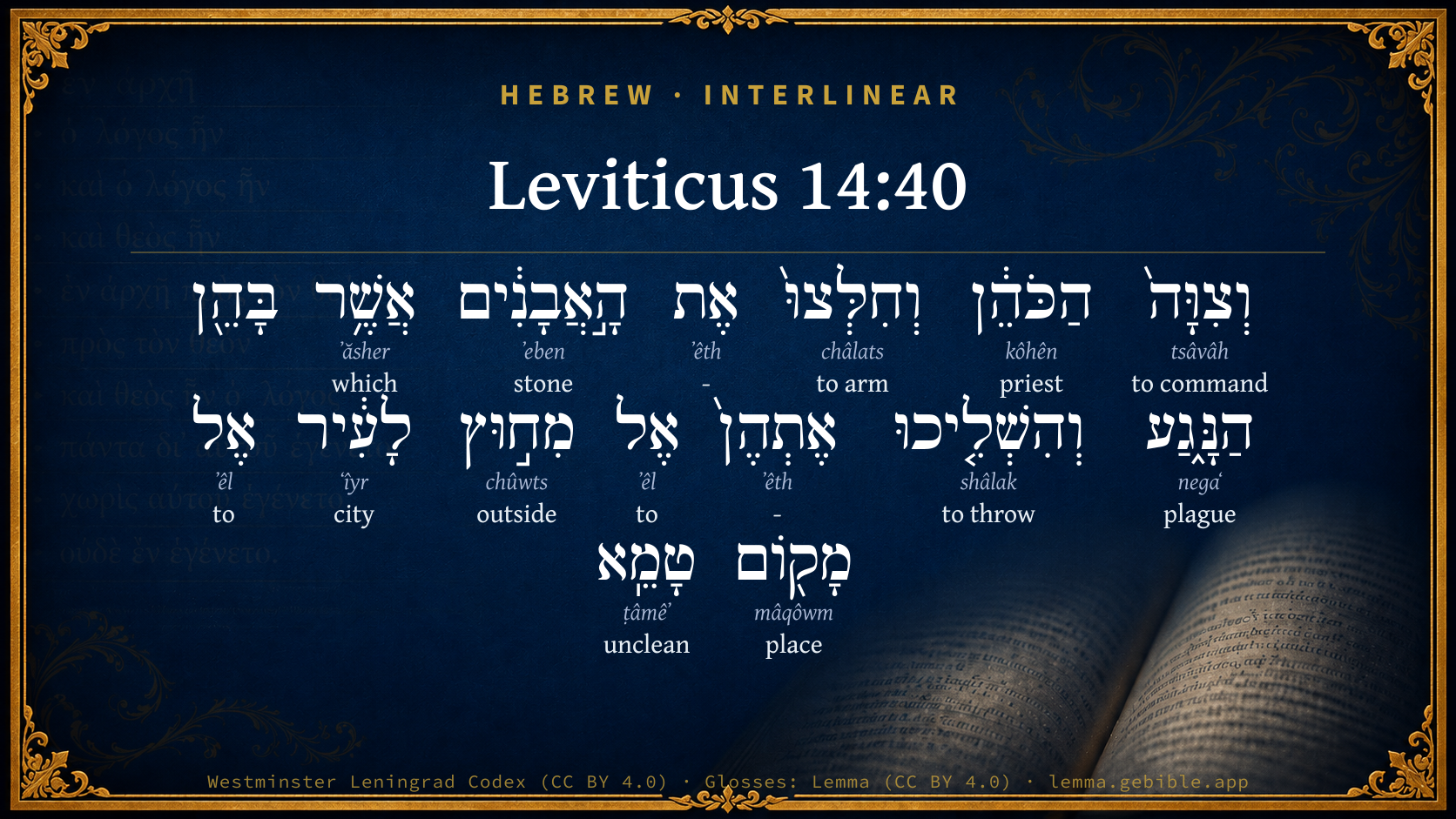
  1. וְצִוָּה֙ tsâvâh H6680 “and · to command” Conjunction + Verb, Piel, Sequential Perfect, 3rd Person, Masculine, Singular
  2. הַכֹּהֵ֔ן kôhên H3548 “the · priest” Particle, Definite Article + Noun, Common, Masculine, Singular, Absolute
  3. אֶת ʼêth H853 “-” Particle, Direct Object
  4. הָ֣אֲבָנִ֔ים ʼeben H68 “the · stones” Particle, Definite Article + Noun, Common, Feminine, Plural, Absolute
  5. אֲשֶׁ֥ר ʼăsher H834 “which” Particle, Relative
  6. הַנָּ֑גַע negaʻ H5061 “the · plague” Particle, Definite Article + Noun, Common, Masculine, Singular, Absolute
  7. וְהִשְׁלִ֤יכוּ shâlak H7993 “and · to throw” Conjunction + Verb, Hiphil, Sequential Perfect, 3rd Person, Common, Plural
  8. אֶתְהֶן֙ ʼêth H853 “- · them” Particle, Direct Object + Suffix, Personal, 3rd Person, Feminine, Plural
  9. אֶל ʼêl H413 “to” Preposition
  10. מִח֣וּץ chûwts H2351 “from · outside” Preposition + Noun, Common, Masculine, Singular, Absolute
  11. לָעִ֔יר ʻîyr H5892 “to/for the · city” Preposition, Determined + Noun, Common, Feminine, Singular, Absolute
  12. אֶל ʼêl H413 “to” Preposition
  13. מָק֖וֹם mâqôwm H4725 “place” Noun, Common, Masculine, Singular, Absolute
  14. טָמֵֽא ṭâmêʼ H2931 “unclean” Adjective, Adjective, Masculine, Singular, Absolute

About this verse

These counts appear in no published source. They are computed here, from the morphology-tagged text and Lemma’s own curated glosses. What Lemma adds →

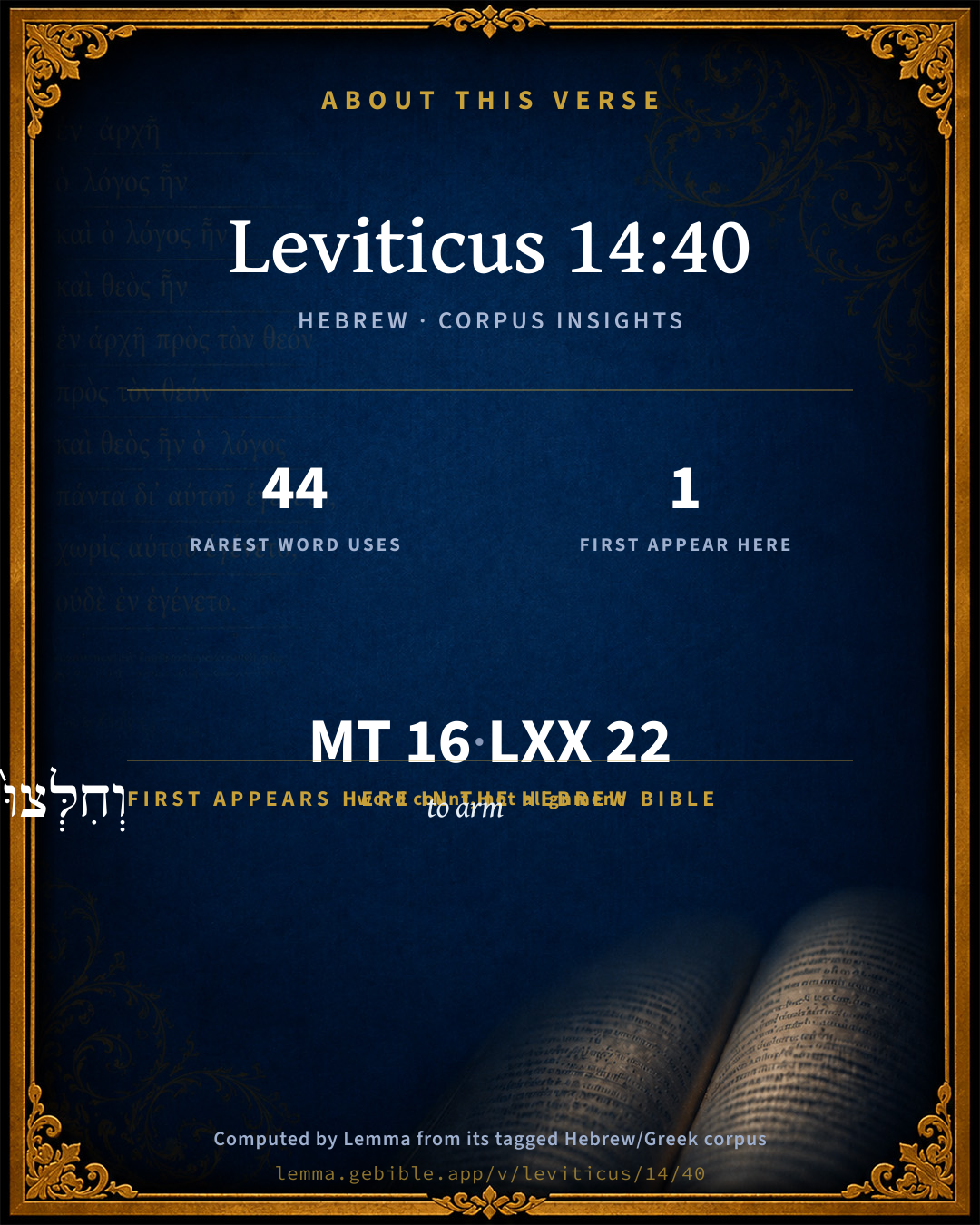
16
words
13
distinct lemmas
Pentateuch
section

First appearance in Scripture

This word makes its first canonical appearance in the Hebrew Bible here:

  • וְחִלְּצוּ֙ to arm H2502

Shared distinctive vocabulary

וְחִלְּצוּ֙ to arm H2502 occurs in 44 verses of the Hebrew Bible. Also found in:

Grammatical profile

  • 3 verbs
  • 6 nouns
  • 1 adjective
  • 3 prepositions
  • 3 particles

Verb forms

  • וְצִוָּה֙ Piel · Sequential Perfect
  • וְחִלְּצוּ֙ Piel · Sequential Perfect
  • וְהִשְׁלִ֤יכוּ Hiphil · Sequential Perfect

Repetition

A word recurs within this verse — often emphatic in Hebrew:

  • אֶל to H413 ×2

Hebrew & Septuagint length

In English translation the verse runs 27 words from the Hebrew and 30 from the Septuagint (LXX English) — closely comparable.

A rough comparison of the two English renderings, which tokenize alike — not a word-level alignment.

Word counts can differ between the Hebrew and the Greek without any difference in meaning — e.g. the Hebrew direct-object marker אֵת has no separate Greek word, and Greek often adds the article ὁ.

In the original languages it is 16 Hebrew tokens and 22 Greek tokens — but the two are counted differently (Hebrew bundles its prefixes and suffixes into one token; the Greek is in lemma form), so that isn’t a like-for-like length.

Cross-references

16

Topical passages linked to Leviticus 14:40 in the Treasury of Scripture Knowledge — connected by theme and wording, ordered by reader-vote popularity; previews shown in the World English Bible.

  • Psalms 101:5 I will silence whoever secretly slanders his neighbor. I won't tolerate one who is haughty and conceited.
  • Psalms 101:7–8 He who practices deceit won't dwell within my house. He who speaks falsehood won't be established before my eyes.
  • Proverbs 22:10 Drive out the mocker, and strife will go out; Yes, quarrels and insults will stop.
  • Proverbs 25:4–5 Take away the dross from the silver, And material comes out for the refiner;
  • Isaiah 1:25–26 And I will turn my hand on you, Thoroughly purge away your dross, And will take away all your tin.
  • Matthew 18:17 If he refuses to listen to them, tell it to the assembly. If he refuses to hear the assembly also, let him be to you as a Gentile or a tax collector.
  • John 15:2 Every branch in me that doesn't bear fruit, he takes away. Every branch that bears fruit, he prunes, that it may bear more fruit.
  • 1 Corinthians 5:5–6 are to deliver such a one to Satan for the destruction of the flesh, that the spirit may be saved in the day of the Lord Jesus.
  • 1 Corinthians 5:13 But those who are outside, God judges. "Put away the wicked man from among yourselves."
  • Titus 3:10 Avoid a factious man after a first and second warning;
  • 2 John 1:10–11 If anyone comes to you, and doesn't bring this teaching, don't receive him into your house, and don't welcome him,
  • Revelation 2:2 "I know your works, and your toil and perseverance, and that you can't tolerate evil men, and have tested those who call themselves apostles, and they are not, and found them false.
  • Revelation 2:6 But this you have, that you hate the works of the Nicolaitans, which I also hate.
  • Revelation 2:14–16 But I have a few things against you, because you have there some who hold the teaching of Balaam, who taught Balak to throw a stumbling block before the children of Israel, to eat things sacrificed to idols, and to commit sexual immorality.
  • Revelation 2:20 But I have this against you, that you tolerate your woman, Jezebel, who calls herself a prophetess. She teaches and seduces my servants to commit sexual immorality, and to eat things sacrificed to idols.
  • Revelation 22:15 Outside are the dogs, the sorcerers, the sexually immoral, the murderers, the idolaters, and everyone who loves and practices falsehood.

Cross-references courtesy of OpenBible.info (CC BY 4.0).

Hebrew and Greek witnesses Masoretic Hebrew ↔ Greek Septuagint

The same verse in the two great witnesses to the Old Testament, shown verse-for-verse.

These are two independent witnesses, not word-aligned to each other, and the Septuagint is shown in lemma (dictionary) form.

Hebrew Leviticus 14:40 Masoretic · Westminster Leningrad Codex

וְצִוָּה֙ הַכֹּהֵ֔ן וְחִלְּצוּ֙ אֶת הָ֣אֲבָנִ֔ים אֲשֶׁ֥ר בָּהֵ֖ן הַנָּ֑גַע וְהִשְׁלִ֤יכוּ אֶתְהֶן֙ אֶל מִח֣וּץ לָעִ֔יר אֶל מָק֖וֹם טָמֵֽא

then the priest shall command that they take out the stones in which is the plague, and cast them into an unclean place outside of the city:

World English Bible · Public Domain

Greek LXX Leviticus 14:40 Septuagint · lemma form

καί προςτάσσω ὁ ἱερεύς καί ἐκαἱρέω ὁ λίθος ἐν ὅς εἰμί ὁ ἁφή καί ἐκβάλλω αὐτός ἔξω ὁ πόλις εἰς τόπος ἀκάθαρτος

then the priest shall give orders, and they shall take away the stones in which the plague is, and shall cast them out of the city into an unclean place.

LXX2012 (modern English Septuagint) · Public Domain

Hebrew: Westminster Leningrad Codex (CC BY 4.0). Greek: Septuagint (public domain); English from LXX2012 (modern English Septuagint) (Public Domain). How the Septuagint differs from the Hebrew →

Targum (Aramaic paraphrase)

2

The Targum is the ancient Jewish Aramaic paraphrase of the Hebrew Scriptures — an interpretive translation, not the Hebrew text itself. Onkelos (literal) and Pseudo-Jonathan (expansive) render the Torah, and Jonathan the Prophets. Coverage is partial: where no permissively-licensed English translation exists for a verse, only the Aramaic is shown. This is verse-level text, not a word-by-word alignment to the Hebrew.

  1. Targum Onkelos Torah (Genesis–Deuteronomy)
    וִיפַקֵד כֲּהֲנָא וִישַׁלְפוּן יָת אַבְנַיָא דִי בְהוֹן מַכְתָּשָׁא וְיִרְמוּן יָתְהוֹן לְמִבָּרָא לְקַרְתָּא לַאַתַר מְסָאָב

    (no public-domain English translation for this verse)

    Targum Onkelos — Aramaic: “Onkelos Genesis” (public domain); “Onkelos Exodus” (public domain); “Onkelos Leviticus” (public domain); “Onkelos Numbers” (public domain); “Onkelos Deuteronomy” (public domain). English: “Sefaria Community Translation” (CC0 1.0 (public-domain dedication)); “J.W. Etheridge. The Targums of Onkelos and Jonathan Ben Uzziel on the Pentateuch. London: Longmans, Green, 1862” (public domain). Text via Sefaria.

  2. Targum Pseudo-Jonathan Torah (Genesis–Deuteronomy)
    וִיפַקֵד כַּהֲנָא וְיִשְׁמְטוּן יַת אַבְנַיָא דִבְהוֹן מַכְתְּשָׁא וִיטַלְקוּן יַתְהוֹן לְמִבָּרָא לְקַרְתָּא לַאֲתַר מְסָאָב

    then the priest shall direct that they break out the stones which have the plague in them, and throw them without the city into an unclean place.

    Targum Pseudo-Jonathan — Aramaic: “Targum Jonathan on Genesis” (public domain); “Targum Jonathan on Exodus” (public domain); “Targum Jonathan on Leviticus” (public domain); “Targum Jonathan on Numbers” (public domain); “Targum Jonathan on Deuteronomy” (public domain). English: “The Targum of Jonathan ben Uzziel, trans. J. W. Etheridge, London, 1862” (public domain). Text via Sefaria.

Commentary

Notes on Leviticus 14:40 from classic Christian and Jewish commentators (each source and its license shown beneath its notes). The classic Christian expositions comment on the surrounding passage and are grouped to its opening verse, so a note may address several verses; the Jewish commentaries on the Tanakh (Rashi and others) are per-verse, so they appear only where the commentator wrote on this verse.

Lemma curates 59 commentaries, every one of them public domain or Creative Commons licensed, each selected and text-cleaned for this edition rather than reprinted as found. About our sources →

Joseph Benson's Commentary

Lev 14:40. That they may take away the stones — Some have thought the leprosy in the house was typical of the idolatry which did strangely cleave to the Jewish Church, and though some of the reforming kings took away the infected stones, yet still it broke out again, till, by the captivity in Babylon, God took down the house and carried it to an unclean land; and that proved an effectual cure of their inclination to idols, and idolatrous worship. An unclean place — Where they used to cast dirt and filthy things.

Joseph Benson's Commentary on the Old and New Testaments (1811–1818) — public domain. Text from a community e-Sword module.

Geneva Bible (1599)

Geneva Bible translators

Or, polluted.

Geneva Bible (1599) marginal notes — public domain. Text via Bolls.life.

John Gill's Exposition

Then the priest shall come and look,.... On the seventh day of the second week; though, according to Maimonides (o), this was at the end of the third seven day, or on the nineteenth day from his first inspection into it; the seventh day being reckoned for the last of the first week, and the first of the second, and so on:

and, behold, if the plague be spread in the house; after all the above precaution is taken:

it is a fretting leprosy in the house; like that in the garment; see Gill on Lev 13:51,

it is unclean; and so not to be inhabited.

(o) Hilchot Tumaat Tzarat, c. 15. sect. 1, 2.

John Gill's Exposition of the Whole Bible (1746–1763) — public domain (CC PDM 1.0). Text via the HelloAO Bible API.

Matthew Poole's English Annotations

Where they used to cast dirt and filthy things.

Matthew Poole's English Annotations on the Holy Bible (1683–1685) — public domain. Text from a community e-Sword/MySword module.

Whedon's Commentary on the Bible

Daniel D. Whedon

40. Take away the stones — Here is a prediction that the people will live in houses of stone, and not of wood or brick. The stones were to be digged out of the wall and cast without the city. Here is a prophecy that the houses will not be scattered through the country, but will be compact, and surrounded by some definite limits. This was true of ancient Jewish houses. For protection the inhabitants of modern Palestine live chiefly in cities.

Daniel D. Whedon (gen. ed.), Commentary on the Old and New Testaments (1874–1909) — public domain. Text from a community e-Sword module.

John Wesley's Explanatory Notes

An unclean place - Where they used to cast dirt and filthy things.

John Wesley, Explanatory Notes Upon the Whole Bible (1754–1765) — public domain. Text via the GEBible commentary corpus.

Rashi

Rabbi Shlomo Yitzchaki (Rashi)

וחלצו את האבנים — Understand וחלצו as the Targum does: וישלפון, i.e. they shall remove them from there. It is similar to, (Deuteronomy 25:9) וחלצה נעלו— which is an expression for removing ("she shall remove his shoe”).

אל מקום טמא UNTO AN UNCLEAN PLACE — i. e. a place where clean things are not likely to be handled. Scripture teaches you that these stones make the place where they are deposited unclean for the time they are there.

Rashi on the Tanakh — English translations: “The Judaica Press complete Tanach with Rashi, translated by A. J. Rosenberg” (CC BY 4.0); “Pentateuch with Rashi's commentary by M. Rosenbaum and A.M. Silbermann, 1929-1934” (public domain); “The Metsudah Tanach series, Lakewood, N.J” (CC BY 4.0); and “The Book of Joshua, Metsudah Publications, 1997” (CC BY 4.0). Text via Sefaria.

Lesson kit

Teaching starters — assembled from the data on this page, not authored interpretation. Every prompt links to the verse data it draws on. Edit before teaching.

Leviticus, in the Pentateuch, opens this verse with 16 words (13 distinct Hebrew lemmas). Its most distinctive word is châlats (“to arm”). A historical commentator’s framing appears above. Read the whole chapter for the surrounding context.

Discussion questions

  1. What does “to arm” (châlats) contribute to the verse as a whole?
  2. This is the first place “to arm” appears in Scripture (first appears here). What does its debut here establish?
  3. How does Leviticus 14:43, which shares the word «to arm», read alongside this verse?
  4. What does the repetition of “to” (2× in this one verse) do in this verse?
  5. These translations render this verse differently. What is at stake in choosing one wording over another?
  6. «וְצִוָּה֙» is a Piel Sequential Perfect verb. How does that grammatical form shape the action described?
  7. Compare how Joseph Benson's Commentary and Geneva Bible (1599) read this verse. Where do they agree or differ?

Things to notice

Reading settings

Reading text

Shown beneath each verse's original-language words.

Old Testament
Old Testament edition

Read the OT as the Masoretic Hebrew (MT) or the Greek Septuagint (LXX).

English shown for the Greek Septuagint (in the Hebrew ↔ Greek comparison).

Comparing translations? Open the Compare panel on any verse page to stack up to four side by side.