Ezekiel 43:21

Hebrew (Westminster Leningrad Codex) Ezekiel 43:21 appears in the Hebrew Old Testament. The text above is from the Westminster Leningrad Codex. Each word links to its Strong’s number, a concise gloss, and parsing drawn from the Open Scriptures Hebrew Bible morphology. Click any word for its full Brown-Driver-Briggs (BDB) entry.
Download image
Cite this verse

Ezekiel 43:21 (World English Bible). Public Domain. Lemma interlinear Bible study tool, https://lemma.gebible.app/v/ezekiel/43/21.

Show BibTeX & RIS
BibTeX
RIS
English Translation
You shall also take the bull of the sin-offering, and it shall be burnt in the appointed place of the house, outside of the sanctuary.
World English Bible · Public Domain
Download a study sheet

One document with this verse’s original text, its word-by-word gloss line, the meaning frame, cross-references with their text, attributed commentary, and full source and license credits — printable, and it pastes into notes with its structure intact.

This verse Autodidact and up

Study sheet (.html) Plain text (.txt)

A passage Seminary Student

Up to 50 verses in one chapter. A passage sheet keeps up to 6 commentary sources and 12 cross-references per verse, in the order this page ranks them, and says so on the sheet whenever that leaves anything out. Ask for a single verse and you get the Autodidact verse sheet above.

Everything on this page stays free to read, with no account — the sheet is a download of what is already on screen, not access to it.

Want to remove ads? Support Godless Engineer
Compare translations 3

The same verse in 3 English versions, stacked beneath the original-language interlinear above. Click any original word for its lexicon entry.

Each is an independent rendering of the whole verse — the interlinear is not word-aligned to these translations.

Highlighted words mark where these versions differ — a whole-verse word diff, not a word-by-word alignment.

  • World English Bible Public Domain
    You shall also take the bull of the sin-offering, and it shall be burnt in the appointed place of the house, outside of the sanctuary.
  • King James Version Public Domain
    Thou shalt take the bullock also of the sin offering, and he shall burn it in the appointed place of the house, without the sanctuary.
  • unfoldingWord Literal Text CC BY-SA 4.0
    Then take the bull for the sin offering and burn it in the appointed part of the temple area outside of the sanctuary.

unfoldingWord Literal Text — © unfoldingWord, licensed CC BY-SA 4.0. Word-aligned USFM3 via Door43 (git.door43.org/unfoldingWord/en_ult).

Versions to compare (up to 4)

3 of 4 selected

Show all 18 translations

Every available English version of this verse, each an independent rendering of the whole verse.

  • World English Bible Public Domain
    You shall also take the bull of the sin-offering, and it shall be burnt in the appointed place of the house, outside of the sanctuary.
  • Berean Standard Bible Public Domain
    Then you are to take away the bull for the sin offering and burn it in the appointed part of the temple area outside the sanctuary.
  • Majority Standard Bible Public Domain
    Then you are to take away the bull for the sin offering and burn it in the appointed part of the temple area outside the sanctuary.
  • King James Version Public Domain
    Thou shalt take the bullock also of the sin offering, and he shall burn it in the appointed place of the house, without the sanctuary.
  • American Standard Version (1901) Public Domain
    Thou shalt also take the bullock of the sin-offering, and it shall be burnt in the appointed place of the house, without the sanctuary.
  • Revised Version (1885) Public Domain
    Thou shalt also take the bullock of the sin offering, and he shall burn it in the appointed place of the house, without the sanctuary.
  • Geneva Bible (1599) Public Domain
    Thou shalt take the bullocke also of the sinne offring, and burne it in the appointed place of the house without the Sanctuarie.
  • Douay-Rheims (1899) Public Domain
    And thou shalt take of his blood, and shalt put it upon the four horns thereof, and upon the four corners of the brim, and upon the crown round
  • Young's Literal Translation Public Domain
    And thou hast taken the bullock of the sin-offering, and hast burnt it in the appointed place of the house at the outside of the sanctuary.
  • Literal Standard Version CC BY-SA 4.0
    And you have taken the bullock of the sin-offering, and have burned it in the appointed place of the house at the outside of the sanctuary.
  • Unlocked Literal Bible CC BY-SA 4.0
    Then take the bull for the sin offering and burn it in the appointed part of the temple area outside of the sanctuary.
  • unfoldingWord Literal Text CC BY-SA 4.0
    Then take the bull for the sin offering and burn it in the appointed part of the temple area outside of the sanctuary.
  • Darby Bible Public Domain
    And thou shalt take the bullock of the sin-offering, and it shall be burned in the appointed place of the house, outside the sanctuary.
  • World Messianic Bible Public Domain
    You shall also take the bull of the sin offering, and it shall be burned in the appointed place of the house, outside of the sanctuary.
  • Webster's Bible Public Domain
    Thou shalt take the bullock also of the sin-offering, and he shall burn it in the appointed place of the house, without the sanctuary.
  • Free Bible Version CC BY-SA 4.0
    Then remove the bull for the sin offering and burn it in the designated place of the Temple area outside the sanctuary.
  • Bible in Basic English Public Domain
    And you are to take the ox of the sin-offering, and have it burned in the special place ordered for it in the house, outside the holy place.
  • JPS Tanakh (1917) Public Domain
    Thou shalt also take the bullock of the sin-offering, and it shall be burnt in the appointed place of the house, without the sanctuary.

Literal Standard Version (2020), Covenant Press — licensed CC BY-SA 4.0. Text via the HelloAO Bible API (eBible.org). Unlocked Literal Bible (unfoldingWord) — licensed CC BY-SA 4.0. Text via the HelloAO Bible API (eBible.org). unfoldingWord Literal Text — © unfoldingWord, licensed CC BY-SA 4.0. Word-aligned USFM3 via Door43 (git.door43.org/unfoldingWord/en_ult). Free Bible Version, Dr. Jonathan Gallagher — licensed CC BY-SA 4.0. Text via the HelloAO Bible API (eBible.org).

Word by word

More ways to search: Search by grammar → Find every occurrence → Compare this word →

Practice this passage: Drill this verse → Learn its vocabulary →

בְּמִפְקַ֣ד
miphqâd
H4662
“in/at · appointment of”
Preposition + Noun, Common, Masculine, Singular, Construct
Part of Speech
Preposition + Noun
Type
Common
Gender
Masculine
Number
Singular
State
Construct
Full BDB Definition

Origin: from H6485

TWOT: 1802g

muster, appointment, appointed place - muster (of people) - appointment - appointed place - (TWOT) number
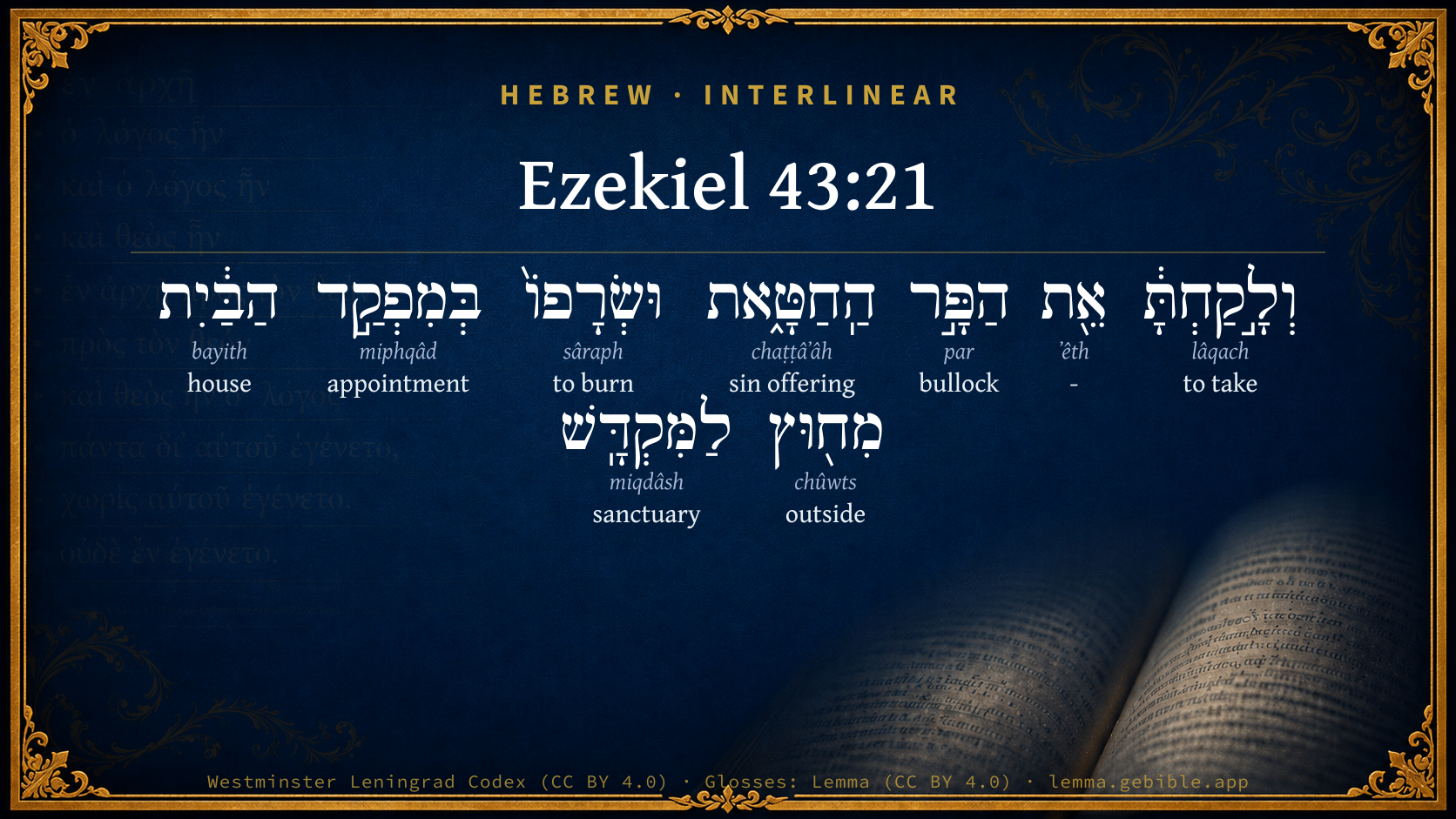
  1. וְלָ֣קַחְתָּ֔ lâqach H3947 “and · to take” Conjunction + Verb, Qal, Sequential Perfect, 2nd Person, Masculine, Singular
  2. אֵ֖ת ʼêth H853 “-” Particle, Direct Object
  3. הַפָּ֣ר par H6499 “the · bullock” Particle, Definite Article + Noun, Common, Masculine, Singular, Absolute
  4. הַֽחַטָּ֑את chaṭṭâʼâh H2403 “the · sin offering” Particle, Definite Article + Noun, Common, Feminine, Singular, Absolute
  5. וּשְׂרָפוֹ֙ sâraph H8313 “and · to burn · him” Conjunction + Verb, Qal, Sequential Perfect, 3rd Person, Masculine, Singular + Suffix, Personal, 3rd Person, Masculine, Singular
  6. הַבַּ֔יִת bayith H1004 “the · house” Particle, Definite Article + Noun, Common, Masculine, Singular, Absolute
  7. מִח֖וּץ chûwts H2351 “from · outside” Preposition + Noun, Common, Masculine, Singular, Absolute
  8. לַמִּקְדָּֽשׁ miqdâsh H4720 “to/for the · sanctuary” Preposition, Determined + Noun, Common, Masculine, Singular, Absolute

About this verse

These counts appear in no published source. They are computed here, from the morphology-tagged text and Lemma’s own curated glosses. What Lemma adds →

9
words
9
distinct lemmas
Prophets
section

Notable vocabulary

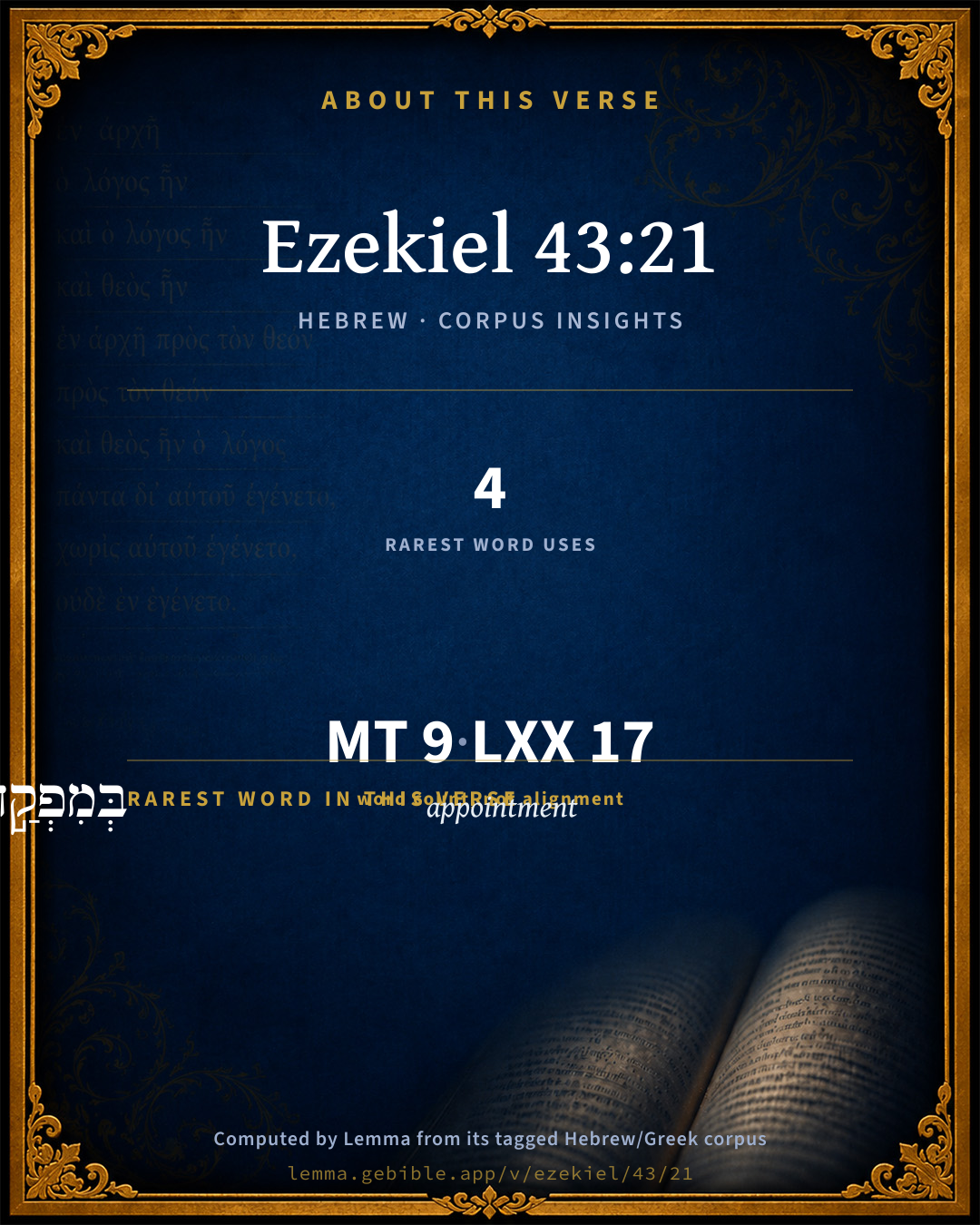
The rarest word here is בְּמִפְקַ֣ד appointment H4662 — appearing just 4 times in the whole Hebrew Bible.

Shared distinctive vocabulary

בְּמִפְקַ֣ד appointment H4662 occurs in 4 verses of the Hebrew Bible. Also found in:

Grammatical profile

  • 2 verbs
  • 6 nouns
  • 1 particle

Verb forms

  • וְלָ֣קַחְתָּ֔ Qal · Sequential Perfect
  • וּשְׂרָפוֹ֙ Qal · Sequential Perfect

Hebrew & Septuagint length

In English translation the verse runs 25 words from the Hebrew and 26 from the Septuagint (LXX English) — closely comparable.

A rough comparison of the two English renderings, which tokenize alike — not a word-level alignment.

Word counts can differ between the Hebrew and the Greek without any difference in meaning — e.g. the Hebrew direct-object marker אֵת has no separate Greek word, and Greek often adds the article ὁ.

In the original languages it is 9 Hebrew tokens and 17 Greek tokens — but the two are counted differently (Hebrew bundles its prefixes and suffixes into one token; the Greek is in lemma form), so that isn’t a like-for-like length.

Cross-references

4

Topical passages linked to Ezekiel 43:21 in the Treasury of Scripture Knowledge — connected by theme and wording, ordered by reader-vote popularity; previews shown in the World English Bible.

  • Exodus 29:14 But the flesh of the bull, and its skin, and its dung, you shall burn with fire outside of the camp: it is a sin-offering.
  • Leviticus 4:12 even the whole bull shall he carry forth outside the camp to a clean place, where the ashes are poured out, and burn it on wood with fire. Where the ashes are poured out it shall be burned.
  • Leviticus 8:17 But the bull, and its skin, and its flesh, and its dung, he burned with fire outside the camp; as Yahweh commanded Moses.
  • Hebrews 13:11–12 For the bodies of those animals, whose blood is brought into the holy place by the high priest as an offering for sin, are burned outside of the camp.

Cross-references courtesy of OpenBible.info (CC BY 4.0).

Hebrew and Greek witnesses Masoretic Hebrew ↔ Greek Septuagint

The same verse in the two great witnesses to the Old Testament, shown verse-for-verse.

These are two independent witnesses, not word-aligned to each other, and the Septuagint is shown in lemma (dictionary) form.

Hebrew Ezekiel 43:21 Masoretic · Westminster Leningrad Codex

וְלָ֣קַחְתָּ֔ אֵ֖ת הַפָּ֣ר הַֽחַטָּ֑את וּשְׂרָפוֹ֙ בְּמִפְקַ֣ד הַבַּ֔יִת מִח֖וּץ לַמִּקְדָּֽשׁ

You shall also take the bull of the sin-offering, and it shall be burnt in the appointed place of the house, outside of the sanctuary.

World English Bible · Public Domain

Greek LXX Ezekiel 43:21 Septuagint · lemma form

καί λαμβάνω ὁ μόσχος ὁ περί ἁμαρτία καί κατακαίω ἐν ὁ ἀποχωρίζω ὁ οἶκος ἔξωθεν ὁ ἅγιος

And they shall take the calf of the sin-offering, and it shall be consumed by fire in the separate place of the house, outside the sanctuary.

LXX2012 (modern English Septuagint) · Public Domain

Hebrew: Westminster Leningrad Codex (CC BY 4.0). Greek: Septuagint (public domain); English from LXX2012 (modern English Septuagint) (Public Domain). How the Septuagint differs from the Hebrew →

Targum (Aramaic paraphrase)

1

The Targum is the ancient Jewish Aramaic paraphrase of the Hebrew Scriptures — an interpretive translation, not the Hebrew text itself. Onkelos (literal) and Pseudo-Jonathan (expansive) render the Torah, and Jonathan the Prophets. Coverage is partial: where no permissively-licensed English translation exists for a verse, only the Aramaic is shown. This is verse-level text, not a word-by-word alignment to the Hebrew.

  1. Targum Jonathan Prophets (Joshua–Malachi)
    וְתִסַב יַת תּוֹרָא דְחַטָאתָא וְיוֹקְדִינֵיהּ בַּאֲתַר דַחֲזִי לְבֵיתָא מִבָּרָא לְמַקְדְשָׁא:

    (no public-domain English translation for this verse)

    Targum Jonathan — Aramaic: “Mikraot Gedolot” (public domain). English: “Sefaria Community Translation” (CC0 1.0 (public-domain dedication)); “London "Chaldee Paraphrase," 1871” (public domain). Text via Sefaria.

Commentary

Notes on Ezekiel 43:21 from classic Christian and Jewish commentators (each source and its license shown beneath its notes). The classic Christian expositions comment on the surrounding passage and are grouped to its opening verse, so a note may address several verses; the Jewish commentaries on the Tanakh (Rashi and others) are per-verse, so they appear only where the commentator wrote on this verse.

Lemma curates 59 commentaries, every one of them public domain or Creative Commons licensed, each selected and text-cleaned for this edition rather than reprinted as found. About our sources →

Trapp's Complete Commentary

John Trapp

Eze 43:21 Thou shalt take the bullock also of the sin offering, and he shall burn it in the appointed place of the house, without the sanctuary.

Ver. 2l. Without the sanctuary.] So Christ suffered without the gate. {Heb 13:11-12}

John Trapp, A Commentary or Exposition upon All the Books of the Old and New Testament (1647–1656) — public domain. Text from a community e-Sword module.

Jamieson, Fausset & Brown

Robert Jamieson, A. R. Fausset & David Brown

burn it . . . without the sanctuary-- (Heb 13:11).

Jamieson, Fausset & Brown — Commentary Critical and Explanatory on the Whole Bible (1871) — public domain (CC PDM 1.0). Text via the HelloAO Bible API.

Ellicott's Commentary for English Readers

(21) Burn it in the appointed place.—The flesh of the ordinary sin offerings was to be eaten by the priests; but when the victim was a bullock, as in case of a sin offering for the high priest (Lev_4:3; Lev_4:11-12), or for the whole congregation (Lev_4:13; Lev_4:20), it was to be burned without the camp. Here it is to be burned “in the appointed place of the house,” and yet “without the sanctuary,” or Temple building itself; it must, therefore, have been in the building described in 41:12

A Bible Commentary for English Readers, edited by Charles John Ellicott (1878–1897) — public domain. Text from a community e-Sword module.

The Cambridge Bible for Schools and Colleges

gen. ed. J. J. S. Perowne

21. The sin-offering was burnt wholly in a place outside the whole temple area, i.e. outside the space enclosed by the 500 cubits square wall (Eze_42:16 seq.), possibly in the space of 50 cubits (Eze_45:2) lying round the outer wall. Cf. Exo_29:14; Lev_4:11; Lev_6:23; Lev_16:27; Heb_13:11.

The Cambridge Bible for Schools and Colleges (gen. ed. J. J. S. Perowne; Cambridge University Press, 1878–1918) — public domain. Text from a community e-Sword module.

John Gill's Exposition

Thou shalt take the bullock also of the sin offering,.... Which was appointed for the sin offering, according to the divine direction, Eze 43:19, the prophet was to take it out of the herd, and separate it from the rest for this purpose, and deliver it into the hands of one of the priests:

and he shall burn it in the appointed place of the house; that is, one of the sons of Zadok should receive it of the prophet, and burn it in its proper place; not within the house, without the court, but within the wall of the house: this burning of it was typical of the dolorous sufferings of Christ; See Gill on Eze 40:39, or of the zeal and fervency of the ministers of the Gospel, in preaching a crucified Christ in the proper place, in the house and church of God: without the sanctuary; the holy place or temple, properly so called; or without the camp, typical of Christ's suffering without Jerusalem, and of his being preached not only there, but in the Gentile world; see Heb 13:11, this was the work of the first day of the consecration of the altar.

John Gill's Exposition of the Whole Bible (1746–1763) — public domain (CC PDM 1.0). Text via the HelloAO Bible API.

Albert Barnes' Notes on the Bible

In the appointed place of the house - A place within the temple-court, but “without the sanctuary” properly so called, that is to say, without the temple and inner court. This was probably the “separate place” (see Eze 41:12).

Albert Barnes' Notes on the Bible (1834–1885) — public domain. Text from a community e-Sword/MySword module.

Haydock's Catholic Bible Commentary

Sanctuary, out of the precincts of the temple, but on the mountain, Leviticus iv. 3., and vi. 11.

George Leo Haydock (1774–1849), Haydock's Catholic Family Bible and Commentary, 1859 edition — public domain. Excludes Psalms (Douay-Rheims chapter numbering differs from Protestant) and Deuterocanonical books (Catholic canon only).

Matthew Poole's English Annotations

Thou shalt take; as Eze 43:20.

And he, the priest of Zadok’s line, that by his course in ministration ought at that time to offer the sacrifice,

shall burn it; either the whole, or so much as is commanded to be burnt.

The house here is not the temple itself, but a place within the circuit of the most consecrated ground; it is called

the place of the house, because the place in which the house was built, which is the sanctuary or temple. This was done without the gate, without the camp, while the tabernacle stood. Now it is to be done in the court of the house, and on the altar appointed and consecrated. This is the first day’s sacrifice.

Matthew Poole's English Annotations on the Holy Bible (1683–1685) — public domain. Text from a community e-Sword/MySword module.

The Pulpit Commentary

As a further stage in the ceremony, the Bullock of the sin offering, i.e. the carcass of the victim, was to be burned by Ezekiel or the priest acting for him in the appointed place of the house, without the sanctuary, as in the Mosaic code it was prescribed that the flesh of the bullock, with his skin and dung, should be burned without the comp. (Exo_29:14; Lev_4:12, 21 9:11, 15; comp. Heb_13:13) Ewald at first sought the place here referred to in the sacrificial kitchens, (Eze_46:19) which it could not be, as these belonged to the "sanctuary" in the strictest sense; he has, however, since adopted the view of Kliefoth, which is doubtless correct, that the "place of the house, without the sanctuary" meant the gizrah, or separate place, (Eze_41:12) which was a part of the "house" in the widest sense, and yet belonged not to the "sanctuary" in the strictest sense. Smend thinks of the migrash, "suburbs" or "open spaces," which surrounded the temple precincts; (Eze_45:2) and these were certainly without the sanctuary, while they were also appointed for the holy place, and might have been designated, as here, miphkadh, as being always under the inspection of the temple watchmen. The fact that in post-exilic times one of the city gates was called Hammiphkadh (Neh_3:31) lends countenance to this view. That in this "appointed place" the carcass of the bullock should be consumed was a deviation from the Mosaic ritual, which prescribed that the fat portions should be burned upon the altar, and the rest eaten as a sacrificial meal. (Lev_4:10, Lev_4:26, 35 7:15, 31; Deu_12:7, Deu_12:17, Deu_12:18) Keil appears to think that the fat portions may have been burned upon the altar, although it is not so mentioned, and that only "those points" were mentioned "in which deviations from the ordinary ritual took place."

The Pulpit Commentary (1880–1919), ed. H.D.M. Spence-Jones & Joseph S. Exell — public domain. Text from a community e-Sword module.

John Wesley's Explanatory Notes

He - The priest. In the appointed place - That is, in the court of the house, and on the altar appointed; this is the first day's sacrifice.

John Wesley, Explanatory Notes Upon the Whole Bible (1754–1765) — public domain. Text via the GEBible commentary corpus.

Rashi

Rabbi Shlomo Yitzchaki (Rashi)

at the end of the House [Heb. בְּמִפְקַד.] Jonathan renders: in a place where he sees the House, i.e., in a holy place. בְּמִפְקַד הַבַּיִת means a place where the House terminates, as in (Num. 32:49): “and not one man of us is terminated (נִפְקַד).” This [bull] is the bull of investiture, [used] in the manner that they [used it] in the Tabernacle, and that bull was burnt and not eaten. And our Sages expounded so in Menahoth (45a): They sacrificed investiture offerings in Ezra’s days just as they sacrificed in Moses’ days.

Rashi on the Tanakh — English translations: “The Judaica Press complete Tanach with Rashi, translated by A. J. Rosenberg” (CC BY 4.0); “Pentateuch with Rashi's commentary by M. Rosenbaum and A.M. Silbermann, 1929-1934” (public domain); “The Metsudah Tanach series, Lakewood, N.J” (CC BY 4.0); and “The Book of Joshua, Metsudah Publications, 1997” (CC BY 4.0). Text via Sefaria.

Lesson kit

Teaching starters — assembled from the data on this page, not authored interpretation. Every prompt links to the verse data it draws on. Edit before teaching.

Ezekiel, in the Prophets, opens this verse with 9 words (9 distinct Hebrew lemmas). Its most distinctive word is miphqâd (“appointment”). A historical commentator’s framing appears above. Read the whole chapter for the surrounding context.

Discussion questions

  1. How does “appointment” (miphqâd) shape what this verse is saying?
  2. How does 2 Samuel 24:9, which shares the word «appointment», read alongside this verse?
  3. These translations render this verse differently. What is at stake in choosing one wording over another?
  4. «וְלָ֣קַחְתָּ֔» is a Qal Sequential Perfect verb. How does that grammatical form shape the action described?
  5. Compare how Trapp's Complete Commentary and Jamieson, Fausset & Brown read this verse. Where do they agree or differ?

Things to notice

Reading settings

Reading text

Shown beneath each verse's original-language words.

Old Testament
Old Testament edition

Read the OT as the Masoretic Hebrew (MT) or the Greek Septuagint (LXX).

English shown for the Greek Septuagint (in the Hebrew ↔ Greek comparison).

Comparing translations? Open the Compare panel on any verse page to stack up to four side by side.