
Jeremiah 6:11

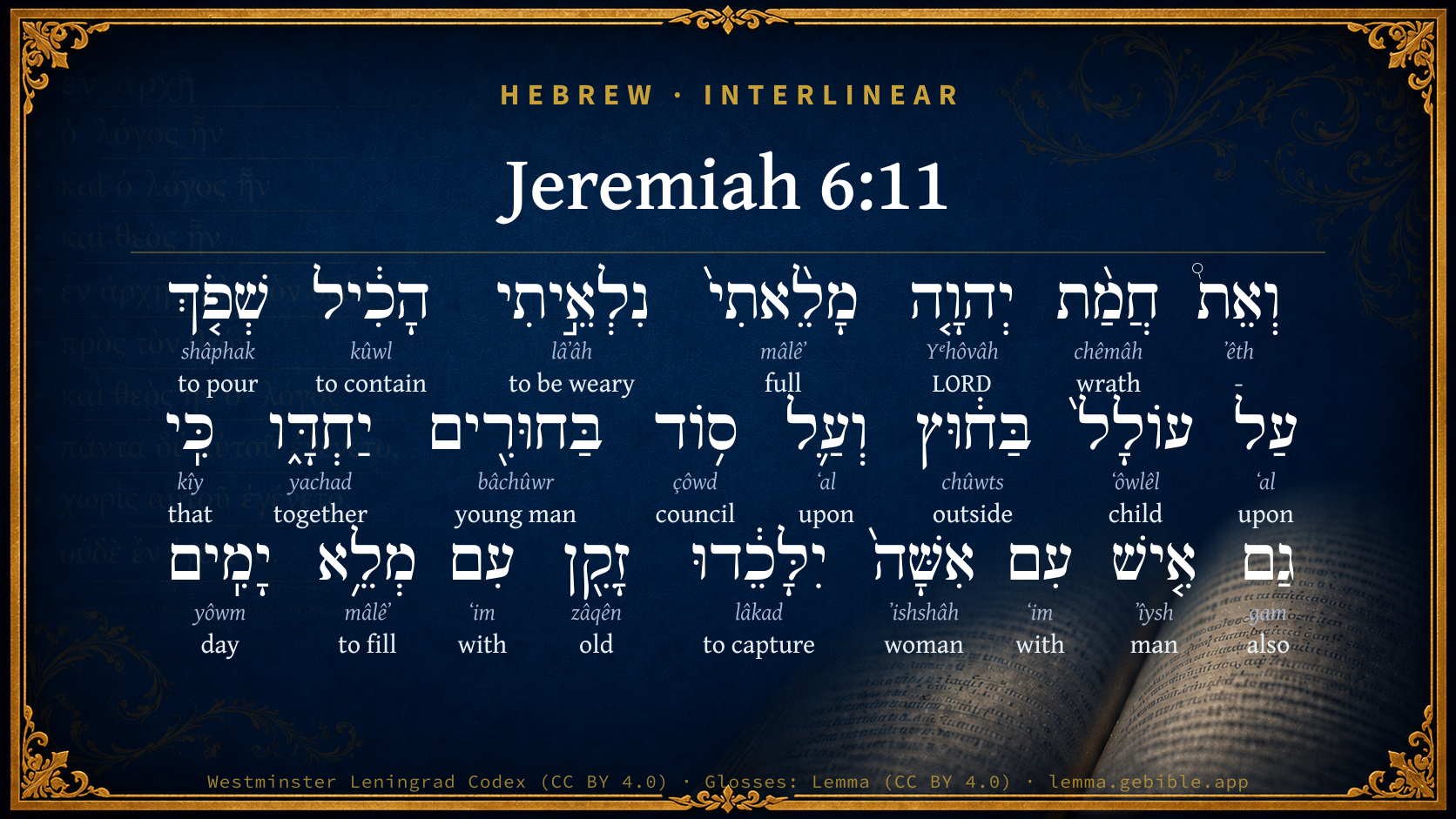
Hebrew (Westminster Leningrad Codex) Jeremiah 6:11 appears in the Hebrew Old Testament. The text above is from the Westminster Leningrad Codex. Each word links to its Strong’s number, a concise gloss, and parsing drawn from the Open Scriptures Hebrew Bible morphology. Click any word for its full Brown-Driver-Briggs (BDB) entry.
Download image
Cite this verse

Jeremiah 6:11 (World English Bible). Public Domain. Lemma interlinear Bible study tool, https://lemma.gebible.app/v/jeremiah/6/11.

Show BibTeX & RIS
BibTeX
RIS
English Translation
Therefore I am full of the wrath of Yahweh; I am weary with holding in: pour it out on the children in the street, and on the assembly of young men together; for even the husband with the wife shall be taken, the aged with him who is full of days.
World English Bible · Public Domain
Download a study sheet

One document with this verse’s original text, its word-by-word gloss line, the meaning frame, cross-references with their text, attributed commentary, and full source and license credits — printable, and it pastes into notes with its structure intact.

This verse Autodidact and up

Study sheet (.html) Plain text (.txt)

A passage Seminary Student

Up to 50 verses in one chapter. A passage sheet keeps up to 6 commentary sources and 12 cross-references per verse, in the order this page ranks them, and says so on the sheet whenever that leaves anything out. Ask for a single verse and you get the Autodidact verse sheet above.

Everything on this page stays free to read, with no account — the sheet is a download of what is already on screen, not access to it.

Want to remove ads? Support Godless Engineer
Compare translations 3

The same verse in 3 English versions, stacked beneath the original-language interlinear above. Click any original word for its lexicon entry.

Each is an independent rendering of the whole verse — the interlinear is not word-aligned to these translations.

Highlighted words mark where these versions differ — a whole-verse word diff, not a word-by-word alignment.

  • World English Bible Public Domain
    Therefore I am full of the wrath of Yahweh; I am weary with holding in: pour it out on the children in the street, and on the assembly of young men together; for even the husband with the wife shall be taken, the aged with him who is full of days.
  • King James Version Public Domain
    Therefore I am full of the fury of the LORD; I am weary with holding in: I will pour it out upon the children abroad, and upon the assembly of young men together: for even the husband with the wife shall be taken, the aged with him that is full of days.
  • unfoldingWord Literal Text CC BY-SA 4.0
    Therefore I am filled with the heat of Yahweh. I am tired of holding. “Pour it out on the children outside and on the groups of young men together. For also a husband will be captured with a wife, an old person with fullness of days.

unfoldingWord Literal Text — © unfoldingWord, licensed CC BY-SA 4.0. Word-aligned USFM3 via Door43 (git.door43.org/unfoldingWord/en_ult).

Versions to compare (up to 4)

3 of 4 selected

Show all 18 translations

Every available English version of this verse, each an independent rendering of the whole verse.

  • World English Bible Public Domain
    Therefore I am full of the wrath of Yahweh; I am weary with holding in: pour it out on the children in the street, and on the assembly of young men together; for even the husband with the wife shall be taken, the aged with him who is full of days.
  • Berean Standard Bible Public Domain
    But I am full of the LORD’s wrath; I am tired of holding it back. “Pour it out on the children in the street, and on the young men gathered together. For both husband and wife will be captured, the old and the very old alike.
  • Majority Standard Bible Public Domain
    But I am full of the LORD’s wrath; I am tired of holding it back. “Pour it out on the children in the street, and on the young men gathered together. For both husband and wife will be captured, the old and the very old alike.
  • King James Version Public Domain
    Therefore I am full of the fury of the LORD; I am weary with holding in: I will pour it out upon the children abroad, and upon the assembly of young men together: for even the husband with the wife shall be taken, the aged with him that is full of days.
  • American Standard Version (1901) Public Domain
    Therefore I am full of the wrath of Jehovah; I am weary with holding in: pour it out upon the children in the street, and upon the assembly of young men together; for even the husband with the wife shall be taken, the aged with him that is full of days.
  • Revised Version (1885) Public Domain
    Therefore I am full of the fury of the LORD; I am weary with holding in: pour it out upon the children in the street, and upon the assembly of young men together: for even the husband with the wife shall be taken, the aged with him that is full of days.
  • Geneva Bible (1599) Public Domain
    Therefore I am full of the wrath of the Lord: I am weary with holding it: I will powre it out vpon the children in the streete, and likewise vpon the assembly of the yong men: for the husband shall euen be taken with the wife, and the aged with him that is full of daies.
  • Douay-Rheims (1899) Public Domain
    Therefore am I full of the fury of the Lord, I am weary with holding in: pour it out upon the child abroad, and upon the council of the young men together: for man and woman shall be taken, the ancient and he that is full of days.
  • Young's Literal Translation Public Domain
    And with the fury of Jehovah I have been filled, (I have been weary of containing,) To pour `it' on the suckling in the street, And on the assembly of youths together, For even husband with wife are captured, An elder with one full of days,
  • Literal Standard Version CC BY-SA 4.0
    And I have been filled with the fury of YHWH || (I have been weary of containing), “To pour [it] on the suckling in the street, || And on the assembly of youths together, || For even husband with wife are captured, || [The] elderly with one full of days,
  • Unlocked Literal Bible CC BY-SA 4.0
    But I am filled with Yahweh's fury. I am tired of holding it in. He said, to me, “Pour it out on the children in the streets and on the groups of young men. For every man will be taken away with his wife; and every old person heavy with years.
  • unfoldingWord Literal Text CC BY-SA 4.0
    Therefore I am filled with the heat of Yahweh. I am tired of holding. “Pour it out on the children outside and on the groups of young men together. For also a husband will be captured with a wife, an old person with fullness of days.
  • Darby Bible Public Domain
    And I am full of the fury of Jehovah, I am weary with holding in. Pour it out upon the children in the street, and upon the assembly of young men together: for even the husband with the wife shall be taken; the aged with him [that is] full of days.
  • World Messianic Bible Public Domain
    Therefore I am full of the LORD’s wrath. I am weary with holding it in. “Pour it out on the children in the street, and on the assembly of young men together; for even the husband with the wife will be taken, the aged with him who is full of days.
  • Webster's Bible Public Domain
    Therefore I am full of the fury of the LORD; I am weary with holding in: I will pour it out upon the children abroad, and upon the assembly of young men together: for even the husband with the wife shall be taken, the aged with him that is full of days.
  • Free Bible Version CC BY-SA 4.0
    But as for me, I'm full of the Lord's anger; I have a hard time keeping it in. The Lord replies, Pour it out on children in the street, and on groups of young people, because both husband and wife are going to be captured—it's everyone, and it doesn't matter how old they are.
  • Bible in Basic English Public Domain
    For this reason I am full of the wrath of the Lord, I am tired of keeping it in: may it be let loose on the children in the street, and on the band of the young men together: for even the husband with his wife will be taken, the old man with him who is full of days.
  • JPS Tanakh (1917) Public Domain
    Therefore I am full of the fury of the LORD, I am weary with holding in: pour it out upon the babes in the street, and upon the assembly of young men together; for even the husband with the wife shall be taken, the aged with him that is full of days.

Literal Standard Version (2020), Covenant Press — licensed CC BY-SA 4.0. Text via the HelloAO Bible API (eBible.org). Unlocked Literal Bible (unfoldingWord) — licensed CC BY-SA 4.0. Text via the HelloAO Bible API (eBible.org). unfoldingWord Literal Text — © unfoldingWord, licensed CC BY-SA 4.0. Word-aligned USFM3 via Door43 (git.door43.org/unfoldingWord/en_ult). Free Bible Version, Dr. Jonathan Gallagher — licensed CC BY-SA 4.0. Text via the HelloAO Bible API (eBible.org).

Word by word

More ways to search: Search by grammar → Find every occurrence → Compare this word →

Practice this passage: Drill this verse → Learn its vocabulary →

נִלְאֵ֣יתִי
lâʼâh
H3811
“to be weary”
Verb, Niphal, Perfect, 1st Person, Common, Singular
Part of Speech
Verb
Stem
Niphal
Form
Perfect
Person
1st Person
Gender
Common
Number
Singular
Full BDB Definition

Origin: a primitive root

TWOT: 1066

to be weary, be impatient, be grieved, be offended - (Qal) to be weary, be impatient - (Niphal) to be tired of something, weary oneself - (Hiphil) to weary, make weary, exhaust
  1. וְאֵת֩ ʼêth H853 “and · -” Conjunction + Particle, Direct Object
  2. חֲמַ֨ת chêmâh H2534 “wrath of” Noun, Common, Feminine, Singular, Construct
  3. יְהוָ֤ה Yᵉhôvâh H3068 “LORD” Noun, Proper
  4. מָלֵ֨אתִי֙ mâlêʼ H4392 “full” Verb, Qal, Perfect, 1st Person, Common, Singular
  5. הָכִ֔יל kûwl H3557 “to contain” Verb, Hiphil, Infinitive Construct
  6. שְׁפֹ֤ךְ shâphak H8210 “pour” Verb, Qal, Imperative, 2nd Person, Masculine, Singular
  7. עַל ʻal H5921 “upon” Preposition
  8. עוֹלָל֙ ʻôwlêl H5768 “child” Noun, Common, Masculine, Singular, Absolute
  9. בַּח֔וּץ chûwts H2351 “in/at the · outside” Preposition, Determined + Noun, Common, Masculine, Singular, Absolute
  10. וְעַ֛ל ʻal H5921 “and · upon” Conjunction + Preposition
  11. ס֥וֹד çôwd H5475 “council of” Noun, Common, Masculine, Singular, Construct
  12. בַּחוּרִ֖ים bâchûwr H970 “young men” Noun, Common, Masculine, Plural, Absolute
  13. יַחְדָּ֑ו yachad H3162 “together” Adverb
  14. כִּֽי kîy H3588 “that” Conjunction
  15. גַם gam H1571 “also” Adverb
  16. אִ֤ישׁ ʼîysh H376 “man” Noun, Common, Masculine, Singular, Absolute
  17. עִם ʻim H5973 “with” Preposition
  18. אִשָּׁה֙ ʼishshâh H802 “woman” Noun, Common, Feminine, Singular, Absolute
  19. יִלָּכֵ֔דוּ lâkad H3920 “to capture” Verb, Niphal, Imperfect, 3rd Person, Masculine, Plural
  20. זָקֵ֖ן zâqên H2205 “old” Adjective, Adjective, Masculine, Singular, Absolute
  21. עִם ʻim H5973 “with” Preposition
  22. מְלֵ֥א mâlêʼ H4390 “full of” Adjective, Adjective, Masculine, Singular, Construct
  23. יָמִֽים yôwm H3117 “days” Noun, Common, Masculine, Plural, Absolute

About this verse

These counts appear in no published source. They are computed here, from the morphology-tagged text and Lemma’s own curated glosses. What Lemma adds →

24
words
22
distinct lemmas
Prophets
section

Notable vocabulary

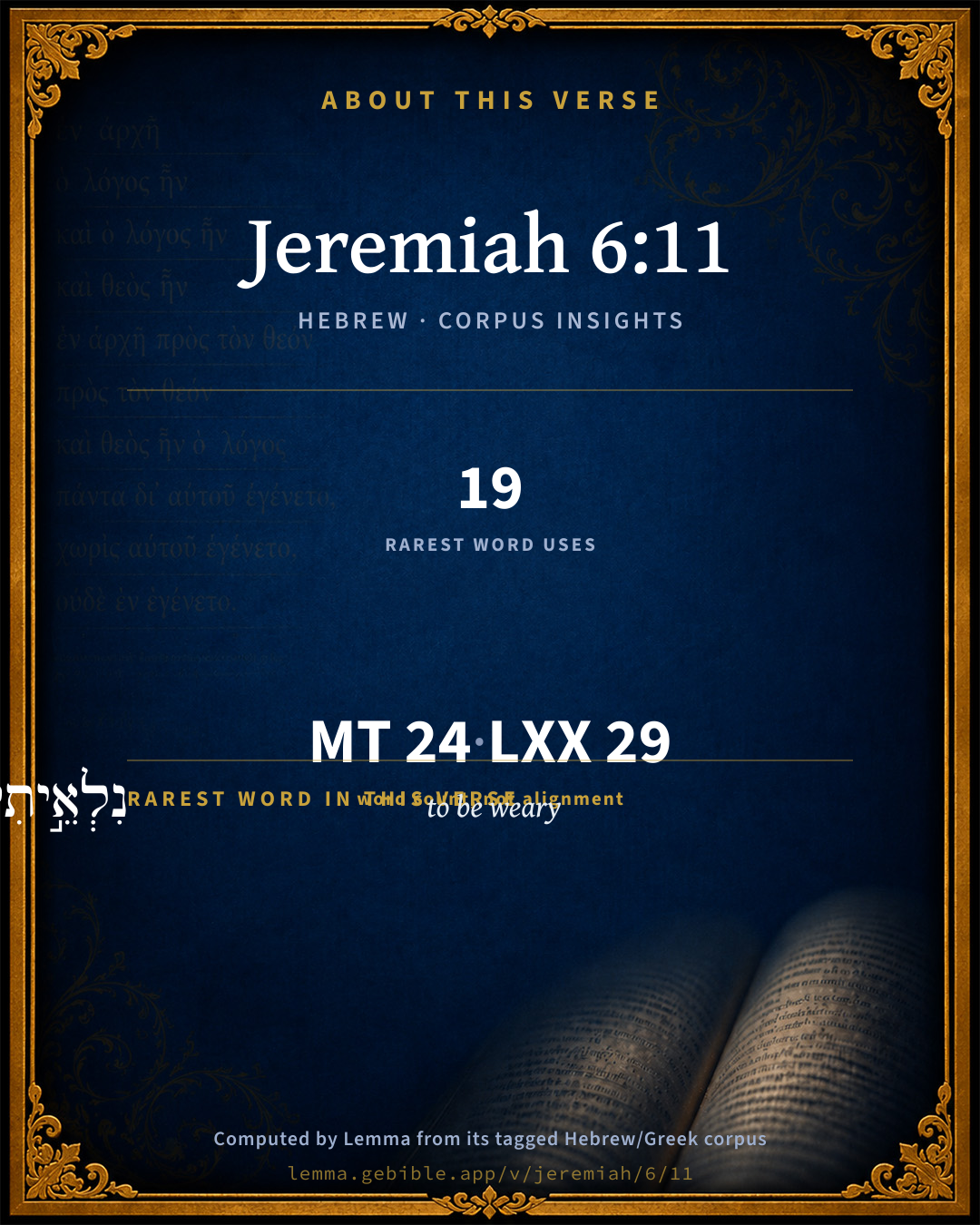
The rarest word here is נִלְאֵ֣יתִי to be weary H3811 — appearing just 19 times in the whole Hebrew Bible.

Shared distinctive vocabulary

נִלְאֵ֣יתִי to be weary H3811 occurs in 18 verses of the Hebrew Bible. Also found in:

Grammatical profile

  • 5 verbs
  • 9 nouns
  • 2 adjectives
  • 4 prepositions
  • 1 conjunction
  • 2 adverbs
  • 1 particle

Verb forms

  • מָלֵ֨אתִי֙ Qal · Perfect
  • נִלְאֵ֣יתִי Niphal · Perfect
  • הָכִ֔יל Hiphil · Infinitive Construct
  • שְׁפֹ֤ךְ Qal · Imperative
  • יִלָּכֵ֔דוּ Niphal · Imperfect

Repetition

Words recur within this verse — often emphatic in Hebrew:

Hebrew & Septuagint length

In the original languages it is 24 Hebrew tokens and 29 Greek tokens — but the two are counted differently (Hebrew bundles its prefixes and suffixes into one token; the Greek is in lemma form), so that isn’t a like-for-like length.

Cross-references

13

Topical passages linked to Jeremiah 6:11 in the Treasury of Scripture Knowledge — connected by theme and wording, ordered by reader-vote popularity; previews shown in the World English Bible.

  • Jeremiah 9:21 For death is come up into our windows, it is entered into our palaces; to cut off the children from outside, [and] the young men from the streets.
  • Jeremiah 20:9 If I say, I will not make mention of him, nor speak any more in his name, then there is in my heart as it were a burning fire shut up in my bones, and I am weary with forbearing, and I can't [contain].
  • Job 32:18–19 For I am full of words. The spirit within me constrains me.
  • Micah 3:8 But as for me, I am full of power by the Spirit of Yahweh, And of judgment, and of might, To declare to Jacob his disobedience, And to Israel his sin.
  • Jeremiah 7:20 Therefore thus says the Lord Yahweh: Behold, my anger and my wrath shall be poured out on this place, on man, and on animal, and on the trees of the field, and on the fruit of the ground; and it shall burn, and shall not be quenched.
  • Jeremiah 18:21 Therefore deliver up their children to the famine, and give them over to the power of the sword; and let their wives become childless, and widows; and let their men be slain of death, [and] their young men struck of the sword in battle.
  • Ezekiel 3:14 So the Spirit lifted me up, and took me away; and I went in bitterness, in the heat of my spirit; and the hand of Yahweh was strong on me.
  • Ezekiel 9:6 kill utterly the old man, the young man and the virgin, and little children and women; but don't come near any man on whom is the mark: and begin at my sanctuary. Then they began at the old men that were before the house.
  • Luke 17:34 I tell you, in that night there will be two people in one bed. The one will be taken, and the other will be left.
  • Acts 4:20 for we can't help telling the things which we saw and heard."
  • Acts 17:16 Now while Paul waited for them at Athens, his spirit was provoked within him as he saw the city full of idols.
  • Acts 18:5 But when Silas and Timothy came down from Macedonia, Paul was compelled by the Spirit, testifying to the Jews that Jesus was the Christ.
  • Revelation 16:1 I heard a loud voice out of the temple, saying to the seven angels, "Go and pour out the seven bowls of the wrath of God on the earth!"

Cross-references courtesy of OpenBible.info (CC BY 4.0).

Hebrew and Greek witnesses Masoretic Hebrew ↔ Greek Septuagint

The same verse in the two great witnesses to the Old Testament, shown verse-for-verse.

These are two independent witnesses, not word-aligned to each other, and the Septuagint is shown in lemma (dictionary) form.

Hebrew Jeremiah 6:11 Masoretic · Westminster Leningrad Codex

וְאֵת֩ חֲמַ֨ת יְהוָ֤ה מָלֵ֨אתִי֙ נִלְאֵ֣יתִי הָכִ֔יל שְׁפֹ֤ךְ עַל עוֹלָל֙ בַּח֔וּץ וְעַ֛ל ס֥וֹד בַּחוּרִ֖ים יַחְדָּ֑ו כִּֽי גַם אִ֤ישׁ עִם אִשָּׁה֙ יִלָּכֵ֔דוּ זָקֵ֖ן עִם מְלֵ֥א יָמִֽים

Therefore I am full of the wrath of Yahweh; I am weary with holding in: pour it out on the children in the street, and on the assembly of young men together; for even the husband with the wife shall be taken, the aged with him who is full of days.

World English Bible · Public Domain

Greek LXX Structure differs

In the Septuagint, Jeremiah is about an eighth shorter than the Hebrew and arranges its material differently — the Oracles Against the Nations (Hebrew chapters 46–51) appear in the middle of the Greek book, after 25:13. Because the chapter and verse boundaries do not line up, a verse-for-verse comparison with the Hebrew is not shown.

A verse-for-verse comparison isn’t shown here because the chapters and verses don’t line up. Switch to the LXX edition with the MT / LXX toggle above to read the Greek directly.

On this verse, The Cambridge Bible for Schools and Colleges discusses the Septuagint’s reading. Read the note in Commentary ↓

Hebrew: Westminster Leningrad Codex (CC BY 4.0). Greek: Septuagint (public domain); English from a public-domain English Septuagint. How the Septuagint differs from the Hebrew →

Targum (Aramaic paraphrase)

1

The Targum is the ancient Jewish Aramaic paraphrase of the Hebrew Scriptures — an interpretive translation, not the Hebrew text itself. Onkelos (literal) and Pseudo-Jonathan (expansive) render the Torah, and Jonathan the Prophets. Coverage is partial: where no permissively-licensed English translation exists for a verse, only the Aramaic is shown. This is verse-level text, not a word-by-word alignment to the Hebrew.

  1. Targum Jonathan Prophets (Joshua–Malachi)
    וְיַת נְבוּאַת דַייָ בִּתְקוֹף מִן קֳדָם יְיָ אִתְמְלֵיתִי לְאֵיתִי לְסוֹבָרָא וְלָא יְכֵילְתִּי לְמִשְׁפַּךְ עַל יַנְקִין בְּשׁוֹקָא וְעַל סִיעַת עוּלֵמִין כַּחֲדָא אֲרֵי אַף גְבַר עִם אִתָּא יִתְאֲחָדוּ סָב עִם דִשְׂבַע יוֹמִין:

    (no public-domain English translation for this verse)

    Targum Jonathan — Aramaic: “Mikraot Gedolot” (public domain). English: “Sefaria Community Translation” (CC0 1.0 (public-domain dedication)); “London "Chaldee Paraphrase," 1871” (public domain). Text via Sefaria.

Commentary

Notes on Jeremiah 6:11 from classic Christian and Jewish commentators (each source and its license shown beneath its notes). The classic Christian expositions comment on the surrounding passage and are grouped to its opening verse, so a note may address several verses; the Jewish commentaries on the Tanakh (Rashi and others) are per-verse, so they appear only where the commentator wrote on this verse.

Lemma curates 59 commentaries, every one of them public domain or Creative Commons licensed, each selected and text-cleaned for this edition rather than reprinted as found. About our sources →

Trapp's Complete Commentary

John Trapp

Jer 6:11 Therefore I am full of the fury of the LORD; I am weary with holding in: I will pour it out upon the children abroad, and upon the assembly of young men together: for even the husband with the wife shall be taken, the aged with [him that is] full of days.

Ver. 11. Therefore I am full of the fury of the Lord,] i.e., Of curses and menaces against this obstinate people. {as Jer 4:19}

I am weary with holding in.] As hitherto I have done, and could still in compassion, but that of necessity I must obey God’s will, and be the messenger of his wrath. It is a folly to think that God’s ministers delight to fling daggers at men’s breasts, or handfuls of hell fire in their faces. Non nisi coactus, said he.

I will pour it forth.] I will denounce it, and then God will soon effect it. See on Jer 1:10.

John Trapp, A Commentary or Exposition upon All the Books of the Old and New Testament (1647–1656) — public domain. Text from a community e-Sword module.

Joseph Benson's Commentary

Jer 6:11-12. Therefore I am full of the fury — את חמת, the anger, or wrath, as it should rather have been rendered; of the Lord — An expression which is to be understood of that divine justice which is worthy of God, and which inflicts most heavy, and yet most just, punishment on the obstinately wicked, after having a long time waited for their repentance. I am weary with holding in — Or, as the words may be rendered, I have laboured to hold it in. They are the words of the prophet, who was unwilling to declare to the people the avenging justice which was ready to fall upon them. I will pour it out — The word in the Hebrew, שׁפךְ, is imperative, Pour it out: God, as it seems, commanding his prophet not to delay to denounce his judgments, about to be inflicted on the inhabitants of Jerusalem, of all ages and orders. The prophets are said to do things, when they declare God’s purpose of doing them, as hath been observed on Jer 1:10; upon the children abroad — Or, in the streets, where they are wont to play: the sword of the merciless Chaldeans shall not spare them, Jer 9:21. The children perish in the calamity, which the sins of their fathers have procured. And upon the assembly of young men — Who meet together for diversion or conversation. The husband with the wife shall be taken — One sex, as well as the other, shall be a prey to the enemy. The aged with him that is full of days — From hence it appears, says Blaney, that the word, זקן, here and elsewhere rendered aged, “means only a man that has passed a certain time of life, which may be considered as his zenith, so as from thenceforth to be upon the decline. In contradistinction to whom is placed one who is arrived at what is esteemed the full period of human life; in respect to which the patriarchs, Abraham, Isaac, David, and Job, are said to have died full of years, or days. See the same distinction made Isa 65:20.” No age or condition shall escape. And their houses shall be turned unto others, &c. — According to the threatening denounced by Moses, Deu 28:30.

Joseph Benson's Commentary on the Old and New Testaments (1811–1818) — public domain. Text from a community e-Sword module.

Tyndale Open Study Notes

Tyndale Open Resources

6:11-12 Jeremiah shared the Lord’s fury toward the people; he could not contain his feelings.

Tyndale Open Study Notes — © Tyndale Open Resources, licensed CC BY-SA 4.0. Text via the HelloAO Bible API.

Geneva Bible (1599)

Geneva Bible translators

As the Lord had given him his word to be as a fire of his indignation to burn the wicked, Jer. 5:14, so he kindleth it now when he seeth that all remedies are past.

None shall be spared.

Geneva Bible (1599) marginal notes — public domain. Text via Bolls.life.

Jamieson, Fausset & Brown

Robert Jamieson, A. R. Fausset & David Brown

fury of . . . Lord--His denunciations against Judah communicated to the prophet.

weary with holding in-- (Jer 20:9).

I will pour--or else imperative: the command of God (see Jer 6:12), "Pour it out" [MAURER].

aged . . . full of days--The former means one becoming old; the latter a decrepit old man [MAURER] (Job 5:26; Isa 65:20).

Jamieson, Fausset & Brown — Commentary Critical and Explanatory on the Whole Bible (1871) — public domain (CC PDM 1.0). Text via the HelloAO Bible API.

Adam Clarke's Commentary

Verse 11. I am full of the fury of the Lord] God has given me a dreadful revelation of the judgments he intends to inflict: my soul is burdened with this prophecy. I have endeavoured to suppress it; but I must pour it forth upon the children, on the young people, on husbands and wives, on the old and the super-annuated. All must partake in these judgments.

Adam Clarke's Commentary on the Bible (1810–1826) — public domain. Text from a community e-Sword/MySword module.

John Calvin's Commentaries

The prophet here rises higher; for it was not enough simply to set forth the truth to refractory men, but it was necessary to stimulate them even sharply, and sometimes to wound them, for they could not otherwise be roused, so great was their hardness. Hence the Prophet proceeds in the same strain with what we observed yesterday; and he declares that he was full of the indignation of God. This may be taken passively and actively, — that the Prophet was indignant with holy zeal, because he undertook the cause of God, — or, that he dreaded the judgment, which the Jews nevertheless in no way heeded. But he speaks here no doubt according to the inspiration of the Holy Spirit, as though he said, that he did not announce what his own mind suggested, but what was dictated by the Spirit of God. This indignation is, in short, to be applied to what was taught, as though he had said, “If I address you with great vehemence, think not that as a man I forget moderation, being influenced by wrath; but the Spirit of God leads and impels me. Whatever indignation then is found in my language, whatever vehemence and sharpness and menacing, all this is from God’s Spirit, and not from my own feelings as a man.” It was on this account that he says, that he was filled with the indignation of God.

What follows confirms this statement; for he says, that he was wearied with restraint; as though he said, that so great was the impulse of God’s wrath, that it could not be withheld from breaking out into vehemence. And hence we learn, as I have said, that the Prophet declares no other thing than that he was not moved by his own indignation, or by any feeling of his own nature, but that he of necessity followed where he was led by the hidden influence of God’s Spirit, lest what he taught might be despised; for the Jews had long accustomed themselves to use their taunts and to say, that they were not to be frightened like children. That the Jews then might not thus trifle, Jeremiah declares, that he was so filled with the indignation of God, that he could contain himself no longer, but must denounce on his own kindred what God had committed to his charge. As we shall elsewhere see the same mode of speaking, and in more express terms, I shall proceed without making any farther remarks.

He afterwards says, I shall pour it out, etc. He no doubt continues the same subject. He then says, that since he could no longer suppress the vengeance of God, whose herald he was, he would now pour it out, and that upon the children, he says, in the streets He doubtless means by these words that there was nothing pure among the people, for the very children were involved in the same guilt. Since, then, impiety so prevailed that even children in their tender age were not exempt from it, it was an evidence of a hopeless condition. This is what the Prophet means by saying, that he would pour wrath upon children. Then he adds, upon the assembly, etc. The word סוד, sud, means a congregation, or an assembly; and it means also counsel. But as the Prophet speaks of streets, there seems to be a contrast between streets and counsels, as though he said, that children playing in the streets were without any counsel or understanding: but still I include with them the old and the grown up men, for they are all exposed to God’s judgment. He then adds, the counsel of young men; for there is more discretion and prudence in young men grown up to maturity. The Hebrews do not call youths of fifteen בחורים, bachurim, but men of full and mature age; and the word is derived from a verb which means to choose. They then who are in the flower of their age are called בחורים, bachurim, because they are endued with discretion, and do not play in the streets like children. The Prophet then says, that God’s wrath would now be poured forth on children, and also on men grown up to the age of twenty or thirty.

For the husband, he says, with his wife shall be taken, the aged with the full of days Some think that the full of days was the decrepit: but by זקן, zaken, I understand the aged, and by the full of days, all those already grown into maturity, as those from fifty to eighty may be so called. He means, in short, that no one would be exempt from suffering God’s vengeance, as impiety had pervaded all stations, ranks, and ages. It follows —

John Calvin's Commentaries (1540-1563) — public domain. Text from the Calvin Translation Society English edition (1840s-50s) via the Christian Classics Ethereal Library (ccel.org). Calvin's coverage is partial (roughly two-thirds of the Bible); uncommented books and verses are honest gaps, never fabricated. The 19th-century editor's footnotes and remarks are omitted so the notes are faithfully Calvin's own voice.

Ellicott's Commentary for English Readers

(11) I am full of the fury . . .—The prophet feels himself filled, frail vessel as he is, with the righteous wrath of Jehovah. It will not be controlled.

I will pour it out.—Better, as the command coming from the mouth of Jehovah, Pour it out. The words that follow describe the several stages of man’s life, upon all of which that torrent of wrath is to flow forth—the children abroad, i.e., playing in the streets (as in Zec_8:5); the assembly, or gathering of young men, whether in their natural mirth (Jer_15:17) or for secret plans (Pro_15:22); the husband and wife in full maturity; the “aged,” i.e., the elder, still active as well as venerable; lastly, the man “full of days,” whose time is nearly over and his sand run out.

A Bible Commentary for English Readers, edited by Charles John Ellicott (1878–1897) — public domain. Text from a community e-Sword module.

The Cambridge Bible for Schools and Colleges

gen. ed. J. J. S. Perowne

11. Therefore] But.

the fury of the Lord] The wrath which He feels has been infused into me His prophet, that I may make it known to men.

pour it out] LXX (so A.V.) have I will pour, etc. The imperative of MT. is best taken not as a prayer by Jeremiah but as God’s command to the prophet. It is, however, harsh. The declaration is made without distinction of age, because the approaching punishment includes all alike. Five periods of life are mentioned.

in the street] at play. Cp. Zec_8:5.

The Cambridge Bible for Schools and Colleges (gen. ed. J. J. S. Perowne; Cambridge University Press, 1878–1918) — public domain. Text from a community e-Sword module.

John Gill's Exposition

Therefore I am full of the fury of the Lord,.... Either of zeal for the Lord, for the glory of his name, and the honour of his word; or rather of the prophecy of the Lord, as the Targum interprets it, concerning the wrath of God, that should come upon this people for their sins:

I am weary with holding it; the prophecy, the message he was sent with to them, to pronounce the judgments of God upon them; which being a disagreeable task to him, he refrained from doing it as long as he could; but being highly provoked with the sins of the people, and particularly with their contempt of the word of God, and especially he being obedient to the divine will, he could forbear no longer making a full declaration of it; see Jer 20:9.

I will pour it upon the children abroad; or, "in the street" (u); that are playing there:

and upon the assembly of young men together; that are met together for their pleasure and diversion; and the sense is, that the prophet would declare in a prophetic manner, and denounce, according to his office and commission, the wrath of God, which should come upon persons of every age, and of every relation in life, as follows: though the words may be rendered, "pour it upon the children", &c. (w); and so it is a prayer of the prophet's to the Lord, that he would execute the vengeance on them which he had threatened them with by him:

for even the husband with the wife shall be taken; and carried captive:

the aged with him that is full of days; the old and the decrepit, such as are advanced in years, and also those that are just upon the brink of the grave, ready to die: the meaning is, that children should not be spared for their tender age, nor young men for their strength, nor husbands and wives on account of their relation, nor any because of their hoary hairs; seeing the corruption was so general, and prevailed in persons of every age, and of every station.

(u) "in platea", Montanus, Schmidt. (w) "effunde in puerum", Cocceius; "super infantem", Schmidt; so V. L. "effundere", Montanus.

John Gill's Exposition of the Whole Bible (1746–1763) — public domain (CC PDM 1.0). Text via the HelloAO Bible API.

Albert Barnes' Notes on the Bible

Or, But I am filled with “the fury of Yahweh: I am weary with holding” it “in.” Pour it out “upon the children” in the street, and upon the company of youths “together;” for both man and “wife shall be taken;” the older and he whose days are full. With emphatic abruptness Jeremiah bids himself give full utterance to God’s message. And the message is to reach all. Five stages of human life are successively marked out.

Albert Barnes' Notes on the Bible (1834–1885) — public domain. Text from a community e-Sword/MySword module.

Haydock's Catholic Bible Commentary

In. Jeremias is indignant. The Lord then orders him to pour, or declare what will ensue. (Calmet)

George Leo Haydock (1774–1849), Haydock's Catholic Family Bible and Commentary, 1859 edition — public domain. Excludes Psalms (Douay-Rheims chapter numbering differs from Protestant) and Deuterocanonical books (Catholic canon only).

Matthew Poole's English Annotations

Therefore. Heb. And; which seems to be a better connexion; for that which putteth him upon this work seems rather to be that Spirit of prophecy that is in him than any consideration drawn from them.

I am full of the fury of the Lord; I am, as it were, filled with the fire of God’s wrath and curses against this people, which I am forced to discharge myself of; a metonymy of the subject. See Eze 3:3; Jer 4:19. He doth not only complain of their stupidity, as in the former verse, but stirs up his indignation against them.

I am weary with holding in; but he can contain himself no longer, which implies his great unwillingness to denounce these curses: q.d. The wrath of God, by the impulse of his Spirit, acting so violently with mine, that it will break out: see the like Job 32:18,19. Whereby it appears the prophet is not carried on by his own private spirit, but by the Spirit of God; he hath no delight in it, but is forced to be the messenger himself of his wrath; therefore if he be sharp against them, they must not impute; it to him, but to the Spirit of God, that constrains him thus to speak.

I will pour it out, viz. in prophesying, noting the great plenty of it; a metaphor from violent rains, that we say do pour down upon the earth, Jer 7:20; Rev 16:1.

Upon the children abroad; the streets being the places where usually little children are wont to sport themselves, Zec 8:5. The same word used Psa 8:2.

Upon the assembly of young men together; their secret meetings, whether in harlots’ houses, Jer 5:7, or for mirth and jollity, or to join either their strength or counsel together, which children are not capable of; for the Hebrews do not only call them youths that are past their childhood, possibly at fifteen or sixteen years of age, but men of twenty or thirty, grown to their full strength and maturity, in the flower of their years; yet it shall advantage them nothing.

The husband with the wife, Heb. man with woman; the wife shall be taken as well as the husband, one sex as well as the other shall be a prey to the enemy.

The aged with him that is full of days; not only men that may be termed old, as they may be from fifty to eighty, which are then said to be waxing old; but such as had upon the point filled up the number of their days, at the edge of the grave, Isa 65:20, called very aged, as Barzillai, 2Sa 19:32,34,35. The sense is, that all sorts, from the children to the decrepit old man, had so corrupted their ways, see Jer 6:13, that their condition was desperate, and God would bring an enemy upon them should spare or pity none, of what sex or age soever.

Matthew Poole's English Annotations on the Holy Bible (1683–1685) — public domain. Text from a community e-Sword/MySword module.

Whedon's Commentary on the Bible

Daniel D. Whedon

11. Full of the fury — Note how this is visited on all classes: Children… young men… husband… wife… the aged with him that is full of days. This last expression describes one who has reached the utmost limit of age. In the two following verses these individualizing specifications are continued.

Daniel D. Whedon (gen. ed.), Commentary on the Old and New Testaments (1874–1909) — public domain. Text from a community e-Sword module.

The Pulpit Commentary

Therefore I am full; rather, But I am full. I will pour it out. The text has "pour it out." The sudden transition to the imperative is certainly harsh, and excuses the conjectural emendation which underlies the rendering of the Authorized Version. If we retain the imperative, we must explain it with reference to Jeremiah"s inner experience. There are, we must remember, two selves in the prophet, (comp. Isa_21:6) and the higher prophetic self here addresses the lower or human self, and calls upon it no longer to withhold the divinely communicated burden. All classes, as the sequel announces, are to share in the dread calamity. Upon the children abroad; literally, upon the child in the street. (comp. Zec_8:5) The assembly of young men. It is a social assembly which is meant. (comp. Jer_15:17, "the assembly of the laughers

The Pulpit Commentary (1880–1919), ed. H.D.M. Spence-Jones & Joseph S. Exell — public domain. Text from a community e-Sword module.

John Wesley's Explanatory Notes

I am full - I am, as it were, filled with the fire of God's wrath, which I am forced to discharge myself of. Abroad - The streets being the places where children are wont to sport. The husband - One sex as well as the other, shall be a prey to the enemy. Full of days - Such as had filled up the number of their days, as were at the edge of the grave.

John Wesley, Explanatory Notes Upon the Whole Bible (1754–1765) — public domain. Text via the GEBible commentary corpus.

unfoldingWord translationNotes

Door43 World Missions Community

But I am filled with Yahweh's fury

Jeremiah is speaking. He feels the same anger that Yahweh feels, and he speaks of being extremely angry as if he were filled with anger. AT: "I am completely angry as Yahweh is" (See: Idiom)

I am tired of holding it in

Jeremiah speaks of not showing Yahweh's anger as if he were holding the anger inside himself. AT: "I am tired from not expressing this anger" or "I am tired of not doing anything about this anger" (See: Metaphor)

Pour it out on the children in the streets and on the groups of young men

God speaks of punishing the people of Israel as if his anger were a liquid that he wanted Jeremiah to pour out on them. AT: "In anger punish the children in the streets and the groups of young men" (See: Metaphor)

For every man will be taken away with his wife

This can be stated in active form. AT: "Because enemies will capture every man with his wife" (See: Active or Passive)

every old person heavy with years

The words "will be taken" are understood from the previous phrase. AT: "every old person heavy with years will be taken" or "they will take every old person heavy with years" (See: Ellipsis)

every old person heavy with years

The phrase "heavy with years" is an idiom that means "very old." It reinforces the phrase "old person." AT: "every very old person" (See: Idiom)

Their houses will be turned over to others

This can be stated in active form. AT: "Their houses will become the possession of other people" or "There people will take their houses" (See: Active or Passive)

both their fields and their wives together

The phrase "will be turned over to others" is understood from the previous phrase. AT: "and their their fields and their women will also be turned over to others" (See: Ellipsis)

For I will attack the inhabitants of the land with my hand

Here "my hand" represents Yahweh's power. Here it shows that when the armies attack Israel, it is because Yahweh caused them to do it. AT: "For by my power I will attack the people living in the land" (See: Metonymy)

this is Yahweh's declaration

Yahweh speaks of himself by name to express the certainty of what he is declaring. See how you translated this in Jeremiah 1:8. AT: "this is what Yahweh has declared" or "this is what I, Yahweh, have declared" (See: First, Second, or Third Person)

translationWords

Yahweh

wrath

hand

declare

unfoldingWord translationNotes — © Distant Shores Media and the Door43 World Missions Community, licensed CC BY-SA 4.0. Source: git.door43.org/Door43/en_tn.

Rashi

Rabbi Shlomo Yitzchaki (Rashi)

Therefore, I am full of the fury of the Lord My heart is full of the prophecy of the coming of the fury of the Lord upon them.

containing Heb. הכיל, like להכיל, to contain ([a]souffrir in O.F.), to tolerate.

to pour it out upon the babes to pour it upon the sucklings.

in the street in the market.

one full of days i.e., one close to death, older than ‘an old man.’

Rashi on the Tanakh — English translations: “The Judaica Press complete Tanach with Rashi, translated by A. J. Rosenberg” (CC BY 4.0); “Pentateuch with Rashi's commentary by M. Rosenbaum and A.M. Silbermann, 1929-1934” (public domain); “The Metsudah Tanach series, Lakewood, N.J” (CC BY 4.0); and “The Book of Joshua, Metsudah Publications, 1997” (CC BY 4.0). Text via Sefaria.

Lesson kit

Teaching starters — assembled from the data on this page, not authored interpretation. Every prompt links to the verse data it draws on. Edit before teaching.

Jeremiah, in the Prophets, opens this verse with 24 words (22 distinct Hebrew lemmas). Its most distinctive word is lâʼâh (“to be weary”). A historical commentator’s framing appears above. Read the whole chapter for the surrounding context.

Discussion questions

  1. How does “to be weary” (lâʼâh) shape what this verse is saying?
  2. How does Genesis 19:11, which shares the word «to be weary», read alongside this verse?
  3. What does the repetition of “upon” (2× in this one verse) do in this verse?
  4. The translations on this page render this verse differently — a whole-verse word diff, not a word-by-word alignment. What might account for the different wordings?
  5. «מָלֵ֨אתִי֙» is a Qal Perfect verb. How does that grammatical form shape the action described?
  6. Compare how Trapp's Complete Commentary and Joseph Benson's Commentary read this verse. Where do they agree or differ?

Things to notice

Reading settings

Reading text

Shown beneath each verse's original-language words.

Old Testament
Old Testament edition

Read the OT as the Masoretic Hebrew (MT) or the Greek Septuagint (LXX).

English shown for the Greek Septuagint (in the Hebrew ↔ Greek comparison).

Comparing translations? Open the Compare panel on any verse page to stack up to four side by side.