Zechariah 9:3

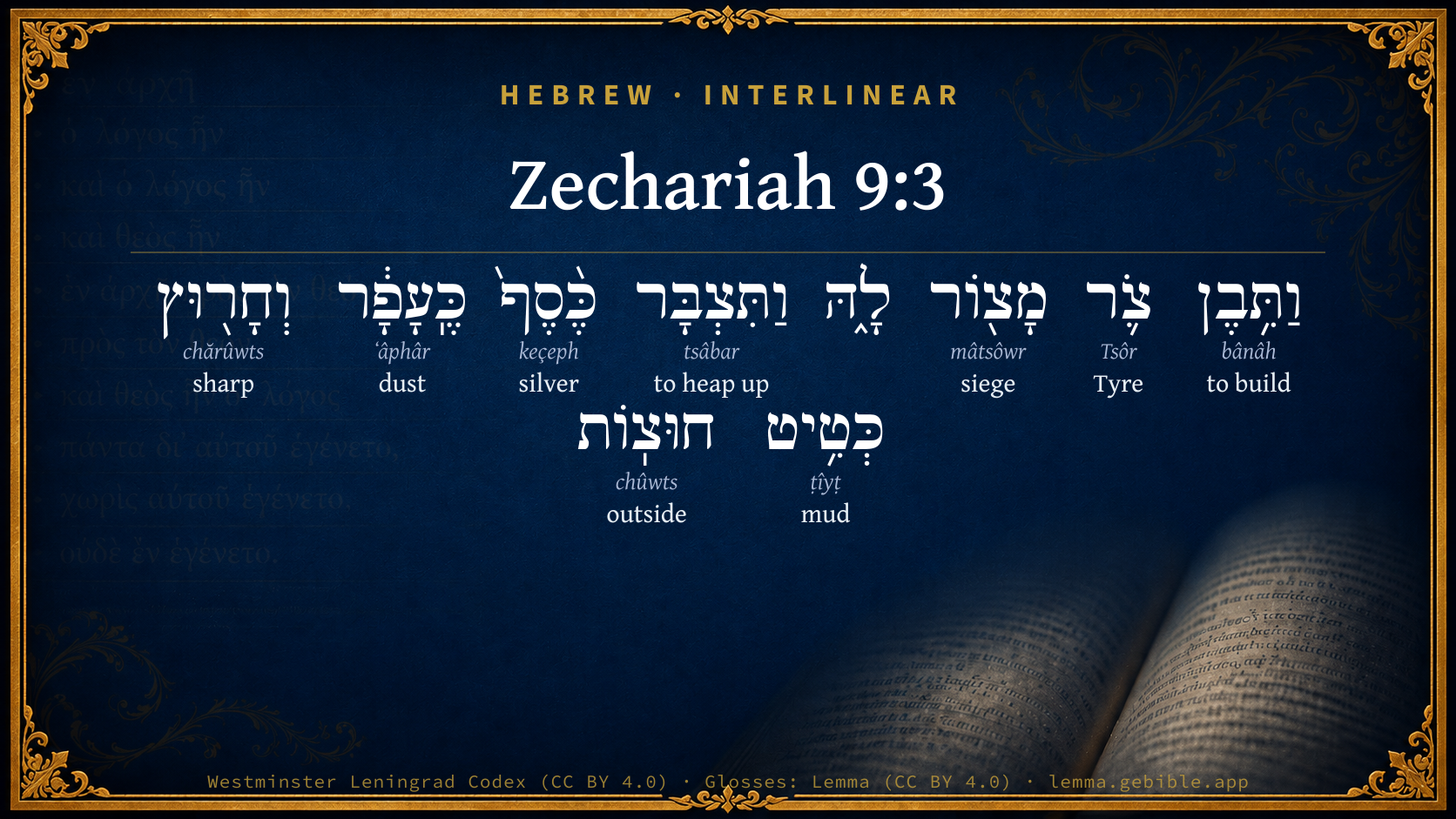
Hebrew (Westminster Leningrad Codex) Zechariah 9:3 appears in the Hebrew Old Testament. The text above is from the Westminster Leningrad Codex. Each word links to its Strong’s number, a concise gloss, and parsing drawn from the Open Scriptures Hebrew Bible morphology. Click any word for its full Brown-Driver-Briggs (BDB) entry.
Download image
Cite this verse

Zechariah 9:3 (World English Bible). Public Domain. Lemma interlinear Bible study tool, https://lemma.gebible.app/v/zechariah/9/3.

Show BibTeX & RIS
BibTeX
RIS
English Translation
Tyre built herself a stronghold, And heaped up silver like the dust, And fine gold like the mire of the streets.
World English Bible · Public Domain
Download a study sheet

One document with this verse’s original text, its word-by-word gloss line, the meaning frame, cross-references with their text, attributed commentary, and full source and license credits — printable, and it pastes into notes with its structure intact.

This verse Autodidact and up

Study sheet (.html) Plain text (.txt)

A passage Seminary Student

Up to 50 verses in one chapter. A passage sheet keeps up to 6 commentary sources and 12 cross-references per verse, in the order this page ranks them, and says so on the sheet whenever that leaves anything out. Ask for a single verse and you get the Autodidact verse sheet above.

Everything on this page stays free to read, with no account — the sheet is a download of what is already on screen, not access to it.

Want to remove ads? Support Godless Engineer
Compare translations 3

The same verse in 3 English versions, stacked beneath the original-language interlinear above. Click any original word for its lexicon entry.

Each is an independent rendering of the whole verse — the interlinear is not word-aligned to these translations.

Highlighted words mark where these versions differ — a whole-verse word diff, not a word-by-word alignment.

  • World English Bible Public Domain
    Tyre built herself a stronghold, And heaped up silver like the dust, And fine gold like the mire of the streets.
  • King James Version Public Domain
    And Tyrus did build herself a strong hold, and heaped up silver as the dust, and fine gold as the mire of the streets.
  • unfoldingWord Literal Text CC BY-SA 4.0
    Tyre has built herself a stronghold and heaped up silver like dust and refined gold like mud in the streets.

unfoldingWord Literal Text — © unfoldingWord, licensed CC BY-SA 4.0. Word-aligned USFM3 via Door43 (git.door43.org/unfoldingWord/en_ult).

Versions to compare (up to 4)

3 of 4 selected

Show all 18 translations

Every available English version of this verse, each an independent rendering of the whole verse.

  • World English Bible Public Domain
    Tyre built herself a stronghold, And heaped up silver like the dust, And fine gold like the mire of the streets.
  • Berean Standard Bible Public Domain
    Tyre has built herself a fortress; she has heaped up silver like dust, and gold like the dirt of the streets.
  • Majority Standard Bible Public Domain
    Tyre has built herself a fortress; she has heaped up silver like dust, and gold like the dirt of the streets.
  • King James Version Public Domain
    And Tyrus did build herself a strong hold, and heaped up silver as the dust, and fine gold as the mire of the streets.
  • American Standard Version (1901) Public Domain
    And Tyre did build herself a stronghold, and heaped up silver as the dust, and fine gold as the mire of the streets.
  • Revised Version (1885) Public Domain
    And Tyre did build herself a strong hold, and heaped up silver as the dust, and fine gold as the mire of the streets.
  • Geneva Bible (1599) Public Domain
    For Tyrus did build her selfe a strong holde, and heaped vp siluer as the dust, and golde as the myre of the streetes.
  • Douay-Rheims (1899) Public Domain
    And Tyre hath built herself a strong hold, and heaped together silver as earth, and gold as the mire of the streets.
  • Young's Literal Translation Public Domain
    And Tyre doth build a bulwark to herself, And doth heap silver as dust, And gold as mire of out-places.
  • Literal Standard Version CC BY-SA 4.0
    And Tyre builds a bulwark for herself, || And heaps silver as dust, || And gold as mire of out-places.
  • Unlocked Literal Bible CC BY-SA 4.0
    Tyre has built herself a stronghold and heaped up silver like dust and refined gold like mud in the streets.
  • unfoldingWord Literal Text CC BY-SA 4.0
    Tyre has built herself a stronghold and heaped up silver like dust and refined gold like mud in the streets.
  • Darby Bible Public Domain
    And Tyre hath built herself a stronghold, and hath heaped up silver as the dust, and fine gold as the mire of the streets.
  • World Messianic Bible Public Domain
    Tyre built herself a stronghold, and heaped up silver like the dust, and fine gold like the mire of the streets.
  • Webster's Bible Public Domain
    And Tyre built herself a strong hold, and amassed silver as the dust, and fine gold as the mire of the streets.
  • Free Bible Version CC BY-SA 4.0
    The people of Tyre built a fortress, and piled up silver like dust and gold like the dirt of the street.
  • Bible in Basic English Public Domain
    And Tyre made for herself a strong place, and got together silver like dust and the best gold like the earth of the streets.
  • JPS Tanakh (1917) Public Domain
    And Tyre did build herself a stronghold, and heaped up silver as the dust, and fine gold as the mire of the streets.

Literal Standard Version (2020), Covenant Press — licensed CC BY-SA 4.0. Text via the HelloAO Bible API (eBible.org). Unlocked Literal Bible (unfoldingWord) — licensed CC BY-SA 4.0. Text via the HelloAO Bible API (eBible.org). unfoldingWord Literal Text — © unfoldingWord, licensed CC BY-SA 4.0. Word-aligned USFM3 via Door43 (git.door43.org/unfoldingWord/en_ult). Free Bible Version, Dr. Jonathan Gallagher — licensed CC BY-SA 4.0. Text via the HelloAO Bible API (eBible.org).

Word by word

More ways to search: Search by grammar → Find every occurrence → Compare this word →

Practice this passage: Drill this verse → Learn its vocabulary →

וַתִּצְבָּר
tsâbar
H6651
“and · to heap up”
Conjunction + Verb, Qal, Sequential Imperfect, 3rd Person, Feminine, Singular
Part of Speech
Conjunction + Verb
Stem
Qal
Form
Sequential Imperfect
Person
3rd Person
Gender
Feminine
Number
Singular
Full BDB Definition

Origin: a primitive root

TWOT: 1874

(Qal) to heap up, pile up - of grain, dust, silver
  1. וַתִּ֥בֶן bânâh H1129 “and · to build” Conjunction + Verb, Qal, Sequential Imperfect, 3rd Person, Feminine, Singular
  2. צֹ֛ר Tsôr H6865 “Tyre” Noun, Proper
  3. מָצ֖וֹר mâtsôwr H4692 “siege” Noun, Common, Masculine, Singular, Absolute
  4. כֶּ֨סֶף֙ keçeph H3701 “silver” Noun, Common, Masculine, Singular, Absolute
  5. כֶּֽעָפָ֔ר ʻâphâr H6083 “like/as the · dust” Preposition, Determined + Noun, Common, Masculine, Singular, Absolute
  6. וְחָר֖וּץ chărûwts H2742 “and · sharp” Conjunction + Noun, Common, Masculine, Singular, Absolute
  7. כְּטִ֥יט ṭîyṭ H2916 “like/as · mud of” Preposition + Noun, Common, Masculine, Singular, Construct
  8. חוּצֽוֹת chûwts H2351 “streets” Noun, Common, Masculine, Plural, Absolute

About this verse

These counts appear in no published source. They are computed here, from the morphology-tagged text and Lemma’s own curated glosses. What Lemma adds →

10
words
9
distinct lemmas
Prophets
section

Notable vocabulary

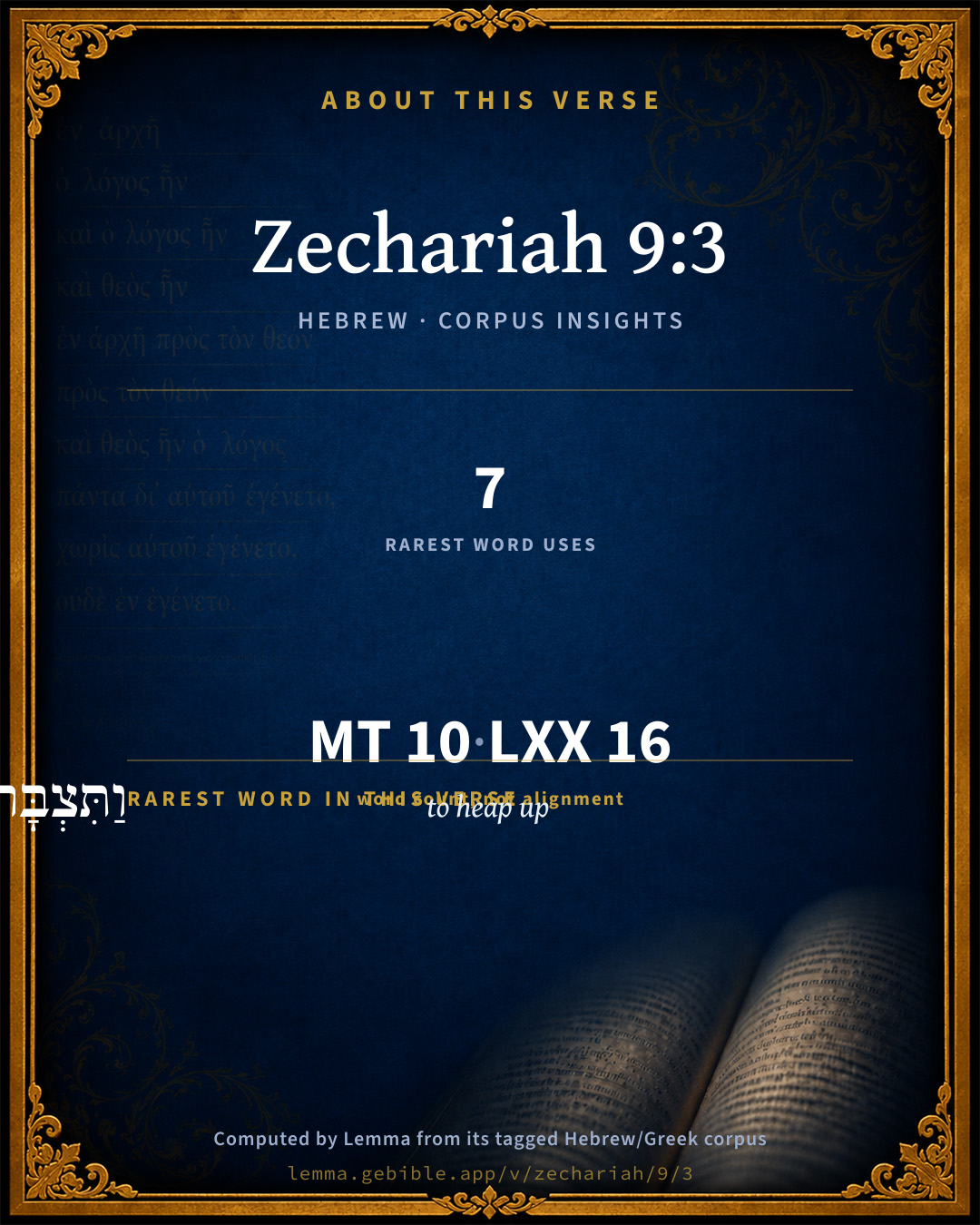
The rarest word here is וַתִּצְבָּר to heap up H6651 — appearing just 7 times in the whole Hebrew Bible.

Shared distinctive vocabulary

וַתִּצְבָּר to heap up H6651 occurs in 7 verses of the Hebrew Bible. Also found in:

Grammatical profile

  • 2 verbs
  • 7 nouns
  • 1 preposition

Verb forms

  • וַתִּ֥בֶן Qal · Sequential Imperfect
  • וַתִּצְבָּר Qal · Sequential Imperfect

Hebrew & Septuagint length

In English translation the verse runs 21 words from the Hebrew and 21 from the Septuagint (LXX English) — the same length.

A rough comparison of the two English renderings, which tokenize alike — not a word-level alignment.

Word counts can differ between the Hebrew and the Greek without any difference in meaning — e.g. the Hebrew direct-object marker אֵת has no separate Greek word, and Greek often adds the article ὁ.

In the original languages it is 10 Hebrew tokens and 16 Greek tokens — but the two are counted differently (Hebrew bundles its prefixes and suffixes into one token; the Greek is in lemma form), so that isn’t a like-for-like length.

Cross-references

8

Topical passages linked to Zechariah 9:3 in the Treasury of Scripture Knowledge — connected by theme and wording, ordered by reader-vote popularity; previews shown in the World English Bible.

  • Joshua 19:29 and the border turned to Ramah, and to the fortified city of Tyre; and the border turned to Hosah; and the goings out of it were at the sea by the region of Achzib;
  • Job 27:16 Though he heap up silver as the dust, And prepare clothing as the clay;
  • Ezekiel 27:33 When your wares went forth out of the seas, you filled many peoples; you did enrich the kings of the earth with the multitude of your riches and of your merchandise.
  • Ezekiel 28:4–5 by your wisdom and by your understanding you have gotten you riches, and have gotten gold and silver into your treasures;
  • 2 Samuel 24:7 and came to the stronghold of Tyre, and to all the cities of the Hivites, and of the Canaanites; and they went out to the south of Judah, at Beersheba.
  • 1 Kings 10:27 The king made silver to be in Jerusalem as stones, and cedars made he to be as the sycamore trees that are in the lowland, for abundance.
  • Job 22:24 Lay your treasure in the dust, The gold of Ophir among the stones of the brooks.
  • Isaiah 23:8 Who has purposed this against Tyre, the giver of crowns, whose merchants are princes, whose traffickers are the honorable of the earth?

Cross-references courtesy of OpenBible.info (CC BY 4.0).

Hebrew and Greek witnesses Masoretic Hebrew ↔ Greek Septuagint

The same verse in the two great witnesses to the Old Testament, shown verse-for-verse.

These are two independent witnesses, not word-aligned to each other, and the Septuagint is shown in lemma (dictionary) form.

Hebrew Zechariah 9:3 Masoretic · Westminster Leningrad Codex

וַתִּ֥בֶן צֹ֛ר מָצ֖וֹר לָ֑הּ וַתִּצְבָּר כֶּ֨סֶף֙ כֶּֽעָפָ֔ר וְחָר֖וּץ כְּטִ֥יט חוּצֽוֹת

Tyre built herself a stronghold, And heaped up silver like the dust, And fine gold like the mire of the streets.

World English Bible · Public Domain

Greek LXX Zechariah 9:3 Septuagint · lemma form

καί οἰκοδομέω τύρος ὀχύρωμα ἑαυτοῦ καί θησαυρίζω ἀργύριον ὡς χοῦς καί συνἄγω χρυσίον ὡς πηλός ὁδός

And Tyrus built strongholds for herself, and heaped up silver as dust, and gathered gold as the mire of the ways.

LXX2012 (modern English Septuagint) · Public Domain

On this verse, The Pulpit Commentary discusses the Septuagint’s reading. Read the note in Commentary ↓

Hebrew: Westminster Leningrad Codex (CC BY 4.0). Greek: Septuagint (public domain); English from LXX2012 (modern English Septuagint) (Public Domain). How the Septuagint differs from the Hebrew →

Targum (Aramaic paraphrase)

1

The Targum is the ancient Jewish Aramaic paraphrase of the Hebrew Scriptures — an interpretive translation, not the Hebrew text itself. Onkelos (literal) and Pseudo-Jonathan (expansive) render the Torah, and Jonathan the Prophets. Coverage is partial: where no permissively-licensed English translation exists for a verse, only the Aramaic is shown. This is verse-level text, not a word-by-word alignment to the Hebrew.

  1. Targum Jonathan Prophets (Joshua–Malachi)
    וּבְנַת צוֹר תּוּקְפָא לָהּ וְכַנְשַׁת כַּסְפָּא כְּעַפְרָא דַהֲבָא כְּטִין שׁוּקִין:

    (no public-domain English translation for this verse)

    Targum Jonathan — Aramaic: “Mikraot Gedolot” (public domain). English: “Sefaria Community Translation” (CC0 1.0 (public-domain dedication)); “London "Chaldee Paraphrase," 1871” (public domain). Text via Sefaria.

Commentary

Notes on Zechariah 9:3 from classic Christian and Jewish commentators (each source and its license shown beneath its notes). The classic Christian expositions comment on the surrounding passage and are grouped to its opening verse, so a note may address several verses; the Jewish commentaries on the Tanakh (Rashi and others) are per-verse, so they appear only where the commentator wrote on this verse.

Lemma curates 59 commentaries, every one of them public domain or Creative Commons licensed, each selected and text-cleaned for this edition rather than reprinted as found. About our sources →

Trapp's Complete Commentary

John Trapp

Zec 9:3 And Tyrus did build herself a strong hold, and heaped up silver as the dust, and fine gold as the mire of the streets.

Ver. 3. And Tyrus did build herself a stronghold] Thor did build herself Matsor; an elegance not to be translated (such as are many in the Old Testament, but especially in Isaiah). It is as if it should be said, A stronghold (such as Tyre, which was naturally fortified) did build itself a stronghold, sc. by the industry and diligence of men; so that she might seem impregnable; yet all should not do. Alexander, after seven months’ siege, took it, and destroyed it.

And heaped up silver as dust] Pulverizavit argentum quasi pulverem. She had money enough (by means of her long and great trade with all the world, Eze 27:1-36), and so might hire what soldiers she pleased for her defence. The sinews of war were not wanting to her. She heaped up her hoards as it were to heaven; her magazines were full fraught. The word here rendered heaped up signifieth to comport and gather in money, as men do grain into barns and granaries, Exo 8:10 Psa 39:7. But riches avail not in the day of wrath. And Tyre converted, leaves laying up and treasuring, and falls to feeding and clothing God’s saints, Isa 23:18.

John Trapp, A Commentary or Exposition upon All the Books of the Old and New Testament (1647–1656) — public domain. Text from a community e-Sword module.

Tyndale Open Study Notes

Tyndale Open Resources

9:3-4 Strong fortress (Hebrew matsor) is a pun on the name of the city of Tyre (Hebrew tsor). This famed island fortress (Isa 23:4; Ezek 26:5) was captured and destroyed by Alexander the Great in 332 BC.

Tyndale Open Study Notes — © Tyndale Open Resources, licensed CC BY-SA 4.0. Text via the HelloAO Bible API.

Jamieson, Fausset & Brown

Robert Jamieson, A. R. Fausset & David Brown

The heathen historian, DIODORUS SICULUS [17.40], confirms this. "Tyre had the greatest confidence owing to her insular position and fortifications, and the abundant stores she had prepared." New Tyre was on an island seven hundred paces from the shore. As Isaiah's and Ezekiel's (Eze. 27:1-36) prophecies were directed against Old Tyre on the mainland and were fulfilled by Nebuchadnezzar, so Zechariah's are against New Tyre, which was made seemingly impregnable by a double wall one hundred fifty feet high, as well as the sea on all sides.

Jamieson, Fausset & Brown — Commentary Critical and Explanatory on the Whole Bible (1871) — public domain (CC PDM 1.0). Text via the HelloAO Bible API.

Adam Clarke's Commentary

Verse 3. And Tyrus did build herself] The rock on which Tyre was built was strongly fortified; and that she had abundance of riches has been already seen, Eze 28:1, &c.

Adam Clarke's Commentary on the Bible (1810–1826) — public domain. Text from a community e-Sword/MySword module.

John Calvin's Commentaries

For Tyrus has for herself built a fortress. The Prophet shows by these words how very cautious or prudent the Syrians had been; for they fortified themselves by strongholds, and thought themselves to be beyond the reach of danger. He then adds, and heaped to herself silver as dust, and gold as the mire of the streets, that is, accumulated wealth above measure; for he mentions “dust” and “mire” as signifying an immense heap; as though he had said, “They have worthless heaps of silver and gold for their vast abundance”. He no doubt includes silver and gold in the fortress which he mentions; for I do not confine the word fortress only to towers and strongholds; but the Prophet, as I think, states generally, that Tyrus was so furnished and fortified with wealth, forces, and all kinds of defences, that it thought itself impregnable.

There is a striking correspondence between צור, tsur, and מצור, metsur צור, Tsur, he says, has built מצור, metsur, a fortress. It is a paronomasia worthy of notice, but cannot be retained in Latin.

John Calvin's Commentaries (1540-1563) — public domain. Text from the Calvin Translation Society English edition (1840s-50s) via the Christian Classics Ethereal Library (ccel.org). Calvin's coverage is partial (roughly two-thirds of the Bible); uncommented books and verses are honest gaps, never fabricated. The 19th-century editor's footnotes and remarks are omitted so the notes are faithfully Calvin's own voice.

The Cambridge Bible for Schools and Colleges

gen. ed. J. J. S. Perowne

3. a strong hold] There is a paronomasia, or play on the words ‘Tyre’ and ‘stronghold,’ in the Hebrew. The reference is to the strongly fortified position of Tyre, which when Alexander attacked it “was situated on an island, nearly half a mile from the mainland. It was completely surrounded by prodigious walls, the loftiest portion of which on the side fronting the mainland reached a height not less than 150 feet; and notwithstanding his persevering efforts he could not have succeeded in his attempt, if the harbour of Tyre to the north had not been blockaded by the Cyprians, and that to the south by the Phœnicians, thus affording an opportunity to Alexander for uniting the island to the mainland by an enormous artificial mole.” Dict. of Bible, Art. Tyre. “Plurimum fiduciæ Tyro munitionibus insulæ et præparatis rerum copiis.” Diod. Sic. xvii. 40.

as the dust] Comp. Job_27:16; 2Ch_9:27.

The Cambridge Bible for Schools and Colleges (gen. ed. J. J. S. Perowne; Cambridge University Press, 1878–1918) — public domain. Text from a community e-Sword module.

John Gill's Exposition

And Tyrus did build herself a strong hold,.... Tyre was built upon a rock, and was a strong fortress itself, from whence it had its name; and, besides its natural defence, it had a wall one hundred and fifty feet high, and its breadth was answerable to its height (e); but yet, as it could not defend itself against Alexander the great, who took it; so neither against the Gospel of Christ, which found its way into it, and was mighty to pull down strong holds in a spiritual sense:

and heaped up silver as the dust, and fine gold as the mire of the streets; the riches of these cities, especially Tyre, are often made mention of; they were famous for their wealth, being places of great trade and merchandise; see Isa 23:2 all which were to be holiness to the Lord, and for the sufficient feeding and durable clothing of them that dwell before him, Isa 23:18 his ministers.

(e) Arrian. de Exped. Alex. l. 2. c. 21.

John Gill's Exposition of the Whole Bible (1746–1763) — public domain (CC PDM 1.0). Text via the HelloAO Bible API.

Albert Barnes' Notes on the Bible

And Tyre did build herself a stronghold - She built it for herself, not for God, and trusted to it, not to God, and so its strength brought her the greater fall. The words in Hebrew express yet more. “Tyre” (Zor) literally, “the rock,” “built herself mazor, tower,” a rock-like fort, as it were, a rock upon exceeding strength, binding her together. . “The walls, 150 feet high and of breadth proportionate, compacted of large stones, embedded in gypsum,” seemed to defy an enemy who could only approach her by sea. “In order to make the wall twice as strong they built a second wall ten cubits broad, leaving a space between of five cubits, which they filled with stones and earth.” Yet high walls do not fence in only; they also hem in. Mazor is both “a stronghold” and “a siege.” Wealth and strength, without God, do but invite and embitter the spoiler and the conqueror.”

And she heaped up silver as the dust, and fine gold as the mire of the streets - “Though he heap up silver as the dust,” Job says, “The King” Job 27:16, Solomon, “made silver in Jerusalem as stones” 2Ch 9:27. Through her manifold commerce she gathered to herself wealth, as abundant as the mire and the dust, and as valueless. “Gold and silver,” said a pagan, “are but red and white earth.” Its strength was its destruction. Tyre determined to resist Alexander, , “trusting in the strength of the island, and the stores which they had laid up,” the strength within and without, of which the prophet speaks.

Albert Barnes' Notes on the Bible (1834–1885) — public domain. Text from a community e-Sword/MySword module.

Matthew Poole's English Annotations

Tyrus; which was naturally a strong hold, situate on a great rock in the sea.

Did build herself a strong hold; fortified herself mightily, and then thought herself impregnable.

Heaped up silver; gathered treasure, and laid it up, so that there was no end of it.

As the dust: it is a proverbial speech, and speaks the very rich stores of their gold and silver, by which they might buy their peace, or maintain their war. So that here is wisdom, strength, and treasure, the master sinews of war, yet all these cannot profit them in the day of their calamities approaching.

Matthew Poole's English Annotations on the Holy Bible (1683–1685) — public domain. Text from a community e-Sword/MySword module.

The Pulpit Commentary

Tyrus (Zor) did build herself a stronghold (mazor). Wright endeavours to imitate the parouomasia, "Tyre built for herself a tower. " It was in her strong fortifications and her amassing of riches that Tyre showed her worldly wisdom. The city was built partly on the mainland, and partly on an island nearly half a mile distant, which rose abruptly out of the water in rocky precipices, and was surrounded with walls a hundred and fifty feet high. The insular portion of the town was that which so long mocked the Macedonian"s utmost efforts, which were only successful when he had united the island to the mainland by erecting an enormous mole between them. This causeway has now become an isthmus of some half mile in width, owing to accumulations of sand and debris. As the dust. (comp. 2Ch_9:27 Job_27:16)

Will cast her out; will take possession of her; i.e. will conquer her by the hands of her enemies, as Jos_8:7 Jos_17:12. Septuagint, klhronomhsei , "will inherit;" Vulgate, possidebit; Ewald and Hitzig render, "will impoverish her." Will smite her power in the sea. "Power" here includes all that made Tyre proud and confident her riches, her fleets, her trade, her fortifications. God declares that she shall be smitten there as she stood in the midst of the sea, which formed her bulwark, and which should soon dash over her ruins. The LXX translates, "shall smite into the sea." Zechariah seems here to have a reminiscence of Eze_27:32, "What city is like Tyres, like the destroyed in the midst of the sea?". (comp. Eze_26:4) With fire. (comp. Amo_1:10) The city was burned by Alexander (see note on ver. 2. The siege is narrated by Arrian, 2:15-24; Quint. Curt., 4:2, etc.; Diod. Sic., 17:46, etc.).

The Pulpit Commentary (1880–1919), ed. H.D.M. Spence-Jones & Joseph S. Exell — public domain. Text from a community e-Sword module.

unfoldingWord translationNotes

Door43 World Missions Community

built herself a stronghold

Here the city of Tyre is pictured as a woman. AT: "built a strong fortress" or "built a high wall" (See: Personification)

heaped up silver like dust and refined gold like mud in the streets

Yahweh exaggerates to emphasize how rich Tyre was. AT: "accumulated silver and gold as much as soil in the streets" (See: Hyperbole and Generalization)

Look! The Lord will dispossess her

Here "Look!" tells the reader to pay attention to the important statement that follows. AT: "Pay attention! The Lord will take away Tyre's possessions"

destroy her strength on the sea

Tyre's "strength on the sea" refers to the ships that were used for commerce and conquest. AT: "destroy Tyre's ships in which men fight on the sea" (See: Metonymy)

so she will be devoured by fire

This can be stated in active form. AT: "and enemies will burn the city to the ground" (See: Active or Passive)

translationWords

stronghold

silver

gold

lord

devour

fire

unfoldingWord translationNotes — © Distant Shores Media and the Door43 World Missions Community, licensed CC BY-SA 4.0. Source: git.door43.org/Door43/en_tn.

Rashi

Rabbi Shlomo Yitzchaki (Rashi)

And Tyre built a fortification for herself and [Tyre] says, “Who will bring me down to earth?”

and she gathered silver like dust and boasts of her wealth.

and gold a certain appearance of gold.

Rashi on the Tanakh — English translations: “The Judaica Press complete Tanach with Rashi, translated by A. J. Rosenberg” (CC BY 4.0); “Pentateuch with Rashi's commentary by M. Rosenbaum and A.M. Silbermann, 1929-1934” (public domain); “The Metsudah Tanach series, Lakewood, N.J” (CC BY 4.0); and “The Book of Joshua, Metsudah Publications, 1997” (CC BY 4.0). Text via Sefaria.

Lesson kit

Teaching starters — assembled from the data on this page, not authored interpretation. Every prompt links to the verse data it draws on. Edit before teaching.

Zechariah, in the Prophets, opens this verse with 10 words (9 distinct Hebrew lemmas). Its most distinctive word is tsâbar (“to heap up”). A historical commentator’s framing appears above. Read the whole chapter for the surrounding context.

Discussion questions

  1. The word tsâbar carries the sense “to heap up.” How does it shape the verse?
  2. How does Genesis 41:35, which shares the word «to heap up», read alongside this verse?
  3. These translations render this verse differently. What is at stake in choosing one wording over another?
  4. «וַתִּ֥בֶן» is a Qal Sequential Imperfect verb. How does that grammatical form shape the action described?
  5. Compare how Trapp's Complete Commentary and Tyndale Open Study Notes read this verse. Where do they agree or differ?

Things to notice

Reading settings

Reading text

Shown beneath each verse's original-language words.

Old Testament
Old Testament edition

Read the OT as the Masoretic Hebrew (MT) or the Greek Septuagint (LXX).

English shown for the Greek Septuagint (in the Hebrew ↔ Greek comparison).

Comparing translations? Open the Compare panel on any verse page to stack up to four side by side.