
Zechariah 10:5

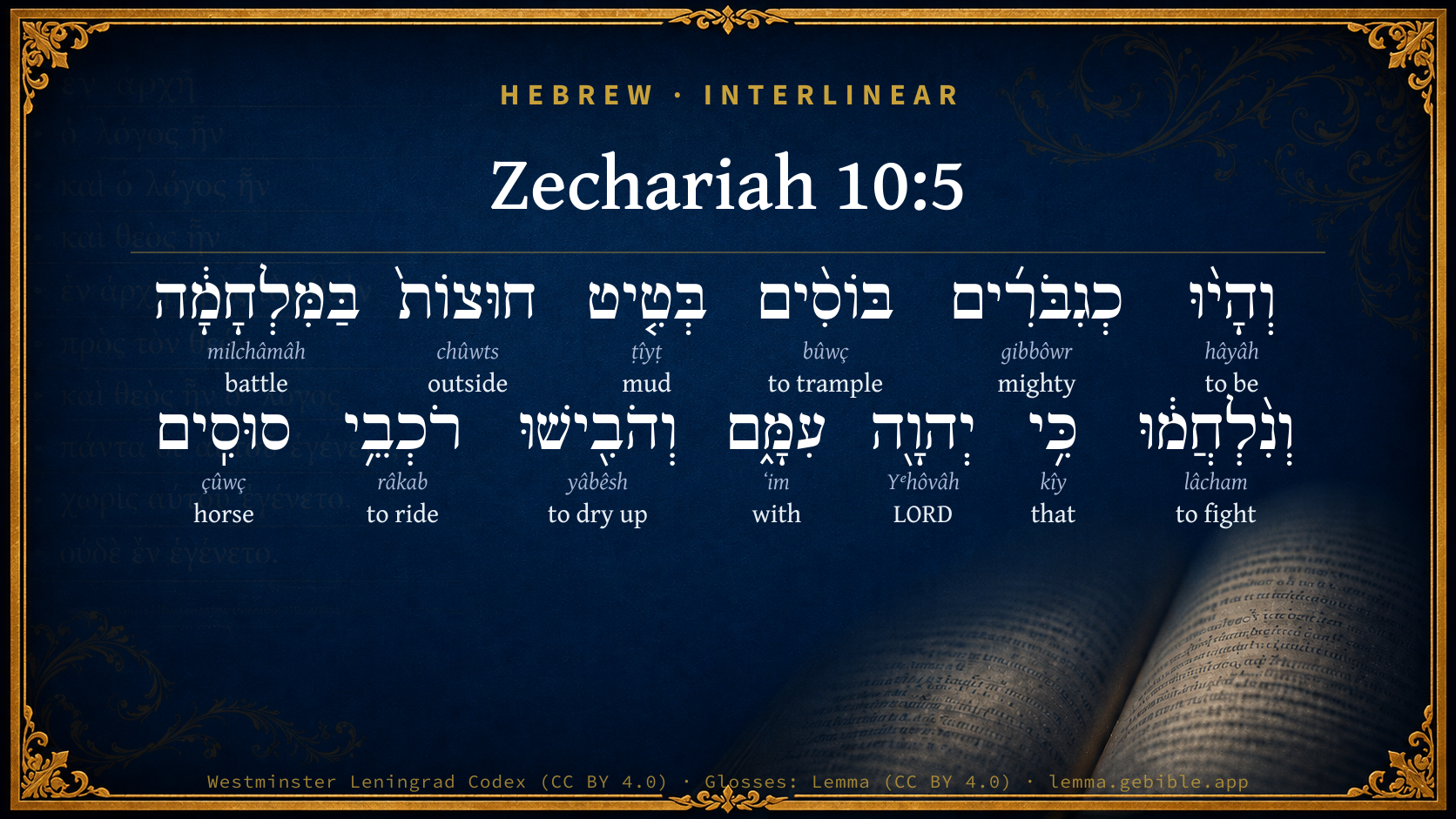
Hebrew (Westminster Leningrad Codex) Zechariah 10:5 appears in the Hebrew Old Testament. The text above is from the Westminster Leningrad Codex. Each word links to its Strong’s number, a concise gloss, and parsing drawn from the Open Scriptures Hebrew Bible morphology. Click any word for its full Brown-Driver-Briggs (BDB) entry.
Download image
Cite this verse

Zechariah 10:5 (World English Bible). Public Domain. Lemma interlinear Bible study tool, https://lemma.gebible.app/v/zechariah/10/5.

Show BibTeX & RIS
BibTeX
RIS
English Translation
They shall be as mighty men, Treading down muddy streets in the battle; And they shall fight, because Yahweh is with them; And the riders on horses will be confounded.
World English Bible · Public Domain
Download a study sheet

One document with this verse’s original text, its word-by-word gloss line, the meaning frame, cross-references with their text, attributed commentary, and full source and license credits — printable, and it pastes into notes with its structure intact.

This verse Autodidact and up

Study sheet (.html) Plain text (.txt)

A passage Seminary Student

Up to 50 verses in one chapter. A passage sheet keeps up to 6 commentary sources and 12 cross-references per verse, in the order this page ranks them, and says so on the sheet whenever that leaves anything out. Ask for a single verse and you get the Autodidact verse sheet above.

Everything on this page stays free to read, with no account — the sheet is a download of what is already on screen, not access to it.

Want to remove ads? Support Godless Engineer
Compare translations 3

The same verse in 3 English versions, stacked beneath the original-language interlinear above. Click any original word for its lexicon entry.

Each is an independent rendering of the whole verse — the interlinear is not word-aligned to these translations.

Highlighted words mark where these versions differ — a whole-verse word diff, not a word-by-word alignment.

  • World English Bible Public Domain
    They shall be as mighty men, Treading down muddy streets in the battle; And they shall fight, because Yahweh is with them; And the riders on horses will be confounded.
  • King James Version Public Domain
    And they shall be as mighty men, which tread down their enemies in the mire of the streets in the battle: and they shall fight, because the LORD is with them, and the riders on horses shall be confounded.
  • unfoldingWord Literal Text CC BY-SA 4.0
    They will be like warriors who trample into the mud of the streets in battle; they will make war, for Yahweh is with them, and they will shame those who ride warhorses.

unfoldingWord Literal Text — © unfoldingWord, licensed CC BY-SA 4.0. Word-aligned USFM3 via Door43 (git.door43.org/unfoldingWord/en_ult).

Versions to compare (up to 4)

3 of 4 selected

Show all 18 translations

Every available English version of this verse, each an independent rendering of the whole verse.

  • World English Bible Public Domain
    They shall be as mighty men, Treading down muddy streets in the battle; And they shall fight, because Yahweh is with them; And the riders on horses will be confounded.
  • Berean Standard Bible Public Domain
    They will be like mighty men in battle, trampling the enemy in the mire of the streets. They will fight because the LORD is with them, and they will put the horsemen to shame.
  • Majority Standard Bible Public Domain
    They will be like mighty men in battle, trampling the enemy in the mire of the streets. They will fight because the LORD is with them, and they will put the horsemen to shame.
  • King James Version Public Domain
    And they shall be as mighty men, which tread down their enemies in the mire of the streets in the battle: and they shall fight, because the LORD is with them, and the riders on horses shall be confounded.
  • American Standard Version (1901) Public Domain
    And they shall be as mighty men, treading down `their enemies' in the mire of the streets in the battle; and they shall fight, because Jehovah is with them; and the riders on horses shall be confounded.
  • Revised Version (1885) Public Domain
    And they shall be as mighty men, treading down their enemies in the mire of the streets in the battle; and they shall fight, because the LORD is with them: and the riders on horses shall be confounded.
  • Geneva Bible (1599) Public Domain
    And they shalbe as the mightie men, which treade downe their enemies in the mire of the streetes in the battell, and they shall fight, because the Lord is with them, and the riders on horses shall be confounded.
  • Douay-Rheims (1899) Public Domain
    And they shall be as mighty men, treading under foot the mire of the ways in battle: and they shall fight, because the Lord is with them, and the riders of horses shall be confounded.
  • Young's Literal Translation Public Domain
    And they have been as heroes, Treading in mire of out-places in battle, And they have fought, for Jehovah `is' with them, And have put to shame riders of horses.
  • Literal Standard Version CC BY-SA 4.0
    And they have been as heroes, || Treading in mire of out-places in battle, || And they have fought, for YHWH [is] with them, || And have put to shame riders of horses.
  • Unlocked Literal Bible CC BY-SA 4.0
    They will be like warriors who trample their enemies into the mud of the streets in battle; they will make war, for Yahweh is with them, and they will shame those who ride warhorses.
  • unfoldingWord Literal Text CC BY-SA 4.0
    They will be like warriors who trample into the mud of the streets in battle; they will make war, for Yahweh is with them, and they will shame those who ride warhorses.
  • Darby Bible Public Domain
    And they shall be as mighty men, treading down the mire of the streets in the battle; and they shall fight, for Jehovah is with them, and the riders on horses shall be put to shame.
  • World Messianic Bible Public Domain
    They will be as mighty men, treading down muddy streets in the battle. They will fight, because the LORD is with them. The riders on horses will be confounded.
  • Webster's Bible Public Domain
    And they shall be as mighty men, who tread down their enemies in the mire of the streets in the battle: and they shall fight, because the LORD is with them, and the riders on horses shall be confounded.
  • Free Bible Version CC BY-SA 4.0
    They will be like warriors going into battle, trampling their enemies in the mud. Because the Lord is with them they will fight and defeat the enemy cavalry.
  • Bible in Basic English Public Domain
    Together they will be like men of war, crushing down their haters into the earth of the streets in the fight; they will make war because the Lord is with them: and the horsemen will be shamed.
  • JPS Tanakh (1917) Public Domain
    And they shall be as mighty men, treading down in the mire of the streets in the battle, and they shall fight, because the LORD is with them; and the riders on horses shall be confounded.

Literal Standard Version (2020), Covenant Press — licensed CC BY-SA 4.0. Text via the HelloAO Bible API (eBible.org). Unlocked Literal Bible (unfoldingWord) — licensed CC BY-SA 4.0. Text via the HelloAO Bible API (eBible.org). unfoldingWord Literal Text — © unfoldingWord, licensed CC BY-SA 4.0. Word-aligned USFM3 via Door43 (git.door43.org/unfoldingWord/en_ult). Free Bible Version, Dr. Jonathan Gallagher — licensed CC BY-SA 4.0. Text via the HelloAO Bible API (eBible.org).

Word by word

More ways to search: Search by grammar → Find every occurrence → Compare this word →

Practice this passage: Drill this verse → Learn its vocabulary →

בּוֹסִ֨ים
bûwç
H947
“trampling”
Verb, Qal, Participle Active, Masculine, Plural, Absolute
Part of Speech
Verb
Stem
Qal
Form
Participle Active
Gender
Masculine
Number
Plural
State
Absolute
Full BDB Definition

Origin: a primitive root

TWOT: 216

to tread down, reject, trample down - (Qal) - to tread down, trample (of warriors) - of rejection (figuratively) - (Polel) - to tread down (in bad sense) - to desecrate - (Hithpolel) - to tread - to kick out - of infants' blind movements - of Jerusalem (figuratively) - (Hophal) to be trodden down
  1. וְהָי֨וּ hâyâh H1961 “and · to be” Conjunction + Verb, Qal, Perfect, 3rd Person, Common, Plural
  2. כְגִבֹּרִ֜ים gibbôwr H1368 “like/as · mighty” Preposition + Adjective, Adjective, Masculine, Plural, Absolute
  3. בְּטִ֤יט ṭîyṭ H2916 “in/at · mud of” Preposition + Noun, Common, Masculine, Singular, Construct
  4. חוּצוֹת֙ chûwts H2351 “streets” Noun, Common, Masculine, Plural, Absolute
  5. בַּמִּלְחָמָ֔ה milchâmâh H4421 “in/at the · battle” Preposition, Determined + Noun, Common, Feminine, Singular, Absolute
  6. וְנִ֨לְחֲמ֔וּ lâcham H3898 “and · to fight” Conjunction + Verb, Niphal, Perfect, 3rd Person, Common, Plural
  7. כִּ֥י kîy H3588 “that” Conjunction
  8. יְהוָ֖ה Yᵉhôvâh H3068 “LORD” Noun, Proper
  9. עִמָּ֑ם ʻim H5973 “with · them” Preposition + Suffix, Personal, 3rd Person, Masculine, Plural
  10. וְהֹבִ֖ישׁוּ yâbêsh H3001 “and · to dry up” Conjunction + Verb, Hiphil, Perfect, 3rd Person, Common, Plural
  11. רֹכְבֵ֥י râkab H7392 “riding” Verb, Qal, Participle Active, Masculine, Plural, Construct
  12. סוּסִֽים çûwç H5483 “horses” Noun, Common, Masculine, Plural, Absolute

About this verse

These counts appear in no published source. They are computed here, from the morphology-tagged text and Lemma’s own curated glosses. What Lemma adds →

13
words
13
distinct lemmas
Prophets
section

Notable vocabulary

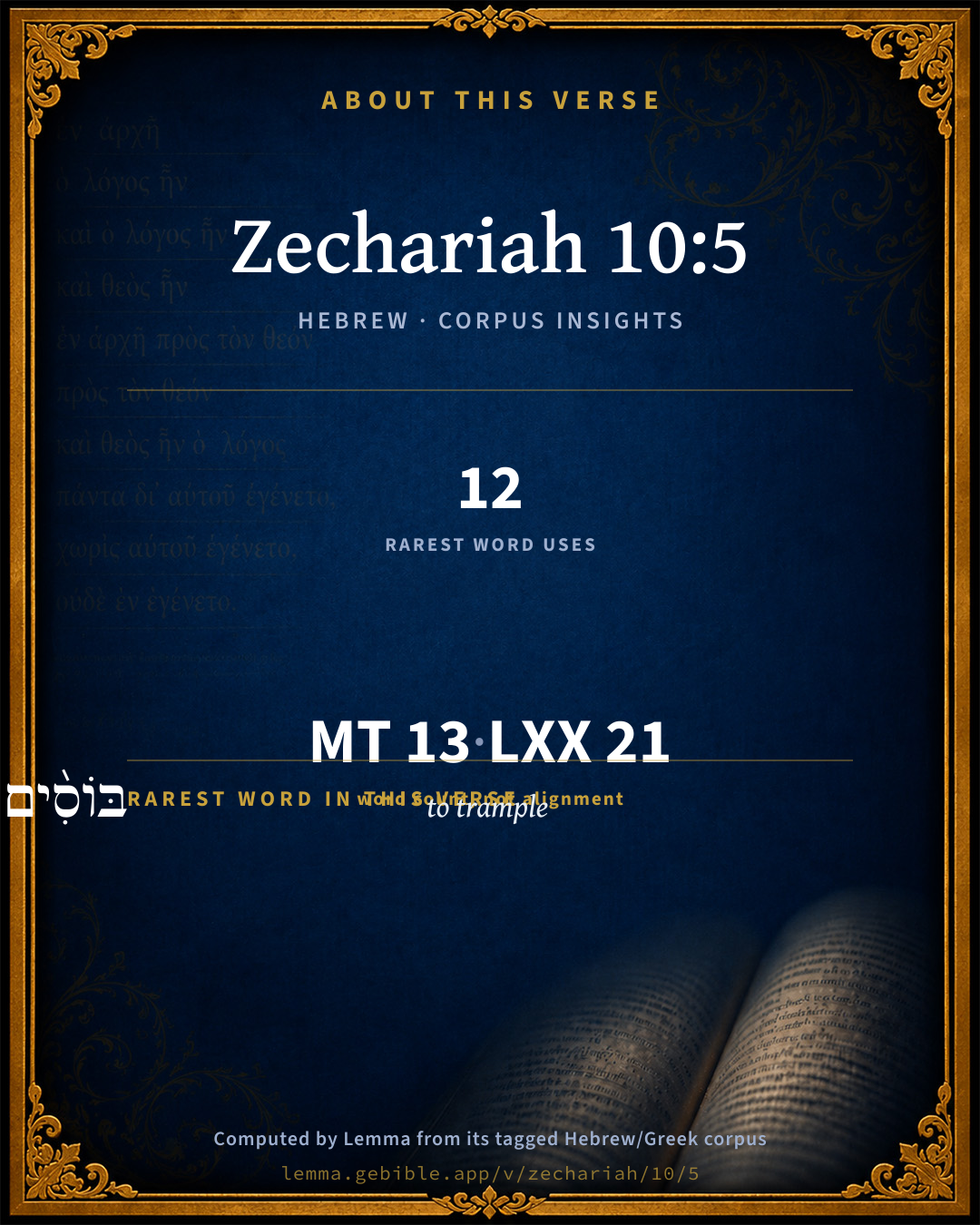
The rarest word here is בּוֹסִ֨ים to trample H947 — appearing just 12 times in the whole Hebrew Bible.

Shared distinctive vocabulary

בּוֹסִ֨ים to trample H947 occurs in 12 verses of the Hebrew Bible. Also found in:

Grammatical profile

  • 5 verbs
  • 5 nouns
  • 1 adjective
  • 1 preposition
  • 1 conjunction

Verb forms

  • וְהָי֨וּ Qal · Perfect
  • בּוֹסִ֨ים Qal · Participle Active
  • וְנִ֨לְחֲמ֔וּ Niphal · Perfect
  • וְהֹבִ֖ישׁוּ Hiphil · Perfect
  • רֹכְבֵ֥י Qal · Participle Active

Hebrew & Septuagint length

In English translation the verse runs 30 words from the Hebrew and 37 from the Septuagint (LXX English) — closely comparable.

A rough comparison of the two English renderings, which tokenize alike — not a word-level alignment.

Word counts can differ between the Hebrew and the Greek without any difference in meaning — e.g. the Hebrew direct-object marker אֵת has no separate Greek word, and Greek often adds the article ὁ.

In the original languages it is 13 Hebrew tokens and 21 Greek tokens — but the two are counted differently (Hebrew bundles its prefixes and suffixes into one token; the Greek is in lemma form), so that isn’t a like-for-like length.

Cross-references

35

Topical passages linked to Zechariah 10:5 in the Treasury of Scripture Knowledge — connected by theme and wording, ordered by reader-vote popularity; previews shown in the World English Bible.

  • Haggai 2:22 I will overthrow the throne of kingdoms. I will destroy the strength of the kingdoms of the nations. I will overthrow the chariots, and those who ride in them. The horses and their riders will come down, everyone by the sword of his brother.
  • Psalms 20:7 Some trust in chariots, and some in horses, But we trust the name of Yahweh our God.
  • Zechariah 9:13 For indeed I bend Judah as a bow for me. I have filled the bow with Ephraim; And I will stir up your sons, Zion, Against your sons, Greece, And will make you like the sword of a mighty man.
  • Zechariah 12:8 In that day Yahweh will defend the inhabitants of Jerusalem. He who is feeble among them at that day will be like David, and the house of David will be like God, like the angel of Yahweh before them.
  • Romans 8:31–37 What then shall we say about these things? If God is for us, who can be against us?
  • Deuteronomy 20:1 When you go forth to battle against your enemies, and see horses, and chariots, [and] a people more than you, you shall not be afraid of them; for Yahweh your God is with you, who brought you up out of the land of Egypt.
  • Joshua 10:14 There was no day like that before it or after it, that Yahweh listened to the voice of a man: for Yahweh fought for Israel.
  • Joshua 10:42 All these kings and their land did Joshua take at one time, because Yahweh, the God of Israel, fought for Israel.
  • 1 Samuel 16:18 Then answered one of the young men, and said, Behold, I have seen a son of Jesse the Bethlehemite, who is skillful in playing, and a mighty man of valor, and a man of war, and prudent in speech, and a comely person; and Yahweh is with him.
  • 2 Samuel 22:8 Then the earth shook and trembled, The foundations of heaven quaked Were shaken, because he was angry.
  • 2 Samuel 22:43 Then did I beat them small as the dust of the earth, I did crush them as the mire of the streets, and did spread them abroad.
  • Psalms 18:42 Then I beat them small as the dust before the wind. I cast them out as the mire of the streets.
  • Psalms 33:16 There is no king saved by the multitude of a host. A mighty man is not delivered by great strength.
  • Psalms 45:3 Gird your sword on your thigh, mighty one: Your splendor and your majesty.
  • Isaiah 8:9 Make an uproar, O you peoples, and be broken in pieces! And give ear, all you of far countries: gird yourselves, and be broken in pieces! Gird yourselves, and be broken in pieces!
  • Isaiah 10:6 I will send him against a profane nation, and against the people of my wrath will I give him a charge, to take the spoil, and to take the prey, and to tread them down like the mire of the streets.
  • Isaiah 25:10 For in this mountain will the hand of Yahweh rest; and Moab shall be trodden down in his place, even as straw is trodden down in the water of the dung-hill.
  • Isaiah 41:12 You shall seek them, and shall not find them, even those who contend with you: those who war against you shall be as nothing, and as a thing of nothing.
  • Ezekiel 38:15 You shall come from your place out of the uttermost parts of the north, you, and many peoples with you, all of them riding on horses, a great company and a mighty army;
  • Joel 3:12–17 "Let the nations arouse themselves, And come up to the valley of Jehoshaphat; For there will I sit to judge all the surrounding nations.
  • Amos 2:15 Neither shall he stand who handles the bow; And he who is swift of foot won't escape; Neither shall he who rides the horse deliver himself;
  • Micah 7:10 Then my enemy will see it, And shame will cover her who said to me, Where is Yahweh your God? Then my enemy will see me and will cover her shame. Now she will be trodden down like the mire of the streets.
  • Zechariah 12:4 In that day," says Yahweh, "I will strike every horse with terror, and his rider with madness; and I will open my eyes on the house of Judah, and will strike every horse of the peoples with blindness.
  • Zechariah 14:3 Then Yahweh will go out and fight against those nations, as when he fought in the day of battle.
  • Zechariah 14:13 It will happen in that day, that a great panic from Yahweh will be among them; and they will lay hold everyone on the hand of his neighbor, and his hand will rise up against the hand of his neighbor.
  • Matthew 4:3 The tempter came and said to him, "If you are the Son of God, command that these stones become bread."
  • Matthew 28:20 teaching them to observe all things that I commanded you. Behold, I am with you always, even to the end of the age." Amen.
  • Luke 24:19 He said to them, "What things?" They said to him, "The things concerning Jesus, the Nazarene, who was a prophet mighty in deed and word before God and all the people;
  • Acts 7:22 Moses was instructed in all the wisdom of the Egyptians. He was mighty in his words and works.
  • 2 Corinthians 10:4 for the weapons of our warfare are not of the flesh, but mighty before God to the throwing down of strongholds,
  • 2 Timothy 4:7 I have fought the good fight. I have finished the course. I have kept the faith.
  • Acts 18:24 Now a certain Jew named Apollos, an Alexandrian by race, an eloquent man, came to Ephesus. He was mighty in the Scriptures.
  • 2 Timothy 4:17 But the Lord stood by me, and strengthened me, that through me the message might be fully proclaimed, and that all the Gentiles might hear; and I was delivered out of the mouth of the lion.
  • Revelation 19:13–15 He is clothed in a garment sprinkled with blood. His name is called "The Word of God."
  • Revelation 19:17 I saw an angel standing in the sun. He cried with a loud voice, saying to all the birds that fly in the sky, "Come! Be gathered together to the great supper of God,

Cross-references courtesy of OpenBible.info (CC BY 4.0).

Hebrew and Greek witnesses Masoretic Hebrew ↔ Greek Septuagint

The same verse in the two great witnesses to the Old Testament, shown verse-for-verse.

These are two independent witnesses, not word-aligned to each other, and the Septuagint is shown in lemma (dictionary) form.

Hebrew Zechariah 10:5 Masoretic · Westminster Leningrad Codex

וְהָי֨וּ כְגִבֹּרִ֜ים בּוֹסִ֨ים בְּטִ֤יט חוּצוֹת֙ בַּמִּלְחָמָ֔ה וְנִ֨לְחֲמ֔וּ כִּ֥י יְהוָ֖ה עִמָּ֑ם וְהֹבִ֖ישׁוּ רֹכְבֵ֥י סוּסִֽים

They shall be as mighty men, Treading down muddy streets in the battle; And they shall fight, because Yahweh is with them; And the riders on horses will be confounded.

World English Bible · Public Domain

Greek LXX Zechariah 10:5 Septuagint · lemma form

καί εἰμί ὡς μαχητής πατέω πηλός ἐν ὁ ὁδός ἐν πόλεμος καί παρατάσσω διότι κύριος μετά αὐτός καί κατααἰσχύνω ἀναβάτης ἵππος

And they shall be as warriors treading clay in the ways in war; and they shall set the battle in array, because the Lord is with them, and the riders on horses shall be put to shame.

LXX2012 (modern English Septuagint) · Public Domain

On this verse, Keil & Delitzsch discusses the Septuagint’s reading. Read the note in Commentary ↓

Hebrew: Westminster Leningrad Codex (CC BY 4.0). Greek: Septuagint (public domain); English from LXX2012 (modern English Septuagint) (Public Domain). How the Septuagint differs from the Hebrew →

Targum (Aramaic paraphrase)

1

The Targum is the ancient Jewish Aramaic paraphrase of the Hebrew Scriptures — an interpretive translation, not the Hebrew text itself. Onkelos (literal) and Pseudo-Jonathan (expansive) render the Torah, and Jonathan the Prophets. Coverage is partial: where no permissively-licensed English translation exists for a verse, only the Aramaic is shown. This is verse-level text, not a word-by-word alignment to the Hebrew.

  1. Targum Jonathan Prophets (Joshua–Malachi)
    וִיהוֹן גִבָּרֵי בֵּית יִשְׂרָאֵל דַיְשִׁין קְטִילֵי עַמְמַיָא בְּטִין שׁוּקִין בִּקְרָבָא וְיִגְחוּן קְרָב אֲרֵי מֵימְרָא דַייָ בְּסַעְדְהוֹן וְיִבְהֲתוּן רָכְבֵי סוּסְוָן:

    (no public-domain English translation for this verse)

    Targum Jonathan — Aramaic: “Mikraot Gedolot” (public domain). English: “Sefaria Community Translation” (CC0 1.0 (public-domain dedication)); “London "Chaldee Paraphrase," 1871” (public domain). Text via Sefaria.

Commentary

Notes on Zechariah 10:5 from classic Christian and Jewish commentators (each source and its license shown beneath its notes). The classic Christian expositions comment on the surrounding passage and are grouped to its opening verse, so a note may address several verses; the Jewish commentaries on the Tanakh (Rashi and others) are per-verse, so they appear only where the commentator wrote on this verse.

Lemma curates 59 commentaries, every one of them public domain or Creative Commons licensed, each selected and text-cleaned for this edition rather than reprinted as found. About our sources →

Matthew Henry's Commentary

Here are divers precious promises made to the people of God, which look further than to the state of the Jews in the latter days of their church, and have certain reference to the spiritual Israel of God, the gospel-church, and all true believers.

I. They shall have God's favour and presence, and shall be owned and accepted of him. This is the foundation of all the rest: The Lord is with them, Zac 10:5. He espouses their cause, takes their part, is on their side; and, if he be for them, who can be against them? Again (Zac 10:6), I have mercy upon them. All their dignity and joy are owing purely to God's mercy; and mercy, as it supposes misery, so it excludes merit. They had been cast off, the effect of which could not but be misery; they had been justly cast off, and therefore could pretend to merit nothing at God's hand but wrath and the curse; yet it is promised, They shall be as though I had not cast them off. The transgressions of their fathers, for which they had been rejected, shall not only not be visited upon them, but shall not be so much as remembered against them. God will be as perfectly reconciled to them as if he had never contended with them, and the falling out of these lovers shall rather be the renewing than the weakening of love. They shall have such a full assurance of God's being reconciled to them, and upon that shall be so well reconciled to themselves, that they shall be as easy as if they had never been cast off; and their condition, after their restoration to the divine favour, shall be so very happy that there shall not remain the least scar from the wounds which were given them by their being cast off. Such favour does God show to returning repenting sinners, who were by nature at a distance, and children of wrath; such fellowship are they admitted into, and such freedom does he use with them, that they are as though they had never been cast off. 1. The covenant they are admitted into is the same that ever it was: I am the Lord their God, according to the original contract, the covenant made with their fathers. 2. The communion they are admitted into is the same that ever it was: I will hear them. They shall be as welcome as ever to speak to him, and as sure as ever to receive from him an answer of peace; for, as he never did, so he never will, say to Jacob's seed, Seek you me in vain.

II. They shall be victorious over their enemies, that would draw them from either their duty to God or their comfort in God (Zac 10:5): They shall be as mighty men, that are both strong in body and bold in spirit, men of vigour, men of valour, effective men. Those of Ephraim, as well as those of Judah, shall be like a mighty man (Zac 10:7), that dares to go about a difficult enterprise and is able to go through with it. They shall, as mighty men, tread down their enemies in the battle, as the dirt that is thrown out of the houses is trodden with other dirt in the mire of the streets. And they shall therefore fight, because the Lord is with them. Some would argue that they may therefore sit still, and do nothing, because the Lord is with them, who can and will do all. No; God's gracious presence with us to help us must not supersede, but quicken and animate, our endeavours to help ourselves; and we must therefore work out our salvation with fear and trembling, because it is God that works in us both to will and to do. They shall fight with readiness and resolution because, if God be with them, they are sure to be conquerors, more than conquerors. For then the riders on horses shall be confounded. The cavalry of the enemies shall be routed, and put into disorder, by the infantry of the Jews. The preachers of the gospel of Christ went forth to war a good warfare; they charged bravely, because God was with them; and the riders on horses that opposed them were confounded, for God chose the weak and foolish things of the world to confound the wise and mighty. But whence have they all this might? How come they to be so able, so active? It is in the Lord, and in the power of his might, that they are so (Zac 10:6): I will strengthen the house of Judah, and so I will save the house of Joseph. Note, God saves us by strengthening us, and works out our happiness by working in us to do our duty. And thus we are engaged to the utmost diligence in using the strength God gives us; and yet, when all is done, God must have the glory of all. God is our strength, and so becomes both our song and our salvation.

III. Those of them that are dispersed shall be gathered together into one body (Zac 10:6): I will bring them again to place them, bring them from other lands to place them in their own land. This was a token of their being perfectly restored to all their other ancient privileges - they shall be restored to the possession of their own land. This was fulfilled when the children of God that were scattered abroad were by faith in Christ incorporated in the gospel-chruch, and Jews and Gentiles became one fold, Joh 10:16. In order to this (Zac 10:8) I will hiss for them, or, rather, whistle for them, as the shepherd with his pipe calls his sheep together, that know his voice; and so I will gather them. The preaching of the gospel was, as it were, God's hissing for souls to come to Jesus Christ, his calling in his scattered sheep to the green pastures. I will gather them, for I have redeemed them. Note, Those whom Christ has redeemed by his blood God will gather by his grace, as a hen gathers her brood under her wings. This promise is enlarged upon Zac 10:10, I will bring them again also out of the land of Egypt. Some think this was literally fulfilled when Ptolemaeus Philadelphus king of Egypt sent 120,000 Jews out of his country into their own land, as was the promise of gathering them out of Assyria by Alexander the son of Antiochus Epiphanes. But it has its spiritual accomplishment in the gathering in of precious souls out of a bondage worse than that in Egypt or Assyria, and the bringing of them into the glorious liberties of the children of God and their enjoyments, which are as the beautiful fruitful pastures in the land of Gilead and Lebanon. All the land of promise is theirs, even Gilead, the utmost border of it eastward, and Lebanon, the utmost border northward. But how shall this be? How shall a people so dispersed be got together? How shall those that are set at such a distance from their own country be brought to it again? It is true the difficulties seem insuperable, but they shall be got over as easily, as effectually as those that lay in the way of their deliverance out of Egypt and their entrance into Canaan: He shall pass through the sea with affliction, as of old through the Red Sea, to the sore affliction of Pharaoh and his hosts, or to the sore affliction of the sea, the waves whereof he shall smite, so that it shall be driven back, as when the sea saw and fled, Psa 114:3. And all the deeps of the river (all the rivers, though ever so deep) shall dry up, as Jordan did, to make way for Israel's passage into that good land which God had given them. Does the pride of Assyria stand in the way of their deliverance? He shall give check to it who sets bounds to the proud waves of the sea, and it shall be brought down. Does the sceptre of Egypt oppose it? That shall depart away, so that it shall not be able to obstruct the gathering in of God's Israel when his time shall come for the doing of it. When the gospel-chruch was to be gathered out of all nations by the preaching of the gospel great opposition was given to it by the enraged combined powers of earth and hell. Insuperable difficulties seemed to be in the way of it. But, by a divine power going along with the doctrine of Christ, it became mighty to the pulling down of strong holds, and the conversion and salvation of thousands. Then the sea fled, and Jordan was driven back at the presence of the Lord.

IV. They shall greatly multiply, and the church, that new world, shall be replenished (Zac 10:8): They shall increase as they have increased formerly in Egypt, and great additions shall be made to their numbers, as in the days of David and Solomon. When God gathers his redeemed ones to himself they shall help to gather in others with them, and their motion homeward shall be like that of a snow-ball. Crescit eundo - The further it goes the larger it grows by accretion. I will gather them, and they shall increase. Note, The church of Christ is a growing body, as long as it is in the present state of minority, till it comes to the measure of the stature of the fulness of Christ. There are added to it daily such as shall be saved. 1. It shall spread to distant places. It shall fill Canaan, even to the lands of Gilead and Lebanon, so that no more place, no more room, shall be found for it there, Zac 10:10. In Judah only God had been known, and his name was great in Israel only; here only he revealed his statutes and judgments. But in gospel-times that place shall be much too strait; the church's tent must be enlarged, and its cords lengthened: Then I will sow them among the people, Zac 10:9. Their scattering shall be like the scattering of seed in the ground, not to bury it, but to increase it, that it may bring forth much fruit. The Jews are said to be dispersed into every nation under heaven (Act 2:5); and, as it was their troubles that dispersed some of them, so perhaps others transplanted themselves into colonies because the land of Israel was too strait for them; and many were natives of other nations, but proselyted to the Jewish religion. Now these were sown among the people, Hos 2:23. And this contributed very much to the spreading of the gospel. The Jews that came from all parts to worship at Jerusalem fetched thence the gospel light and fire to their own countries, as those Acts 2, and the eunuch, Acts 8. And their own synagogues in the several cities of the Gentiles were the first receptacles of the apostles and their preaching, wherever they came. Thus when God sowed them among the people, that they might not get hurt by the Gentiles, but do good to them, he took care that they should remember him, and make mention of his name in far countries; and, by keeping up the knowledge of God among them as he had revealed himself in the Old Testament, they would be the more ready to admit the knowledge of Christ as he has revealed himself in the New Testament. 2. It shall last to future ages. The church shall not be res unius aetatis - a temporary thing, but a seed in it shall serve the Lord, Zac 10:7. Yea, their children shall see it and be glad; and they shall live with their children, and turn again, Zac 10:9. Converts to Christ shall have their children about them, whom they shall teach the knowledge of the Lord, and bring with them when they turn again to the holy land and the way of holiness. It was said to those to whom the gospel was first preached, The promise is to you and to your children, Act 2:39. They shall be so sown among the people as never to be extirpated. Christ's family upon earth shall never be extinct, nor his purchased possession lost for want of heirs.

V. God himself will be both their strength and their song. 1. In him they shall be comforted, and shall have abundant satisfaction (Zac 10:7): Their heart shall rejoice as through wine; for Christ's love, which is their joy, is better than wine. They shall be like a mighty man, and their heart shall rejoice. When we resolutely resist, and so overcome, our spiritual enemies, then our hearts shall rejoice. But we ruin our own joy if our resistance be feeble and we yield to the temptations of Satan. Their heart shall rejoice, and then they shall be as a mighty man; for the joy of the Lord will be our strength. And with their graces their joys shall be propagated: Their children shall see it and be glad, and their hearts also shall rejoice in the Lord. It is good to acquaint children betimes with the delights of religion, and to make the services of it as pleasant as may be to them, that, learning betimes to rejoice in the Lord, they may with purpose of heart cleave to him. 2. By him they shall be carried on with vigour, and enlargement of heart, in his service (Zac 10:12): I will strengthen them in the Lord, strengthen them for their walk and work, as well as for their warfare. It is the God of Israel that gives strength and power unto his people, that strengthens all their powers and faculties for spiritual performances, above what they are by nature and against what they are by the corruption of nature. Now observe, (1.) How they are thus enabled and invigorated for their duty: I the Lord will strengthen them in the Lord, in the Messiah, who is Jehovah our strength, as well as Jehovah our righteousness. Strength is treasured up for us in Christ, and from him it is communicated to us. It is through Christ strengthening us that we can do all things, and without him we can do nothing. His strength is commanded him for this purpose, Psa 68:28. (2.) What good use they shall make of this strength given unto them: They shall walk up and down in his name. If God strengthen us, we must bestir ourselves, must walk up and down in all the duties of the Christian life, must be active and busy in the work of God, must walk up and down as industrious men do, losing no time, and letting slip no opportunity. But still we must walk up and down in the name of Christ, must do all by warrant from him and in dependence on him, with an eye to his word as our rule and his glory as our end. To us to live must be Christ; and, whatever we do in word or deed, we must do all in the name of the Lord Jesus, that we receive not the strengthening grace of God in vain. See Psa 80:17, Psa 80:18.

Matthew Henry's Commentary on the Whole Bible (1708–1710) — public domain (CC PDM 1.0). Text via the HelloAO Bible API.

Trapp's Complete Commentary

John Trapp

Zec 10:5 And they shall be as mighty [men], which tread down [their enemies] in the mire of the streets in the battle: and they shall fight, because the LORD [is] with them, and the riders on horses shall be confounded.

Ver. 5. And they shall be as mighty men] Or, as giants, as Gabriels, they shall be strong in the Lord, and in the power of his might, they shall do worthily in Ephratas, and be famous in Bethlehem, Rth 4:11 "their bow shall abide in strength, and the arms of their hands be made strong, by the hands of the mighty God of Jacob: from thence is the shepherd, the stone of Israel," Gen 49:24. If it could be said of Mithridates, a mere atheist, that he never wanted any courage nor counsel; how much more of God’s warriors, such as Judas Maccabeus, especially Messiah, the Prince, who treads down his enemies as the mire of the streets, setting his feet in their necks and making them to be found liars unto him, that is, to yield him at least a forced and feigned subjection.

And they shall fight because the Lord is with them] This is enough to make them fight up to the knees in blood, that they have God to stand by them; not only as a spectator, or Agonotheta (though that is somewhat; dogs and other baser creatures will fight lustily when their masters are by, and do set them on), but as a Captain of the Lord’s hosts, as Christ is called, and a coadjutor, a champion, man of war, Exo 15:3. Yea, he alone is whole army of men, he is Van and Rear both Isa 52:12. The shields of the earth belong to him, the militia of the world is his, Psa 47:9, he hath magnleh cheloth and matteh cheloth as the Rabbis well observe, armies both above and beneath, as his horse and foot to fight for his people.

And the riders on horses shall be confounded] As they were in the conquest of Canaan, where the enemies had horses and chariots, when the Israelites had neither, as Origen observeth and as they were all in David’s wars, and the rest of the victorious kings of Israel, who, according to the law, Deu 17:16, made no use of horses (but said, A horse is but a vain thing for battle, &c. God takes no delight in the strength of a horse), and ever fought on foot with singular success. So did the Maccabees, Zisca, and after him the Bohemians, the English in France at the battle of Spurs (so the battle of Terwin was called in Henry VIII’s time, from the French fleeing away to save their lives).

John Trapp, A Commentary or Exposition upon All the Books of the Old and New Testament (1647–1656) — public domain. Text from a community e-Sword module.

The Biblical Illustrator

Joseph S. Exell

Zec_10:5

Because the Lord is with them

Jehovah with His people

There is nothing which so emphatically marks and so undoubtedly describes the people of the living God as His own presence with them.

1. The Lord is with His Church relatively. It is only a third part, and perhaps a small third. We might divide our own land into one-third of open enemies, one-third of false professors, and one-third of real Christians. The third part only are really spiritual characters, having the blessing of vital godliness. These shall remain; they shall be left. God is with them relatively, that is, He is with them in covenant union eternally.

2. The Lord is with His Church experimentally. God has always been with His Church, as a body, and with the individual members.

3. The Lord is with His Church perpetually. It is His promise, I am with you alway, even unto the end of the world.

Consider how this fact that Jehovah is with His people, explains some mysteries. Because the Lord is with them.

1. Then they shall fight victoriously and successfully. This explains why their enemies cannot destroy them.

2. For this same reason the truth of God must triumph. Note the distinct character of the Church and their destiny, as set forth in this text. Life Divine is a pledge of life eternal. Ii God be with you, your religion is a thing of life. Gods yea and amen are stamped upon His people. (Joseph Irons.)

Victory, unification, and blessedness far the good

I. Victory. This victory was--

1. Complete. The enemies were trodden down as mire in the streets.

2. Divine. Because the Lord is with them.

3. Reinvigorating. I will strengthen the house of Judah. They would be strengthened by their victory, not only in wealth and security, but in courage.

4. Extensive. And they of Ephraim shall be like a mighty man, and their heart shall rejoice as through wine: yea, their children shall see it, and be glad; their heart shall rejoice in the Lord. The prophet had, says Hengstenberg, occupied himself first of an with Judah, the centre of the people of God. In Zec_10:6 he proceeds to speak of Judah and Ephraim together. In this verse, and those which follow, he fixes his attention peculiarly upon Ephraim, which looked in the prophets day like a withered branch that had been severed from the vine. He first promises that descendants of the citizens of the former kingdom of the ten tribes will also take part in the glorious conflict, and then announces the return of the ten tribes from their exile, which was to be the condition of their participating in the battle. Now, all these facts connected with this victory apply to that victory the grandest of all,--the victory of all true souls over error and wrong.

II. Unification. I will hiss for them, and gather them, etc. Observe--

1. The ease with which the regathering win be effected. I will hiss [or whistle] for them. The word is understood as referring to a particular whistle used by the shepherd for calling his scattered flock together, or by those who have the care of bees, to bring them into the hive. As sheep flock together at the well-known call of the shepherd, as bees follow in swarms the shrill note of the beemaster, so should the Lord, by His own means, gather His scattered people from their dispersions, how widely soever distant, and bring them to Himself and to their heritage. With what ease God does His work; a mere look, a breath, a word!

2. The regions to which the regathering will extend. And I will sow them among the people,--or, as it should be rendered, though I have scattered them among the nations,--and they shall remember Me in far countries [distant regions]; they shall live with their children, and turn again. They had been scattered, not only through Egypt and Assyria. It does not say that all Jews shall return, but a great multitude is implied.

3. The scene at which the regathering will take place. I will bring them again also out of the land of Egypt, etc.

4. The national catastrophes which the regathering will involve. And he shall pass through the sea with affliction, and shall smite the waves in the sea, and all the deeps of the river shall dry up. There is evidently an allusion here to their first deliverance from Egypt; and it means that something similar to that event will occur in the course of their regathering (see Exo_24:4-14). And the pride of Assyria shall be brought down, and the sceptre of Egypt shall depart away. The idea probably is, that as the haughty boastings of Sennacherib, and the sceptred power of Pharaoh proved alike feeble and unavailing against the might of Jehovah in former days, so should all the combined opposition of the most inveterate enemies prove in days to come. Before Him,--when He had a purpose to fulfil, or promise to His people to accomplish,--all pride should be abased, all power baffled, all counsel turned to foolishness. Now there is a unification, of which this is but a faint emblem--the unification of the good of all ages. They shall come from the east and from the west, from the north and from the south, and shall sit down with Isaac and with Jacob. What a blessed union is this!

III. Blessedness. Here is the highest strength. And I will strengthen them in the Lord,

1. Whether this refers to their national strength, their security in their own country, or moral strength,--strength of faith in Him,--or all, one thing is clear, that to be strengthened in the Lord is the highest strength we can get. The greatest blessing of life is strength: physical strength, to do with ease and to endure with patience. Intellectual strength, strength to master with ease all the great problems of life, and to reach a theory of being in which the understanding can repose free from all disturbing doubt. These strengths are blessings; but moral strength,--strength to resist the wrong, to pursue the right, to serve Almighty God with acceptance, and to bless the race with beneficent influences,--this indeed is the perfection of our blessedness. Be strong in the Lord, and in the power of His might, says Paul. He giveth power to the faint, and to them that have no might He increaseth strength.

2. Here is the highest exercise. They shall walk up and down in His name, saith the Lord.

(1) All living men must walk the road that is up and down. Human life is made up of ups and downs; the road is not smooth and level, but rugged and hilly, sometimes up and sometimes down: up today and down tomorrow.

(2) This road can only be walked happily by walking it in the name of the Lord. A practical recognition of His presence and of His claims to our supreme reverence and worship. (Homilist.)

Judah and Joseph

There can be no question that the gradual development of the great principles of the Reformation has led to a corresponding discovery of the duty and obligation of Christians towards Gods ancient people. But our interest in the Jewish question should be based upon sound scriptural principles. If we confine our view exclusively to the hopes which unfulfilled prophecy presents, we shall be in danger of indulging speculations inconsistent with the history of the past, and irreconcilable with present duty. If we confine attention to the present aspect of the Jewish people, to the exclusion of the consideration of prophecy, we descend to the arena of political expediency. The destinies of the world are inseparably bound up with the Jewish people. In making any effort for the evangelisation of the Jew, there are three points demanding attention.

I. The persons to whom we are directing our efforts. In the text we have an address to the two grand divisions of the nation,--Judah, and Joseph or Israel; and a blessing common to both is secured by virtue of the covenant relation in which God stands to them mutually. I am the Lord their God, If we can find traces of Judah, and none of Joseph, probably the latter are in reserve, and sooner or later will come into the enjoyment of the promised mercy. It is objected, that the words of the text were fulfilled upon the restoration of the Jews after the captivity in Babylon. But the prophecy of Zechariah was delivered to the remnant which had returned. If Zechariah foretells fuller blessings than any which had been enjoyed up to the period of the restoration from Babylon, when were they enjoyed? If the two divisions or families of Israel returned after the Babylonish captivity, the distinction between Judah and Ephraim was at an end; and the conditions of the national covenant with Abraham, Isaac, and Jacob, so far as the land, the city, and the possession of the inheritance was concerned, must have been accomplished. But the facts of the case do not correspond with any of the leading provisions of the covenant.

1. Instead of an increase, there was a decrease of population.

2. The extent of territory inhabited by Jews after the captivity was even more limited than that which had been apportioned to the tribes by Joshua, and much less than that which was promised to Abraham.

3. Their civil polity did not correspond to the promise (Eze_37:22-24; Hos_1:11).

4. If the return from Babylon was a restoration, and only one restoration is spoken of by the prophets, then how can we explain the full declaration in our text, They shall be as though I had not cast them off? Where are the myriads of Israelites who in their hiding place have been in existence, and have been multiplying, for all we know, since the days of Shahnaneser until now? The little remnant sojourning in these western portions of the world can only be regarded as emigrants from a vast and populous nation, whose locality is as yet unknown and unvisited by us.

II. The grounds for supposing that any success will attend our efforts. We may assume that the nation of Israel has not lost its place in the Divine purpose. However secretly and obscurely to us, the Jews occupy as important and influential a position in reference to other nations of the world as in the days of old. The fortunes of Israel have ever been bound up with the destinies of nations; and we have no reason to suppose that this universal rule of the Divine administration has been or will be departed from. The Jews have been and are the index to prophecy. We authenticate chronology and balance historical accuracy by reference to this wonderful people. If, under the Old Testament dispensation, the kingdoms of the Gentiles performed their appointed course around the visible centre of Israel, we must also believe that under the New Testament, which is a supplement of the Old, the empires of the world are now revolving round the same centre, although obscured and unseen.

III. The privilege of participating in these efforts.

1. It is a privilege to have the grace of faith and prayer continually exercised. Effort for the good of Israel is a work of faith from first to last. No temporal or international advantage can enter into the consideration of it; no worldly or selfish motive can be charged upon those who engage in it. The friend of Israel walks by faith, not by sight. What encouragement is now presented in the results of work for the Jews! But mercy to Israel is mercy to the world. God has declared His will concerning the precious sons of Zion. It is a privilege to know that the truth of Gods Word is tested by His faithfulness to Israel. What is promised to individuals is promised to the nation. If the promises (such as Isa_24:1-23; Isa_25:1-12; Isa_26:1-21.; Hos_13:14; 1Co_15:54; Mat_23:39, etc.) belong not to the nation, they belong not unto us. It would be a strange inconsistency for us as Gentiles to employ these passages as a ground of our hope of a resurrection, and withhold them from the Jewish nation, who read them literally as a promise to their fathers (Act_23:6; Act_24:21; Act_26:6-7). Do we look for the return of Christ? Then let us reconcile the contemporaneous existence of the earthly and heavenly Jerusalem. Jesus, the light of the Gentiles, is the glory of His people Israel. Gentile fulness and Israels glory will flow in together. Like the sudden burst of two fountains they will join their living streams, and fill to overflowing the long-prepared channels, and flood the universe with blessing, and the knowledge of the glory of the Lord will cover the earth as the waters cover the sea. (W. R. Fremantle, M. A.)

The Biblical Illustrator, edited by Joseph S. Exell (c. 1880s–1900s) — public domain. Text from a community e-Sword module.

Joseph Benson's Commentary

Zec 10:5-7. And they — The Jews, under the conduct of their captains; shall be as mighty men which tread down their enemies — God shall inspire them with courage to subdue their enemies, and trample upon their carcasses. This it seems must be understood of the victories obtained by the Jews under the Maccabees, or of those which they shall obtain over their enemies in the latter times, to which the latter part of the chapter seems ultimately to relate. And the riders on horses shall be confounded — The cavalry of Antiochus seems to be intended by this. We have a description of this cavalry in some heathen writers, which shows it to have been a very formidable one. And I will strengthen the house of Judah — I will not only give courage to attempt, but also strength to go through with and finish the undertaking. This was remarkably verified in the wars of the Jews against the Seleucidæ, in which wars they had wonderful difficulties, and as wonderful courage and success. And I will save the house of Joseph — The remnant of the kingdom of Israel, the residue of the ten tribes. And I will bring them again — Both Judah and Joseph, out of captivity, or from their various dispersions; to place them — In their own land and in their own cities. This promise is understood by many interpreters to relate to the general restoration of the Jewish nation upon their conversion, a subject which seems to be treated of in many passages of the Old Testament, in which Judah and Israel are represented as equal sharers of this blessing: see the note on Isa 11:11, and compare Eze 37:16. And they shall be as though I had not cast them off — They shall be in as flourishing a condition as they were before I cast them off. And they of Ephraim shall be like a mighty man — Ephraim is put here for the ten tribes, as the house of Joseph is, Zec 10:6. And their heart shall rejoice as through wine —

Their heart shall be made as glad by their victories, as if they had been made merry through wine. Yea, their children shall see it and be glad — The children and youths, not yet fit for war, shall partake of their fathers’ joy.

Joseph Benson's Commentary on the Old and New Testaments (1811–1818) — public domain. Text from a community e-Sword module.

Keil & Delitzsch

C. F. Keil & F. Delitzsch

Thus equipped for battle, Judah will annihilate its foes. Zac 10:5. "And they will be like heroes, treading street-mire in the battle: and will fight, for Jehovah is with them, and the riders upon horses are put to shame. Zac 10:6. And I shall strengthen the house of Judah, and grant salvation to the house of Joseph, and shall make them dwell; for I have had compassion upon them: and they will be as if I had not rejected them: for I am Jehovah their God, and will hear them. Zac 10:7. And Ephraim will be like a hero, and their heart will rejoice as if with wine: and their children will see it, and rejoice; their heart shall rejoice in Jehovah." In Zac 10:5, bōsı̄m is a more precise definition of kegibbōrı̄m, and the house of Judah (Zac 10:3) is the subject of the sentence. They will be like heroes, namely, treading upon mire. Bōsı̄m is the kal participle used in an intransitive sense, since the form with o only occurs in verbs with an intransitive meaning, like bōsh, lōt, qōm; and būs in kal is construed in every other case with the accusative of the object: treading upon mire = treading or treading down mire. Consequently the object which they tread down or trample in pieces is expressed by בּטיט חוּצות; and thus the arbitrary completion of the sentence by "everything that opposes them" (C. B. Mich. and Koehler) is set aside as untenable. Now, as "treading upon mire" cannot possibly express merely the firm tread of a courageous man (Hitzig), we must take the dirt of the streets as a figurative expression for the enemy, and the phrase "treading upon street-mire" as a bold figure denoting the trampling down of the enemy in the mire of the streets (Mic 7:10; Sa2 22:43), analogous to their "treading down sling-stones," Zac 9:15. For such heroic conflict will they be fitted by the help of Jehovah, that the enemy will be put to shame before them. The riders of the horses are mentioned for the purpose of individualizing the enemy, because the principal strength of the Asiatic rulers consisted in cavalry (see Dan 11:40). הובישׁ intransitive, as in Zac 9:5. This strength for a victorious conflict will not be confined to Judah, but Ephraim will also share it. The words, "and the house of Ephraim will I endow with salvation," have been taken by Koehler as signifying "that Jehovah will deliver the house of Ephraim by granting the victory to the house of Judah in conflict with its own foes and those of Ephraim also;" but there is no ground for this. We may see from Zac 10:7, according to which Ephraim will also fight as a hero, as Judah will according to Zac 10:5, that הושׁיע does not mean merely to help or deliver, but to grant salvation, as in Zac 9:16. The circumstance, however, "that in the course of the chapter, at any rate from Zac 10:7 onwards, it is only Ephraim whose deliverance and restoration are spoken of," proves nothing more than that Ephraim will receive the same salvation as Judah, but not that it will be delivered by the house of Judah. The abnormal form הושׁבותים is regarded by many, who follow Kimchi and Aben Ezra, as a forma composita from הושׁבתּים and השׁיבותי: "I make them dwell, and bring them back." But this is precluded by the fact that the bringing back would necessarily precede the making to dwell, to say nothing of the circumstance that there is no analogy whatever for such a composition (cf. Jer 32:37). The form is rather to be explained from a confusion of the verbs עו and פי, and is the hiphil of ישׁב for הושׁבתּים (lxx, Maurer, Hengstenberg; comp. Olshausen, Grammat. p. 559), and not a hiphil of שׁוּב, in which a transition has taken place into the hiphil form of the verbs פו (Ewald, 196, b, Not. 1; Targ., Vulg., Hitzig, and Koehler). For "bringing back" affirms too little here. הושׁבתּים, "I make them dwell," corresponds rather to "they shall be as if they had not been cast off," without needing any further definition, since not only do we meet with ישׁב without anything else, in the sense of peaceful, happy dwelling (e.g., Mic 5:3), but here also the manner of dwelling is indicated in the appended clause כּאשׁר לא־זנחתּים, "as before they were cast off" (cf. Eze 36:11). אענם is also not to be taken as referring to the answering of the prayers, which Ephraim addressed to Jehovah out of its distress, out of its imprisonment (Koehler), but is to be taken in a much more general sense, as in Zac 13:9; Isa 58:9, and Hos 2:23. Ephraim, like Judah, will also become a hero, and rejoice as if with wine, i.e., fight joyfully like a hero strengthened with wine (cf. Psa 78:65-66). This rejoicing in conflict the sons will see, and exult in consequence; so that it will be a lasting joy.

Keil & Delitzsch — Biblical Commentary on the Old Testament (1861–1891) — public domain (CC PDM 1.0). Text via the HelloAO Bible API. (Old Testament only.)

Jamieson, Fausset & Brown

Robert Jamieson, A. R. Fausset & David Brown

riders on horses--namely, the enemy's horsemen. Though the Jews were forbidden by the law to multiply horses in battle (Deu 17:16), they are made Jehovah's war horse (Zac 10:3; Psa 20:7), and so tread down on foot the foe with all his cavalry (Eze 38:4; Dan 11:40). Cavalry was the chief strength of the Syro-Grecian army (I Maccabees 3:39).

Jamieson, Fausset & Brown — Commentary Critical and Explanatory on the Whole Bible (1871) — public domain (CC PDM 1.0). Text via the HelloAO Bible API.

Adam Clarke's Commentary

Verse 5. They shall be as mighty men] The Maccabees and their successors.

Riders on horses] The Macedonians, who opposed the Maccabees, and had much cavalry; whereas the Jews had none, and even few weapons of war; yet they overcame these horsemen.

Adam Clarke's Commentary on the Bible (1810–1826) — public domain. Text from a community e-Sword/MySword module.

John Calvin's Commentaries

He confirms what I have already said — that the Jews would be victorious over all nations. Though the Church is fighting under the cross, she yet triumphs over all the wicked, partly by hope and partly by present success; for God wonderfully sustains it, and makes the faithful to possess their souls in patience; and he also protects them by his own power, and renders them safe amidst all the roarings and insatiable rage of their enemies. Since then God thus strengthens the minds of his people, and cherishes in them the hope of salvation, and also defends them against raging assaults, it is no wonder that the Prophet testifies that the church would be victorious, treading down, as a giant or a strong man, her enemies in the mire.

He gives the reason, For Jehovah will be with them; and this he said, that they might know that nothing in this case would be their own, but that they might, on the contrary, learn to depend on God’s aid alone. And he explains this still more clearly at the end of the verse, by saying, Ashamed shall be the riders on horses; that is, their strength and velour, their use of arms and their skill in handling them, shall avail them nothing, for the Lord will lay prostrate, notwithstanding their arrogance and pride, all those wicked men who in their cruelty devour the faithful, and think that they have strength more than enough to destroy the Church: the Lord will cause all these things to pass away like mist.

John Calvin's Commentaries (1540-1563) — public domain. Text from the Calvin Translation Society English edition (1840s-50s) via the Christian Classics Ethereal Library (ccel.org). Calvin's coverage is partial (roughly two-thirds of the Bible); uncommented books and verses are honest gaps, never fabricated. The 19th-century editor's footnotes and remarks are omitted so the notes are faithfully Calvin's own voice.

Ellicott's Commentary for English Readers

(5-7) The preceding idea is now further dwelt on, and Ephraim not merely implicitly, but explicitly (as in Zec_9:13-16) included in the promise as one with Judah (Eze_37:16-17; Eze_37:22). For a fulfilment of the promises contained in this passage, see 1Ma_3:39; 1Ma_4:7; 1Ma_4:31; 1Ma_6:30; 1Ma_6:35; 1Ma_9:4; 1Ma_9:11; 1Ma_10:73; 1Ma_10:77; 1Ma_15:13, &c.

A Bible Commentary for English Readers, edited by Charles John Ellicott (1878–1897) — public domain. Text from a community e-Sword module.

The Cambridge Bible for Schools and Colleges

gen. ed. J. J. S. Perowne

5. Comp. Zec_9:15.

The Cambridge Bible for Schools and Colleges (gen. ed. J. J. S. Perowne; Cambridge University Press, 1878–1918) — public domain. Text from a community e-Sword module.

John Gill's Exposition

And they shall be as mighty men,.... That is, the converted Jews shall be such; they shall be strong in faith, giving glory to the Messiah; they shall be strong in the grace that is in him; they shall be strong in the Lord, and in the power of his might; his strength shall be made perfect in their weakness:

which tread down their enemies in the mire of the streets in the battle; being victorious over sin, Satan, and the world, through Christ, in whom they will believe:

and they shall fight; against all their inward and outward enemies, the good fight of faith, with great valour and courage:

because the Lord is with them; who is the Lord of hosts or armies; his presence gives boldness and intrepidity; for, if he is for them, who can be against them? the battle is theirs, success is certain:

and the riders on horses shall be confounded; such that come up against them on them, and trust in them, shall be beaten by them, and so made ashamed; and the flesh, both of the horses and their riders, shall be the food of the fowls of the air, Rev 19:18 perhaps the Turkish cavalry is meant, who may attempt to hinder the settlement of the Jews in their own land; the armies of the Turks consisting greatly of horsemen, Rev 9:16.

John Gill's Exposition of the Whole Bible (1746–1763) — public domain (CC PDM 1.0). Text via the HelloAO Bible API.

Albert Barnes' Notes on the Bible

And they - (the house of Judah , of whom he had said, He hath made them as the goodly horse in the battle) shall be as mighty men, trampling on the mire of the streets Micah had said, “she shall be a trampling, as the mire of the streets” Mic 7:10, and David, “I did stamp them as the mire of the street” 2Sa 22:43. Zechariah, by a yet bolder image, pictures those trampled upon, as what they had become, “the mire of the streets,” as worthless, as foul; as he had said, “they shall trample on the sling-stones” Zec 9:15. And they shall fight, because the Lord is with them, not in their own strength, he still reminds them; they shall have power, because God empowers them; strength, because God strengthens them : in presence of which, the goodly war-horse of God, human strength, “the riders on horses, shall be ashamed.”

Albert Barnes' Notes on the Bible (1834–1885) — public domain. Text from a community e-Sword/MySword module.

Haydock's Catholic Bible Commentary

Riders. The Syrians, with (Haydock) all their cavalry, were routed by a few ill-armed infantry. (Calmet)

George Leo Haydock (1774–1849), Haydock's Catholic Family Bible and Commentary, 1859 edition — public domain. Excludes Psalms (Douay-Rheims chapter numbering differs from Protestant) and Deuterocanonical books (Catholic canon only).

Matthew Poole's English Annotations

They, the Jews under the conduct of their captains, such as the Maccabees, shall be as mighty men; shall be valiant, mighty warriors, shall take cities, and beat down those that oppose them, and, as usual in such cases, tread the conquered as mire in the streets:

they shall fight thus valiantly and successfully,

because the Lord is with them, fighteth for them and against their enemies.

The riders on horses shall be confounded: this is the character of the Jews’ enemies, they came with armed men, and a mighty cavalry, as Antiochus and others did, in which they trusted; but this availed little, these horsemen were confounded, beaten, or fled away from a beating: when God was with Judah’s enemies, so they behaved themselves, and trod down Judah; now he is reconciled to Judah and fighteth for Judah. Judah shall behave himself, and succeed against his enemies, as before they did against him.

Matthew Poole's English Annotations on the Holy Bible (1683–1685) — public domain. Text from a community e-Sword/MySword module.

The Pulpit Commentary

Vers. 5-7. Thus equipped, Israel and Judah united shall triumph over their foes.

Which tread down their enemies in the mire of the streets. "Their enemies" is supplied naturally from the context. Others take the participle "treading" intransitively, "treading upon street mire," the enemy being figuratively denoted by "mire." The Greek and Latin Versions give, "treading the mud in the streets". (comp. Psa_18:42 Mic_7:10) They shall fight. They shall carry on long continued war successfully because God is with them. The riders on horses. The strong force of cavalry arrayed against them shall fall before Israel, and be put to shame. The Israelite forces were for the most part infantry, while the principal strength of their enemies consisted in cavalry. (Dan_11:40)

Vers. 5-12. Redemption.

I CONFLICT RESULTING IN VICTORY.

II VICTORY RESULTING IN UNION. This does not always happen. There have been wars that have bred more wars, and victories that have left strong hates and bitter memories prolonged for generations. Besides, union may be based on defeat in the interest of the conqueror and not of the conquered; more formal than real, more a thing of covenants and legal fictions than the free choice of the people. But here it is real and true. The middle wall of partition has been taken away. Enmity has given place to love. Jealousy and strife, to brotherhood and peace.

III UNION RESULTING IN HAPPINESS. There have been examples of union with various results. The union of England and Scotland has been productive of the highest good to both countries. The union with Ireland has not been so happy. We see a beautiful example of prosperity under just covenants and laws in the United States of America. Here the highest and best results are foreshadowed.

1. Increase of strength.

2. General freedom.

3. Abounding prosperity. F.

Vers. 5-12. Victory, unification, and blessedness for the good.

"And they shall be as mighty men," etc. This paragraph is a continuation of the preceding portions of the chapter. The various statements bring under our notice subjects which, if we give them a spiritual application, are of great and permanent interest, viz. the subjects of victory, unification, and blessedness.

I VICTORY. "And they shall be as mighty men, which tread down their enemies in the mire of the streets in the battle: and they shall fight, because the Lord is with them, and the riders on the horses shall be confounded." Or, as Hengstenberg renders it, "And they will be like heroes, treading street mire in the battle: and will fight, for Jehovah is with them, and the riders upon horses are put to shame." "Though the Jews were forbidden by the Law to multiply horses in battle, (Deu_17:16) they themselves figuratively are made Jehovah"s war horses, (Psa_20:7) and so on foot tread down the foe, with all his cavalry. (Eze_38:4 Dan_11:40) Cavalry was the chief strength of the Syro-Grecian army." This victory was:

1. Complete. The enemies were trodden down as "mire in the streets," and were utterly discomfited.

2. Divine. "Because the Lord is with them." They became victorious through him.

3. Reinvigorating. "I will strengthen the house of Judah, and I will save the house of Joseph, and I will bring them again to place them." They would be strengthened by their victory, not only in wealth and security, but in courage.

4. Extensive. "And they of Ephraim shall be like a mighty man, and their heart shall rejoice as through wine: yea, their children shall see it, and be glad; their heart shall rejoice in the Lord." "The prophet had," says Hengstenberg, "occupied himself first of all with Judah, the centre of the people of God. In ver. 6 he proceeds to speak of Judah and Ephraim together. In this verse, and those which follow, he fixes his attention peculiarly upon Ephraim, which looked in the prophet"s day like a withered branch that had been severed from the vine. He first promises that descendants of the citizens of the former kingdom of the ten tribes will also take part in the glorious conflict, and then announces the return of the ten tribes from their exile, which was to be the condition of their participating in the battle. Now, all these facts connected with this victory apply to that victory the grandest of all the victory of all true souls over error and wrong. That victory will be complete. "The last enemy that shall be destroyed is death." That victory will be Divine. It is the Almighty himself that bruises Satan under their feet. That victory will be reinvigorating. Some savages have the belief that the strength of the creature they destroy passes into themselves, and gives new vigour to their frames. Every victory we achieve in morals adds new energy to our souls. This victory will be extensive. Millions in heaven have achieved it; millions on earth are achieving it now; the moral conquerors will at last be more numerous than the stars of heaven, or perhaps the sands that gird old ocean"s shores.

II UNIFICATION. "I will hiss for them, and gather them," etc. There is no sufficient reason for regarding this regathering, recollecting of the world scattered Hebrews as pointing to that far distant period which some believe in, viz. the universal restoration of the Jews to their own country. Observe:

1. The ease with which the regathering will be effected. "I will hiss or, "whistle for them." The word is understood as referring to a particular whistle used by the shepherd for calling his scattered flock together, or by those who have the care of bees, to bring them into the hive. "As sheep flock together at the well known call of the shepherd, as bees follow in swarms the shrill note of the bee master, so should the Lord, by his own means, gather his scattered people from their dispersions, how widely soever distant, and bring them to himself and to their heritage." With what ease God does his work a mere look, a breath, a word! "He looketh on the earth, and it trembleth; he toucheth the hills, and they smoke.

2. The regions to which the regathering will extend. "And I will sow them among the people or, as some render it, "Though I have scattered them among the nations: and they shall remember me in far countries distant regions; and they shall live with their, children, and turn again." They had been scattered, not only through Egypt and Assyria. It does not say that all Jews shall return, but a great multitude is implied.

3. The scene at which the regathering will take place. "I will bring them again also out of the land of Egypt, and gather them out of Assyria," and I will bring them into the land of Gilead and Lebanon. This describes the whole of Palestine, with its two boundaries the eastern, Gilead beyond Jordan; and the northern, that is, Lebanon. Large as that district is, there will not be room for all. "Place shall not be found for them.

4. The national catastrophes which the regathering will involve. "And he shall pass through the sea with affliction, and shall smite the waves in the sea, and all the deeps of the river shall dry up." There is evidently an allusion here to their first deliverance from Egypt; and it means that something similar to that event will occur in the course of their regathering. (see Exo_14:4-14) "And the pride of Assyria shall be brought down, and the sceptre of Egypt shall depart away." The idea probably is that as "the haughty boastings of Sennacherib and the sceptred power of Pharaoh proved alike feeble and unavailing against the might of Jehovah in former days, so should all the combined opposition of the most inveterate enemies prove in days to come. Before him when he had a purpose to fulfil or promise to his people to accomplish all pride should be abased, all power baffled, all counsel turned to foolishness." Now there is a unification, of which this is but a faint emblem the unification of the good of all ages. "They shall come from the east, and from the west, and from the north, and from the south, and shall sit down with Isaac and with Jacob." What a blessed union is this! What countless millions will it include, and what overturning of the kingdoms of the world will its full realization involve!

III BLESSEDNESS. Here is the highest strength. "And I will strengthen them in the Lord.

1. Whether this refers to their national strength, their security in their own country, or moral strength strength of faith in him or all, one thing is clear, that to be strengthened in the Lord is the highest strength we can have. The greatest blessing of life is strength: physical strength, to do with ease and to endure with patience; intellectual strength strength to master with ease all the great problems of life, and to reach a theory of being in which the understanding can repose tree from all disturbing doubt. These strengths are blessings; but moral strength strength to resist the wrong, to pursue, the right, to serve Almighty God with acceptance, and to bless the race of man with beneficent influences this, indeed, is the perfection of our blessedness. This strength, which implies unbounded confidence in the procedure and an unconquerable love for the character of God, is the strength we all need. "Be strong in the Lord, and in the power of his might, says Paul. He giveth power to the faint, and to them that have no might he increaseth strength.

2. Here is the highest exercise. "They shall walk up and down in his Name, saith the Lord,

(1) All living men must walk the road that is "up and down" Human life is made up of "ups" and "downs;" the road is not smooth and level, but rugged and hilly, sometimes up and sometimes down; up today and down tomorrow.

(2) This road can only be walked happily by walking it in the "Name" of the Lord. A practical recognition of his presence, and of his claims to our supreme reverence and worship. Alas I how few walk this road in the Name of the Lord! They walk it in the name of pleasure, of greed, or of ambition, or, it may be, of intellectual research. Dreary and dangerous is this road without God.

CONCLUSION. Let us battle for this victory, cease not a stroke until the foe is beneath our feet; let us hail this grand unification of souls, hail the time when God shall meet and mingle with all noble and Heaven-born spirits. Meanwhile, let us walk this "up-and-down" road of life in the Name of the Lord. "For all people will walk every one in the name of his god, but we will walk in the Name of the Lord". D.T. (Mic_4:5)

The Pulpit Commentary (1880–1919), ed. H.D.M. Spence-Jones & Joseph S. Exell — public domain. Text from a community e-Sword module.

Rashi

Rabbi Shlomo Yitzchaki (Rashi)

And they shall be like mighty men, treading the mire of the streets in battle This verse is inverted. It should be understood: And they shall be in battle, walking and treading people as mighty men tread the mire of the streets. treading as in (Ps. 60:14), “And He shall tread down our enemies,” and (Jer. 12:10) “They have trampled My field.”

and they shall shame the riders of horses The house of Judah shall shame the riders of horses who come to wage war with them.

Rashi on the Tanakh — English translations: “The Judaica Press complete Tanach with Rashi, translated by A. J. Rosenberg” (CC BY 4.0); “Pentateuch with Rashi's commentary by M. Rosenbaum and A.M. Silbermann, 1929-1934” (public domain); “The Metsudah Tanach series, Lakewood, N.J” (CC BY 4.0); and “The Book of Joshua, Metsudah Publications, 1997” (CC BY 4.0). Text via Sefaria.

Lesson kit

Teaching starters — assembled from the data on this page, not authored interpretation. Every prompt links to the verse data it draws on. Edit before teaching.

Zechariah, in the Prophets, opens this verse with 13 words (13 distinct Hebrew lemmas). Its most distinctive word is bûwç (“to trample”). A historical commentator’s framing appears above. Read the whole chapter for the surrounding context.

Discussion questions

  1. How does “to trample” (bûwç) shape what this verse is saying?
  2. How does Psalms 44:5, which shares the word «to trample», read alongside this verse?
  3. These translations render this verse differently. What is at stake in choosing one wording over another?
  4. «וְהָי֨וּ» is a Qal Perfect verb. How does that grammatical form shape the action described?
  5. Compare how Matthew Henry's Commentary and Trapp's Complete Commentary read this verse. Where do they agree or differ?

Things to notice

Reading settings

Reading text

Shown beneath each verse's original-language words.

Old Testament
Old Testament edition

Read the OT as the Masoretic Hebrew (MT) or the Greek Septuagint (LXX).

English shown for the Greek Septuagint (in the Hebrew ↔ Greek comparison).

Comparing translations? Open the Compare panel on any verse page to stack up to four side by side.