
Proverbs 8:26

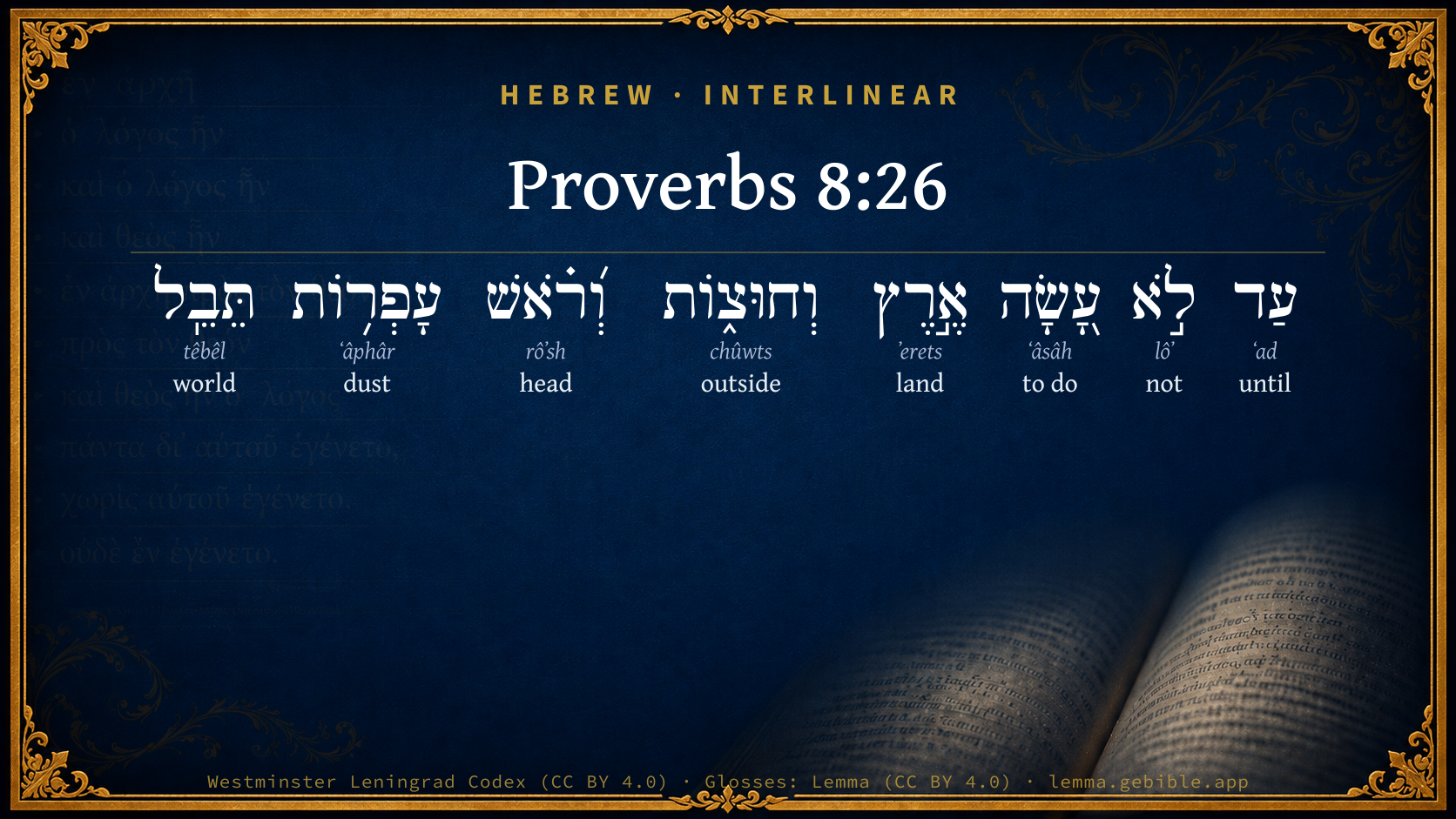
Hebrew (Westminster Leningrad Codex) Proverbs 8:26 appears in the Hebrew Old Testament. The text above is from the Westminster Leningrad Codex. Each word links to its Strong’s number, a concise gloss, and parsing drawn from the Open Scriptures Hebrew Bible morphology. Click any word for its full Brown-Driver-Briggs (BDB) entry.
Download image
Cite this verse

Proverbs 8:26 (World English Bible). Public Domain. Lemma interlinear Bible study tool, https://lemma.gebible.app/v/proverbs/8/26.

Show BibTeX & RIS
BibTeX
RIS
English Translation
While as yet he had not made the earth, nor the fields, Nor the beginning of the dust of the world.
World English Bible · Public Domain
Download a study sheet

One document with this verse’s original text, its word-by-word gloss line, the meaning frame, cross-references with their text, attributed commentary, and full source and license credits — printable, and it pastes into notes with its structure intact.

This verse Autodidact and up

Study sheet (.html) Plain text (.txt)

A passage Seminary Student

Up to 50 verses in one chapter. A passage sheet keeps up to 6 commentary sources and 12 cross-references per verse, in the order this page ranks them, and says so on the sheet whenever that leaves anything out. Ask for a single verse and you get the Autodidact verse sheet above.

Everything on this page stays free to read, with no account — the sheet is a download of what is already on screen, not access to it.

Want to remove ads? Support Godless Engineer
Compare translations 3

The same verse in 3 English versions, stacked beneath the original-language interlinear above. Click any original word for its lexicon entry.

Each is an independent rendering of the whole verse — the interlinear is not word-aligned to these translations.

Highlighted words mark where these versions differ — a whole-verse word diff, not a word-by-word alignment.

  • World English Bible Public Domain
    While as yet he had not made the earth, nor the fields, Nor the beginning of the dust of the world.
  • King James Version Public Domain
    While as yet he had not made the earth, nor the fields, nor the highest part of the dust of the world.
  • unfoldingWord Literal Text CC BY-SA 4.0
    before he made the earth or the outside places or the head of the loose soil of the world.

unfoldingWord Literal Text — © unfoldingWord, licensed CC BY-SA 4.0. Word-aligned USFM3 via Door43 (git.door43.org/unfoldingWord/en_ult).

Versions to compare (up to 4)

3 of 4 selected

Show all 18 translations

Every available English version of this verse, each an independent rendering of the whole verse.

  • World English Bible Public Domain
    While as yet he had not made the earth, nor the fields, Nor the beginning of the dust of the world.
  • Berean Standard Bible Public Domain
    before He made the land or fields, or any of the dust of the earth.
  • Majority Standard Bible Public Domain
    before He made the land or fields, or any of the dust of the earth.
  • King James Version Public Domain
    While as yet he had not made the earth, nor the fields, nor the highest part of the dust of the world.
  • American Standard Version (1901) Public Domain
    While as yet he had not made the earth, nor the fields, Nor the beginning of the dust of the world.
  • Revised Version (1885) Public Domain
    While as yet he had not made the earth, nor the fields, nor the beginning of the dust of the world.
  • Geneva Bible (1599) Public Domain
    He had not yet made the earth, nor the open places, nor the height of the dust in the worlde.
  • Douay-Rheims (1899) Public Domain
    He had not yet made the earth, nor the rivers, nor the poles of the world.
  • Young's Literal Translation Public Domain
    While He had not made the earth, and out-places, And the top of the dusts of the world.
  • Literal Standard Version CC BY-SA 4.0
    While He had not made the earth, and out-places, || And the top of the dusts of the world.
  • Unlocked Literal Bible CC BY-SA 4.0
    I was born before Yahweh had made the earth or the fields, or even the first dust in the world.
  • unfoldingWord Literal Text CC BY-SA 4.0
    before he made the earth or the outside places or the head of the loose soil of the world.
  • Darby Bible Public Domain
    while as yet he had not made the earth, nor the fields, nor the beginning of the dust of the world.
  • World Messianic Bible Public Domain
    while as yet he had not made the earth, nor the fields, nor the beginning of the dust of the world.
  • Webster's Bible Public Domain
    While as yet he had not made the earth, nor the fields, nor the highest part of the dust of the world.
  • Free Bible Version CC BY-SA 4.0
    when he hadn't made the earth and its fields or any of the earth's dust.
  • Bible in Basic English Public Domain
    When he had not made the earth or the fields or the dust of the world.
  • JPS Tanakh (1917) Public Domain
    While as yet He had not made the earth, nor the fields, nor the beginning of the dust of the world.

Literal Standard Version (2020), Covenant Press — licensed CC BY-SA 4.0. Text via the HelloAO Bible API (eBible.org). Unlocked Literal Bible (unfoldingWord) — licensed CC BY-SA 4.0. Text via the HelloAO Bible API (eBible.org). unfoldingWord Literal Text — © unfoldingWord, licensed CC BY-SA 4.0. Word-aligned USFM3 via Door43 (git.door43.org/unfoldingWord/en_ult). Free Bible Version, Dr. Jonathan Gallagher — licensed CC BY-SA 4.0. Text via the HelloAO Bible API (eBible.org).

Word by word

More ways to search: Search by grammar → Find every occurrence → Compare this word →

Practice this passage: Drill this verse → Learn its vocabulary →

About this verse

These counts appear in no published source. They are computed here, from the morphology-tagged text and Lemma’s own curated glosses. What Lemma adds →

8
words
8
distinct lemmas
Wisdom
section

Shared distinctive vocabulary

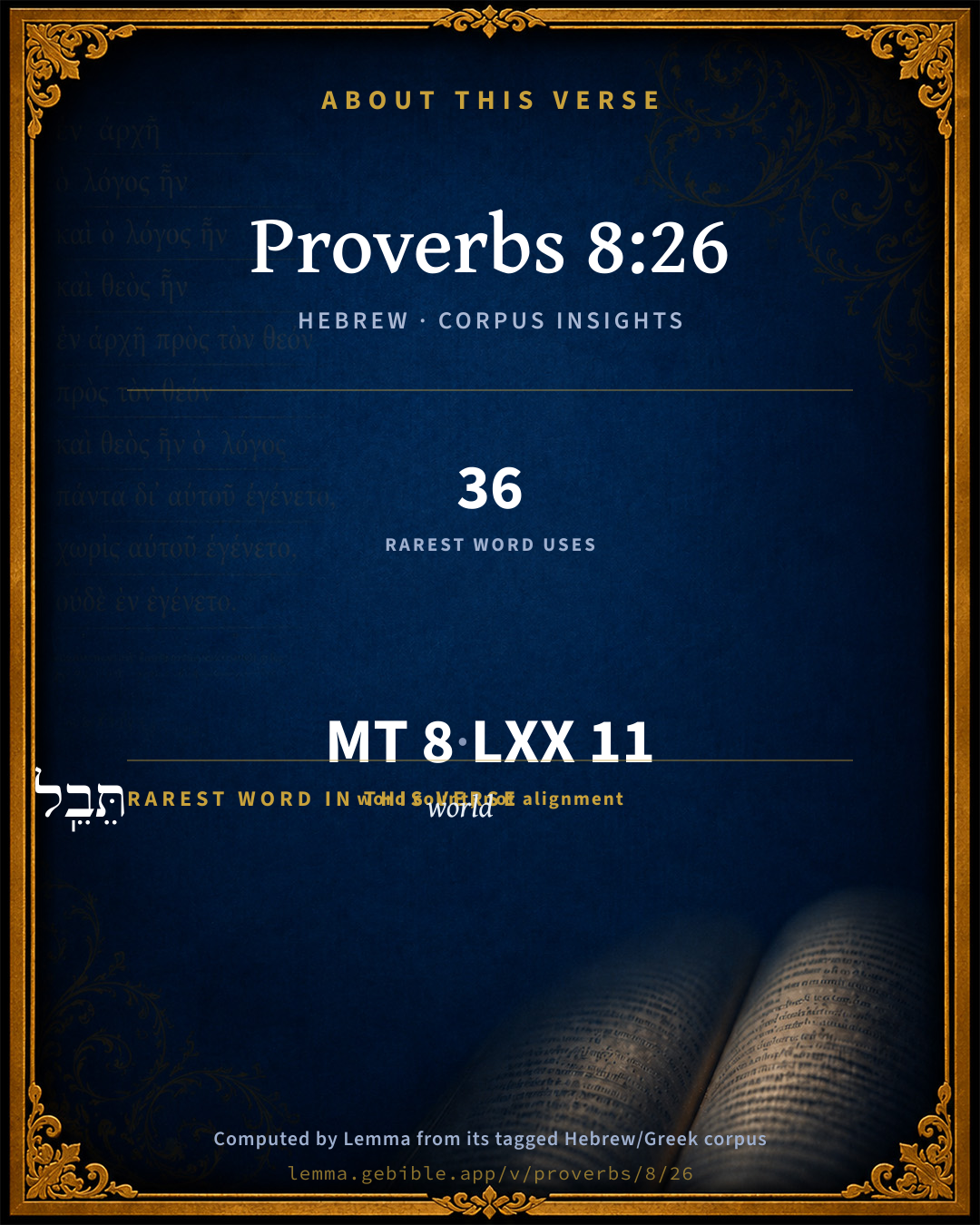
תֵּבֵֽל world H8398 occurs in 36 verses of the Hebrew Bible. Also found in:

Grammatical profile

  • 1 verb
  • 5 nouns
  • 1 preposition
  • 1 particle

Verb forms

  • עָ֭שָׂה Qal · Perfect

Hebrew & Septuagint length

In English translation the verse runs 21 words from the Hebrew and 15 from the Septuagint (LXX English) — the Septuagint runs noticeably shorter here. See the side-by-side →

A rough comparison of the two English renderings, which tokenize alike — not a word-level alignment.

Word counts can differ between the Hebrew and the Greek without any difference in meaning — e.g. the Hebrew direct-object marker אֵת has no separate Greek word, and Greek often adds the article ὁ.

In the original languages it is 8 Hebrew tokens and 11 Greek tokens — but the two are counted differently (Hebrew bundles its prefixes and suffixes into one token; the Greek is in lemma form), so that isn’t a like-for-like length.

Cross-references

1

Topical passages linked to Proverbs 8:26 in the Treasury of Scripture Knowledge — connected by theme and wording, ordered by reader-vote popularity; previews shown in the World English Bible.

Cross-references courtesy of OpenBible.info (CC BY 4.0).

Hebrew and Greek witnesses Masoretic Hebrew ↔ Greek Septuagint

The same verse in the two great witnesses to the Old Testament, shown verse-for-verse.

Here the Septuagint runs noticeably shorter than the Hebrew — LXX2012 (modern English Septuagint) 15 words vs World English Bible 21. A rough length comparison of the two English translations, not a word-level alignment — read both below.

These are two independent witnesses, not word-aligned to each other, and the Septuagint is shown in lemma (dictionary) form.

Hebrew Proverbs 8:26 Masoretic · Westminster Leningrad Codex

עַד לֹ֣א עָ֭שָׂה אֶ֣רֶץ וְחוּצ֑וֹת וְ֝רֹ֗אשׁ עָפְר֥וֹת תֵּבֵֽל

While as yet he had not made the earth, nor the fields, Nor the beginning of the dust of the world.

World English Bible · Public Domain

Greek LXX Proverbs 8:26 Septuagint · lemma form

κύριος ποιέω χώρα καί ἀοίκητος καί ἄκρος οἰκέω ὁ ὑπό οὐρανός

The Lord made countries and uninhabited tracks, and the highest inhabited parts of the world.

LXX2012 (modern English Septuagint) · Public Domain

On this verse, The Pulpit Commentary discusses the Septuagint’s reading. Read the note in Commentary ↓

Hebrew: Westminster Leningrad Codex (CC BY 4.0). Greek: Septuagint (public domain); English from LXX2012 (modern English Septuagint) (Public Domain). How the Septuagint differs from the Hebrew →

Commentary

Notes on Proverbs 8:26 from classic Christian and Jewish commentators (each source and its license shown beneath its notes). The classic Christian expositions comment on the surrounding passage and are grouped to its opening verse, so a note may address several verses; the Jewish commentaries on the Tanakh (Rashi and others) are per-verse, so they appear only where the commentator wrote on this verse.

Lemma curates 59 commentaries, every one of them public domain or Creative Commons licensed, each selected and text-cleaned for this edition rather than reprinted as found. About our sources →

Trapp's Complete Commentary

John Trapp

Pro 8:26 While as yet he had not made the earth, nor the fields, nor the highest part of the dust of the world.

Ver. 26. Nor the fields, nor the highest.] {See Trapp on "Pro 8:24"}

John Trapp, A Commentary or Exposition upon All the Books of the Old and New Testament (1647–1656) — public domain. Text from a community e-Sword module.

Jamieson, Fausset & Brown

Robert Jamieson, A. R. Fausset & David Brown

fields--or, "out places," "deserts," as opposite to (habitable) "world."

highest part--or, "sum," all particles together,

Jamieson, Fausset & Brown — Commentary Critical and Explanatory on the Whole Bible (1871) — public domain (CC PDM 1.0). Text via the HelloAO Bible API.

Adam Clarke's Commentary

Verse 26. The highest part of the dust of the world] ראש עפרות תבל rosh aphroth tebel, "the first particle of matter." The prima materia, the primitive atom. All these verses (Pr 8:3-29) are a periphrasis for I existed before creation; consequently before time was. I dwelt in God as a principle which might be communicated in its influences to intellectual beings when formed.

Adam Clarke's Commentary on the Bible (1810–1826) — public domain. Text from a community e-Sword/MySword module.

Ellicott's Commentary for English Readers

(26) The earth.—i.e., the cultivated and enclosed part of it.

The fields.—The open country.

The highest part of the dust of the world. Literally, “the head of the dusts of the fertile earth” i.e. the heaps of the clods of arable land, or better perhaps, “the sum of the atoms of dust.” Some refer to Gen_2:7, and interpret the words of man, as formed out of the dust.

A Bible Commentary for English Readers, edited by Charles John Ellicott (1878–1897) — public domain. Text from a community e-Sword module.

The Cambridge Bible for Schools and Colleges

gen. ed. J. J. S. Perowne

26. highest part] Rather, beginning; R.V. text (“or sum,” marg.); i.e. the primary elements out of which other things were subsequently formed. Comp. “all his work which God created and made,” Gen_2:3.

The idea that man is intended as the “chief part of the dust of the earth,” out of which he was formed, has little to commend it.

dust] Lit. dusts (plural), i.e. particles, or clods, of earth. Comp. dusts of gold, Job_28:6, where R.V. marg. suggests lumps.

The Cambridge Bible for Schools and Colleges (gen. ed. J. J. S. Perowne; Cambridge University Press, 1878–1918) — public domain. Text from a community e-Sword module.

John Gill's Exposition

While as yet he had not made the earth,.... That is, the Lord, who possessed Wisdom, or Christ, and by whom he was set up; he as yet had not made the earth, when this was done; this shows that the earth had a beginning, contrary to those philosophers who asserted the eternity of it; that Christ was before that was, for it was made by him; and consequently he must be eternal, and was before any man was, since the earth was made before man; and that he was not of the earth, earthy, as was the first man;

nor the fields; the plain parts of the earth, in opposition to the mountains and hills before mentioned; the valleys and meadows that lay between them, full of grass, flowers, and fruits; pleasant to behold, and profitable to be enjoyed; so the word is also rendered Job 5:10; and "valleys", by the Targum here: or the "out parts" (m); the extremities of the earth, the two poles of it; the uninhabitable parts of the earth, as distinct from the habitable part of it afterwards mentioned: or all with out it; the ambient and spacious ether;

nor the highest part of the dust of the world: meaning, not the mountains and hills, which are before mentioned, and are the highest part of the earth; but rather "the chief of the dust of the earth" (n), as the words may be rendered; these are the metals and minerals within it; the gold, silver, and precious stones, of which we read very early, Gen 2:12; or the "beginning", the first and chief, the "prima materia", even the dusts of the world, out of which man and all the creatures were made, Gen 2:6. Dr. Lister (o) was of opinion that sand was once the most exterior and general cover of the surface of the whole earth; partly because all our northern mountains are covered with it, more or less, at this day; and partly because of its great hardness, durableness, and unalterable quality; and the higher the mountains be, he says, still the more and coarser the sand is; and if so, this might with propriety be called the highest part of the dust of the earth. But Christ was before any of them, as well as is more excellent than they. Or it may be man is designed, who was made of the dust of the earth; even the first man Adam, so Jarchi, Gen 2:7; before whom Christ was: yea, the human nature of Christ himself may be meant, which is fairer than any of the children of men, and the chief of all the individuals of human nature; being without sin, and united to the Son of God, and also the curious workmanship of the Spirit of God. Now Christ, as the Son of God, as the only begotten of the Father, existed before his human nature did, or before he was the Son of man.

(m) "quae extra sunt", Tigurine version, Vatablus; "exteriora", Cocceius, Michaelis. (n) "caput", Montanus, Tigurine version; "summam", Cocceius, Michaelis, Schultens. (o) In Philosoph. Transact. abridged, vol. 2. p. 452, 453.

John Gill's Exposition of the Whole Bible (1746–1763) — public domain (CC PDM 1.0). Text via the HelloAO Bible API.

Albert Barnes' Notes on the Bible

The highest part of the dust of the world - literally, “the head of the dusts of the world;” an image of either:

(1) the dry land, habitable, fit for cultivation, as contrasted with the waters of the chaotic deep; or

(2) man himself. Compare Ecc 3:20.

Albert Barnes' Notes on the Bible (1834–1885) — public domain. Text from a community e-Sword/MySword module.

Haydock's Catholic Bible Commentary

Poles. Hebrew, "head or height of the dust of the world." (Haydock) --- I subsisted with the chaos, before things appeared in their present form. (Calmet) --- The poles denote the north and south, or the four quarters of the world. (Menochius)

George Leo Haydock (1774–1849), Haydock's Catholic Family Bible and Commentary, 1859 edition — public domain. Excludes Psalms (Douay-Rheims chapter numbering differs from Protestant) and Deuterocanonical books (Catholic canon only).

Matthew Poole's English Annotations

The earth, i.e. the dry land, called earth after it was separated from the waters, Gen 1:10.

The fields; the plain and open parts of the earth, distinguished from the mountains and hills, and the valleys enclosed between them.

The highest part; or, the first part, or beginning; or, the best part, Heb. the head; that which exceeds other parts in riches or fruitfulness; which he seems to distinguish from the common fields.

Of the dust of the world; of this lower part of the world, which consisteth of dust.

Matthew Poole's English Annotations on the Holy Bible (1683–1685) — public domain. Text from a community e-Sword/MySword module.

Whedon's Commentary on the Bible

Daniel D. Whedon

26. The fields — חוצות, (hhutsoth,) the exterior surface, or ostensible part.

Nor the highest part of the dust of the world — ראשׁ עפרות תבל, (rosh ‘haphroth tebhel,) the first dust of the world — the primeval atoms, seemingly opposed to the hhutsoth — the observable part. “World,” (tebhel,) a poetic word from בלל, (balal,) one of the meanings of which is to mix, mingle — the compounded mass of the earth. The sense of the whole, throwing off the poetic garb, and carrying forward the verb from the preceding verse, appears to be: I was produced while yet he had not made the land, neither the observable exterior nor the interior atoms of the complex globe. Some expositors fancy that the highest part of the dust of the earth means man himself, originally formed of the dust of the earth.

The drift of the thought in Pro_8:23-27, is seemingly this: We have, first, the proposition, (Pro_8:23,) I existed before the earth (as a whole) existed. This is amplified in sundry particulars, first, (Pro_8:24,) before the fluid parts, the oceans and streams; second, (Pro_8:25,) before the solid parts, especially the more prominent and observable, as the mountains and hills; third, (ver.

26,) an amplification of this again, descending to other particulars — the surface of the land and its internal components — the original atoms or particles of the same. Wisdom was before all these.

Daniel D. Whedon (gen. ed.), Commentary on the Old and New Testaments (1874–1909) — public domain. Text from a community e-Sword module.

The Pulpit Commentary

The earth, nor the fields. The distinction intended is land as cultivated and occupied by buildings, etc., and waste uncultivated land outside towns. Septuagint, "The Lord made countries and uninhabited places (aoikhtouv );" Vulgate, Adhuc terram non fecerat, et flumina. Hebrew, chutsoth; things without, abroad, hence open country. The Vulgate rendering, and that of Aquila and Symmaehus, exodouv , are plainly erroneous, as waters have already been mentioned (ver. 24). The highest part of the dust of the world; literally, the head of the dusts of the world. Some have interpreted this expression of "man," the chief of those creatures which are made of the dust of the ground. (Gen_3:19 Ecc_3:20) But the idea comes in awkwardly here; it is not natural to introduce man amid the inanimate works of nature, or to use such an enigmatical designation for him. St. Jerome has, cardines orbis terrarum, "the world"s hinges;" Septuagint, "the inhabited summits of the earth beneath the heavens; according to St. Hilary ("De Trinit.," 12), "cacumina quae habitantur sub coelo." Others take the term to signify the capes or promontories of the world, the peaks and elevations; others, the clods of dry, amble land, in contrast to the untilled waste of waters; others, the chief elements, the matter of which the earth is composed. This last interpretation would lead us back to a period which has already been passed. Amid the many possible explanations, it is perhaps best (with Delitzsch, Nowack, etc.) to take rosh, "head" as equivalent to "sum," "mass," as in Psa_139:17. "How great is the sum (rosh ) of them!" Then the expression comprehensively means all the mass of earth"s dust.

The Pulpit Commentary (1880–1919), ed. H.D.M. Spence-Jones & Joseph S. Exell — public domain. Text from a community e-Sword module.

John Wesley's Explanatory Notes

The earth - The dry land called earth after it was separated from the waters Gen. i, 10. Fields - The plain and open parts of the earth distinguished from the mountains. Dust - Of this lower part of the world which consists of dust.

John Wesley, Explanatory Notes Upon the Whole Bible (1754–1765) — public domain. Text via the GEBible commentary corpus.

unfoldingWord translationNotes

Door43 World Missions Community

I was born ... I was there

This is wisdom speaking about herself. (See: Personification)

was born

"I was alive"

established

To establish something is to bring into being on a stable basis. AT: "created" or "made"

when he drew a circle on the surface of the deep

This refers to setting a limit to how far someone in a ship at sea can see all around himself. AT: "when he marked on the ocean's surface how far a person at sea can see in every direction" (See: Assumed Knowledge and Implicit Information)

the deep

"the ocean"

translationWords

Yahweh

earth

heaven

unfoldingWord translationNotes — © Distant Shores Media and the Door43 World Missions Community, licensed CC BY-SA 4.0. Source: git.door43.org/Door43/en_tn.

Rashi

Rabbi Shlomo Yitzchaki (Rashi)

the land and the outsides The land of Israel and other lands.

and the beginning of the dust of the earth The first man.

Rashi on the Tanakh — English translations: “The Judaica Press complete Tanach with Rashi, translated by A. J. Rosenberg” (CC BY 4.0); “Pentateuch with Rashi's commentary by M. Rosenbaum and A.M. Silbermann, 1929-1934” (public domain); “The Metsudah Tanach series, Lakewood, N.J” (CC BY 4.0); and “The Book of Joshua, Metsudah Publications, 1997” (CC BY 4.0). Text via Sefaria.

Lesson kit

Teaching starters — assembled from the data on this page, not authored interpretation. Every prompt links to the verse data it draws on. Edit before teaching.

Proverbs, in the Wisdom, opens this verse with 8 words (8 distinct Hebrew lemmas). Its most distinctive word is têbêl (“world”). The Greek Septuagint runs shorter here. A historical commentator’s framing appears above. Read the whole chapter for the surrounding context.

Discussion questions

  1. The word têbêl carries the sense “world.” How does it shape the verse?
  2. How does 1 Samuel 2:8, which shares the word «world», read alongside this verse?
  3. The Septuagint runs shorter here than the Hebrew. What might account for the difference?
  4. These translations render this verse differently; the difference is in the English rendering, not the original. What questions does that raise?
  5. «עָ֭שָׂה» is a Qal Perfect verb. How does that grammatical form shape the action described?
  6. Compare how Trapp's Complete Commentary and Jamieson, Fausset & Brown read this verse. Where do they agree or differ?

Things to notice

Reading settings

Reading text

Shown beneath each verse's original-language words.

Old Testament
Old Testament edition

Read the OT as the Masoretic Hebrew (MT) or the Greek Septuagint (LXX).

English shown for the Greek Septuagint (in the Hebrew ↔ Greek comparison).

Comparing translations? Open the Compare panel on any verse page to stack up to four side by side.