Ezekiel 42:7

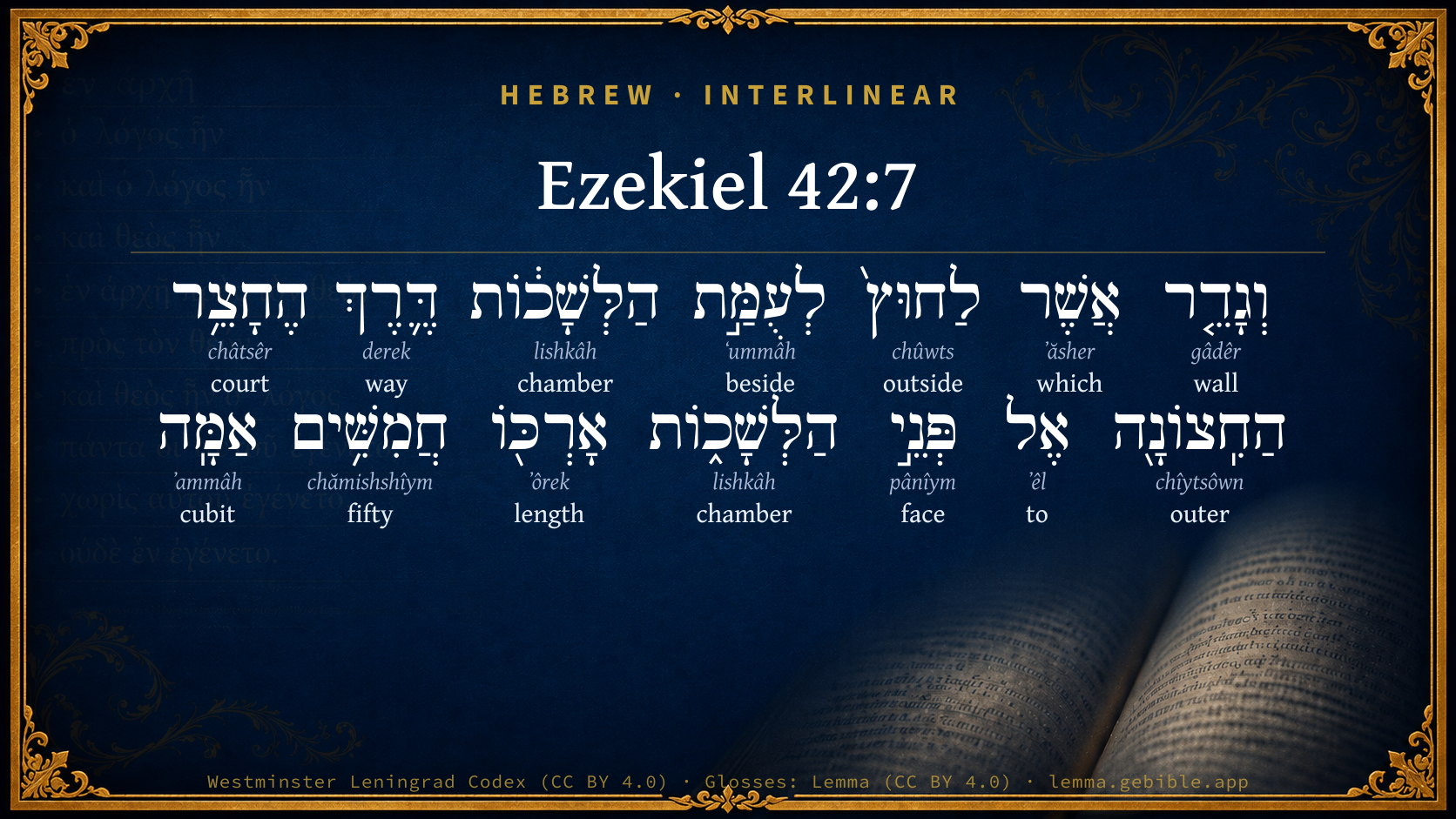
Hebrew (Westminster Leningrad Codex) Ezekiel 42:7 appears in the Hebrew Old Testament. The text above is from the Westminster Leningrad Codex. Each word links to its Strong’s number, a concise gloss, and parsing drawn from the Open Scriptures Hebrew Bible morphology. Click any word for its full Brown-Driver-Briggs (BDB) entry.
Download image
Cite this verse

Ezekiel 42:7 (World English Bible). Public Domain. Lemma interlinear Bible study tool, https://lemma.gebible.app/v/ezekiel/42/7.

Show BibTeX & RIS
BibTeX
RIS
English Translation
The wall that was outside by the side of the chambers, toward the outer court before the chambers, the length of it was fifty cubits.
World English Bible · Public Domain
Download a study sheet

One document with this verse’s original text, its word-by-word gloss line, the meaning frame, cross-references with their text, attributed commentary, and full source and license credits — printable, and it pastes into notes with its structure intact.

This verse Autodidact and up

Study sheet (.html) Plain text (.txt)

A passage Seminary Student

Up to 50 verses in one chapter. A passage sheet keeps up to 6 commentary sources and 12 cross-references per verse, in the order this page ranks them, and says so on the sheet whenever that leaves anything out. Ask for a single verse and you get the Autodidact verse sheet above.

Everything on this page stays free to read, with no account — the sheet is a download of what is already on screen, not access to it.

Want to remove ads? Support Godless Engineer
Compare translations 3

The same verse in 3 English versions, stacked beneath the original-language interlinear above. Click any original word for its lexicon entry.

Each is an independent rendering of the whole verse — the interlinear is not word-aligned to these translations.

Highlighted words mark where these versions differ — a whole-verse word diff, not a word-by-word alignment.

  • World English Bible Public Domain
    The wall that was outside by the side of the chambers, toward the outer court before the chambers, the length of it was fifty cubits.
  • King James Version Public Domain
    And the wall that was without over against the chambers, toward the utter court on the forepart of the chambers, the length thereof was fifty cubits.
  • unfoldingWord Literal Text CC BY-SA 4.0
    The outside wall ran along the rooms toward the outer courtyard, the courtyard that was in front of the rooms. That wall was fifty cubits in length.

unfoldingWord Literal Text — © unfoldingWord, licensed CC BY-SA 4.0. Word-aligned USFM3 via Door43 (git.door43.org/unfoldingWord/en_ult).

Versions to compare (up to 4)

3 of 4 selected

Show all 18 translations

Every available English version of this verse, each an independent rendering of the whole verse.

  • World English Bible Public Domain
    The wall that was outside by the side of the chambers, toward the outer court before the chambers, the length of it was fifty cubits.
  • Berean Standard Bible Public Domain
    An outer wall in front of the chambers was fifty cubits long and ran parallel to the chambers and the outer court.
  • Majority Standard Bible Public Domain
    An outer wall in front of the chambers was fifty cubits long and ran parallel to the chambers and the outer court.
  • King James Version Public Domain
    And the wall that was without over against the chambers, toward the utter court on the forepart of the chambers, the length thereof was fifty cubits.
  • American Standard Version (1901) Public Domain
    And the wall that was without by the side of the chambers, toward the outer court before the chambers, the length thereof was fifty cubits.
  • Revised Version (1885) Public Domain
    And the wall that was without by the side of the chambers, toward the outer court before the chambers, the length thereof was fifty cubits.
  • Geneva Bible (1599) Public Domain
    And the wall that was without ouer against the chambers, toward the vtter court on the forefront of the chambers, was fiftie cubites long.
  • Douay-Rheims (1899) Public Domain
    And the outward wall that went about by the chambers, which were towards the outward court on the forepart of the chambers, was fifty cubits long.
  • Young's Literal Translation Public Domain
    As to the wall that `is' at the outside, over-against the chambers, the way of the outer-court at the front of the chambers, its length `is' fifty cubits;
  • Literal Standard Version CC BY-SA 4.0
    As for the wall that [is] at the outside, alongside the chambers, the way of the outer-court at the front of the chambers, its length [is] fifty cubits;
  • Unlocked Literal Bible CC BY-SA 4.0
    The outside wall ran along the rooms toward the outer courtyard, the courtyard that was in front of the rooms. That wall was fifty cubits in length.
  • unfoldingWord Literal Text CC BY-SA 4.0
    The outside wall ran along the rooms toward the outer courtyard, the courtyard that was in front of the rooms. That wall was fifty cubits in length.
  • Darby Bible Public Domain
    And the wall that was without, answering to the cells, toward the outer court in the front of the cells, its length was fifty cubits:
  • World Messianic Bible Public Domain
    The wall that was outside by the side of the rooms, toward the outer court before the rooms, was fifty cubits long.
  • Webster's Bible Public Domain
    And the wall that was without over against the chambers, towards the outer court on the forepart of the chambers, the length of it was fifty cubits.
  • Free Bible Version CC BY-SA 4.0
    An external wall ran in front of the rooms for fifty cubits long parallel to the outer courtyard.
  • Bible in Basic English Public Domain
    And the wall which went outside by the side of the rooms, in the direction of the outer square in front of the rooms, was fifty cubits long.
  • JPS Tanakh (1917) Public Domain
    And the wall that was without by the side of the chambers, toward the outer court in front of the chambers, the length thereof was fifty cubits.

Literal Standard Version (2020), Covenant Press — licensed CC BY-SA 4.0. Text via the HelloAO Bible API (eBible.org). Unlocked Literal Bible (unfoldingWord) — licensed CC BY-SA 4.0. Text via the HelloAO Bible API (eBible.org). unfoldingWord Literal Text — © unfoldingWord, licensed CC BY-SA 4.0. Word-aligned USFM3 via Door43 (git.door43.org/unfoldingWord/en_ult). Free Bible Version, Dr. Jonathan Gallagher — licensed CC BY-SA 4.0. Text via the HelloAO Bible API (eBible.org).

Word by word

More ways to search: Search by grammar → Find every occurrence → Compare this word →

Practice this passage: Drill this verse → Learn its vocabulary →

וְגָדֵ֤ר
gâdêr
H1447
“and · wall”
Conjunction + Noun, Common, Masculine, Singular, Absolute
Part of Speech
Conjunction + Noun
Type
Common
Gender
Masculine
Number
Singular
State
Absolute
Full BDB Definition

Origin: from H1443

TWOT: 318a

fence, wall
  1. אֲשֶׁר ʼăsher H834 “which” Particle, Relative
  2. לַחוּץ֙ chûwts H2351 “to/for the · outside” Preposition, Determined + Noun, Common, Masculine, Singular, Absolute
  3. לְעֻמַּ֣ת ʻummâh H5980 “to/for · beside of” Preposition + Noun, Common, Feminine, Singular, Construct
  4. הַלְּשָׁכ֔וֹת lishkâh H3957 “the · chambers” Particle, Definite Article + Noun, Common, Feminine, Plural, Absolute
  5. דֶּ֛רֶךְ derek H1870 “way of” Noun, Common, Both, Singular, Construct
  6. הֶחָצֵ֥ר châtsêr H2691 “the · court” Particle, Definite Article + Noun, Common, Both, Singular, Absolute
  7. הַחִֽצוֹנָ֖ה chîytsôwn H2435 “the · outer” Particle, Definite Article + Adjective, Adjective, Feminine, Singular, Absolute
  8. אֶל ʼêl H413 “to” Preposition
  9. פְּנֵ֣י pânîym H6440 “face(s) of” Noun, Common, Both, Plural, Construct
  10. הַלְּשָׁכ֑וֹת lishkâh H3957 “the · chambers” Particle, Definite Article + Noun, Common, Feminine, Plural, Absolute
  11. אָרְכּ֖וֹ ʼôrek H753 “length · his” Noun, Common, Masculine, Singular, Construct + Suffix, Personal, 3rd Person, Masculine, Singular
  12. חֲמִשִּׁ֥ים chămishshîym H2572 “fifty” Adjective, Cardinal number, Both, Plural, Absolute
  13. אַמָּֽה ʼammâh H520 “cubit” Noun, Common, Feminine, Singular, Absolute

About this verse

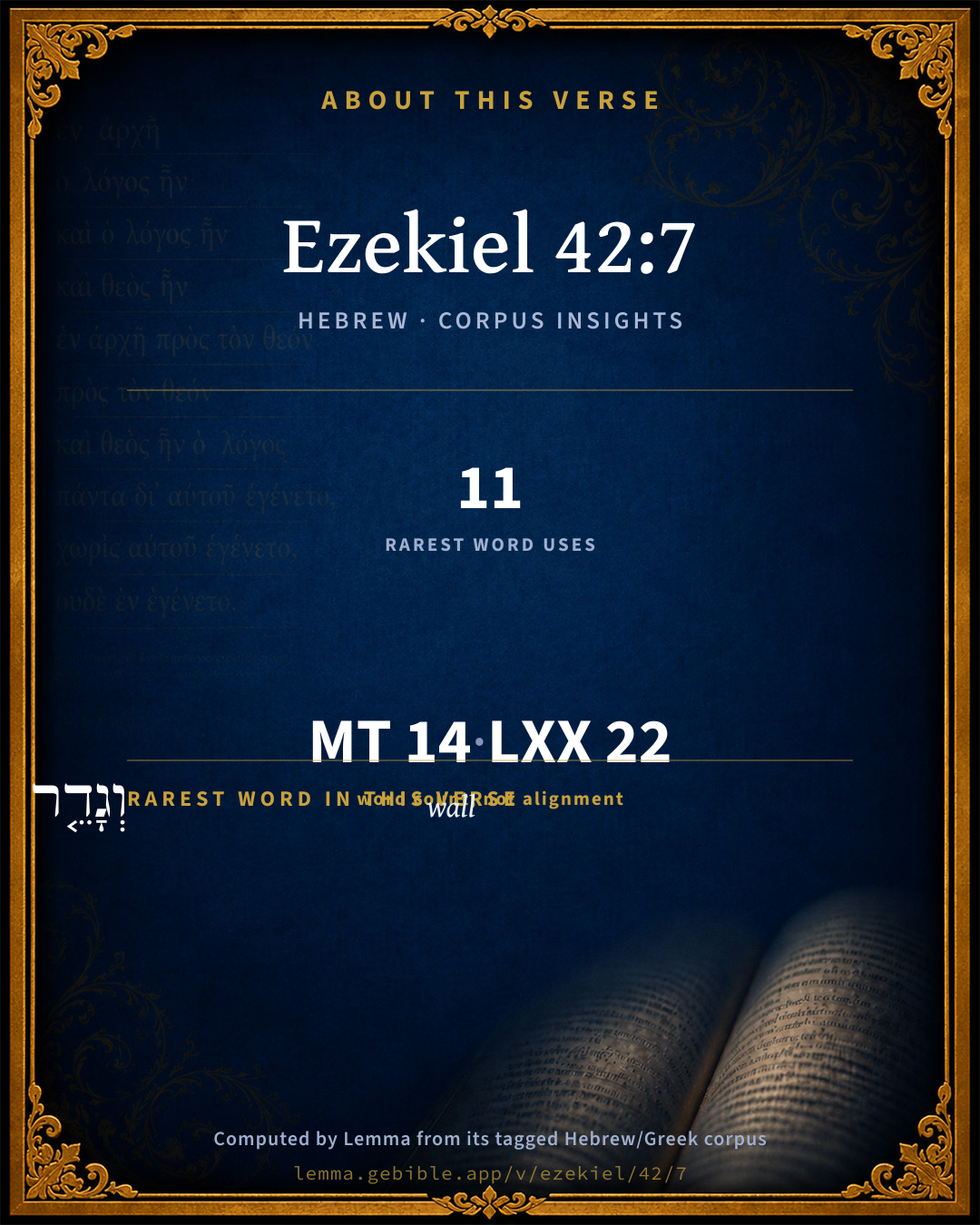
These counts appear in no published source. They are computed here, from the morphology-tagged text and Lemma’s own curated glosses. What Lemma adds →

14
words
13
distinct lemmas
Prophets
section

Notable vocabulary

The rarest word here is וְגָדֵ֤ר wall H1447 — appearing just 11 times in the whole Hebrew Bible.

Shared distinctive vocabulary

וְגָדֵ֤ר wall H1447 occurs in 10 verses of the Hebrew Bible. Also found in:

Grammatical profile

  • 10 nouns
  • 2 adjectives
  • 1 preposition
  • 1 particle

Repetition

A word recurs within this verse — often emphatic in Hebrew:

  • הַלְּשָׁכ֔וֹת chamber H3957 ×2

Hebrew & Septuagint length

In English translation the verse runs 25 words from the Hebrew and 28 from the Septuagint (LXX English) — closely comparable.

A rough comparison of the two English renderings, which tokenize alike — not a word-level alignment.

Word counts can differ between the Hebrew and the Greek without any difference in meaning — e.g. the Hebrew direct-object marker אֵת has no separate Greek word, and Greek often adds the article ὁ.

In the original languages it is 14 Hebrew tokens and 22 Greek tokens — but the two are counted differently (Hebrew bundles its prefixes and suffixes into one token; the Greek is in lemma form), so that isn’t a like-for-like length.

Cross-references

2

Topical passages linked to Ezekiel 42:7 in the Treasury of Scripture Knowledge — connected by theme and wording, ordered by reader-vote popularity; previews shown in the World English Bible.

  • Ezekiel 42:10 In the thickness of the wall of the court toward the east, before the separate place, and before the building, there were chambers.
  • Ezekiel 42:12 According to the doors of the chambers that were toward the south was a door at the head of the way, even the way directly before the wall toward the east, as one enters into them.

Cross-references courtesy of OpenBible.info (CC BY 4.0).

Hebrew and Greek witnesses Masoretic Hebrew ↔ Greek Septuagint

The same verse in the two great witnesses to the Old Testament, shown verse-for-verse.

These are two independent witnesses, not word-aligned to each other, and the Septuagint is shown in lemma (dictionary) form.

Hebrew Ezekiel 42:7 Masoretic · Westminster Leningrad Codex

וְגָדֵ֤ר אֲשֶׁר לַחוּץ֙ לְעֻמַּ֣ת הַלְּשָׁכ֔וֹת דֶּ֛רֶךְ הֶחָצֵ֥ר הַחִֽצוֹנָ֖ה אֶל פְּנֵ֣י הַלְּשָׁכ֑וֹת אָרְכּ֖וֹ חֲמִשִּׁ֥ים אַמָּֽה

The wall that was outside by the side of the chambers, toward the outer court before the chambers, the length of it was fifty cubits.

World English Bible · Public Domain

Greek LXX Ezekiel 42:7 Septuagint · lemma form

καί φῶς ἔξωθεν ὅς τρόπος ὁ ἐξέδρα ὁ αὐλή ὁ ἐξώτερος ὁ βλέπω ἀπέναντι ὁ ἐξέδρα ὁ πρός βορέας μῆκος πῆχυς πεντήκοντα

And there was light without, corresponding to the chambers of the outer court looking toward the front of the northern chambers; the length of them was fifty cubits.

LXX2012 (modern English Septuagint) · Public Domain

Hebrew: Westminster Leningrad Codex (CC BY 4.0). Greek: Septuagint (public domain); English from LXX2012 (modern English Septuagint) (Public Domain). How the Septuagint differs from the Hebrew →

Targum (Aramaic paraphrase)

1

The Targum is the ancient Jewish Aramaic paraphrase of the Hebrew Scriptures — an interpretive translation, not the Hebrew text itself. Onkelos (literal) and Pseudo-Jonathan (expansive) render the Torah, and Jonathan the Prophets. Coverage is partial: where no permissively-licensed English translation exists for a verse, only the Aramaic is shown. This is verse-level text, not a word-by-word alignment to the Hebrew.

  1. Targum Jonathan Prophets (Joshua–Malachi)
    וְכָתְלָא דִלְבָרָא לָקֳבֵל לִשְׁכָּתָא אוֹרַח דַרְתָּא בָרַיְתָא דִקֳדָם לִשְׁכָּתָא אוּרְכֵּהּ חַמְשִׁין אַמִין:

    (no public-domain English translation for this verse)

    Targum Jonathan — Aramaic: “Mikraot Gedolot” (public domain). English: “Sefaria Community Translation” (CC0 1.0 (public-domain dedication)); “London "Chaldee Paraphrase," 1871” (public domain). Text via Sefaria.

Commentary

Notes on Ezekiel 42:7 from classic Christian and Jewish commentators (each source and its license shown beneath its notes). The classic Christian expositions comment on the surrounding passage and are grouped to its opening verse, so a note may address several verses; the Jewish commentaries on the Tanakh (Rashi and others) are per-verse, so they appear only where the commentator wrote on this verse.

Lemma curates 59 commentaries, every one of them public domain or Creative Commons licensed, each selected and text-cleaned for this edition rather than reprinted as found. About our sources →

Trapp's Complete Commentary

John Trapp

Eze 42:7 And the wall that [was] without over against the chambers, toward the utter court on the forepart of the chambers, the length thereof [was] fifty cubits.

Ver. 7. Here the Rabbis call again for the help of their Elias. See on Eze 40:6.

John Trapp, A Commentary or Exposition upon All the Books of the Old and New Testament (1647–1656) — public domain. Text from a community e-Sword module.

Ellicott's Commentary for English Readers

(7) The wall that was without.—We have two indications of what wall is here meant. In the first place, the word itself is neither of those which have been hitherto used, but one signifying a fence-wall, and is translated in Eze_13:5; Eze_22:30, hedge; and in Num_22:24, a vineyard wall. Its length is also said to be fifty cubits (the breadth of the chamber). It must, therefore, have been a screen wall at one end of the chambers, and it could not have been at the western end, as that was otherwise occupied (Eze_46:19-20). It was then at the eastern end, and was doubtless for the purpose of screening the windows at that end from the outer court while the priests were changing their garments. The word here translated over against is not the one used in Eze_42:1; Eze_42:3, and may equally well be rendered parallel to.

A Bible Commentary for English Readers, edited by Charles John Ellicott (1878–1897) — public domain. Text from a community e-Sword module.

The Cambridge Bible for Schools and Colleges

gen. ed. J. J. S. Perowne

7. wall … without] i.e. not forming part of the block of cells, but extending eastward from the end of the shorter wing, and therefore said to be beside the cells that lay towards the outer court. Fig. 3, vw.

on the forepart] in front of or facing—still said of the wall (Fig. 3, vw). The “chambers” seem to be those of the longer wing. The piece of wall would face them; but the words might be (though less likely) a second specification of the position of the piece of wall referred to in regard to the shorter wing (cf. Eze_42:2). The length of this piece of wall was 50 cubits. The reason is stated in Eze_42:8.

7–9. The shorter wing of chambers. Read together the verses run: “And the wall that was without, beside the chambers which were toward the outer court, facing the (other?) chambers, the length thereof was 50 cubits. 8 For the length of the chambers that were toward the outer court was 50 cubits; but those toward the temple were 100 cubits. 9 And below these chambers was the entrance-way on the east when one goeth to them from the outer court, at the beginning of the wall of the court”—the first words of Eze_42:10 being connected with Eze_42:9.

The Cambridge Bible for Schools and Colleges (gen. ed. J. J. S. Perowne; Cambridge University Press, 1878–1918) — public domain. Text from a community e-Sword module.

John Gill's Exposition

And the wall that was without over against the chambers,.... This wall separated and distinguished the chambers from the outward court, as well as was a protection of them; and signifies the grace and power of God, which separates his true churches from the world, and is the security of them; See Gill on Eze 11:5.

this was towards the utter court, on the fore part of the chambers; or front of them, which seems to be to the north of them; since their doors were towards the north, Eze 42:4, though Cocceius makes it to be to the west, which better agrees with what follows:

the length thereof was fifty cubits; which answers to the breadth of the chambers, Eze 42:2 and what is called length here, with respect to the wall, is called the breadth with respect to the chambers. The wall of divine protection is equal to the length and breadth, and even the whole compass, of the churches of Christ.

John Gill's Exposition of the Whole Bible (1746–1763) — public domain (CC PDM 1.0). Text via the HelloAO Bible API.

Albert Barnes' Notes on the Bible

The “wall” here must be one from north to south, fencing off from the outer court the passage along the east side of the chambers, and therefore fifty cubits long.

Albert Barnes' Notes on the Bible (1834–1885) — public domain. Text from a community e-Sword/MySword module.

Matthew Poole's English Annotations

The wall; not of the chambers, but some wall at distance from them; perhaps some wall that might keep up a terrace-walk.

Over against the chambers; therefore was northward from the chambers.

The utter court; the court of the men, or of Israel, which is called utter with respect to this, wherein this building stood, as this was called utter, Eze 42:1,3, with respect to the court that was more inward.

On the forepart of the chambers; which evidently shows that the wall of fifty cubits stood north from these chambers.

The length thereof was fifty cubits; answerable to the length of this building from east to west.

Matthew Poole's English Annotations on the Holy Bible (1683–1685) — public domain. Text from a community e-Sword/MySword module.

The Pulpit Commentary

The wall; or, fence the Hebrew term being not hm; jo, as in Eze_40:5, or ryqi, as in Eze_41:5, both of which signify the wall of a city or a building, but rdeg; (or rdg, as in ver. 10), which means a fence or hedge, as in Eze 13:5without, over against or, by the side of (Revised Version)the chambers, toward the outer court, cannot have been a rampart along the north side of-the chambers, since this was a hundred cubits long, but must have been a wall upon the side of the chambers (east or west) fencing off the outer court from the passage which led down by the side of the chambers. That this fence was on the east side is rendered probable by the circumstance that the sacrificial kitchen lay upon the west, (see Eze_46:19, Eze_46:20) and by the statements which follow in vers. 8 and 9. The fence was doubtless intended to screen the side windows of the lower chambers from public gaze, since these were to be occupied as robing and disrobing rooms for the priests who should officiate in the temple. (see ver. 14; and Eze_44:19)

The Pulpit Commentary (1880–1919), ed. H.D.M. Spence-Jones & Joseph S. Exell — public domain. Text from a community e-Sword module.

John Wesley's Explanatory Notes

The wall - A wall at a distance from them, perhaps some wall that might keep up a terrace-walk.

John Wesley, Explanatory Notes Upon the Whole Bible (1754–1765) — public domain. Text via the GEBible commentary corpus.

unfoldingWord translationNotes

Door43 World Missions Community

fifty cubits ... one hundred cubits

Each long cubit was about 54 centimeters. See how you translated this in Ezekiel 40:5. AT: "50 cubits ... 100 cubits" or "about 27 meters ... about 54 meters" (See: Biblical Distance)

translationWords

court

sanctuary

unfoldingWord translationNotes — © Distant Shores Media and the Door43 World Missions Community, licensed CC BY-SA 4.0. Source: git.door43.org/Door43/en_tn.

Rashi

Rabbi Shlomo Yitzchaki (Rashi)

And the outer wall, etc. that intervenes between the chambers and the Outer Court of the eastern side.

its length being fifty cubits from north to south.

Rashi on the Tanakh — English translations: “The Judaica Press complete Tanach with Rashi, translated by A. J. Rosenberg” (CC BY 4.0); “Pentateuch with Rashi's commentary by M. Rosenbaum and A.M. Silbermann, 1929-1934” (public domain); “The Metsudah Tanach series, Lakewood, N.J” (CC BY 4.0); and “The Book of Joshua, Metsudah Publications, 1997” (CC BY 4.0). Text via Sefaria.

Lesson kit

Teaching starters — assembled from the data on this page, not authored interpretation. Every prompt links to the verse data it draws on. Edit before teaching.

Ezekiel, in the Prophets, opens this verse with 14 words (13 distinct Hebrew lemmas). Its most distinctive word is gâdêr (“wall”). A historical commentator’s framing appears above. Read the whole chapter for the surrounding context.

Discussion questions

  1. The word gâdêr carries the sense “wall.” How does it shape the verse?
  2. Numbers 22:24 shares the word «wall» with this verse. How do the two illuminate each other?
  3. “chamber” occurs 2× in this one verse. What is the effect of the repetition?
  4. These translations render this verse differently. What is at stake in choosing one wording over another?
  5. Reading how Trapp's Complete Commentary and Ellicott's Commentary for English Readers read this verse, where do the two commentators agree and where do they part?

Things to notice

Reading settings

Reading text

Shown beneath each verse's original-language words.

Old Testament
Old Testament edition

Read the OT as the Masoretic Hebrew (MT) or the Greek Septuagint (LXX).

English shown for the Greek Septuagint (in the Hebrew ↔ Greek comparison).

Comparing translations? Open the Compare panel on any verse page to stack up to four side by side.