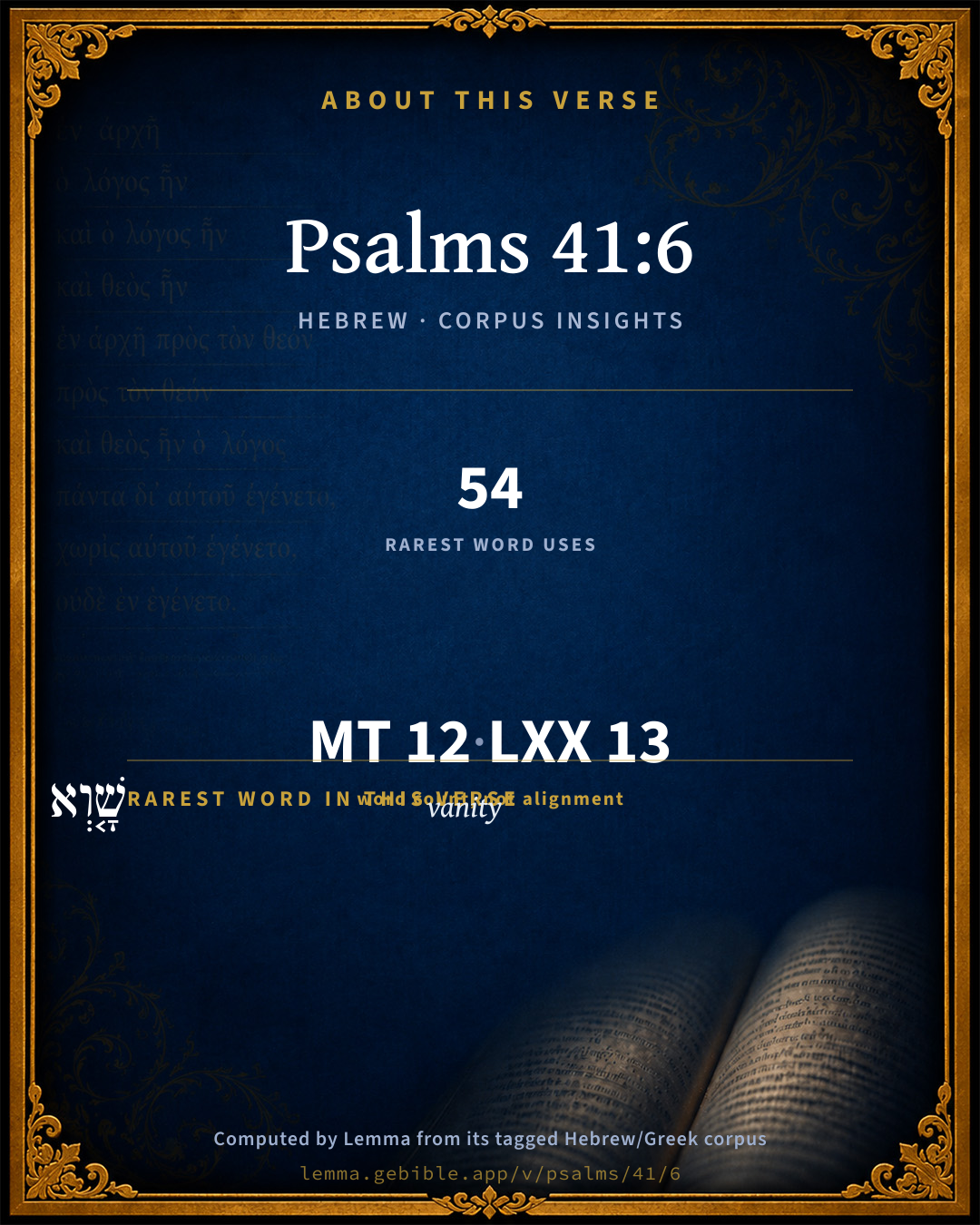
Psalms 41:6

Hebrew (Westminster Leningrad Codex) Psalms 41:6 appears in the Hebrew Old Testament. The text above is from the Westminster Leningrad Codex. Each word links to its Strong’s number, a concise gloss, and parsing drawn from the Open Scriptures Hebrew Bible morphology. Click any word for its full Brown-Driver-Briggs (BDB) entry.
Download image
Cite this verse

Psalms 41:6 (World English Bible). Public Domain. Lemma interlinear Bible study tool, https://lemma.gebible.app/v/psalms/41/6.

Show BibTeX & RIS
BibTeX
RIS
English Translation
If he comes to see me, he speaks falsehood. His heart gathers iniquity to itself. When he goes abroad, he tells it.
World English Bible · Public Domain
Download a study sheet

One document with this verse’s original text, its word-by-word gloss line, the meaning frame, cross-references with their text, attributed commentary, and full source and license credits — printable, and it pastes into notes with its structure intact.

This verse Autodidact and up

Study sheet (.html) Plain text (.txt)

A passage Seminary Student

Up to 50 verses in one chapter. A passage sheet keeps up to 6 commentary sources and 12 cross-references per verse, in the order this page ranks them, and says so on the sheet whenever that leaves anything out. Ask for a single verse and you get the Autodidact verse sheet above.

Everything on this page stays free to read, with no account — the sheet is a download of what is already on screen, not access to it.

Want to remove ads? Support Godless Engineer
Compare translations 3

The same verse in 3 English versions, stacked beneath the original-language interlinear above. Click any original word for its lexicon entry.

Each is an independent rendering of the whole verse — the interlinear is not word-aligned to these translations.

Highlighted words mark where these versions differ — a whole-verse word diff, not a word-by-word alignment.

  • World English Bible Public Domain
    If he comes to see me, he speaks falsehood. His heart gathers iniquity to itself. When he goes abroad, he tells it.
  • King James Version Public Domain
    And if he come to see me, he speaketh vanity: his heart gathereth iniquity to itself; when he goeth abroad, he telleth it.
  • unfoldingWord Literal Text CC BY-SA 4.0
    And if he comes to see he speaks worthlessness; his heart gathers iniquity to itself. He goes out to the outside; he speaks.

unfoldingWord Literal Text — © unfoldingWord, licensed CC BY-SA 4.0. Word-aligned USFM3 via Door43 (git.door43.org/unfoldingWord/en_ult).

Versions to compare (up to 4)

3 of 4 selected

Show all 18 translations

Every available English version of this verse, each an independent rendering of the whole verse.

  • World English Bible Public Domain
    If he comes to see me, he speaks falsehood. His heart gathers iniquity to itself. When he goes abroad, he tells it.
  • Berean Standard Bible Public Domain
    My visitor speaks falsehood; he gathers slander in his heart; he goes out and spreads it abroad.
  • Majority Standard Bible Public Domain
    My visitor speaks falsehood; he gathers slander in his heart; he goes out and spreads it abroad.
  • King James Version Public Domain
    And if he come to see me, he speaketh vanity: his heart gathereth iniquity to itself; when he goeth abroad, he telleth it.
  • American Standard Version (1901) Public Domain
    And if he come to see `me', he speaketh falsehood; His heart gathereth iniquity to itself: When he goeth abroad, he telleth it.
  • Revised Version (1885) Public Domain
    And if he come to see me, he speaketh vanity; his heart gathereth iniquity to itself: when he goeth abroad, he telleth it.
  • Geneva Bible (1599) Public Domain
    And if hee come to see mee, hee speaketh lies, but his heart heapeth iniquitie within him, and when he commeth foorth, he telleth it.
  • Douay-Rheims (1899) Public Domain
    My enemies have spoken evils against me: when shall he die and his name perish?
  • Young's Literal Translation Public Domain
    And if he came to see -- vanity he speaketh, His heart gathereth iniquity to itself, He goeth out -- at the street he speaketh.
  • Literal Standard Version CC BY-SA 4.0
    And if he came to see—he speaks vanity, || His heart gathers iniquity to itself, || He goes out—at the street he speaks.
  • Unlocked Literal Bible CC BY-SA 4.0
    If my enemy comes to see me, he says worthless things; his heart gathers up my disaster for itself; when he goes away from me, he tells others about it.
  • unfoldingWord Literal Text CC BY-SA 4.0
    And if he comes to see he speaks worthlessness; his heart gathers iniquity to itself. He goes out to the outside; he speaks.
  • Darby Bible Public Domain
    And if one come to see [me], he speaketh falsehood; his heart gathereth wickedness to itself: he goeth abroad, he telleth [it].
  • World Messianic Bible Public Domain
    If he comes to see me, he speaks falsehood. His heart gathers iniquity to itself. When he goes abroad, he tells it.
  • Webster's Bible Public Domain
    \\41:5\\My enemies speak evil of me, When shall he die, and his name perish?
  • Free Bible Version CC BY-SA 4.0
    They come to visit me, but their sympathy is not sincere. They're only interested in the bad news, which they spread around as soon as they leave.
  • Bible in Basic English Public Domain
    If one comes to see me, deceit is in his heart; he keeps a store of evil, which he makes public in every place.
  • JPS Tanakh (1917) Public Domain
    (41-7) And if one come to see me, he speaketh falsehood; his heart gathereth iniquity to itself; when he goeth abroad, he speaketh of it.

Literal Standard Version (2020), Covenant Press — licensed CC BY-SA 4.0. Text via the HelloAO Bible API (eBible.org). Unlocked Literal Bible (unfoldingWord) — licensed CC BY-SA 4.0. Text via the HelloAO Bible API (eBible.org). unfoldingWord Literal Text — © unfoldingWord, licensed CC BY-SA 4.0. Word-aligned USFM3 via Door43 (git.door43.org/unfoldingWord/en_ult). Free Bible Version, Dr. Jonathan Gallagher — licensed CC BY-SA 4.0. Text via the HelloAO Bible API (eBible.org).

Word by word

More ways to search: Search by grammar → Find every occurrence → Compare this word →

Practice this passage: Drill this verse → Learn its vocabulary →

שָׁ֤וְא
shâvᵉʼ
H7723
“vanity”
Noun, Common, Masculine, Singular, Absolute
Part of Speech
Noun
Type
Common
Gender
Masculine
Number
Singular
State
Absolute
Full BDB Definition

Origin: from the same as H7722 in the sense of desolating

TWOT: 2338a

emptiness, vanity, falsehood - emptiness, nothingness, vanity - emptiness of speech, lying - worthlessness (of conduct)
  1. וְאִם ʼim H518 “and · if” Conjunction + Conjunction
  2. בָּ֤א bôwʼ H935 “to enter” Verb, Qal, Perfect, 3rd Person, Masculine, Singular
  3. לִרְא֨וֹת râʼâh H7200 “to see” Preposition + Verb, Qal, Infinitive Construct
  4. יְדַבֵּ֗ר dâbar H1696 “to speak” Verb, Piel, Imperfect, 3rd Person, Masculine, Singular
  5. לִבּ֗וֹ lêb H3820 “heart · his” Noun, Common, Masculine, Singular, Construct + Suffix, Personal, 3rd Person, Masculine, Singular
  6. יִקְבָּץ qâbats H6908 “to gather” Verb, Qal, Imperfect, 3rd Person, Masculine, Singular
  7. אָ֥וֶן ʼâven H205 “trouble” Noun, Common, Masculine, Singular, Absolute
  8. יֵצֵ֖א yâtsâʼ H3318 “to go out” Verb, Qal, Imperfect, 3rd Person, Masculine, Singular
  9. לַח֣וּץ chûwts H2351 “to/for the · outside” Preposition, Determined + Noun, Common, Masculine, Singular, Absolute
  10. יְדַבֵּֽר dâbar H1696 “to speak” Verb, Piel, Imperfect, 3rd Person, Masculine, Singular

About this verse

These counts appear in no published source. They are computed here, from the morphology-tagged text and Lemma’s own curated glosses. What Lemma adds →

12
words
10
distinct lemmas
Wisdom
section

Shared distinctive vocabulary

שָׁ֤וְא vanity H7723 occurs in 48 verses of the Hebrew Bible. Also found in:

Grammatical profile

  • 6 verbs
  • 4 nouns
  • 1 preposition
  • 1 conjunction

Verb forms

  • בָּ֤א Qal · Perfect
  • לִרְא֨וֹת Qal · Infinitive Construct
  • יְדַבֵּ֗ר Piel · Imperfect
  • יִקְבָּץ Qal · Imperfect
  • יֵצֵ֖א Qal · Imperfect
  • יְדַבֵּֽר Piel · Imperfect

Repetition

A word recurs within this verse — often emphatic in Hebrew:

  • יְדַבֵּ֗ר to speak H1696 ×2

Hebrew & Septuagint length

In English translation the verse runs 22 words from the Hebrew and 24 from the Septuagint (LXX English) — closely comparable.

A rough comparison of the two English renderings, which tokenize alike — not a word-level alignment.

Word counts can differ between the Hebrew and the Greek without any difference in meaning — e.g. the Hebrew direct-object marker אֵת has no separate Greek word, and Greek often adds the article ὁ.

In the original languages it is 12 Hebrew tokens and 13 Greek tokens — but the two are counted differently (Hebrew bundles its prefixes and suffixes into one token; the Greek is in lemma form), so that isn’t a like-for-like length.

Cross-references

9

Topical passages linked to Psalms 41:6 in the Treasury of Scripture Knowledge — connected by theme and wording, ordered by reader-vote popularity; previews shown in the World English Bible.

  • Psalms 12:2 Everyone lies to his neighbor. They speak with flattering lips, and with a double heart.
  • Luke 11:53–54 As he said these things to them, the scribes and the Pharisees began to be terribly angry, and to draw many things out of him;
  • Proverbs 26:24–26 A malicious man disguises himself with his lips, But he harbors evil in his heart.
  • Luke 20:20–23 They watched him, and sent out spies, who pretended to be righteous, that they might trap him in something he said, so as to deliver him up to the power and authority of the governor.
  • Nehemiah 6:1–14 Now it happened, when it was reported to Sanballat and Tobiah, and to Geshem the Arabian, and to the rest of our enemies, that I had built the wall, and that there was no breach left therein; (though even to that time I had not set up the doors in the gates;)
  • Jeremiah 20:10 For I have heard the defaming of many, terror on every side. Denounce, and we will denounce him, [say] all my familiar friends, those who watch for my fall; peradventure he will be persuaded, and we shall prevail against him, and we shall take our revenge on him.
  • Daniel 11:27 As for both these kings, their hearts shall be to do mischief, and they shall speak lies at one table: but it shall not prosper; for yet the end shall be at the time appointed.
  • Micah 7:5–7 Don't trust in a neighbor. Don't put confidence in a friend. With the woman lying in your embrace, Be careful of the words of your mouth!
  • 2 Corinthians 11:26 I have been in travels often, perils of rivers, perils of robbers, perils from my countrymen, perils from the Gentiles, perils in the city, perils in the wilderness, perils in the sea, perils among false brothers;

Cross-references courtesy of OpenBible.info (CC BY 4.0).

Hebrew and Greek witnesses Masoretic Hebrew ↔ Greek Septuagint

The same verse in the two great witnesses to the Old Testament, shown verse-for-verse.

You’re reading Greek Psalm 40 (Hebrew Psalm 41). The Septuagint counts the superscription, so verse numbers can differ from the Hebrew — chapter-level alignment, not verse-by-verse. Numbering follows Rahlfs.

These are two independent witnesses, not word-aligned to each other, and the Septuagint is shown in lemma (dictionary) form.

Hebrew Psalms 41:6 Masoretic · Westminster Leningrad Codex

וְאִם בָּ֤א לִרְא֨וֹת שָׁ֤וְא יְדַבֵּ֗ר לִבּ֗וֹ יִקְבָּץ אָ֥וֶן ל֑וֹ יֵצֵ֖א לַח֣וּץ יְדַבֵּֽר

If he comes to see me, he speaks falsehood. His heart gathers iniquity to itself. When he goes abroad, he tells it.

World English Bible · Public Domain

Greek LXX Greek Psalm 40:6 Septuagint · lemma form

ὁ ἐχθρός ἐγώ εἶπον κακός ἐγώ πότε ἀποθνήσκω καί ἀποὀλλύω ὁ ὄνομα αὐτός

And if he came to see me, his heart spoke vainly; he gathered iniquity to himself; he went forth and spoke in like manner.

LXX2012 (modern English Septuagint) · Public Domain

Hebrew: Westminster Leningrad Codex (CC BY 4.0). Greek: Septuagint (public domain); English from LXX2012 (modern English Septuagint) (Public Domain). How the Septuagint differs from the Hebrew →

Commentary

Notes on Psalms 41:6 from classic Christian and Jewish commentators (each source and its license shown beneath its notes). The classic Christian expositions comment on the surrounding passage and are grouped to its opening verse, so a note may address several verses; the Jewish commentaries on the Tanakh (Rashi and others) are per-verse, so they appear only where the commentator wrote on this verse.

Lemma curates 59 commentaries, every one of them public domain or Creative Commons licensed, each selected and text-cleaned for this edition rather than reprinted as found. About our sources →

Trapp's Complete Commentary

John Trapp

Psa 41:6 And if he come to see [me], he speaketh vanity: his heart gathereth iniquity to itself; [when] he goeth abroad, he telleth [it].

Ver. 6. And if he come to see me] That is, Ahithophel, or some such hollow hearted Holophanta (Plaut.).

He speaketh vanity] Pretending that he is very sorry to see me so ill at ease; and letting fall some crocodile’s tears perhaps, Ore pro mea sanitate orant sed corde quaeruut malum (Midrash Tillin.).

His heart gathereth iniquity to itself] As toads and serpents gather venom to vomit at you.

When he goeth abroad, he telleth it] Boasting to his treacherous brotherhood of his base behaviour.

John Trapp, A Commentary or Exposition upon All the Books of the Old and New Testament (1647–1656) — public domain. Text from a community e-Sword module.

The Biblical Illustrator

Joseph S. Exell

Psa_41:6

And if he come to see me, he speaketh vanity: his heart gathereth iniquity to itself; when he goeth abroad, he telleth it.

An unsympathetic visitor

The picture drawn by the poet is a very common one. He has unfortunately sent for a man who does not understand his ease. The man is full of words; he can dilate upon the events of the time; he can ask many questions; he can be ostentatiously officious and meddlesome; but all is vanity, a veering wind, a mere noise in the air. The person sent for was destitute of the quality of sympathy. He did not know the ministry of silence. He did not understand that by a mere look, tender, lingering, and sympathetic, he could heal a human heart. Being a newsmonger he brought in the news of the day, which is a sure proof that he would carry the news of the day away with him. When he goeth abroad, he telleth it: there is nothing sacred to the mere talker; there is a disease of words, a gossip which could pry and prattle about the most mysterious and tragical experiences of the heart. The text teaches us how important it is to entrust ourselves in trying moments only to those who are rich in Christian wisdom and sympathy. Few men know how to visit the sick. Those who are in Christ Jesus ought to be able to take rich Christian sympathy to sick-chambers, and to make houses beautiful with instances of Divine revelation and promise and comfort. It should not be beneath the greatest to visit the humblest. The temptation is to over-ride the poor; to make a false use of strength in the presence of the poor; to bear down upon and discourage the poor; such persons should never be sent to minister to souls that are in distress. The piety of Christs Church is not to be roughshod. The saints are to study the gentlest courtesy and grace of manner. They are to act as becometh saints. (J. Parker, D. D.)

The Biblical Illustrator, edited by Joseph S. Exell (c. 1880s–1900s) — public domain. Text from a community e-Sword module.

J. A. Alexander on Psalms

Joseph Addison Alexander

7. (Psa 41:6) And if he come to see me, falsehood he will speak; (in) his heart he is gathering mischief; he will go out, to the street (or out of doors) he will speak (or tell it). The subject of the sentence is his enemy viewed as an ideal person. Compare the alternation of the singular and plural forms in Psa 41:6 (5) and Psa 41:12 (11). If he come, literally has come, at any former time; or still better, if he has come now, if he is now here, the scene being then described as actually present to the writer's senses, which adds greatly to its graphic vividness and beauty. To see, not merely to see me, in the usual sense of visiting, which is rather an English than a Hebrew idiom, but to see for himself, to observe, to play the spy, to watch the progress of the malady, and judge how soon a fatal termination may be looked for. Falsehood, vanity, in the strong scriptural sense of emptiness, hypocrisy, false professions (in this case) of sympathy and friendly interest. He will speak: I am sure that he will do so; I know him too well to doubt it for a moment. The idea thus suggested by the future is entirely lost by exchanging it for the present, which it really includes, but something in addition. The construction, his heart gathereth, is at variance witch the Masoretic accents, and does not yield so good a sense as that which makes his heart an adverbial phrase, a Hebrew idiom of perpetual occurence. In our idiom it will then mean in (or as to) his heart, as opposed to the outward appearance of benevolence and friendship. The second future may be either construed like the first, he (certainly) will gather, (I know that) he will gather; or understood to signify an action which has been begun but is not finished, he is gathering. To gather mischief is, in this connection, to collect materials for calumnious reports. He will go out, he will speak, or as we should say in English, when he goes out he will speak. The Hebrew verb itself used here means to go out. The additional phrase means strictly to the street, or to the outside of the house. It might be grammatically construed with the verb before it, he will go out to the street. But the accents connect it with the verb that follows, to the street he will tell (it), or to the outside, i.e. to those without, who are perhaps to be conceived of, as impatiently awaiting his report.

Joseph Addison Alexander, The Psalms Translated and Explained (1850) — public domain. Text from a community e-Sword module.

Geneva Bible (1599)

Geneva Bible translators

For pretending to comfort me, he conspireth my death in his heart, and braggeth thereof.

Geneva Bible (1599) marginal notes — public domain. Text via Bolls.life.

Jamieson, Fausset & Brown

Robert Jamieson, A. R. Fausset & David Brown

to see me--as if to spy out my case.

he speaketh . . . itself--or, "he speaketh vanity as to his heart"--that is, does not speak candidly, "he gathereth iniquity to him," collects elements for mischief, and then divulges the gains of his hypocrisy.

Jamieson, Fausset & Brown — Commentary Critical and Explanatory on the Whole Bible (1871) — public domain (CC PDM 1.0). Text via the HelloAO Bible API.

Adam Clarke's Commentary

Verse 6. And if he come to see me] This may relate to Ahithophel; but it is more likely that it was to some other person who was his secret enemy, who pretended to come and inquire after his health, but with the secret design to see whether death was despatching his work.

When he goeth abroad, he telleth it.] He makes several observations on my dying state; intimates that I am suffering deep remorse for secret crimes; that God is showing his displeasure against me, and that I am full of sorrow at the approach of death.

Adam Clarke's Commentary on the Bible (1810–1826) — public domain. Text from a community e-Sword/MySword module.

John Calvin's Commentaries

6. And if he come to see me, he speaketh lies. What is contained in this verse relates to his false and treacherous friends. Those who were his professed enemies made no secret of their enmity against him, but openly persecuted him; and that he has already shown in the preceding verse. In addition to this, he now complains that many came to him with professions of attachment to him, as if they had been his friends, who, nevertheless, afterwards poured forth their malicious ill-will in secret against him. Enemies of this sort, who thus cover and conceal their malice, and insinuate themselves under the mask of a fair appearance, only for the purpose of secretly doing us mischief, are indeed much more to be feared than those who openly declare their wicked intentions. Accordingly, having complained of his open enemies, he proceeds to speak of his pretended friends, of whom he declares that they come to see him with no other design than to speak lies, and yet that they are meanwhile devising some deceitful and malicious purpose against him, nay, that they are even secretly heaping up iniquity, and, so to speak, laying it up in store in their hearts; and then he adds, that when they have gone forth from his presence, they manifest their hypocrisy and deceitfulness.

John Calvin's Commentaries (1540-1563) — public domain. Text from the Calvin Translation Society English edition (1840s-50s) via the Christian Classics Ethereal Library (ccel.org). Calvin's coverage is partial (roughly two-thirds of the Bible); uncommented books and verses are honest gaps, never fabricated. The 19th-century editor's footnotes and remarks are omitted so the notes are faithfully Calvin's own voice.

Ellicott's Commentary for English Readers

(6) And if he come.—Some one particular individual is here singled out from the body of enemies.

To see.—The usual word for visiting a sick person. (Comp. 2Sa_13:5; 2Ki_8:29.)

Vanity.—Better, lies. No more vivid picture of an insincere friend could be given. Pretended sympathy lies at the very bedside, while eye and ear are open to catch up anything that can be retailed abroad or turned into mischief, when the necessity of concealment is over.

The scene of the visit of the king to the death-bed of Gaunt in Shakespeare’s King Richard II. illustrates the psalmist’s position, and the poet may even have had this verse in his mind when he wrote.

“Should dying men flatter with those that live

No, no; men living flatter those that die.

A Bible Commentary for English Readers, edited by Charles John Ellicott (1878–1897) — public domain. Text from a community e-Sword module.

The Cambridge Bible for Schools and Colleges

gen. ed. J. J. S. Perowne

6. And if one of them comes to see me, he speaketh falsehood. If one of these enemies comes to visit him, as was usual in sickness (2Ki_8:29), he speaks vanity or falsehood (Psa_12:2), makes hypocritical professions of sympathy; though all the time his heart it gathering iniquity or mischief; he is collecting materials for fresh slander, or feeding his malice on the sight of the sick man; and then he goeth abroad, he telleth what he has seen.

The Cambridge Bible for Schools and Colleges (gen. ed. J. J. S. Perowne; Cambridge University Press, 1878–1918) — public domain. Text from a community e-Sword module.

John Gill's Exposition

And if he come to see me,.... Meaning anyone of his enemies, when they came, as pretended, to pay him a friendly visit. A late learned writer (x) interprets this of Absalom, who visited his father when he had the smallpox, which he thinks, after mentioned, of which his enemies expected he would die, when Absalom pretended great concern for his life; though he, with others, were plotting against him, should he live, to destroy him;

he speaketh vanity; lies and falsehoods, in an hypocritical manner, with a double heart; his mouth and his heart not agreeing together; see Mat 22:16;

his heart gathereth iniquity to itself; amasses to itself greater treasures of wickedness still, thought that itself is desperately wicked, and very wickedness: this is to be understood of the enemies of Christ observing his words and actions, and laying them up, with a wicked intention, against a proper time;

when he goeth abroad, he telleth it; as in the instances concerning giving tribute to Caesar, destroying the temple, and saying he was the son of God, Mat 22:17; compared with Luk 23:2; compared with Mat 26:60, compared with Joh 19:5.

(x) Delaney's Life of King David, vol. 2. p. 157, 158.

John Gill's Exposition of the Whole Bible (1746–1763) — public domain (CC PDM 1.0). Text via the HelloAO Bible API.

Albert Barnes' Notes on the Bible

And if he come to see me - If he condescends to visit me in my sickness. The word me is not in the original; and perhaps the idea is not that he came to see the sufferer, but that he came to see “for himself,” though under pretence of paying a visit of kindness. His real motive was to make observation, that he might find something in the expressions or manner of the sufferer that would enable him to make a report unfavorable to him, and to confirm him in his impression that it was desirable such a man should die. He would come under the mask of sympathy and friendship, but really to find something that would confirm him in the opinion that he was a bad man, and that would enable him to state to others that it was desirable he should die.

He speaketh vanity - He utters no expressions of sincerity and truth; he suggests nothing that would console and comfort me; his words are all foreign to the purpose for which a man should visit another in such circumstances, and are, therefore, vain words. What he says is mere pretence and hypocrisy, and is designed to deceive me, as if he had sympathy with me, while his real purpose is to do me mischief.

His heart gathereth iniquity to itself - Or, in his heart he is gathering mischief. That is, in his heart, or in his secret purpose, under the pretence of sympathy and friendship, he is really aiming to gather the materials for doing me wrong. He is endeavoring to find something in my words or manner; in my expressions of impatience and complaining; in the utterances of my unguarded moments, when I am scarcely conscious - something that may be uttered in the honesty of feeling when a man thinks that he is about to die - some reflections of my own on my past life - some confession of sin, which he may turn to my disadvantage, or which may justify his slanderous report that I am a bad man, and that it is desirable that such a man should live no longer. Can anything be imagined more malicious than this?

When he goeth abroad, he telleth it - literally, he tells it to the street, or to those who are without. Perhaps his friends, as malicious as himself, are anxiously waiting without for his report, and, like him, are desirous of finding something that may confirm them in their opinion of him. Or perhaps he designs to tell this to the friends of the sufferer, to show them now that they were deceived in the man; that although in the days of his health, and in his prosperity, he seemed to be a good man, yet that now, when the trial has come, and a real test has been applied, all his religion has been found false and hollow; his impatience, his complaining, his murmuring, and his unwillingness to die, all showing that he was a hypocrite, and was at heart a bad man. Compare the notes at Job 1:9-11.

Albert Barnes' Notes on the Bible (1834–1885) — public domain. Text from a community e-Sword/MySword module.

Matthew Poole's English Annotations

To see me; to visit me in my sickness, according to the custom.

He speaketh vanity, or falsehood; pretending sympathy with me, and friendship to me, whilst they plot mischief in their hearts against me.

His heart gathereth iniquity to itself; even when he is with me, and pretends hearty affection to me, his heart cannot forbear its customary practice of meditating and devising mischief against me; for which he watcheth and seeketh for all occasions from my speeches, or carriage, or the circumstances of my condition, which he observes.

He telleth it, partly to delight his companions, and partly to encourage them to and direct them in their malicious designs against me.

Matthew Poole's English Annotations on the Holy Bible (1683–1685) — public domain. Text from a community e-Sword/MySword module.

The Treasury of David

Charles H. Spurgeon

Ver. 6. And if he come to see me, he speaketh vanity. His visits of sympathy are visitations of mockery. When the fox calls on the sick lamb his words are soft, but he licks his lips in hope of the carcass. It is wretched work to have spies haunting one's bedchamber, calling in pretence of kindness, but with malice in their hearts. Hypocritical talk is always fulsome and sickening to honest men, but especially to the suffering saint. Our divine Lord had much of this from the false hearts that watched his words. His heart gathereth iniquity to itself. Like will to like. The bird makes its nest of feathers. Out of the sweetest flowers chemists can distil poison, and from the purest words and deeds malice can gather groundwork for calumnious report. It is perfectly marvellous how spite spins webs out of no materials whatever. It is no small trial to have base persons around you lying in wait for every word which they may pervert into evil. The Master whom we serve was constantly subject to this affliction. When he goeth abroad, he telleth it. He makes his lies, and then vends them in open market. He is no sooner out of the house than he outs with his lie, and this against a sick man whom he called to see as a frienda sick man to whose incoherent and random speeches pity should be showed. Ah, black hearted wretch! A devil's cub indeed. How far abroad men will go to publish their slanders! They would fain placard the sky with their falsehoods. A little fault is made much of; a slip of the tongue is a libel, a mistake a crime, and if a word can bear two meanings the worse is always fathered upon it. Tell it in Gath, publish it in Askelon, that the daughters of the uncircumcised may triumph. It is base to strike a man when he is down, yet such is the meanness of mankind towards a Christian hero should he for awhile chance to be under a cloud.

Ver. 6. If he come to see me, he speaketh vanity: many fair words, but none of them true. David Dickson.

Ver. 6. I remember a pretty apologue that Bromiard tells: A fowler, in a sharp, frosty morning, having taken many little birds for which he had long watched, began to take up his nets, and nipping the birds on the head laid them down. A young thrush, espying the tears trickling down his cheek by reason of the extreme cold, said to her mother, that certainly the man was very merciful and compassionate, who wept so bitterly over the calamity of the poor birds. But her mother told her more wisely, that she might better judge of the man's disposition by his hand than by his eye; and if the hands do strike treacherously, he can never be admitted to friendship, who speaks fairly and weeps pitifully. Jeremy Taylor.

Ver. 6. His heart gathereth iniquity to itself.

1. By adding sin to sin, in that he covers over his malice with such horrid hypocrisy.

2. By inventing or contriving all the several ways he can to ensnare me, or do me some mischief, thereby seeking to satisfy and please his corrupt lusts and affections;

3. (Which I like best), by observing all he can in me, and drawing what he can from me, and so laying all up together in his mind, as the ground of his unjust surmises and censures concerning me. Arthur Jackson.

Ver. 6. (first clause). The folly and sin of frivolous visits.

Ver. 6. (second and third clauses). Like to like, or the way in which character draws its like to itself. The same subject might be treated under the title of The Chiffonnier, or the rag collector. What he gathers; where he puts itin his heart; what he does with it; what he gets for it; and what will become of him.

Psalms 41:7*

Charles H. Spurgeon's The Treasury of David (1869–1885) — public domain. Psalms only. Text from a community e-Sword/MySword module.

Whedon's Commentary on the Bible

Daniel D. Whedon

6. If he come to see me—Professedly to inquire after my health as a friend.

He speaketh vanity—His professions of friendship are empty and hypocritical.

His heart gathereth iniquity—Not only is his false profession of friendship an accumulation of his guilt, but it is in his heart even there to gather up material for my injury. Nay, this was the real object of his professedly friendly visit. Compare with this the feigned friendship but real malignity of Christ’s enemies. Luk_20:20.

He telleth it—He reports my sickness, and my private conversation, in a way to hurt me with the people.

Daniel D. Whedon (gen. ed.), Commentary on the Old and New Testaments (1874–1909) — public domain. Text from a community e-Sword module.

The Pulpit Commentary

And if he come to see me, he speaketh vanity; rather, he speaketh falsehood. (see the comment on Psa_12:2) It is suggested that Ahithophel is especially aimed at. But there is no proof of this. All the enemies are probably intended, only distributively instead of collectively. His heart gathereth iniquity to itself. Dr. Kay"s comment is, "He makes a show of friendship, using hollow compliments; but he is treasuring up every expression as material for misrepresentation." When he goeth abroad, he telleth it. He reports what he has seen and heard, but untruly.

The Pulpit Commentary (1880–1919), ed. H.D.M. Spence-Jones & Joseph S. Exell — public domain. Text from a community e-Sword module.

John Wesley's Explanatory Notes

His heart - Even when he is with me, and pretends hearty affection, his heart is devising mischief against me.

John Wesley, Explanatory Notes Upon the Whole Bible (1754–1765) — public domain. Text via the GEBible commentary corpus.

Lesson kit

Teaching starters — assembled from the data on this page, not authored interpretation. Every prompt links to the verse data it draws on. Edit before teaching.

Psalms, in the Wisdom, opens this verse with 12 words (10 distinct Hebrew lemmas). Its most distinctive word is shâvᵉʼ (“vanity”). A historical commentator’s framing appears above. Read the whole chapter for the surrounding context.

Discussion questions

  1. The word shâvᵉʼ carries the sense “vanity.” How does it shape the verse?
  2. How does Exodus 20:7, which shares the word «vanity», read alongside this verse?
  3. What does the repetition of “to speak” (2× in this one verse) do in this verse?
  4. The translations on this page render this verse differently — a whole-verse word diff, not a word-by-word alignment. What might account for the different wordings?
  5. «בָּ֤א» is a Qal Perfect verb. How does that grammatical form shape the action described?
  6. Compare how Trapp's Complete Commentary and The Biblical Illustrator read this verse. Where do they agree or differ?

Things to notice

Reading settings

Reading text

Shown beneath each verse's original-language words.

Old Testament
Old Testament edition

Read the OT as the Masoretic Hebrew (MT) or the Greek Septuagint (LXX).

English shown for the Greek Septuagint (in the Hebrew ↔ Greek comparison).

Comparing translations? Open the Compare panel on any verse page to stack up to four side by side.