Leviticus 14:45

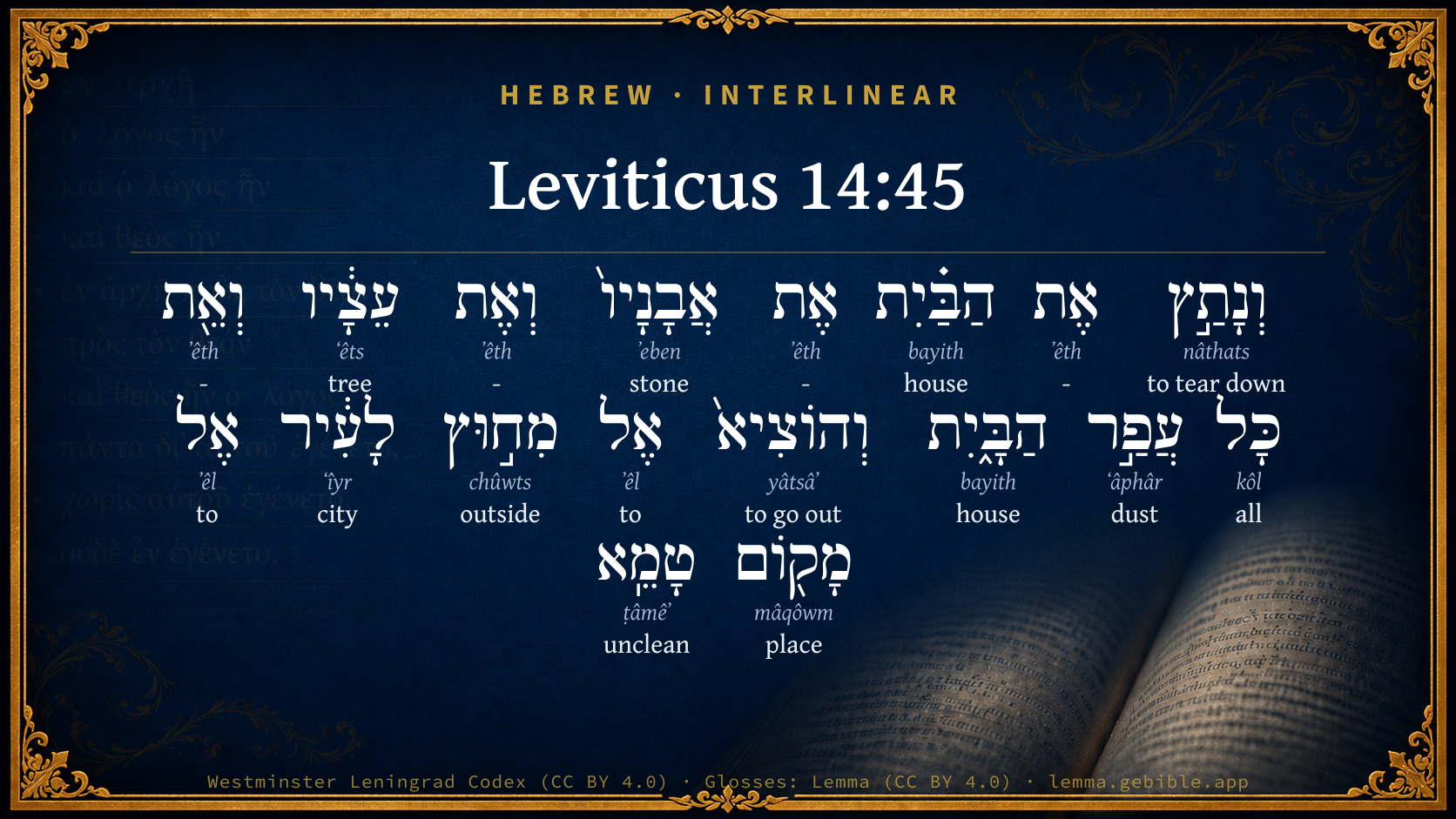
Hebrew (Westminster Leningrad Codex) Leviticus 14:45 appears in the Hebrew Old Testament. The text above is from the Westminster Leningrad Codex. Each word links to its Strong’s number, a concise gloss, and parsing drawn from the Open Scriptures Hebrew Bible morphology. Click any word for its full Brown-Driver-Briggs (BDB) entry.
Download image
Cite this verse

Leviticus 14:45 (World English Bible). Public Domain. Lemma interlinear Bible study tool, https://lemma.gebible.app/v/leviticus/14/45.

Show BibTeX & RIS
BibTeX
RIS
English Translation
He shall break down the house, its stones, and its timber, and all the house's mortar. He shall carry them out of the city into an unclean place.
World English Bible · Public Domain
Download a study sheet

One document with this verse’s original text, its word-by-word gloss line, the meaning frame, cross-references with their text, attributed commentary, and full source and license credits — printable, and it pastes into notes with its structure intact.

This verse Autodidact and up

Study sheet (.html) Plain text (.txt)

A passage Seminary Student

Up to 50 verses in one chapter. A passage sheet keeps up to 6 commentary sources and 12 cross-references per verse, in the order this page ranks them, and says so on the sheet whenever that leaves anything out. Ask for a single verse and you get the Autodidact verse sheet above.

Everything on this page stays free to read, with no account — the sheet is a download of what is already on screen, not access to it.

Want to remove ads? Support Godless Engineer
Compare translations 3

The same verse in 3 English versions, stacked beneath the original-language interlinear above. Click any original word for its lexicon entry.

Each is an independent rendering of the whole verse — the interlinear is not word-aligned to these translations.

Highlighted words mark where these versions differ — a whole-verse word diff, not a word-by-word alignment.

  • World English Bible Public Domain
    He shall break down the house, its stones, and its timber, and all the house's mortar. He shall carry them out of the city into an unclean place.
  • King James Version Public Domain
    And he shall break down the house, the stones of it, and the timber thereof, and all the mortar of the house; and he shall carry them forth out of the city into an unclean place.
  • unfoldingWord Literal Text CC BY-SA 4.0
    Then he shall tear down the house—its stones and its wood and all the mortar of the house. And he shall take out to on the outside of the city, to an unclean place.

unfoldingWord Literal Text — © unfoldingWord, licensed CC BY-SA 4.0. Word-aligned USFM3 via Door43 (git.door43.org/unfoldingWord/en_ult).

Versions to compare (up to 4)

3 of 4 selected

Show all 18 translations

Every available English version of this verse, each an independent rendering of the whole verse.

  • World English Bible Public Domain
    He shall break down the house, its stones, and its timber, and all the house's mortar. He shall carry them out of the city into an unclean place.
  • Berean Standard Bible Public Domain
    It must be torn down with its stones, its timbers, and all its plaster, and taken outside the city to an unclean place.
  • Majority Standard Bible Public Domain
    It must be torn down with its stones, its timbers, and all its plaster, and taken outside the city to an unclean place.
  • King James Version Public Domain
    And he shall break down the house, the stones of it, and the timber thereof, and all the mortar of the house; and he shall carry them forth out of the city into an unclean place.
  • American Standard Version (1901) Public Domain
    And he shall break down the house, the stones of it, and the timber thereof, and all the mortar of the house; and he shall carry them forth out of the city into an unclean place.
  • Revised Version (1885) Public Domain
    And he shall break down the house, the stones of it, and the timber thereof, and all the mortar of the house; and he shall carry them forth out of the city into an unclean place.
  • Geneva Bible (1599) Public Domain
    And hee shall breake downe the house, with the stones of it, and the timber thereof, and all the mortar of the house, and hee shall carie them out of the citie vnto an vncleane place.
  • Douay-Rheims (1899) Public Domain
    And they shall destroy it forthwith, and shall cast the stones and timber thereof, and all the dust without the town into an unclean place.
  • Young's Literal Translation Public Domain
    `And he hath broken down the house, its stones, and its wood, and all the clay of the house, and he hath brought `them' forth unto the outside of the city, unto an unclean place.
  • Literal Standard Version CC BY-SA 4.0
    And he has broken down the house, its stones, and its wood, and all the clay of the house, and he has brought [them] forth to the outside of the city, to an unclean place.
  • Unlocked Literal Bible CC BY-SA 4.0
    The house must be torn down. The stones, timber, and all the plaster in the house must be carried away out of the city to the unclean place.
  • unfoldingWord Literal Text CC BY-SA 4.0
    Then he shall tear down the house—its stones and its wood and all the mortar of the house. And he shall take out to on the outside of the city, to an unclean place.
  • Darby Bible Public Domain
    And they shall break down the house, the stones of it, and the timber thereof, and all the mortar of the house, and shall carry them forth out of the city to an unclean place.
  • World Messianic Bible Public Domain
    He shall break down the house, its stones, and its timber, and all the house’s mortar. He shall carry them out of the city into an unclean place.
  • Webster's Bible Public Domain
    And he shall break down the house, its stones, and its timber, and all the mortar of the house: and he shall carry them forth out of the city to an unclean place.
  • Free Bible Version CC BY-SA 4.0
    It must be demolished, and all its stones, timbers, and plaster must be taken and dumped in an unclean area outside the town.
  • Bible in Basic English Public Domain
    And the house will have to be pulled down, the stones of it and the wood and the paste; and everything is to be taken out to an unclean place outside the town.
  • JPS Tanakh (1917) Public Domain
    And he shall break down the house, the stones of it, and the timber thereof, and all the mortar of the house; and he shall carry them forth out of the city into an unclean place.

Literal Standard Version (2020), Covenant Press — licensed CC BY-SA 4.0. Text via the HelloAO Bible API (eBible.org). Unlocked Literal Bible (unfoldingWord) — licensed CC BY-SA 4.0. Text via the HelloAO Bible API (eBible.org). unfoldingWord Literal Text — © unfoldingWord, licensed CC BY-SA 4.0. Word-aligned USFM3 via Door43 (git.door43.org/unfoldingWord/en_ult). Free Bible Version, Dr. Jonathan Gallagher — licensed CC BY-SA 4.0. Text via the HelloAO Bible API (eBible.org).

Word by word

More ways to search: Search by grammar → Find every occurrence → Compare this word →

Practice this passage: Drill this verse → Learn its vocabulary →

וְנָתַ֣ץ
nâthats
H5422
“and · to tear down”
Conjunction + Verb, Qal, Sequential Perfect, 3rd Person, Masculine, Singular
Part of Speech
Conjunction + Verb
Stem
Qal
Form
Sequential Perfect
Person
3rd Person
Gender
Masculine
Number
Singular
Full BDB Definition

Origin: a primitive root

TWOT: 1446

to pull down, break down, cast down, throw down, beat down, destroy, overthrow, break out (teeth) - (Qal) - to pull down - to break down, break off - (Niphal) to be pulled or broken down - (Piel) to tear down - (Pual) to be torn down - (Hophal) to be broken, be broken down
  1. אֶת ʼêth H853 “-” Particle, Direct Object
  2. הַבַּ֗יִת bayith H1004 “the · house” Particle, Definite Article + Noun, Common, Masculine, Singular, Absolute
  3. אֶת ʼêth H853 “-” Particle, Direct Object
  4. אֲבָנָיו֙ ʼeben H68 “stones · his” Noun, Common, Feminine, Plural, Construct + Suffix, Personal, 3rd Person, Masculine, Singular
  5. וְאֶת ʼêth H853 “and · -” Conjunction + Particle, Direct Object
  6. עֵצָ֔יו ʻêts H6086 “trees · his” Noun, Common, Masculine, Plural, Construct + Suffix, Personal, 3rd Person, Masculine, Singular
  7. וְאֵ֖ת ʼêth H853 “and · -” Conjunction + Particle, Direct Object
  8. כָּל kôl H3605 “all of” Noun, Common, Masculine, Singular, Construct
  9. עֲפַ֣ר ʻâphâr H6083 “dust of” Noun, Common, Masculine, Singular, Construct
  10. הַבָּ֑יִת bayith H1004 “the · house” Particle, Definite Article + Noun, Common, Masculine, Singular, Absolute
  11. וְהוֹצִיא֙ yâtsâʼ H3318 “and · to go out” Conjunction + Verb, Hiphil, Sequential Perfect, 3rd Person, Masculine, Singular
  12. אֶל ʼêl H413 “to” Preposition
  13. מִח֣וּץ chûwts H2351 “from · outside” Preposition + Noun, Common, Masculine, Singular, Absolute
  14. לָעִ֔יר ʻîyr H5892 “to/for the · city” Preposition, Determined + Noun, Common, Feminine, Singular, Absolute
  15. אֶל ʼêl H413 “to” Preposition
  16. מָק֖וֹם mâqôwm H4725 “place” Noun, Common, Masculine, Singular, Absolute
  17. טָמֵֽא ṭâmêʼ H2931 “unclean” Adjective, Adjective, Masculine, Singular, Absolute

About this verse

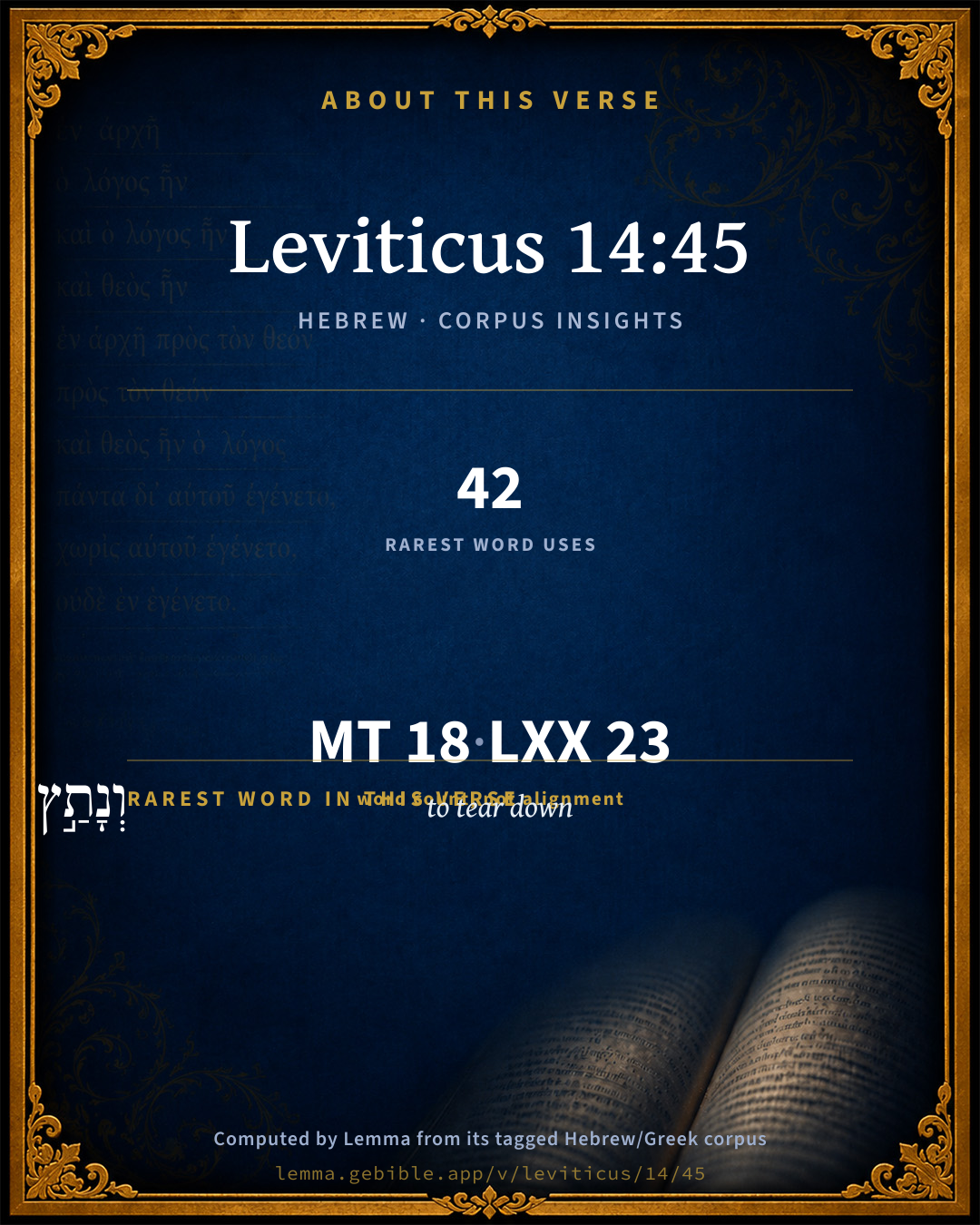
These counts appear in no published source. They are computed here, from the morphology-tagged text and Lemma’s own curated glosses. What Lemma adds →

18
words
13
distinct lemmas
Pentateuch
section

Shared distinctive vocabulary

וְנָתַ֣ץ to tear down H5422 occurs in 41 verses of the Hebrew Bible. Also found in:

Grammatical profile

  • 2 verbs
  • 9 nouns
  • 1 adjective
  • 2 prepositions
  • 4 particles

Verb forms

  • וְנָתַ֣ץ Qal · Sequential Perfect
  • וְהוֹצִיא֙ Hiphil · Sequential Perfect

Repetition

Words recur within this verse — often emphatic in Hebrew:

  • הַבַּ֗יִת house H1004 ×2
  • אֶל to H413 ×2

Hebrew & Septuagint length

In English translation the verse runs 28 words from the Hebrew and 28 from the Septuagint (LXX English) — the same length.

A rough comparison of the two English renderings, which tokenize alike — not a word-level alignment.

Word counts can differ between the Hebrew and the Greek without any difference in meaning — e.g. the Hebrew direct-object marker אֵת has no separate Greek word, and Greek often adds the article ὁ.

In the original languages it is 18 Hebrew tokens and 23 Greek tokens — but the two are counted differently (Hebrew bundles its prefixes and suffixes into one token; the Greek is in lemma form), so that isn’t a like-for-like length.

Cross-references

12

Topical passages linked to Leviticus 14:45 in the Treasury of Scripture Knowledge — connected by theme and wording, ordered by reader-vote popularity; previews shown in the World English Bible.

  • 1 Kings 9:6–9 But if you shall turn away from following me, you or your children, and not keep my commandments and my statutes which I have set before you, but shall go and serve other gods, and worship them;
  • 2 Kings 10:27 They broke down the pillar of Baal, and broke down the house of Baal, and made it a latrine, to this day.
  • 2 Kings 17:20–23 Yahweh rejected all the seed of Israel, and afflicted them, and delivered them into the hand of spoilers, until he had cast them out of his sight.
  • 2 Kings 18:4 He removed the high places, and broke the pillars, and cut down the Asherah: and he broke in pieces the brazen serpent that Moses had made; for to those days the children of Israel did burn incense to it; and he called it Nehushtan.
  • 2 Kings 25:4–12 Then a breach was made in the city, and all the men of war [fled] by night by the way of the gate between the two walls, which was by the king's garden (now the Chaldeans were against the city round about); and [the king] went by the way of the Arabah.
  • 2 Kings 25:25–26 But it happened in the seventh month, that Ishmael the son of Nethaniah, the son of Elishama, of the royal seed came, and ten men with him, and struck Gedaliah, so that he died, and the Jews and the Chaldeans that were with him at Mizpah.
  • Jeremiah 52:13 and he burned the house of Yahweh, and the king's house; and all the houses of Jerusalem, even every great house, burned he with fire.
  • Ezekiel 5:4 Of these again shall you take, and cast them into the midst of the fire, and burn them in the fire; from it shall a fire come forth into all the house of Israel.
  • Matthew 22:7 When the king heard that, he was angry, and he sent his armies, destroyed those murderers, and burned their city.
  • Matthew 24:2 But he answered them, "Don't you see all of these things? Most assuredly I tell you, there will not be left here one stone on another, that will not be thrown down."
  • Romans 11:7–11 What then? That which Israel seeks for, that he didn't obtain, but the chosen ones obtained it, and the rest were hardened.
  • Revelation 11:2 Leave out the court which is outside of the temple, and don't measure it, for it has been given to the gentiles. They will tread the holy city under foot for forty-two months.

Cross-references courtesy of OpenBible.info (CC BY 4.0).

Hebrew and Greek witnesses Masoretic Hebrew ↔ Greek Septuagint

The same verse in the two great witnesses to the Old Testament, shown verse-for-verse.

These are two independent witnesses, not word-aligned to each other, and the Septuagint is shown in lemma (dictionary) form.

Hebrew Leviticus 14:45 Masoretic · Westminster Leningrad Codex

וְנָתַ֣ץ אֶת הַבַּ֗יִת אֶת אֲבָנָיו֙ וְאֶת עֵצָ֔יו וְאֵ֖ת כָּל עֲפַ֣ר הַבָּ֑יִת וְהוֹצִיא֙ אֶל מִח֣וּץ לָעִ֔יר אֶל מָק֖וֹם טָמֵֽא

He shall break down the house, its stones, and its timber, and all the house's mortar. He shall carry them out of the city into an unclean place.

World English Bible · Public Domain

Greek LXX Leviticus 14:45 Septuagint · lemma form

καί κατααἱρέω ὁ οἰκία καί ὁ ξύλον αὐτός καί ὁ λίθος αὐτός καί πᾶς ὁ χοῦς ἐκφέρω ἔξω ὁ πόλις εἰς τόπος ἀκάθαρτος

And they shall take down the house, and its timbers and its stones, and they shall carry out all the mortar without the city into an unclean place.

LXX2012 (modern English Septuagint) · Public Domain

Hebrew: Westminster Leningrad Codex (CC BY 4.0). Greek: Septuagint (public domain); English from LXX2012 (modern English Septuagint) (Public Domain). How the Septuagint differs from the Hebrew →

Targum (Aramaic paraphrase)

2

The Targum is the ancient Jewish Aramaic paraphrase of the Hebrew Scriptures — an interpretive translation, not the Hebrew text itself. Onkelos (literal) and Pseudo-Jonathan (expansive) render the Torah, and Jonathan the Prophets. Coverage is partial: where no permissively-licensed English translation exists for a verse, only the Aramaic is shown. This is verse-level text, not a word-by-word alignment to the Hebrew.

  1. Targum Onkelos Torah (Genesis–Deuteronomy)
    וִיתָרַע יָת בֵּיתָא יָת אַבְנוֹהִי וְיָת אָעוֹהִי וְיָת כָּל עֲפַר בֵּיתָא וְיַפֵּק לְמִבָּרָא לְקַרְתָּא לַאֲתַר מְסָאָב

    (no public-domain English translation for this verse)

    Targum Onkelos — Aramaic: “Onkelos Genesis” (public domain); “Onkelos Exodus” (public domain); “Onkelos Leviticus” (public domain); “Onkelos Numbers” (public domain); “Onkelos Deuteronomy” (public domain). English: “Sefaria Community Translation” (CC0 1.0 (public-domain dedication)); “J.W. Etheridge. The Targums of Onkelos and Jonathan Ben Uzziel on the Pentateuch. London: Longmans, Green, 1862” (public domain). Text via Sefaria.

  2. Targum Pseudo-Jonathan Torah (Genesis–Deuteronomy)
    וִיפַכְרוּן יַת בֵּיתָא יַת אַבְנוֹי וְיַת קֵיסוֹי וְיַת כָּל עַפְרָא דְבֵיתָא וְיִנְפַּק לְמִבָּרָא לְקַרְתָּא לַאֲתַר מְסָאָב

    Then shall they destroy that house, and its stones, and its timber, and all the plaster of the house, and lie shall remove it without the city to an unclean place.

    Targum Pseudo-Jonathan — Aramaic: “Targum Jonathan on Genesis” (public domain); “Targum Jonathan on Exodus” (public domain); “Targum Jonathan on Leviticus” (public domain); “Targum Jonathan on Numbers” (public domain); “Targum Jonathan on Deuteronomy” (public domain). English: “The Targum of Jonathan ben Uzziel, trans. J. W. Etheridge, London, 1862” (public domain). Text via Sefaria.

Commentary

Notes on Leviticus 14:45 from classic Christian and Jewish commentators (each source and its license shown beneath its notes). The classic Christian expositions comment on the surrounding passage and are grouped to its opening verse, so a note may address several verses; the Jewish commentaries on the Tanakh (Rashi and others) are per-verse, so they appear only where the commentator wrote on this verse.

Lemma curates 59 commentaries, every one of them public domain or Creative Commons licensed, each selected and text-cleaned for this edition rather than reprinted as found. About our sources →

Geneva Bible (1599)

Geneva Bible translators

That is, he shall command it to be pulled down, as verse 40.

Or, dust.

Geneva Bible (1599) marginal notes — public domain. Text via Bolls.life.

Adam Clarke's Commentary

Verse 45. He shall break down the house] "On the suspicion of a house being infected, the priest examined it, and ordered it to be shut up seven days; if he found the plague, or signs of the plague, (hollow streaks, greenish or reddish,) were not spread, he commanded it to be shut up seven days more. On the thirteenth day he revisited it; and if he found the infected place dim, or gone away, he took out that part of the wall, carried it out to an unclean place, mended the wall, and caused the whole house to be new plastered. It was then shut up a third seven days, and he came on the nineteenth, and if he found that the plague was broken out anew, he ordered the house to be pulled down." See Ainsworth. From all this may we not learn a lesson of instruction? If the means made use of by God and his ministers for the conversion of a sinner be, through his wilful obstinacy, rendered of no avail; if by his evil practices he trample under foot the blood of the covenant wherewith he might have been sanctified, and do despite to the Spirit of God; then God will pull down his house-dislodge his soul from its earthly tabernacle, consign the house, the body, to corruption, and the spirit to the perdition of ungodly men. Reader, see well how it stands with thy soul. God is not mocked: what a man soweth, that shall he reap.

Adam Clarke's Commentary on the Bible (1810–1826) — public domain. Text from a community e-Sword/MySword module.

John Gill's Exposition

And he shall take to cleanse the house,.... The priest, or by his fellow priest, as Aben Ezra, though some interpret it of the master of the house; in Lev 14:49, an account is given of the manner of cleansing a leprous house, which is the same with that of cleansing a leprous man, see notes on Lev 14:4-7,

Two birds. The birds here indeed are not described as "alive and clean", Lev 14:4; but both are plainly implied and the house is said to be cleansed with the blood of the slain bird, as well as with the living bird; and it was the upper door post of the house which was sprinkled seven times with it, but there were no sacrifices offered; in this case, as in the cleansing of the leper, the atonement for it was made by the other rites, which were sufficient to render it habitable again, and free for use, either of the owner or any other person:

and cedar wood, and scarlet, and hyssop. See Gill on Lev 14:4.

John Gill's Exposition of the Whole Bible (1746–1763) — public domain (CC PDM 1.0). Text via the HelloAO Bible API.

Whedon's Commentary on the Bible

Daniel D. Whedon

45. He shall break down… carry… out — The priest, according to the literalism of Colenso, would have a vast work to do single-handed. But common sense assures us that he may be said to perform labour which he directs. The damage done by such a house to the ceremonial purity and health of its occupants was of far more consequence in the estimation of the lawgiver than the building itself. “Those to whom this appears strange, and who lament the fate of a house pulled down by legal authority, probably think of large and magnificent houses like ours, of many stories high, which cost a great deal of money,” whereas the houses of those days were usually rude, low, and cheap.

Daniel D. Whedon (gen. ed.), Commentary on the Old and New Testaments (1874–1909) — public domain. Text from a community e-Sword module.

The Pulpit Commentary

As the leper was removed from the camp, so the leprous house is to be utterly pulled down; the house, the stones of it, and the timber thereof, and all the morter of the house; and all its materials carried forth eat of the city into an unclean place.

The Pulpit Commentary (1880–1919), ed. H.D.M. Spence-Jones & Joseph S. Exell — public domain. Text from a community e-Sword module.

unfoldingWord translationNotes

Door43 World Missions Community

The house must be torn down

This can be translated in active form. AT: "They must tear the house down" (See: Active or Passive)

The stones, timber, and all the plaster in the house must be carried away

This can be translated in active form. AT: "They must carry away the stones, timber, and all the plaster in the house" (See: Active or Passive)

whoever goes into the house ... will be unclean

A person whom other people may not touch and who is not acceptable for God's purposes because he has entered the house is spoken of as if the person were physically unclean. (See: Metaphor)

until evening

"until sunset"

translationWords

clean

unfoldingWord translationNotes — © Distant Shores Media and the Door43 World Missions Community, licensed CC BY-SA 4.0. Source: git.door43.org/Door43/en_tn.

Lesson kit

Teaching starters — assembled from the data on this page, not authored interpretation. Every prompt links to the verse data it draws on. Edit before teaching.

Leviticus, in the Pentateuch, opens this verse with 18 words (13 distinct Hebrew lemmas). Its most distinctive word is nâthats (“to tear down”). A historical commentator’s framing appears above. Read the whole chapter for the surrounding context.

Discussion questions

  1. What does “to tear down” (nâthats) contribute to the verse as a whole?
  2. Exodus 34:13 shares the word «to tear down» with this verse. How do the two illuminate each other?
  3. “house” occurs 2× in this one verse. What is the effect of the repetition?
  4. These translations render this verse differently. What is at stake in choosing one wording over another?
  5. The verb «וְנָתַ֣ץ» is Qal Sequential Perfect. How does its form color the action?
  6. Reading how Geneva Bible (1599) and Adam Clarke's Commentary read this verse, where do the two commentators agree and where do they part?

Things to notice

Reading settings

Reading text

Shown beneath each verse's original-language words.

Old Testament
Old Testament edition

Read the OT as the Masoretic Hebrew (MT) or the Greek Septuagint (LXX).

English shown for the Greek Septuagint (in the Hebrew ↔ Greek comparison).

Comparing translations? Open the Compare panel on any verse page to stack up to four side by side.