
1 Kings 7:9

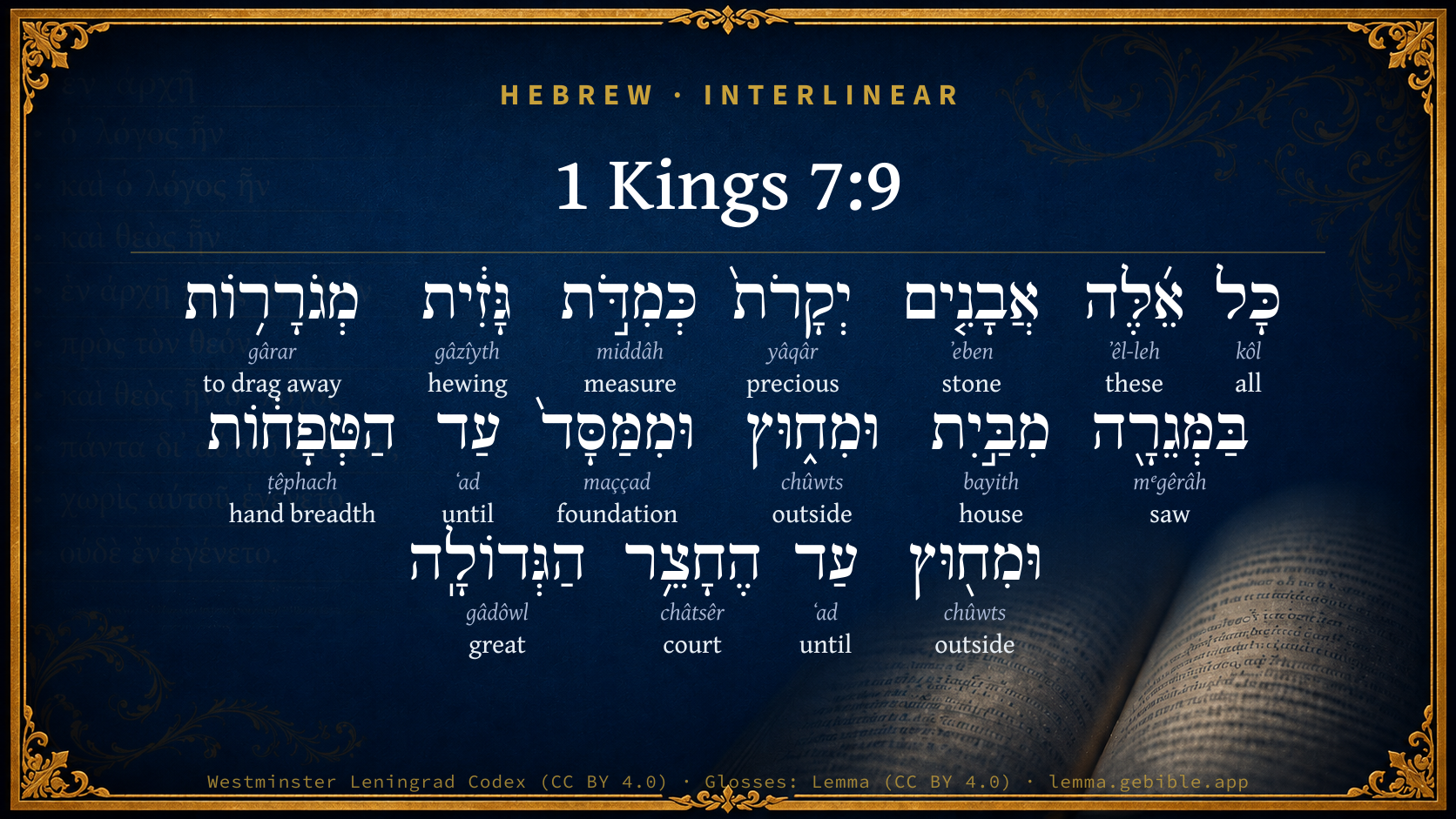
Hebrew (Westminster Leningrad Codex) 1 Kings 7:9 appears in the Hebrew Old Testament. The text above is from the Westminster Leningrad Codex. Each word links to its Strong’s number, a concise gloss, and parsing drawn from the Open Scriptures Hebrew Bible morphology. Click any word for its full Brown-Driver-Briggs (BDB) entry.
Download image
Cite this verse

1 Kings 7:9 (World English Bible). Public Domain. Lemma interlinear Bible study tool, https://lemma.gebible.app/v/1-kings/7/9.

Show BibTeX & RIS
BibTeX
RIS
English Translation
All these were of costly stones, even of hewn stone, according to measure, sawed with saws, inside and outside, even from the foundation to the coping, and so on the outside to the great court.
World English Bible · Public Domain
Highlights
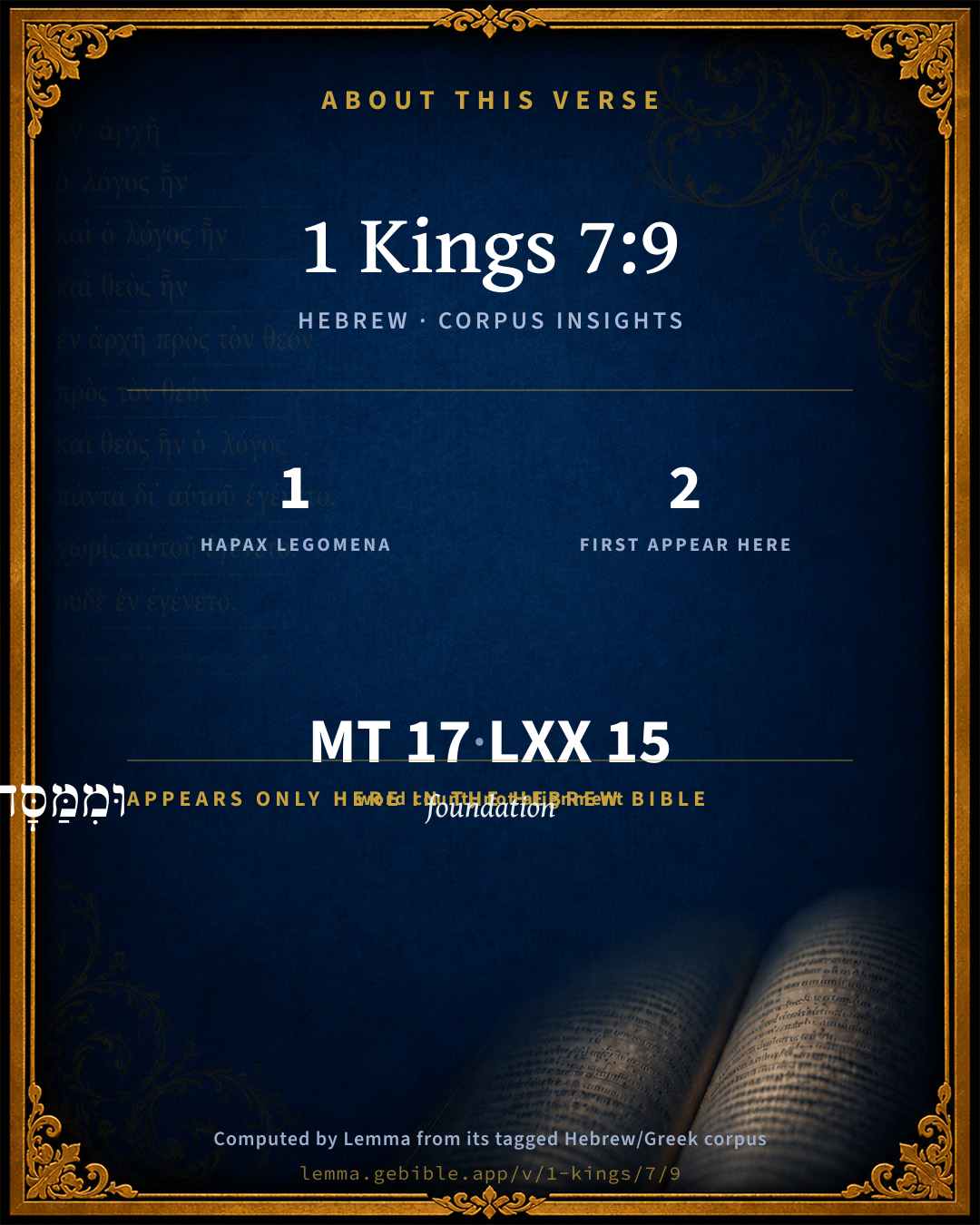
  • 1 hapax legomenon — only here in the Hebrew Bible
  • 2 first appearances in the Hebrew Bible
Full analysis ↓
Download a study sheet

One document with this verse’s original text, its word-by-word gloss line, the meaning frame, cross-references with their text, attributed commentary, and full source and license credits — printable, and it pastes into notes with its structure intact.

This verse Autodidact and up

Study sheet (.html) Plain text (.txt)

A passage Seminary Student

Up to 50 verses in one chapter. A passage sheet keeps up to 6 commentary sources and 12 cross-references per verse, in the order this page ranks them, and says so on the sheet whenever that leaves anything out. Ask for a single verse and you get the Autodidact verse sheet above.

Everything on this page stays free to read, with no account — the sheet is a download of what is already on screen, not access to it.

Want to remove ads? Support Godless Engineer
Compare translations 3

The same verse in 3 English versions, stacked beneath the original-language interlinear above. Click any original word for its lexicon entry.

Each is an independent rendering of the whole verse — the interlinear is not word-aligned to these translations.

Highlighted words mark where these versions differ — a whole-verse word diff, not a word-by-word alignment.

  • World English Bible Public Domain
    All these were of costly stones, even of hewn stone, according to measure, sawed with saws, inside and outside, even from the foundation to the coping, and so on the outside to the great court.
  • King James Version Public Domain
    All these were of costly stones, according to the measures of hewed stones, sawed with saws, within and without, even from the foundation unto the coping, and so on the outside toward the great court.
  • unfoldingWord Literal Text CC BY-SA 4.0
    All of these valuable stones, according to the measurements of hewn stone, sawn with the saw on the inside and on the outside, and from the foundation to the eaves and from outside to the great courtyard.

unfoldingWord Literal Text — © unfoldingWord, licensed CC BY-SA 4.0. Word-aligned USFM3 via Door43 (git.door43.org/unfoldingWord/en_ult).

Versions to compare (up to 4)

3 of 4 selected

Show all 18 translations

Every available English version of this verse, each an independent rendering of the whole verse.

  • World English Bible Public Domain
    All these were of costly stones, even of hewn stone, according to measure, sawed with saws, inside and outside, even from the foundation to the coping, and so on the outside to the great court.
  • Berean Standard Bible Public Domain
    All these buildings were constructed with costly stones, cut to size and trimmed with saws inside and out from the foundation to the eaves, and from the outside to the great courtyard.
  • Majority Standard Bible Public Domain
    All these buildings were constructed with costly stones, cut to size and trimmed with saws inside and out from the foundation to the eaves, and from the outside to the great courtyard.
  • King James Version Public Domain
    All these were of costly stones, according to the measures of hewed stones, sawed with saws, within and without, even from the foundation unto the coping, and so on the outside toward the great court.
  • American Standard Version (1901) Public Domain
    All these were of costly stones, even of hewn stone, according to measure, sawed with saws, within and without, even from the foundation unto the coping, and so on the outside unto the great court.
  • Revised Version (1885) Public Domain
    All these were of costly stones, even of hewn stone, according to measure, sawed with saws, within and without, even from the foundation unto the coping, and so on the outside unto the great court.
  • Geneva Bible (1599) Public Domain
    All these were of costly stones, hewed by measure, and sawed with sawes within and without, from the foundation vnto the stones of an hand breadth, and on the outside to the great court.
  • Douay-Rheims (1899) Public Domain
    All of costly stones, which were sawed by a certain rule and measure both within and without: from the foundation to the top of the walls, and without unto the great court.
  • Young's Literal Translation Public Domain
    All these `are' of precious stone, according to the measures of hewn work, sawn with a saw, within and without, even from the foundation unto the coping, and at the outside, unto the great court.
  • Literal Standard Version CC BY-SA 4.0
    All these [are] of precious stones, according to the measures of hewn work, sawn with a saw, inside and outside, even from the foundation to the coping, and at the outside, to the great court.
  • Unlocked Literal Bible CC BY-SA 4.0
    These buildings were adorned with costly hewn stones, precisely measured and cut with a saw and smoothed on all sides. These stones were used from the foundation to the stones on top, and also on the outside to the great court.
  • unfoldingWord Literal Text CC BY-SA 4.0
    All of these valuable stones, according to the measurements of hewn stone, sawn with the saw on the inside and on the outside, and from the foundation to the eaves and from outside to the great courtyard.
  • Darby Bible Public Domain
    All these [buildings] were of costly stones, hewn stones, according to the measures, sawed with saws, within and without, even from the foundation to the coping, and on the outside as far as the great court.
  • World Messianic Bible Public Domain
    All these were of costly stones, even of stone cut according to measure, sawed with saws, inside and outside, even from the foundation to the coping, and so on the outside to the great court.
  • Webster's Bible Public Domain
    All these were of costly stones, according to the measures of hewn stones, sawed with saws, within and without, even from the foundation to the coping, and so on the outside towards the great court.
  • Free Bible Version CC BY-SA 4.0
    All these buildings were built using stone blocks that were expensive to produce. They were cut to size and trimmed with saws on the inside and outside. These stones were used from the foundation to the eaves, from the outside of the building all the way to the great courtyard.
  • Bible in Basic English Public Domain
    All these buildings were made, inside and out, from base to crowning stone, and outside to the great walled square, of highly priced stone, cut to different sizes with cutting-instruments.
  • JPS Tanakh (1917) Public Domain
    All these were of costly stones, according to the measures of hewn stones, sawed with saws, within and without, even from the foundation unto the coping, and so on the outside unto the great court.

Literal Standard Version (2020), Covenant Press — licensed CC BY-SA 4.0. Text via the HelloAO Bible API (eBible.org). Unlocked Literal Bible (unfoldingWord) — licensed CC BY-SA 4.0. Text via the HelloAO Bible API (eBible.org). unfoldingWord Literal Text — © unfoldingWord, licensed CC BY-SA 4.0. Word-aligned USFM3 via Door43 (git.door43.org/unfoldingWord/en_ult). Free Bible Version, Dr. Jonathan Gallagher — licensed CC BY-SA 4.0. Text via the HelloAO Bible API (eBible.org).

Word by word

More ways to search: Search by grammar → Find every occurrence → Compare this word →

Practice this passage: Drill this verse → Learn its vocabulary →

וּמִמַּסָּד֙
maççad
H4527
“and · from · foundation”
Conjunction + Preposition + Noun, Common, Masculine, Singular, Absolute
Part of Speech
Conjunction + Preposition + Noun
Type
Common
Gender
Masculine
Number
Singular
State
Absolute
Full BDB Definition

Origin: from H3245

TWOT: 875g

foundation
  1. כָּל kôl H3605 “all of” Noun, Common, Masculine, Singular, Construct
  2. אֵ֜לֶּה ʼêl-leh H428 “these” Pronoun, Demonstrative, Common, Plural
  3. אֲבָנִ֤ים ʼeben H68 “stones” Noun, Common, Feminine, Plural, Absolute
  4. יְקָרֹת֙ yâqâr H3368 “precious” Adjective, Adjective, Feminine, Plural, Absolute
  5. כְּמִדֹּ֣ת middâh H4060 “like/as · measures of” Preposition + Noun, Common, Feminine, Plural, Construct
  6. גָּזִ֔ית gâzîyth H1496 “hewing” Noun, Common, Feminine, Singular, Absolute
  7. מְגֹרָר֥וֹת gârar H1641 “dragged away” Verb, Poal, Participle Passive, Feminine, Plural, Absolute
  8. בַּמְּגֵרָ֖ה mᵉgêrâh H4050 “in/at the · saw” Preposition, Determined + Noun, Common, Feminine, Singular, Absolute
  9. מִבַּ֣יִת bayith H1004 “from · house” Preposition + Noun, Common, Masculine, Singular, Absolute
  10. וּמִח֑וּץ chûwts H2351 “and · from · outside” Conjunction + Preposition + Noun, Common, Masculine, Singular, Absolute
  11. עַד ʻad H5704 “until” Preposition
  12. הַטְּפָח֔וֹת ṭêphach H2947 “the · hand breadths” Particle, Definite Article + Noun, Common, Masculine, Plural, Absolute
  13. וּמִח֖וּץ chûwts H2351 “and · from · outside” Conjunction + Preposition + Noun, Common, Masculine, Singular, Absolute
  14. עַד ʻad H5704 “until” Preposition
  15. הֶחָצֵ֥ר châtsêr H2691 “the · court” Particle, Definite Article + Noun, Common, Both, Singular, Absolute
  16. הַגְּדוֹלָֽה gâdôwl H1419 “the · great” Particle, Definite Article + Adjective, Adjective, Feminine, Singular, Absolute

About this verse

These counts appear in no published source. They are computed here, from the morphology-tagged text and Lemma’s own curated glosses. What Lemma adds →

17
words
15
distinct lemmas
Historical
section

Notable vocabulary

1 hapax legomenon — a word that appears only here in the entire Hebrew Bible:

  • וּמִמַּסָּד֙ foundation H4527

First appearance in Scripture

These words make their first canonical appearance in the Hebrew Bible here:

  • וּמִמַּסָּד֙ foundation H4527
  • הַטְּפָח֔וֹת hand breadth H2947

Shared distinctive vocabulary

בַּמְּגֵרָ֖ה saw H4050 occurs in 3 verses of the Hebrew Bible. Also found in:

Grammatical profile

  • 1 verb
  • 11 nouns
  • 2 adjectives
  • 1 pronoun
  • 2 prepositions

Verb forms

  • מְגֹרָר֥וֹת Poal · Participle Passive

Repetition

Words recur within this verse — often emphatic in Hebrew:

  • וּמִח֑וּץ outside H2351 ×2
  • עַד until H5704 ×2

Hebrew & Septuagint length

In the original languages it is 17 Hebrew tokens and 15 Greek tokens — but the two are counted differently (Hebrew bundles its prefixes and suffixes into one token; the Greek is in lemma form), so that isn’t a like-for-like length.

Cross-references

2

Topical passages linked to 1 Kings 7:9 in the Treasury of Scripture Knowledge — connected by theme and wording, ordered by reader-vote popularity; previews shown in the World English Bible.

  • 1 Kings 5:17 The king commanded, and they hewed out great stones, costly stones, to lay the foundation of the house with worked stone.
  • 1 Kings 7:10–11 The foundation was of costly stones, even great stones, stones of ten cubits, and stones of eight cubits.

Cross-references courtesy of OpenBible.info (CC BY 4.0).

Hebrew and Greek witnesses Masoretic Hebrew ↔ Greek Septuagint

The same verse in the two great witnesses to the Old Testament, shown verse-for-verse.

These are two independent witnesses, not word-aligned to each other, and the Septuagint is shown in lemma (dictionary) form.

Hebrew 1 Kings 7:9 Masoretic · Westminster Leningrad Codex

כָּל אֵ֜לֶּה אֲבָנִ֤ים יְקָרֹת֙ כְּמִדֹּ֣ת גָּזִ֔ית מְגֹרָר֥וֹת בַּמְּגֵרָ֖ה מִבַּ֣יִת וּמִח֑וּץ וּמִמַּסָּד֙ עַד הַטְּפָח֔וֹת וּמִח֖וּץ עַד הֶחָצֵ֥ר הַגְּדוֹלָֽה

All these were of costly stones, even of hewn stone, according to measure, sawed with saws, inside and outside, even from the foundation to the coping, and so on the outside to the great court.

World English Bible · Public Domain

Greek LXX 1 Kings 7:9 Septuagint · lemma form

καί μέλαθρον ἐπί ἀμφότεροι ὁ στῦλος καί ἐπάνωθεν ὁ πλευρά ἐπίθεμα ὁ μέλαθρον ὁ πάχος

No English rendering of this Greek verse — the small residue in the structurally divergent books.

Hebrew: Westminster Leningrad Codex (CC BY 4.0). Greek: Septuagint (public domain); English from a public-domain English Septuagint. How the Septuagint differs from the Hebrew →

Targum (Aramaic paraphrase)

1

The Targum is the ancient Jewish Aramaic paraphrase of the Hebrew Scriptures — an interpretive translation, not the Hebrew text itself. Onkelos (literal) and Pseudo-Jonathan (expansive) render the Torah, and Jonathan the Prophets. Coverage is partial: where no permissively-licensed English translation exists for a verse, only the Aramaic is shown. This is verse-level text, not a word-by-word alignment to the Hebrew.

  1. Targum Jonathan Prophets (Joshua–Malachi)
    כָּל אִלֵין אַבְנִין טָבָן כְּמִשְׁחַת גָזִית מְמַסְרָן בִּמְסָרִין מִגָיו וּמִבָּרָא וּמְשַׁכְלְלָן בְּפוּשְׁכַיָא וּמִלְבָרָא עַד דָרְתָא רַבְּתָא:

    (no public-domain English translation for this verse)

    Targum Jonathan — Aramaic: “Mikraot Gedolot” (public domain). English: “Sefaria Community Translation” (CC0 1.0 (public-domain dedication)); “London "Chaldee Paraphrase," 1871” (public domain). Text via Sefaria.

Commentary

Notes on 1 Kings 7:9 from classic Christian and Jewish commentators (each source and its license shown beneath its notes). The classic Christian expositions comment on the surrounding passage and are grouped to its opening verse, so a note may address several verses; the Jewish commentaries on the Tanakh (Rashi and others) are per-verse, so they appear only where the commentator wrote on this verse.

Lemma curates 59 commentaries, every one of them public domain or Creative Commons licensed, each selected and text-cleaned for this edition rather than reprinted as found. About our sources →

Trapp's Complete Commentary

John Trapp

1Ki 7:9 All these [were of] costly stones, according to the measures of hewed stones, sawed with saws, within and without, even from the foundation unto the coping, and [so] on the outside toward the great court.

Ver. 9. According to the measure of hewed stones.] Though costly, yet as great as other hewed stones.

Unto the coping,] i.e., The top of the wall, whereon the beams were laid.

John Trapp, A Commentary or Exposition upon All the Books of the Old and New Testament (1647–1656) — public domain. Text from a community e-Sword module.

Joseph Benson's Commentary

1Ki 7:9. All these were of costly stones — Namely, the buildings described here, and in the former chapter. According to the measures of hewed stones — Either, 1st, Which were hewed in such measure and proportion, as exact workmen use in hewing ordinary stones: or, 2d, As large as hewed stones commonly are, which are often very great. Sawed them with saws, within and without — Both on the inside of the buildings, which were covered with cedar, and on the outside also. From the foundation unto the coping — From the bottom to the top of the building. So on the outside toward the great court — Not only on the outside of the front of the house, which, being most visible, men are more careful to adorn, but also of the other side of the house, which looked toward the great court belonging to the king’s house.

Joseph Benson's Commentary on the Old and New Testaments (1811–1818) — public domain. Text from a community e-Sword module.

Tyndale Open Study Notes

Tyndale Open Resources

7:9-11 As with the Temple, the stones for Solomon’s palace complex were high-quality stone, cut . . . and trimmed to exact specifications. Similar stonework has been found at Megiddo. Cedar beams between the courses of the wall provided better protection against earthquakes.

Tyndale Open Study Notes — © Tyndale Open Resources, licensed CC BY-SA 4.0. Text via the HelloAO Bible API.

Geneva Bible (1599)

Geneva Bible translators

Which were rests and stays for the beams to lie upon.

Or, precious.

Or, span.

Geneva Bible (1599) marginal notes — public domain. Text via Bolls.life.

The Cambridge Bible for Schools and Colleges

gen. ed. J. J. S. Perowne

9. All these] i.e. The whole of the buildings described in the previous verses.

according to the measures of hewed stones] Better not to be taken as in construction, but with R.V. even hewn stones according to measure. The word is literally ‘according to measures,’ and this the R.V. explains on the margin as ‘after divers measures.’ But this is what is meant by their text.

within and without] Though the inside face of the walls was to be covered with cedar, and so put out of sight, the same care was taken with the dressing of that part of the stone work, as with all that was to remain uncovered.

toward the great court] Better, unto. What appears to be meant in the verse is a strong expression of the excellency of the stone work. This is said to have been of the same character from the base to the coping of all the walls, and then is added, that it was the same from the front part of the buildings to the back. The front part, which was the house of the forest, is not mentioned, but it said that the good work extended unto the great court, which lay farthest back of all the buildings.

The Cambridge Bible for Schools and Colleges (gen. ed. J. J. S. Perowne; Cambridge University Press, 1878–1918) — public domain. Text from a community e-Sword module.

John Gill's Exposition

And the foundation was of costly stones, even great stones,.... Of a great price, and very large:

stones of ten cubits, and stones of eight cubits some of one measure, and some of another; not so many cubits square, but of solid measure; they were so many in length.

John Gill's Exposition of the Whole Bible (1746–1763) — public domain (CC PDM 1.0). Text via the HelloAO Bible API.

Albert Barnes' Notes on the Bible

The stones were uniform - all cut to certain fixed measures of length, breadth, and thickness. They were not squared only on the face which showed, but also on the sides which fell within the wall and were not seen. Saws appear in Assyrian sculptures of the age of Sennacherib; and fragments of an iron saw have been found at Nimrud.

Albert Barnes' Notes on the Bible (1834–1885) — public domain. Text from a community e-Sword/MySword module.

Matthew Poole's English Annotations

All these buildings described here and in the former chapter.

According to the measures of hewed stones; either first, which were hewed in such measure and proportion, as exact workmen used to hew ordinary stones; or, secondly, as large as common hewed stones, which are oft very great.

Within and without; both on the inside of the buildings which were covered with cedar, and on the outside also.

From the foundation unto the coping; from the bottom to the top of the building.

On the outside toward the great court; not only on the outside of the front of the house, which being most visible, men are more careful to adorn; but also of the other side of the house, which looked towards the great court belonging to the king’s house.

Matthew Poole's English Annotations on the Holy Bible (1683–1685) — public domain. Text from a community e-Sword/MySword module.

Whedon's Commentary on the Bible

Daniel D. Whedon

9. All these were of costly stones — That is, the exterior walls of all these buildings were built of costly stones.

According to the measures of hewed stones — Rather, according to the measure of hewing; that is, according to the amount of skill and labour required in sawing and hewing them. They were costly on account of this vast amount of labour and expense in preparing them for use.

Sawed with saws — Here is evidence of the ancient use of saws in cutting stone. “Saws appear in Assyrian sculptures of the age of Sennacherib; and fragments of an iron saw were found at Nimrud.” — Rawlinson.

Within and without — That is, on both sides of the wall the sawn surface of the stones appeared. But the inside of most of the buildings was covered with cedar, and so only the outside, towards the great court, continued to reveal from foundation to coping the smoothly sawn faces of the costly stones.

Daniel D. Whedon (gen. ed.), Commentary on the Old and New Testaments (1874–1909) — public domain. Text from a community e-Sword module.

John Wesley's Explanatory Notes

These - Buildings described here and in the former chapter. The measures - Hewed in such measure and proportion as exact workmen use to hew ordinary stones. Within, &c. - Both on the inside of the buildings which were covered with cedar, and on the outside also. To the coping - From the bottom to the top of the building. And so on - Not only on the outside of the front of the house, which being most visible, men are more careful to adorn; but also of the other side of the house, which looked towards the great court belonging to the king's house.

John Wesley, Explanatory Notes Upon the Whole Bible (1754–1765) — public domain. Text via the GEBible commentary corpus.

unfoldingWord translationNotes

Door43 World Missions Community

General Information:

The writer is writing about the stones used for the buildings.

These buildings were adorned with costly hewn stones

This can be stated in active form. AT: "The workers adorned the buildings with costly, hewn stones" (See: Active or Passive)

hewn stones, precisely measured and cut with a saw and smoothed

This can be stated in active form. AT: "hewn stones, that workers had precisely measured and cut with a saw and smoothed" (See: Active or Passive)

These stones were used

This can be stated in active form. AT: "The workers used these stones" (See: Active or Passive)

from the foundation to the stones on top, and also on the outside to the great court

The author is emphasizing that the workers used expensive stones for the foundations and all the buildings.

The foundation was constructed

This can be stated in active form. AT: "The workers constructed the foundation" (See: Active or Passive)

eight and ten cubits

A cubit is 46 centimeters. AT: "about 3.7 meters and 4.6 meters" (See: Biblical Distance)

translationWords

found

unfoldingWord translationNotes — © Distant Shores Media and the Door43 World Missions Community, licensed CC BY-SA 4.0. Source: git.door43.org/Door43/en_tn.

Rashi

Rabbi Shlomo Yitzchaki (Rashi)

All these [structures] were of heavy stones. All these stones were made heavy.

According to the dimensions of standard cut stones. According to the measures of cut stone, [i.e.,] theyhad one [standard] size for cut stone [for buildings] in that country,

From the foundation to the ceiling. This building in height was made of these cut stones from the foundation until the highest beam.

From the foundation. [ממסד is] an expression [meaning] foundation [=יסוד].

The ceiling. The highest beam, as in, “My right hand had spanned [טפחה] the heavens.”

And from the outside. On the outside, the entire length of the walls until the great court, were of these stones.

Rashi on the Tanakh — English translations: “The Judaica Press complete Tanach with Rashi, translated by A. J. Rosenberg” (CC BY 4.0); “Pentateuch with Rashi's commentary by M. Rosenbaum and A.M. Silbermann, 1929-1934” (public domain); “The Metsudah Tanach series, Lakewood, N.J” (CC BY 4.0); and “The Book of Joshua, Metsudah Publications, 1997” (CC BY 4.0). Text via Sefaria.

Lesson kit

Teaching starters — assembled from the data on this page, not authored interpretation. Every prompt links to the verse data it draws on. Edit before teaching.

1 Kings, in the Historical, opens this verse with 17 words (15 distinct Hebrew lemmas). Its most distinctive word is maççad (“foundation”). A historical commentator’s framing appears above. Read the whole chapter for the surrounding context.

Discussion questions

  1. How does “foundation” (maççad) shape what this verse is saying?
  2. 1 word here appears nowhere else in the Hebrew Bible. Why might the author reach for such rare wording?
  3. 2 words make their first appearance in Scripture here. What does this debut establish?
  4. How does 2 Samuel 12:31, which shares the word «saw», read alongside this verse?
  5. What does the repetition of “outside” (2× in this one verse) do in this verse?
  6. The translations on this page render this verse differently — a whole-verse word diff, not a word-by-word alignment. What might account for the different wordings?
  7. «מְגֹרָר֥וֹת» is a Poal Participle Passive verb. How does that grammatical form shape the action described?
  8. Compare how Trapp's Complete Commentary and Joseph Benson's Commentary read this verse. Where do they agree or differ?

Things to notice

  • 1 word in this verse appears nowhere else in the Hebrew Bible.
  • 2 words make their first canonical appearance in Scripture here.
  • This verse counts 17 Hebrew ↔ 15 Greek words.
  • These translations choose different wording for 21 words in this verse.
  • “outside” occurs 2× in this single verse.

Reading settings

Reading text

Shown beneath each verse's original-language words.

Old Testament
Old Testament edition

Read the OT as the Masoretic Hebrew (MT) or the Greek Septuagint (LXX).

English shown for the Greek Septuagint (in the Hebrew ↔ Greek comparison).

Comparing translations? Open the Compare panel on any verse page to stack up to four side by side.