
Jeremiah 11:6

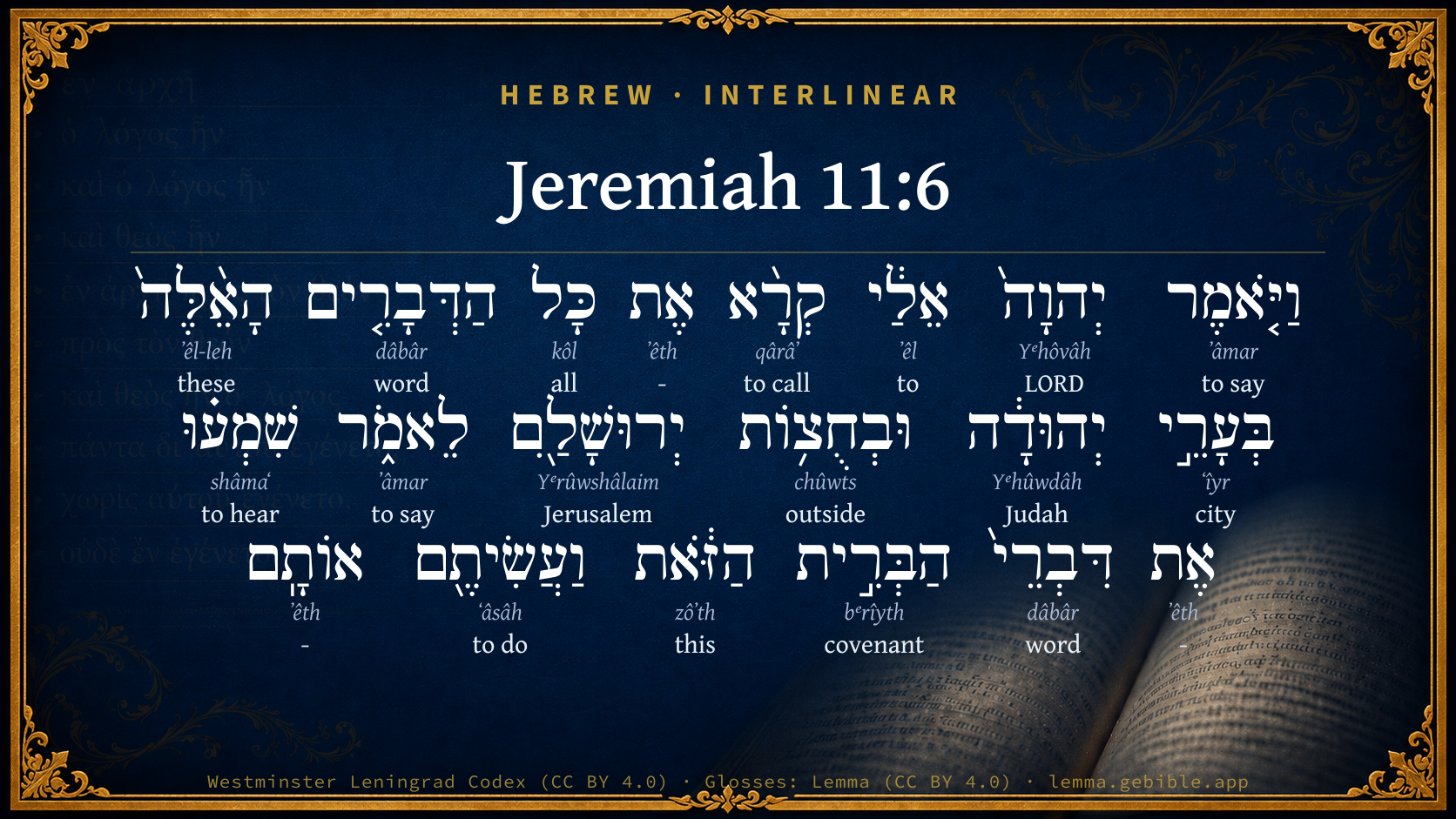
Hebrew (Westminster Leningrad Codex) Jeremiah 11:6 appears in the Hebrew Old Testament. The text above is from the Westminster Leningrad Codex. Each word links to its Strong’s number, a concise gloss, and parsing drawn from the Open Scriptures Hebrew Bible morphology. Click any word for its full Brown-Driver-Briggs (BDB) entry.
Download image
Cite this verse

Jeremiah 11:6 (World English Bible). Public Domain. Lemma interlinear Bible study tool, https://lemma.gebible.app/v/jeremiah/11/6.

Show BibTeX & RIS
BibTeX
RIS
English Translation
Yahweh said to me, Proclaim all these words in the cities of Judah, and in the streets of Jerusalem, saying, Hear you the words of this covenant, and do them.
World English Bible · Public Domain
Download a study sheet

One document with this verse’s original text, its word-by-word gloss line, the meaning frame, cross-references with their text, attributed commentary, and full source and license credits — printable, and it pastes into notes with its structure intact.

This verse Autodidact and up

Study sheet (.html) Plain text (.txt)

A passage Seminary Student

Up to 50 verses in one chapter. A passage sheet keeps up to 6 commentary sources and 12 cross-references per verse, in the order this page ranks them, and says so on the sheet whenever that leaves anything out. Ask for a single verse and you get the Autodidact verse sheet above.

Everything on this page stays free to read, with no account — the sheet is a download of what is already on screen, not access to it.

Want to remove ads? Support Godless Engineer
Compare translations 3

The same verse in 3 English versions, stacked beneath the original-language interlinear above. Click any original word for its lexicon entry.

Each is an independent rendering of the whole verse — the interlinear is not word-aligned to these translations.

Highlighted words mark where these versions differ — a whole-verse word diff, not a word-by-word alignment.

  • World English Bible Public Domain
    Yahweh said to me, Proclaim all these words in the cities of Judah, and in the streets of Jerusalem, saying, Hear you the words of this covenant, and do them.
  • King James Version Public Domain
    Then the LORD said unto me, Proclaim all these words in the cities of Judah, and in the streets of Jerusalem, saying, Hear ye the words of this covenant, and do them.
  • unfoldingWord Literal Text CC BY-SA 4.0
    And Yahweh said to me, “Proclaim all these words in the cities of Judah and in the streets of Jerusalem. Say, ‘Listen to the words of this covenant and do them.

unfoldingWord Literal Text — © unfoldingWord, licensed CC BY-SA 4.0. Word-aligned USFM3 via Door43 (git.door43.org/unfoldingWord/en_ult).

Versions to compare (up to 4)

3 of 4 selected

Show all 18 translations

Every available English version of this verse, each an independent rendering of the whole verse.

  • World English Bible Public Domain
    Yahweh said to me, Proclaim all these words in the cities of Judah, and in the streets of Jerusalem, saying, Hear you the words of this covenant, and do them.
  • Berean Standard Bible Public Domain
    Then the LORD said to me, “Proclaim all these words in the cities of Judah and in the streets of Jerusalem, saying: Hear the words of this covenant and carry them out.
  • Majority Standard Bible Public Domain
    Then the LORD said to me, “Proclaim all these words in the cities of Judah and in the streets of Jerusalem, saying: Hear the words of this covenant and carry them out.
  • King James Version Public Domain
    Then the LORD said unto me, Proclaim all these words in the cities of Judah, and in the streets of Jerusalem, saying, Hear ye the words of this covenant, and do them.
  • American Standard Version (1901) Public Domain
    And Jehovah said unto me, Proclaim all these words in the cities of Judah, and in the streets of Jerusalem, saying, Hear ye the words of this covenant, and do them.
  • Revised Version (1885) Public Domain
    And the LORD said unto me, Proclaim all these words in the cities of Judah, and in the streets of Jerusalem, saying, Hear ye the words of this covenant, and do them.
  • Geneva Bible (1599) Public Domain
    Then the Lord saide vnto me, Cry all these words in the cities of Iudah, and in the streetes of Ierusalem, saying, Heare yee the words of this couenant, and doe them.
  • Douay-Rheims (1899) Public Domain
    And the Lord said to me: Proclaim aloud all these words in the cities of Juda, and in the streets of Jerusalem, saying: Hear ye the words of the covenant, and do them:
  • Young's Literal Translation Public Domain
    And Jehovah saith unto me, `Proclaim all these words in the cities of Judah, and in the streets of Jerusalem, saying: Hear ye the words of this covenant, And ye have done them.
  • Literal Standard Version CC BY-SA 4.0
    And YHWH says to me, “Proclaim all these words in the cities of Judah, and in the streets of Jerusalem, saying, || Hear the words of this covenant, || And you have done them.
  • Unlocked Literal Bible CC BY-SA 4.0
    Yahweh said to me, “Proclaim all these things in the cities of Judah and in the streets of Jerusalem. Say, 'Listen to the words of this covenant and carry them out.
  • unfoldingWord Literal Text CC BY-SA 4.0
    And Yahweh said to me, “Proclaim all these words in the cities of Judah and in the streets of Jerusalem. Say, ‘Listen to the words of this covenant and do them.
  • Darby Bible Public Domain
    And Jehovah said unto me, Proclaim all these words in the cities of Judah, and in the streets of Jerusalem, saying: Hear the words of this covenant, and do them.
  • World Messianic Bible Public Domain
    The LORD said to me, “Proclaim all these words in the cities of Judah, and in the streets of Jerusalem, saying, ‘Hear the words of this covenant, and do them.
  • Webster's Bible Public Domain
    Then the LORD said to me, Proclaim all these words in the cities of Judah, and in the streets of Jerusalem, saying, Hear ye the words of this covenant, and do them.
  • Free Bible Version CC BY-SA 4.0
    Then the Lord told me, Go and publicly announce this whole message in the towns of Judah and in the streets of Jerusalem, saying: Pay attention to the terms of this agreement and do what they say.
  • Bible in Basic English Public Domain
    And the Lord said to me, Give out these words in the towns of Judah and in the streets of Jerusalem, saying, Give ear to the words of this agreement and do them.
  • JPS Tanakh (1917) Public Domain
    And the LORD said unto me: 'Proclaim all these words in the cities of Judah, and in the streets of Jerusalem, saying: Hear ye the words of this covenant, and do them.

Literal Standard Version (2020), Covenant Press — licensed CC BY-SA 4.0. Text via the HelloAO Bible API (eBible.org). Unlocked Literal Bible (unfoldingWord) — licensed CC BY-SA 4.0. Text via the HelloAO Bible API (eBible.org). unfoldingWord Literal Text — © unfoldingWord, licensed CC BY-SA 4.0. Word-aligned USFM3 via Door43 (git.door43.org/unfoldingWord/en_ult). Free Bible Version, Dr. Jonathan Gallagher — licensed CC BY-SA 4.0. Text via the HelloAO Bible API (eBible.org).

Word by word

More ways to search: Search by grammar → Find every occurrence → Compare this word →

Practice this passage: Drill this verse → Learn its vocabulary →

וּבְחֻצ֥וֹת
chûwts
H2351
“and · in/at · streets of”
Conjunction + Preposition + Noun, Common, Masculine, Plural, Construct
Part of Speech
Conjunction + Preposition + Noun
Type
Common
Gender
Masculine
Number
Plural
State
Construct
Full BDB Definition

Origin: (both forms fem. in the pl.) from an unused root meaning to sever

TWOT: 627a

outside, outward, street, the outside
  1. וַיֹּ֤אמֶר ʼâmar H559 “and · to say” Conjunction + Verb, Qal, Sequential Imperfect, 3rd Person, Masculine, Singular
  2. יְהוָה֙ Yᵉhôvâh H3068 “LORD” Noun, Proper
  3. אֵלַ֔י ʼêl H413 “to · me” Preposition + Suffix, Personal, 1st Person, Common, Singular
  4. קְרָ֨א qârâʼ H7121 “call” Verb, Qal, Imperative, 2nd Person, Masculine, Singular
  5. אֶת ʼêth H853 “-” Particle, Direct Object
  6. כָּל kôl H3605 “all of” Noun, Common, Masculine, Singular, Construct
  7. הַדְּבָרִ֤ים dâbâr H1697 “the · words” Particle, Definite Article + Noun, Common, Masculine, Plural, Absolute
  8. הָאֵ֨לֶּה֙ ʼêl-leh H428 “the · these” Particle, Definite Article + Pronoun, Demonstrative, Common, Plural
  9. בְּעָרֵ֣י ʻîyr H5892 “in/at · cities of” Preposition + Noun, Common, Feminine, Plural, Construct
  10. יְהוּדָ֔ה Yᵉhûwdâh H3063 “Judah” Noun, Proper
  11. יְרוּשָׁלִַ֖ם Yᵉrûwshâlaim H3389 “Jerusalem” Noun, Proper
  12. לֵאמֹ֑ר ʼâmar H559 “to say” Preposition + Verb, Qal, Infinitive Construct
  13. שִׁמְע֗וּ shâmaʻ H8085 “hear” Verb, Qal, Imperative, 2nd Person, Masculine, Plural
  14. אֶת ʼêth H853 “-” Particle, Direct Object
  15. דִּבְרֵי֙ dâbâr H1697 “words of” Noun, Common, Masculine, Plural, Construct
  16. הַבְּרִ֣ית bᵉrîyth H1285 “the · covenant” Particle, Definite Article + Noun, Common, Feminine, Singular, Absolute
  17. הַזֹּ֔את zôʼth H2063 “the · this” Particle, Definite Article + Pronoun, Demonstrative, Feminine, Singular
  18. וַעֲשִׂיתֶ֖ם ʻâsâh H6213 “and · to do” Conjunction + Verb, Qal, Sequential Perfect, 2nd Person, Masculine, Plural
  19. אוֹתָֽם ʼêth H853 “- · them” Particle, Direct Object + Suffix, Personal, 3rd Person, Masculine, Plural

About this verse

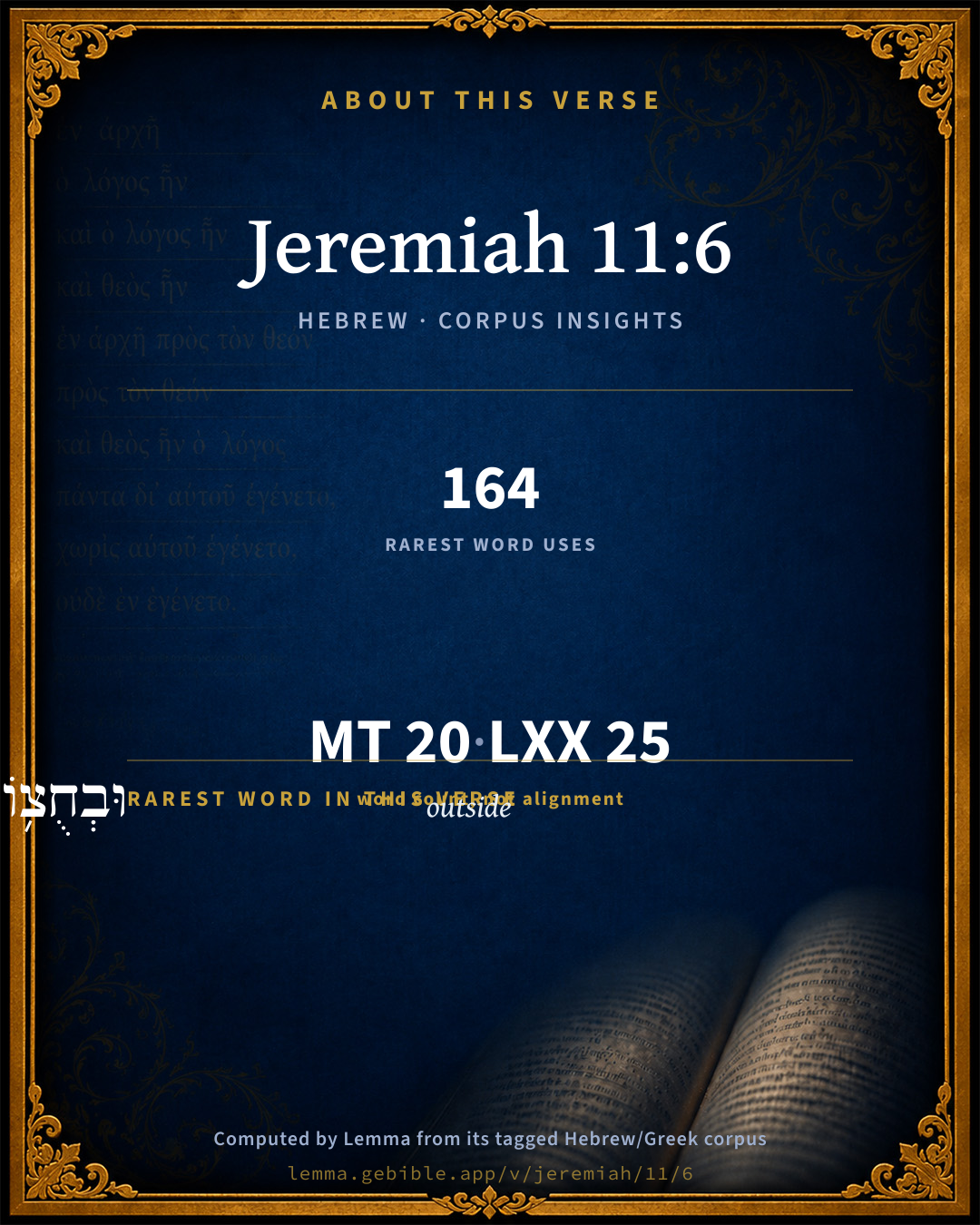
These counts appear in no published source. They are computed here, from the morphology-tagged text and Lemma’s own curated glosses. What Lemma adds →

20
words
16
distinct lemmas
Prophets
section

Grammatical profile

  • 5 verbs
  • 9 nouns
  • 2 pronouns
  • 1 preposition
  • 3 particles

Verb forms

  • וַיֹּ֤אמֶר Qal · Sequential Imperfect
  • קְרָ֨א Qal · Imperative
  • לֵאמֹ֑ר Qal · Infinitive Construct
  • שִׁמְע֗וּ Qal · Imperative
  • וַעֲשִׂיתֶ֖ם Qal · Sequential Perfect

Repetition

Words recur within this verse — often emphatic in Hebrew:

  • וַיֹּ֤אמֶר to say H559 ×2
  • הַדְּבָרִ֤ים word H1697 ×2

Hebrew & Septuagint length

In the original languages it is 20 Hebrew tokens and 25 Greek tokens — but the two are counted differently (Hebrew bundles its prefixes and suffixes into one token; the Greek is in lemma form), so that isn’t a like-for-like length.

Cross-references

10

Topical passages linked to Jeremiah 11:6 in the Treasury of Scripture Knowledge — connected by theme and wording, ordered by reader-vote popularity; previews shown in the World English Bible.

  • Romans 2:13 For it isn't the hearers of the law who are righteous before God, but the doers of the law will be justified
  • James 1:22 But be doers of the word, and not only hearers, deluding your own selves.
  • Jeremiah 3:12 Go, and proclaim these words toward the north, and say, Return, you backsliding Israel, says Yahweh; I will not look in anger on you; for I am merciful, says Yahweh, I will not keep [anger] forever.
  • Jeremiah 7:2 Stand in the gate of Yahweh's house, and proclaim there this word, and say, Hear the word of Yahweh, all you of Judah, who enter in at these gates to worship Yahweh.
  • Jeremiah 19:2 and go forth to the valley of the son of Hinnom, which is by the entry of the gate Harsith, and proclaim there the words that I shall tell you;
  • John 13:17 If you know these things, blessed are you if you do them.
  • Psalms 15:5 He who doesn't lend out his money for usury, Nor take a bribe against the innocent. He who does these things shall never be shaken.
  • Isaiah 58:1 Cry aloud, don't spare, lift up your voice like a trumpet, and declare to my people their disobedience, and to the house of Jacob their sins.
  • Jeremiah 11:2–4 Hear you the words of this covenant, and speak to the men of Judah, and to the inhabitants of Jerusalem;
  • Zechariah 7:7 Aren't these the words which Yahweh proclaimed by the former prophets, when Jerusalem was inhabited and in prosperity, and its cities around her, and the South and the lowland were inhabited?'"

Cross-references courtesy of OpenBible.info (CC BY 4.0).

Hebrew and Greek witnesses Masoretic Hebrew ↔ Greek Septuagint

The same verse in the two great witnesses to the Old Testament, shown verse-for-verse.

These are two independent witnesses, not word-aligned to each other, and the Septuagint is shown in lemma (dictionary) form.

Hebrew Jeremiah 11:6 Masoretic · Westminster Leningrad Codex

וַיֹּ֤אמֶר יְהוָה֙ אֵלַ֔י קְרָ֨א אֶת כָּל הַדְּבָרִ֤ים הָאֵ֨לֶּה֙ בְּעָרֵ֣י יְהוּדָ֔ה וּבְחֻצ֥וֹת יְרוּשָׁלִַ֖ם לֵאמֹ֑ר שִׁמְע֗וּ אֶת דִּבְרֵי֙ הַבְּרִ֣ית הַזֹּ֔את וַעֲשִׂיתֶ֖ם אוֹתָֽם

Yahweh said to me, Proclaim all these words in the cities of Judah, and in the streets of Jerusalem, saying, Hear you the words of this covenant, and do them.

World English Bible · Public Domain

Greek LXX Structure differs

In the Septuagint, Jeremiah is about an eighth shorter than the Hebrew and arranges its material differently — the Oracles Against the Nations (Hebrew chapters 46–51) appear in the middle of the Greek book, after 25:13. Because the chapter and verse boundaries do not line up, a verse-for-verse comparison with the Hebrew is not shown.

A verse-for-verse comparison isn’t shown here because the chapters and verses don’t line up. Switch to the LXX edition with the MT / LXX toggle above to read the Greek directly.

On this verse, The Cambridge Bible for Schools and Colleges discusses the Septuagint’s reading. Read the note in Commentary ↓

Hebrew: Westminster Leningrad Codex (CC BY 4.0). Greek: Septuagint (public domain); English from a public-domain English Septuagint. How the Septuagint differs from the Hebrew →

Targum (Aramaic paraphrase)

1

The Targum is the ancient Jewish Aramaic paraphrase of the Hebrew Scriptures — an interpretive translation, not the Hebrew text itself. Onkelos (literal) and Pseudo-Jonathan (expansive) render the Torah, and Jonathan the Prophets. Coverage is partial: where no permissively-licensed English translation exists for a verse, only the Aramaic is shown. This is verse-level text, not a word-by-word alignment to the Hebrew.

  1. Targum Jonathan Prophets (Joshua–Malachi)
    וַאֲמַר יְיָ לִי אִתְנַבֵּי יַת כָּל פִּתְגָמַיָא הָאִלֵין בְּקִרְוַיָא דְבֵית יְהוּדָה וּבְשׁוּקֵי יְרוּשְׁלֵם לְמֵימָר קַבִּילוּ יַת פִּתְגָמֵי קְיָמָא הָדֵין וְתַעְבְּדוּן יַתְהוֹן:

    (no public-domain English translation for this verse)

    Targum Jonathan — Aramaic: “Mikraot Gedolot” (public domain). English: “Sefaria Community Translation” (CC0 1.0 (public-domain dedication)); “London "Chaldee Paraphrase," 1871” (public domain). Text via Sefaria.

Commentary

Notes on Jeremiah 11:6 from classic Christian and Jewish commentators (each source and its license shown beneath its notes). The classic Christian expositions comment on the surrounding passage and are grouped to its opening verse, so a note may address several verses; the Jewish commentaries on the Tanakh (Rashi and others) are per-verse, so they appear only where the commentator wrote on this verse.

Lemma curates 59 commentaries, every one of them public domain or Creative Commons licensed, each selected and text-cleaned for this edition rather than reprinted as found. About our sources →

The Cambridge Bible for Schools and Colleges

gen. ed. J. J. S. Perowne

6–8. See summary at commencement of section. Gi. omits these three vv. But Jer_11:6 is needed, in order to account for the hostility roused at Anathoth by Jeremiah’s mission. Jer_11:7-8 on the other hand are omitted by LXX, and may well have been inserted here from the parallel passage, Jer_7:23 f.

The Cambridge Bible for Schools and Colleges (gen. ed. J. J. S. Perowne; Cambridge University Press, 1878–1918) — public domain. Text from a community e-Sword module.

Trapp's Complete Commentary

John Trapp

Jer 11:6 Then the LORD said unto me, Proclaim all these words in the cities of Judah, and in the streets of Jerusalem, saying, Hear ye the words of this covenant, and do them.

Ver. 6. Hear ye the words of this covenant, and do them.] Else ye hear to no purpose; as the salamander liveth in the fire, and is not made hot by the fire; as the Ethiopian goeth black into the bath, and as black he cometh forth.

John Trapp, A Commentary or Exposition upon All the Books of the Old and New Testament (1647–1656) — public domain. Text from a community e-Sword module.

Joseph Benson's Commentary

Jer 11:6-8. Proclaim all these words in the cities of Judah, &c. — That all may hear, for all are concerned; saying, Hear ye the words, &c., and do them — Let it be thy work to call upon this people, not only to hear, but to do the things which I have commanded them, and which they have engaged to do. For I earnestly protested — Hebrew, in protesting I protested; a way of speaking by which the Hebrews expressed the seriousness and earnestness wherewith any thing was done: by protesting, he means the same with charging and solemnly enjoining, with promises annexed to obedience, and threatenings denounced in case of disobedience. This, God says, he had done with a great deal of patience and diligence, even from the time that this people were brought by him out of the land of Egypt to the present period. Yet they obeyed not — And, because they were resolved not to be subject to God’s commandments, they would not so much as incline their ears to them, but walked every one in the imagination of his evil heart, following their own inventions; and each one acting as his fancy or humour led him, both in their devotions and in their conversations. Therefore I will bring upon them all the words of this covenant — That is, all the threatenings contained in it. Observe, reader, the words of God’s covenant shall not fall to the ground. If we do not by our obedience qualify ourselves for the blessings of it, we shall, by our disobedience, bring ourselves under the curses of it.

Joseph Benson's Commentary on the Old and New Testaments (1811–1818) — public domain. Text from a community e-Sword module.

Tyndale Open Study Notes

Tyndale Open Resources

11:6-7 Jeremiah was to use every available means to broadcast the Lord’s message to as many people as he could. As he visited every town and walked the streets of Jerusalem, he reminded the people to remember and obey the requirements of the ancient covenant.

Tyndale Open Study Notes — © Tyndale Open Resources, licensed CC BY-SA 4.0. Text via the HelloAO Bible API.

Jamieson, Fausset & Brown

Robert Jamieson, A. R. Fausset & David Brown

Jeremiah was to take a prophetic tour throughout Judah, to proclaim everywhere the denunciations in the book of the law found in the temple.

Hear . . . do-- (Rom 2:13; Jam 1:22).

Jamieson, Fausset & Brown — Commentary Critical and Explanatory on the Whole Bible (1871) — public domain (CC PDM 1.0). Text via the HelloAO Bible API.

Adam Clarke's Commentary

Verse 6. Proclaim all these words] Let the same covenant, with the blessings and cursings, be read in every city of Judah, and in all the streets of Jerusalem, that all the people may know their duty, their privileges, and their danger.

Adam Clarke's Commentary on the Bible (1810–1826) — public domain. Text from a community e-Sword/MySword module.

John Calvin's Commentaries

Here the Prophet explains more clearly why he had been commanded to promulgate the words of the covenant: for the greater part of the people were no doubt ready boldly to object and say, “What dost thou mean? Are not we the disciples of Moses? Thou, forsooth! thinkest that thou hast to do with a barbarous people. Have we not been from our childhood taught the law of God? Is it not daily enjoined on us? We are sufficiently instructed in this doctrine of which thou pretendest that we are ignorant. Be gone hence; and go either to the Chaldeans or to the Assyrians or to the Egyptians; for we understand what the law teaches.”

There is then no doubt but that Jeremiah had been repulsed by this kind of insolence: he therefore shews that he had a just cause to set before them the law of God; for so great an oblivion had prevailed, that they did not know what God had formerly taught in his law: and besides, they and their fathers had been always rebellious, so that they had ever need of being taught, according to what is said by Isaiah, that the people were to be treated like children and taught, A, A; B, B, and that though the same things were repeated, they yet stopped at the rudiments and never made any progress. (Isaiah 28:10, 13) As then Isaiah reproached the people with tardiness in learning the law, so Jeremiah shews now that they were not to think it strange that God commanded his law to be proclaimed to them, because it had been hitherto despised by them. The rest we shall defer.

John Calvin's Commentaries (1540-1563) — public domain. Text from the Calvin Translation Society English edition (1840s-50s) via the Christian Classics Ethereal Library (ccel.org). Calvin's coverage is partial (roughly two-thirds of the Bible); uncommented books and verses are honest gaps, never fabricated. The 19th-century editor's footnotes and remarks are omitted so the notes are faithfully Calvin's own voice.

Ellicott's Commentary for English Readers

(6) In the cities of Judah . . .—It is, at least, probable that the words are to be taken literally, and that the prophet went from city to city, doing his work as a preacher of repentance, and taking the new-found book of Deuteronomy as his text. The narrative of 2Ki_23:13-20 indicates an iconoclastic journey throughout the kingdom as made by Josiah; and the prophetic discourse now before us, enforcing the observance of the covenant just made, would have been a fit accompaniment for such a mission.

A Bible Commentary for English Readers, edited by Charles John Ellicott (1878–1897) — public domain. Text from a community e-Sword module.

John Gill's Exposition

For I earnestly protested unto your fathers,.... Or "witnessing, witnessed" (g); testified his great affection for them; importunately solicited their observation of his precepts for their good; and strictly cautioned them against neglect and disobedience:

the day that I brought them out of the land of Egypt; See Gill on Jer 11:4,

even unto this day, rising early, and protesting, saying, obey my voice; that is, from the time of the giving of the law, in all successive ages, to the present time, he had sent his prophets to them, time after time, morning by morning, early and late, to press, exhort, and stir them up to an obedience to his will, and to warn them of the evils that would come by disobedience to it.

(g) "testificando tesficatus sum", Schmidt; "contestando contestatus sum", Pagninus, Montanus, Cocceius.

John Gill's Exposition of the Whole Bible (1746–1763) — public domain (CC PDM 1.0). Text via the HelloAO Bible API.

Albert Barnes' Notes on the Bible

Proclaim ... - Probably Jeremiah accompanied Josiah in his progress 2Ki 23:15-20, and everywhere read to the people the words of the newly-found book.

Albert Barnes' Notes on the Bible (1834–1885) — public domain. Text from a community e-Sword/MySword module.

Haydock's Catholic Bible Commentary

Cities, or to those who come thence to the temple, that all may know.

George Leo Haydock (1774–1849), Haydock's Catholic Family Bible and Commentary, 1859 edition — public domain. Excludes Psalms (Douay-Rheims chapter numbering differs from Protestant) and Deuterocanonical books (Catholic canon only).

Matthew Poole's English Annotations

Let it be thy work to call upon this people, not only to hear, but to do, the words which I have commanded them, and they have engaged to do.

Matthew Poole's English Annotations on the Holy Bible (1683–1685) — public domain. Text from a community e-Sword/MySword module.

Whedon's Commentary on the Bible

Daniel D. Whedon

6. In the cities of Judah — Comp. 2Ki_23:15-20. Henderson suggests that Jeremiah accompanied Josiah in visits to the different cities to carry forward his work of reformation. Certainly the work of these two reformers was mutually helpful, and each has an illustrative bearing upon that of the other.

Daniel D. Whedon (gen. ed.), Commentary on the Old and New Testaments (1874–1909) — public domain. Text from a community e-Sword module.

The Pulpit Commentary

Proclaim all these words, etc. This command probably points to a missionary circuit of Jeremiah, as suggested above. Others render, "read aloud"; (comp. 2Ki_22:8, Hebrew) but Jeremiah receives the direction to "proclaim" or "cry" elsewhere. (Jer_2:2 Jer_3:12, etc.) So Gabriel, in the Koran, directs Mohammed to "cry," i.e. to proclaim or preach (Sura 96:1).

The Pulpit Commentary (1880–1919), ed. H.D.M. Spence-Jones & Joseph S. Exell — public domain. Text from a community e-Sword module.

unfoldingWord translationNotes

Door43 World Missions Community

solemn

serious and important

the words of this covenant

"the terms of this covenant"

carry them out

This is an idiom. AT: "obey them" (See: Idiom)

Listen to my voice

The word "voice" here is a metonym for what the speaker says with the voice, and "listen" is a metonym for "obey." AT: "Obey what I say" (See: Metonymy)

Each person has been walking in the stubbornness of his wicked heart.

Here "walking" is an idiom for the way a person lives. The word "heart" is a metonym for a person's desires and emotions. AT: "Each person has refused to change and has been living by his own wicked desires" or "Each person has refused to change and continues to do the evil things that they want to do" (See: Idiom and Metonymy)

So I brought all the curses in this covenant that I commanded to come against them

"So I punished them with all the curses that I described in this covenant that I had commanded them to obey"

translationWords

preach

walk

stiff-necked

evil

heart

people group

unfoldingWord translationNotes — © Distant Shores Media and the Door43 World Missions Community, licensed CC BY-SA 4.0. Source: git.door43.org/Door43/en_tn.

Lesson kit

Teaching starters — assembled from the data on this page, not authored interpretation. Every prompt links to the verse data it draws on. Edit before teaching.

Jeremiah, in the Prophets, opens this verse with 20 words (16 distinct Hebrew lemmas). Its most distinctive word is chûwts (“outside”). A historical commentator’s framing appears above. Read the whole chapter for the surrounding context.

Discussion questions

  1. The word chûwts carries the sense “outside.” How does it shape the verse?
  2. How does Romans 2:13, which shares this passage’s theme, read alongside this verse?
  3. What does the repetition of “to say” (2× in this one verse) do in this verse?
  4. These translations render this verse differently; the difference is in the English rendering, not the original. What questions does that raise?
  5. «וַיֹּ֤אמֶר» is a Qal Sequential Imperfect verb. How does that grammatical form shape the action described?
  6. Compare how The Cambridge Bible for Schools and Colleges and Trapp's Complete Commentary read this verse. Where do they agree or differ?

Things to notice

Reading settings

Reading text

Shown beneath each verse's original-language words.

Old Testament
Old Testament edition

Read the OT as the Masoretic Hebrew (MT) or the Greek Septuagint (LXX).

English shown for the Greek Septuagint (in the Hebrew ↔ Greek comparison).

Comparing translations? Open the Compare panel on any verse page to stack up to four side by side.