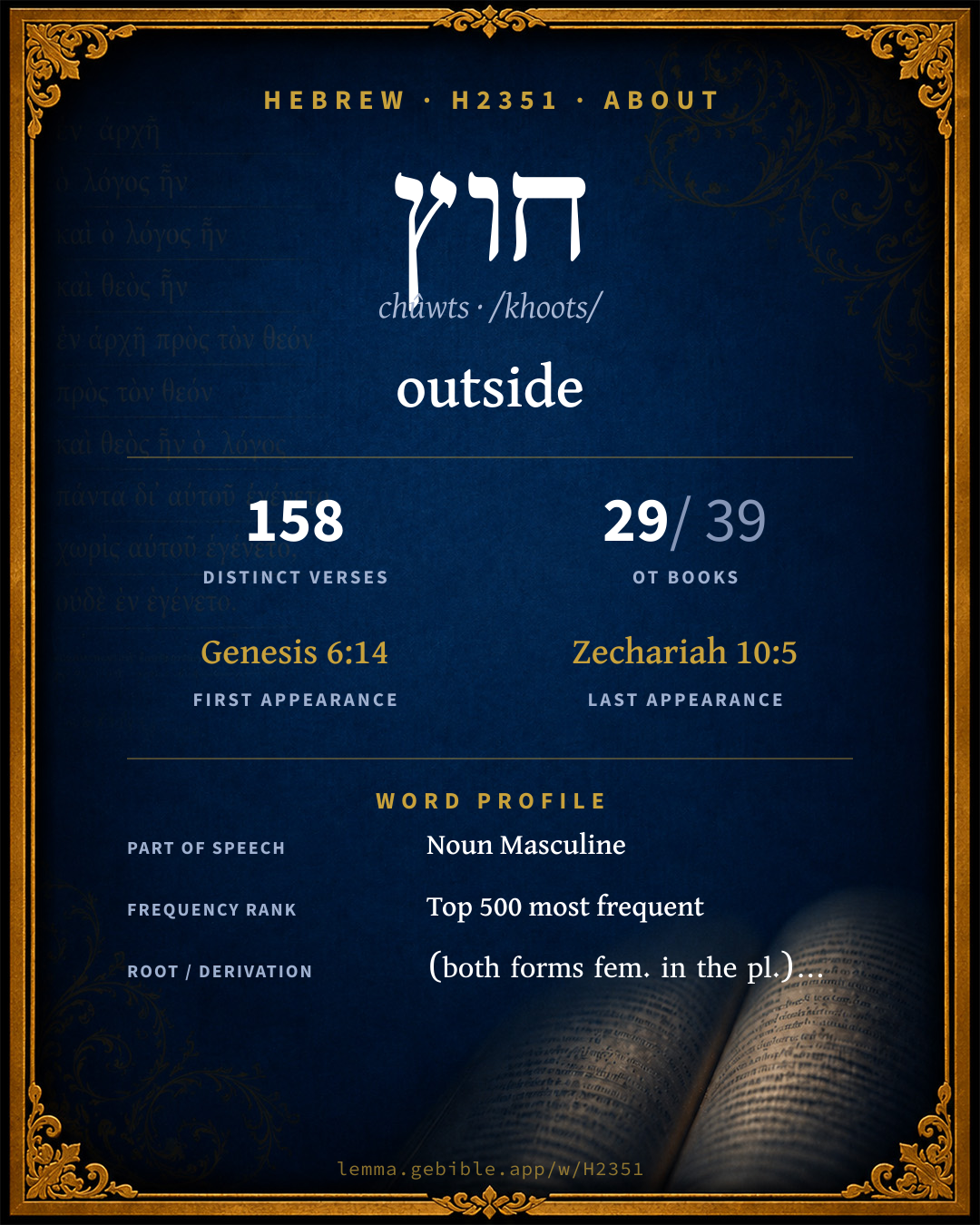
חוּץ
outside
Full lexicon entry — Brown-Driver-Briggs (BDB)
From Brown-Driver-Briggs (BDB)
Where this word appears
See every Construct-state word in the Hebrew Bible →
Grammar key — what these labels mean
Part of speech
- Noun
- A naming word — a person, place, thing, or idea.
Noun type
- Common
- A common noun — a general class of person, place, or thing (“king,” “city,” “water”), not a specific name.
State
- Absolute
- The independent form of a noun, not bound to a following word.
- Construct
- A noun bound to a following noun in a possessive / “of” relationship (the construct chain).
Gender
- Masculine
- Grammatically masculine.
Number
- Singular
- One.
- Plural
- More than one (in Hebrew, generally three or more).
Every verse where H2351 appears in the Book of Jeremiah — 16 distinct verses. Click any verse to open its interlinear word-by-word view. Verse text shown in the World English Bible for context — . Each verse’s Hebrew form is shown with its reference; the English is not keyword-highlighted, since the data carries no word-level English alignment. Use “Compare translations” on any verse to read it across multiple English versions. This concordance covers the Hebrew Bible; Septuagint (Greek Old Testament) occurrences are not indexed here.
Jeremiah
- Jeremiah 5:1 בְּ/חוּצ֣וֹת prep + n c mp cs Run you back and forth through the streets of Jerusalem, and see now, and know, and seek in the broad places of it, if you can find a man, if there are any who does justly, who seeks truth; and I will pardon her.
- Jeremiah 6:11 בַּ/ח֔וּץ prep det + n c ms Therefore I am full of the wrath of Yahweh; I am weary with holding in: pour it out on the children in the street, and on the assembly of young men together; for even the husband with the wife shall be taken, the aged with him who is full of days.
- Jeremiah 7:17 וּ/בְ/חֻצ֖וֹת conj + prep + n c mp cs Don't you see what they do in the cities of Judah and in the streets of Jerusalem?
- Jeremiah 7:34 וּ/מֵֽ/חֻצוֹת֙ conj + prep + n c mp cs Then will I cause to cease from the cities of Judah, and from the streets of Jerusalem, the voice of mirth and the voice of gladness, the voice of the bridegroom and the voice of the bride; for the land shall become a waste.
- Jeremiah 9:21 מִ/ח֔וּץ prep + n c ms For death is come up into our windows, it is entered into our palaces; to cut off the children from outside, [and] the young men from the streets.
- Jeremiah 11:6 וּ/בְ/חֻצ֥וֹת conj + prep + n c mp cs Yahweh said to me, Proclaim all these words in the cities of Judah, and in the streets of Jerusalem, saying, Hear you the words of this covenant, and do them.
- Jeremiah 11:13 חֻצ֣וֹת n c mp cs For according to the number of your cities are your gods, Judah; and according to the number of the streets of Jerusalem have you set up altars to the shameful thing, even altars to burn incense to Baal.
- Jeremiah 14:16 בְּ/חֻצ֨וֹת prep + n c mp cs The people to whom they prophesy shall be cast out in the streets of Jerusalem because of the famine and the sword; and they shall have none to bury them-them, their wives, nor their sons, nor their daughters: for I will pour their wickedness on them.
- Jeremiah 21:4 מִ/ח֖וּץ prep + n c ms Thus says Yahweh, the God of Israel, Behold, I will turn back the weapons of war that are in your hands, with which you fight against the king of Babylon, and against the Chaldeans who besiege you, without the walls; and I will gather them into the midst of this city.
- Jeremiah 33:10 וּ/בְ/חֻצ֣וֹת conj + prep + n c mp cs Thus says Yahweh: Yet again there shall be heard in this place, about which you say, It is waste, without man and without animal, even in the cities of Judah, and in the streets of Jerusalem, that are desolate, without man and without inhabitant and without animal,
- Jeremiah 37:21 מִ/ח֣וּץ prep + n c ms cs Then Zedekiah the king commanded, and they committed Jeremiah into the court of the guard; and they gave him daily a loaf of bread out of the bakers' street, until all the bread in the city was spent. Thus Jeremiah remained in the court of the guard.
- Jeremiah 44:6 וּ/בְ/חֻצ֖וֹת conj + prep + n c mp cs Therefore my wrath and my anger was poured forth, and was kindled in the cities of Judah and in the streets of Jerusalem; and they are wasted and desolate, as it is this day.
- Jeremiah 44:9 וּ/בְ/חֻצ֖וֹת conj + prep + n c mp cs Have you forgotten the wickedness of your fathers, and the wickedness of the kings of Judah, and the wickedness of their wives, and your own wickedness, and the wickedness of your wives which they committed in the land of Judah, and in the streets of Jerusalem?
- Jeremiah 44:17 וּ/בְ/חֻצ֖וֹת conj + prep + n c mp cs But we will certainly perform every word that is gone forth out of our mouth, to burn incense to the queen of the sky, and to pour out drink-offerings to her, as we have done, we and our fathers, our kings and our princes, in the cities of Judah, and in the streets of Jerusalem; for then had we plenty of food, and were well, and saw no evil.
- Jeremiah 44:21 וּ/בְ/חֻצ֣וֹת conj + prep + n c mp cs The incense that you burned in the cities of Judah, and in the streets of Jerusalem, you and your fathers, your kings and your princes, and the people of the land, didn't Yahweh remember them, and didn't it come into his mind?
- Jeremiah 51:4 בְּ/חוּצוֹתֶֽי/הָ prep + n c mp cs + sfx pers 3fs They shall fall down slain in the land of the Chaldeans, and thrust through in her streets.
About this entry
At a glance — auto-summarized from this page’s data, not written by a person. Every figure links to its source below. This summary describes the numbers; it doesn’t interpret them.
חוץ — transliterated chûwts — is a Hebrew noun carrying the sense “outside.” Where the King James Version says “without,” newer translations reach for “outside” (Berean Standard Bible); the renderings breakdown has the detail. The Hebrew Bible uses it across 158 verses — common. Debuting at Genesis 6:14, it then recurs through the corpus. It shares a root with חיץ. Each statement above links to its evidence; the full detail follows below.
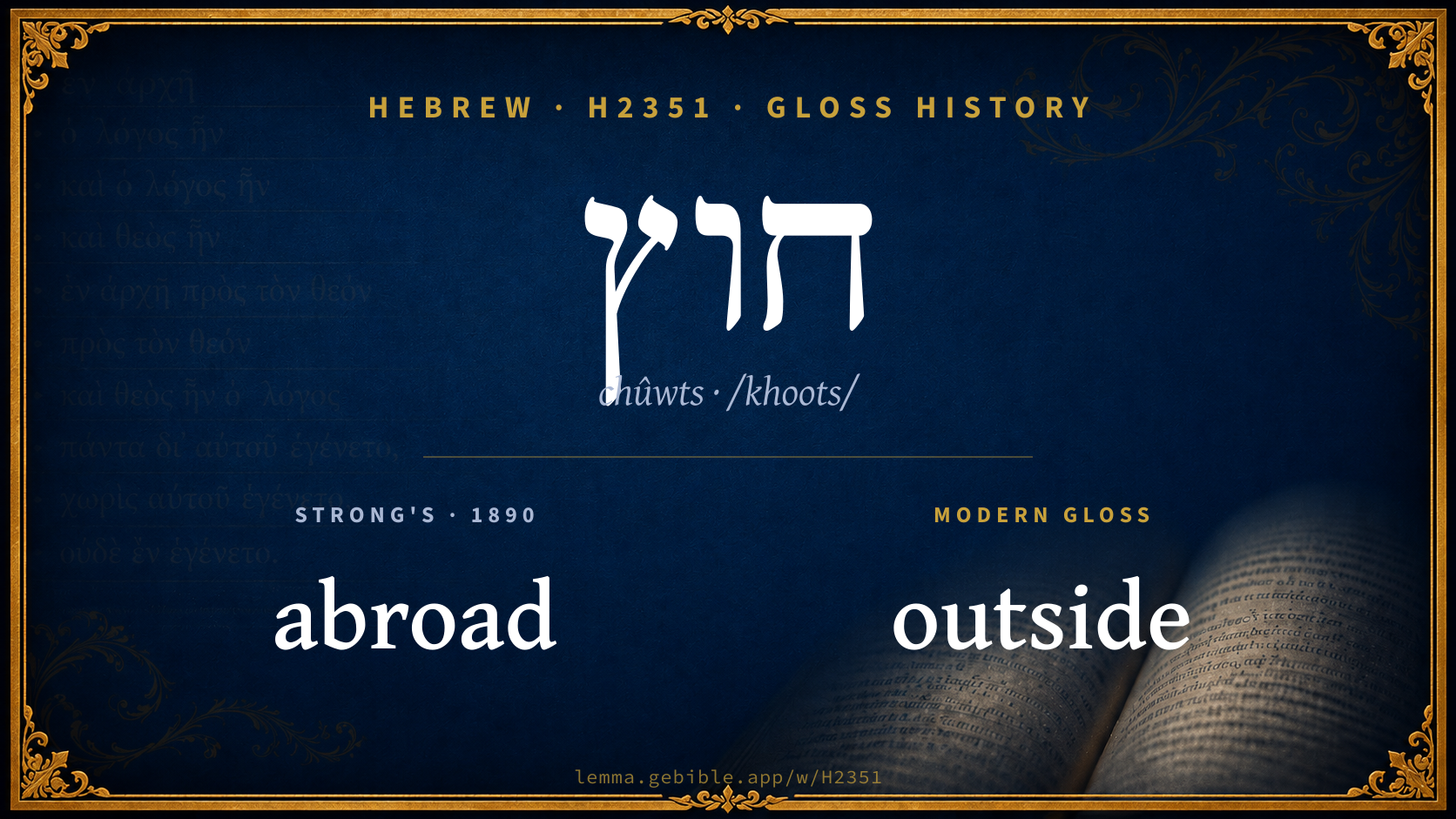
Gloss history
Strong's 1890 vs modern scholarship
About this word
Strong's H2351 catalogs a Hebrew word from the Hebrew Old Testament.
These counts are not copied from any lexicon or concordance. They are computed here, from the morphology-tagged Hebrew Old Testament. What Lemma adds →
- 158
- distinct verses
- The word appears in 158 distinct verses.
- 29 / 39
- OT books
- The word appears in 29 of 39 Old Testament books.
- #279
- by frequency
- Top 500 most frequent Hebrew words (rank 279 of 8,640 Hebrew words by occurrence).
View all 158 occurrences in the concordance →
By section of the Old Testament
By traditional corpus
Conventional, traditional groupings — biblical authorship is debated, so this is a traditional corpus grouping, not an authorship claim. Each share is this word’s portion of its verses in that division of the Hebrew canon. Each figure is a share of the word’s 158 distinct verses.
- Prophets (Nevi'im) 67 verses · 42%
- Torah (Pentateuch) 60 verses · 38%
- Writings (Ketuvim) 31 verses · 20%
How translations render this word
Counts come from each version’s own published word-to-Strong’s tagging or interlinear alignment — an approximate guide to how each version renders this word, not a word-level alignment the data otherwise carries. Because each total is that version’s own tagged count, the per-version totals vary from one another and need not match the appearance or distinct-verse counts above. These counts may also differ from a printed concordance because Lemma counts each distinctly tagged rendering and does not collapse phrase taggings into a single head-word total. This is a fixed set of word-tagged versions (KJV, ASV, BSB, ULT) and does not change with the reading translation you choose elsewhere. Each version’s license is shown beside its name below (and on Sources).
- King James Version: Without 59×, Streets 29×, Abroad 20×
- American Standard Version: Without 56×, Streets 28×, Abroad 12×
- Berean Standard Bible: Outside 68×, Streets 36×, Out 15×
- unfoldingWord Literal Text: Outside 78×, Streets 19×, Outside of 8×
King James Version Public Domain
Renders H2351 across 163 tagged occurrences — most commonly:
Plus 21 renderings that appear only once — usually multi-word phrases or single function words the recovered tagging swept in, not distinct renderings. Not rendered by a distinct English word in 1 further occurrence.
American Standard Version Public Domain
Renders H2351 across 160 tagged occurrences — most commonly:
Plus 31 renderings that appear only once — usually multi-word phrases or single function words the recovered tagging swept in, not distinct renderings.
Berean Standard Bible Public Domain
Renders H2351 across 156 tagged occurrences — most commonly:
Plus 18 renderings that appear only once — usually multi-word phrases or single function words the recovered tagging swept in, not distinct renderings. Not rendered by a distinct English word in 6 further occurrences.
unfoldingWord Literal Text CC BY-SA 4.0
Renders H2351 across 159 tagged occurrences — most commonly:
Plus 23 renderings that appear only once — usually multi-word phrases or single function words the recovered tagging swept in, not distinct renderings.
Senses in the full BDB
What do BDB’s symbols mean?
BDB uses these scholarly abbreviations:
| Symbol | Meaning |
|---|---|
| 𝔊 | the Septuagint (the ancient Greek translation, LXX) |
| 𝔙 | the Vulgate (the Latin translation) |
| 𝔖 | the Syriac version (the Peshitta) |
| 𝔗 | the Targum (the Aramaic translation) |
| ψ | the Psalms |
| √ | root (the underlying root or stem) |
| ‖ | parallel passage (a synonymous or contrasted parallel) |
| † | the dagger: every passage where the word occurs is cited |
The 6 senses and sub-senses the full Brown-Driver-Briggs lexicon distinguishes for this word, in lexicon order (not ranked by frequency), with BDB’s own verbatim wording and sub-sense lettering. Shown in Hebrew script with BDB’s own scholarly abbreviations. The condensed entry is in the Lexicon Entry tab. See also the Forms in the corpus table below.
- 1. the outside, of a house, tent, city, camp, etc., often used, especially with preps., to express the adv. idea of outside, abroad (Aramaic syn., except in sense 2 a, is בַּר, ܒܰܪ):
- a. as accus. after vb. of motion Dt 23:13 יָצָא חוּץ to go forth outside (sc. a camp), v 14 (as adv. accus.) בְּשִׁבְתְּךָ חוּץ outside, הוֹצִיא הַחוּץ to bring forth outside (a house or chamber) Ju 19:25 2 S 13:18 cf. Ne 13:8, Ju 12:9b בָּנוֹת הֵבִיא לְבָנָיו מִן־הַחוּץ from outside, from abroad, 2 K 4:3 שַׁאֲלִי־לָךְ כֵּלִים מִן־הַחוּץ from outside (opp. בַּבַּיִת v 2); as genit. Lv 18:9 מוֹלֶדֶת חוּץ one born abroad (i.e. by another father or mother, of a half-sister: opp. מוֹלֶדֶת בַּיִת) Ez 47:2(×2). With ָה loc. חוּצָה, after a vb. of motion Ex 12:46 מִן־הַבַּיִת … חוּצָה, Pr 5:16 2 Ch 29:16, 33:15 חוּצָה לָעִיר outside of the city, Nu 35:4 מִקִּיר הָעִיר וָחוּצָה from the wall of the city and outwards; = on the outside, without 1 K 6:6 Is 33:7 צָֽעֲקוּ חוּצָה cry without, 2 Ch 24:8: so הַחוּצָה Gn 15:5 וַיּוֹצֵא אֹתוֹ הח׳ and brought him outside, 19:17; 24:29 Jos 2:19 +, 1 K 8:8 לֹא יֵרָאוּ הַחוּצָה were not seen towards the outside, Dt 25:5 לֹא תִהְיֶה אֵשֶׁת הַמֵּת הַחוּצָה לְאִישׁ זָר i.e. shall not be married into another family, cf. Ju 12:9a. e.g. Deuteronomy 23:13
- b. with preps.: a. †אל־החוץ towards the outside Ez 41:9, †34:21 pleon. אל־החוצה. b. בחוץ Gn 9:22 outside (opp. בְּתוֹךְ אָהֳלֹה v 21), 24:31 לָמָּה תַעֲמֹד בַּחוּץ, Dt 24:11 Ex 21:19 אם יקום והתהלך בחוץ (after leaving a sick couch), 2 K 10:24 ψ 31:12 Ez 7:15 (opp. מִבַּיִת), Ho 7:1 +. c. †לחוץ ψ 41:7 יצא לחוץ; = on the outside Ez 41:17; 42:7, †לַחוּצָה 2 Ch 32:5 towards the outside. d. מִחוּץ on (מִן 1 c) the outside Ez 40:19; 46:2, מִבַּיִת וּמִחוּץ within and without (of an ark, building, etc.) Gn 6:14 Ex 25:11 = 37:2 1 K 7:9, Dt 32:25 מחוץ תְּשַׁכֶּל־חֶרֶב (opp. וּמֵחֲדָרִים אֵימָה), La 1:20 (cf. Ez 7:15 supr. b); so מֵהַחוּץ †Ez 41:25. מִחוּץ לְ on the outside of, Gn 19:16 וַיַּנִּיחֵהוּ מִחוּץ לָעִיר, 24:11 Ex 26:35; 37:7(×2) Lv 8:17; 14:8 Nu 35:5 Jos 6:23 Je 21:4 +, even after a vb. of motion 1 K 21:13 וַיּוֹצִיאוּהוּ מִחוּץ לָעִיר, 2 K 23:6, though in this case אל מחוץ ל is more common, Lv 4:12, 21 אל מחוץ למחנה, 6:4; 10:4; 14:40, 41 + often P, Dt 23:11. e. †מִחוּצָה Ez 40:40 on the outside, מִחוּצָה לְ v 44. f. (late) †חוּץ מִן outside of, Ec 2:25 who can eat, and who enjoy, חוּץ מִמֶּנִּי outside of me, i.e. except me? (but read rather, with 𝔊 𝔖 De Now al., חוּץ מִמֶּנּוּ apart from, without him, i.e. God). (So NH חוּץ מִן except, without, v. De Ec 2:25. Cf. the Aramaic syn. בַּר מִן except Ex 20:3 𝔗, apart from, without Is 36:10 𝔗; Syriac ܠܒܰܪ ܡܶܢ id.) e.g. Ezekiel 41:9
- 2. Of a definite locality, viz.
- a. that which is outside the houses of a town, i.e. a street Is 51:23 כַּחוּץ לַעֹבְרִים, Je 37:21 חוּץ הָאֹפִים the Bakers’ street, Pr 1:20 בַּחוּץ (‖ בָּֽרְחֹבוֹת: so 7:12; 22:13 Je 9:20); often in pl., as חוּצֹת אַשְׁקְלוֹן the streets of Ashkelon 2 S 1:20, ח׳ ירושׁלם Je 5:1; 7:17, 34 + often Jer., 1 K 20:34 וְחֻצוֹת תָּשִׂים־לְךָ בְּדַמֶּשֶׂק and streets (i.e. bazaars) shalt thou make thee in D., as my father made in Samaria (a concession involving the right of trading), Am 5:16 Is 15:3; 24:11 (as scene of mourning), Is 5:25 Je 51:4 Ez 11:6; 28:23 (as filled with corpses of slain), בְּרֹאשׁ כָּל־חוּצוֹת i.e. in conspicuous places, Na 3:10 La 2:19; 4:1 Is 51:20, טִיט חוּצוֹת mire of streets Zc 10:5 (trampled on by warriors), in simile, of foes trodden under foot, ψ 18:43 Mi 7:10 (so כְּחֹמֶר ח׳ Is 10:6), metaph. of cheapness and abundance Zc 9:3. e.g. Isaiah 51:23
- b. more gen., that which is outside enclosed cities, the open country, Jb 18:17 וְלֹא שֵׁם לוֹ עַל־פְּנֵי־חוּץ (v. De), cr. Pr 24:27; in the pl. Jb 5:10 וְשֹׁלֵחַ מַיִם עַל פְּנֵי חוּצוֹת, Pr 8:26 ψ 144:13 (as place where flocks abound). e.g. Job 18:17
Senses from the full Brown-Driver-Briggs lexicon (Brown, Driver, Briggs; Oxford 1906 — public domain), digitized via Sefaria, supplemented by the OpenScriptures HebrewLexicon (CC BY 4.0). Full attribution on Sources.
Word origin
n.[m.] the outside, sometimes, especially in pl., spec. a street, never with sf. in sg., with ָה loc. ח֫וּצָה, חֻ֫צָה, pl. חוּצוֹת, חֻצוֹת, with sf. חוּצֹתָיו etc., Is 15:3 etc.;—
— Brown-Driver-Briggs (Oxford 1906, public domain), digitized via Sefaria, supplemented by the OpenScriptures HebrewLexicon (CC BY 4.0). See Sources.
Origin: (both forms fem. in the pl.) from an unused root meaning to sever
Jastrow Dictionary
A second Hebrew/Aramaic lexicon for comparison, covering Aramaic and post-biblical (Talmudic, Targumic, Midrashic) usage that the biblical-Hebrew BDB does not. Matched by lemma rather than by Strong’s number, so a lemma may carry more than one Jastrow headword (shown separately below), and the entries cover usage well beyond the Bible.
חוּץ I
- (cmp. אוּץ), perf. a. part. חָץ [to squeeze in; to be wedged in,]
- 1. to be tight, immovable. Makhsh. III, 8 בשביל שיָחוּצוּ that they may become tight (by swelling). Mikv. X, 3 בזמן שהיא חוֹצָה (cmp. part. fem. חוֹלָה, fr. חוּל) if it is tight (immovable).
- 2. to tighten, tie closely. Y. Ḥag. III, 79ᵃ top (חָצִין) חָצִים אותה they tie it watertight.
- 3. חוּץ or הָצַץ to wedge in, form a partition; to intervene, esp. (at bathing) to prevent the water from touching the body. Erub. III, 1 (27ᵃ) יכול לָחוּץ (לָחוֹץ) ולאכול Ms. M. (Bab. ed. לח׳ ולילך וכ׳, Mish. לילך לח׳ ולאכ׳, Y. ed. לח׳ ולוכל, v. Rabb. D. S. a. l. note) he may form a partition (between himself and the uncleanness, by sitting in a vehicle &c.) and eat. Zeb. 19ᵃ מהו שיָחוּץ (שתָּהוּץ) does it form a partition between the body and the water (so as to make the immersion ineffective)?—Y. Sabb. VII, beg. 7ᵈ שהן חָצִין וכ׳ for they form an interposition at bathing after menstruation. V. חָצַץ.
חוּץ
- 1. same. Part. חָיֵיץ, f. חָיְיצָא same. Zeb. 19ᵃ, v. preced. Ib. חָיְיצֵי (Rashi: חָיְיצָן)
- 2. (v. חַיִיץ) to form a partition, to build a wall by piling up material without cementing; (of persons) to form a lane. Y. Shebi. III, end, 34ᵈ חָיֵיץ ליה, v. חַיִיץ.—Keth. 17ᵃ; Meg. 29ᵃ דחָיְיצֵי וכ׳, v. אִבּוּלָא.
חוּץ II
- preced.)
- 1. that which is divided off, outside, street. Kel. XXVIII, 9 חלוק של יוצאת הח׳ the shirt of the runabout (prostitute; v. Sm. Ant. s. v. Coa Vestis a. Diaphane Heimata; Tosef. Kel. B. Bath. V, 14 יוצאות החוט going out of the line of custom). Zeb. 57ᵇ; Yoma 57ᵃ ח׳ ופנים Ar. (v. Rabb. D. S. a. l note 2, a. Tosaf. to Zeb. l. c.) what is done outside the Temple and what inside. Ḥull. VI, 2 השוחט … בח׳ he who slaughters unconsecrated animals within the Temple court, or consecrated animals without. Ib. 85ᵃ שחוטי ח׳ consecrated animals slaughtered outside the Temple court. Ib. 68ᵃ וצתה ח׳ למחיצתו was carried outside of its legal limits; a. fr.—בַּח׳, מִבַּח׳ outside, from outside, לַח׳ out (through the window &c.). Sabb. I, 1. Ab. Zar. 11ᵃ; a. v. fr.
- 2. (followed by מ־) except, without. Ḥull. I, 1 ח׳ מחרש וכ׳ except a deaf and dumb &c. Gen. R. s. 49 ח׳ מדעתו without consulting him; a. v. fr.
A Dictionary of the Targumim, the Talmud Babli and Yerushalmi, and the Midrashic Literature (Marcus Jastrow; London, Luzac, 1903) — Public Domain. Digitized via Sefaria. Digitized via Sefaria. Full attribution on Sources.
Forms in the corpus
The 78 distinct written forms H2351 takes in the Hebrew Bible, most frequent first — each parse links to that state’s occurrences in the concordance. Hebrew forms include their vowel points and cantillation, so a single lemma takes many written forms.
The 60 most common forms are shown; 18 rarer forms follow in the full concordance.
Same root — word family
Other BDB entries built from the same root as H2351, grouped by Strong’s listed origin. These share a root / origin per the lexicon — not necessarily a shared meaning. Each links to that word’s own entry.
Derived from this word
Compare all same-root words → They share a root, not necessarily a meaning.
Septuagint verse parallels
This word appears in 154 verses that also exist in the Greek Old Testament (Septuagint), out of the 158 Hebrew verses it occurs in. You can read those verses in Greek by switching the Old Testament edition to the Septuagint.
Read these verses in the Septuagint
- Genesis 6:14
- Exodus 12:46
- Leviticus 4:12
- Numbers 5:3
- Deuteronomy 23:10
- Joshua 2:19
- Judges 12:9
- 1 Samuel 9:26
- 2 Samuel 1:20
- 1 Kings 6:6
- 2 Kings 4:3
- 2 Chronicles 5:9
This is a verse-level parallel only — the same verses exist in both the Hebrew and Greek Old Testaments. No word-level Hebrew↔Greek correspondence is claimed: the data carries no such alignment, so no Greek word is shown as this Hebrew word’s translation. Coverage is not total — the Septuagint omits the deuterocanon and renumbers the Psalms, so some Hebrew verses have no direct Greek parallel.