Leviticus 6:11

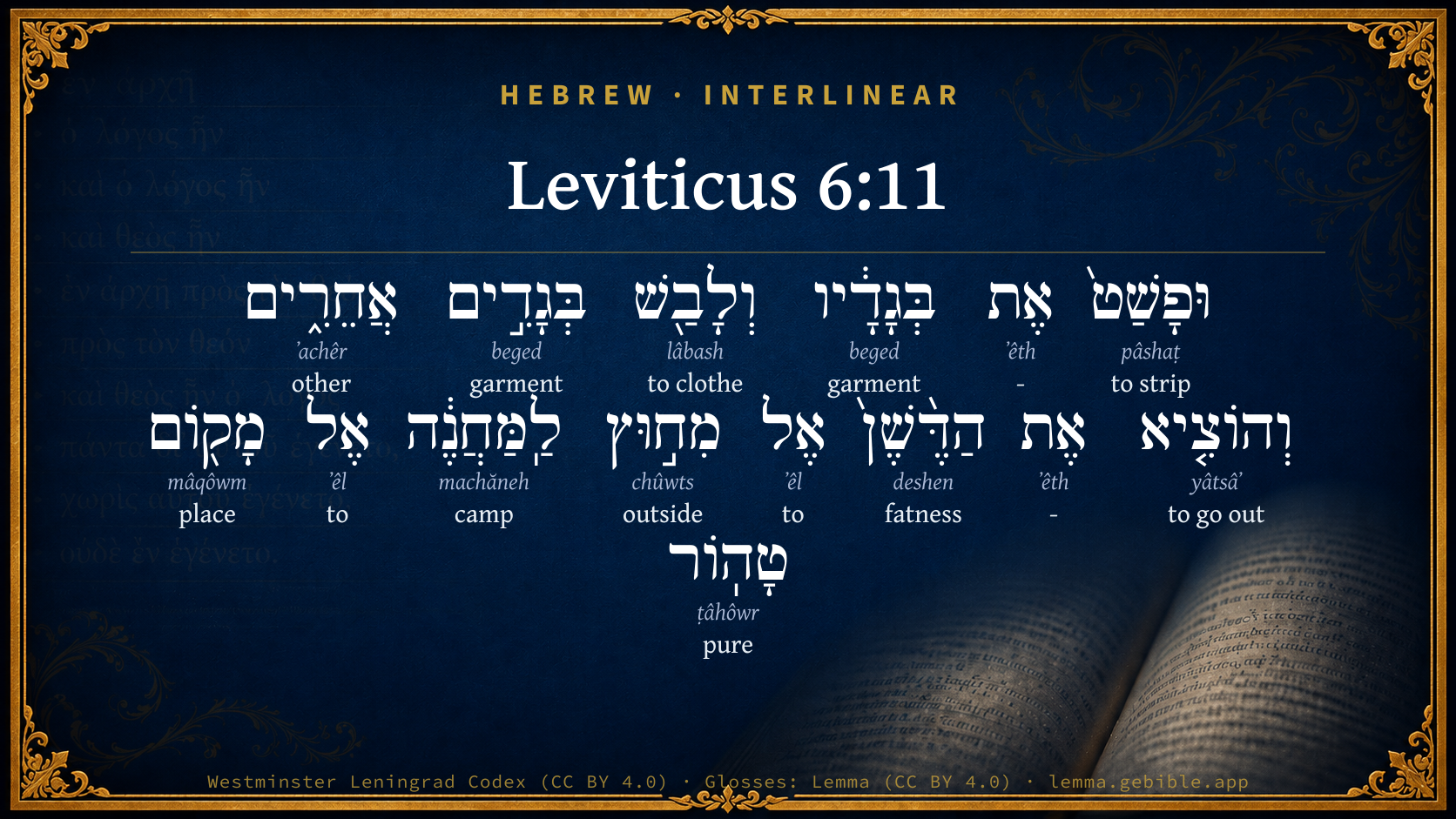
Hebrew (Westminster Leningrad Codex) Leviticus 6:11 appears in the Hebrew Old Testament. The text above is from the Westminster Leningrad Codex. Each word links to its Strong’s number, a concise gloss, and parsing drawn from the Open Scriptures Hebrew Bible morphology. Click any word for its full Brown-Driver-Briggs (BDB) entry.
Download image
Cite this verse

Leviticus 6:11 (World English Bible). Public Domain. Lemma interlinear Bible study tool, https://lemma.gebible.app/v/leviticus/6/11.

Show BibTeX & RIS
BibTeX
RIS
English Translation
He shall take off his garments, and put on other garments, and carry the ashes outside the camp to a clean place.
World English Bible · Public Domain
Download a study sheet

One document with this verse’s original text, its word-by-word gloss line, the meaning frame, cross-references with their text, attributed commentary, and full source and license credits — printable, and it pastes into notes with its structure intact.

This verse Autodidact and up

Study sheet (.html) Plain text (.txt)

A passage Seminary Student

Up to 50 verses in one chapter. A passage sheet keeps up to 6 commentary sources and 12 cross-references per verse, in the order this page ranks them, and says so on the sheet whenever that leaves anything out. Ask for a single verse and you get the Autodidact verse sheet above.

Everything on this page stays free to read, with no account — the sheet is a download of what is already on screen, not access to it.

Want to remove ads? Support Godless Engineer
Compare translations 3

The same verse in 3 English versions, stacked beneath the original-language interlinear above. Click any original word for its lexicon entry.

Each is an independent rendering of the whole verse — the interlinear is not word-aligned to these translations.

Highlighted words mark where these versions differ — a whole-verse word diff, not a word-by-word alignment.

  • World English Bible Public Domain
    He shall take off his garments, and put on other garments, and carry the ashes outside the camp to a clean place.
  • King James Version Public Domain
    And he shall put off his garments, and put on other garments, and carry forth the ashes without the camp unto a clean place.
  • unfoldingWord Literal Text CC BY-SA 4.0
    And he shall take off his clothes and shall wear other clothes. And he shall take the fatty ash out to on the outside of the camp, to a clean place.

unfoldingWord Literal Text — © unfoldingWord, licensed CC BY-SA 4.0. Word-aligned USFM3 via Door43 (git.door43.org/unfoldingWord/en_ult).

Versions to compare (up to 4)

3 of 4 selected

Show all 18 translations

Every available English version of this verse, each an independent rendering of the whole verse.

  • World English Bible Public Domain
    He shall take off his garments, and put on other garments, and carry the ashes outside the camp to a clean place.
  • Berean Standard Bible Public Domain
    Then he must take off his garments, put on other clothes, and carry the ashes outside the camp to a ceremonially clean place.
  • Majority Standard Bible Public Domain
    Then he must take off his garments, put on other clothes, and carry the ashes outside the camp to a ceremonially clean place.
  • King James Version Public Domain
    And he shall put off his garments, and put on other garments, and carry forth the ashes without the camp unto a clean place.
  • American Standard Version (1901) Public Domain
    And he shall put off his garments, and put on other garments, and carry forth the ashes without the camp unto a clean place.
  • Revised Version (1885) Public Domain
    And he shall put off his garments, and put on other garments, and carry forth the ashes without the camp unto a clean place.
  • Geneva Bible (1599) Public Domain
    After, he shall put off his garments, and put on other raiment, and cary the ashes foorth without the hoste vnto a cleane place.
  • Douay-Rheims (1899) Public Domain
    Shall put off his former vestments, and being clothed with others, shall carry them forth without the camp, and shall cause them to be consumed to dust in a very clean place,
  • Young's Literal Translation Public Domain
    and he hath stripped off his garments, and hath put on other garments, and hath brought out the ashes unto the outside of the camp, unto a clean place.
  • Literal Standard Version CC BY-SA 4.0
    and he has stripped off his garments, and has put on other garments, and has brought out the ashes to the outside of the camp, to a clean place.
  • Unlocked Literal Bible CC BY-SA 4.0
    He will take off his garments and put on other garments to carry the ashes outside the camp to a place that is clean.
  • unfoldingWord Literal Text CC BY-SA 4.0
    And he shall take off his clothes and shall wear other clothes. And he shall take the fatty ash out to on the outside of the camp, to a clean place.
  • Darby Bible Public Domain
    And he shall put off his garments, and put on other garments, and carry forth the ashes without the camp unto a clean place.
  • World Messianic Bible Public Domain
    He shall take off his garments, and put on other garments, and carry the ashes outside the camp to a clean place.
  • Webster's Bible Public Domain
    \\6:18\\All the males among the children of Aaron shall eat of it. It shall be a statute for ever in your generations concerning the offerings of the LORD made by fire: every one that toucheth them shall be holy.
  • Free Bible Version CC BY-SA 4.0
    Then he has to change his clothes, and take the ashes outside the camp to a place that's ceremonially clean.
  • Bible in Basic English Public Domain
    Every male among the children of Aaron may have it for food; it is their right for ever through all your generations, from the offerings made by fire to the Lord: anyone touching them will be holy.
  • JPS Tanakh (1917) Public Domain
    (6-4) And he shall put off his garments, and put on other garments, and carry forth the ashes without the camp unto a clean place.

Literal Standard Version (2020), Covenant Press — licensed CC BY-SA 4.0. Text via the HelloAO Bible API (eBible.org). Unlocked Literal Bible (unfoldingWord) — licensed CC BY-SA 4.0. Text via the HelloAO Bible API (eBible.org). unfoldingWord Literal Text — © unfoldingWord, licensed CC BY-SA 4.0. Word-aligned USFM3 via Door43 (git.door43.org/unfoldingWord/en_ult). Free Bible Version, Dr. Jonathan Gallagher — licensed CC BY-SA 4.0. Text via the HelloAO Bible API (eBible.org).

Word by word

More ways to search: Search by grammar → Find every occurrence → Compare this word →

Practice this passage: Drill this verse → Learn its vocabulary →

הַדֶּ֨שֶׁן֙
deshen
H1880
“the · fatness”
Particle, Definite Article + Noun, Common, Masculine, Singular, Absolute
Part of Speech
Particle + Noun
Type
Common
Gender
Masculine
Number
Singular
State
Absolute
Full BDB Definition

Origin: from H1878

TWOT: 457a

fat ashes, fatness - fatness - of fertility - of blessing (figuratively) - fat ashes (ashes of victims, mixed with the fat)
  1. וּפָשַׁט֙ pâshaṭ H6584 “and · to strip” Conjunction + Verb, Qal, Sequential Perfect, 3rd Person, Masculine, Singular
  2. אֶת ʼêth H853 “-” Particle, Direct Object
  3. בְּגָדָ֔יו beged H899 “garments · his” Noun, Common, Masculine, Plural, Construct + Suffix, Personal, 3rd Person, Masculine, Singular
  4. וְלָבַ֖שׁ lâbash H3847 “and · to clothe” Conjunction + Verb, Qal, Sequential Perfect, 3rd Person, Masculine, Singular
  5. בְּגָדִ֣ים beged H899 “garments” Noun, Common, Masculine, Plural, Absolute
  6. אֲחֵרִ֑ים ʼachêr H312 “other” Adjective, Adjective, Masculine, Plural, Absolute
  7. וְהוֹצִ֤יא yâtsâʼ H3318 “and · to go out” Conjunction + Verb, Hiphil, Sequential Perfect, 3rd Person, Masculine, Singular
  8. אֶת ʼêth H853 “-” Particle, Direct Object
  9. אֶל ʼêl H413 “to” Preposition
  10. מִח֣וּץ chûwts H2351 “from · outside” Preposition + Noun, Common, Masculine, Singular, Absolute
  11. לַֽמַּחֲנֶ֔ה machăneh H4264 “to/for the · camp” Preposition, Determined + Noun, Common, Both, Singular, Absolute
  12. אֶל ʼêl H413 “to” Preposition
  13. מָק֖וֹם mâqôwm H4725 “place” Noun, Common, Masculine, Singular, Absolute
  14. טָהֽוֹר ṭâhôwr H2889 “pure” Adjective, Adjective, Masculine, Singular, Absolute

About this verse

These counts appear in no published source. They are computed here, from the morphology-tagged text and Lemma’s own curated glosses. What Lemma adds →

15
words
12
distinct lemmas
Pentateuch
section

Notable vocabulary

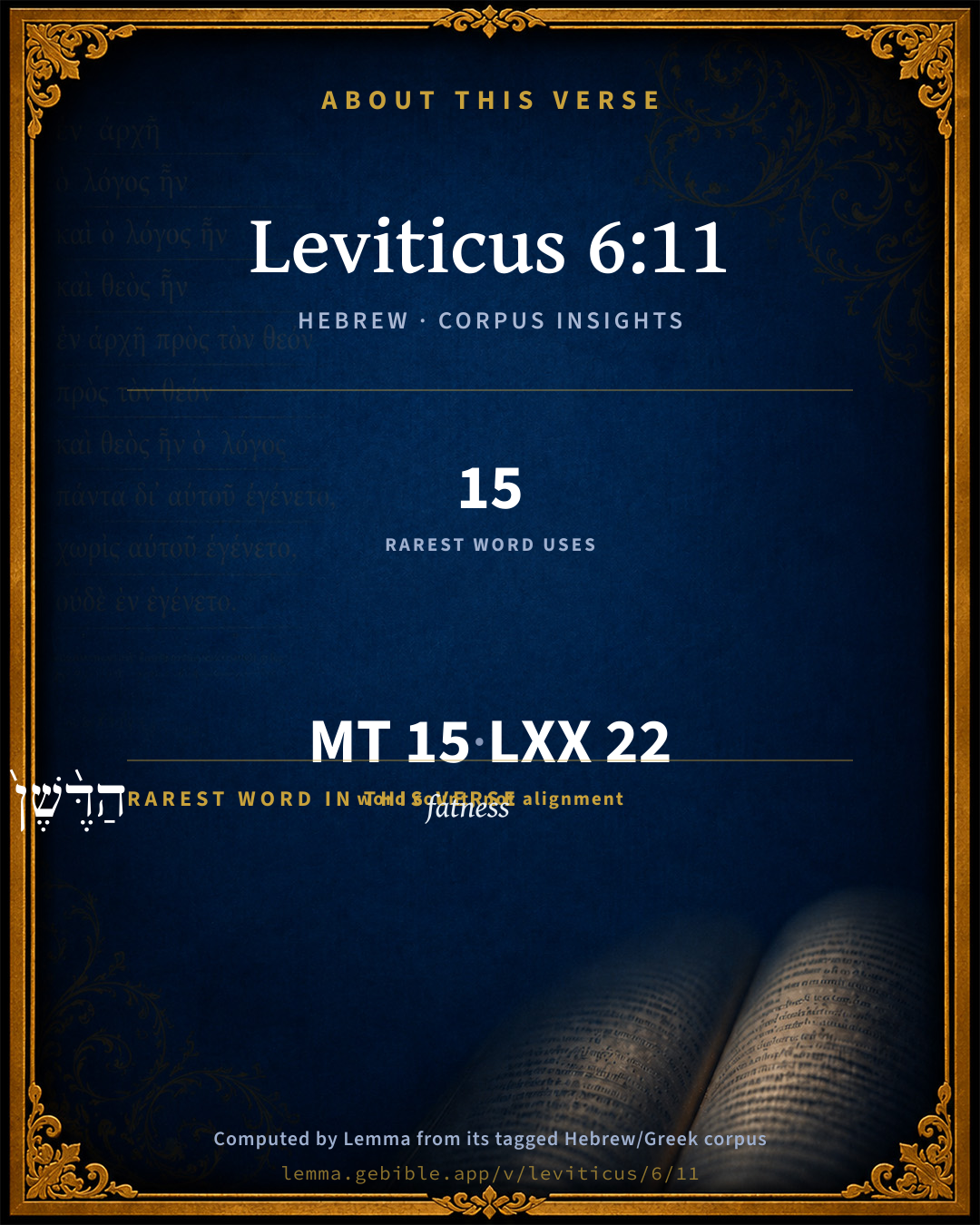
The rarest word here is הַדֶּ֨שֶׁן֙ fatness H1880 — appearing just 15 times in the whole Hebrew Bible.

Shared distinctive vocabulary

הַדֶּ֨שֶׁן֙ fatness H1880 occurs in 14 verses of the Hebrew Bible. Also found in:

Grammatical profile

  • 3 verbs
  • 6 nouns
  • 2 adjectives
  • 2 prepositions
  • 2 particles

Verb forms

  • וּפָשַׁט֙ Qal · Sequential Perfect
  • וְלָבַ֖שׁ Qal · Sequential Perfect
  • וְהוֹצִ֤יא Hiphil · Sequential Perfect

Repetition

Words recur within this verse — often emphatic in Hebrew:

  • בְּגָדָ֔יו garment H899 ×2
  • אֶל to H413 ×2

Hebrew & Septuagint length

In English translation the verse runs 22 words from the Hebrew and 30 from the Septuagint (LXX English) — closely comparable.

A rough comparison of the two English renderings, which tokenize alike — not a word-level alignment.

Word counts can differ between the Hebrew and the Greek without any difference in meaning — e.g. the Hebrew direct-object marker אֵת has no separate Greek word, and Greek often adds the article ὁ.

In the original languages it is 15 Hebrew tokens and 22 Greek tokens — but the two are counted differently (Hebrew bundles its prefixes and suffixes into one token; the Greek is in lemma form), so that isn’t a like-for-like length.

Cross-references

7

Topical passages linked to Leviticus 6:11 in the Treasury of Scripture Knowledge — connected by theme and wording, ordered by reader-vote popularity; previews shown in the World English Bible.

  • Leviticus 4:12 even the whole bull shall he carry forth outside the camp to a clean place, where the ashes are poured out, and burn it on wood with fire. Where the ashes are poured out it shall be burned.
  • Ezekiel 44:19 When they go forth into the outer court, even into the outer court to the people, they shall put off their garments in which they minister, and lay them in the holy chambers; and they shall put on other garments, that they not sanctify the people with their garments.
  • Hebrews 13:11–13 For the bodies of those animals, whose blood is brought into the holy place by the high priest as an offering for sin, are burned outside of the camp.
  • Leviticus 4:21 He shall carry forth the bull outside the camp, and burn it as he burned the first bull. It is the sin offering for the assembly.
  • Leviticus 14:40–41 then the priest shall command that they take out the stones in which is the plague, and cast them into an unclean place outside of the city:
  • Leviticus 16:23–24 "Aaron shall come into the Tent of Meeting, and shall take off the linen garments, which he put on when he went into the Holy Place, and shall leave them there.
  • Leviticus 16:27 The bull for the sin offering, and the goat for the sin offering, whose blood was brought in to make atonement in the Holy Place, shall be carried forth outside the camp; and they shall burn their skins, their flesh, and their dung with fire.

Cross-references courtesy of OpenBible.info (CC BY 4.0).

Hebrew and Greek witnesses Masoretic Hebrew ↔ Greek Septuagint

The same verse in the two great witnesses to the Old Testament, shown verse-for-verse.

These are two independent witnesses, not word-aligned to each other, and the Septuagint is shown in lemma (dictionary) form.

Hebrew Leviticus 6:11 Masoretic · Westminster Leningrad Codex

וּפָשַׁט֙ אֶת בְּגָדָ֔יו וְלָבַ֖שׁ בְּגָדִ֣ים אֲחֵרִ֑ים וְהוֹצִ֤יא אֶת הַדֶּ֨שֶׁן֙ אֶל מִח֣וּץ לַֽמַּחֲנֶ֔ה אֶל מָק֖וֹם טָהֽוֹר

He shall take off his garments, and put on other garments, and carry the ashes outside the camp to a clean place.

World English Bible · Public Domain

Greek LXX Leviticus 6:11 Septuagint · lemma form

πᾶς ἀρσενικός ὁ ἱερεύς ἐσθίω αὐτός νόμιμος αἰώνιος εἰς ὁ γενεά σύ ἀπό ὁ κάρπωμα κύριος πᾶς ὅς ἐάν ἅπτομαι αὐτός ἁγιάζω

And he shall put off his robe, and put on another robe, and he shall take forth the offering that has been burnt without the camp into a clean place.

LXX2012 (modern English Septuagint) · Public Domain

Hebrew: Westminster Leningrad Codex (CC BY 4.0). Greek: Septuagint (public domain); English from LXX2012 (modern English Septuagint) (Public Domain). How the Septuagint differs from the Hebrew →

Targum (Aramaic paraphrase)

2

The Targum is the ancient Jewish Aramaic paraphrase of the Hebrew Scriptures — an interpretive translation, not the Hebrew text itself. Onkelos (literal) and Pseudo-Jonathan (expansive) render the Torah, and Jonathan the Prophets. Coverage is partial: where no permissively-licensed English translation exists for a verse, only the Aramaic is shown. This is verse-level text, not a word-by-word alignment to the Hebrew.

  1. Targum Onkelos Torah (Genesis–Deuteronomy)
    כָּל דְכוּרָא בִּבְנֵי אַהֲרֹן יֵכְלֻנַהּ קְיָם עָלָם לְדָרָתֵיכוֹן מִקֻרָבָּנַיָא דַיְיָ כֹּל דְיִקְרַב בְּהוֹן יִתְקַדָּשׁ

    (no public-domain English translation for this verse)

    Targum Onkelos — Aramaic: “Onkelos Genesis” (public domain); “Onkelos Exodus” (public domain); “Onkelos Leviticus” (public domain); “Onkelos Numbers” (public domain); “Onkelos Deuteronomy” (public domain). English: “Sefaria Community Translation” (CC0 1.0 (public-domain dedication)); “J.W. Etheridge. The Targums of Onkelos and Jonathan Ben Uzziel on the Pentateuch. London: Longmans, Green, 1862” (public domain). Text via Sefaria.

  2. Targum Pseudo-Jonathan Torah (Genesis–Deuteronomy)
    כָּל דְכוּרָא בִּבְנֵי אַהֲרן יֵיכְלֻנָהּ קְיַים עֲלַם לְדָרֵיכוֹן מִקוּרְבָּנַיָיא דַיְיָ כָּל דְיִקְרַב בְּהוֹן יִתְקַדָשׁ

    Every man of the sons of Aharon may eat of it. This is an everlasting statute for your generations concerning the oblations of the Lord: every one who toucheth them must be sanctified.

    Targum Pseudo-Jonathan — Aramaic: “Targum Jonathan on Genesis” (public domain); “Targum Jonathan on Exodus” (public domain); “Targum Jonathan on Leviticus” (public domain); “Targum Jonathan on Numbers” (public domain); “Targum Jonathan on Deuteronomy” (public domain). English: “The Targum of Jonathan ben Uzziel, trans. J. W. Etheridge, London, 1862” (public domain). Text via Sefaria.

Commentary

Notes on Leviticus 6:11 from classic Christian and Jewish commentators (each source and its license shown beneath its notes). The classic Christian expositions comment on the surrounding passage and are grouped to its opening verse, so a note may address several verses; the Jewish commentaries on the Tanakh (Rashi and others) are per-verse, so they appear only where the commentator wrote on this verse.

Lemma curates 59 commentaries, every one of them public domain or Creative Commons licensed, each selected and text-cleaned for this edition rather than reprinted as found. About our sources →

Trapp's Complete Commentary

John Trapp

Lev 6:11 And he shall put off his garments, and put on other garments, and carry forth the ashes without the camp unto a clean place.

Ver. 11. Unto a clean place.] Because they came from the Lord’s holy house. See the contrary commanded concerning the stones and dust of a leprous house. {Lev 14:40}

John Trapp, A Commentary or Exposition upon All the Books of the Old and New Testament (1647–1656) — public domain. Text from a community e-Sword module.

Joseph Benson's Commentary

Lev 6:11. Other garments — Because this was no sacred, but a common work. A clean place — Where no dung or filth was laid. The priest himself was to do all this. God’s servants must think nothing below them but sin.

Joseph Benson's Commentary on the Old and New Testaments (1811–1818) — public domain. Text from a community e-Sword module.

Tyndale Open Study Notes

Tyndale Open Resources

6:11 Most natural environments qualified as a place that is ceremonially clean.

Tyndale Open Study Notes — © Tyndale Open Resources, licensed CC BY-SA 4.0. Text via the HelloAO Bible API.

Adam Clarke's Commentary

Verse 11. And put on other garments] The priests approached the altar in their holiest garments; when carrying the ashes, c., from the altar, they put on other garments, the holy garments being only used in the holy place.

Clean place.] A place where no dead carcasses, dung, or filth of any kind was laid for the ashes were holy, as being the remains of the offerings made by fire unto the Lord.

Adam Clarke's Commentary on the Bible (1810–1826) — public domain. Text from a community e-Sword/MySword module.

Ellicott's Commentary for English Readers

(11) And he shall put off his garments.—That is, the priest shall change the sacred robes in which he ministered at the altar; for other garments, though less holy, were not common, since the removing of the ashes was still a sacerdotal function. The holy garments were deposited in the cells within the precincts of the sanctuary, till they were required again for the altar service (Eze_44:19; Ezr_2:6; Ezr_2:9; Neh_7:70). Great care was taken that the place to which the ashes were removed was well sheltered, so that the wind should not blow them about. The priest was not allowed to scatter them, but had to deposit them gently. No stranger was permitted to gather them, or to make profit by the ashes.

A Bible Commentary for English Readers, edited by Charles John Ellicott (1878–1897) — public domain. Text from a community e-Sword module.

The Cambridge Bible for Schools and Colleges

gen. ed. J. J. S. Perowne

11. beside the altar] on the east part (Lev_1:16, there called the place of the ashes).

put off his garments] Cp. Eze_44:19 for the reason. For the danger to unconsecrated persons arising from what has been called ‘contagious holiness’ as a feature of early religions see Rob.-Sm. Rel. Sem.2 pp. 46 ff. See further on Lev_6:18.

put on other garments] The priestly garments were worn only at the altar and in the tabernacle. On going without the sacred precincts they were removed. Cp. Eze_44:19.

without the camp] to the place whither parts of the Sin-Offering for ‘the anointed priest’ and for ‘the whole congregation’ were taken (Lev_4:12; Lev_4:21).

The Cambridge Bible for Schools and Colleges (gen. ed. J. J. S. Perowne; Cambridge University Press, 1878–1918) — public domain. Text from a community e-Sword module.

John Gill's Exposition

And he shall put off his garments,.... Those before mentioned, he is said to put on:

and put on other garments; not common garments or lay-habits, what the priests wore when they were not on duty; for, as Ben Gersom says, these were priestly garments, though meaner than the first, or those that were put off: and so Jarchi says, they were worse than they were: it seems as if they were such that were spotted and dirty, and threadbare, almost worn out, and only fit for such sort of work as to carry out ashes: and so Maimonides (w) observes, that these other garments are not to be understood of common garments; but of such that are meaner in value and esteem, for both are holy garments; and, indeed, nothing belonging to the priestly office was to be performed but with the priestly garments, and they were only to be worn by the priests while in service:

and carry forth the ashes; when these, gathered on a heap, were become large, as Jarchi says, and there was no room for the pile of wood, they carried them out from thence; and this, he observes, was not obligatory every day, but the taking of them up, as in the preceding verse Lev 6:10, they were bound to every day: and these they carried

without the camp, unto a clean place; for though they were ashes, yet being ashes of holy things, were not to be laid in an unclean place, or where unclean things were: as the burnt offering was a type of Christ in his sufferings and death, enduring the fire of divine wrath in the room and stead of his people; so the carrying forth the ashes of the burnt offering, and laying them in a clean place, may denote the burial of the body of Christ without the city of Jerusalem, wrapped in a clean linen cloth and laid in a new tomb, wherein no man had been laid, Mat 27:59.

(w) In Misn. Tamid, c. 5. sect. 3.

John Gill's Exposition of the Whole Bible (1746–1763) — public domain (CC PDM 1.0). Text via the HelloAO Bible API.

Haydock's Catholic Bible Commentary

Others; such as were worn on common occasions, out of the tabernacle. --- And shall, &c. Hebrew has only, "unto a clean place," as the other versions and some Latin copies read. The meaning of the addition is, that all the bones, &c., must be perfectly reduced to dust, before they be carried out of the camp. (Calmet)

George Leo Haydock (1774–1849), Haydock's Catholic Family Bible and Commentary, 1859 edition — public domain. Excludes Psalms (Douay-Rheims chapter numbering differs from Protestant) and Deuterocanonical books (Catholic canon only).

Matthew Poole's English Annotations

Put on other garments, because this was no sacred, but a common work.

Unto a clean place, where no dung or filth was laid. See Lev 4:12, and compare Lev 14:40,41.

Matthew Poole's English Annotations on the Holy Bible (1683–1685) — public domain. Text from a community e-Sword/MySword module.

Whedon's Commentary on the Bible

Daniel D. Whedon

11. Put on other garments — This change was required because the priest was to go forth from the consecrated enclosure of the tabernacle and to come in contact with things unsanctified. The ashes must be deposited in a clean place, because they were regarded as a part of the holy offering.

See note on Lev_4:12.

Daniel D. Whedon (gen. ed.), Commentary on the Old and New Testaments (1874–1909) — public domain. Text from a community e-Sword module.

John Wesley's Explanatory Notes

Other garments - Because this was no sacred, but a common work. A clean place - Where no dung or filth was laid. The priest himself was to do all this. God's servants must think nothing below them but sin.

John Wesley, Explanatory Notes Upon the Whole Bible (1754–1765) — public domain. Text via the GEBible commentary corpus.

Rashi

Rabbi Shlomo Yitzchaki (Rashi)

כל זכר ALL THE MALES [AMONG THE CHILDREN OF AARON SHALL EAT OF IT] — all the males: even one with a bodily blemish. But why is this stated at all? If you say: for the purpose of permitting the eating of the meal-offering to such a priest, then it is redundant, for you see, this has already been stated, (Leviticus 21:22) “He (the priest with a blemish) may eat of the bread of his God, both of the most holy [and of the holy]”! But it is intended to include the priests with bodily blemishes in the right of apportionment alluded to in the preceding verse: I have given it to them as their portion (i.e. that they may not only eat holy food if such is given to them by their fellow priests, but they are entitled to participate in the apportionment) (Sifra, Tzav, Chapter 3 5; Zevachim 102a).

כל אשר ‎'יגע וגו‎‎‏ WHATEVER TOUCHETH THEM — i. e. sacrifices holy in a minor degree or non-consecrated flesh (חולין) which touch it (the meal-offering) and absorb anything of it (Sifra, Tzav, Chapter 3 6; Zevachim 97b),

יקדש SHALL BECOME HOLY so as to be exactly like it (the מנחה) — that if it (the meal-offering) has become disqualified (as when e. g. it was not offered as such, לשמה), they (the holy things touching it) shall also become similarly disqualified, and if it is fit for eating they must be eaten only under the same stringency as the meal-offering (i.e., they must be eaten in a holy place (v. 9) and by males only; v. 11, etc.) (Sifra, Tzav, Chapter 3 6; Zevachim 97b).

Rashi on the Tanakh — English translations: “The Judaica Press complete Tanach with Rashi, translated by A. J. Rosenberg” (CC BY 4.0); “Pentateuch with Rashi's commentary by M. Rosenbaum and A.M. Silbermann, 1929-1934” (public domain); “The Metsudah Tanach series, Lakewood, N.J” (CC BY 4.0); and “The Book of Joshua, Metsudah Publications, 1997” (CC BY 4.0). Text via Sefaria.

Lesson kit

Teaching starters — assembled from the data on this page, not authored interpretation. Every prompt links to the verse data it draws on. Edit before teaching.

Leviticus, in the Pentateuch, opens this verse with 15 words (12 distinct Hebrew lemmas). Its most distinctive word is deshen (“fatness”). A historical commentator’s framing appears above. Read the whole chapter for the surrounding context.

Discussion questions

  1. What does “fatness” (deshen) contribute to the verse as a whole?
  2. Leviticus 1:16 shares the word «fatness» with this verse. How do the two illuminate each other?
  3. “garment” occurs 2× in this one verse. What is the effect of the repetition?
  4. These translations render this verse differently. What is at stake in choosing one wording over another?
  5. The verb «וּפָשַׁט֙» is Qal Sequential Perfect. How does its form color the action?
  6. Reading how Trapp's Complete Commentary and Joseph Benson's Commentary read this verse, where do the two commentators agree and where do they part?

Things to notice

Reading settings

Reading text

Shown beneath each verse's original-language words.

Old Testament
Old Testament edition

Read the OT as the Masoretic Hebrew (MT) or the Greek Septuagint (LXX).

English shown for the Greek Septuagint (in the Hebrew ↔ Greek comparison).

Comparing translations? Open the Compare panel on any verse page to stack up to four side by side.