
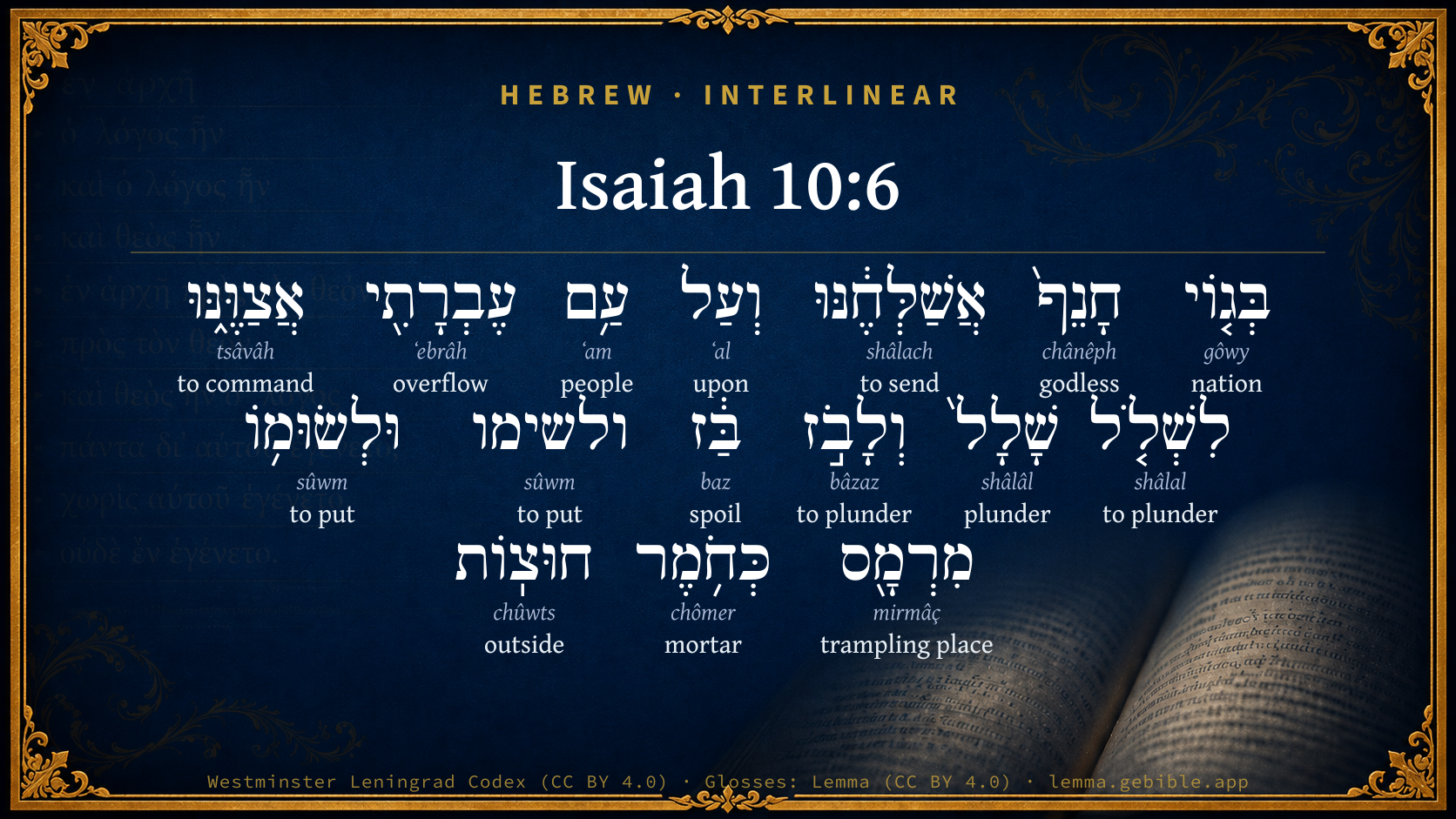
Isaiah 10:6

Hebrew (Westminster Leningrad Codex) Isaiah 10:6 appears in the Hebrew Old Testament. The text above is from the Westminster Leningrad Codex. Each word links to its Strong’s number, a concise gloss, and parsing drawn from the Open Scriptures Hebrew Bible morphology. Click any word for its full Brown-Driver-Briggs (BDB) entry.
Download image
Cite this verse

Isaiah 10:6 (World English Bible). Public Domain. Lemma interlinear Bible study tool, https://lemma.gebible.app/v/isaiah/10/6.

Show BibTeX & RIS
BibTeX
RIS
English Translation
I will send him against a profane nation, and against the people of my wrath will I give him a charge, to take the spoil, and to take the prey, and to tread them down like the mire of the streets.
World English Bible · Public Domain
Download a study sheet

One document with this verse’s original text, its word-by-word gloss line, the meaning frame, cross-references with their text, attributed commentary, and full source and license credits — printable, and it pastes into notes with its structure intact.

This verse Autodidact and up

Study sheet (.html) Plain text (.txt)

A passage Seminary Student

Up to 50 verses in one chapter. A passage sheet keeps up to 6 commentary sources and 12 cross-references per verse, in the order this page ranks them, and says so on the sheet whenever that leaves anything out. Ask for a single verse and you get the Autodidact verse sheet above.

Everything on this page stays free to read, with no account — the sheet is a download of what is already on screen, not access to it.

Want to remove ads? Support Godless Engineer
Compare translations 3

The same verse in 3 English versions, stacked beneath the original-language interlinear above. Click any original word for its lexicon entry.

Each is an independent rendering of the whole verse — the interlinear is not word-aligned to these translations.

Highlighted words mark where these versions differ — a whole-verse word diff, not a word-by-word alignment.

  • World English Bible Public Domain
    I will send him against a profane nation, and against the people of my wrath will I give him a charge, to take the spoil, and to take the prey, and to tread them down like the mire of the streets.
  • King James Version Public Domain
    I will send him against an hypocritical nation, and against the people of my wrath will I give him a charge, to take the spoil, and to take the prey, and to tread them down like the mire of the streets.
  • unfoldingWord Literal Text CC BY-SA 4.0
    I have sent him against a godless nation, and against the people of my wrath I have commanded him to spoil spoil and to plunder plunder, and to make him a trampling like the mud of the streets.

unfoldingWord Literal Text — © unfoldingWord, licensed CC BY-SA 4.0. Word-aligned USFM3 via Door43 (git.door43.org/unfoldingWord/en_ult).

Versions to compare (up to 4)

3 of 4 selected

Show all 18 translations

Every available English version of this verse, each an independent rendering of the whole verse.

  • World English Bible Public Domain
    I will send him against a profane nation, and against the people of my wrath will I give him a charge, to take the spoil, and to take the prey, and to tread them down like the mire of the streets.
  • Berean Standard Bible Public Domain
    I will send him against a godless nation; I will dispatch him against a people destined for My rage, to take spoils and seize plunder, and to trample them down like clay in the streets.
  • Majority Standard Bible Public Domain
    I will send him against a godless nation; I will dispatch him against a people destined for My rage, to take spoils and seize plunder, and to trample them down like clay in the streets.
  • King James Version Public Domain
    I will send him against an hypocritical nation, and against the people of my wrath will I give him a charge, to take the spoil, and to take the prey, and to tread them down like the mire of the streets.
  • American Standard Version (1901) Public Domain
    I will send him against a profane nation, and against the people of my wrath will I give him a charge, to take the spoil, and to take the prey, and to tread them down like the mire of the streets.
  • Revised Version (1885) Public Domain
    I will send him against a profane nation, and against the people of my wrath will I give him a charge, to take the spoil, and to take the prey, and to tread them down like the mire of the streets.
  • Geneva Bible (1599) Public Domain
    I will sende him to a dissembling nation, and I will giue him a charge against the people of my wrath to take the spoyle and to take the pray, and to treade them vnder feete like the mire in the streete.
  • Douay-Rheims (1899) Public Domain
    I will send him to a deceitful nation, and I will give him a charge against the people of my wrath, to take away the spoils, and to lay hold on the prey, and to tread them down like the mire of the streets.
  • Young's Literal Translation Public Domain
    Against a profane nation I send him, And concerning a people of My wrath I charge him, To spoil spoil, and to seize prey, And to make it a treading-place as the clay of out places.
  • Literal Standard Version CC BY-SA 4.0
    I send him against a profane nation, || And concerning a people of My wrath || I charge him, || To spoil spoil, and to seize prey, || And to make it a treading-place as the clay of out places.
  • Unlocked Literal Bible CC BY-SA 4.0
    I send him against an arrogant nation and against the people who bear my overflowing wrath. I order him to take the spoil, to take the prey, and to trample them like mud in the streets.
  • unfoldingWord Literal Text CC BY-SA 4.0
    I have sent him against a godless nation, and against the people of my wrath I have commanded him to spoil spoil and to plunder plunder, and to make him a trampling like the mud of the streets.
  • Darby Bible Public Domain
    I will send him against a hypocritical nation, and against the people of my wrath will I give him a charge; to take the spoil, and to seize the prey, and to tread them down like the mire of the streets.
  • World Messianic Bible Public Domain
    I will send him against a profane nation, and against the people who anger me I will give him a command to take the plunder and to take the prey, and to tread them down like the mire of the streets.
  • Webster's Bible Public Domain
    I will send him against a hypocritical nation, and against the people of my wrath will I give him a charge, to take the spoil, and to take the prey, and to tread them down like the mire of the streets.
  • Free Bible Version CC BY-SA 4.0
    I am sending the Assyrians against a nation that has given up on its God, against a people that make me angry. I order the Assyrians to loot them, to take their possessions, and to trample them down like mud in the street.
  • Bible in Basic English Public Domain
    I will send him against a nation of wrongdoers, and against the people of my wrath I will give him orders, to take their wealth in war, crushing them down like the dust in the streets.
  • JPS Tanakh (1917) Public Domain
    I do send him against an ungodly nation, and against the people of My wrath do I give him a charge, to take the spoil, and to take the prey, and to tread them down like the mire of the streets.

Literal Standard Version (2020), Covenant Press — licensed CC BY-SA 4.0. Text via the HelloAO Bible API (eBible.org). Unlocked Literal Bible (unfoldingWord) — licensed CC BY-SA 4.0. Text via the HelloAO Bible API (eBible.org). unfoldingWord Literal Text — © unfoldingWord, licensed CC BY-SA 4.0. Word-aligned USFM3 via Door43 (git.door43.org/unfoldingWord/en_ult). Free Bible Version, Dr. Jonathan Gallagher — licensed CC BY-SA 4.0. Text via the HelloAO Bible API (eBible.org).

Word by word

More ways to search: Search by grammar → Find every occurrence → Compare this word →

Practice this passage: Drill this verse → Learn its vocabulary →

מִרְמָ֖ס
mirmâç
H4823
“trampling place”
Noun, Common, Masculine, Singular, Absolute
Part of Speech
Noun
Type
Common
Gender
Masculine
Number
Singular
State
Absolute
Full BDB Definition

Origin: from H7429

TWOT: 2176a

trampling place, trampling - trampling place - trampling
  1. בְּג֤וֹי gôwy H1471 “in/at · nation” Preposition + Noun, Common, Masculine, Singular, Absolute
  2. חָנֵף֙ chânêph H2611 “godless” Adjective, Adjective, Masculine, Singular, Absolute
  3. אֲשַׁלְּחֶ֔נּוּ shâlach H7971 “to send · him” Verb, Piel, Imperfect, 1st Person, Common, Singular + Suffix, Personal, 3rd Person, Masculine, Singular
  4. וְעַל ʻal H5921 “and · upon” Conjunction + Preposition
  5. עַ֥ם ʻam H5971 “people of” Noun, Common, Masculine, Singular, Construct
  6. עֶבְרָתִ֖י ʻebrâh H5678 “overflow · my” Noun, Common, Feminine, Singular, Construct + Suffix, Personal, 1st Person, Common, Singular
  7. אֲצַוֶּ֑נּוּ tsâvâh H6680 “to command · him” Verb, Piel, Imperfect, 1st Person, Common, Singular + Suffix, Personal, 3rd Person, Masculine, Singular
  8. לִשְׁלֹ֤ל shâlal H7997 “to plunder” Preposition + Verb, Qal, Infinitive Construct
  9. שָׁלָל֙ shâlâl H7998 “plunder” Noun, Common, Masculine, Singular, Absolute
  10. וְלָבֹ֣ז bâzaz H962 “and · to plunder” Conjunction + Preposition + Verb, Qal, Infinitive Construct
  11. בַּ֔ז baz H957 “spoil” Noun, Common, Masculine, Singular, Absolute
  12. ולשימו sûwm H7760 “and · to put · him” Conjunction + Preposition + Verb, Qal, Infinitive Construct + Suffix, Personal, 3rd Person, Masculine, Singular
  13. וּלְשׂוּמ֥וֹ sûwm H7760 “and · to put · him” Conjunction + Preposition + Verb, Qal, Infinitive Construct + Suffix, Personal, 3rd Person, Masculine, Singular
  14. כְּחֹ֥מֶר chômer H2563 “like/as · mortar of” Preposition + Noun, Common, Masculine, Singular, Construct
  15. חוּצֽוֹת chûwts H2351 “streets” Noun, Common, Masculine, Plural, Absolute

About this verse

These counts appear in no published source. They are computed here, from the morphology-tagged text and Lemma’s own curated glosses. What Lemma adds →

16
words
15
distinct lemmas
Prophets
section

Notable vocabulary

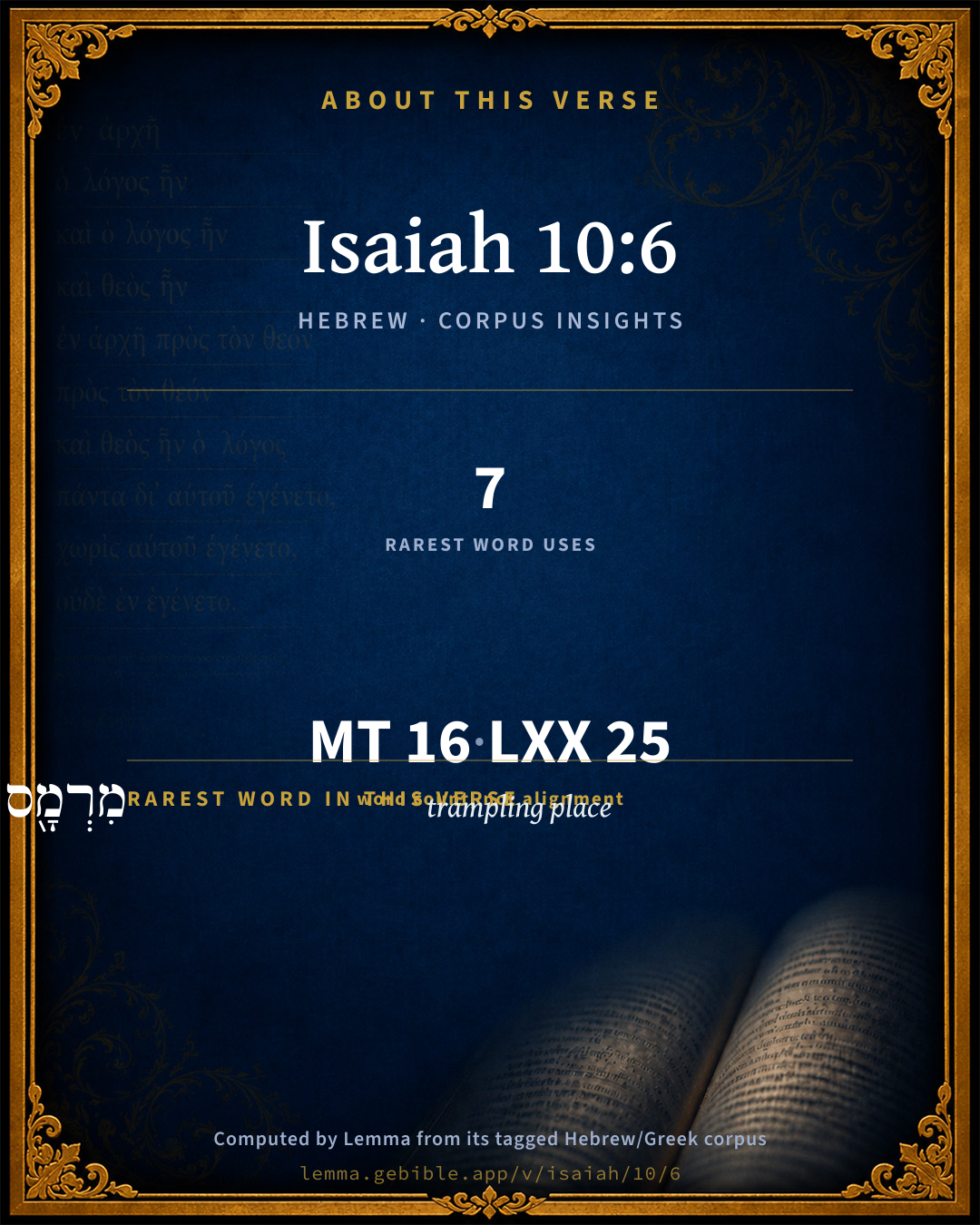
The rarest word here is מִרְמָ֖ס trampling place H4823 — appearing just 7 times in the whole Hebrew Bible.

Shared distinctive vocabulary

מִרְמָ֖ס trampling place H4823 occurs in 7 verses of the Hebrew Bible. Also found in:

Grammatical profile

  • 6 verbs
  • 8 nouns
  • 1 adjective
  • 1 preposition

Verb forms

  • אֲשַׁלְּחֶ֔נּוּ Piel · Imperfect
  • אֲצַוֶּ֑נּוּ Piel · Imperfect
  • לִשְׁלֹ֤ל Qal · Infinitive Construct
  • וְלָבֹ֣ז Qal · Infinitive Construct
  • ולשימו Qal · Infinitive Construct
  • וּלְשׂוּמ֥וֹ Qal · Infinitive Construct

Repetition

A word recurs within this verse — often emphatic in Hebrew:

  • ולשימו to put H7760 ×2

Hebrew & Septuagint length

In English translation the verse runs 41 words from the Hebrew and 30 from the Septuagint (LXX English) — closely comparable.

A rough comparison of the two English renderings, which tokenize alike — not a word-level alignment.

Word counts can differ between the Hebrew and the Greek without any difference in meaning — e.g. the Hebrew direct-object marker אֵת has no separate Greek word, and Greek often adds the article ὁ.

In the original languages it is 16 Hebrew tokens and 25 Greek tokens — but the two are counted differently (Hebrew bundles its prefixes and suffixes into one token; the Greek is in lemma form), so that isn’t a like-for-like length.

Cross-references

23

Topical passages linked to Isaiah 10:6 in the Treasury of Scripture Knowledge — connected by theme and wording, ordered by reader-vote popularity; previews shown in the World English Bible.

  • Isaiah 9:17 Therefore the Lord will not rejoice over their young men, neither will he have compassion on their fatherless and widows; for everyone is profane and an evil-doer, and every mouth speaks folly. For all this his anger is not turned away, but his hand is stretched out still.
  • Isaiah 10:13–14 For he has said, By the strength of my hand I have done it, and by my wisdom; for I have understanding: and I have removed the bounds of the peoples, and have robbed their treasures, and like a valiant man I have brought down those who sit [on thrones]:
  • Isaiah 19:17 The land of Judah shall become a terror to Egypt; everyone to whom mention is made of it shall be afraid, because of the purpose of Yahweh of Hosts, which he purposes against it.
  • Isaiah 37:26–27 Have you not heard how I have done it long ago, and formed it of ancient times? now have I brought it to pass, that it should be your to lay waste fortified cities into ruinous heaps.
  • Jeremiah 25:9 behold, I will send and take all the families of the north, says Yahweh, and [I will send] to Nebuchadrezzar the king of Babylon, my servant, and will bring them against this land, and against the inhabitants of it, and against all these nations round about; and I will utterly destroy them, and make them an astonishment, and a hissing, and perpetual desolations.
  • Jeremiah 34:22 Behold, I will command, says Yahweh, and cause them to return to this city; and they shall fight against it, and take it, and burn it with fire: and I will make the cities of Judah a desolation, without inhabitant.
  • Jeremiah 47:6–7 You sword of Yahweh, how long will it be before you be quiet? put up yourself into your scabbard; rest, and be still.
  • Zechariah 10:5 They shall be as mighty men, Treading down muddy streets in the battle; And they shall fight, because Yahweh is with them; And the riders on horses will be confounded.
  • 2 Samuel 22:43 Then did I beat them small as the dust of the earth, I did crush them as the mire of the streets, and did spread them abroad.
  • Isaiah 5:29 Their roaring will be like a lioness. They will roar like young lions. Yes, they shall roar, And seize their prey and carry it off, And there will be no one to deliver.
  • Isaiah 22:5 For it is a day of confusion, and of treading down, and of perplexity, from the Lord, Yahweh of Hosts, in the valley of vision; a breaking down of the walls, and a crying to the mountains.
  • Isaiah 29:13 The Lord said, Because this people draw near [to me], and with their mouth and with their lips to honor me, but have removed their heart far from me, and their fear of me is a commandment of men which has been taught [them];
  • Isaiah 30:9–11 For it is a rebellious people, lying children, children who will not hear the law of Yahweh;
  • Isaiah 33:14 The sinners in Zion are afraid; trembling has seized the godless ones: Who among us can dwell with the devouring fire? who among us can dwell with everlasting burning?
  • Isaiah 41:25 I have raised up one from the north, and he has come; from the rising of the sun one who calls on my name: and he shall come on rulers as on mortar, and as the potter treads clay.
  • Isaiah 45:1–5 Thus says Yahweh to his anointed, to Cyrus, whose right hand I have held, to subdue nations before him, and I will loose the loins of kings; to open the doors before him, and the gates shall not be shut:
  • Isaiah 63:3 I have trodden the winepress alone; and of the peoples there was no man with me: yes, I trod them in my anger, and trampled them in my wrath; and their lifeblood is sprinkled on my garments, and I have stained all my clothing.
  • Isaiah 63:6 I trod down the peoples in my anger, and made them drunk in my wrath, and I poured out their lifeblood on the earth.
  • Jeremiah 3:10 Yet for all this her treacherous sister Judah has not returned to me with her whole heart, but only in pretense, says Yahweh.
  • Jeremiah 4:14 Jerusalem, wash your heart from wickedness, that you may be saved. How long shall your evil thoughts lodge within you?
  • Micah 7:10 Then my enemy will see it, And shame will cover her who said to me, Where is Yahweh your God? Then my enemy will see me and will cover her shame. Now she will be trodden down like the mire of the streets.
  • Matthew 15:7 You hypocrites! Well did Isaiah prophesy of you, saying,
  • Isaiah 9:19 Through the wrath of Yahweh of hosts is the land burnt up; and the people are as the fuel of fire: no man spares his brother.

Cross-references courtesy of OpenBible.info (CC BY 4.0).

Hebrew and Greek witnesses Masoretic Hebrew ↔ Greek Septuagint

The same verse in the two great witnesses to the Old Testament, shown verse-for-verse.

These are two independent witnesses, not word-aligned to each other, and the Septuagint is shown in lemma (dictionary) form.

Hebrew Isaiah 10:6 Masoretic · Westminster Leningrad Codex

בְּג֤וֹי חָנֵף֙ אֲשַׁלְּחֶ֔נּוּ וְעַל עַ֥ם עֶבְרָתִ֖י אֲצַוֶּ֑נּוּ לִשְׁלֹ֤ל שָׁלָל֙ וְלָבֹ֣ז בַּ֔ז ולשימו וּלְשׂוּמ֥וֹ מִרְמָ֖ס כְּחֹ֥מֶר חוּצֽוֹת

I will send him against a profane nation, and against the people of my wrath will I give him a charge, to take the spoil, and to take the prey, and to tread them down like the mire of the streets.

World English Bible · Public Domain

Greek LXX Isaiah 10:6 Septuagint · lemma form

ὁ ὀργή ἐγώ εἰς ἔθνος ἄνομος ἀποστέλλω καί ὁ ἐμός λαός συντάσσω ποιέω σκῦλον καί προνομή καί καταπατέω ὁ πόλις καί τίθημι αὐτός εἰς κονιορτός

I will send my wrath against a sinful nation, and I will charge my people to take plunder and spoil, and to trample the cities, and to make them dust.

LXX2012 (modern English Septuagint) · Public Domain

Hebrew: Westminster Leningrad Codex (CC BY 4.0). Greek: Septuagint (public domain); English from LXX2012 (modern English Septuagint) (Public Domain). How the Septuagint differs from the Hebrew →

Targum (Aramaic paraphrase)

1

The Targum is the ancient Jewish Aramaic paraphrase of the Hebrew Scriptures — an interpretive translation, not the Hebrew text itself. Onkelos (literal) and Pseudo-Jonathan (expansive) render the Torah, and Jonathan the Prophets. Coverage is partial: where no permissively-licensed English translation exists for a verse, only the Aramaic is shown. This is verse-level text, not a word-by-word alignment to the Hebrew.

  1. Targum Jonathan Prophets (Joshua–Malachi)
    בִּכְנֵישָׁא חֲנִיפָא אֲשַׁלְחִינֵיהּ וְעַל עַמָא דַעֲבָרוּ עַל אוֹרַיְתָא אֲפַקְדִינֵיהּ לְמִבַּז בִּזָא וּלְמֶעְדֵי עֲדָאָה וּלְשַׁוָיוּתֵיהּ לְדָיִישׁ כְּסִין שׁוּקִין:

    I will send him against an hypocritical assembly, and against a people that have transgressed my law will I give him a charge, to take the spoil, and to take the prey, and to place him for a treading under foot like the mire of the streets.

    Targum Jonathan — Aramaic: “Mikraot Gedolot” (public domain). English: “Sefaria Community Translation” (CC0 1.0 (public-domain dedication)); “London "Chaldee Paraphrase," 1871” (public domain). Text via Sefaria.

Commentary

Notes on Isaiah 10:6 from classic Christian and Jewish commentators (each source and its license shown beneath its notes). The classic Christian expositions comment on the surrounding passage and are grouped to its opening verse, so a note may address several verses; the Jewish commentaries on the Tanakh (Rashi and others) are per-verse, so they appear only where the commentator wrote on this verse.

Lemma curates 59 commentaries, every one of them public domain or Creative Commons licensed, each selected and text-cleaned for this edition rather than reprinted as found. About our sources →

Trapp's Complete Commentary

John Trapp

Isa 10:6 I will send him against an hypocritical nation, and against the people of my wrath will I give him a charge, to take the spoil, and to take the prey, and to tread them down like the mire of the streets.

Ver. 6. I will send him … I will give him a charge.] Non patefacta quidem voluntate, sed arcana providentia, I will stir him up by a secret providence, which, being nothing else but the carrying on of the divine decree, is that helm that turneth about the whole ship of the universe.

Against an hypocritical nation.] Pretenders only to religion, {see Isa 9:17} qui toti ex hypocrisi sunt conflati, such as are wholly made up of hypocrisy: God was near in their mouth, and far from their reins. {Jer 12:2} Nemo tam prope proculque Deo. {Mat 15:8} Hot meteors they are. saith one, shooting, yet showing like stars; shaming goodness by seeming good; Virtutis stragulam pudefaciunt, as Diogenes said to Antipater, who, being vicious, wore a white cloak, the ensign of innocence. These are little better than devils wrapped up in Samuel’s mantle; odious therefore to God, whom they would cozen of heaven, if they could tell how.

And against the people of my wrath.] Who are therefore the worse, and shall fare the worse, because they ought to have been better. Indignation and wrath shall he upon the Jew first, because of his privileges, and then upon the Gentile. {Rom 2:9}

To take the spoil, and to take the prey.] As had been foretold in Maher-shalal-hash-baz’s name. {Isa 8:1}

And to tread them down like mire in the streets.] To make mortar of them, as we use to say: Gens simulatrix tota terrena, Is trodden under foot as unsavoury salt, which is not good enough for the dunghill.

John Trapp, A Commentary or Exposition upon All the Books of the Old and New Testament (1647–1656) — public domain. Text from a community e-Sword module.

Joseph Benson's Commentary

Isa 10:6-7. I will send him — By my providence, giving him both opportunity and inclination to undertake this expedition; against a hypocritical nation — Or, a profane nation, as the word חנŠrather signifies; and against the people of my wrath — The objects of my just wrath, devoted to destruction. To tread them down like the mire of the streets — Easily to conquer them, and utterly to destroy them, as he did after this time. Howbeit, he meaneth not so — He does not design the execution of my will, but only to extend his conquests, and thereby to enlarge his empire, and gratify his ambition. Which is seasonably added, to justify God in his judgments threatened to the Assyrian, notwithstanding this service. But to destroy nations not a few — To sacrifice multitudes of people to his own pride and covetousness, which was abominable impiety.

Joseph Benson's Commentary on the Old and New Testaments (1811–1818) — public domain. Text from a community e-Sword module.

Tyndale Open Study Notes

Tyndale Open Resources

10:6 Despite their privileged calling as God’s covenant people, Judah had become a godless nation, making them the object of God’s anger (10:4). • The word plunder translates both the Hebrew words shalal and baz, recalling the name Maher-shalal-hash-baz (see 5:19; 8:1, 3, 5-10).

Tyndale Open Study Notes — © Tyndale Open Resources, licensed CC BY-SA 4.0. Text via the HelloAO Bible API.

Geneva Bible (1599)

Geneva Bible translators

That is, the Assyrians against the Jews, which are but hypocrites: and in the sixth and seventh verse is declared the difference of the work of God, and of the wicked in one very thing and act: for God’s intention is to chastise them for their amendment, and the Assyrians’ purpose is to destroy them to enrich themselves: thus in respect of God’s justice, it is God’s work, but in respect of their own malice, it is the work of the devil.

Geneva Bible (1599) marginal notes — public domain. Text via Bolls.life.

Jamieson, Fausset & Brown

Robert Jamieson, A. R. Fausset & David Brown

send him--"Kings' hearts are in the hand of the Lord" (Pro 21:1).

hypocritical--polluted [HORSLEY].

nation--Judah, against whom Sennacherib was forming designs.

of my wrath--objects of My wrath.

give . . . charge-- (Jer 34:22).

and to tread, &c.--HORSLEY translates: "And then to make him (the Assyrian) a trampling under foot like the mire of the streets" (so Isa 10:12; Isa 33:1; Zac 10:5). But see Isa 37:26.

Jamieson, Fausset & Brown — Commentary Critical and Explanatory on the Whole Bible (1871) — public domain (CC PDM 1.0). Text via the HelloAO Bible API.

Ellicott's Commentary for English Readers

(6) I will send him against an hypocritical nation.—Better, impious. The verb admits of the various renderings, “I will send,” “I did send,” and “I am wont to send.” The last seems to give the best meaning—not a mere fact in history, nor an isolated prediction, but a law of the Divine government.

To take the spoil.—The series of words, though general in meaning, contains probably a special reference to the recent destruction of Samaria, walls pulled down, houses and palaces turned into heaps of rubbish, the soldiers trampling on flower and fruit gardens, this was what the Assyrian army left behind it. Judah had probably suffered in the same way in the hands of Sargon.

A Bible Commentary for English Readers, edited by Charles John Ellicott (1878–1897) — public domain. Text from a community e-Sword module.

The Cambridge Bible for Schools and Colleges

gen. ed. J. J. S. Perowne

6. I will send him, &c.] Rather: I send him against a profane nation (R.V.). See ch. Isa_9:17. In a general description of the mission of Assyria it is not advisable to limit the reference to Judah or Israel. The meaning is that Jehovah sends the Assyrian against any nation that deserves punishment.

people of my wrath] See Isa_9:19.

like the mire of the streets] Cf. Psa_18:42; Mic_7:10.

The Cambridge Bible for Schools and Colleges (gen. ed. J. J. S. Perowne; Cambridge University Press, 1878–1918) — public domain. Text from a community e-Sword module.

John Gill's Exposition

I will send him against a hypocritical nation,.... The people of Israel, who might well be called so, since everyone of them was a hypocrite, Isa 9:17 pretending to love, fear, and serve the Lord, when it was only outwardly, and by profession, and not in deed, and in truth; their character contains the reason of the Lord's calling and sending the Assyrian to correct and chastise them:

and against the people of my wrath: who provoked him to wrath, were deserving of it, and upon whom he was about to bring it; it was their hypocrisy that stirred up his wrath against them; nothing is more hateful to God than that:

will I give him a charge, to take the spoil, and to take the prey: that is, the Assyrian monarch, to make a spoil and a prey of the people of the Jews, not by any legal commission, or express command, but by the secret power of his providence, guiding and directing him into the land of Judea, to ravage and spoil it:

and to tread them down like the mire of the streets: which denotes the great subjection of the inhabitants of it to him; the very low and mean estate into which they should be brought; the great contempt they should be had in; the little account that should be had of them; and their inability to help and recover themselves.

John Gill's Exposition of the Whole Bible (1746–1763) — public domain (CC PDM 1.0). Text via the HelloAO Bible API.

Albert Barnes' Notes on the Bible

I will send him - Implying that he was entirely in the hand of God, and subject to his direction; and showing that God has control over kings and conqueror’s; Pro 21:1.

Against an hypocritical nation - Whether the prophet here refers to Ephraim, or to Judah, or to the Jewish people in general, has been an object of inquiry among interpreters. As the designs of Sennacherib were mainly against Judah. it is probable that that part of the nation was intended. This is evidently the case, if, as has been supposed, the prophecy was uttered after the captivity of the ten tribes; see Isa 10:20. It need scarcely be remarked, that it was eminently the characteristic of the nation that they were hypocritical; compare Isa 9:17; Mat 15:17; Mar 7:6.

And against the people of my wrath - That is, those who were the objects of my wrath; or the people on whom I am about to pour out my indignation.

To take the spoil - To plunder them.

And to tread them down - Hebrew, ‘And to make them a treading down.’ The expression is drawn from war, where the vanquished and the slain are trodden down by the horses of the conquering army. It means here, that the Assyrian would humble and subdue the people; that he would trample indignantly on the nation, regarding them with contempt, and no more to be esteemed than the mire of the streets. A similar figure occurs in Zec 10:5 : ‘And they shall be as mighty men which tread down their enemies in the mire of the streets in battle.’

Albert Barnes' Notes on the Bible (1834–1885) — public domain. Text from a community e-Sword/MySword module.

Haydock's Catholic Bible Commentary

Deceitful. Hebrew, "hypocritical," joining my worship with that of idols. (Calmet) --- They had solemnly promised to serve the Lord, Exodus xix. 8. (Worthington)

George Leo Haydock (1774–1849), Haydock's Catholic Family Bible and Commentary, 1859 edition — public domain. Excludes Psalms (Douay-Rheims chapter numbering differs from Protestant) and Deuterocanonical books (Catholic canon only).

Matthew Poole's English Annotations

I will send him, not by express commission, but by the secret yet powerful conduct of my providence, giving him both occasion and inclination to this expedition. Hypocritical: See Poole "Isa 9:17".

The people of my wrath; the objects of my just wrath, devoted to destruction.

Give him a charge, by putting this instinct into his mind.

To tread them down like the mire of the streets; which signifies that he should easily conquer them, and utterly destroy them, as he did after this time.

Matthew Poole's English Annotations on the Holy Bible (1683–1685) — public domain. Text from a community e-Sword/MySword module.

Whedon's Commentary on the Bible

Daniel D. Whedon

6. Against — Or, upon.

A hypocritical nation — Israel is meant, but Judah is not to escape. The Assyrian knew not that God sends him, or allows him, with far different purpose from his own, to invade his fallen people, the people of his wrath who have persistently become objects of divine disfavour.

To take… spoil… prey — Literally, To spoil spoil, and to prey prey. The Hebrew has a strong, though meagre, vocabulary.

To tread them down — Hebrew, To lay them a treading. Psa_18:42.

Daniel D. Whedon (gen. ed.), Commentary on the Old and New Testaments (1874–1909) — public domain. Text from a community e-Sword module.

The Pulpit Commentary

I will send him against a hypocritical nation; or, against a corrupt nation. Israel in the wider sense, inclusive of Judah, seems to be intended. The people of my wrath; i.e. "the people who are the object of my wrath." Will I give him a charge. In 2Ki_18:25 Sennacherib nays, "Am I come up without the Lord (Jehovah) against thin, lace, to destroy it? The Lord (Jehovah) said to me, Go up against this land, and destroy it". (compare below, Isa_36:10) It has been usual to consider Sennacherib"s words a vain boast; but if God instructed Nebuchadnezzar through dreams, may he not also by the same means have "given charges" to Assyrian monarchs? To take the spoil, and to take the prey; rather, to gather spoil, and seize prey. The terms used carry the thoughts back to Isa_8:1-4, and to the symbolic name, Maher-shalal-hash-baz. And to tread them down; literally, to make it a trampling. "It" refers to "nation" in the first clause.

The Pulpit Commentary (1880–1919), ed. H.D.M. Spence-Jones & Joseph S. Exell — public domain. Text from a community e-Sword module.

John Wesley's Explanatory Notes

Send him - By my providence, giving him both occasion and inclination to this expedition.

John Wesley, Explanatory Notes Upon the Whole Bible (1754–1765) — public domain. Text via the GEBible commentary corpus.

J. A. Alexander on Isaiah

Joseph Addison Alexander

“Upon (or against) an impious nation (i.e., Israel, including Ephraim and Judah) will I send him (the Assyrian), and against the people of my wrath (i.e., the people that provokes it and deserves it and is to experience it). I will commission him (or give him his orders), to take spoil and to seize prey (literally to spoil and to prey), and to place (or render) it (the people) a trampling (a thing to be trodden under foot, a common figure for extreme degradation) like the mire of streets.” See the same comparison in Isa 5:25 and Psa 18:42.

Joseph Addison Alexander, The Prophecies of Isaiah (1846–1847; New York: Scribner, 1870–1878) — public domain. Text from a community e-Sword module.

Rashi

Rabbi Shlomo Yitzchaki (Rashi)

Against a hypocritical nation Israel.

Rashi on the Tanakh — English translations: “The Judaica Press complete Tanach with Rashi, translated by A. J. Rosenberg” (CC BY 4.0); “Pentateuch with Rashi's commentary by M. Rosenbaum and A.M. Silbermann, 1929-1934” (public domain); “The Metsudah Tanach series, Lakewood, N.J” (CC BY 4.0); and “The Book of Joshua, Metsudah Publications, 1997” (CC BY 4.0). Text via Sefaria.

Ibn Ezra

Rabbi Abraham ibn Ezra

The people of my wrath. The people with whom I am wroth.

Ibn Ezra on the Tanakh — English translations: “Sefaria Community Translation” (CC0 1.0 (public-domain dedication)); “Yalkut, Sifsei Chachomim Chumash, Metsudah Publications, 2009” (CC BY 4.0); and “Commentary of Ibn Ezra on Isaiah - trans. by M. Friedlander, 1873” (public domain). Text via Sefaria.

Lesson kit

Teaching starters — assembled from the data on this page, not authored interpretation. Every prompt links to the verse data it draws on. Edit before teaching.

Isaiah, in the Prophets, opens this verse with 16 words (15 distinct Hebrew lemmas). Its most distinctive word is mirmâç (“trampling place”). A historical commentator’s framing appears above. Read the whole chapter for the surrounding context.

Discussion questions

  1. The word mirmâç carries the sense “trampling place.” How does it shape the verse?
  2. Isaiah 5:5 shares the word «trampling place» with this verse. How do the two illuminate each other?
  3. “to put” occurs 2× in this one verse. What is the effect of the repetition?
  4. These translations render this verse differently; the difference is in the English rendering, not the original. What questions does that raise?
  5. The verb «אֲשַׁלְּחֶ֔נּוּ» is Piel Imperfect. How does its form color the action?
  6. Reading how Trapp's Complete Commentary and Joseph Benson's Commentary read this verse, where do the two commentators agree and where do they part?

Things to notice

Reading settings

Reading text

Shown beneath each verse's original-language words.

Old Testament
Old Testament edition

Read the OT as the Masoretic Hebrew (MT) or the Greek Septuagint (LXX).

English shown for the Greek Septuagint (in the Hebrew ↔ Greek comparison).

Comparing translations? Open the Compare panel on any verse page to stack up to four side by side.