
Jeremiah 44:9

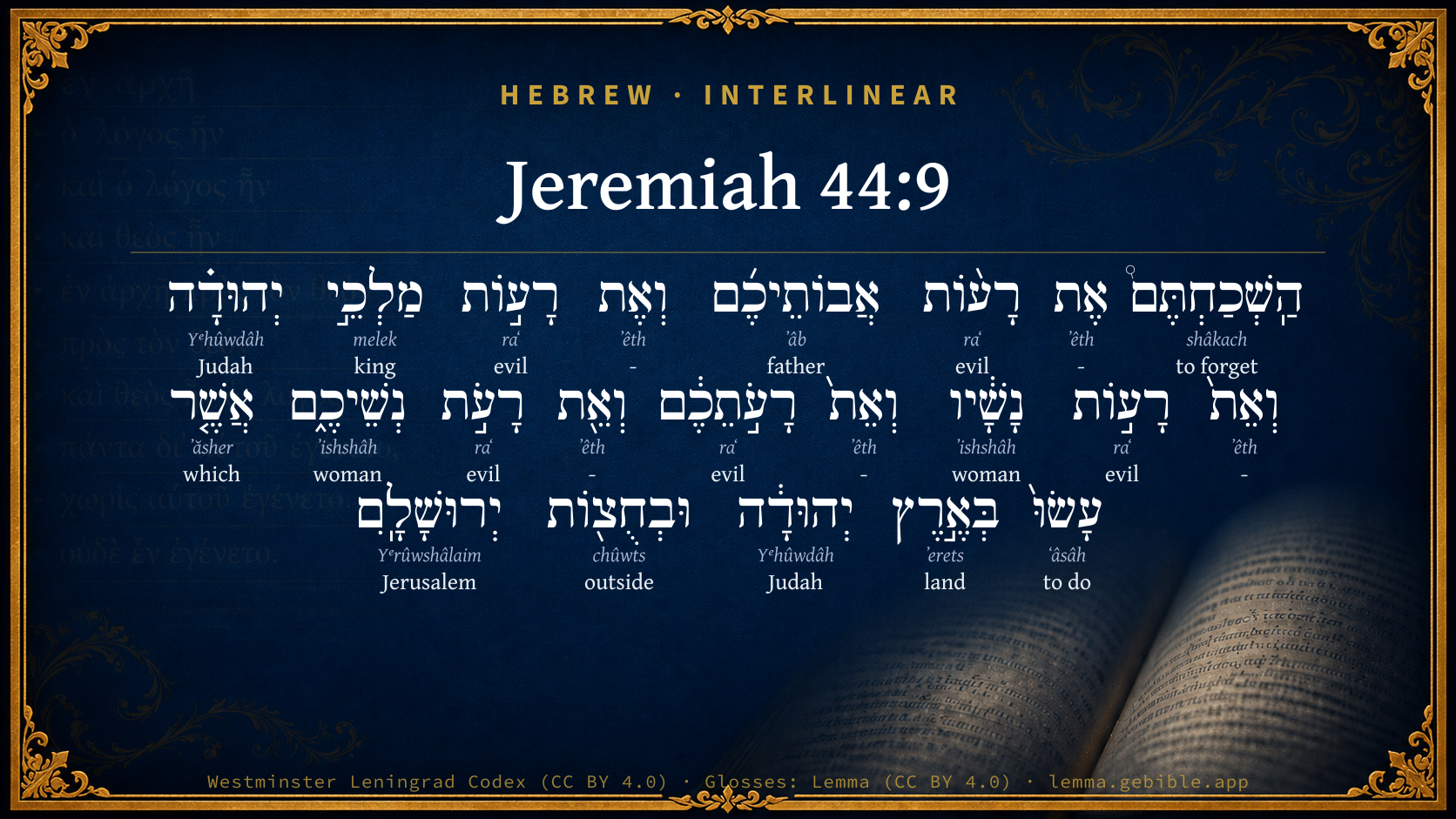
Hebrew (Westminster Leningrad Codex) Jeremiah 44:9 appears in the Hebrew Old Testament. The text above is from the Westminster Leningrad Codex. Each word links to its Strong’s number, a concise gloss, and parsing drawn from the Open Scriptures Hebrew Bible morphology. Click any word for its full Brown-Driver-Briggs (BDB) entry.
Download image
Cite this verse

Jeremiah 44:9 (World English Bible). Public Domain. Lemma interlinear Bible study tool, https://lemma.gebible.app/v/jeremiah/44/9.

Show BibTeX & RIS
BibTeX
RIS
English Translation
Have you forgotten the wickedness of your fathers, and the wickedness of the kings of Judah, and the wickedness of their wives, and your own wickedness, and the wickedness of your wives which they committed in the land of Judah, and in the streets of Jerusalem?
World English Bible · Public Domain
Download a study sheet

One document with this verse’s original text, its word-by-word gloss line, the meaning frame, cross-references with their text, attributed commentary, and full source and license credits — printable, and it pastes into notes with its structure intact.

This verse Autodidact and up

Study sheet (.html) Plain text (.txt)

A passage Seminary Student

Up to 50 verses in one chapter. A passage sheet keeps up to 6 commentary sources and 12 cross-references per verse, in the order this page ranks them, and says so on the sheet whenever that leaves anything out. Ask for a single verse and you get the Autodidact verse sheet above.

Everything on this page stays free to read, with no account — the sheet is a download of what is already on screen, not access to it.

Want to remove ads? Support Godless Engineer
Compare translations 3

The same verse in 3 English versions, stacked beneath the original-language interlinear above. Click any original word for its lexicon entry.

Each is an independent rendering of the whole verse — the interlinear is not word-aligned to these translations.

Highlighted words mark where these versions differ — a whole-verse word diff, not a word-by-word alignment.

  • World English Bible Public Domain
    Have you forgotten the wickedness of your fathers, and the wickedness of the kings of Judah, and the wickedness of their wives, and your own wickedness, and the wickedness of your wives which they committed in the land of Judah, and in the streets of Jerusalem?
  • King James Version Public Domain
    Have ye forgotten the wickedness of your fathers, and the wickedness of the kings of Judah, and the wickedness of their wives, and your own wickedness, and the wickedness of your wives, which they have committed in the land of Judah, and in the streets of Jerusalem?
  • unfoldingWord Literal Text CC BY-SA 4.0
    Have you forgotten the wickedness committed by your ancestors and the wickedness committed by the kings of Judah and their wives? Have you forgotten the evil committed by yourselves and your wives in the land of Judah and the streets of Jerusalem?

unfoldingWord Literal Text — © unfoldingWord, licensed CC BY-SA 4.0. Word-aligned USFM3 via Door43 (git.door43.org/unfoldingWord/en_ult).

Versions to compare (up to 4)

3 of 4 selected

Show all 18 translations

Every available English version of this verse, each an independent rendering of the whole verse.

  • World English Bible Public Domain
    Have you forgotten the wickedness of your fathers, and the wickedness of the kings of Judah, and the wickedness of their wives, and your own wickedness, and the wickedness of your wives which they committed in the land of Judah, and in the streets of Jerusalem?
  • Berean Standard Bible Public Domain
    Have you forgotten the wickedness of your fathers and of the kings of Judah and their wives, as well as the wickedness that you and your wives committed in the land of Judah and in the streets of Jerusalem?
  • Majority Standard Bible Public Domain
    Have you forgotten the wickedness of your fathers and of the kings of Judah and their wives, as well as the wickedness that you and your wives committed in the land of Judah and in the streets of Jerusalem?
  • King James Version Public Domain
    Have ye forgotten the wickedness of your fathers, and the wickedness of the kings of Judah, and the wickedness of their wives, and your own wickedness, and the wickedness of your wives, which they have committed in the land of Judah, and in the streets of Jerusalem?
  • American Standard Version (1901) Public Domain
    Have ye forgotten the wickedness of your fathers, and the wickedness of the kings of Judah, and the wickedness of their wives, and your own wickedness, and the wickedness of your wives which they committed in the land of Judah, and in the streets of Jerusalem?
  • Revised Version (1885) Public Domain
    Have ye forgotten the wickedness of your fathers, and the wickedness of the kings of Judah, and the wickedness of their wives, and your own wickedness, and the wickedness of your wives, which they committed in the land of Judah, and in the streets of Jerusalem?
  • Geneva Bible (1599) Public Domain
    Haue yee forgotten the wickednes of your fathers, and the wickednesse of the Kings of Iudah and the wickednesse of their wiues and your owne wickednes and the wickednes of your wiues, which they haue committed in the land of Iudah and in the streetes of Ierusalem?
  • Douay-Rheims (1899) Public Domain
    Have you forgotten the evils of your fathers, and the evils of the kings of Juda, and the evils of their wives, and your evils, and the evils of your wives, that they have done in the land of Juda, and in the streets of Jerusalem?
  • Young's Literal Translation Public Domain
    `Have ye forgotten the wickedness of your fathers, and the wickedness of the kings of Judah, and the wickedness of their wives, and your own wickedness, and the wickedness of your wives, that they have done in the land of Judah, and in streets of Jerusalem?
  • Literal Standard Version CC BY-SA 4.0
    Have you forgotten the wickedness of your fathers, and the wickedness of the kings of Judah, and the wickedness of their wives, and your own wickedness, and the wickedness of your wives, that they have done in the land of Judah, and in streets of Jerusalem?
  • Unlocked Literal Bible CC BY-SA 4.0
    Have you forgotten the wickedness committed by your ancestors and the wickedness committed by the kings of Judah and their wives? Have you forgotten the evil committed by yourselves and your wives in the land of Judah and the streets of Jerusalem?
  • unfoldingWord Literal Text CC BY-SA 4.0
    Have you forgotten the wickedness committed by your ancestors and the wickedness committed by the kings of Judah and their wives? Have you forgotten the evil committed by yourselves and your wives in the land of Judah and the streets of Jerusalem?
  • Darby Bible Public Domain
    Have ye forgotten the wickedness of your fathers, and the wickedness of the kings of Judah, and the wickedness of their wives, and your own wickedness, and the wickedness of your wives, which they have committed in the land of Judah and in the streets of Jerusalem?
  • World Messianic Bible Public Domain
    Have you forgotten the wickedness of your fathers, the wickedness of the kings of Judah, the wickedness of their wives, your own wickedness, and the wickedness of your wives which they committed in the land of Judah and in the streets of Jerusalem?
  • Webster's Bible Public Domain
    Have ye forgotten the wickedness of your fathers, and the wickedness of the kings of Judah, and the wickedness of their wives, and your own wickedness, and the wickedness of your wives, which they have committed in the land of Judah, and in the streets of Jerusalem?
  • Free Bible Version CC BY-SA 4.0
    Have you forgotten the evil of your forefathers and the evil of the kings of Judah and the evil of their wives, as well as your own evil and the evil your wives, all practiced in the country of Judah and in the streets of Jerusalem?
  • Bible in Basic English Public Domain
    Have you no memory of the evil-doing of your fathers, and the evil-doing of the kings of Judah, and the evil-doing of their wives, and the evil which you yourselves have done, and the evil which your wives have done, in the land of Judah and in the streets of Jerusalem?
  • JPS Tanakh (1917) Public Domain
    Have ye forgotten the wicked deeds of your fathers, and the wicked deeds of the kings of Judah, and the wicked deeds of their wives, and your own wicked deeds, and the wicked deeds of your wives, which they committed in the land of Judah, and in the streets of Jerusalem?

Literal Standard Version (2020), Covenant Press — licensed CC BY-SA 4.0. Text via the HelloAO Bible API (eBible.org). Unlocked Literal Bible (unfoldingWord) — licensed CC BY-SA 4.0. Text via the HelloAO Bible API (eBible.org). unfoldingWord Literal Text — © unfoldingWord, licensed CC BY-SA 4.0. Word-aligned USFM3 via Door43 (git.door43.org/unfoldingWord/en_ult). Free Bible Version, Dr. Jonathan Gallagher — licensed CC BY-SA 4.0. Text via the HelloAO Bible API (eBible.org).

Word by word

More ways to search: Search by grammar → Find every occurrence → Compare this word →

Practice this passage: Drill this verse → Learn its vocabulary →

הַֽשְׁכַחְתֶּם֩
shâkach
H7911
“to forget”
Particle, Interrogative + Verb, Qal, Perfect, 2nd Person, Masculine, Plural
Part of Speech
Particle + Verb
Stem
Qal
Form
Perfect
Person
2nd Person
Gender
Masculine
Number
Plural
Full BDB Definition

Origin: a primitive root

TWOT: 2383

to forget, ignore, wither - (Qal) - to forget - to cease to care - (Niphal) to be forgotten - (Piel) to cause to forget - (Hiphil) to make or cause to forget - (Hithpael) to be forgotten
  1. אֶת ʼêth H853 “-” Particle, Direct Object
  2. רָע֨וֹת raʻ H7451 “evils of” Noun, Common, Feminine, Plural, Construct
  3. אֲבוֹתֵיכֶ֜ם ʼâb H1 “fathers · your” Noun, Common, Masculine, Plural, Construct + Suffix, Personal, 2nd Person, Masculine, Plural
  4. וְאֶת ʼêth H853 “and · -” Conjunction + Particle, Direct Object
  5. רָע֣וֹת raʻ H7451 “evils of” Noun, Common, Feminine, Plural, Construct
  6. מַלְכֵ֣י melek H4428 “kings of” Noun, Common, Masculine, Plural, Construct
  7. יְהוּדָ֗ה Yᵉhûwdâh H3063 “Judah” Noun, Proper
  8. וְאֵת֙ ʼêth H853 “and · -” Conjunction + Particle, Direct Object
  9. רָע֣וֹת raʻ H7451 “evils of” Noun, Common, Feminine, Plural, Construct
  10. נָשָׁ֔יו ʼishshâh H802 “women · his” Noun, Common, Feminine, Plural, Construct + Suffix, Personal, 3rd Person, Masculine, Singular
  11. וְאֵת֙ ʼêth H853 “and · -” Conjunction + Particle, Direct Object
  12. רָעֹ֣תֵכֶ֔ם raʻ H7451 “evils · your” Noun, Common, Feminine, Plural, Construct + Suffix, Personal, 2nd Person, Masculine, Plural
  13. וְאֵ֖ת ʼêth H853 “and · -” Conjunction + Particle, Direct Object
  14. רָעֹ֣ת raʻ H7451 “evils of” Noun, Common, Feminine, Plural, Construct
  15. נְשֵׁיכֶ֑ם ʼishshâh H802 “women · your” Noun, Common, Feminine, Plural, Construct + Suffix, Personal, 2nd Person, Masculine, Plural
  16. אֲשֶׁ֤ר ʼăsher H834 “which” Particle, Relative
  17. עָשׂוּ֙ ʻâsâh H6213 “to do” Verb, Qal, Perfect, 3rd Person, Common, Plural
  18. בְּאֶ֣רֶץ ʼerets H776 “in/at · land of” Preposition + Noun, Common, Both, Singular, Construct
  19. יְהוּדָ֔ה Yᵉhûwdâh H3063 “Judah” Noun, Proper
  20. וּבְחֻצ֖וֹת chûwts H2351 “and · in/at · streets of” Conjunction + Preposition + Noun, Common, Masculine, Plural, Construct
  21. יְרוּשָׁלִָֽם Yᵉrûwshâlaim H3389 “Jerusalem” Noun, Proper

About this verse

These counts appear in no published source. They are computed here, from the morphology-tagged text and Lemma’s own curated glosses. What Lemma adds →

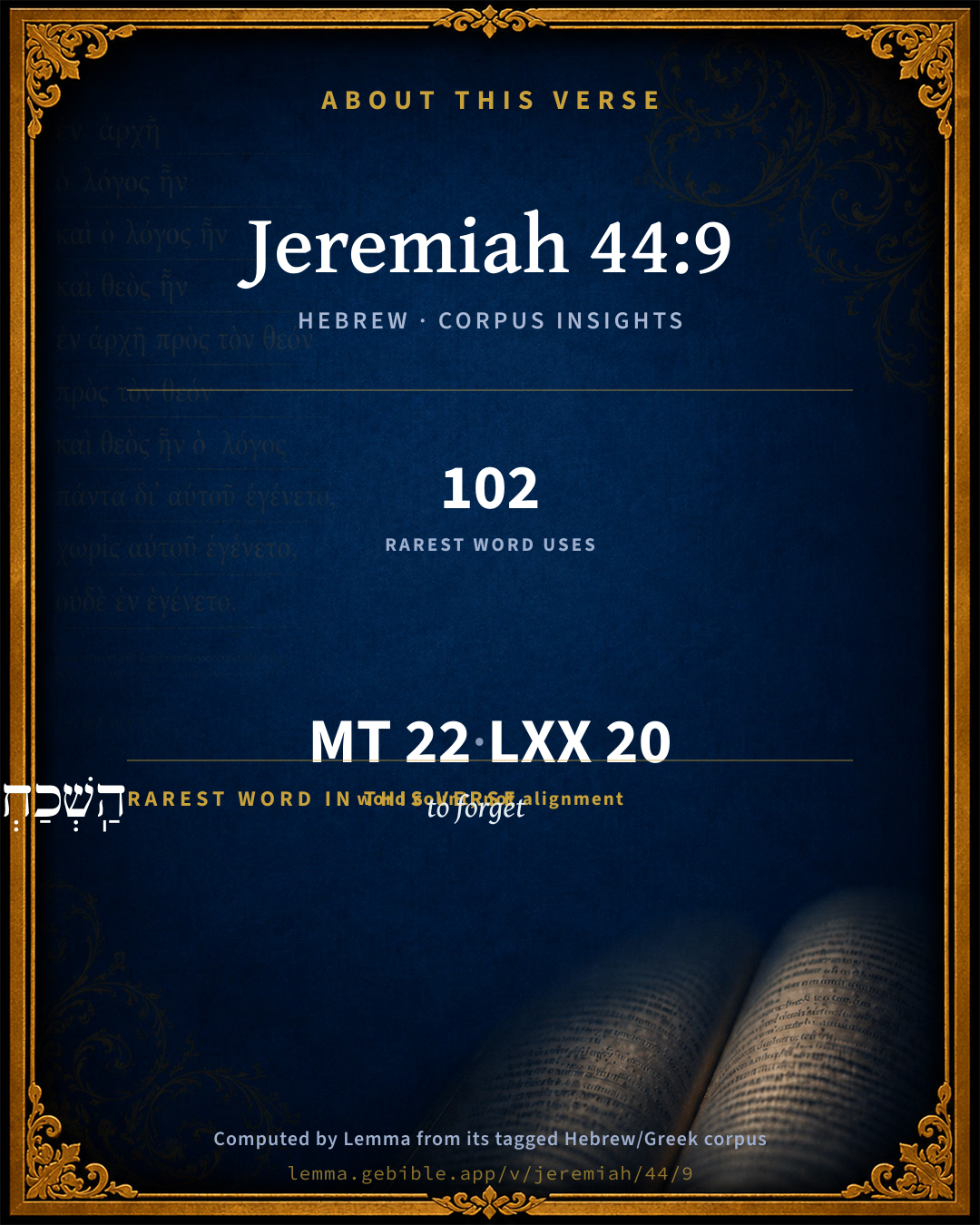
22
words
12
distinct lemmas
Prophets
section

Grammatical profile

  • 2 verbs
  • 14 nouns
  • 6 particles

Verb forms

  • הַֽשְׁכַחְתֶּם֩ Qal · Perfect
  • עָשׂוּ֙ Qal · Perfect

Repetition

Words recur within this verse — often emphatic in Hebrew:

  • רָע֨וֹת evil H7451 ×5
  • יְהוּדָ֗ה Judah H3063 ×2
  • נָשָׁ֔יו woman H802 ×2

Hebrew & Septuagint length

In the original languages it is 22 Hebrew tokens and 20 Greek tokens — but the two are counted differently (Hebrew bundles its prefixes and suffixes into one token; the Greek is in lemma form), so that isn’t a like-for-like length.

Cross-references

6

Topical passages linked to Jeremiah 44:9 in the Treasury of Scripture Knowledge — connected by theme and wording, ordered by reader-vote popularity; previews shown in the World English Bible.

  • Jeremiah 7:17–18 Don't you see what they do in the cities of Judah and in the streets of Jerusalem?
  • Joshua 22:17–20 Is the iniquity of Peor too little for us, from which we have not cleansed ourselves to this day, although there came a plague on the congregation of Yahweh,
  • Ezra 9:7–15 Since the days of our fathers we have been exceeding guilty to this day; and for our iniquities have we, our kings, and our priests, been delivered into the hand of the kings of the lands, to the sword, to captivity, and to plunder, and to confusion of face, as it is this day.
  • Jeremiah 44:15–19 Then all the men who knew that their wives burned incense to other gods, and all the women who stood by, a great assembly, even all the people who lived in the land of Egypt, in Pathros, answered Jeremiah, saying,
  • Jeremiah 44:21 The incense that you burned in the cities of Judah, and in the streets of Jerusalem, you and your fathers, your kings and your princes, and the people of the land, didn't Yahweh remember them, and didn't it come into his mind?
  • Daniel 9:5–8 we have sinned, and have dealt perversely, and have done wickedly, and have rebelled, even turning aside from your precepts and from your ordinances;

Cross-references courtesy of OpenBible.info (CC BY 4.0).

Hebrew and Greek witnesses Masoretic Hebrew ↔ Greek Septuagint

The same verse in the two great witnesses to the Old Testament, shown verse-for-verse.

These are two independent witnesses, not word-aligned to each other, and the Septuagint is shown in lemma (dictionary) form.

Hebrew Jeremiah 44:9 Masoretic · Westminster Leningrad Codex

הַֽשְׁכַחְתֶּם֩ אֶת רָע֨וֹת אֲבוֹתֵיכֶ֜ם וְאֶת רָע֣וֹת מַלְכֵ֣י יְהוּדָ֗ה וְאֵת֙ רָע֣וֹת נָשָׁ֔יו וְאֵת֙ רָעֹ֣תֵכֶ֔ם וְאֵ֖ת רָעֹ֣ת נְשֵׁיכֶ֑ם אֲשֶׁ֤ר עָשׂוּ֙ בְּאֶ֣רֶץ יְהוּדָ֔ה וּבְחֻצ֖וֹת יְרוּשָׁלִָֽם

Have you forgotten the wickedness of your fathers, and the wickedness of the kings of Judah, and the wickedness of their wives, and your own wickedness, and the wickedness of your wives which they committed in the land of Judah, and in the streets of Jerusalem?

World English Bible · Public Domain

Greek LXX Structure differs

In the Septuagint, Jeremiah is about an eighth shorter than the Hebrew and arranges its material differently — the Oracles Against the Nations (Hebrew chapters 46–51) appear in the middle of the Greek book, after 25:13. Because the chapter and verse boundaries do not line up, a verse-for-verse comparison with the Hebrew is not shown.

A verse-for-verse comparison isn’t shown here because the chapters and verses don’t line up. Switch to the LXX edition with the MT / LXX toggle above to read the Greek directly.

On this verse, The Cambridge Bible for Schools and Colleges discusses the Septuagint’s reading. Read the note in Commentary ↓

Hebrew: Westminster Leningrad Codex (CC BY 4.0). Greek: Septuagint (public domain); English from a public-domain English Septuagint. How the Septuagint differs from the Hebrew →

Targum (Aramaic paraphrase)

1

The Targum is the ancient Jewish Aramaic paraphrase of the Hebrew Scriptures — an interpretive translation, not the Hebrew text itself. Onkelos (literal) and Pseudo-Jonathan (expansive) render the Torah, and Jonathan the Prophets. Coverage is partial: where no permissively-licensed English translation exists for a verse, only the Aramaic is shown. This is verse-level text, not a word-by-word alignment to the Hebrew.

  1. Targum Jonathan Prophets (Joshua–Malachi)
    הַאִתְנְשִׁיתוּן יַת בִּישׁוּת אֲבָהְתְכוֹן וְיַת בִּישׁוּת מַלְכַיָא דְבֵית יְהוּדָה וְיַת בִּישׁוּת נְשׁוֹהִי וְיַת בִּישַׁתְכוֹן וְיַת בִּישׁוּת נְשֵׁיכוֹן דַעֲבַדוּ בְּאַרְעָא דְבֵית יְהוּדָה וּבְשׁוּקֵי יְרוּשְׁלֵם:

    (no public-domain English translation for this verse)

    Targum Jonathan — Aramaic: “Mikraot Gedolot” (public domain). English: “Sefaria Community Translation” (CC0 1.0 (public-domain dedication)); “London "Chaldee Paraphrase," 1871” (public domain). Text via Sefaria.

Commentary

Notes on Jeremiah 44:9 from classic Christian and Jewish commentators (each source and its license shown beneath its notes). The classic Christian expositions comment on the surrounding passage and are grouped to its opening verse, so a note may address several verses; the Jewish commentaries on the Tanakh (Rashi and others) are per-verse, so they appear only where the commentator wrote on this verse.

Lemma curates 59 commentaries, every one of them public domain or Creative Commons licensed, each selected and text-cleaned for this edition rather than reprinted as found. About our sources →

Trapp's Complete Commentary

John Trapp

Jer 44:9 Have ye forgotten the wickedness of your fathers, and the wickedness of the kings of Judah, and the wickedness of their wives, and your own wickedness, and the wickedness of your wives, which they have committed in the land of Judah, and in the streets of Jerusalem?

Ver. 9. Have ye forgotten the wickedness of your fathers?] Mira hic verborum apparet emphasis. What a powerful and pressing discourse is this! Sed surdis fabulam, but they were as a stake in the water that stirreth not.

John Trapp, A Commentary or Exposition upon All the Books of the Old and New Testament (1647–1656) — public domain. Text from a community e-Sword module.

Tyndale Open Study Notes

Tyndale Open Resources

44:9 These Judean refugees had learned nothing; they had already forgotten their former sins and how God had judged them.

Tyndale Open Study Notes — © Tyndale Open Resources, licensed CC BY-SA 4.0. Text via the HelloAO Bible API.

Geneva Bible (1599)

Geneva Bible translators

He showeth that we ought to keep in memory God’s plagues from the beginning, that considering them, we might live in his fear, and know if he have not spared our fathers, yea, kings, princes, and rulers, and also whole countries, and nations for their sins, that we vile worms, cannot look to escape punishment for ours.

Geneva Bible (1599) marginal notes — public domain. Text via Bolls.life.

Jamieson, Fausset & Brown

Robert Jamieson, A. R. Fausset & David Brown

Have you forgotten how the wickednesses of your fathers were the source of the greatest calamities to you?

their wives--The Jews' worldly queens were great promoters of idolatry (Kg1 11:1-8; Kg1 15:13; Kg1 16:31).

the land of Judah--They defiled the land which was holy unto God.

Jamieson, Fausset & Brown — Commentary Critical and Explanatory on the Whole Bible (1871) — public domain (CC PDM 1.0). Text via the HelloAO Bible API.

Adam Clarke's Commentary

Verse 9. Have ye forgotten the wickedness of your fathers] It seems that the women were principal agents in idolatrous practices; for the queens - the wives, of rulers and of common people, burnt incense to the queen of heaven, (the moon,) Jer 44:17, and poured out drink-offerings to her.

Adam Clarke's Commentary on the Bible (1810–1826) — public domain. Text from a community e-Sword/MySword module.

John Calvin's Commentaries

The Prophet now sets forth how extremely shameful was the insensibility of the Jews, in not acknowledging that God had most severely and grievously punished the superstitions to which they had previously been addicted. At the same time, if we regard the word used, he seems not to understand punishments by evils, but raffler the wicked deeds by which they had provoked God. And this ought to be observed, for some interpreters give this rendering, “Have you forgotten your evils and those of your fathers;” that is, how severely God had afflicted you? But there is no doubt but that the Prophet means by רעות, rout, their sins, by which they had exposed themselves to God’s judgment; for it immediately follows, which they did, or committed, in the land of Judah, and in the streets of Jerusalem But though he means by this word the sins of the people, there is yet no doubt but that he includes also the punishments by which they ought to have known that the impiety in which they continued most obstinately had displeased God.

When therefore the Prophet says, Have ye forgotten your evils and those of your fathers? he takes it for granted that it was sufficiently known that God had taken vengeance on them for their sins; for he does not address the Jews in their prosperity, but when they were fugitives from their own land and under the curse of heaven. As, then, they were evidently condemned by God, the Prophet justly asks them, “Have ye forgotten that you have been condemned for the sins of your fathers and those of your kings, even for those which they had committed?” This he asked, because it was a horrid stupidity, that though the city had been overthrown and the temple burnt, they did not yet leave off their superstitions, especially when so singular a vengeance of God ought to have retained their posterity in fear and obedience even for ten ages. Thus we see that punishment is linked with sins.

He says, of the kings of Judah and of their wives The relative is singular, “his wives;” but no doubt it refers to the people. Some read, “of every one of them;” but there is no need, it being a singular number, referring to a collective noun, Judah. he afterwards adds, which they did This ought not to be confined to the women, (nor is it suitable,) but it refers to all the Jews as well as to kings of Judah, and also to the women, — which then they did in the land of Judah, and in the streets of Jerusalem

When he mentions the streets of Jerusalem, he exaggerates their wickedness. For we know that city to have been as it were the earthly sanctuary of God. It, was then a most disgraceful impiety to pollute that place which God had consecrated for himself. The whole land of Judah was indeed under his authority and power, but he had favored the city, and especially Mount Sion, with singular privileges. Then the Prophet amplifies the greatness of their sin, when he says that Jerusalem had been polluted by their superstitions.

John Calvin's Commentaries (1540-1563) — public domain. Text from the Calvin Translation Society English edition (1840s-50s) via the Christian Classics Ethereal Library (ccel.org). Calvin's coverage is partial (roughly two-thirds of the Bible); uncommented books and verses are honest gaps, never fabricated. The 19th-century editor's footnotes and remarks are omitted so the notes are faithfully Calvin's own voice.

Ellicott's Commentary for English Readers

(9) The wickedness of their wives.—As in the first introduction of idolatry under Solomon (1Ki_11:4) so in the reigns of his successors, as in the case of Asa (1Ki_15:13) and Ahaziah (2Ch_22:2), the queens for the time being, often of alien birth, seem to have been the chief patrons of foreign and idolatrous worship, and their example was naturally followed by the wives of the nobles and other citizens.

A Bible Commentary for English Readers, edited by Charles John Ellicott (1878–1897) — public domain. Text from a community e-Sword module.

The Cambridge Bible for Schools and Colleges

gen. ed. J. J. S. Perowne

9. their wives] rightly, by a slight deviation from MT. Cp. Jer_44:17; Jer_44:21 (so Gi., Du. and Co.). LXX your princes.

The Cambridge Bible for Schools and Colleges (gen. ed. J. J. S. Perowne; Cambridge University Press, 1878–1918) — public domain. Text from a community e-Sword module.

John Gill's Exposition

Have ye forgotten the wickedness of your fathers,.... And what judgments it brought upon them; meaning not their more remote ancestors in the wilderness, and the idolatry they committed, and the punishment inflicted upon them for it; but more near, such who lived a little before the destruction of Jerusalem, and whose sins had brought on that; and therefore could not be easily forgotten by them; or, if they were forgotten, it argued great stupidity:

and the wickedness of the kings of Judah, and the wickedness of their wives; by whom they were drawn into idolatry, particularly Solomon; and it is in the original text, "the wickedness of his wives" (z); and Dr. Lightfoot thinks respect is had to Solomon's wives; but it may be understood distributively of everyone of their wives, as Kimchi and Ben Melech interpret it (a):

and your own wickedness, and the wickedness of your wives, which you have committed in the land of Judah, and in the streets of Jerusalem? where they had built altars, and worshipped strange gods, they, and their wives, as well as those who were carried captive; and which were the cause of all those evils that came upon them; these, being recent things, could not be forgotten by them; or however should have been remembered, and that so as to have deterred them from going into such practices again, as they now did in Egypt.

(z) "mala mulierum ejus", Schmidt; "et mala foeminarum ejus", Cocceius; "uxorum ejus", V. L. Montanus. (a) "Et mala uxorum cujusque illorum", Junius & Tremellius, Piscator.

John Gill's Exposition of the Whole Bible (1746–1763) — public domain (CC PDM 1.0). Text via the HelloAO Bible API.

Albert Barnes' Notes on the Bible

The wickedness of their wives - Many accept the reading of the Septuagint: the “wickedness of your princes.” “The kings, the princes, the people,” and finally “their wives,” is a summary enumeration of all classes, by whose united persistence in sin the ruin of their country had been consummated.

Albert Barnes' Notes on the Bible (1834–1885) — public domain. Text from a community e-Sword/MySword module.

Matthew Poole's English Annotations

God accounteth men and women to have forgotten that, the sight and reflection upon which hath made no such impression upon them, as to produce a practice suitable to those notices, according to the conduct of a reasonable soul, which teacheth every man, having notice of a great evil brought upon a man by such or such practices, to avoid running into the like danger. It was the aggravation of this people’s sins, that they were committed in the holy land, and in a city which God had more favoured than any other place: to have done these things in any place had been guilt enough, but more to do it

in the land of Judah, and in the streets of Jerusalem.

Matthew Poole's English Annotations on the Holy Bible (1683–1685) — public domain. Text from a community e-Sword/MySword module.

Whedon's Commentary on the Bible

Daniel D. Whedon

PERSISTENCE IN IDOLATRY WILL BRING ONLY RUIN, Jer_44:8-14.

9. Wickedness of their wives — Literally, his “wives.” The singular is difficult of explanation, and the translators have made a very natural, though unwarranted, change. The LXX has for “his wives” “your princes,” and Ewald accepts this as the true reading. Taking the Hebrew text, however, as it stands, it is probably best to refer the pronoun his to Judah as a nation. As to “the wickedness of his wives,” see Jer_44:15; Jer_44:19. The worship of the queen of heaven was peculiarly a feminine idolatry.

Daniel D. Whedon (gen. ed.), Commentary on the Old and New Testaments (1874–1909) — public domain. Text from a community e-Sword module.

The Pulpit Commentary

Have ye forgotten, etc.? The prophet wonderingly asks if they have forgotten the sins of their forefathers and the consequent calamities. No other explanation of this present idolatry seems possible; and yet how passing strange is it! Their wives. The Hebrew has "his wives," i.e. according to Kimchi and Hitzig, the wives of each of the kings (sometimes great patrons of idolatry). But it is better to adopt, with Ewald, Graf, and Dr. Payne Smith, the reading of the Septuagint, "his princes."

The Pulpit Commentary (1880–1919), ed. H.D.M. Spence-Jones & Joseph S. Exell — public domain. Text from a community e-Sword module.

unfoldingWord translationNotes

Door43 World Missions Community

Have you forgotten the wickedness committed by your ancestors and the wickedness committed by the kings of Judah and their wives?

Yahweh rebukes the people for not thinking about the wicked behavior of their ancestors and how Yahweh punished them. This can be stated in active form. AT: "Think about what happened to your ancestors and the kings of Judah and their wives when they did wicked things." (See: Rhetorical Question and Active or Passive)

Have you forgotten the evil committed by yourselves and your wives in the land of Judah and the streets of Jerusalem?

Yahweh rebukes the people for not thinking about their own wicked behavior and how Yahweh punished them. This can be stated in active form. AT: "Think about what happened to you and your wives when you did evil things in the land Judah and the streets of Jerusalem." (See: Rhetorical Question and Active or Passive)

the streets of Jerusalem

Jerusalem is referred to by the part of the city where people walk. This means the people did evil things in public places. AT: "Jerusalem" or "the public places of Jerusalem" (See: Synecdoche)

they still are not humbled

"the people of Judah are still not humble." Yahweh is still speaking to the people of Judah, so this can be stated in second person. AT: "you are still not humble" (See: First, Second, or Third Person)

nor do they walk in them

Obeying the laws is spoken of as if it were walking in the laws. AT: "nor do they obey them" or "nor do you obey them" (See: Metaphor)

translationWords

king

humble

honor

law

decree

walk

unfoldingWord translationNotes — © Distant Shores Media and the Door43 World Missions Community, licensed CC BY-SA 4.0. Source: git.door43.org/Door43/en_tn.

Lesson kit

Teaching starters — assembled from the data on this page, not authored interpretation. Every prompt links to the verse data it draws on. Edit before teaching.

Jeremiah, in the Prophets, opens this verse with 22 words (12 distinct Hebrew lemmas). Its most distinctive word is shâkach (“to forget”). A historical commentator’s framing appears above. Read the whole chapter for the surrounding context.

Discussion questions

  1. The word shâkach carries the sense “to forget.” How does it shape the verse?
  2. Jeremiah 7:17–18 shares this passage’s theme. How do the two illuminate each other?
  3. “evil” occurs 5× in this one verse. What is the effect of the repetition?
  4. The translations on this page render this verse differently — a whole-verse word diff, not a word-by-word alignment. What might account for the different wordings?
  5. The verb «הַֽשְׁכַחְתֶּם֩» is Qal Perfect. How does its form color the action?
  6. Reading how Trapp's Complete Commentary and Tyndale Open Study Notes read this verse, where do the two commentators agree and where do they part?

Things to notice

Reading settings

Reading text

Shown beneath each verse's original-language words.

Old Testament
Old Testament edition

Read the OT as the Masoretic Hebrew (MT) or the Greek Septuagint (LXX).

English shown for the Greek Septuagint (in the Hebrew ↔ Greek comparison).

Comparing translations? Open the Compare panel on any verse page to stack up to four side by side.