
Nahum 3:10

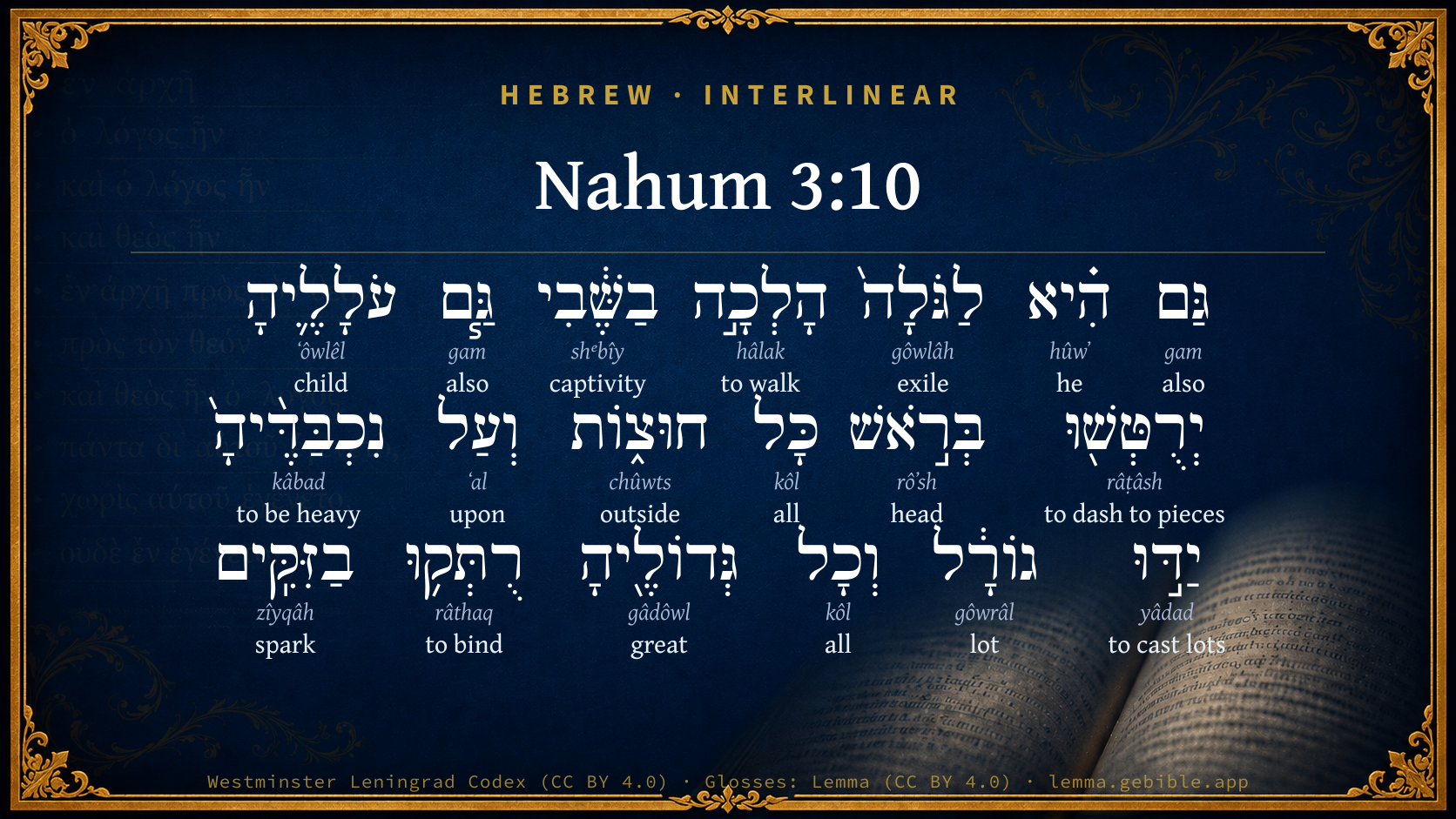
Hebrew (Westminster Leningrad Codex) Nahum 3:10 appears in the Hebrew Old Testament. The text above is from the Westminster Leningrad Codex. Each word links to its Strong’s number, a concise gloss, and parsing drawn from the Open Scriptures Hebrew Bible morphology. Click any word for its full Brown-Driver-Briggs (BDB) entry.
Download image
Cite this verse

Nahum 3:10 (World English Bible). Public Domain. Lemma interlinear Bible study tool, https://lemma.gebible.app/v/nahum/3/10.

Show BibTeX & RIS
BibTeX
RIS
English Translation
Yet was she carried away. She went into captivity. Her young children also were dashed in pieces at the head of all the streets, and they cast lots for her honorable men, and all her great men were bound in chains.
World English Bible · Public Domain
Download a study sheet

One document with this verse’s original text, its word-by-word gloss line, the meaning frame, cross-references with their text, attributed commentary, and full source and license credits — printable, and it pastes into notes with its structure intact.

This verse Autodidact and up

Study sheet (.html) Plain text (.txt)

A passage Seminary Student

Up to 50 verses in one chapter. A passage sheet keeps up to 6 commentary sources and 12 cross-references per verse, in the order this page ranks them, and says so on the sheet whenever that leaves anything out. Ask for a single verse and you get the Autodidact verse sheet above.

Everything on this page stays free to read, with no account — the sheet is a download of what is already on screen, not access to it.

Want to remove ads? Support Godless Engineer
Compare translations 3

The same verse in 3 English versions, stacked beneath the original-language interlinear above. Click any original word for its lexicon entry.

Each is an independent rendering of the whole verse — the interlinear is not word-aligned to these translations.

Highlighted words mark where these versions differ — a whole-verse word diff, not a word-by-word alignment.

  • World English Bible Public Domain
    Yet was she carried away. She went into captivity. Her young children also were dashed in pieces at the head of all the streets, and they cast lots for her honorable men, and all her great men were bound in chains.
  • King James Version Public Domain
    Yet was she carried away, she went into captivity: her young children also were dashed in pieces at the top of all the streets: and they cast lots for her honourable men, and all her great men were bound in chains.
  • unfoldingWord Literal Text CC BY-SA 4.0
    Yet she as an exile went into captivity; also her young children were dashed in pieces at the head of every street; and for her honored ones they cast lots, and all her great ones were bound in chains.

unfoldingWord Literal Text — © unfoldingWord, licensed CC BY-SA 4.0. Word-aligned USFM3 via Door43 (git.door43.org/unfoldingWord/en_ult).

Versions to compare (up to 4)

3 of 4 selected

Show all 18 translations

Every available English version of this verse, each an independent rendering of the whole verse.

  • World English Bible Public Domain
    Yet was she carried away. She went into captivity. Her young children also were dashed in pieces at the head of all the streets, and they cast lots for her honorable men, and all her great men were bound in chains.
  • Berean Standard Bible Public Domain
    Yet she became an exile; she went into captivity. Her infants were dashed to pieces at the head of every street. They cast lots for her dignitaries, and all her nobles were bound in chains.
  • Majority Standard Bible Public Domain
    Yet she became an exile; she went into captivity. Her infants were dashed to pieces at the head of every street. They cast lots for her dignitaries, and all her nobles were bound in chains.
  • King James Version Public Domain
    Yet was she carried away, she went into captivity: her young children also were dashed in pieces at the top of all the streets: and they cast lots for her honourable men, and all her great men were bound in chains.
  • American Standard Version (1901) Public Domain
    Yet was she carried away, she went into captivity; her young children also were dashed in pieces at the head of all the streets; and they cast lots for her honorable men, and all her great men were bound in chains.
  • Revised Version (1885) Public Domain
    Yet was she carried away, she went into captivity: her young children also were dashed in pieces at the top of all the streets: and they cast lots for her honourable men, and all her great men were bound in chains.
  • Geneva Bible (1599) Public Domain
    Yet was she caried awaye, and went into captiuitie: her young children also were dashed in pieces at the head of all the streetes: and they cast lottes for her noble men, and al her myghtie men were bound in chaines.
  • Douay-Rheims (1899) Public Domain
    Yet she also was removed and carried into captivity: her young children were dashed in pieces at the top of every street, and they cast lots upon her nobles, and all her great men were bound in fetters.
  • Young's Literal Translation Public Domain
    Even she doth become an exile, She hath gone into captivity, Even her sucklings are dashed to pieces At the top of all out-places, And for her honoured ones they cast a lot, And all her great ones have been bound in fetters.
  • Literal Standard Version CC BY-SA 4.0
    Even she becomes an exile, || She has gone into captivity, || Even her sucklings are dashed to pieces || At the top of all out-places, || And for her honored ones they cast a lot, || And all her great ones have been bound in chains.
  • Unlocked Literal Bible CC BY-SA 4.0
    Yet Thebes was carried away; she went into captivity; her young children were dashed in pieces at the head of every street; her enemies threw lots for her honorable men, and all her great men were bound in chains.
  • unfoldingWord Literal Text CC BY-SA 4.0
    Yet she as an exile went into captivity; also her young children were dashed in pieces at the head of every street; and for her honored ones they cast lots, and all her great ones were bound in chains.
  • Darby Bible Public Domain
    She too was carried away, she went into captivity: her infants also were dashed in pieces, at the top of all the streets; and they cast lots for her honourable men, and all her great men were bound with chains.
  • World Messianic Bible Public Domain
    Yet was she carried away. She went into captivity. Her young children also were dashed in pieces at the head of all the streets, and they cast lots for her honorable men, and all her great men were bound in chains.
  • Webster's Bible Public Domain
    Yet was she carried away, she went into captivity: her young children also were dashed in pieces at the head of all the streets: and they cast lots for her honorable men, and all her great men were bound in chains.
  • Free Bible Version CC BY-SA 4.0
    Yet its people were also taken away into exile, into captivity. Their babies were dashed to pieces in every street. Their nobles were bound in chains and taken away as servants, chosen by lot.
  • Bible in Basic English Public Domain
    But even she has been taken away, she has gone away as a prisoner: even her young children are smashed to bits at the top of all the streets: the fate of her honoured men is put to the decision of chance, and all her great men are put in chains.
  • JPS Tanakh (1917) Public Domain
    Yet was she carried away, she went into captivity; her young children also were dashed in pieces at the head of all the streets; and they cast lots for her honourable men, and all her great men were bound in chains.

Literal Standard Version (2020), Covenant Press — licensed CC BY-SA 4.0. Text via the HelloAO Bible API (eBible.org). Unlocked Literal Bible (unfoldingWord) — licensed CC BY-SA 4.0. Text via the HelloAO Bible API (eBible.org). unfoldingWord Literal Text — © unfoldingWord, licensed CC BY-SA 4.0. Word-aligned USFM3 via Door43 (git.door43.org/unfoldingWord/en_ult). Free Bible Version, Dr. Jonathan Gallagher — licensed CC BY-SA 4.0. Text via the HelloAO Bible API (eBible.org).

Word by word

More ways to search: Search by grammar → Find every occurrence → Compare this word →

Practice this passage: Drill this verse → Learn its vocabulary →

רֻתְּק֥וּ
râthaq
H7576
“to bind”
Verb, Pual, Perfect, 3rd Person, Common, Plural
Part of Speech
Verb
Stem
Pual
Form
Perfect
Person
3rd Person
Gender
Common
Number
Plural
Full BDB Definition

Origin: a primitive root

TWOT: 2227

to bind - (Niphal) to be snapped, be broken - (Pual) to be bound
  1. גַּם gam H1571 “also” Particle, Accusative
  2. הִ֗יא hûwʼ H1931 “he” Pronoun, Personal, 3rd Person, Feminine, Singular
  3. לַגֹּלָה֙ gôwlâh H1473 “to/for the · exile” Preposition, Determined + Noun, Common, Feminine, Singular, Absolute
  4. הָלְכָ֣ה hâlak H1980 “to walk” Verb, Qal, Perfect, 3rd Person, Feminine, Singular
  5. בַשֶּׁ֔בִי shᵉbîy H7628 “in/at the · captivity” Preposition, Determined + Noun, Common, Both, Singular, Absolute
  6. גַּ֧ם gam H1571 “also” Particle, Accusative
  7. עֹלָלֶ֛יהָ ʻôwlêl H5768 “children · her” Noun, Common, Masculine, Plural, Construct + Suffix, Personal, 3rd Person, Feminine, Singular
  8. יְרֻטְּשׁ֖וּ râṭâsh H7376 “to dash to pieces” Verb, Pual, Imperfect, 3rd Person, Masculine, Plural
  9. בְּרֹ֣אשׁ rôʼsh H7218 “in/at · head of” Preposition + Noun, Common, Masculine, Singular, Construct
  10. כָּל kôl H3605 “all of” Noun, Common, Masculine, Singular, Construct
  11. חוּצ֑וֹת chûwts H2351 “streets” Noun, Common, Masculine, Plural, Absolute
  12. וְעַל ʻal H5921 “and · upon” Conjunction + Preposition
  13. נִכְבַּדֶּ֨יהָ֙ kâbad H3513 “heavy · her” Verb, Niphal, Participle Passive, Masculine, Plural, Construct + Suffix, Personal, 3rd Person, Feminine, Singular
  14. יַדּ֣וּ yâdad H3032 “to cast lots” Verb, Qal, Perfect, 3rd Person, Common, Plural
  15. גוֹרָ֔ל gôwrâl H1486 “lot” Noun, Common, Masculine, Singular, Absolute
  16. וְכָל kôl H3605 “and · all of” Conjunction + Noun, Common, Masculine, Singular, Construct
  17. גְּדוֹלֶ֖יהָ gâdôwl H1419 “great · her” Adjective, Adjective, Masculine, Plural, Construct + Suffix, Personal, 3rd Person, Feminine, Singular
  18. בַזִּקִּֽים zîyqâh H2131 “in/at the · sparks” Preposition, Determined + Noun, Common, Masculine, Plural, Absolute

About this verse

These counts appear in no published source. They are computed here, from the morphology-tagged text and Lemma’s own curated glosses. What Lemma adds →

19
words
17
distinct lemmas
Prophets
section

Notable vocabulary

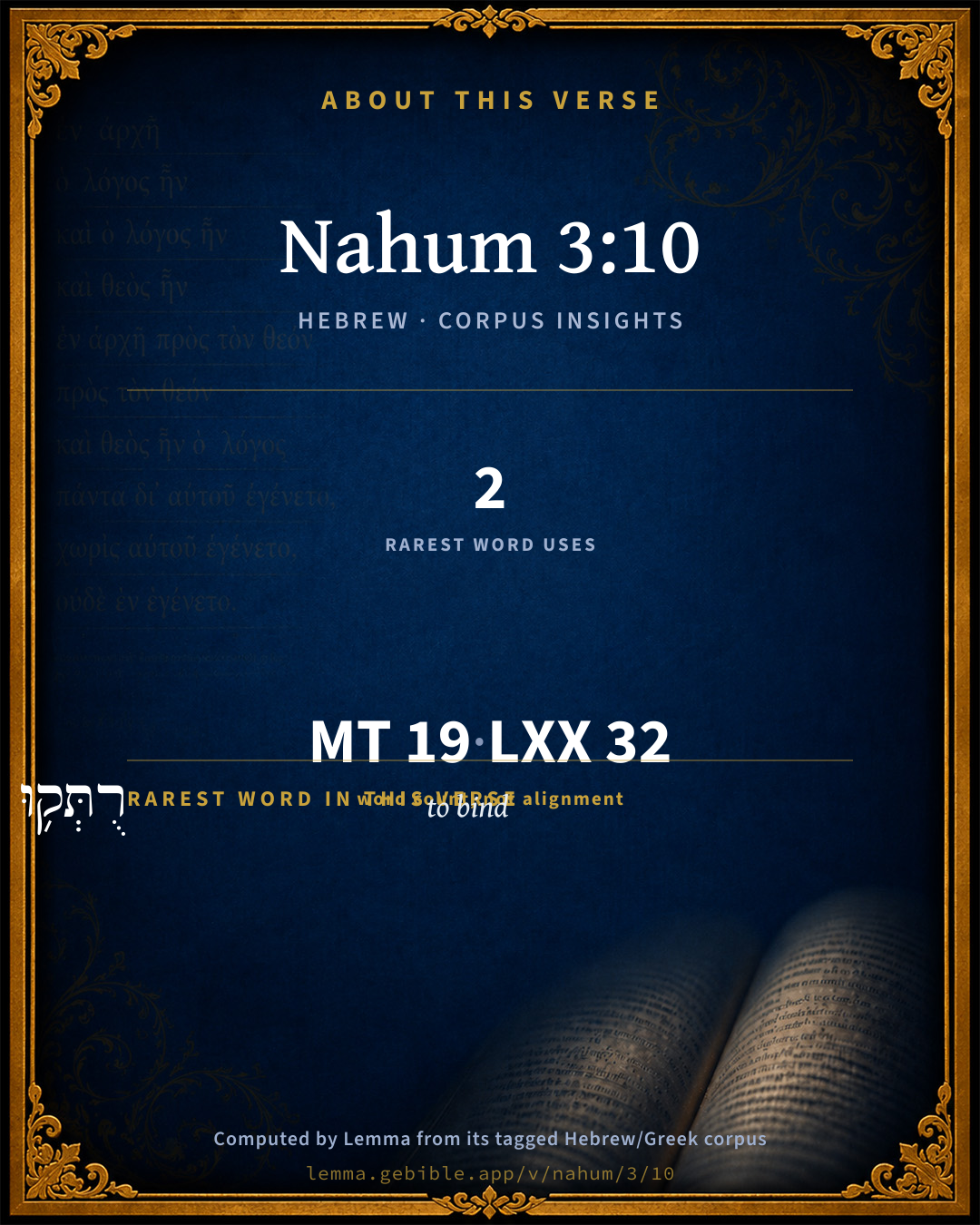
The rarest word here is רֻתְּק֥וּ to bind H7576 — appearing just 2 times in the whole Hebrew Bible.

Shared distinctive vocabulary

רֻתְּק֥וּ to bind H7576 occurs in 2 verses of the Hebrew Bible. Also found in:

Grammatical profile

  • 5 verbs
  • 9 nouns
  • 1 adjective
  • 1 pronoun
  • 1 preposition
  • 2 particles

Verb forms

  • הָלְכָ֣ה Qal · Perfect
  • יְרֻטְּשׁ֖וּ Pual · Imperfect
  • נִכְבַּדֶּ֨יהָ֙ Niphal · Participle Passive
  • יַדּ֣וּ Qal · Perfect
  • רֻתְּק֥וּ Pual · Perfect

Repetition

Words recur within this verse — often emphatic in Hebrew:

Hebrew & Septuagint length

In English translation the verse runs 41 words from the Hebrew and 44 from the Septuagint (LXX English) — closely comparable.

A rough comparison of the two English renderings, which tokenize alike — not a word-level alignment.

Word counts can differ between the Hebrew and the Greek without any difference in meaning — e.g. the Hebrew direct-object marker אֵת has no separate Greek word, and Greek often adds the article ὁ.

In the original languages it is 19 Hebrew tokens and 32 Greek tokens — but the two are counted differently (Hebrew bundles its prefixes and suffixes into one token; the Greek is in lemma form), so that isn’t a like-for-like length.

Cross-references

12

Topical passages linked to Nahum 3:10 in the Treasury of Scripture Knowledge — connected by theme and wording, ordered by reader-vote popularity; previews shown in the World English Bible.

  • Isaiah 20:4 so shall the king of Assyria lead away the captives of Egypt, and the exiles of Ethiopia, young and old, naked and barefoot, and with buttocks uncovered, to the shame of Egypt.
  • Hosea 13:16 Samaria will bear her guilt; For she has rebelled against her God. They will fall by the sword. Their infants will be dashed in pieces, And their pregnant women will be ripped open."
  • Joel 3:3 And have cast lots for my people, And have given a boy for a prostitute, And sold a girl for wine, that they may drink.
  • Obadiah 1:11 In the day that you stood on the other side, in the day that strangers carried away his substance, and foreigners entered into his gates, and cast lots for Jerusalem, even you were like one of them.
  • Isaiah 13:16 Their infants also shall be dashed in pieces before their eyes; their houses shall be rifled, and their wives ravished.
  • Lamentations 2:19 Arise, cry out in the night, at the beginning of the watches; Pour out your heart like water before the face of the Lord: Lift up your hands toward him for the life of your young children, that faint for hunger at the head of every street.
  • 2 Kings 8:12 Hazael said, Why weeps my lord? He answered, Because I know the evil that you will do to the children of Israel: their strongholds will you set on fire, and their young men will you kill with the sword, and will dash in pieces their little ones, and rip up their women with child.
  • Psalms 33:16–17 There is no king saved by the multitude of a host. A mighty man is not delivered by great strength.
  • Psalms 137:8 Daughter of Babylon, doomed to destruction, He will be happy who rewards you, As you have served us.
  • Isaiah 13:6 Wail; for the day of Yahweh is at hand; as destruction from the Almighty shall it come.
  • Lamentations 4:1 How is the gold become dim! [how] is the most pure gold changed! The stones of the sanctuary are poured out at the head of every street.
  • Amos 1:13 Thus says Yahweh: "For three transgressions of the children of Ammon, yes, for four, I will not turn away its punishment; Because they have ripped open the pregnant women of Gilead, That they may enlarge their border.

Cross-references courtesy of OpenBible.info (CC BY 4.0).

Hebrew and Greek witnesses Masoretic Hebrew ↔ Greek Septuagint

The same verse in the two great witnesses to the Old Testament, shown verse-for-verse.

These are two independent witnesses, not word-aligned to each other, and the Septuagint is shown in lemma (dictionary) form.

Hebrew Nahum 3:10 Masoretic · Westminster Leningrad Codex

גַּם הִ֗יא לַגֹּלָה֙ הָלְכָ֣ה בַשֶּׁ֔בִי גַּ֧ם עֹלָלֶ֛יהָ יְרֻטְּשׁ֖וּ בְּרֹ֣אשׁ כָּל חוּצ֑וֹת וְעַל נִכְבַּדֶּ֨יהָ֙ יַדּ֣וּ גוֹרָ֔ל וְכָל גְּדוֹלֶ֖יהָ רֻתְּק֥וּ בַזִּקִּֽים

Yet was she carried away. She went into captivity. Her young children also were dashed in pieces at the head of all the streets, and they cast lots for her honorable men, and all her great men were bound in chains.

World English Bible · Public Domain

Greek LXX Nahum 3:10 Septuagint · lemma form

καί αὐτός εἰς μετοικεσία πορεύομαι αἰχμάλωτος καί ὁ νήπιος αὐτός ἐδαφίζω ἐπί ἀρχή πᾶς ὁ ὁδός αὐτός καί ἐπί πᾶς ὁ ἔνδοξος αὐτός βάλλω κλῆρος καί πᾶς ὁ μεγιστάν αὐτός δέω χειροπέδη

Yet she shall go as a prisoner into captivity, and they shall dash her infants against the ground at the top of all her ways: and they shall cast lots upon all her glorious possessions, and all her nobles shall be bound in chains.

LXX2012 (modern English Septuagint) · Public Domain

Hebrew: Westminster Leningrad Codex (CC BY 4.0). Greek: Septuagint (public domain); English from LXX2012 (modern English Septuagint) (Public Domain). How the Septuagint differs from the Hebrew →

Targum (Aramaic paraphrase)

1

The Targum is the ancient Jewish Aramaic paraphrase of the Hebrew Scriptures — an interpretive translation, not the Hebrew text itself. Onkelos (literal) and Pseudo-Jonathan (expansive) render the Torah, and Jonathan the Prophets. Coverage is partial: where no permissively-licensed English translation exists for a verse, only the Aramaic is shown. This is verse-level text, not a word-by-word alignment to the Hebrew.

  1. Targum Jonathan Prophets (Joshua–Malachi)
    אַף הִיא בְּגָלוּתָא תְּהַךְ בְּשִׁבְיָא אַף עוּלֵמָהָא וְטָרְפוּן בְּרֵישׁ כָּל שׁוּקַיָא וְעַל יַקִירָהָא רְמוֹ עַדְבִין וְכָל רַבְרְבָהָא יְדַקְדְקוּן בְּשִׁלְשְׁלָן:

    (no public-domain English translation for this verse)

    Targum Jonathan — Aramaic: “Mikraot Gedolot” (public domain). English: “Sefaria Community Translation” (CC0 1.0 (public-domain dedication)); “London "Chaldee Paraphrase," 1871” (public domain). Text via Sefaria.

Commentary

Notes on Nahum 3:10 from classic Christian and Jewish commentators (each source and its license shown beneath its notes). The classic Christian expositions comment on the surrounding passage and are grouped to its opening verse, so a note may address several verses; the Jewish commentaries on the Tanakh (Rashi and others) are per-verse, so they appear only where the commentator wrote on this verse.

Lemma curates 59 commentaries, every one of them public domain or Creative Commons licensed, each selected and text-cleaned for this edition rather than reprinted as found. About our sources →

Trapp's Complete Commentary

John Trapp

Nah 3:10 Yet [was] she carried away, she went into captivity: her young children also were dashed in pieces at the top of all the streets: and they cast lots for her honourable men, and all her great men were bound in chains.

Ver. 10. Yet was she carried away, she went into captivity] Whereof though there be no other record, yet we ought not to doubt the truth, since it is here alleged by the Holy Ghost, as a thing either done before or shortly after to be done, as may be probably gathered from Jer 46:25 Eze 30:19; Eze 30:21 cf. Jer 20:5; Jer 44:28. To God (by reason of the vastness of his being) all things are present. As he that stands on a high mountain, and looks down, though to the passenger that goes by some are before some behind, yet to him they are all present; so here.

Her young children also were dashed in pieces at the top of all the streets] A terrible spectacle to those that passed by; who were to look for little mercy, when children, in whom there is so little guile or gall, and who are usually favoured for their innocence and ignoscence, met with such hard measure. {See Trapp on "Hos 13:16"} War is an evil, Isa 45:7, such as no words (how wide soever) can sufficiently set forth. Bellum a belluis.

And they cast lots for her honourable men] Whether so for age or authority; the dice were cast on them for slaves, as Oba 1:11. A great alteration on the sudden. Tamerlane’s coach horses were conquered kings; Adonibezek’s dogs, seventy kings, gathering crumbs under his table; Sapores used the Emperor Valerian for a footstool; Croesus, carried captive by Cyrus, cries out, "O Solon, O Solon"; Gelimer: led in triumph by Belisarius, "Vanity of vanities, all is vanity," and calls to him for a crust to relieve him, a cittern to solace him, and sponge to dry his eyes with (Procop. lib. ii de Belle Vandal.).

“ Omnia sunt hominum tenui pendentia file:

Et subito casu, quae valuere, ruunt. ”

Henry IV, Emperor of Germany, after 10 years’ reign was deposed; and by his enemies, driven to that exigent, that he desired only a clerkship in a house at Spire, of his own founding; which was barbarously, by the bishop of that place, denied him. Our Henry VI, that had been the most potent monarch for dominions that ever England had, was, when deposed, not the master of a molehill nor of his own liberty, but beaten and wounded, &c., to show that mortality is but the stage of mutability, when "they that were brought up in scarlet embrace dunghills," Lam 4:5.

Bound in chains] Not of gold, as Zenobia was; but of iron, as the word signifieth.

John Trapp, A Commentary or Exposition upon All the Books of the Old and New Testament (1647–1656) — public domain. Text from a community e-Sword module.

The Biblical Illustrator

Joseph S. Exell

Nah_3:10

Yet was she carried away, she went into captivity.

Environments

These were certainly close environments; but whence had they come? From still closer ones, like those of pride and enervating habits among a luxurious people; from neglect of the higher demands of the spiritual life; from living too much on the lower plane, which prophets in all ages have warned against. It did not require miraculous power then to discern what causes would be sure to produce disintegration of a city or nation. It does not require any superhuman gift to-day. Every clear seeing mind knows that dissipation will make nations and individuals weak and easily overcome. Certain courses will tend to strengthen and fortify; opposite courses will produce final disaster. There is no power enduring and sufficient but the power of the Spirit; and if this be neglected there remains, of course, nothing with which to repel invasions. This is true of a single individual, or of many united. Not the force from without, but the weakness within, should cause apprehension. We have often seen good work done in overcoming environments. Hard, crushing, discouraging environments do not hinder brave spirits. There have been crises in the worlds history when the massed power of dauntless spirit has finally swept away seemingly immovable environment. It is not in the nature of our surroundings to hold us caged for ever, or even for this life. There are no chains for the free spirit. Let us beware of the chains of pride, resentment, envy, of criticism and complaint, and break those that we can break. (Mrs. E. M. Hickok.)

The Biblical Illustrator, edited by Joseph S. Exell (c. 1880s–1900s) — public domain. Text from a community e-Sword module.

The Preacher's Complete Homiletical Commentary

Joseph S. Exell (gen. ed.)

CRITICAL NOTES.]

Nah_3:11. Drunken] with the cup of Divine anger. A refuge from the enemy sought and not found in other nations.

Nah_3:12. Strongholds] All the fortifications will be easily taken, like ripe figs they will fall into the mouth of the gatherer (cf. Isa_28:4; Rev_6:13).

Nah_3:13. Women] Effeminate and timid, or weak and unable to offer resistance (cf. Isa_19:6; Jer_50:37).

HOMILETICS

THE FATE OF SOME WORSE THAN THAT OF OTHERS.—Nah_3:10-13

No-Amon suffered greatly, but Nineveh will suffer more. “Thou also shalt be drunken” with the cup of God’s wrath. The greatness of thy anguish shall deprive thee of reason and strength, and stupefy thee like death.

I. The punishment is a Divine judgment. God acts by the same unchanging law in all ages and to all nations. No and Nineveh must alike suffer for sins.

1. Punishment in great degree. Not a mere taste, but drunken. They drink till overwhelmed. The most prudent will lose judgment, and act like a drunken man. “Drink ye, and be drunken, and spue, and fall, and rise no more, because of the sword which I will send among you.

2. Punishment without refuge. Help shall be sought in vain from others. No stronghold from the enemy. If God forsake, no help can be found in man. In time of justice it is too late to cry for mercy.

3. Punishment ending in ruin. “Thou shalt be hid.” The city once so proud and glorious was buried beneath the mounds, hidden as in a tomb; covered out of sight, and has only lately been discovered. In unearthing Nineveh from its ruins, we read a tale of splendour and power, of cruelty and blood, of sin and retribution.

II. The punishment is easily inflicted. The two figures are strikingly expressive of the extreme ease with which they are overcome.

1. Their valiant men are fain-hearted. “Behold, the people in the midst of thee are women.” Stone-walls should make cowards brave. But in the midst, in the very centre, there is weakness and fear. Warriors, whom no toil wearied and no danger daunted, one and all become helpless as women. Where sin dwells there is no power to resist. When God takes the mettle out of men, the strongest faint away. “The mighty men of Babylon have forborne to fight, they have remained in their holds; their might hath failed; they became as women” (Jer_51:30; Jer_50:37; Isa_19:16).

2. Every avenue opens to the enemy. “The gates of thy land,” the fortified passes and natural barriers on the hills, do not check the invader. Passes have been held by devoted men against countless multitudes (Thermopylæ), but the whole would be open to the enemy, and frontier garrisons would pass away as if consumed by fire.

3. Strongholds would be easily taken. Weak are fortifications against Divine wrath; trees which tremble in the breeze, they only need the breath of God. Wealth and position, self-righteousness and human wisdom, however great and relied upon, are false towers, and will give no refuge at last (Pro_18:10). The judgment of God will shatter them and sweep them all away.

4. Everything is ripe for destruction. “Like fig-trees with the first ripe figs.” They are eagerly sought after, ready to fall by the slightest effort, and “will drop into the mouth of the eater.” Without cost or sacrifice the enemy will take the city. The first assault would be successful. What a fearful moral condition, to ripen so easily for the judgment of God. “The wine of the wrath of God, which is poured out without mixture into the cup of his indignation.”

ILLUSTRATIONS TO CHAPTER 3

Nah_3:11-19. Nahum’s prophecy of the future destruction of Nineveh was fulfilled by the Medes and Babylonians (cf. ch. Nah_2:1); and according to his prediction, the vast power of Nineveh completely vanished, and its glory was utterly eclipsed, so that in the year B. C. 401, Xenophon passed by the site without learning its name (Xen. Anab. iii. 4–7). Four hundred years afterwards a small fortress was standing on the site, to guard the passsage of the river Tigris (Tacitus, Ann. xii. 13), and opposite to it, on the west bank of the Tigris, has arisen the city of Mosul. In the year 1776, Niebuhr visited the spot, and supposed that what were the heaps of ruins of Nineveh, were natural undulations in the soil (See Rawlinson, i. 326). In more modern times it has been explored by Botta, the French Consul (in 1842), and more recently by Layard and others, who have brought to light those gigantic remains of palaces, statues, and other monuments which testify to the ancient grandeur of Nineveh, and those annalistic inscriptions which confirm the veracity of the prophecies of Nahum and of Isaiah, and of the historical narrative of Holy Scripture: and bear witness to the Divine foreknowledge of the Holy Ghost who speaks in it; to whom with the Father and the Son, Three Persons and one God, be honour and glory now and for evermore. Amen [Wordsworth].

The Preacher's Complete Homiletical Commentary (gen. ed. Joseph S. Exell; Funk & Wagnalls, c. 1892) — public domain (pre-1929). A full-Bible homiletical/sermon-outline anthology covering 65 of 66 books (2 John is absent from the source module). Text from a community e-Sword module.

Jamieson, Fausset & Brown

Robert Jamieson, A. R. Fausset & David Brown

Notwithstanding all her might, she was overcome.

cast lots for her honourable men--They divided them among themselves by lot, as slaves (Joe 3:3).

Jamieson, Fausset & Brown — Commentary Critical and Explanatory on the Whole Bible (1871) — public domain (CC PDM 1.0). Text via the HelloAO Bible API.

Adam Clarke's Commentary

Verse 10. They cast lots for her honourable men] This refers still to the city called populous No. And the custom of casting lots among the commanders, for the prisoners which they had taken, is here referred to.

Great men were bound in chains] These were reserved to grace the triumph of the victor.

Adam Clarke's Commentary on the Bible (1810–1826) — public domain. Text from a community e-Sword/MySword module.

John Calvin's Commentaries

Yet, he says, she departed into captivity a captive; that is, the inhabitants of Alexandria have been banished, and the city become as it were captive, for its inhabitants were driven here and there. Dashed, he says, have been their little ones at the head of every street The Prophet means, that so great a power as that of Alexandria did not prevent the conquerors to exercise towards her the most barbarous cruelty; for it was a savage act to dash little children against stones, who ought on account of their tender age, to have been spared. There was indeed no reason for raging against them, for they could not have been deemed enemies. But yet the Prophet says that Alexandria had been thus treated; and he said this, that Nineveh might not trust in her strength, and thus perversely despise God’s judgment, which he now denounced on it. He adds, They cast lots on her princess and bound were her great men with fetters In saying that lots were cast, he refers to an ancient custom; for when there was any dispute respecting a captive, the lot was cast: as for instance, when two had taken one man, to prevent contention, it was by lot determined who was to be his master. So then he says that lots were cast on their princes. This usually happened to the common people and to the lowest slaves; but the Prophet says that the conquerors spared not even the princes. They were therefore treated as the lowest class; and though they were great princes, they were led into captivity and bound with chains, in the same manner with the meanest and the lowest of the people. They were not treated according to their rank; and there was no differences between the chief men and the most degraded of the humbler classes; for even the very princes were so brought down, that their lot differed not from that of the wretched; for as common people are usually treated with contempt, so were the chiefs of Alexandria treated by their enemies.

John Calvin's Commentaries (1540-1563) — public domain. Text from the Calvin Translation Society English edition (1840s-50s) via the Christian Classics Ethereal Library (ccel.org). Calvin's coverage is partial (roughly two-thirds of the Bible); uncommented books and verses are honest gaps, never fabricated. The 19th-century editor's footnotes and remarks are omitted so the notes are faithfully Calvin's own voice.

The Cambridge Bible for Schools and Colleges

gen. ed. J. J. S. Perowne

10. children were dashed in pieces] A barbarous practice in ancient warfare; the children were taken hold of and their heads dashed against the wall or stones. The term used appears technical, 2Ki_8:12; Isa_13:16; Hos_13:16 (14:1 Heb.); cf. however the two passages, Isa_13:18; Hos_10:14. The object of this savage act was to exterminate the whole population with which war was waged; a similar practice was to rip up the women with child, Amo_1:13; Hos_13:16.

cast lots for her honourable men] Lots were cast for the nobles who were taken as captives. Joe_3:3, Oba_1:11.

No Amon was celebrated in antiquity as Thebes of the hundred gates (2:9. 381). It possessed a famous library, and was filled with temples and other buildings of extraordinary magnificence. Its riches were fabulous; compare the statements of Assurbanipal regarding the wealth his armies carried away when they captured it (Schrader, ii. 149 ff.). The splendid ruins of Karnac and Luxor attest the former magnificence of the city.

The Cambridge Bible for Schools and Colleges (gen. ed. J. J. S. Perowne; Cambridge University Press, 1878–1918) — public domain. Text from a community e-Sword module.

John Gill's Exposition

Yet was she carried away, she went into captivity,.... Not by Nebuchadnezzar; though this city was afterwards taken, and its inhabitants carried captive, by that monarch, as was foretold, Jer 46:25 but the prophet here does not predict an event to be accomplished, and instance in that, and argue from it, which could have no effect on Nineveh and its inhabitants, or be an example or terror to them; but refers to what had been done, a recent fact, and which they were well acquainted with. Aben Ezra says, this city No was a city of the land of Egypt, which the king of the Chaldeans took as he went to Nineveh; but when, and by whom it was taken, is nowhere said. According to Bishop Usher (s) and Dean Prideaux (t), the destruction of the city of Thebes was by Sennacherib, in his expedition against Egypt, which he harassed for three years together, from one end to the other; at which time Sevechus, the son of Sabacon, or So, the Ethiopian, was king of Egypt; and Egypt and Ethiopia were as one country, and helped each other; but could not secure this city from falling into the hands of Sennacherib, about three years before he besieged Jerusalem; and so, according to Mr. Whiston (u), it was destroyed three years before the army of Sennacherib was destroyed at Jerusalem:

her young children also were dashed in pieces at the top of all the streets: against the walls of the houses, or upon the stones and pavements of the streets; which cruelties were often used by conquerors upon innocent babes at the sacking of cities, Psa 137:9,

and they cast lots for her honourable men; the soldiers did, who should have them, and sell them for slaves; which was done without any regard to their birth and breeding, Joe 3:3,

and all her great men were bound in chains; as nobles may be meant by "honourable men", by "great men" may be designed the gentry, merchants, and others; these were taken, and bound in iron chains, handcuffed, and pinioned, and so led captive into a foreign land; and Nineveh might expect the same treatment.

(s) Annales Vet. Test. A. M. 3292. (t) Connexion, par. 1. B. 1. p. 22, 23. (u) Chronological Tables, cent. 8.

John Gill's Exposition of the Whole Bible (1746–1763) — public domain (CC PDM 1.0). Text via the HelloAO Bible API.

Albert Barnes' Notes on the Bible

Yet was she - (also ) carried away, literally, “She also became an exile band,” her people were carried away, with all the barbarities of pagan war. All, through whom she might recover, were destroyed or scattered abroad; “the young,” the hope of another age, cruelly destroyed (see Hos 14:1-9; Isa 13:16; 2Ki 8:12); “her honorable men” enslaved (see Joe 3:3), “all her great men prisoners.” God’s judgments are executed step by step. Assyria herself was the author of this captivity, which Isaiah prophesied in the first years of Hezekiah when Judah was leaning upon Egypt (see Isa 20:1-6). It was repeated by all of the house of Sargon. Jeremiah and Ezekiel foretold fresh desolation by Nebuchadnezzar Jer 46:25-26; Eze 30:14-16. God foretold to His people, “I gave Egypt for thy ransom, Ethiopia and Seba for thee” Isa 43:3; and the Persian monarchs, who fulfilled prophecy in the restoration of Judah, fulfilled it also in the conquest of Egypt and Ethiopia. Both perhaps out of human policy in part.

But Cambyses’ wild hatred of Egyptian idolatry fulfilled God’s word. Ptolemy Lathyrus carried on the work of Cambyses; the Romans, Ptolemy’s. Cambyses burned its temples ; Lathyrus its four-or five-storied private houses ; the Roman Gallus leveled it to the ground . A little after it was said of her , “she is inhabited as so many scattered villages.” A little after our Lord’s Coming, Germanicus went to visit, not it, but “the vast traces of it.” : “It lay overwhelmed with its hundred gates” and utterly impoverished. No was powerful as Nineveh, and less an enemy of the people of God. For though these often suffered from Egypt, yet in those times they even trusted too much to its help (see Isa. 30). If then the judgments of God came upon No, how much more upon Nineveh! In type, Nineveh is the image of the world as oppressing God’s Church; No, rather of those who live for this life, abounding in wealth, ease, power, and forgetful of God. If, then, they were punished, who took no active part against God, fought not against God’s truth, yet still were sunk in the cares and riches and pleasures of this life, what shall be the end of those who openly resist God?

Albert Barnes' Notes on the Bible (1834–1885) — public domain. Text from a community e-Sword/MySword module.

Haydock's Catholic Bible Commentary

Captivity. It was afterwards re-established and taken by Nabuchodonosor. (Calmet) --- Fetters, or stocks. (Haydock)

George Leo Haydock (1774–1849), Haydock's Catholic Family Bible and Commentary, 1859 edition — public domain. Excludes Psalms (Douay-Rheims chapter numbering differs from Protestant) and Deuterocanonical books (Catholic canon only).

Matthew Poole's English Annotations

She was carried away: it is probable this might be about thirty years before; for about A.M. 3207, as Calvisius, or 3277, as Archbishop Usher, Sabacon king of Ethiopia invaded Egypt, took Bocchoris, and burnt him, which was not likely to be done without slaughter of men and sacking of towns, among which time No might be ruined. Now, as Calvisius and Helvicus account, about A.M. 3238, or as Usher, 3307, Nahum appears and flourisheth. She went into captivity: this ingemination confirms the certainty of the thing, and intends to affect the Ninevites the more.

Her young children; their innocent age was no safeguard to them.

Were dashed in pieces; first barbarously murdered, and then trod under foot in the streets, as was usual with those cruel, bloody soldiers, 2Ki 8:12; Psa 137:9; Isa 13:16.

They cast lots; either to put a scorn upon them, or else to prevent any contest about them, being taken among many others together, and none could say, This is my prisoner.

Honourable men; citizens of note, or some officers or governors.

Great men; great in place, strength, valour, wisdom, and so likely to do the conqueror a displeasure, should they not be secured.

Were bound in chains of iron, or manacled, used as worst slaves.

Matthew Poole's English Annotations on the Holy Bible (1683–1685) — public domain. Text from a community e-Sword/MySword module.

The Pulpit Commentary

Yet was she carried away. In spite of her strong position and infinite resources, Thebes was captured and despoiled; and shall Nineveh fare better? Surely not. This capture of Thebes took place B.C. 664, and must have been in men"s minds when Nahum wrote his prophecy. The Assyrians twice took Thebes in the days of Assurbanipal. The first time it is merely recorded that the soldiers, under the commander of the satraps, made a slaughter in the city. The second capture is thus described in the monarch"s own tablet (Brugsch, "Egypt," 1:272-275, Eng. transl.): "Urdamaneh fled alone, and entered Thebes, the city of his kingdom... I directed my march in pursuit of him. I came to Thebes. He saw the strength of my army, and left Thebes, and fled to the city of Kipkip. Of that whole city (Thebes), with thanksgiving to Asur and Istar, my hands took the complete possession. Silver, gold, metals, stones, all the treasures of its palace whatsoever, dyed garments of before and linen, great horses elephants? men and women, great and small, works of zakah basalt? and marble, their kelal and manzas, the gates of their palace... I tare away and carried to Assyria. I made spoil of the animals of the land without number, and carried them forth in the midst out of Thebes I caused a catalogue to be made of the spoil. I returned in safety to Nineveh" (see a different version in O. Smith, "Assurbanipal," p. 52, etc.). Were dashed in pieces. The prophet describes the usual treatment of captured cities. (comp. 2Ki_8:12 Psa_137:9 Isa_13:16) At the top of all the streets. In the most public places, where many streets converge. (Lam_2:19) Cast lots. The victors divided the nobles among themselves by lot. (see note on Oba_1:11) Were bound in chains. We find in the Assyrian monuments delineations of captives with their arms bound together by a rope held by a soldier, sometimes men, sometimes women and children; the women are tearing their hair in despair (see Bonomi, "Nineveh and its Palaces," pp. 226, 277). In a bas-relief at Khorsabad captives were led by a rope fastened to a ring in the lip. (comp. 2Ki_19:28; see Rawlinson, "Ant. Men.," 1:904; Layard, "Nineveh," fig. 60, and col. 1. p. 376)

The Pulpit Commentary (1880–1919), ed. H.D.M. Spence-Jones & Joseph S. Exell — public domain. Text from a community e-Sword module.

unfoldingWord translationNotes

Door43 World Missions Community

General Information:

Nahum continues to speak to the people of Nineveh as though they were the city itself. (See: Metonymy)

Yet Thebes was carried away

The word "Thebes" represents the people who lived in Thebes. This can be stated in active form. AT: "Yet those who attacked Thebes carried the people away" (See: Metonymy and Active or Passive)

she went into captivity

The word "she" refers to Thebes and represents the people who lived there. AT: "they went into captivity" (See: Metonymy)

her young children were dashed in pieces

This is a brutal description of the soldiers killing children. This can be stated in active form. AT: "enemy soldiers dashed her young children to pieces" or "enemy soldiers beat her young children to death" (See: Active or Passive)

at the head of every street

The beginning of a street is spoken of as if it were the head. Also, "every" is a generalization that means many places all over the city. AT: "on every street corner" or "in the streets all over the city" (See: Metaphor and Hyperbole and Generalization)

all her great men were bound in chains

This can be stated in active form. AT: "they bound all her great men in chains" (See: Active or Passive)

You also will become drunk

Here the word "You" refers to Nineveh. Nahum speaks of the people of Nineveh suffering and dying in battle as if they had become drunk from drinking too much wine. (See: Metaphor)

translationWords

captive

lots

drunk

refuge

adversary

unfoldingWord translationNotes — © Distant Shores Media and the Door43 World Missions Community, licensed CC BY-SA 4.0. Source: git.door43.org/Door43/en_tn.

Rashi

Rabbi Shlomo Yitzchaki (Rashi)

She, too, went into exile—She, too, went into exile. Nevertheless, their greatness did not stand up before Nebuchadnezzar.

were bound Heb. רֻתְּקוּ, were fettered; an expression similar to (Isa. 40:19) “And chains (וּרְתֻּקוֹת) of silver” and (Ezek. 7:23) “Make the chain (הָרַתּוֹק),” meaning a chain.

in chains Heb. בַזִּקִּים, chains.

Rashi on the Tanakh — English translations: “The Judaica Press complete Tanach with Rashi, translated by A. J. Rosenberg” (CC BY 4.0); “Pentateuch with Rashi's commentary by M. Rosenbaum and A.M. Silbermann, 1929-1934” (public domain); “The Metsudah Tanach series, Lakewood, N.J” (CC BY 4.0); and “The Book of Joshua, Metsudah Publications, 1997” (CC BY 4.0). Text via Sefaria.

Lesson kit

Teaching starters — assembled from the data on this page, not authored interpretation. Every prompt links to the verse data it draws on. Edit before teaching.

Nahum, in the Prophets, opens this verse with 19 words (17 distinct Hebrew lemmas). Its most distinctive word is râthaq (“to bind”). A historical commentator’s framing appears above. Read the whole chapter for the surrounding context.

Discussion questions

  1. How does “to bind” (râthaq) shape what this verse is saying?
  2. How does Ecclesiastes 12:6, which shares the word «to bind», read alongside this verse?
  3. What does the repetition of “also” (2× in this one verse) do in this verse?
  4. These translations render this verse differently; the difference is in the English rendering, not the original. What questions does that raise?
  5. «הָלְכָ֣ה» is a Qal Perfect verb. How does that grammatical form shape the action described?
  6. Compare how Trapp's Complete Commentary and The Biblical Illustrator read this verse. Where do they agree or differ?

Things to notice

Reading settings

Reading text

Shown beneath each verse's original-language words.

Old Testament
Old Testament edition

Read the OT as the Masoretic Hebrew (MT) or the Greek Septuagint (LXX).

English shown for the Greek Septuagint (in the Hebrew ↔ Greek comparison).

Comparing translations? Open the Compare panel on any verse page to stack up to four side by side.