
Zephaniah 3:6

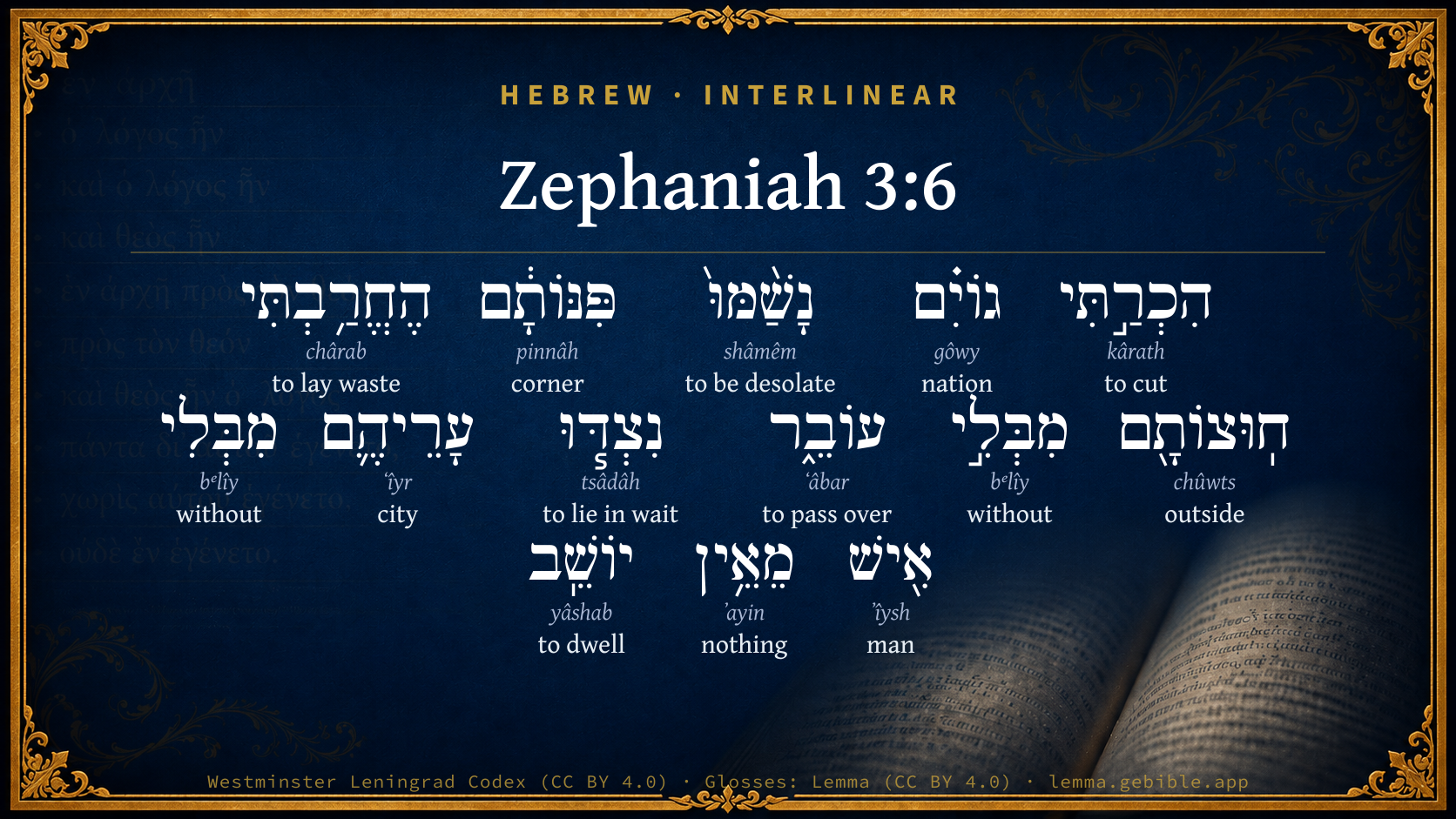
Hebrew (Westminster Leningrad Codex) Zephaniah 3:6 appears in the Hebrew Old Testament. The text above is from the Westminster Leningrad Codex. Each word links to its Strong’s number, a concise gloss, and parsing drawn from the Open Scriptures Hebrew Bible morphology. Click any word for its full Brown-Driver-Briggs (BDB) entry.
Download image
Cite this verse

Zephaniah 3:6 (World English Bible). Public Domain. Lemma interlinear Bible study tool, https://lemma.gebible.app/v/zephaniah/3/6.

Show BibTeX & RIS
BibTeX
RIS
English Translation
I have cut off nations. Their battlements are desolate. I have made their streets waste, so that no one passes by. Their cities are destroyed, so that there is no man, so that there is no inhabitant.
World English Bible · Public Domain
Download a study sheet

One document with this verse’s original text, its word-by-word gloss line, the meaning frame, cross-references with their text, attributed commentary, and full source and license credits — printable, and it pastes into notes with its structure intact.

This verse Autodidact and up

Study sheet (.html) Plain text (.txt)

A passage Seminary Student

Up to 50 verses in one chapter. A passage sheet keeps up to 6 commentary sources and 12 cross-references per verse, in the order this page ranks them, and says so on the sheet whenever that leaves anything out. Ask for a single verse and you get the Autodidact verse sheet above.

Everything on this page stays free to read, with no account — the sheet is a download of what is already on screen, not access to it.

Want to remove ads? Support Godless Engineer
Compare translations 3

The same verse in 3 English versions, stacked beneath the original-language interlinear above. Click any original word for its lexicon entry.

Each is an independent rendering of the whole verse — the interlinear is not word-aligned to these translations.

Highlighted words mark where these versions differ — a whole-verse word diff, not a word-by-word alignment.

  • World English Bible Public Domain
    I have cut off nations. Their battlements are desolate. I have made their streets waste, so that no one passes by. Their cities are destroyed, so that there is no man, so that there is no inhabitant.
  • King James Version Public Domain
    I have cut off the nations: their towers are desolate; I made their streets waste, that none passeth by: their cities are destroyed, so that there is no man, that there is none inhabitant.
  • unfoldingWord Literal Text CC BY-SA 4.0
    “I have cut off nations, their corners have been demolished; I have destroyed their streets, without one passing over. Their cities are ruined, without a man, with no one dwelling.

unfoldingWord Literal Text — © unfoldingWord, licensed CC BY-SA 4.0. Word-aligned USFM3 via Door43 (git.door43.org/unfoldingWord/en_ult).

Versions to compare (up to 4)

3 of 4 selected

Show all 18 translations

Every available English version of this verse, each an independent rendering of the whole verse.

  • World English Bible Public Domain
    I have cut off nations. Their battlements are desolate. I have made their streets waste, so that no one passes by. Their cities are destroyed, so that there is no man, so that there is no inhabitant.
  • Berean Standard Bible Public Domain
    “I have cut off the nations; their corner towers are destroyed. I have made their streets deserted with no one to pass through. Their cities are laid waste, with no man, no inhabitant.
  • Majority Standard Bible Public Domain
    “I have cut off the nations; their corner towers are destroyed. I have made their streets deserted with no one to pass through. Their cities are laid waste, with no man, no inhabitant.
  • King James Version Public Domain
    I have cut off the nations: their towers are desolate; I made their streets waste, that none passeth by: their cities are destroyed, so that there is no man, that there is none inhabitant.
  • American Standard Version (1901) Public Domain
    I have cut off nations; their battlements are desolate; I have made their streets waste, so that none passeth by; their cities are destroyed, so that there is no man, so that there is no inhabitant.
  • Revised Version (1885) Public Domain
    I have cut off nations, their battlements are desolate; I have made their streets waste, that none passeth by: their cities are destroyed, so that there is no man, that there is none inhabitant.
  • Geneva Bible (1599) Public Domain
    I haue cut off the nations: their towres are desolate: I haue made their streetes waste, that none shall passe by: their cities are destroyed without man and without inhabitant.
  • Douay-Rheims (1899) Public Domain
    I have destroyed the nations, and their towers are beaten down: I have made their ways desert, so that there is none that passeth by: their cities are desolate, there is not a man remaining, nor any inhabitant.
  • Young's Literal Translation Public Domain
    I have cut off nations, Desolated have been their chief ones, I have laid waste their out-places without any passing by, Destroyed have been their cities, Without man, without inhabitant.
  • Literal Standard Version CC BY-SA 4.0
    “I have cut off nations, || Desolated have been their chief ones, || I have laid waste their out-places without any passing by, || Destroyed have been their cities, || Without man, without inhabitant.
  • Unlocked Literal Bible CC BY-SA 4.0
    “I have destroyed nations; their fortresses are ruined. I have made their streets ruins, so that no one passes over them. Their cities are destroyed so that there is no man inhabiting them.
  • unfoldingWord Literal Text CC BY-SA 4.0
    “I have cut off nations, their corners have been demolished; I have destroyed their streets, without one passing over. Their cities are ruined, without a man, with no one dwelling.
  • Darby Bible Public Domain
    I have cut off nations: their battlements are desolate; I made their streets waste, that none passeth by; their cities are destroyed, so that there is no man, so that there is no inhabitant.
  • World Messianic Bible Public Domain
    I have cut off nations. Their battlements are desolate. I have made their streets waste, so that no one passes by. Their cities are destroyed, so that there is no man, so that there is no inhabitant.
  • Webster's Bible Public Domain
    I have cut off the nations: their towers are desolate; I made their streets waste, that none passeth by: their cities are destroyed, so that there is no man, that there is no inhabitant.
  • Free Bible Version CC BY-SA 4.0
    I have destroyed nations. Their fortresses are deserted; their streets are empty; their cities are destroyed—there are no survivors, not one.
  • Bible in Basic English Public Domain
    I have had the nations cut off, their towers are broken down; I have made their streets a waste so that no one goes through them: destruction has overtaken their towns, so that there is no man living in them.
  • JPS Tanakh (1917) Public Domain
    I have cut off nations, their corners are desolate; I have made their streets waste, so that none passeth by; their cities are destroyed, so that there is no man, so that there is no inhabitant.

Literal Standard Version (2020), Covenant Press — licensed CC BY-SA 4.0. Text via the HelloAO Bible API (eBible.org). Unlocked Literal Bible (unfoldingWord) — licensed CC BY-SA 4.0. Text via the HelloAO Bible API (eBible.org). unfoldingWord Literal Text — © unfoldingWord, licensed CC BY-SA 4.0. Word-aligned USFM3 via Door43 (git.door43.org/unfoldingWord/en_ult). Free Bible Version, Dr. Jonathan Gallagher — licensed CC BY-SA 4.0. Text via the HelloAO Bible API (eBible.org).

Word by word

More ways to search: Search by grammar → Find every occurrence → Compare this word →

Practice this passage: Drill this verse → Learn its vocabulary →

נִצְדּ֧וּ
tsâdâh
H6658
“to lie in wait”
Verb, Niphal, Perfect, 3rd Person, Common, Plural
Part of Speech
Verb
Stem
Niphal
Form
Perfect
Person
3rd Person
Gender
Common
Number
Plural
Full BDB Definition

Origin: a primitive root

TWOT: 1877 , 1878

(Qal) to lie in wait - to lay waste - (Niphal) to be laid waste
  1. הִכְרַ֣תִּי kârath H3772 “to cut” Verb, Hiphil, Perfect, 1st Person, Common, Singular
  2. גוֹיִ֗ם gôwy H1471 “nations” Noun, Common, Masculine, Plural, Absolute
  3. נָשַׁ֨מּוּ֙ shâmêm H8074 “to be desolate” Verb, Niphal, Perfect, 3rd Person, Common, Plural
  4. פִּנּוֹתָ֔ם pinnâh H6438 “corners · their” Noun, Common, Feminine, Plural, Construct + Suffix, Personal, 3rd Person, Masculine, Plural
  5. הֶחֱרַ֥בְתִּי chârab H2717 “to lay waste” Verb, Hiphil, Perfect, 1st Person, Common, Singular
  6. חֽוּצוֹתָ֖ם chûwts H2351 “streets · their” Noun, Common, Masculine, Plural, Construct + Suffix, Personal, 3rd Person, Masculine, Plural
  7. מִבְּלִ֣י bᵉlîy H1097 “from · without of” Preposition + Noun, Common, Masculine, Singular, Construct
  8. עוֹבֵ֑ר ʻâbar H5674 “passing over” Verb, Qal, Participle Active, Masculine, Singular, Absolute
  9. עָרֵיהֶ֛ם ʻîyr H5892 “cities · their” Noun, Common, Feminine, Plural, Construct + Suffix, Personal, 3rd Person, Masculine, Plural
  10. מִבְּלִי bᵉlîy H1097 “from · without of” Preposition + Noun, Common, Masculine, Singular, Construct
  11. אִ֖ישׁ ʼîysh H376 “man” Noun, Common, Masculine, Singular, Absolute
  12. מֵאֵ֥ין ʼayin H369 “from · nothing” Preposition + Particle, Negative
  13. יוֹשֵֽׁב yâshab H3427 “dwelling” Verb, Qal, Participle Active, Masculine, Singular, Absolute

About this verse

These counts appear in no published source. They are computed here, from the morphology-tagged text and Lemma’s own curated glosses. What Lemma adds →

14
words
13
distinct lemmas
Prophets
section

Notable vocabulary

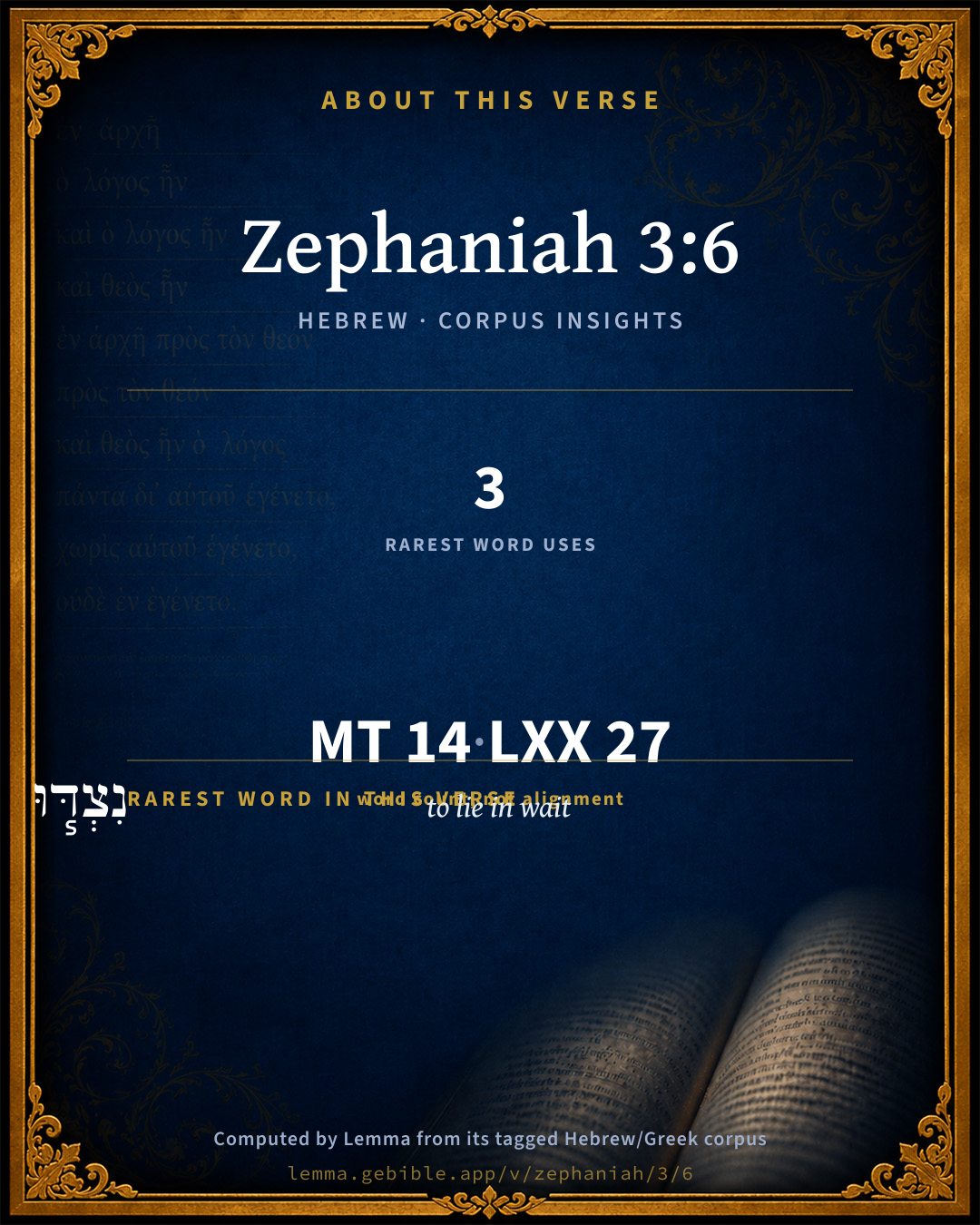
The rarest word here is נִצְדּ֧וּ to lie in wait H6658 — appearing just 3 times in the whole Hebrew Bible.

Shared distinctive vocabulary

נִצְדּ֧וּ to lie in wait H6658 occurs in 3 verses of the Hebrew Bible. Also found in:

Grammatical profile

  • 6 verbs
  • 7 nouns
  • 1 particle

Verb forms

  • הִכְרַ֣תִּי Hiphil · Perfect
  • נָשַׁ֨מּוּ֙ Niphal · Perfect
  • הֶחֱרַ֥בְתִּי Hiphil · Perfect
  • עוֹבֵ֑ר Qal · Participle Active
  • נִצְדּ֧וּ Niphal · Perfect
  • יוֹשֵֽׁב Qal · Participle Active

Repetition

A word recurs within this verse — often emphatic in Hebrew:

  • מִבְּלִ֣י without H1097 ×2

Hebrew & Septuagint length

In English translation the verse runs 37 words from the Hebrew and 42 from the Septuagint (LXX English) — closely comparable.

A rough comparison of the two English renderings, which tokenize alike — not a word-level alignment.

Word counts can differ between the Hebrew and the Greek without any difference in meaning — e.g. the Hebrew direct-object marker אֵת has no separate Greek word, and Greek often adds the article ὁ.

In the original languages it is 14 Hebrew tokens and 27 Greek tokens — but the two are counted differently (Hebrew bundles its prefixes and suffixes into one token; the Greek is in lemma form), so that isn’t a like-for-like length.

Cross-references

14

Topical passages linked to Zephaniah 3:6 in the Treasury of Scripture Knowledge — connected by theme and wording, ordered by reader-vote popularity; previews shown in the World English Bible.

  • Zephaniah 2:5 Woe to the inhabitants of the sea coast, the nation of the Cherethites! The word of Yahweh is against you, Canaan, the land of the Philistines. I will destroy you, that there will be no inhabitant.
  • 1 Corinthians 10:6 Now these things were our examples, to the intent we should not lust after evil things, as they also lusted.
  • Isaiah 37:24–26 By your servants have you defied the Lord, and have said, With the multitude of my chariots am I come up to the height of the mountains, to the innermost parts of Lebanon; and I will cut down the tall cedars of it, and the choice fir trees of it; and I will enter into its farthest height, the forest of its fruitful field;
  • Jeremiah 25:9–11 behold, I will send and take all the families of the north, says Yahweh, and [I will send] to Nebuchadrezzar the king of Babylon, my servant, and will bring them against this land, and against the inhabitants of it, and against all these nations round about; and I will utterly destroy them, and make them an astonishment, and a hissing, and perpetual desolations.
  • 1 Corinthians 10:11 Now all these things happened to them by way of example, and they were written for our admonition, on whom the ends of the ages have come.
  • Leviticus 26:31 I will lay your cities waste, and will bring your sanctuaries to desolation, and I will not take delight in the sweet fragrence of your offerings.
  • Isaiah 10:1–34 Woe to those who decree unrighteous decrees, and to the writers who write perverseness;
  • Isaiah 15:1–9 The burden of Moab. For in a night Ar of Moab is laid waste, [and] brought to nothing; for in a night Kir of Moab is laid waste, [and] brought to nothing.
  • Isaiah 19:1–25 The burden of Egypt. Behold, Yahweh rides on a swift cloud, and comes to Egypt: and the idols of Egypt shall tremble at his presence; and the heart of Egypt shall melt in the midst of it.
  • Isaiah 37:11–13 Behold, you have heard what the kings of Assyria have done to all lands, by destroying them utterly: and shall you be delivered?
  • Isaiah 37:36 The angel of Yahweh went forth, and struck in the camp of the Assyrians one hundred and eighty-five thousand; and when men arose early in the morning, behold, these were all dead bodies.
  • Jeremiah 25:18–26 [to wit], Jerusalem, and the cities of Judah, and the kings of it, and the princes of it, to make them a desolation, an astonishment, a hissing, and a curse, as it is this day;
  • Nahum 2:1–3 He who dashes in pieces has come up against you. Keep the fortress! Watch the way! Strengthen your loins! Fortify your power mightily!
  • Zechariah 7:14 "but I will scatter them with a whirlwind among all the nations which they have not known. Thus the land was desolate after them, so that no man passed through nor returned: for they made the pleasant land desolate."

Cross-references courtesy of OpenBible.info (CC BY 4.0).

Hebrew and Greek witnesses Masoretic Hebrew ↔ Greek Septuagint

The same verse in the two great witnesses to the Old Testament, shown verse-for-verse.

These are two independent witnesses, not word-aligned to each other, and the Septuagint is shown in lemma (dictionary) form.

Hebrew Zephaniah 3:6 Masoretic · Westminster Leningrad Codex

הִכְרַ֣תִּי גוֹיִ֗ם נָשַׁ֨מּוּ֙ פִּנּוֹתָ֔ם הֶחֱרַ֥בְתִּי חֽוּצוֹתָ֖ם מִבְּלִ֣י עוֹבֵ֑ר נִצְדּ֧וּ עָרֵיהֶ֛ם מִבְּלִי אִ֖ישׁ מֵאֵ֥ין יוֹשֵֽׁב

I have cut off nations. Their battlements are desolate. I have made their streets waste, so that no one passes by. Their cities are destroyed, so that there is no man, so that there is no inhabitant.

World English Bible · Public Domain

Greek LXX Zephaniah 3:6 Septuagint · lemma form

ἐν διαφθορά κατασπάω ὑπερήφανος ἀπο ἀναἵζω γωνία αὐτός ἐκἐρημόω ὁ ὁδός αὐτός ὁ παράπαν ὁ μή διαὁδεύω ἐκλείπω ὁ πόλις αὐτός παρά ὁ μηδείς ὑποἄρχω μηδέ καταοἰκέω

I have brought down the proud with destruction; their corners are destroyed: I will make their ways completely waste, so that none shall go through: their cities are come to an end, by reason of no man living or dwelling in them.

LXX2012 (modern English Septuagint) · Public Domain

Hebrew: Westminster Leningrad Codex (CC BY 4.0). Greek: Septuagint (public domain); English from LXX2012 (modern English Septuagint) (Public Domain). How the Septuagint differs from the Hebrew →

Targum (Aramaic paraphrase)

1

The Targum is the ancient Jewish Aramaic paraphrase of the Hebrew Scriptures — an interpretive translation, not the Hebrew text itself. Onkelos (literal) and Pseudo-Jonathan (expansive) render the Torah, and Jonathan the Prophets. Coverage is partial: where no permissively-licensed English translation exists for a verse, only the Aramaic is shown. This is verse-level text, not a word-by-word alignment to the Hebrew.

  1. Targum Jonathan Prophets (Joshua–Malachi)
    שֵׁיצֵיתִי עַמְמַיָא אַצְדִיאָה בִּרְנְיָתְהוֹן אַחֲרִיבַית שׁוּקֵיהוֹן מִבְּלִי עָדֵי צְדִיאָה קִרְוֵיהוֹן מִבְּלִי אֱנַשׁ מִבְּלִי יָתֵיב:

    (no public-domain English translation for this verse)

    Targum Jonathan — Aramaic: “Mikraot Gedolot” (public domain). English: “Sefaria Community Translation” (CC0 1.0 (public-domain dedication)); “London "Chaldee Paraphrase," 1871” (public domain). Text via Sefaria.

Commentary

Notes on Zephaniah 3:6 from classic Christian and Jewish commentators (each source and its license shown beneath its notes). The classic Christian expositions comment on the surrounding passage and are grouped to its opening verse, so a note may address several verses; the Jewish commentaries on the Tanakh (Rashi and others) are per-verse, so they appear only where the commentator wrote on this verse.

Lemma curates 59 commentaries, every one of them public domain or Creative Commons licensed, each selected and text-cleaned for this edition rather than reprinted as found. About our sources →

John Calvin's Commentaries

Here the Prophet shows in another way that there was no hope for a people, who could not have been instructed by the calamities of others, to seek to return to God’s favor. For God here complains that he had in vain punished neighboring nations, and made them examples, in order to recall the Jews to himself. Had they been of a sane mind they might have been led, by their quiet state, while God spared them, to consider what they had deserved—If this is done in the green tree, what at length will be done in the dry? They might then have thought within themselves, that a most grievous calamity was at hand, except they anticipated God’s wrath, which had grown ripe against them; and God also testified that he intended by such examples to stay the judgment which he might have already justly executed on them. As they then even hastened it, it is evident that their wickedness was past remedy. This is the sum of the whole.

He says first, I have cut off nations; by which words he shows that he warned the Jews to repent, not only by one example, but by many examples; for not one instance only of God’s wrath had appeared, but God had on all sides manifested himself to be a judge, in inflicting punishment on one nation after another. Since then they had been so often warned, we may hence learn that they were wholly blinded by their wickedness.

He now enhances the atrocity of the punishment inflicted, and says, that citadels had been demolished and streets cut off, that no one passed through; and then, that cities had been reduced to solitude, so that there was no inhabitant. For when punishment is of an ordinary kind, it is wont, for the most part, to be disregarded; but when God showed, by so remarkable proofs, that he was displeased with the nations, that is, with the ignorant, who in comparison with the Jews were innocent, how could such an instance as this be disregarded by the Jews, whom God thus recalled to himself, except that they were of a disposition wholly desperate and irreclaimable? We now then see why the Prophet enlarges on the punishments which, having been inflicted on the nations, ought to have been considered by the Jews.

He now subjoins the object which God had in view, I said, Surely thou wilt fear me. Here God assumes the character of man, as he does often elsewhere: for he does not wait for what is future, as though he was doubtful; but all things, as we know, are before his eyes. Hence God was not deceived, as though something had happened beyond his expectation; but as I have already said, he undertakes here the character of man; for he could not otherwise have sufficiently expressed how inexcusable the Jews were who had despised all his warnings. For what was God’s design when he punished the heathens, one nation after another, except that the Jews might be awakened by the evils of others, and not provoke his wrath against themselves? Paul makes use of the same argument.

‘On account of these things,’ he says, ‘the wrath of God comes upon all the unbelieving.’ Romans 1:17 [Ephesians 5:6, Colossians 3:6].

Inasmuch as men for the most part deceive themselves by self-flatteries and cherish with extreme indulgence their own wickedness, Paul says, that the wrath of God comes on the unbelieving: and it is a singular proof of God’s love, that he does not immediately assail us, but sets before us the examples of others. As when any one lays hold of his servant in the presence of his son, and punishes him severely, the son must be moved by the sight, except he be wholly an abandoned character: however, in such a case the father’s love manifests itself; for he withholds his hand from his son and inflicts punishment on the servant, and this for the benefit of his son, that he may learn wisdom by what another suffers. God declares in this place that he had done the same; but he complains that it had been without benefit, for the Jews had frustrated his purpose.

It may be here asked, whether men so frustrate God that he looks for something different from what happens. I have already said, that God speaks after the manner of men, and in a language not strictly correct: and hence we ought not here to enter or penetrate into the secret purpose of God, but to be satisfied with this reason,—that if we profit nothing when God warns us either by his word or by his scourges, we are then equally guilty, as though he was deceived by us: and hence also the madness of those is reproved, who are unwilling to ascribe anything to God but what is conveyed in these common forms of speech: God says, that he wills the salvation of all, 1 Timothy 2:4;) hence there is no election, which makes a distinction between one man and another; but the Lord leaves the whole human race to their free-will, so that every one may provide for himself as he pleases; otherwise the will of God must be twofold. So unlearned men vainly talk; and such not only show their ignorance in religion, but are also wholly destitute of common sense. For what is more absurd than to conclude, that there is a twofold will in God, because he speaks otherwise with us than is consistent with his incomprehensible majesty? God’s will then is one and simple, but manifold as to the perceptions of men; for we cannot comprehend his hidden purpose, which angels adore with reverence and humility. Hence the Lord accommodates himself to the measure of our capacities, as this passage teaches us with sufficient clearness. For if we receive what the fanatics imagine, then God is like man, who hopes well, and finds afterwards that he has been deceived: but what can be more alien to his glory? We hence see how these insane men not only obscure the glory of God, but also labor, as far as they can, to reduce his whole essence to nothing. But this mode of speaking ought to be sufficiently familiar to us,—that God justly complains that he has been deceived by us, when we do not repent, inasmuch as he invites us to himself, and even stimulates us, I said, Surely thou wilt fear me

This word said, ought not then to be referred to the hidden counsel of God, but to the subject itself, and that is, that it was time to repent. Who would not have hoped but that you would have returned to the right way? When the next house was on fire, how was it possible for you to sleep, except ye were extremely stupid? And when so many examples were presented before your eyes without any advantage, it is evident that there is no more any hope of repentance. Thou, then, wilt fear me; that is, God might have hoped for some amendment, though he had not yet touched you even with his smallest finger; for ye beheld, while in a tranquil state, how severely he punished the contempt of his justice as to the heathens. He uses a similar language in Isaiah 5:4,

‘My vine, what have I done to thee? or what could I have done to thee more than what I have done? I expected thee to bring forth fruit; but, behold, thou hast brought forth wild grapes.’

God in that passage expostulates with the Jews as though they had by their perfidiousness deceived him. But we know, that whatever happens was known to him before the creation of the world: but, as I have already said, the fact itself is to be regarded by us, and not the hidden judgment of God.

He afterwards adds, Thou wilt receive correction; that is, thou wilt be hereafter more tractable: for monstrous is our stupidity, when we fear not God’s vengeance; when yet it evidently appears that we are warned, as I have already said, to repent, by all the examples of judgments which are daily presented to us. But if we proceed in our wickedness, what else is it but to kick against the goad, as the old proverb is? In short, we here see described an extreme wickedness and obstinacy, which admitted of no remedy.

Hence the Prophet adds again, And cut off should not be her habitation, howsoever I might have visited her; that is, though the Jews had already provoked me, so that the punishment they have deserved was nigh; yet I was ready to withdraw my hand and to forgive them, if they repented: not that God ever turns aside from his purpose, for there is no shadow of turning in him; but he sets before them the fact as it was; for the subject here, as I have said, is not respecting the secret purpose of God, but we ought to confine ourselves to the means which he employs in promoting our salvation. God had already threatened the Jews for many years; he had as yet deferred to execute what he had threatened. In the meantime his wrath had been manifested through the whole neighborhood; the heathen nations had suffered the severest judgments. God here declares, that he had been so lenient to his people as to give time to repent; and he complains that he had delayed in vain, for they had gone on in their wickedness, and had mocked, as it were, his patience. When, therefore, he says, Cut off should not be her habitation, howsoever I might have visited her, or have visited her, he pursues still the same mode of speaking, that is, that he was prepared to forgive the Jews, though he had before destined them to destruction; not that he, as to himself, would retract that sentence; but that he was still reconcilable, if the Jews had been touched by any feeling of repentance.

He at last adds, Surely, (some render it, but,) surely they have hastened. The verb שכם, shecam, means properly to rise early, but is to be taken metaphorically in the sense of hastening; as though he had said, They run headlong to corrupt their ways. God had said that he had been indulgent to them for this end—that he might lead them by degrees to repentance: now he complains, that they on the contrary had run another way, when they saw that he suspended his judgments, as though it was their designed object to accelerate his wrath. Thus they hastened to corrupt their ways. The meaning, then, is that this people were not only irreclaimable in their obstinacy, but that they were also sottish and presumptuous, as though they wished to hasten the judgment, which the Lord was ready for a time to defer. It now follows—

John Calvin's Commentaries (1540-1563) — public domain. Text from the Calvin Translation Society English edition (1840s-50s) via the Christian Classics Ethereal Library (ccel.org). Calvin's coverage is partial (roughly two-thirds of the Bible); uncommented books and verses are honest gaps, never fabricated. The 19th-century editor's footnotes and remarks are omitted so the notes are faithfully Calvin's own voice.

The Cambridge Bible for Schools and Colleges

gen. ed. J. J. S. Perowne

6. Zep_3:6 continues the preceding: Jehovah’s righteous rule is exercised not only in the midst of Israel itself but also among the nations without. His judgments among the nations were also meant for Israel’s instruction, and should have been laid to heart (Zep_3:7).

I have cut off the nations] Rather: I have cut off nations. No particular nations are named; history is full of God’s judgments on the peoples for their unrighteousness, the Flood, the overthrow of Sodom, the destruction of Samaria, and the like.

I made their streets] have made; the examples or some of them are recent. The term “streets” might mean outplaces, territories. On the language of the verse comp. Jer_33:10.

The Cambridge Bible for Schools and Colleges (gen. ed. J. J. S. Perowne; Cambridge University Press, 1878–1918) — public domain. Text from a community e-Sword module.

Trapp's Complete Commentary

John Trapp

Zep 3:6 I have cut off the nations: their towers are desolate; I made their streets waste, that none passeth by: their cities are destroyed, so that there is no man, that there is none inhabitant.

Ver. 6. I have cut off the nations] And hanged them up in gibbets, as it were, before your eyes, for your admonition, ut ruina maiorum sit cautela minorum, that their destruction might be your instruction; that, seeing your neighbour’s house on fire, you might look to your own; that, observing others to suffer shipwreck, you might see to your tackling. This is the use God expects we should make of his judgments upon others, Luk 13:3; Luk 13:5; Luk 17:26; Luk 17:29 Mat 12:13; Mat 12:41-42 1Co 10:1-2, and surely he deserveth to be made an example that will not take example by others.

Their towers are desolate] Or, their corners, sc. of their munitions, whereon towers were set. Or, their extremities, q.d. I have overturned them from one end to another. Drusius and Ribera interpreteth it of their princes. {See Trapp on "Zep 1:6"}

I made their streets waste, &c.] See Zep 2:5-6; Zep 2:14-15. To the end, that when my judgments were thus on the earth, the inhabitants of the world (but especially of the Church) might learn righteousness, Isa 26:9; that the righteous, seeing the vengeance, might wash his feet in the blood of the wicked, Psa 59:10, taking warning by his harms. Observe here, by the way, what great account God makes of his people, since for their instance and instruction he thus wasteth the wicked; like as the Persian kings, when their sons had committed a fault, made their servants to be beaten before them.

John Trapp, A Commentary or Exposition upon All the Books of the Old and New Testament (1647–1656) — public domain. Text from a community e-Sword module.

The Biblical Illustrator

Joseph S. Exell

Zep_3:6-8

I have cut off the nations.

Terrible calamities in human history

In these verses the prophet sums up all that he had said in the preceding verses of this chapter, and thus closes his admonition to repentance with the announcement of tremendous judgments. These verses remind us of the following great truths--

I. That there is a sense in which the most terrible calamities in human history may be ascribed to God. Here He is represented as cutting off the nations, destroying their towers, making their streets waste, so that there is no man, and none inhabitant.

II. That the grand design of such calamities is the promotion of moral improvement amongst mankind. As the storms, the snows, the frosts, and the cutting winds of winter help to bring on the luxuriant spring, so the calamities in human life contribute to the moral regeneration of mankind.

III. That the non-realisation of this design amongst a people exposes them to terrible retribution. But they rose early, and corrupted all their doings. The men of Jerusalem, instead of getting better for these terrible calamities, grew worse. They corrupted all their doings. This they did with assiduity. (Homilist.)

The Biblical Illustrator, edited by Joseph S. Exell (c. 1880s–1900s) — public domain. Text from a community e-Sword module.

Joseph Benson's Commentary

Zep 3:6-7. I have cut off the nations — I have executed vengeance upon that great city Nineveh, Zep 2:15, and have brought my judgments nearer to you, by giving up your brethren of the ten tribes into the hands of Shalmaneser; who hath put an end to that kingdom, and hath carried its inhabitants captive into a strange land: see 2Ki 17:6. I said, Surely thou wilt fear me, thou wilt receive instruction — This is addressed to the city of Jerusalem. And God is here introduced as speaking after the manner of men, and signifying what effect it was reasonable to conclude the execution of his judgments upon the ten tribes would have had upon the inhabitants of Jerusalem; that it would have caused them to fear him, and to have taken example, from the destruction of their brethren, to avoid similar crimes, and obey the laws which God had given them. So their dwelling should not be cut off — In order that by that means their city and country might be saved from destruction. But they rose early, and corrupted all their doings — But they, as it were with diligence and assiduity, corrupted their ways, and daily proceeded to greater and greater acts of wickedness. The expression, to rise early to do a thing, signifies to do it with assiduity, and with a great inclination, or good-will toward it.

Joseph Benson's Commentary on the Old and New Testaments (1811–1818) — public domain. Text from a community e-Sword module.

unfoldingWord translationNotes

Door43 World Missions Community

General Information:

In verses Zep 3:6-7, Yahweh rebukes the people of Jerusalem because they did not learn from how he judged other sinful cities. It may be helpful to add "Yahweh says this:" to the beginning of verse 6 to make this explicit. (See: Assumed Knowledge and Implicit Information)

I have made their streets ruins, so that no one passes over them. Their cities are destroyed so that there is no man inhabiting them

These two sentences express the same idea in two different ways in order to emphasize the complete destruction of the cities. (See: Parallelism)

no one passes over them

"no one walks on them"

there is no man inhabiting them

"no one lives there." This can be stated in positive form. AT: "all the people are dead"

I said, 'Surely you will fear me ... I have planned to do to you.'

This can be stated as an indirect quotation. AT: "I thought they would surely fear me and accept correction so that they would not be cut off from their homes by all that I have planned to do to them." (See: Direct and Indirect Quotations)

and do not be cut off from your homes

Here "cut off" is an idiom that means to be removed. This can be stated in active form. AT: "so that I will not remove you from your homes" (See: Idiom and Active or Passive)

by corrupting all their deeds

"by doing deeds that were corrupt"

translationWords

nation

stronghold

ruin

fear

cut off

corrupt

unfoldingWord translationNotes — © Distant Shores Media and the Door43 World Missions Community, licensed CC BY-SA 4.0. Source: git.door43.org/Door43/en_tn.

Geneva Bible (1599)

Geneva Bible translators

By the destruction of other nations he showeth that the Jews should have learned to fear God.

Geneva Bible (1599) marginal notes — public domain. Text via Bolls.life.

Jamieson, Fausset & Brown

Robert Jamieson, A. R. Fausset & David Brown

I had hoped that My people by My judgments on other nations would be led to amendment; but they are not, so blinded by sin are they.

towers--literally, "angles" or "corners"; hence the towers built at the angles of their city walls. Under Josiah's long and peaceful reign the Jews were undisturbed, while the great incursion of Scythians into Western Asia took place. The judgment on the ten tribes in a former reign also is here alluded to.

Jamieson, Fausset & Brown — Commentary Critical and Explanatory on the Whole Bible (1871) — public domain (CC PDM 1.0). Text via the HelloAO Bible API.

Adam Clarke's Commentary

Verse 6. I have cut off the nations] Syria, Israel, and those referred to, Isa 36:18; Isa 36:20. - Newcome.

Adam Clarke's Commentary on the Bible (1810–1826) — public domain. Text from a community e-Sword/MySword module.

Ellicott's Commentary for English Readers

(6) The nations.—Those that were destroyed by the agency of Israel on invading the Promised Land; those also which were cut off by the Assyrians and the other great powers whom God used as His instruments (Isa_37:26).

A Bible Commentary for English Readers, edited by Charles John Ellicott (1878–1897) — public domain. Text from a community e-Sword module.

John Gill's Exposition

I have cut off the nations Utterly destroyed them, as the Philistines, Moabites, Ethiopians, and Assyrians, as in the preceding chapters; all which were done before the coming of Christ in the flesh; and by which instances the Jews should have took warning, lest by their sins they should provoke the Lord to destroy their nation, city, and temple: their towers are desolate; built on their frontiers, or on the walls of their cities, to defend them; these were demolished, and laid waste, and of no use: or, "their corners" F2; towers being usually built on the angles or corners of walls. Some interpret this of their princes, nobles, and great men, who were destroyed; see ( Zechariah 10:4 ) : I made their streets waste, that none passeth by; the streets of their cities, the houses being pulled down by the enemy, the rubbish of them lay in the streets, so that there was no passing for any; and indeed, the houses being demolished, the streets were no more in form: their cities are destroyed, so that there is no man, that there is none inhabitant; the houses being burnt with fire, or pulled down, and plundered of the goods and substance in them, and the people cut off by famine, pestilence, or sword; and the rest carried captive, there was scarce a man or inhabitant left; so general was the destruction. FOOTNOTES: F2 (Mtwnp) "anguli earum", Pagninus, Montanus, Drusius, Cocceius, Burkius.

John Gill's Exposition of the Whole Bible (1746–1763) — public domain (CC PDM 1.0). Text via the HelloAO Bible API.

Albert Barnes' Notes on the Bible

I have cut off the nations - God appeals to His judgments on pagan nations, not on any particular nation, as far as we know; but to past history, whether of those, of whose destruction Israel itself had been the instrument, or others. The judgments upon the nations before them were set forth to them, when they were about to enter on their inheritance, as a warning to themselves. “Defile not ye yourselves in any of these things, for in all these have the nations defiled themselves, which I cast out before you: and the land is defiled; therefore I do visit the iniquity thereof upon it, and the land vomiteth out her inhabitants. And ye, ye shall keep My statutes and My judgements and shall not commit any of these abominations - And the land shall not spue you out when ye defile it, as it spued out the nations which were before you” (Lev 18:24-26, Lev 18:28, add Lev 20:23). The very possession then of the land was a warning to them; the ruins, which crowned so many of its hilltops , were silent preachers to them; they lived among the memories of God’s visitations; if neglected, they were an earnest of future judgments on themselves.

Yet God’s judgments are not at one time only. Sennacherib appealed to their own knowledge, “Behold, thou hast heard what the kings of Assyria have done to all lands by destroying them utterly. Have the gods of the nations delivered them which my fathers have destroyed?” Isa 37:11, Isa 37:13. Hezekiah owned it as a fact which he knew: “Of a truth, Lord, the kings of Assyria have laid waste all the nations and their land” Isa 37:18. And God owns him as His instrument: “Now I have brought it to pass, that thou shouldest be to lay waste defensed cities into ruinous heaps” Isa 37:26 : and, “I will send him against an ungodly nation, and against the people of My wrath will I give him a charge, to take the spoil and to take the prey, and to tread them down as the mire of the streets,” and says of him, “It is in his heart to destroy and to cut off nations not a few” . The king of Babylon too he describes as “the man that made the earth to tremble, that did shake kingdoms. that made the world as a wilderness, and destroyed the cities thereof” Isa 14:16-17. Habakkuk recently described the wide wasting by the Babylonians, and the helplessness of nations before him Hab 1:14-16.

Their towers, corner towers - o, the most carefully fortified parts of their fortified cities, “are desolate; I made their streets waste.” The desolation is complete, within as well as without; ruin itself is hardly so desolate as the empty habitations and forsaken streets, once full of life, where

“The echoes and the empty tread

Would sound like voices from the dead.”

Albert Barnes' Notes on the Bible (1834–1885) — public domain. Text from a community e-Sword/MySword module.

Haydock's Catholic Bible Commentary

Towers. Literally, "angles," (Haydock) the chiefs, or to the very last, Job xxxviii. 6., and Zacharias x. 4. The nations have been punished for an example. But you do not take warning. (Calmet)

George Leo Haydock (1774–1849), Haydock's Catholic Family Bible and Commentary, 1859 edition — public domain. Excludes Psalms (Douay-Rheims chapter numbering differs from Protestant) and Deuterocanonical books (Catholic canon only).

Matthew Poole's English Annotations

I have cut off the nations; of old the Canaanites, lately the ten tribes, later yet the Assyrians and others, have been cut off for their sins.

Their towers; either metaphorically, magistrates and great men, as Zep 1:16; or literally, strong towers built on the angles of walls or palaces.

Are desolate; razed and demolished. I made their streets waste; I overthrew their houses, that there were no streets.

None passeth by; or none walked through them. Their cities, small or great, capital or not capital, are destroyed; taken, plundered, burnt, and ruined.

There is no man; all fled, or slain, or starved, or swept away with pestilence, or carried into captivity, not an inhabitant left in the places.

Matthew Poole's English Annotations on the Holy Bible (1683–1685) — public domain. Text from a community e-Sword/MySword module.

The Pulpit Commentary

Vers. 6-8. Obdurate and blinded as nations are, these extreme measures are the only way left to secure salvation for Israel and the whole world.

God speaks, showing why he has sent these judgments. I have cut off the nations. The reference is to facts well known to the hearers (though not specified here); such as the rain of Pentapolis, the destruction of the Canaanites, the defeat of the Chaldeans in Hezekiah"s time, the conquest of cities and countries by the Assyrians, and the devastation of Israel itself. Their towers are desolate. Their towers, (see note on Zep_1:16) in which they trusted for defence, are overthrown and lie in ruins. Others translate, "street corners," where people most do congregate. Streets; perhaps, roads; signifying the open country. So Keil. None inhabitant. (comp. Jer_4:7)

Vers. 6-8. Terrible calamities it, human history.

"I have cut off the nations: their towers are desolate; I made their streets waste, that none passeth by: their cities are destroyed, so that there is no man, that there is none inhabitant. I said, Surely thou wilt fear me, thou wilt receive instruction," etc. In these verses the prophet sums up all that he had said in the preceding verses of this chapter, and thus closes his admonition to repentance with the announcement of tremendous judgments. These verses remind us of three great truths of universal importance, claiming the attention of men wherever they exist.

I THAT THERE IS A SENSE IN WHICH THE MOST TERRIBLE CALAMITIES IN HUMAN HISTORY MAY BE ASCRIBED TO GOD. Here he is represented as cutting off the nations, destroying their "towers," making their "streets waste," so that "there is no man," and "none inhabitant." What particular nation is here referred to cannot be determined with certainty. We know that he did destroy nations the Canaanitish nations, also Assyria and Babylon. These calamities are here ascribed to God. In Bible language he is frequently represented as doing that which he only permits. Nations destroy each other, he allows them to do so. Though he does not give them the disposition for the work, he imparts the power and the opportunities.

II THAT THE GRAND DESIGN OF SUCH CALAMITIES IS THE PROMOTION OF MORAL IMPROVEMENT AMONGST MANKIND. Why did he permit the wreck and ruin of those nations, and all the dire desolations here recorded? Here is the answer, "I said, Surely thou. wilt fear me, thou wilt receive instruction." The grand end of all his dispensations with men is to generate within them the right state of mind in relation to himself; in other words, to make them "meet for the inheritance of the saints in light." "Lo, all these things worketh God oftentimes with man, to bring back his soul from the pit, to enlighten him with the light of the living". (Job_33:29, Job_33:30) As the storms, the snows, the frosts, and the cutting winds of winter help to bring on the luxuriant spring, so the calamities in human life contribute to the moral regeneration of mankind.

III THAT THE NON-REALIZATION OF THIS DESIGN AMONGST A PEOPLE EXPOSES THEM TO TERRIBLE RETRIBUTION. "But they rose early, and corrupted all their doings." The men of Jerusalem, instead of becoming better for these terrible calamities, grew worse. They "corrupted all their doings." This they did with assiduity. They "rose early." They began their morning with it. "Therefore wait ye upon me, saith the Lord, until the day that I rise up to the prey; for my determination is to gather the nations, that I may assemble the kingdoms, to pour upon them mine indignation, even all my fierce anger: for all the earth shall be devoured with the fire of my jealousy." Or, as Keil renders it, "Therefore wait for me, is the saying of Jehovah, for the day when I rise up to the prey; for it is my right to gather nations together, to bring kingdoms in crowds, to heap upon them my fury, all the burning of my wrath; for in the fire of my zeal will the whole earth be devoured." The Almighty here speaks after the manner of men, as he does almost everywhere in the Bible, in condescension to human infirmities. He speaks as if he were disappointed in the moral results of the calamities which he had sent, and as if his nature now glowed with the fires of his indignation. There is, of course, really no disappointment for him, for he knows the future, and "fury" is not in him. D.T.

The Pulpit Commentary (1880–1919), ed. H.D.M. Spence-Jones & Joseph S. Exell — public domain. Text from a community e-Sword module.

John Wesley's Explanatory Notes

The nations - Of old, the Canaanites, lastly the ten tribes, and later yet, the Assyrians.

John Wesley, Explanatory Notes Upon the Whole Bible (1754–1765) — public domain. Text via the GEBible commentary corpus.

Rashi

Rabbi Shlomo Yitzchaki (Rashi)

I have cut off nations I brought retribution upon the nations so that you should see and fear as He concludes, “I said, ‘Surely you will fear Me.’”

Rashi on the Tanakh — English translations: “The Judaica Press complete Tanach with Rashi, translated by A. J. Rosenberg” (CC BY 4.0); “Pentateuch with Rashi's commentary by M. Rosenbaum and A.M. Silbermann, 1929-1934” (public domain); “The Metsudah Tanach series, Lakewood, N.J” (CC BY 4.0); and “The Book of Joshua, Metsudah Publications, 1997” (CC BY 4.0). Text via Sefaria.

Lesson kit

Teaching starters — assembled from the data on this page, not authored interpretation. Every prompt links to the verse data it draws on. Edit before teaching.

Zephaniah, in the Prophets, opens this verse with 14 words (13 distinct Hebrew lemmas). Its most distinctive word is tsâdâh (“to lie in wait”). A historical commentator’s framing appears above. Read the whole chapter for the surrounding context.

Discussion questions

  1. What does “to lie in wait” (tsâdâh) contribute to the verse as a whole?
  2. How does Exodus 21:13, which shares the word «to lie in wait», read alongside this verse?
  3. What does the repetition of “without” (2× in this one verse) do in this verse?
  4. These translations render this verse differently; the difference is in the English rendering, not the original. What questions does that raise?
  5. «הִכְרַ֣תִּי» is a Hiphil Perfect verb. How does that grammatical form shape the action described?
  6. Compare how John Calvin's Commentaries and The Cambridge Bible for Schools and Colleges read this verse. Where do they agree or differ?

Things to notice

Reading settings

Reading text

Shown beneath each verse's original-language words.

Old Testament
Old Testament edition

Read the OT as the Masoretic Hebrew (MT) or the Greek Septuagint (LXX).

English shown for the Greek Septuagint (in the Hebrew ↔ Greek comparison).

Comparing translations? Open the Compare panel on any verse page to stack up to four side by side.