
Ezekiel 41:9

Hebrew (Westminster Leningrad Codex) Ezekiel 41:9 appears in the Hebrew Old Testament. The text above is from the Westminster Leningrad Codex. Each word links to its Strong’s number, a concise gloss, and parsing drawn from the Open Scriptures Hebrew Bible morphology. Click any word for its full Brown-Driver-Briggs (BDB) entry.
Download image
Cite this verse

Ezekiel 41:9 (World English Bible). Public Domain. Lemma interlinear Bible study tool, https://lemma.gebible.app/v/ezekiel/41/9.

Show BibTeX & RIS
BibTeX
RIS
English Translation
The thickness of the wall, which was for the side-chambers, on the outside, was five cubits: and that which was left was the place of the side-chambers that belonged to the house.
World English Bible · Public Domain
Download a study sheet

One document with this verse’s original text, its word-by-word gloss line, the meaning frame, cross-references with their text, attributed commentary, and full source and license credits — printable, and it pastes into notes with its structure intact.

This verse Autodidact and up

Study sheet (.html) Plain text (.txt)

A passage Seminary Student

Up to 50 verses in one chapter. A passage sheet keeps up to 6 commentary sources and 12 cross-references per verse, in the order this page ranks them, and says so on the sheet whenever that leaves anything out. Ask for a single verse and you get the Autodidact verse sheet above.

Everything on this page stays free to read, with no account — the sheet is a download of what is already on screen, not access to it.

Want to remove ads? Support Godless Engineer
Compare translations 3

The same verse in 3 English versions, stacked beneath the original-language interlinear above. Click any original word for its lexicon entry.

Each is an independent rendering of the whole verse — the interlinear is not word-aligned to these translations.

Highlighted words mark where these versions differ — a whole-verse word diff, not a word-by-word alignment.

  • World English Bible Public Domain
    The thickness of the wall, which was for the side-chambers, on the outside, was five cubits: and that which was left was the place of the side-chambers that belonged to the house.
  • King James Version Public Domain
    The thickness of the wall, which was for the side chamber without, was five cubits: and that which was left was the place of the side chambers that were within.
  • unfoldingWord Literal Text CC BY-SA 4.0
    The width of the wall of the side rooms on the outside was five cubits. There was an open space to the outside of these rooms in the sanctuary.

unfoldingWord Literal Text — © unfoldingWord, licensed CC BY-SA 4.0. Word-aligned USFM3 via Door43 (git.door43.org/unfoldingWord/en_ult).

Versions to compare (up to 4)

3 of 4 selected

Show all 18 translations

Every available English version of this verse, each an independent rendering of the whole verse.

  • World English Bible Public Domain
    The thickness of the wall, which was for the side-chambers, on the outside, was five cubits: and that which was left was the place of the side-chambers that belonged to the house.
  • Berean Standard Bible Public Domain
    The outer wall of the side rooms was five cubits thick, and the open area between the side rooms of the temple
  • Majority Standard Bible Public Domain
    The outer wall of the side rooms was five cubits thick, and the open area between the side rooms of the temple
  • King James Version Public Domain
    The thickness of the wall, which was for the side chamber without, was five cubits: and that which was left was the place of the side chambers that were within.
  • American Standard Version (1901) Public Domain
    The thickness of the wall, which was for the side-chambers, on the outside, was five cubits: and that which was left was the place of the side-chambers that belonged to the house.
  • Revised Version (1885) Public Domain
    The thickness of the wall, which was for the side chambers, on the outside, was five cubits: and that which was left was the place of the side-chambers that belonged to the house.
  • Geneva Bible (1599) Public Domain
    The thickenesse of the wall which was for the chamber without, was fiue cubites, and that which remained, was the place of the chambers that were within.
  • Douay-Rheims (1899) Public Domain
    And the thickness of the wall for the side chamber without, which was five cubits: and the inner house was within the side chambers of the house.
  • Young's Literal Translation Public Domain
    The breadth of the wall that `is' to the side-chamber at the outside `is' five cubits; and that which is left `is' the place of the side-chambers that `are' to the house.
  • Literal Standard Version CC BY-SA 4.0
    The breadth of that wall, of the side-chamber, at the outside, [is] five cubits; and the space remaining of the side-chambers—that of the house,
  • Unlocked Literal Bible CC BY-SA 4.0
    The width of the wall of the side rooms on the outside was five cubits. There was an open space to the outside of these rooms in the sanctuary.
  • unfoldingWord Literal Text CC BY-SA 4.0
    The width of the wall of the side rooms on the outside was five cubits. There was an open space to the outside of these rooms in the sanctuary.
  • Darby Bible Public Domain
    The thickness of the wall, which was for the side-chambers without, was five cubits, as also what was left free along the building of the side-chambers that pertained to the house.
  • World Messianic Bible Public Domain
    The thickness of the outer wall of the side rooms was five cubits. That which was left was the place of the side rooms that belonged to the house.
  • Webster's Bible Public Domain
    The thickness of the wall, which was for the side-chamber without, was five cubits: and that which was left was the place of the side-chambers that were within.
  • Free Bible Version CC BY-SA 4.0
    The thickness of the outer wall of the side rooms was five cubits, and there was open space between the side rooms of the Temple
  • Bible in Basic English Public Domain
    The wall supporting the side-rooms on the outside was five cubits thick: and there was a free space of five cubits between the side-rooms of the house.
  • JPS Tanakh (1917) Public Domain
    The breadth of the outer wall which belonged to the side-chambers was five cubits; and so that which was left by the structure of the side-chambers that belonged to the house.

Literal Standard Version (2020), Covenant Press — licensed CC BY-SA 4.0. Text via the HelloAO Bible API (eBible.org). Unlocked Literal Bible (unfoldingWord) — licensed CC BY-SA 4.0. Text via the HelloAO Bible API (eBible.org). unfoldingWord Literal Text — © unfoldingWord, licensed CC BY-SA 4.0. Word-aligned USFM3 via Door43 (git.door43.org/unfoldingWord/en_ult). Free Bible Version, Dr. Jonathan Gallagher — licensed CC BY-SA 4.0. Text via the HelloAO Bible API (eBible.org).

Word by word

More ways to search: Search by grammar → Find every occurrence → Compare this word →

Practice this passage: Drill this verse → Learn its vocabulary →

לַצֵּלָ֛ע
tsêlâʻ
H6763
“to/for the · rib”
Preposition, Determined + Noun, Common, Both, Singular, Absolute
Part of Speech
Preposition + Noun
Type
Common
Gender
Both
Number
Singular
State
Absolute
Full BDB Definition

Origin: from H6760

TWOT: 1924a

side, rib, beam - rib (of man) - rib (of hill, ridge, etc) - side-chambers or cells (of temple structure) - rib, plank, board (of cedar or fir) - leaves (of door) - side (of ark)
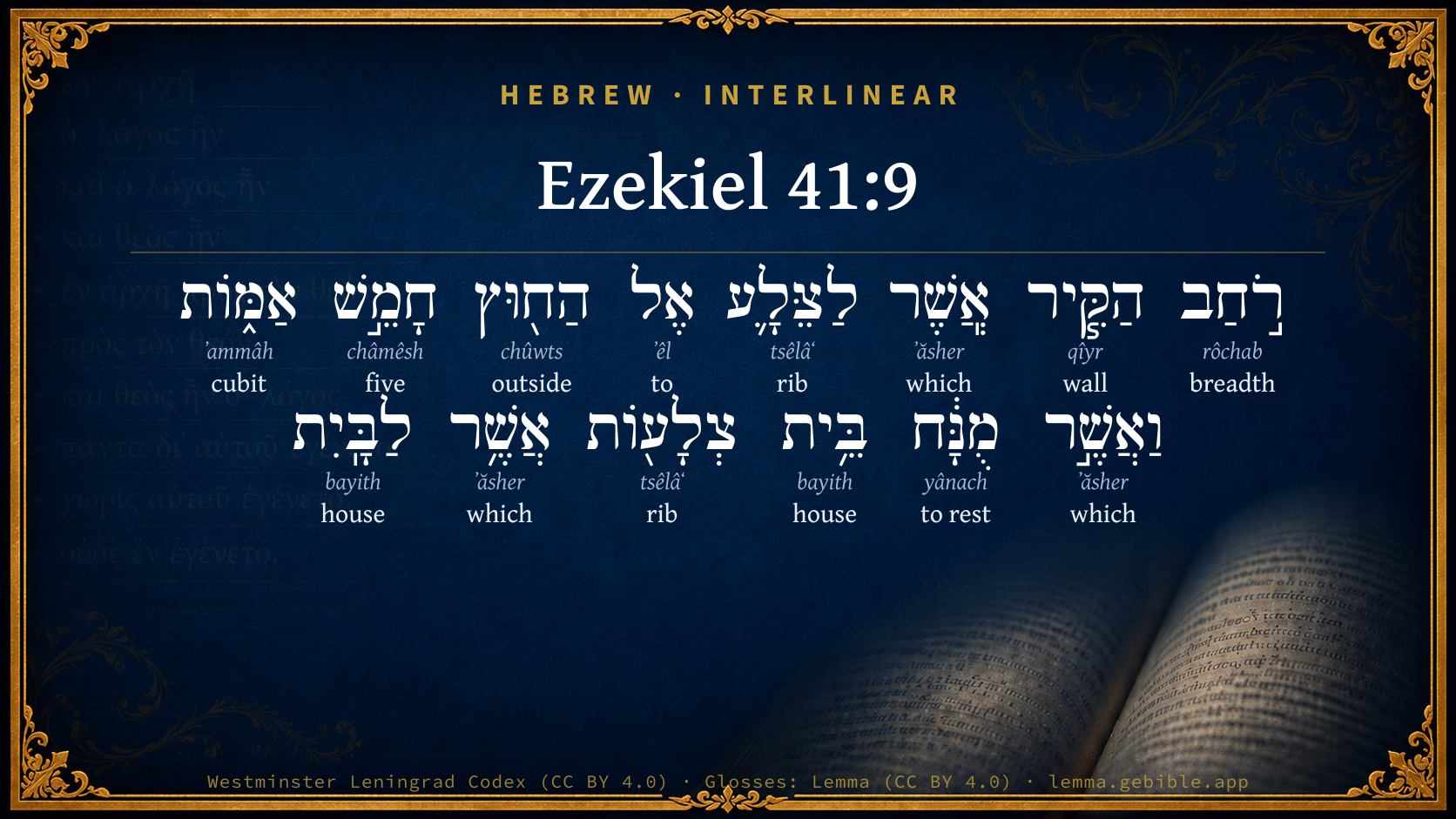
  1. רֹ֣חַב rôchab H7341 “breadth of” Noun, Common, Masculine, Singular, Construct
  2. הַקִּ֧יר qîyr H7023 “the · wall” Particle, Definite Article + Noun, Common, Masculine, Singular, Absolute
  3. אֲֽשֶׁר ʼăsher H834 “which” Particle, Relative
  4. אֶל ʼêl H413 “to” Preposition
  5. הַח֖וּץ chûwts H2351 “the · outside” Particle, Definite Article + Noun, Common, Masculine, Singular, Absolute
  6. חָמֵ֣שׁ châmêsh H2568 “five” Adjective, Cardinal number, Feminine, Singular, Absolute
  7. אַמּ֑וֹת ʼammâh H520 “cubits” Noun, Common, Feminine, Plural, Absolute
  8. וַאֲשֶׁ֣ר ʼăsher H834 “and · which” Conjunction + Particle, Relative
  9. מֻנָּ֔ח yânach H3240 “rested” Verb, Hophal, Participle Passive, Masculine, Singular, Absolute
  10. בֵּ֥ית bayith H1004 “house of” Noun, Common, Masculine, Singular, Construct
  11. צְלָע֖וֹת tsêlâʻ H6763 “ribs” Noun, Common, Both, Plural, Absolute
  12. אֲשֶׁ֥ר ʼăsher H834 “which” Particle, Relative
  13. לַבָּֽיִת bayith H1004 “to/for the · house” Preposition, Determined + Noun, Common, Masculine, Singular, Absolute

About this verse

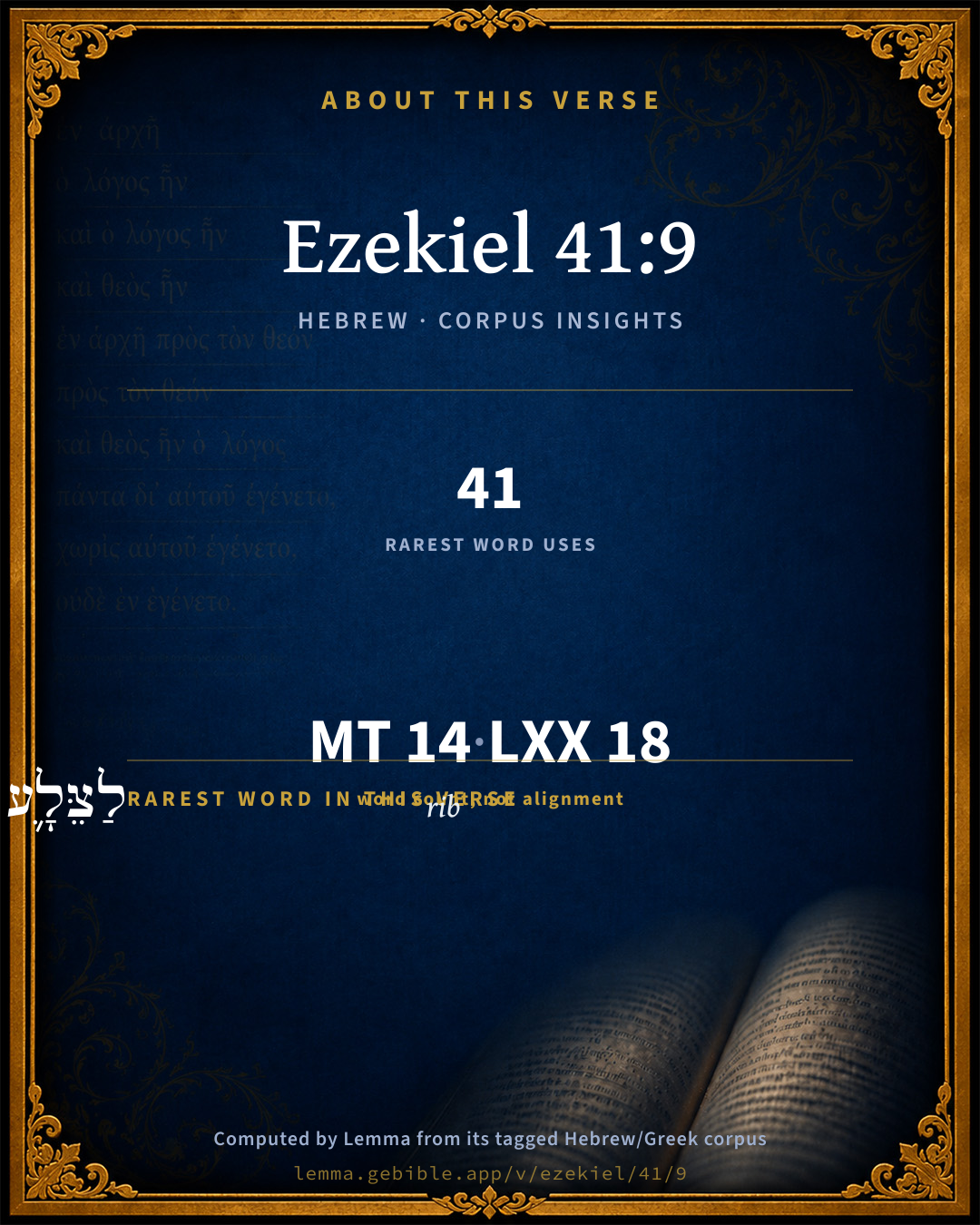
These counts appear in no published source. They are computed here, from the morphology-tagged text and Lemma’s own curated glosses. What Lemma adds →

14
words
10
distinct lemmas
Prophets
section

Shared distinctive vocabulary

לַצֵּלָ֛ע rib H6763 occurs in 32 verses of the Hebrew Bible. Also found in:

Grammatical profile

  • 1 verb
  • 8 nouns
  • 1 adjective
  • 1 preposition
  • 3 particles

Verb forms

  • מֻנָּ֔ח Hophal · Participle Passive

Repetition

Words recur within this verse — often emphatic in Hebrew:

  • לַצֵּלָ֛ע rib H6763 ×2
  • בֵּ֥ית house H1004 ×2
  • אֲֽשֶׁר which H834 ×3

Hebrew & Septuagint length

In English translation the verse runs 32 words from the Hebrew and 25 from the Septuagint (LXX English) — closely comparable.

A rough comparison of the two English renderings, which tokenize alike — not a word-level alignment.

Word counts can differ between the Hebrew and the Greek without any difference in meaning — e.g. the Hebrew direct-object marker אֵת has no separate Greek word, and Greek often adds the article ὁ.

In the original languages it is 14 Hebrew tokens and 18 Greek tokens — but the two are counted differently (Hebrew bundles its prefixes and suffixes into one token; the Greek is in lemma form), so that isn’t a like-for-like length.

Cross-references

3

Topical passages linked to Ezekiel 41:9 in the Treasury of Scripture Knowledge — connected by theme and wording, ordered by reader-vote popularity; previews shown in the World English Bible.

  • Ezekiel 41:11 The doors of the side-chambers were toward [the place] that was left, one door toward the north, and another door toward the south: and the breadth of the place that was left was five cubits round about.
  • Ezekiel 42:1 Then he brought me forth into the outer court, the way toward the north: and he brought me into the chamber that was over against the separate place, and which was over against the building toward the north.
  • Ezekiel 42:4 Before the chambers was a walk of ten cubits' breadth inward, a way of one cubit; and their doors were toward the north.

Cross-references courtesy of OpenBible.info (CC BY 4.0).

Hebrew and Greek witnesses Masoretic Hebrew ↔ Greek Septuagint

The same verse in the two great witnesses to the Old Testament, shown verse-for-verse.

These are two independent witnesses, not word-aligned to each other, and the Septuagint is shown in lemma (dictionary) form.

Hebrew Ezekiel 41:9 Masoretic · Westminster Leningrad Codex

רֹ֣חַב הַקִּ֧יר אֲֽשֶׁר לַצֵּלָ֛ע אֶל הַח֖וּץ חָמֵ֣שׁ אַמּ֑וֹת וַאֲשֶׁ֣ר מֻנָּ֔ח בֵּ֥ית צְלָע֖וֹת אֲשֶׁ֥ר לַבָּֽיִת

The thickness of the wall, which was for the side-chambers, on the outside, was five cubits: and that which was left was the place of the side-chambers that belonged to the house.

World English Bible · Public Domain

Greek LXX Ezekiel 41:9 Septuagint · lemma form

καί εὖρος ὁ τοῖχος ὁ πλευρά ἔξωθεν πηχύς πέντε καί ὁ ἀπόλοιπος ἀνά μέσος ὁ πλευρά ὁ οἶκος

and the breadth of the wall of each side without was five cubits; and the spaces that were left between the sides of the house,

LXX2012 (modern English Septuagint) · Public Domain

On this verse, The Cambridge Bible for Schools and Colleges discusses the Septuagint’s reading. Read the note in Commentary ↓

Hebrew: Westminster Leningrad Codex (CC BY 4.0). Greek: Septuagint (public domain); English from LXX2012 (modern English Septuagint) (Public Domain). How the Septuagint differs from the Hebrew →

Targum (Aramaic paraphrase)

1

The Targum is the ancient Jewish Aramaic paraphrase of the Hebrew Scriptures — an interpretive translation, not the Hebrew text itself. Onkelos (literal) and Pseudo-Jonathan (expansive) render the Torah, and Jonathan the Prophets. Coverage is partial: where no permissively-licensed English translation exists for a verse, only the Aramaic is shown. This is verse-level text, not a word-by-word alignment to the Hebrew.

  1. Targum Jonathan Prophets (Joshua–Malachi)
    פּוּתְיָא דְכִתְלָא דִמְחִיצְתָּא דִלְבָרָא חֲמֵשׁ אַמִין וַאֲתַר שְׁבִיק בֵּית מְחִיצַיָא דִלְגָיו:

    (no public-domain English translation for this verse)

    Targum Jonathan — Aramaic: “Mikraot Gedolot” (public domain). English: “Sefaria Community Translation” (CC0 1.0 (public-domain dedication)); “London "Chaldee Paraphrase," 1871” (public domain). Text via Sefaria.

Commentary

Notes on Ezekiel 41:9 from classic Christian and Jewish commentators (each source and its license shown beneath its notes). The classic Christian expositions comment on the surrounding passage and are grouped to its opening verse, so a note may address several verses; the Jewish commentaries on the Tanakh (Rashi and others) are per-verse, so they appear only where the commentator wrote on this verse.

Lemma curates 59 commentaries, every one of them public domain or Creative Commons licensed, each selected and text-cleaned for this edition rather than reprinted as found. About our sources →

The Cambridge Bible for Schools and Colleges

gen. ed. J. J. S. Perowne

9. The outside wall of the side-chambers was 5 cubits; and there was left a part of the raised platform not covered by buildings (Eze_41:11).

that which was left was] This clause is in some disorder; and must be connected with Eze_41:10. The text clearly distinguishes between “that which was left” (munnach), i.e. the outer margin of the raised platform left free of buildings, which was 5 cubits broad (Eze_41:11), Fig. 2, E, and the “separate place” (gizrah), Fig. 3, H, i.e. the court running round the whole house buildings or the raised platform on which they stood, which was 20 cubits broad (Eze_41:10; Eze_41:13-14)—although LXX. renders both by the same word. In Eze_41:9, “that which was left” cannot differ from the same in Eze_41:11, where it is undoubtedly the remainder of the raised platform. Some words have fallen out in Eze_41:9. It is easiest perhaps to supply the words “five cubits” from Syr. and read: and that which was left was 5 cubits; and between (bçth for bçn) the side-chambers of (belonging to) the house, 10 and the cells was a breadth of 20 cubits, &c. All the versions agree as to Eze_41:10, but “between the cells” cannot mean between something else and the cells. The “cells” or chambers here are undoubtedly those on the N. and S. walls of the inner court (Eze_42:1, seq.), which were separated from the house buildings by the court of 20 cubits, Fig. 3, GG´.

The Cambridge Bible for Schools and Colleges (gen. ed. J. J. S. Perowne; Cambridge University Press, 1878–1918) — public domain. Text from a community e-Sword module.

Trapp's Complete Commentary

John Trapp

Eze 41:9 The thickness of the wall, which [was] for the side chamber without, [was] five cubits: and [that] which [was] left [was] the place of the side chambers that [were] within.

Ver. 9. And that which was left.] Area pura, {a} the void place.

{a} Piscat.

John Trapp, A Commentary or Exposition upon All the Books of the Old and New Testament (1647–1656) — public domain. Text from a community e-Sword module.

Joseph Benson's Commentary

Eze 41:9-11. The thickness of the wall, &c. — This is supposed to be meant of an outward wall enclosing the side-chambers. And that which was left — Or, the space which was left, as Bishop Newcome translates it, judging it to be intended of a space allowed for a walk, or gallery of communication, before the chambers, which space was five cubits broad, Eze 41:11. And between the chambers was the wideness of twenty cubits —

A word being here used for chambers different from that which occurs before, it is supposed that another row of buildings, parallel with the side- chambers, but at twenty yards’ distance from them, is intended, and that there was a passage of twenty cubits between these buildings. The description, however, is very obscure, and the interpretations of commentators, of course, different. The doors of the side-chambers were toward the place that was left — Or, toward the void space. The doors of the lower rooms opened into this void space before the chambers.

Joseph Benson's Commentary on the Old and New Testaments (1811–1818) — public domain. Text from a community e-Sword module.

Jamieson, Fausset & Brown

Robert Jamieson, A. R. Fausset & David Brown

that which was left--There was an unoccupied place within chambers that belonged to the house. The buildings in this unoccupied place, west of the temple, and so much resembling it in size, imply that no place was to be left which was to be held, as of old, not sacred. Manasseh (Kg2 23:11) had abused these "suburbs of the temple" to keeping horses sacred to the sun. All excuse for such abominations was henceforth to be taken away, the Lord claiming every space, and filling up this also with sacred erections [FAIRBAIRN].

Jamieson, Fausset & Brown — Commentary Critical and Explanatory on the Whole Bible (1871) — public domain (CC PDM 1.0). Text via the HelloAO Bible API.

Adam Clarke's Commentary

Verse 9. The thickness of the wall] See LLL in the plan. See Clarke on Eze 48:35.

The place of the side chambers] A walk, or gallery of communication along the chambers, five cubits broad, Eze 41:11.

Adam Clarke's Commentary on the Bible (1810–1826) — public domain. Text from a community e-Sword/MySword module.

Ellicott's Commentary for English Readers

(9) That which was left.—After stating the thickness of the outer wall of the side chambers at five cubits, the prophet speaks of the remaining space left unoccupied by the building. The clause should be translated, “and so also (i.e., of the same width) was that which was left free against the house of side chambers which belonged to the house,” i.e., to the Temple. The same width is assigned to this space in Eze_41:11.

A Bible Commentary for English Readers, edited by Charles John Ellicott (1878–1897) — public domain. Text from a community e-Sword module.

John Gill's Exposition

The thickness of the wall, which was for the side chambers without, was five cubits,.... This is the outward wall of the chambers, north and south, which was five cubits thick, made of stone; See Gill on Eze 41:5,

and that which was left was the place of the side chambers that were within; this was a void space, not built upon, which was before the chambers that stood within it; and was a space to walk in for those that dwelt in the chambers, or to go in from chamber to chamber; which also was five cubits in breadth, as appears from the next verse. This may denote the communion of churches, and the members of them one with another.

John Gill's Exposition of the Whole Bible (1746–1763) — public domain (CC PDM 1.0). Text via the HelloAO Bible API.

Albert Barnes' Notes on the Bible

And that which was left - i. e., the passage (F) between the side-chambers and the temple-wall, was five cubits Eze 41:11.

The place of the side chambers that were within - Within the side-chambers which belong to the house. The seer is giving first the height of the side-chambers Eze 41:8, and then the breadth, from the outside of the wall of these chambers to the temple-wall.

Albert Barnes' Notes on the Bible (1834–1885) — public domain. Text from a community e-Sword/MySword module.

Haydock's Catholic Bible Commentary

House. Because these side-chambers were in the very walls of the temple all around: or it may also be rendered, (more agreeably to the Hebrew) so as to signify, that the thickness of the wall for the side-chambers within was the same as that of the wall without; that is, equally five cubits. (Challoner) --- Protestants, "and that which was left, was the place of the side-chambers that were within." (Haydock) --- To manifest a greater respect for God, the apartments of the priests were twenty-five cubits from the temple, (ver. 10.) and divided by a wall, which Josephus describes as three cubits high. (Antiquities viii. 2.) This wall was at the distance of five cubits from the temple. (Calmet)

George Leo Haydock (1774–1849), Haydock's Catholic Family Bible and Commentary, 1859 edition — public domain. Excludes Psalms (Douay-Rheims chapter numbering differs from Protestant) and Deuterocanonical books (Catholic canon only).

Matthew Poole's English Annotations

The outward wall for these chambers was five cubits in thickness, and was made of stone, which added both beauty and strength to the other part of the building, and served as buttresses to the temple wall.

That which was left; that space which was left without this wall, about five cubits broad, and served for a walk before the chambers, or for a passage from one chamber to another.

Within the walk and wall.

Matthew Poole's English Annotations on the Holy Bible (1683–1685) — public domain. Text from a community e-Sword/MySword module.

The Pulpit Commentary

The thickness of the wall, which was for the side chambers on the outside, is next mentioned as having been five cubits, i.e. the same as the breadth of the wall of the porch, (Eze_40:48) but one cubit thinner than that of the temple (ver. 5). The clause which follows is obscure. By that which was left, the Authorized and Revised Versions understand the place of the side chambers that were within or, that belonged to the house (Revised Version) without intending to assert that the whole space left, which was five cubits (ver. 11), was occupied by the side chambers, which were only four cubits broad (ver. 5). Accepting these measurements, Kliefoth and Keil regard the free space as a walk of five cubits broad on the outside of the side chambers. Ewald, and Dr. Currey, in the "Speaker"s Commentary," place the five cubits between the temple wall and the side chambers.

The Pulpit Commentary (1880–1919), ed. H.D.M. Spence-Jones & Joseph S. Exell — public domain. Text from a community e-Sword module.

John Wesley's Explanatory Notes

The place - The walk and wall.

John Wesley, Explanatory Notes Upon the Whole Bible (1754–1765) — public domain. Text via the GEBible commentary corpus.

Rashi

Rabbi Shlomo Yitzchaki (Rashi)

The width of the wall of the cell to the outside The wall of the cells adjoining the Court; i.e., the western wall.

was five cubits And we also learned in Tractate Middoth (4:7), that the wall was five cubits [wide].

and what was left clear And a clear area was left at the northern and southern corners that adjoined the east and the west. For the cells did not encompass the entire House, and the entrances of the cells in the eastern corners led to that cleared area - as is stated in this section: “And the entrance of the cell to the clear space”. The cells had no entrances either to the side of the Court or to the side of the Heichal, but to those in the northeastern [corner] and the southeastern corner, had an the entrance in the wall which opened to the cleared off area. And by that entrance they would enter it, and from it, into the second cell, and from the second into the third, and so on all around, as we learned in Tractate Middoth (4:3): “and an area left over.” Another explanation: left clear Those on the inside of the cells that were toward the side of the House was left clear; i.e., a clear area was left over between the cells and the House, and in the area were the cells’ entrances, as is delineated in this section: “And the entrance of the cell was toward the clear place,” and its width was five cubits, as [Scripture] says: “and the width of the clear area was five cubits,” as I explained above, [i.e.,] that the cells will not be close to the House at all, and there will be a space of five cubits between them and the House. And so did Jonathan render: and an area left over.

for the structure of cells that belonged to the House Opposite the space of the width of the cells in the corner. The words “round about,” written about the clear area, are not referring to [all] four corners, but mean “here and there,” i.e., south and north: the southeastern and the northeastern corners.

Rashi on the Tanakh — English translations: “The Judaica Press complete Tanach with Rashi, translated by A. J. Rosenberg” (CC BY 4.0); “Pentateuch with Rashi's commentary by M. Rosenbaum and A.M. Silbermann, 1929-1934” (public domain); “The Metsudah Tanach series, Lakewood, N.J” (CC BY 4.0); and “The Book of Joshua, Metsudah Publications, 1997” (CC BY 4.0). Text via Sefaria.

Lesson kit

Teaching starters — assembled from the data on this page, not authored interpretation. Every prompt links to the verse data it draws on. Edit before teaching.

Ezekiel, in the Prophets, opens this verse with 14 words (10 distinct Hebrew lemmas). Its most distinctive word is tsêlâʻ (“rib”). A historical commentator’s framing appears above. Read the whole chapter for the surrounding context.

Discussion questions

  1. What does “rib” (tsêlâʻ) contribute to the verse as a whole?
  2. How does Genesis 2:21, which shares the word «rib», read alongside this verse?
  3. What does the repetition of “rib” (2× in this one verse) do in this verse?
  4. These translations render this verse differently; the difference is in the English rendering, not the original. What questions does that raise?
  5. «מֻנָּ֔ח» is a Hophal Participle Passive verb. How does that grammatical form shape the action described?
  6. Compare how The Cambridge Bible for Schools and Colleges and Trapp's Complete Commentary read this verse. Where do they agree or differ?

Things to notice

Reading settings

Reading text

Shown beneath each verse's original-language words.

Old Testament
Old Testament edition

Read the OT as the Masoretic Hebrew (MT) or the Greek Septuagint (LXX).

English shown for the Greek Septuagint (in the Hebrew ↔ Greek comparison).

Comparing translations? Open the Compare panel on any verse page to stack up to four side by side.