
Ezekiel 47:2

Hebrew (Westminster Leningrad Codex) Ezekiel 47:2 appears in the Hebrew Old Testament. The text above is from the Westminster Leningrad Codex. Each word links to its Strong’s number, a concise gloss, and parsing drawn from the Open Scriptures Hebrew Bible morphology. Click any word for its full Brown-Driver-Briggs (BDB) entry.
Download image
Cite this verse

Ezekiel 47:2 (World English Bible). Public Domain. Lemma interlinear Bible study tool, https://lemma.gebible.app/v/ezekiel/47/2.

Show BibTeX & RIS
BibTeX
RIS
English Translation
Then he brought me out by the way of the gate northward, and led me round by the way outside to the outer gate, by the way of [the gate] that looks toward the east; and, behold, there ran out waters on the right side.
World English Bible · Public Domain
Highlights
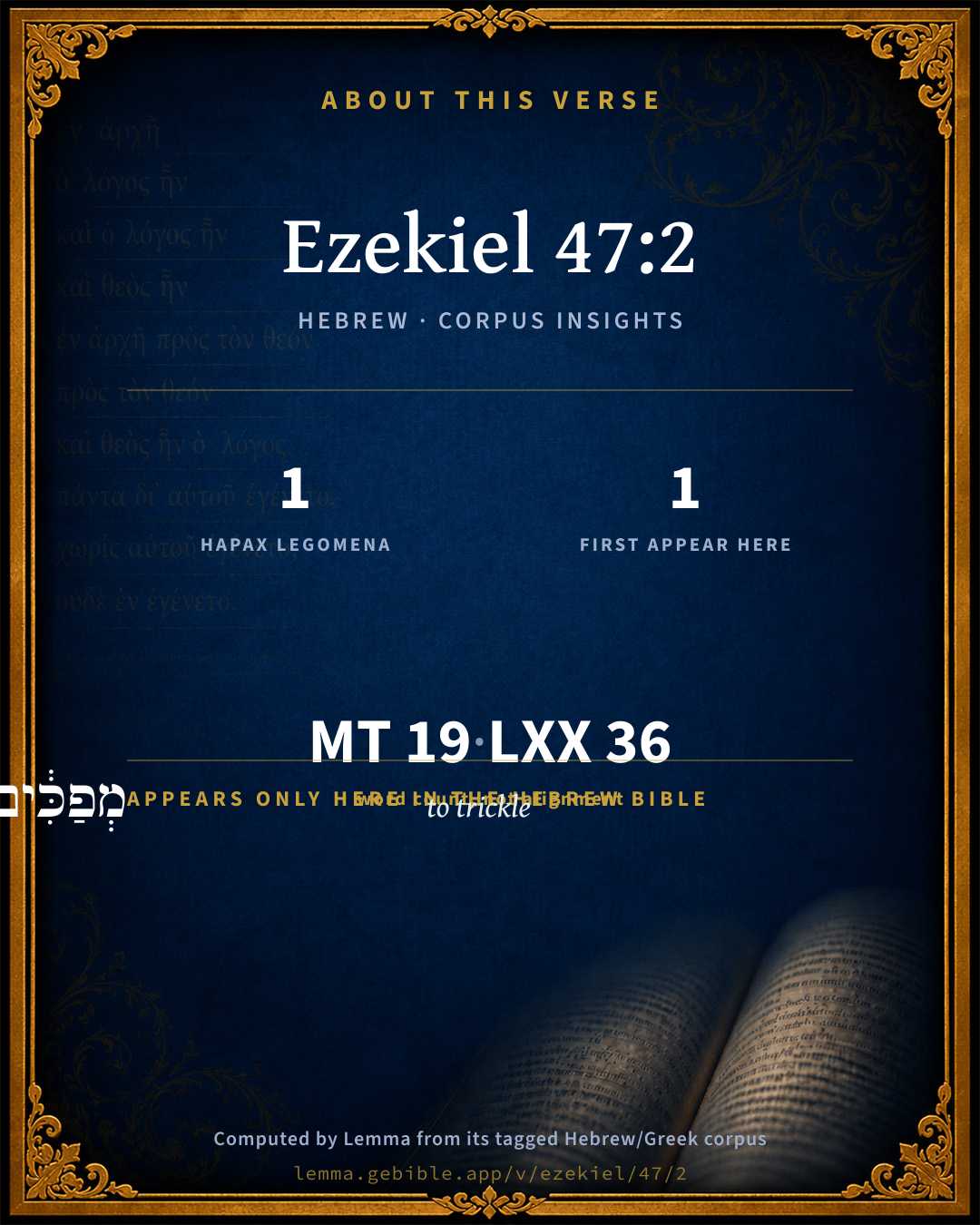
  • 1 hapax legomenon — only here in the Hebrew Bible
  • 1 first appearance in the Hebrew Bible
Full analysis ↓
Download a study sheet

One document with this verse’s original text, its word-by-word gloss line, the meaning frame, cross-references with their text, attributed commentary, and full source and license credits — printable, and it pastes into notes with its structure intact.

This verse Autodidact and up

Study sheet (.html) Plain text (.txt)

A passage Seminary Student

Up to 50 verses in one chapter. A passage sheet keeps up to 6 commentary sources and 12 cross-references per verse, in the order this page ranks them, and says so on the sheet whenever that leaves anything out. Ask for a single verse and you get the Autodidact verse sheet above.

Everything on this page stays free to read, with no account — the sheet is a download of what is already on screen, not access to it.

Want to remove ads? Support Godless Engineer
Compare translations 3

The same verse in 3 English versions, stacked beneath the original-language interlinear above. Click any original word for its lexicon entry.

Each is an independent rendering of the whole verse — the interlinear is not word-aligned to these translations.

Highlighted words mark where these versions differ — a whole-verse word diff, not a word-by-word alignment.

  • World English Bible Public Domain
    Then he brought me out by the way of the gate northward, and led me round by the way outside to the outer gate, by the way of [the gate] that looks toward the east; and, behold, there ran out waters on the right side.
  • King James Version Public Domain
    Then brought he me out of the way of the gate northward, and led me about the way without unto the utter gate by the way that looketh eastward; and, behold, there ran out waters on the right side.
  • unfoldingWord Literal Text CC BY-SA 4.0
    So he brought me out through the northern gate and led me around to the gate facing east, and there the water was flowing from this gate on its south side.

unfoldingWord Literal Text — © unfoldingWord, licensed CC BY-SA 4.0. Word-aligned USFM3 via Door43 (git.door43.org/unfoldingWord/en_ult).

Versions to compare (up to 4)

3 of 4 selected

Show all 18 translations

Every available English version of this verse, each an independent rendering of the whole verse.

  • World English Bible Public Domain
    Then he brought me out by the way of the gate northward, and led me round by the way outside to the outer gate, by the way of [the gate] that looks toward the east; and, behold, there ran out waters on the right side.
  • Berean Standard Bible Public Domain
    Next he brought me out through the north gate and led me around the outside to the outer gate facing east, and there I saw the water trickling out from the south side.
  • Majority Standard Bible Public Domain
    Next he brought me out through the north gate and led me around the outside to the outer gate facing east, and there I saw the water trickling out from the south side.
  • King James Version Public Domain
    Then brought he me out of the way of the gate northward, and led me about the way without unto the utter gate by the way that looketh eastward; and, behold, there ran out waters on the right side.
  • American Standard Version (1901) Public Domain
    Then he brought me out by the way of the gate northward, and led me round by the way without unto the outer gate, by the way of `the gate' that looketh toward the east; and, behold, there ran out waters on the right side.
  • Revised Version (1885) Public Domain
    Then brought he me out by the way of the gate northward, and led me round by the way without unto the outer gate, by the way of the gate that looketh toward the east; and behold, there ran out waters on the right side.
  • Geneva Bible (1599) Public Domain
    Then brought he me out toward the North gate, and led me about by the way without vnto the vtter gate, by the way that turneth Eastward: and behold, there came forth waters on ye right side
  • Douay-Rheims (1899) Public Domain
    And he led me out by the way of the north gate, and he caused me to turn to the way without the outward gate to the way that looked toward the east: and behold there ran out waters on the right side.
  • Young's Literal Translation Public Domain
    And he causeth me to go out the way of the gate northward, and causeth me to turn round the way without, unto the gate that `is' without, the way that is looking eastward, and lo, water is coming forth from the right side.
  • Literal Standard Version CC BY-SA 4.0
    And he causes me to go out the way of the gate northward, and causes me to turn around the way outside, to the gate that [is] outside, the way that is looking eastward, and behold, water is coming forth from the right side.
  • Unlocked Literal Bible CC BY-SA 4.0
    So he brought me out through the northern gate and led around to the gate facing east, and there the water was flowing from this gate on its south side.
  • unfoldingWord Literal Text CC BY-SA 4.0
    So he brought me out through the northern gate and led me around to the gate facing east, and there the water was flowing from this gate on its south side.
  • Darby Bible Public Domain
    And he brought me out by the way of the gate northward, and led me round outside unto the outer gate towards [the gate] that looketh eastward; and behold, waters ran out on the right side.
  • World Messianic Bible Public Domain
    Then he brought me out by the way of the gate northward, and led me around by the way outside to the outer gate, by the way of the gate that looks toward the east. Behold, waters ran out on the right side.
  • Webster's Bible Public Domain
    Then he brought me out of the way of the gate northward, and led me about the way without to the outer gate by the way that looketh eastward; and behold, there ran out waters on the right side.
  • Free Bible Version CC BY-SA 4.0
    Then he took me out through the north gate and led me around the outside to the outer gate that faced east. I saw water was trickling out from the south side of the gate.
  • Bible in Basic English Public Domain
    And he took me out by the north doorway, and made me go round to the outside of the doorway looking to the east; and I saw waters running slowly out on the south side.
  • JPS Tanakh (1917) Public Domain
    Then brought he me out by the way of the gate northward, and led me round by the way without unto the outer gate, by the way of the gate that looketh toward the east; and, behold, there trickled forth waters on the right side.

Literal Standard Version (2020), Covenant Press — licensed CC BY-SA 4.0. Text via the HelloAO Bible API (eBible.org). Unlocked Literal Bible (unfoldingWord) — licensed CC BY-SA 4.0. Text via the HelloAO Bible API (eBible.org). unfoldingWord Literal Text — © unfoldingWord, licensed CC BY-SA 4.0. Word-aligned USFM3 via Door43 (git.door43.org/unfoldingWord/en_ult). Free Bible Version, Dr. Jonathan Gallagher — licensed CC BY-SA 4.0. Text via the HelloAO Bible API (eBible.org).

Word by word

More ways to search: Search by grammar → Find every occurrence → Compare this word →

Practice this passage: Drill this verse → Learn its vocabulary →

מְפַכִּ֔ים
pâkâh
H6379
“trickling”
Verb, Piel, Participle Active, Masculine, Plural, Absolute
Part of Speech
Verb
Stem
Piel
Form
Participle Active
Gender
Masculine
Number
Plural
State
Absolute
Full BDB Definition

Origin: a primitive root

TWOT: 1767b

to trickle, pour - (Piel) to trickle, drop down (water)
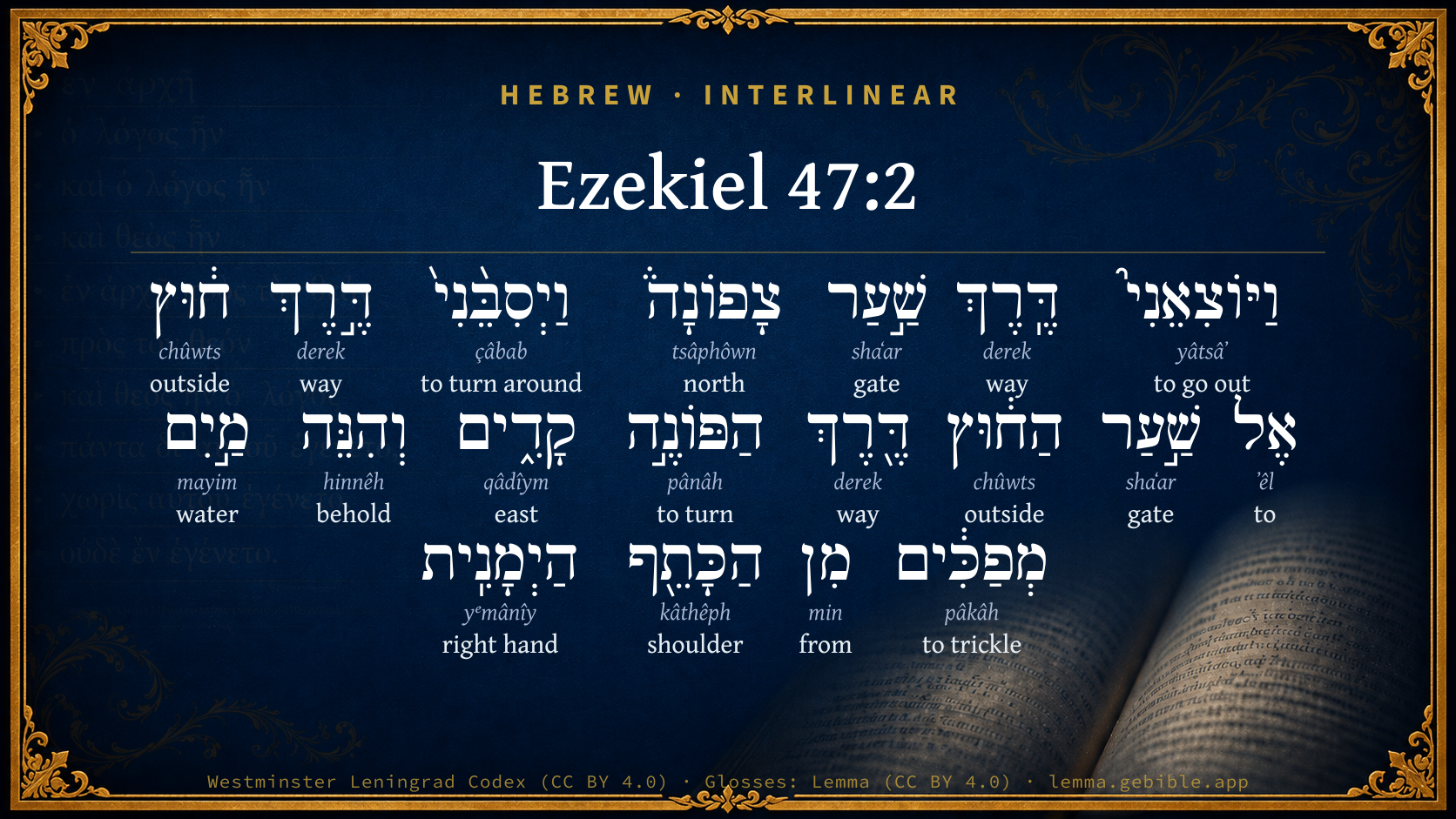
  1. וַיּוֹצִאֵנִי֮ yâtsâʼ H3318 “and · to go out · me” Conjunction + Verb, Hiphil, Sequential Imperfect, 3rd Person, Masculine, Singular + Suffix, Personal, 1st Person, Common, Singular
  2. דֶּֽרֶךְ derek H1870 “way of” Noun, Common, Both, Singular, Construct
  3. שַׁ֣עַר shaʻar H8179 “gate” Noun, Common, Masculine, Singular, Absolute
  4. צָפוֹנָה֒ tsâphôwn H6828 “north · toward” Noun, Common, Feminine, Singular, Absolute + Suffix, Demonstrative
  5. וַיְסִבֵּ֨נִי֙ çâbab H5437 “and · to turn around · me” Conjunction + Verb, Hiphil, Sequential Imperfect, 3rd Person, Masculine, Singular + Suffix, Personal, 1st Person, Common, Singular
  6. דֶּ֣רֶךְ derek H1870 “way of” Noun, Common, Both, Singular, Construct
  7. ח֔וּץ chûwts H2351 “outside” Noun, Common, Masculine, Singular, Absolute
  8. אֶל ʼêl H413 “to” Preposition
  9. שַׁ֣עַר shaʻar H8179 “gate of” Noun, Common, Masculine, Singular, Construct
  10. הַח֔וּץ chûwts H2351 “the · outside” Particle, Definite Article + Noun, Common, Masculine, Singular, Absolute
  11. דֶּ֖רֶךְ derek H1870 “way” Noun, Common, Both, Singular, Absolute
  12. הַפּוֹנֶ֣ה pânâh H6437 “the · turning” Particle, Definite Article + Verb, Qal, Participle Active, Masculine, Singular, Absolute
  13. קָדִ֑ים qâdîym H6921 “east” Noun, Common, Masculine, Singular, Absolute
  14. וְהִנֵּה hinnêh H2009 “and · behold” Conjunction + Particle, Demonstrative
  15. מַ֣יִם mayim H4325 “water(s)” Noun, Common, Masculine, Plural, Absolute
  16. מִן min H4480 “from” Preposition
  17. הַכָּתֵ֖ף kâthêph H3802 “the · shoulder” Particle, Definite Article + Noun, Common, Feminine, Singular, Absolute
  18. הַיְמָנִֽית yᵉmânîy H3233 “the · right hand” Particle, Definite Article + Adjective, Adjective, Feminine, Singular, Absolute

About this verse

These counts appear in no published source. They are computed here, from the morphology-tagged text and Lemma’s own curated glosses. What Lemma adds →

19
words
15
distinct lemmas
Prophets
section

Notable vocabulary

1 hapax legomenon — a word that appears only here in the entire Hebrew Bible:

  • מְפַכִּ֔ים to trickle H6379

First appearance in Scripture

This word makes its first canonical appearance in the Hebrew Bible here:

  • מְפַכִּ֔ים to trickle H6379

Shared distinctive vocabulary

הַיְמָנִֽית right hand H3233 occurs in 19 verses of the Hebrew Bible. Also found in:

Grammatical profile

  • 4 verbs
  • 11 nouns
  • 1 adjective
  • 2 prepositions
  • 1 particle

Verb forms

  • וַיּוֹצִאֵנִי֮ Hiphil · Sequential Imperfect
  • וַיְסִבֵּ֨נִי֙ Hiphil · Sequential Imperfect
  • הַפּוֹנֶ֣ה Qal · Participle Active
  • מְפַכִּ֔ים Piel · Participle Active

Repetition

Words recur within this verse — often emphatic in Hebrew:

  • דֶּֽרֶךְ way H1870 ×3
  • שַׁ֣עַר gate H8179 ×2
  • ח֔וּץ outside H2351 ×2

Hebrew & Septuagint length

In English translation the verse runs 45 words from the Hebrew and 39 from the Septuagint (LXX English) — closely comparable.

A rough comparison of the two English renderings, which tokenize alike — not a word-level alignment.

Word counts can differ between the Hebrew and the Greek without any difference in meaning — e.g. the Hebrew direct-object marker אֵת has no separate Greek word, and Greek often adds the article ὁ.

In the original languages it is 19 Hebrew tokens and 36 Greek tokens — but the two are counted differently (Hebrew bundles its prefixes and suffixes into one token; the Greek is in lemma form), so that isn’t a like-for-like length.

Cross-references

2

Topical passages linked to Ezekiel 47:2 in the Treasury of Scripture Knowledge — connected by theme and wording, ordered by reader-vote popularity; previews shown in the World English Bible.

  • Ezekiel 44:2 Yahweh said to me, This gate shall be shut; it shall not be opened, neither shall any man enter in by it; for Yahweh, the God of Israel, has entered in by it; therefore it shall be shut.
  • Ezekiel 44:4 Then he brought me by the way of the north gate before the house; and I looked, and, behold, the glory of Yahweh filled the house of Yahweh: and I fell on my face.

Cross-references courtesy of OpenBible.info (CC BY 4.0).

Hebrew and Greek witnesses Masoretic Hebrew ↔ Greek Septuagint

The same verse in the two great witnesses to the Old Testament, shown verse-for-verse.

These are two independent witnesses, not word-aligned to each other, and the Septuagint is shown in lemma (dictionary) form.

Hebrew Ezekiel 47:2 Masoretic · Westminster Leningrad Codex

וַיּוֹצִאֵנִי֮ דֶּֽרֶךְ שַׁ֣עַר צָפוֹנָה֒ וַיְסִבֵּ֨נִי֙ דֶּ֣רֶךְ ח֔וּץ אֶל שַׁ֣עַר הַח֔וּץ דֶּ֖רֶךְ הַפּוֹנֶ֣ה קָדִ֑ים וְהִנֵּה מַ֣יִם מְפַכִּ֔ים מִן הַכָּתֵ֖ף הַיְמָנִֽית

Then he brought me out by the way of the gate northward, and led me round by the way outside to the outer gate, by the way of [the gate] that looks toward the east; and, behold, there ran out waters on the right side.

World English Bible · Public Domain

Greek LXX Ezekiel 47:2 Septuagint · lemma form

καί ἐκἄγω ἐγώ κατά ὁ ὁδός ὁ πύλη ὁ πρός βορέας καί περιἄγω ἐγώ ὁ ὁδός ἔξωθεν πρός ὁ πύλη ὁ αὐλή ὁ βλέπω κατά ἀνατολή καί ἰδού ὁ ὕδωρ καταφέρω ἀπό ὁ κλίτος ὁ δεξιός

And he brought me out by the way of the northern gate, and he led me round by the way outside to the gate of the court that looks eastward; and, behold, water came down from the right side,

LXX2012 (modern English Septuagint) · Public Domain

Hebrew: Westminster Leningrad Codex (CC BY 4.0). Greek: Septuagint (public domain); English from LXX2012 (modern English Septuagint) (Public Domain). How the Septuagint differs from the Hebrew →

Targum (Aramaic paraphrase)

1

The Targum is the ancient Jewish Aramaic paraphrase of the Hebrew Scriptures — an interpretive translation, not the Hebrew text itself. Onkelos (literal) and Pseudo-Jonathan (expansive) render the Torah, and Jonathan the Prophets. Coverage is partial: where no permissively-licensed English translation exists for a verse, only the Aramaic is shown. This is verse-level text, not a word-by-word alignment to the Hebrew.

  1. Targum Jonathan Prophets (Joshua–Malachi)
    וְאַפְקֵנִי בְּאוֹרַח תַּרְעָא צִפּוּנָא וְאַסְחֲרַנִי בְּאוֹרַח דִי לְבָרָא לְתַרְעָא בְּרָאָה אוֹרַח תַּרְעָא דִפְתִיחַ לְמַדִינְחָא וְהָא מַיָא נַפְקִין מִן עַבְרָא דְיַמִינָא:

    (no public-domain English translation for this verse)

    Targum Jonathan — Aramaic: “Mikraot Gedolot” (public domain). English: “Sefaria Community Translation” (CC0 1.0 (public-domain dedication)); “London "Chaldee Paraphrase," 1871” (public domain). Text via Sefaria.

Commentary

Notes on Ezekiel 47:2 from classic Christian and Jewish commentators (each source and its license shown beneath its notes). The classic Christian expositions comment on the surrounding passage and are grouped to its opening verse, so a note may address several verses; the Jewish commentaries on the Tanakh (Rashi and others) are per-verse, so they appear only where the commentator wrote on this verse.

Lemma curates 59 commentaries, every one of them public domain or Creative Commons licensed, each selected and text-cleaned for this edition rather than reprinted as found. About our sources →

Trapp's Complete Commentary

John Trapp

Eze 47:2 Then brought he me out of the way of the gate northward, and led me about the way without unto the utter gate by the way that looketh eastward; and, behold, there ran out waters on the right side.

Ver. 2. And, behold, there ran out waters.] As out of a vial.

On the right side.] The right side is a place of honour and defence. The doctrine of the gospel hath the pre-eminence, and is maintained by the right hand of God against all opposites.

John Trapp, A Commentary or Exposition upon All the Books of the Old and New Testament (1647–1656) — public domain. Text from a community e-Sword module.

Adam Clarke's Commentary

Verse 2. There ran out waters] מים מפכים mayim mephaccim, the waters seem to have been at first in small quantity; for the words imply that they oozed or dropped out. They were at first so small that they came guttatim, drop by drop; but they increased so, that they became a river in which one could swim.

Adam Clarke's Commentary on the Bible (1810–1826) — public domain. Text from a community e-Sword/MySword module.

Ellicott's Commentary for English Readers

(2) Out of the way of the gate northward.—Rather, out by the way of the north gate. The east gate, the direct way, was shut (Eze_44:2); the prophet was therefore carried round to the outside of it by the way of the north gate. There he saw the waters on the right, or south, side of the gateway.

A Bible Commentary for English Readers, edited by Charles John Ellicott (1878–1897) — public domain. Text from a community e-Sword module.

The Cambridge Bible for Schools and Colleges

gen. ed. J. J. S. Perowne

2. The eastern gates being shut (Eze_44:2, Eze_46:1) the prophet is led put by the N. gate, round to the outer E. gate, at which he beheld the stream emerge into the open at the S. side of the gate.

by the way that looketh] which looketh, viz. the gate.

The Cambridge Bible for Schools and Colleges (gen. ed. J. J. S. Perowne; Cambridge University Press, 1878–1918) — public domain. Text from a community e-Sword module.

John Gill's Exposition

Then brought he me out of the way of the gate northward,.... Out of the inward court where he was, by the way of the north gate, the eastern gate being shut:

and led me about the way without unto the utter gate, by the way that looketh eastward; and from thence he had him round to the outward eastern gate, where he was at first, Eze 40:6, to meet the flow of waters that came through the inward and outward courts eastward:

and, behold, there ran out waters on the right side; that is, on the south side of the gate, in a small quantity, and in a very still and easy way, like water out of the mouth of a vial, as the word (b) signifies. So Bartenora (c), who understands this gate of the water gate, interprets the right side of the south; and observes, that the prophet first saw the waters come out very small, like the horns of a locust; but when they came to this gate, they became like water as it flows out of the mouth of a small pitcher: and from this whole account of the waters, it is plain they cannot be understood literally, but figuratively; and which confirm this to be the sense of the whole vision. They may be applied unto, and serve to illustrate, the love of God; the secret spring of which is in the heart and will of God; ran under ground from all eternity; channelled in Christ; broke up and issued forth in the mission of him into the world, under the threshold of him, the door of the church; and in and by him, the altar, sacrifice, and propitiation; wherein the love of God in an especial manner is manifested; and which has its heights and depths, immeasurable and unfathomable, Eph 3:18, these waters also may be applied to the grace of the Spirit of God in regeneration and conversion; which is compared to water, for its cleansing, fructifying, and refreshing nature; to "waters", for the abundance of it; and this flows from the God of all grace through Christ, and out of his fulness is gradually increased, and becomes a well, yea, rivers of living water, Joh 7:37, but it seems best to understand them of the Gospel, and the doctrines of it; which, like water, cools those who are inflamed with the heat of the fiery law; extinguishes the thirst of sensible sinners, and refreshes them; cleanses and purifies their souls, which is instrumentally done with the washing of water by the word; and makes them fruitful and flourishing: this is not of men, but God; comes from heaven, the holy of holies; and out of the house and church of God; from Zion and Jerusalem, by Christ the door, and points to him the way; and is chiefly concerning him, the altar, his sacrifice and satisfaction, peace, atonement, and propitiation by him; see Isa 2:3.

(b) "manabant tanquam e phiala", Junius & Tremellius; "phialabant", Junius; "destillabant", Cocceius, Starckius. (c) In Misn. Middot, c. 1. sect. 4.

John Gill's Exposition of the Whole Bible (1746–1763) — public domain (CC PDM 1.0). Text via the HelloAO Bible API.

Albert Barnes' Notes on the Bible

Out of the way of the gate northward - Rather, by the way of the northward gate.

Albert Barnes' Notes on the Bible (1834–1885) — public domain. Text from a community e-Sword/MySword module.

Haydock's Catholic Bible Commentary

East. This gate was shut, and therefore he went out at the north gate. (Calmet)

George Leo Haydock (1774–1849), Haydock's Catholic Family Bible and Commentary, 1859 edition — public domain. Excludes Psalms (Douay-Rheims chapter numbering differs from Protestant) and Deuterocanonical books (Catholic canon only).

Matthew Poole's English Annotations

Then brought he me out of the inmost court, where he saw the waters running under the threshold, and by the south side of the altar.

The way of the gate northward: the east gate being shut, the prophet in this vision is led to the north gate, out of which he goeth into the next court, and so through them all, till he comes to the north gate of the outmost court.

Led me about; caused him to go about from that gate to the east gate of the same court.

The way without; not on the inside of the wall, but round on the outside of the wall, which will appear presently, and the reason why.

The utter gate; the outmost north gate in the wall, that compassed the whole mountain of the Lord’s house.

The way that looketh eastward; when the prophet was come quite out of all the courts, and is on the outside of the last wall, he is turned from the north gate towards the east gate, and walks up to that gate.

And, behold, there he found the watercourse.

On the right side; that is, on the south side. See Eze 47:1.

Matthew Poole's English Annotations on the Holy Bible (1683–1685) — public domain. Text from a community e-Sword/MySword module.

The Pulpit Commentary

As the prophet could not follow the stream"s course by passing through the east inner gate, which was shut on the six working days, (Eze_46:1) or through the east outer gate, which was always shut, (Eze_44:1) his conductor led him outside of the inner and outer courts by the north gates (literally, to the north (outer) gate), and brought him round by the way without unto the outer gate by the way that looketh eastward. This can only import that, on reaching the north outer gate, the prophet and his guide turned eastward and moved round to the east outer gate. The Revised Version reads, by the way of the gate that looketh toward the east; but as the east outer gate was the terminus ad quem of the prophet"s walk, it is better to translate, to the gate looking eastward. When the prophet had arrived thither, he once more beheld that there ran out literally, trickled forth ( occurring here only in Scripture, and being derived from hkp; "to drop down," or "weep")waters. Obviously these were the same as Ezekiel had already observed (whence probably the omission of the article; see Ewald"s "Syntax of the Hebrew Grammar," p. 34, Eng. transl.). On (literally, from) the right side; or, shoulder. This, again, signified the corner where the east wall of the temple and the south wall of the gate joined.

The Pulpit Commentary (1880–1919), ed. H.D.M. Spence-Jones & Joseph S. Exell — public domain. Text from a community e-Sword module.

John Wesley's Explanatory Notes

Out - Of the inmost court. The outer gate - The outmost north- gate in the wall that compassed the whole mountain of the Lord's house.

John Wesley, Explanatory Notes Upon the Whole Bible (1754–1765) — public domain. Text via the GEBible commentary corpus.

Rashi

Rabbi Shlomo Yitzchaki (Rashi)

And he took me out of the Inner Court to the Outer Court through the northern gate.

and led me around around the inner wall within the outer one.

to the...Gate The outer [gate] that faces eastward.

water was trickling [Heb. מְפַכִּים,] buient in O.F., dripping, trickling, as wide as the width of the mouth of a jug. So did our Sages explain it, as above.

Rashi on the Tanakh — English translations: “The Judaica Press complete Tanach with Rashi, translated by A. J. Rosenberg” (CC BY 4.0); “Pentateuch with Rashi's commentary by M. Rosenbaum and A.M. Silbermann, 1929-1934” (public domain); “The Metsudah Tanach series, Lakewood, N.J” (CC BY 4.0); and “The Book of Joshua, Metsudah Publications, 1997” (CC BY 4.0). Text via Sefaria.

Lesson kit

Teaching starters — assembled from the data on this page, not authored interpretation. Every prompt links to the verse data it draws on. Edit before teaching.

Ezekiel, in the Prophets, opens this verse with 19 words (15 distinct Hebrew lemmas). Its most distinctive word is pâkâh (“to trickle”). A historical commentator’s framing appears above. Read the whole chapter for the surrounding context.

Discussion questions

  1. The word pâkâh carries the sense “to trickle.” How does it shape the verse?
  2. This verse holds 1 word here found nowhere else in the Hebrew Bible. What might the rare word draw attention to?
  3. The word “to trickle” first appears here in Scripture. What is being introduced at this debut?
  4. Exodus 29:20 shares the word «right hand» with this verse. How do the two illuminate each other?
  5. “way” occurs 3× in this one verse. What is the effect of the repetition?
  6. These translations render this verse differently; the difference is in the English rendering, not the original. What questions does that raise?
  7. The verb «וַיּוֹצִאֵנִי֮» is Hiphil Sequential Imperfect. How does its form color the action?
  8. Reading how Trapp's Complete Commentary and Adam Clarke's Commentary read this verse, where do the two commentators agree and where do they part?

Things to notice

  • 1 word in this verse appears nowhere else in the Hebrew Bible.
  • 1 word makes its first canonical appearance in Scripture here.
  • This verse counts 19 Hebrew ↔ 36 Greek words.
  • These translations choose different wording for 24 words in this verse.
  • “way” occurs 3× in this single verse.

Reading settings

Reading text

Shown beneath each verse's original-language words.

Old Testament
Old Testament edition

Read the OT as the Masoretic Hebrew (MT) or the Greek Septuagint (LXX).

English shown for the Greek Septuagint (in the Hebrew ↔ Greek comparison).

Comparing translations? Open the Compare panel on any verse page to stack up to four side by side.