Leviticus 24:14

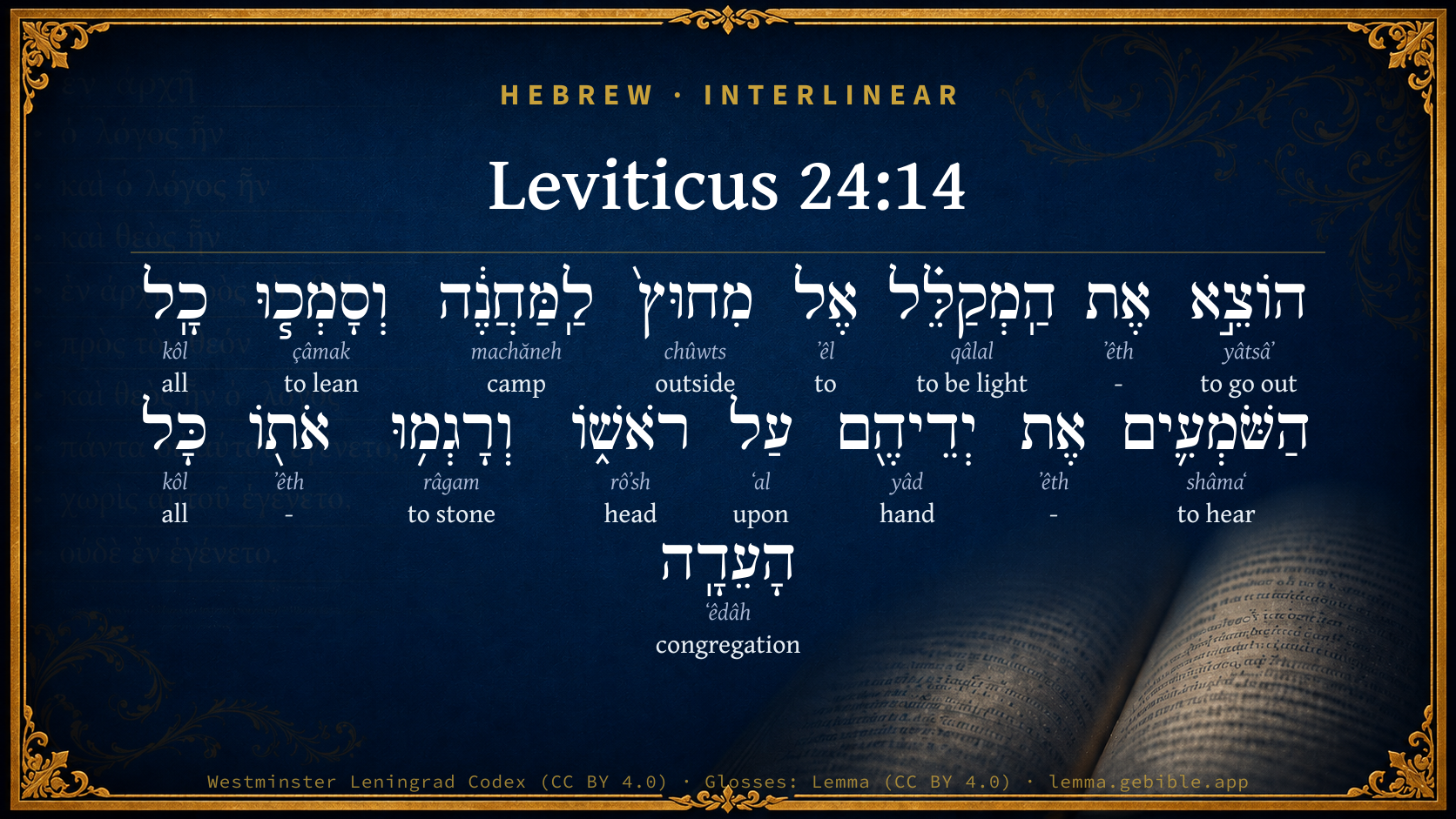
Hebrew (Westminster Leningrad Codex) Leviticus 24:14 appears in the Hebrew Old Testament. The text above is from the Westminster Leningrad Codex. Each word links to its Strong’s number, a concise gloss, and parsing drawn from the Open Scriptures Hebrew Bible morphology. Click any word for its full Brown-Driver-Briggs (BDB) entry.
Download image
Cite this verse

Leviticus 24:14 (World English Bible). Public Domain. Lemma interlinear Bible study tool, https://lemma.gebible.app/v/leviticus/24/14.

Show BibTeX & RIS
BibTeX
RIS
English Translation
"Bring out of the camp him who cursed; and let all who heard him lay their hands on his head, and let all the congregation stone him.
World English Bible · Public Domain
Download a study sheet

One document with this verse’s original text, its word-by-word gloss line, the meaning frame, cross-references with their text, attributed commentary, and full source and license credits — printable, and it pastes into notes with its structure intact.

This verse Autodidact and up

Study sheet (.html) Plain text (.txt)

A passage Seminary Student

Up to 50 verses in one chapter. A passage sheet keeps up to 6 commentary sources and 12 cross-references per verse, in the order this page ranks them, and says so on the sheet whenever that leaves anything out. Ask for a single verse and you get the Autodidact verse sheet above.

Everything on this page stays free to read, with no account — the sheet is a download of what is already on screen, not access to it.

Want to remove ads? Support Godless Engineer
Compare translations 3

The same verse in 3 English versions, stacked beneath the original-language interlinear above. Click any original word for its lexicon entry.

Each is an independent rendering of the whole verse — the interlinear is not word-aligned to these translations.

Highlighted words mark where these versions differ — a whole-verse word diff, not a word-by-word alignment.

  • World English Bible Public Domain
    "Bring out of the camp him who cursed; and let all who heard him lay their hands on his head, and let all the congregation stone him.
  • King James Version Public Domain
    Bring forth him that hath cursed without the camp; and let all that heard him lay their hands upon his head, and let all the congregation stone him.
  • unfoldingWord Literal Text CC BY-SA 4.0
    “Bring out the curser to outside of the camp, and all the hearers shall lay their hands on his head, and all the congregation shall stone him.

unfoldingWord Literal Text — © unfoldingWord, licensed CC BY-SA 4.0. Word-aligned USFM3 via Door43 (git.door43.org/unfoldingWord/en_ult).

Versions to compare (up to 4)

3 of 4 selected

Show all 18 translations

Every available English version of this verse, each an independent rendering of the whole verse.

  • World English Bible Public Domain
    "Bring out of the camp him who cursed; and let all who heard him lay their hands on his head, and let all the congregation stone him.
  • Berean Standard Bible Public Domain
    “Take the blasphemer outside the camp, and have all who heard him lay their hands on his head; then have the whole assembly stone him.
  • Majority Standard Bible Public Domain
    “Take the blasphemer outside the camp, and have all who heard him lay their hands on his head; then have the whole assembly stone him.
  • King James Version Public Domain
    Bring forth him that hath cursed without the camp; and let all that heard him lay their hands upon his head, and let all the congregation stone him.
  • American Standard Version (1901) Public Domain
    Bring forth him that hath cursed without the camp; and let all that heard him lay their hands upon his head, and let all the congregation stone him.
  • Revised Version (1885) Public Domain
    Bring forth him that hath cursed without the camp; and let all that heard him lay their hands upon his head, and let all the congregation stone him.
  • Geneva Bible (1599) Public Domain
    Bring the blasphemer without the hoste, and let all that heard him, put their handes vpon his head, and let all the Congregation stone him.
  • Douay-Rheims (1899) Public Domain
    Saying: Bring forth the blasphemer without the camp, and let them that heard him, put their hands upon his head, and let all the people stone him.
  • Young's Literal Translation Public Domain
    `Bring out the reviler unto the outside of the camp; and all those hearing have laid their hands on his head, and all the company have stoned him.
  • Literal Standard Version CC BY-SA 4.0
    “Bring out the reviler to the outside of the camp; and all those hearing have laid their hands on his head, and all the congregation has stoned him.
  • Unlocked Literal Bible CC BY-SA 4.0
    “Take the man who has cursed God outside the camp. All who heard him must lay their hands on his head, and then the entire assembly must stone him.
  • unfoldingWord Literal Text CC BY-SA 4.0
    “Bring out the curser to outside of the camp, and all the hearers shall lay their hands on his head, and all the congregation shall stone him.
  • Darby Bible Public Domain
    Lead the reviler outside the camp; and all that heard [him] shall lay their hands upon his head, and the whole assembly shall stone him.
  • World Messianic Bible Public Domain
    “Bring him who cursed out of the camp; and let all who heard him lay their hands on his head, and let all the congregation stone him.
  • Webster's Bible Public Domain
    Bring forth him that hath cursed without the camp; and let all that heard him lay their hands upon his head, and let all the congregation stone him.
  • Free Bible Version CC BY-SA 4.0
    “Take the man who cursed me outside the camp. Have all who heard him curse put their hands on his head; then have everyone stone him to death.
  • Bible in Basic English Public Domain
    Take the curser outside the tent-circle; and let all in whose hearing the words were said put their hands on his head, and let him be stoned by all the people.
  • JPS Tanakh (1917) Public Domain
    'Bring forth him that hath cursed without the camp; and let all that heard him lay their hands upon his head, and let all the congregation stone him.

Literal Standard Version (2020), Covenant Press — licensed CC BY-SA 4.0. Text via the HelloAO Bible API (eBible.org). Unlocked Literal Bible (unfoldingWord) — licensed CC BY-SA 4.0. Text via the HelloAO Bible API (eBible.org). unfoldingWord Literal Text — © unfoldingWord, licensed CC BY-SA 4.0. Word-aligned USFM3 via Door43 (git.door43.org/unfoldingWord/en_ult). Free Bible Version, Dr. Jonathan Gallagher — licensed CC BY-SA 4.0. Text via the HelloAO Bible API (eBible.org).

Word by word

More ways to search: Search by grammar → Find every occurrence → Compare this word →

Practice this passage: Drill this verse → Learn its vocabulary →

וְרָגְמ֥וּ
râgam
H7275
“and · to stone”
Conjunction + Verb, Qal, Perfect, 3rd Person, Common, Plural
Part of Speech
Conjunction + Verb
Stem
Qal
Form
Perfect
Person
3rd Person
Gender
Common
Number
Plural
Full BDB Definition

Origin: a primitive root [compare H7263 , H7321 , H7551 ]

TWOT: 2114

to stone, slay or kill by stoning - (Qal) to stone
  1. הוֹצֵ֣א yâtsâʼ H3318 “go out” Verb, Hiphil, Imperative, 2nd Person, Masculine, Singular
  2. אֶת ʼêth H853 “-” Particle, Direct Object
  3. הַֽמְקַלֵּ֗ל qâlal H7043 “the · being light” Particle, Definite Article + Verb, Piel, Participle Active, Masculine, Singular, Absolute
  4. אֶל ʼêl H413 “to” Preposition
  5. מִחוּץ֙ chûwts H2351 “from · outside” Preposition + Noun, Common, Masculine, Singular, Absolute
  6. לַֽמַּחֲנֶ֔ה machăneh H4264 “to/for the · camp” Preposition, Determined + Noun, Common, Both, Singular, Absolute
  7. וְסָמְכ֧וּ çâmak H5564 “and · to lean” Conjunction + Verb, Qal, Perfect, 3rd Person, Common, Plural
  8. כָֽל kôl H3605 “all of” Noun, Common, Masculine, Singular, Construct
  9. הַשֹּׁמְעִ֛ים shâmaʻ H8085 “the · hearing” Particle, Definite Article + Verb, Qal, Participle Active, Masculine, Plural, Absolute
  10. אֶת ʼêth H853 “-” Particle, Direct Object
  11. יְדֵיהֶ֖ם yâd H3027 “hands · their” Noun, Common, Both, Dual, Construct + Suffix, Personal, 3rd Person, Masculine, Plural
  12. עַל ʻal H5921 “upon” Preposition
  13. רֹאשׁ֑וֹ rôʼsh H7218 “head · his” Noun, Common, Masculine, Singular, Construct + Suffix, Personal, 3rd Person, Masculine, Singular
  14. אֹת֖וֹ ʼêth H853 “- · him” Particle, Direct Object + Suffix, Personal, 3rd Person, Masculine, Singular
  15. כָּל kôl H3605 “all of” Noun, Common, Masculine, Singular, Construct
  16. הָעֵדָֽה ʻêdâh H5712 “the · congregation” Particle, Definite Article + Noun, Common, Feminine, Singular, Absolute

About this verse

These counts appear in no published source. They are computed here, from the morphology-tagged text and Lemma’s own curated glosses. What Lemma adds →

17
words
14
distinct lemmas
Pentateuch
section

Notable vocabulary

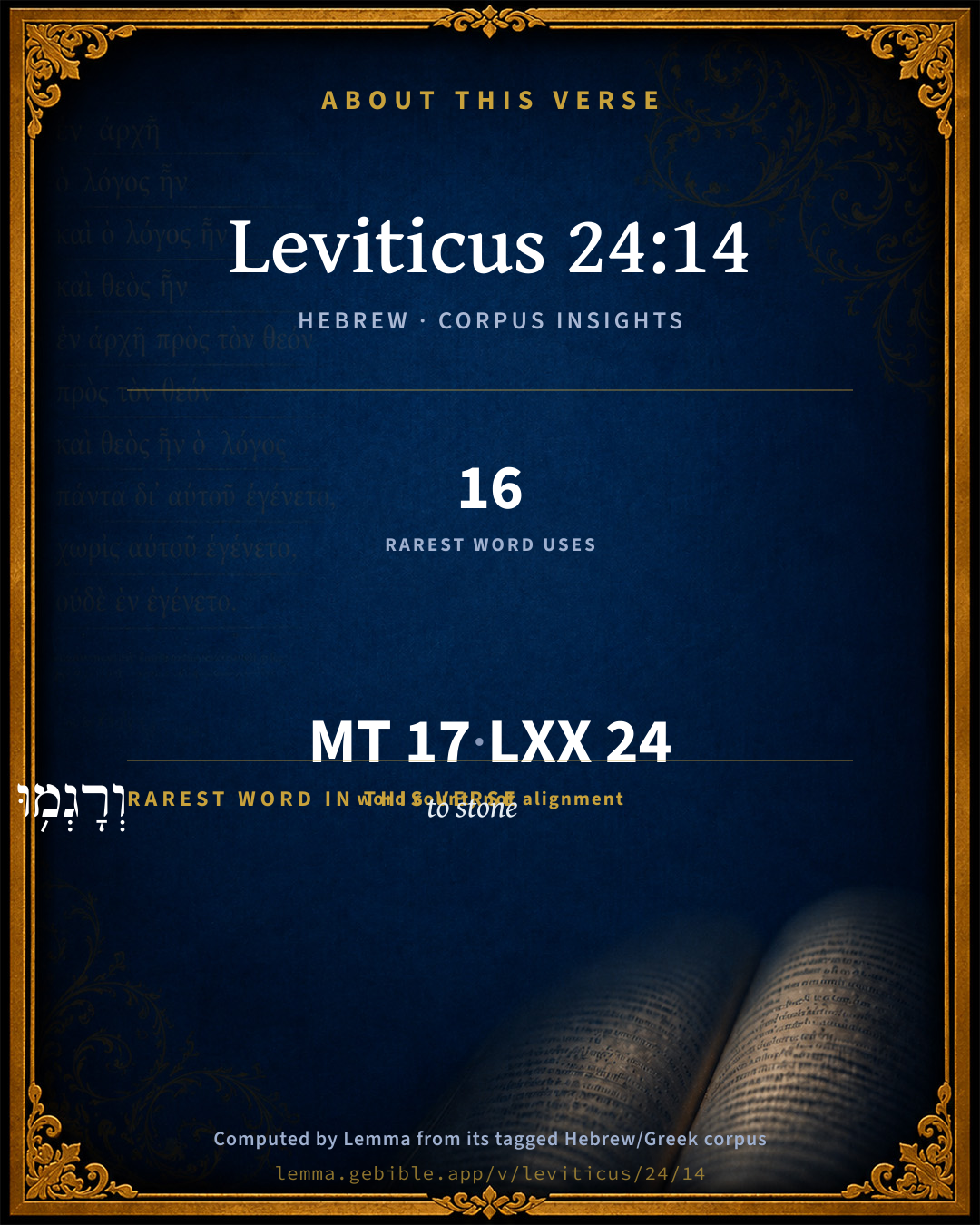
The rarest word here is וְרָגְמ֥וּ to stone H7275 — appearing just 16 times in the whole Hebrew Bible.

Shared distinctive vocabulary

וְרָגְמ֥וּ to stone H7275 occurs in 15 verses of the Hebrew Bible. Also found in:

Grammatical profile

  • 5 verbs
  • 7 nouns
  • 2 prepositions
  • 3 particles

Verb forms

  • הוֹצֵ֣א Hiphil · Imperative
  • הַֽמְקַלֵּ֗ל Piel · Participle Active
  • וְסָמְכ֧וּ Qal · Perfect
  • הַשֹּׁמְעִ֛ים Qal · Participle Active
  • וְרָגְמ֥וּ Qal · Perfect

Repetition

A word recurs within this verse — often emphatic in Hebrew:

Hebrew & Septuagint length

In English translation the verse runs 27 words from the Hebrew and 26 from the Septuagint (LXX English) — closely comparable.

A rough comparison of the two English renderings, which tokenize alike — not a word-level alignment.

Word counts can differ between the Hebrew and the Greek without any difference in meaning — e.g. the Hebrew direct-object marker אֵת has no separate Greek word, and Greek often adds the article ὁ.

In the original languages it is 17 Hebrew tokens and 24 Greek tokens — but the two are counted differently (Hebrew bundles its prefixes and suffixes into one token; the Greek is in lemma form), so that isn’t a like-for-like length.

Cross-references

13

Topical passages linked to Leviticus 24:14 in the Treasury of Scripture Knowledge — connected by theme and wording, ordered by reader-vote popularity; previews shown in the World English Bible.

  • Deuteronomy 17:7 The hand of the witnesses shall be first on him to put him to death, and afterward the hand of all the people. So you shall put away the evil from the midst of you.
  • Leviticus 20:27 "'A man or a woman that is a medium, or is a wizard, shall surely be put to death: they shall stone them with stones; their blood shall be upon them.'"
  • Deuteronomy 21:21 All the men of his city shall stone him to death with stones: so shall you put away the evil from the midst of you; and all Israel shall hear, and fear.
  • Leviticus 20:2 "Moreover, you shall tell the children of Israel, 'Anyone of the children of Israel, or of the strangers who live as foreigners in Israel, who gives any of his seed to Molech; he shall surely be put to death. The people of the land shall stone him with stones.
  • John 10:31–33 Therefore Jews took up stones again to stone him.
  • Leviticus 13:46 All the days in which the plague is in him he shall be unclean. He is unclean. He shall dwell alone. Outside of the camp shall be his dwelling.
  • Numbers 5:2–4 "Command the children of Israel that they put out of the camp every leper, and everyone who has an issue, and whoever is unclean by the dead.
  • Numbers 15:35–36 Yahweh said to Moses, The man shall surely be put to death: all the congregation shall stone him with stones outside of the camp.
  • Deuteronomy 13:9–10 but you shall surely kill him; your hand shall be first on him to put him to death, and afterwards the hand of all the people.
  • Deuteronomy 22:21 then they shall bring out the young lady to the door of her father's house, and the men of her city shall stone her to death with stones, because she has done folly in Israel, to play the prostitute in her father's house: so shall you put away the evil from the midst of you.
  • Joshua 7:25 Joshua said, Why have you troubled us? Yahweh shall trouble you this day. All Israel stoned him with stones; and they burned them with fire, and stoned them with stones.
  • John 8:59 Therefore they took up stones to throw at him, but Jesus was hidden, and went out of the temple, having gone through the midst of them, and so passed by.
  • Acts 7:58–59 They threw him out of the city, and stoned him. The witnesses placed their garments at the feet of a young man named Saul.

Cross-references courtesy of OpenBible.info (CC BY 4.0).

Hebrew and Greek witnesses Masoretic Hebrew ↔ Greek Septuagint

The same verse in the two great witnesses to the Old Testament, shown verse-for-verse.

These are two independent witnesses, not word-aligned to each other, and the Septuagint is shown in lemma (dictionary) form.

Hebrew Leviticus 24:14 Masoretic · Westminster Leningrad Codex

הוֹצֵ֣א אֶת הַֽמְקַלֵּ֗ל אֶל מִחוּץ֙ לַֽמַּחֲנֶ֔ה וְסָמְכ֧וּ כָֽל הַשֹּׁמְעִ֛ים אֶת יְדֵיהֶ֖ם עַל רֹאשׁ֑וֹ וְרָגְמ֥וּ אֹת֖וֹ כָּל הָעֵדָֽה

"Bring out of the camp him who cursed; and let all who heard him lay their hands on his head, and let all the congregation stone him.

World English Bible · Public Domain

Greek LXX Leviticus 24:14 Septuagint · lemma form

ἐκἄγω ὁ καταἀράομαι ἔξω ὁ παρεμβολή καί ἐπιτίθημι πᾶς ὁ ἀκούω ὁ χείρ αὐτός ἐπί ὁ κεφαλή αὐτός καί λιθοβολέω αὐτός πᾶς ὁ συναγωγή

Bring forth him that cursed outside the camp, and all who heard shall lay their hands upon his head, and all the congregation shall stone him.

LXX2012 (modern English Septuagint) · Public Domain

Hebrew: Westminster Leningrad Codex (CC BY 4.0). Greek: Septuagint (public domain); English from LXX2012 (modern English Septuagint) (Public Domain). How the Septuagint differs from the Hebrew →

Targum (Aramaic paraphrase)

2

The Targum is the ancient Jewish Aramaic paraphrase of the Hebrew Scriptures — an interpretive translation, not the Hebrew text itself. Onkelos (literal) and Pseudo-Jonathan (expansive) render the Torah, and Jonathan the Prophets. Coverage is partial: where no permissively-licensed English translation exists for a verse, only the Aramaic is shown. This is verse-level text, not a word-by-word alignment to the Hebrew.

  1. Targum Onkelos Torah (Genesis–Deuteronomy)
    אַפֵּק יָת דְאַרְגֵז לְמִבָּרָא לְמַשְּׁרִיתָא וְיִסְמְכוּן כָּל דִי שְׁמָעוּ יָת יְדֵיהוֹן עַל רֵישֵׁהּ וְיִרְגְמוּן יָתֵהּ כָּל כְּנִשְּׁתָּא

    (no public-domain English translation for this verse)

    Targum Onkelos — Aramaic: “Onkelos Genesis” (public domain); “Onkelos Exodus” (public domain); “Onkelos Leviticus” (public domain); “Onkelos Numbers” (public domain); “Onkelos Deuteronomy” (public domain). English: “Sefaria Community Translation” (CC0 1.0 (public-domain dedication)); “J.W. Etheridge. The Targums of Onkelos and Jonathan Ben Uzziel on the Pentateuch. London: Longmans, Green, 1862” (public domain). Text via Sefaria.

  2. Targum Pseudo-Jonathan Torah (Genesis–Deuteronomy)
    הַנְפֵּק יַת מַרְגְזָא לְמִבָּרָא לְמַשְׁרִיתָא וְיִסְמְכוּן כָּל סַהֲדַיָא דְשָׁמְעוּ בְּאַרְגָזוּתֵיהּ וְדַיְינַיָא יַת יְדֵיהוֹן עַל רֵישֵׁיהּ וִיאַטְלוּן יָתֵיהּ בְּאַבְנִין כָּל כְּנִישְׁתָּא

    Bring forth the blasphemer without the camp, and let the witnesses who heard his blasphemy, and the judges, lay their hands upon his head, and let the whole congregation stone him with stones.

    Targum Pseudo-Jonathan — Aramaic: “Targum Jonathan on Genesis” (public domain); “Targum Jonathan on Exodus” (public domain); “Targum Jonathan on Leviticus” (public domain); “Targum Jonathan on Numbers” (public domain); “Targum Jonathan on Deuteronomy” (public domain). English: “The Targum of Jonathan ben Uzziel, trans. J. W. Etheridge, London, 1862” (public domain). Text via Sefaria.

Commentary

Notes on Leviticus 24:14 from classic Christian and Jewish commentators (each source and its license shown beneath its notes). The classic Christian expositions comment on the surrounding passage and are grouped to its opening verse, so a note may address several verses; the Jewish commentaries on the Tanakh (Rashi and others) are per-verse, so they appear only where the commentator wrote on this verse.

Lemma curates 59 commentaries, every one of them public domain or Creative Commons licensed, each selected and text-cleaned for this edition rather than reprinted as found. About our sources →

Trapp's Complete Commentary

John Trapp

Lev 24:14 Bring forth him that hath cursed without the camp; and let all that heard [him] lay their hands upon his head, and let all the congregation stone him.

Ver. 14. And let all that heard him.] The Jews at this day abhor the blasphemies of Christians, so openly and ordinarily darted up with hellish mouths against God. The Turks punish their prisoners sorely, when as, through impatience or desperateness, they break out into them. {a}

{a} Spec. Europ.

John Trapp, A Commentary or Exposition upon All the Books of the Old and New Testament (1647–1656) — public domain. Text from a community e-Sword module.

Joseph Benson's Commentary

Lev 24:14. Lay their hands upon his head — Whereby they gave public testimony that they heard this person speak such words, and did in their own and all the people’s names demand justice to be executed upon him, that by this sacrifice God might be appeased, and his judgments turned away from the people, upon whom they would certainly fall if he were unpunished. Stone him — The same punishment which was before appointed for those who cursed their parents.

Joseph Benson's Commentary on the Old and New Testaments (1811–1818) — public domain. Text from a community e-Sword module.

Tyndale Open Study Notes

Tyndale Open Resources

24:14 Those who heard a blasphemer curse were to lay their hands on his head. This indicated their own innocence by symbolically transferring the guilt (see 16:21), as well as their willingness to accept responsibility for the blasphemer’s death. A single witness was not enough to cause a man to die (see Num 35:30; Deut 17:2-7; Matt 18:16; 2 Cor 13:1; 1 Tim 5:19; Heb 10:28).

Tyndale Open Study Notes — © Tyndale Open Resources, licensed CC BY-SA 4.0. Text via the HelloAO Bible API.

Jamieson, Fausset & Brown

Robert Jamieson, A. R. Fausset & David Brown

Bring forth him that hath cursed without the camp--All executions took place without the camp; and this arrangement probably originated in the idea that, as the Israelites were to be "a holy people" [Deu 7:6; Deu 14:2, Deu 14:21; Deu 26:19; Deu 28:9], all flagrant offenders should be thrust out of their society.

let all that heard him lay their hands upon his head, &c.--The imposition of hands formed a public and solemn testimony against the crime, and at the same time made the punishment legal.

Jamieson, Fausset & Brown — Commentary Critical and Explanatory on the Whole Bible (1871) — public domain (CC PDM 1.0). Text via the HelloAO Bible API.

Adam Clarke's Commentary

Verse 14. Lay their hands upon his head] It was by this ceremony that the people who heard him curse bore their public testimony in order to his being fully convicted, for without this his punishment would not have been lawful. By this ceremony also they in effect said to the man, Thy blood be upon thy own head.

Adam Clarke's Commentary on the Bible (1810–1826) — public domain. Text from a community e-Sword/MySword module.

Ellicott's Commentary for English Readers

(14) Bring forth him that hath cursed.—The sentence which God now passes upon the blasphemer is that he should be conducted from prison outside the camp, where all unclean persons had to abide (Num_5:2-3), and where malefactors were executed (Heb_13:12-13).

Let all that heard him lay their hands upon his head.—That is, the witnesses who heard him blaspheme, and upon whose evidence he was convicted, and the judges who found him guilty, are to lay their hands upon the criminal’s head. Hence the Chaldee version translates it, “Let the witnesses who heard his blasphemy and the judges lay their hands upon his head.” This imposition of hands upon a criminal was peculiar to the blasphemer who was sentenced to death, and according to the Jewish canonists, the witnesses and the judges thereby declared that the testimony and the sentence were faithful and righteous, and at the same time uttered the solemn words, “Let thy blood be upon thine own head; thou hast brought this upon thyself.”

Let all the congregation stone him.—The witnesses, who are the representatives of the people, cast the first stone, and then all the people who stood by covered the convict with stones. (See Lev_20:2.)

A Bible Commentary for English Readers, edited by Charles John Ellicott (1878–1897) — public domain. Text from a community e-Sword module.

The Cambridge Bible for Schools and Colleges

gen. ed. J. J. S. Perowne

14. let all that heard him lay their hands upon his head] Cp. the inclusion of the witnesses in the account of the stoning of St Stephen (Act_7:58).

The Cambridge Bible for Schools and Colleges (gen. ed. J. J. S. Perowne; Cambridge University Press, 1878–1918) — public domain. Text from a community e-Sword module.

John Gill's Exposition

Bring forth him that hath cursed without the camp,.... To show that he had no part nor lot in Israel, and that he was unworthy to be a member of their civil community, or of their church state; and, besides, the place of stoning, or where malefactors suffered any kind of death, was without the camp, as afterwards without the city, see Heb 13:12,

let all that heard him lay their hands upon his head; the Targum of Jonathan adds,"and the judges;''so Jarchi remarks, that they that "heard him" are the witnesses, and the word "all" comprehends the judges: Maimonides says (e) the same, and observes that hands were laid on no malefactor but the blasphemer; and this was done to show that the one had bore a faithful testimony, and the other had pronounced a righteous sentence on him; and that he had brought this guilt and punishment upon himself by his sin; wherefore it was usual for them to say, as the same writers observe,"thy blood be upon thine own head, and we not punished for thy death, which thou hast been the cause of to thyself:"

and let all the congregation stone him; which Aben Ezra interprets of the great men of Israel; nor can it be thought that every individual of the people could cast a stone at him, but it was to be done by some of them, in the presence of them all, or as many as could conveniently get together to behold it; and this was done to show their detestation of the sin, and to deter from the commission of it: it was the same kind of punishment that was ordered to be inflicted on him that cursed his father or mother, Lev 20:9; God, the God of mercy, requiring no sorer punishment, though it deterred a greater, for such a sin against himself, than against a common parent.

(e) Hilchot Obede Cochabim, c. 2. sect. 10.

John Gill's Exposition of the Whole Bible (1746–1763) — public domain (CC PDM 1.0). Text via the HelloAO Bible API.

Albert Barnes' Notes on the Bible

Lay their hands upon his head - As a protest against the impiety of the criminal, symbolically laying the guilt upon his head. Compare the washing of hands, Deu 21:6; Mat 27:24.

Let all the congregation stone him - See Lev 20:2 note.

Albert Barnes' Notes on the Bible (1834–1885) — public domain. Text from a community e-Sword/MySword module.

Haydock's Catholic Bible Commentary

Head. To testify, that if they witness falsehood, they are willing to suffer the like punishment; and to beg that God would accept this victim, and not afflict all his people. (Tirinus)

George Leo Haydock (1774–1849), Haydock's Catholic Family Bible and Commentary, 1859 edition — public domain. Excludes Psalms (Douay-Rheims chapter numbering differs from Protestant) and Deuterocanonical books (Catholic canon only).

Matthew Poole's English Annotations

By

laying their hands upon his head they gave public testimony that they heard this person speak such words, and did in their own and in all the people’s names desire and demand justice to be executed upon him, that by this sacrifice God might be appeased, and his judgments turned away from the people, upon whom they would certainly fall if he were unpunished.

Stone him; the same punishment which was before appointed for those who cursed their parents, whereas it deserved a far more grievous death, Thus God in this life mixeth mercy with judgment, and punisheth men less than their iniquities deserve.

Matthew Poole's English Annotations on the Holy Bible (1683–1685) — public domain. Text from a community e-Sword/MySword module.

Whedon's Commentary on the Bible

Daniel D. Whedon

14. Lay their hands upon his head — For the significance of this ceremony, in the case of a victim for the altar, see chap. Lev_1:4, note. In this particular case, the witnesses who heard the blasphemy were required to cast off the guilt which they had involuntarily contracted by transferring it to the head of the sinner. By laying their hands upon his head they gave back the infection which they had received. In later ages it was a Jewish practice, when a person heard blasphemy, to lay his hand on the offender’s head to symbolize his sole responsibility for the guilt, and to rise up and tear his robe, which might never again be mended. See Mat_26:65, note.

Let all the congregation stone him — Says Baumgarten: “According to the sentence of Jehovah, the whole congregation was to be regarded as participating in the crime of the individual, because every one was a living member of the whole. For this reason the punishment was committed to the whole congregation, who gave back to the criminal its share of the guilt by leading him out of the camp and putting him to death. Thus they wiped off sin from Israel.” By this requirement of “all the congregation,” we are taught that for the efficient execution of laws against immoralities there must be strong public sentiment in favour of such law behind the officers of justice. The divine method, which puts a stone into every man’s hand to cast at the criminal, also effectually protects the witnesses. When any community has a righteous abhorrence of drunkenness, licentiousness, profanity, and other vices, sufficient to move a large majority of the citizens personally to assist in their suppression, these foul blots will be almost entirely wiped away from that community. The practice of stoning for blasphemy was continued till the martyrdom of Stephen.

Daniel D. Whedon (gen. ed.), Commentary on the Old and New Testaments (1874–1909) — public domain. Text from a community e-Sword module.

John Wesley's Explanatory Notes

Lay their hands upon his head - Whereby they gave public testimony that they heard this person speak such words, and did in their own and all the peoples names, demand justice to be executed upon him, that by this sacrifice God might be appeased, and his judgments turned away from the people, upon whom they would certainly fall if he were unpunished. Stone him - The same punishment which was before appointed for those who cursed their parents.

John Wesley, Explanatory Notes Upon the Whole Bible (1754–1765) — public domain. Text via the GEBible commentary corpus.

Rashi

Rabbi Shlomo Yitzchaki (Rashi)

השמעים THEY THAT HEARD — This refers to the witnesses.

כל ALL [THOSE THAT HEARD] — 'all' serves to include the judges also (Sifra, Emor, Chapter 19 1).

את ידיהם [AND ALL THAT HEARD HIM SHALL LAY] THEIR HANDS [UPON HIS HEAD] — They said to him: your blood is upon your head; we do not deserve punishment on account of your death, for it was you yourself who brought it about (Sifra, Emor, Chapter 19 2).

כל העדה ALL THE CONGREGATION [SHALL CERTAINLY PELT HIM WITH STONES] — (This means: the witnesses shall stone him), all the congregation standing by (because it cannot possibly mean that all the 600,000 men comprising the whole of the congregation should stone him). From here, we may derive the legal principle that a man’s agent is as himself (i. e. that his actions are legally of the same effect as though they were carried out by those for whom he acts the order) (cf. Sifra, Emor, Chapter 19 23).

Rashi on the Tanakh — English translations: “The Judaica Press complete Tanach with Rashi, translated by A. J. Rosenberg” (CC BY 4.0); “Pentateuch with Rashi's commentary by M. Rosenbaum and A.M. Silbermann, 1929-1934” (public domain); “The Metsudah Tanach series, Lakewood, N.J” (CC BY 4.0); and “The Book of Joshua, Metsudah Publications, 1997” (CC BY 4.0). Text via Sefaria.

Lesson kit

Teaching starters — assembled from the data on this page, not authored interpretation. Every prompt links to the verse data it draws on. Edit before teaching.

Leviticus, in the Pentateuch, opens this verse with 17 words (14 distinct Hebrew lemmas). Its most distinctive word is râgam (“to stone”). A historical commentator’s framing appears above. Read the whole chapter for the surrounding context.

Discussion questions

  1. What does “to stone” (râgam) contribute to the verse as a whole?
  2. How does Leviticus 20:2, which shares the word «to stone», read alongside this verse?
  3. What does the repetition of “all” (2× in this one verse) do in this verse?
  4. These translations render this verse differently; the difference is in the English rendering, not the original. What questions does that raise?
  5. «הוֹצֵ֣א» is a Hiphil Imperative verb. How does that grammatical form shape the action described?
  6. Compare how Trapp's Complete Commentary and Joseph Benson's Commentary read this verse. Where do they agree or differ?

Things to notice

Reading settings

Reading text

Shown beneath each verse's original-language words.

Old Testament
Old Testament edition

Read the OT as the Masoretic Hebrew (MT) or the Greek Septuagint (LXX).

English shown for the Greek Septuagint (in the Hebrew ↔ Greek comparison).

Comparing translations? Open the Compare panel on any verse page to stack up to four side by side.