Numbers 19:3

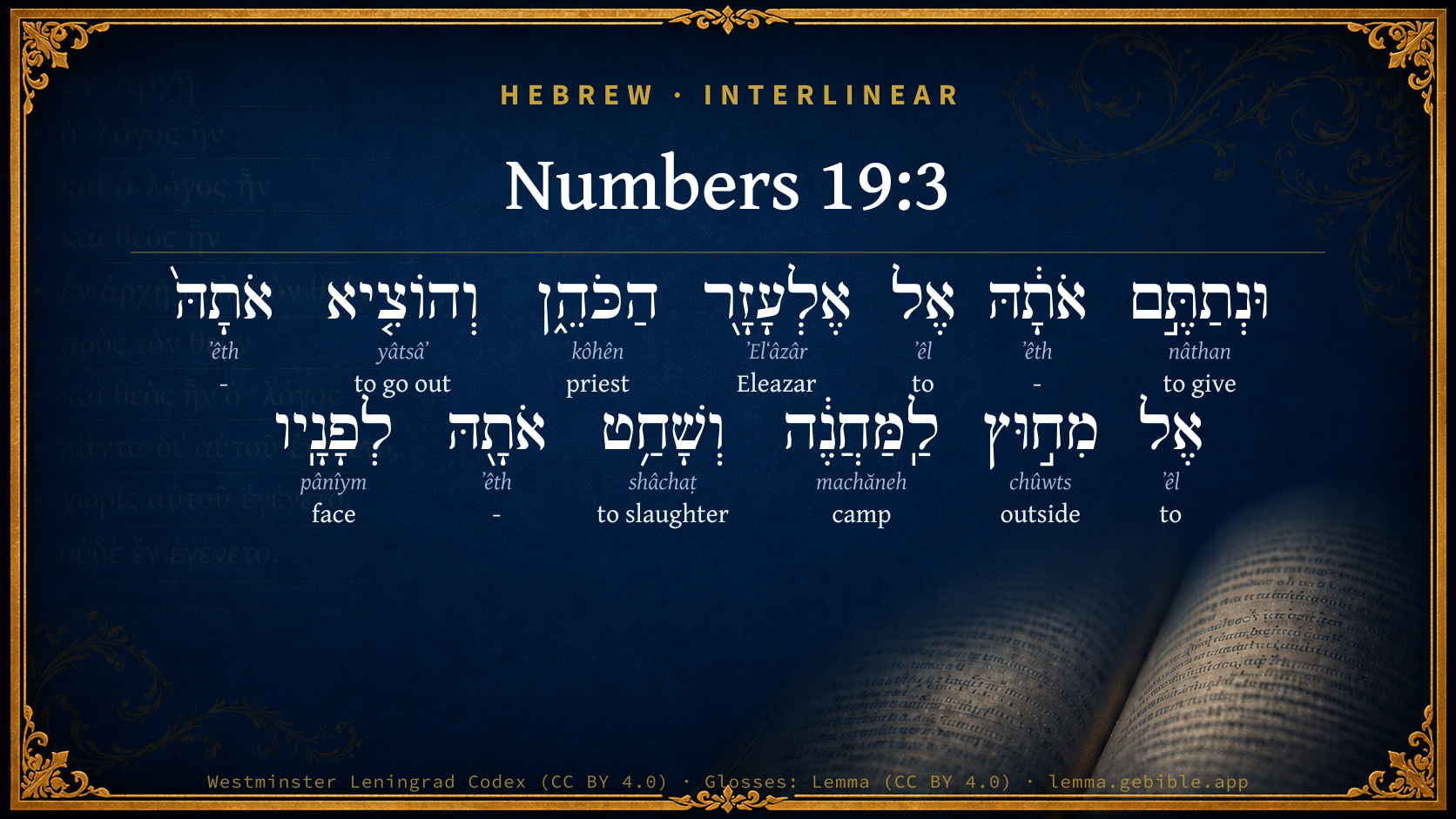
Hebrew (Westminster Leningrad Codex) Numbers 19:3 appears in the Hebrew Old Testament. The text above is from the Westminster Leningrad Codex. Each word links to its Strong’s number, a concise gloss, and parsing drawn from the Open Scriptures Hebrew Bible morphology. Click any word for its full Brown-Driver-Briggs (BDB) entry.
Download image
Cite this verse

Numbers 19:3 (World English Bible). Public Domain. Lemma interlinear Bible study tool, https://lemma.gebible.app/v/numbers/19/3.

Show BibTeX & RIS
BibTeX
RIS
English Translation
You shall give her to Eleazar the priest, and he shall bring her forth outside of the camp, and one shall kill her before his face:
World English Bible · Public Domain
Download a study sheet

One document with this verse’s original text, its word-by-word gloss line, the meaning frame, cross-references with their text, attributed commentary, and full source and license credits — printable, and it pastes into notes with its structure intact.

This verse Autodidact and up

Study sheet (.html) Plain text (.txt)

A passage Seminary Student

Up to 50 verses in one chapter. A passage sheet keeps up to 6 commentary sources and 12 cross-references per verse, in the order this page ranks them, and says so on the sheet whenever that leaves anything out. Ask for a single verse and you get the Autodidact verse sheet above.

Everything on this page stays free to read, with no account — the sheet is a download of what is already on screen, not access to it.

Want to remove ads? Support Godless Engineer
Compare translations 3

The same verse in 3 English versions, stacked beneath the original-language interlinear above. Click any original word for its lexicon entry.

Each is an independent rendering of the whole verse — the interlinear is not word-aligned to these translations.

Highlighted words mark where these versions differ — a whole-verse word diff, not a word-by-word alignment.

  • World English Bible Public Domain
    You shall give her to Eleazar the priest, and he shall bring her forth outside of the camp, and one shall kill her before his face:
  • King James Version Public Domain
    And ye shall give her unto Eleazar the priest, that he may bring her forth without the camp, and one shall slay her before his face:
  • unfoldingWord Literal Text CC BY-SA 4.0
    And you shall give it to Eleazar the priest, and he shall bring it out to the outside of the camp, and he shall slaughter it to his face.

unfoldingWord Literal Text — © unfoldingWord, licensed CC BY-SA 4.0. Word-aligned USFM3 via Door43 (git.door43.org/unfoldingWord/en_ult).

Versions to compare (up to 4)

3 of 4 selected

Show all 18 translations

Every available English version of this verse, each an independent rendering of the whole verse.

  • World English Bible Public Domain
    You shall give her to Eleazar the priest, and he shall bring her forth outside of the camp, and one shall kill her before his face:
  • Berean Standard Bible Public Domain
    Give it to Eleazar the priest, and he will have it brought outside the camp and slaughtered in his presence.
  • Majority Standard Bible Public Domain
    Give it to Eleazar the priest, and he will have it brought outside the camp and slaughtered in his presence.
  • King James Version Public Domain
    And ye shall give her unto Eleazar the priest, that he may bring her forth without the camp, and one shall slay her before his face:
  • American Standard Version (1901) Public Domain
    And ye shall give her unto Eleazar the priest, and he shall bring her forth without the camp, and one shall slay her before his face:
  • Revised Version (1885) Public Domain
    and ye shall give her unto Eleazar the priest, and he shall bring her forth without the camp, and one shall slay her before his face:
  • Geneva Bible (1599) Public Domain
    And ye shall giue her vnto Eleazar ye Priest, that hee may bring her without the hoste, and cause her to be slaine before his face.
  • Douay-Rheims (1899) Public Domain
    And you shall deliver her to Eleazar the priest, who shall bring her forth without the camp, and shall immolate her in the sight of all:
  • Young's Literal Translation Public Domain
    and ye have given it unto Eleazar the priest, and he hath brought it out unto the outside of the camp, and hath slaughtered it before him.
  • Literal Standard Version CC BY-SA 4.0
    and you have given it to Eleazar the priest, and he has brought it out to the outside of the camp, and has slaughtered it before him.
  • Unlocked Literal Bible CC BY-SA 4.0
    Give the heifer to Eleazar the priest. He must bring it outside the camp, and someone must kill it in front of him.
  • unfoldingWord Literal Text CC BY-SA 4.0
    And you shall give it to Eleazar the priest, and he shall bring it out to the outside of the camp, and he shall slaughter it to his face.
  • Darby Bible Public Domain
    and ye shall give it to Eleazar the priest, and he shall bring it outside the camp, and one shall slaughter it before him.
  • World Messianic Bible Public Domain
    You shall give her to Eleazar the priest, and he shall bring her outside of the camp, and one shall kill her before his face.
  • Webster's Bible Public Domain
    And ye shall give her to Eleazar the priest, that he may bring her forth without the camp, and one shall slay her before his face:
  • Free Bible Version CC BY-SA 4.0
    Hand it over to Eleazar the priest, and he will take it outside the camp and have it slaughtered before him.
  • Bible in Basic English Public Domain
    Give her to Eleazar the priest and let him take her outside the tent-circle and have her put to death before him.
  • JPS Tanakh (1917) Public Domain
    And ye shall give her unto Eleazar the priest, and she shall be brought forth without the camp, and she shall be slain before his face.

Literal Standard Version (2020), Covenant Press — licensed CC BY-SA 4.0. Text via the HelloAO Bible API (eBible.org). Unlocked Literal Bible (unfoldingWord) — licensed CC BY-SA 4.0. Text via the HelloAO Bible API (eBible.org). unfoldingWord Literal Text — © unfoldingWord, licensed CC BY-SA 4.0. Word-aligned USFM3 via Door43 (git.door43.org/unfoldingWord/en_ult). Free Bible Version, Dr. Jonathan Gallagher — licensed CC BY-SA 4.0. Text via the HelloAO Bible API (eBible.org).

Word by word

More ways to search: Search by grammar → Find every occurrence → Compare this word →

Practice this passage: Drill this verse → Learn its vocabulary →

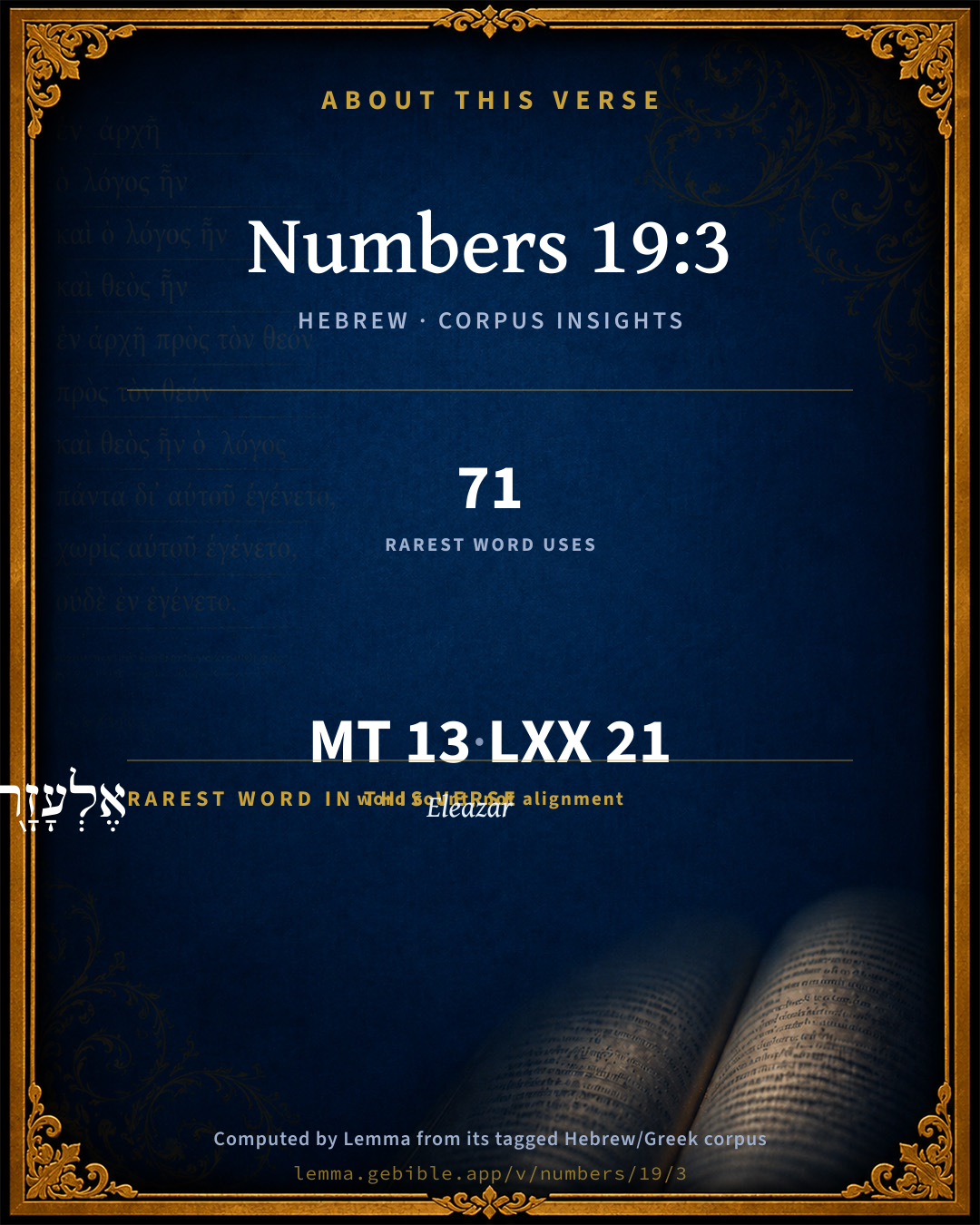
אֶלְעָזָ֖ר
ʼElʻâzâr
H499
“Eleazar”
Noun, Proper
Part of Speech
Noun
Type
Proper
Full BDB Definition

Origin: from H410 and H5826

TWOT: None

Eleazar = "God has helped" - the high priest son of Aaron - Abinadab's son who cared for the ark - the priest who rebuilt and dedicated the restored walls of Jerusalem in time of Ezra - one of David's mighty warriors - a Levite - one of the line of Parosh
  1. וּנְתַתֶּ֣ם nâthan H5414 “and · to give” Conjunction + Verb, Qal, Sequential Perfect, 2nd Person, Masculine, Plural
  2. אֹתָ֔הּ ʼêth H853 “- · her” Particle, Direct Object + Suffix, Personal, 3rd Person, Feminine, Singular
  3. אֶל ʼêl H413 “to” Preposition
  4. הַכֹּהֵ֑ן kôhên H3548 “the · priest” Particle, Definite Article + Noun, Common, Masculine, Singular, Absolute
  5. וְהוֹצִ֤יא yâtsâʼ H3318 “and · to go out” Conjunction + Verb, Hiphil, Sequential Perfect, 3rd Person, Masculine, Singular
  6. אֹתָהּ֙ ʼêth H853 “- · her” Particle, Direct Object + Suffix, Personal, 3rd Person, Feminine, Singular
  7. אֶל ʼêl H413 “to” Preposition
  8. מִח֣וּץ chûwts H2351 “from · outside” Preposition + Noun, Common, Masculine, Singular, Absolute
  9. לַֽמַּחֲנֶ֔ה machăneh H4264 “to/for the · camp” Preposition, Determined + Noun, Common, Both, Singular, Absolute
  10. וְשָׁחַ֥ט shâchaṭ H7819 “and · to slaughter” Conjunction + Verb, Qal, Sequential Perfect, 3rd Person, Masculine, Singular
  11. אֹתָ֖הּ ʼêth H853 “- · her” Particle, Direct Object + Suffix, Personal, 3rd Person, Feminine, Singular
  12. לְפָנָֽיו pânîym H6440 “to/for · face(s) · his” Preposition + Noun, Common, Both, Plural, Construct + Suffix, Personal, 3rd Person, Masculine, Singular

About this verse

These counts appear in no published source. They are computed here, from the morphology-tagged text and Lemma’s own curated glosses. What Lemma adds →

13
words
10
distinct lemmas
Pentateuch
section

Grammatical profile

  • 3 verbs
  • 5 nouns
  • 2 prepositions
  • 3 particles

Verb forms

  • וּנְתַתֶּ֣ם Qal · Sequential Perfect
  • וְהוֹצִ֤יא Hiphil · Sequential Perfect
  • וְשָׁחַ֥ט Qal · Sequential Perfect

Repetition

A word recurs within this verse — often emphatic in Hebrew:

  • אֶל to H413 ×2

Hebrew & Septuagint length

In English translation the verse runs 26 words from the Hebrew and 29 from the Septuagint (LXX English) — closely comparable.

A rough comparison of the two English renderings, which tokenize alike — not a word-level alignment.

Word counts can differ between the Hebrew and the Greek without any difference in meaning — e.g. the Hebrew direct-object marker אֵת has no separate Greek word, and Greek often adds the article ὁ.

In the original languages it is 13 Hebrew tokens and 21 Greek tokens — but the two are counted differently (Hebrew bundles its prefixes and suffixes into one token; the Greek is in lemma form), so that isn’t a like-for-like length.

Cross-references

9

Topical passages linked to Numbers 19:3 in the Treasury of Scripture Knowledge — connected by theme and wording, ordered by reader-vote popularity; previews shown in the World English Bible.

  • Leviticus 4:12 even the whole bull shall he carry forth outside the camp to a clean place, where the ashes are poured out, and burn it on wood with fire. Where the ashes are poured out it shall be burned.
  • Leviticus 4:21 He shall carry forth the bull outside the camp, and burn it as he burned the first bull. It is the sin offering for the assembly.
  • Leviticus 13:45–46 "The leper in whom the plague is shall wear torn clothes, and the hair of his head shall hang loose. He shall cover his upper lip, and shall cry, 'Unclean! Unclean!'
  • Leviticus 16:27 The bull for the sin offering, and the goat for the sin offering, whose blood was brought in to make atonement in the Holy Place, shall be carried forth outside the camp; and they shall burn their skins, their flesh, and their dung with fire.
  • Leviticus 24:14 "Bring out of the camp him who cursed; and let all who heard him lay their hands on his head, and let all the congregation stone him.
  • Numbers 3:4 Nadab and Abihu died before Yahweh, when they offered strange fire before Yahweh, in the wilderness of Sinai, and they had no children. Eleazar and Ithamar ministered in the priest's office in the presence of Aaron their father.
  • Numbers 5:2 "Command the children of Israel that they put out of the camp every leper, and everyone who has an issue, and whoever is unclean by the dead.
  • Numbers 15:36 All the congregation brought him outside of the camp, and stoned him to death with stones; as Yahweh commanded Moses.
  • Hebrews 13:11–13 For the bodies of those animals, whose blood is brought into the holy place by the high priest as an offering for sin, are burned outside of the camp.

Cross-references courtesy of OpenBible.info (CC BY 4.0).

Hebrew and Greek witnesses Masoretic Hebrew ↔ Greek Septuagint

The same verse in the two great witnesses to the Old Testament, shown verse-for-verse.

These are two independent witnesses, not word-aligned to each other, and the Septuagint is shown in lemma (dictionary) form.

Hebrew Numbers 19:3 Masoretic · Westminster Leningrad Codex

וּנְתַתֶּ֣ם אֹתָ֔הּ אֶל אֶלְעָזָ֖ר הַכֹּהֵ֑ן וְהוֹצִ֤יא אֹתָהּ֙ אֶל מִח֣וּץ לַֽמַּחֲנֶ֔ה וְשָׁחַ֥ט אֹתָ֖הּ לְפָנָֽיו

You shall give her to Eleazar the priest, and he shall bring her forth outside of the camp, and one shall kill her before his face:

World English Bible · Public Domain

Greek LXX Numbers 19:3 Septuagint · lemma form

καί δίδωμι αὐτός πρός ελεαζαρ ὁ ἱερεύς καί ἐκἄγω αὐτός ἔξω ὁ παρεμβολή εἰς τόπος καθαρός καί σφάζω αὐτός ἐνώπιον αὐτός

And you shall give her to Eleazar the priest; and they shall bring her out of the camp into a clean place, and shall kill her before his face.

LXX2012 (modern English Septuagint) · Public Domain

On this verse, Haydock's Catholic Bible Commentary discusses the Septuagint’s reading. Read the note in Commentary ↓

Hebrew: Westminster Leningrad Codex (CC BY 4.0). Greek: Septuagint (public domain); English from LXX2012 (modern English Septuagint) (Public Domain). How the Septuagint differs from the Hebrew →

Targum (Aramaic paraphrase)

2

The Targum is the ancient Jewish Aramaic paraphrase of the Hebrew Scriptures — an interpretive translation, not the Hebrew text itself. Onkelos (literal) and Pseudo-Jonathan (expansive) render the Torah, and Jonathan the Prophets. Coverage is partial: where no permissively-licensed English translation exists for a verse, only the Aramaic is shown. This is verse-level text, not a word-by-word alignment to the Hebrew.

  1. Targum Onkelos Torah (Genesis–Deuteronomy)
    וְתִתְּנוּן יָתַהּ לְאֶלְעָזָר כַּהֲנָא וְיַפֵּק יָתַהּ לְמִבָּרָא לְמַשְׁרִיתָא וְיִכּוֹס יָתַהּ קֳדָמוֹהִי

    (no public-domain English translation for this verse)

    Targum Onkelos — Aramaic: “Onkelos Genesis” (public domain); “Onkelos Exodus” (public domain); “Onkelos Leviticus” (public domain); “Onkelos Numbers” (public domain); “Onkelos Deuteronomy” (public domain). English: “Sefaria Community Translation” (CC0 1.0 (public-domain dedication)); “J.W. Etheridge. The Targums of Onkelos and Jonathan Ben Uzziel on the Pentateuch. London: Longmans, Green, 1862” (public domain). Text via Sefaria.

  2. Targum Pseudo-Jonathan Torah (Genesis–Deuteronomy)
    וְתִתְּנוּן יָתָהּ לְאֶלְעָזָר סְגַן כַּהֲנַיָא וִיהַנְפַּק יָתָהּ לְחוֹדָא לְמִבָּרָא לְמַשְׁרִיתָא וִיסַדֵר חֲזוֹר חֲזוֹר לָהּ סִידוּרֵי קִיסִין דְתֵינַיָא וְכַהֲנָא אוֹחֲרַן יִכּוֹס יָתָהּ קֳדָמוֹי בִּתְרֵין סִימָנַיָא כְּמִשְׁאַר בְּעִירַן וְיִבְדִיקְנָהּ בִּתְמַנֵי סְרִי טְרִיפַן

    And thou shalt give her unto Elazar, the chief of the priests, who shall lead her alone without the camp, and set round about her a railing (border) of the branches of fig trees; and another priest shall slay her with the two signs before him, after the manner of other animals, and examine her by the eighteen kinds of divisions.

    Targum Pseudo-Jonathan — Aramaic: “Targum Jonathan on Genesis” (public domain); “Targum Jonathan on Exodus” (public domain); “Targum Jonathan on Leviticus” (public domain); “Targum Jonathan on Numbers” (public domain); “Targum Jonathan on Deuteronomy” (public domain). English: “The Targum of Jonathan ben Uzziel, trans. J. W. Etheridge, London, 1862” (public domain). Text via Sefaria.

Commentary

Notes on Numbers 19:3 from classic Christian and Jewish commentators (each source and its license shown beneath its notes). The classic Christian expositions comment on the surrounding passage and are grouped to its opening verse, so a note may address several verses; the Jewish commentaries on the Tanakh (Rashi and others) are per-verse, so they appear only where the commentator wrote on this verse.

Lemma curates 59 commentaries, every one of them public domain or Creative Commons licensed, each selected and text-cleaned for this edition rather than reprinted as found. About our sources →

Trapp's Complete Commentary

John Trapp

Num 19:3 And ye shall give her unto Eleazar the priest, that he may bring her forth without the camp, and [one] shall slay her before his face:

Ver. 3. To Eleazar the priest.] To assure him of the succession of the priesthood. Besides, it was fitter he should be defiled than his father. {Num 19:7} Hereby also might haply be foretold, that the priests should kill Christ; but they were but our workmen, we should "look upon him whom we have pierced, and mourn over him," {Zec 12:10} that the fountain opened for sin, and for separation from uncleanness, {see Num 19:9} may be free to us, the king’s bath of Christ’s blood. {Zec 13:1}

Without the camp.] Signifying, that Christ should be taken from all earthly comforts, and crucified "without the gate." {Heb 13:12}

Before his face.] So was Christ before God’s face; yea, his Father laid upon him with his own hand, and let loose all the powers of darkness at him.

John Trapp, A Commentary or Exposition upon All the Books of the Old and New Testament (1647–1656) — public domain. Text from a community e-Sword module.

Joseph Benson's Commentary

Num 19:3. Ye shall give her unto Eleazar — Who was the second priest, and in some cases the deputy of the high-priest. To him this service was committed, and not to Aaron, because it was not fit that Aaron should be engaged in any thing that would render him ceremonially unclean, although but till the evening, Num 19:8. Yet as it was an affair of great moment, especially as typifying the sufferings and death of Christ, and purification through his blood, it was proper it should be performed by him who was next to Aaron in dignity. The chief priests of our Lord’s time had the principal hand in his death. That he may bring her forth without the camp — Partly because this heifer was reputed an unclean and accursed thing, being laden with the sins of all the people, and partly to signify that Christ should suffer without the gate, (Heb 13:12,) in the place where malefactors suffered.

Joseph Benson's Commentary on the Old and New Testaments (1811–1818) — public domain. Text from a community e-Sword module.

Tyndale Open Study Notes

Tyndale Open Resources

19:3-5 The need to safeguard Aaron’s consecrated status (see Lev 21:10-12) required that Eleazar perform the offering of the red heifer, since it caused ritual impurity. The ceremony of the red heifer contrasted with the regular sacrifice (cp. Lev 4:3-12).

Tyndale Open Study Notes — © Tyndale Open Resources, licensed CC BY-SA 4.0. Text via the HelloAO Bible API.

Geneva Bible (1599)

Geneva Bible translators

By another Priest.

Geneva Bible (1599) marginal notes — public domain. Text via Bolls.life.

Jamieson, Fausset & Brown

Robert Jamieson, A. R. Fausset & David Brown

ye shall give her unto Eleazar the priest that he may bring her forth without the camp--He was the second or deputy high priest, and he was selected for this duty because the execution of it entailed temporary defilement, from which the acting high priest was to be preserved with the greatest care. It was led "forth without the camp," in accordance with the law regarding victims laden with the sins of the people, and thus typical of Christ (Heb 13:12; also Lev 24:14). The priest was to sprinkle the blood "seven times" before--literally, "towards" or "near" the tabernacle, a description which seems to imply either that he carried a portion of the blood in a basin to the door of the tabernacle (Lev 4:17), or that in the act of sprinkling he turned his face towards the sacred edifice, being disqualified through the defiling influence of this operation from approaching close to it. By this attitude he indicated that he was presenting an expiatory sacrifice, for the acceptance of which he hoped, in the grace of God, by looking to the mercy seat. Every part of it was consumed by fire except the blood used in sprinkling, and the ingredients mixed with the ashes were the same as those employed in the sprinkling of lepers (Lev 14:4-7). It was a water of separation--that is, of "sanctification" for the people of Israel.

Jamieson, Fausset & Brown — Commentary Critical and Explanatory on the Whole Bible (1871) — public domain (CC PDM 1.0). Text via the HelloAO Bible API.

The Cambridge Bible for Schools and Colleges

gen. ed. J. J. S. Perowne

3. and one shall bring her forth] Probably the person who is to kill her; not Eleazar.

The Cambridge Bible for Schools and Colleges (gen. ed. J. J. S. Perowne; Cambridge University Press, 1878–1918) — public domain. Text from a community e-Sword module.

John Gill's Exposition

And ye shall give her unto Eleazar the priest,.... The son of Aaron; the Sagan of the priests, as the Targum of Jonathan calls him, the second or deputy priest; it was not to be given to Aaron, that he might not be defiled, though but for a small time, that so he might not be hindered in his office at all; but to Eleazar, to inure him to his office, and to confirm him in it:

that he may bring her forth without the camp; without the camp of Israel; Jarchi says, without the three camps, as afterwards without Jerusalem; it used in later times to be burnt on the mount of Olives; it was brought forth as impure, and was a type of Christ, having the sins of his people on him, and who in conformity to this type suffered without the gates of Jerusalem, see Heb 13:11,

and one shall slay her before his face; the Targum of Jonathan says, another priest; but it was not necessary that it should be slain by a priest, any man might do it. Jarchi says, a stranger slew, and Eleazar looked on; though it was not slain by him, yet it was slain before him, that it might look like a sacrifice, though not offered on the altar; and slaying of it denotes the putting of Christ to death, which was done in the presence, and with the approbation, of the priests and elders of the people.

John Gill's Exposition of the Whole Bible (1746–1763) — public domain (CC PDM 1.0). Text via the HelloAO Bible API.

Albert Barnes' Notes on the Bible

The work would necessarily require a priest; yet as it rendered him unclean for the day Num 19:22, the high priest was relieved from performing it.

Without the camp - The defilement was viewed as transferred to the victim that was to be offered for its removal. Under these circumstances the victim, like the defiled persons themselves, would be removed outside the camp. The particular pollution to be remedied by this ordinance was the indirect one resulting from contact with tokens and manifestations of sin, not the direct and personal one arising from actual commission of sin. So too the sinless antitype had to bear the reproach of associating with sinners Luk 5:30; Luk 15:2. And as the red heifer was expelled from the precincts of the camp, so was the Saviour cut off in no small measure during His Life from the fellowship of the chief representatives of the theocracy, and put to death outside Jerusalem between two thieves. Compare Heb 13:11-12.

Albert Barnes' Notes on the Bible (1834–1885) — public domain. Text from a community e-Sword/MySword module.

Haydock's Catholic Bible Commentary

Of all. Hebrew, "before his face." Septuagint, "they shall bring her out, slay and burn her before him," which must be referred to some other priests, who accompanied Eleazar on this occasion, ver. 8. (Calmet) --- Aaron did not perform this office, as the sacrifice was not solemn, but sorrowful, and designed for purification. (Menochius) --- The Rabbins say, however, that the high priest performed this ceremony ever after; and, since the building of the temple, they did it upon Mount Olivet. This is also marked by St. Jerome, ep. 27. It was thus a more lively figure of Jesus Christ sweating blood on that same ground; as the smoke might represent his ascension, Acts i. 10., and Luke xxii. 44. (Calmet) --- He died out of Jerusalem, in full age, (ver. 2,) or 33 years old, being wounded in every part for our transgressions, (ver. 5,) setting us an example how to suffer, (ver. 6,) and by his blood communicating virtue to the sacraments, ver. 5. His body, derived from Adam, (or red earth, ver. 2,) was buried in a most clean place, (ver. 9,) and those who crucified him became more unclean; (ver. 8) while even those who were employed in burying him (ver. 9,) required to be cleansed by the grace of his passion, which must be communicated to them by baptism, in the name of the blessed Trinity, without which they cannot partake of any of the sacraments, chap. xii. The old law could bring nothing to perfection. Those who lived under that dispensation, were forced to wait till the evening, (ver. 7,) when in the last ages the new law commenced, that by faith in Christ they might obtain the remission of their sins. Thus we perceive the meaning of many things which to the Jews were veiled in shadows, Hebrews x. (St. Augustine, q. 33.; Theodoret, q. 36.) (Worthington) --- The Fathers observe also, that the infirmity of our Saviour’s flesh, and his liberty in giving and resuming his life, (John x. 18,) were denoted by the cow, which had never been yoked. (Calmet)

George Leo Haydock (1774–1849), Haydock's Catholic Family Bible and Commentary, 1859 edition — public domain. Excludes Psalms (Douay-Rheims chapter numbering differs from Protestant) and Deuterocanonical books (Catholic canon only).

Matthew Poole's English Annotations

Unto Eleazar, who was the second priest, and, in some cases, the vicegerent or deputy of the high priest. To him, not to Aaron, because this service made him unclean for a season, Num 19:7, and consequently unfit for holy ministrations; whereas the high priest was, as far as possibly he could, to be preserved from all sorts of defilement, and constantly fit for his high and holy work. Without the camp; partly because it was reputed an unclean and accursed thing, being ceremoniously laden with the sins of all the people; and partly to signify that Christ should suffer without the camp, as he did, Heb 13:12, in the place where malefactors suffered, Lev 24:14.

One; a person appointed by Eleazar for this work.

Matthew Poole's English Annotations on the Holy Bible (1683–1685) — public domain. Text from a community e-Sword/MySword module.

Whedon's Commentary on the Bible

Daniel D. Whedon

3. Eleazar was charged with this duty because Aaron, the high priest, must hold himself ever ready to offer the individual sin offerings of the people, for which he would be disqualified by the uncleanness which this statute of the water of preparation declares to attach to the priest superintending the sacrifice of the red heifer. Num_19:7.

Without the camp — This was rendered necessary because the sacrifice had respect to the purification of the priests by the water of separation as well as that of the people. Hence the priests could no more eat of this sin-offering than they could of that made exclusively for themselves. See Lev_4:3-12, notes. It indicates that every thing dead must be removed outside the kingdom of God, over which the Prince of Life presides. After the temple was built, the heifer was customarily slain on the Mount of Olives, and the blood was sprinkled toward the sanctuary visible through the eastern gate of the temple court.

One shall slay — The subject to “bring her forth” and “slay her” is indefinite. The offerer, and not the priest, was to slay the victim, except when the priest is the offerer. In this case the people not only gave the victim but appointed an offerer. All that the priest had to do was sprinkling the blood.

Daniel D. Whedon (gen. ed.), Commentary on the Old and New Testaments (1874–1909) — public domain. Text from a community e-Sword module.

The Pulpit Commentary

Unto Eleazar the priest. Possibly in order that Aaron himself might not be associated with dearly, even in this indirect way (see verse 6). In after times, however, it was usually the high priest who officiated on this occasion, and therefore it is quite as likely that Eleazar was designated because he was already beginning to take the place of his father in his especial duties. Without the comp. The bodies of those animals which were offered for the sin of the congregation were always burnt outside the camp, the law thus testifying that sin and death had no proper place within the city of God. In this case, however, the whole sacrifice was performed outside the camp, and was only brought into relation with the national sanctuary by the sprinkling of the blood in that direction. Various symbolic reasons have been assigned to this fact, but none are satisfactory except the following:

1. It served to intensify the conviction, which the whole of this ordinance was intended to bring home to the minds of men, that death was an awful thing, and that everything connected with it was wholly foreign to the presence and habitation of the living God.

2. It served to mark with more emphasis the contrast between this one offering, which was perhaps almost the only one they had in the wilderness, and those which ought to have been offered continually according to the Levitical ordinances. The red heifer stood quite outside the number of ordinary victims as demanded by the law, and therefore it was not slain at any hallowed altar, nor, necessarily, by any hallowed hand.

3. It served to prefigure in a wonderful and indeed startling way the sacrifice of Christ outside the gate. In later days the heifer was conducted upon a double tier of arches over the ravine of Kedron to the opposite slope of Olivet. That he may bring her forth... and one shall slay her. The nominative to both these verbs is alike unexpressed. Septuagint, kai exaxousin ... kai sfaxousin . In the practice of later ages the high priest led her out, and another priest killed her in his presence, but it was not so commanded.

The Pulpit Commentary (1880–1919), ed. H.D.M. Spence-Jones & Joseph S. Exell — public domain. Text from a community e-Sword module.

John Wesley's Explanatory Notes

Eleazar - Who was the second priest, and in some cases, the deputy of the high-priest. To him, not to Aaron, because this service made him unclean for a season, and consequently unfit for holy ministrations, whereas the high-priest was, as far as possibly he could, to be preserved from all sorts of defilement, fit for his high and holy work. Without the camp -Partly because it was reputed an unclean and accursed thing, being laden with the sins of all the people; and partly to signify that Christ should suffer without the camp, in the place where malefactors suffered.

John Wesley, Explanatory Notes Upon the Whole Bible (1754–1765) — public domain. Text via the GEBible commentary corpus.

unfoldingWord translationNotes

Door43 World Missions Community

in his sight

"in his view" or "so he could see it"

priest must take cedarwood

"The priest" refers to Eleazar.

scarlet wool

"red wool"

translationWords

Eleazar

priest

blood

tent of meeting

flesh

dung

cedar

unfoldingWord translationNotes — © Distant Shores Media and the Door43 World Missions Community, licensed CC BY-SA 4.0. Source: git.door43.org/Door43/en_tn.

Rashi

Rabbi Shlomo Yitzchaki (Rashi)

אלעזר [YE SHALL GIVE IT TO] ELEAZAR — The command concerning it is to be carried out by the Segan (the second to the High Priest) (Sifrei Bamidbar 123:2; Yoma 42b).

אל מחוץ למחנה [HE SHALL BRING IT FORTH] WITHOUT THE CAMP — Outside the three camps (Yoma 68a; cf. Rashi on Leviticus 4:12).

ושחט אתה לפניו AND ONE SHALL SLAUGHTER IT IN HIS PRESENCE — A stranger (a non-priest) slaughters it while Eleazar looks on (superintends) (Sifrei Bamidbar 123:2; Yoma 42a).

Rashi on the Tanakh — English translations: “The Judaica Press complete Tanach with Rashi, translated by A. J. Rosenberg” (CC BY 4.0); “Pentateuch with Rashi's commentary by M. Rosenbaum and A.M. Silbermann, 1929-1934” (public domain); “The Metsudah Tanach series, Lakewood, N.J” (CC BY 4.0); and “The Book of Joshua, Metsudah Publications, 1997” (CC BY 4.0). Text via Sefaria.

Ramban (Nachmanides)

Rabbi Moshe ben Nachman (Ramban / Nachmanides)

AND YE SHALL GIVE HER UNTO ELEAZAR THE PRIEST. “[The proper fulfillment of] the commandment is [only when it is done] by the deputy High Priest.” This is Rashi’s language. But his intention is not to say that the obligation to perform this commandment [always] devolves upon the deputy High Priest rather than devolving upon the High Priest or any ordinary priest; but that this was a [special] temporary command in the case of the first Red Heifer that it should be done by Eleazar, who [happened to be] the deputy High Priest. In the words of the Sifre: 123. “‘Scripture here teaches that the Red Heifer was to be prepared by the deputy High Priest. This is made evident [by the fact] that [although] Aaron was still living, Eleazar [who was the deputy High Priest] burnt the heifer. And ye shall give ‘her’ unto Eleazar the priest. This [first heifer] was to be prepared by Eleazar, [“her” — and you shall give ‘her’ unto Eleazar]. Hence Rabbi Meir explains that it means that it was this first Red Heifer that was to be done by Eleazar, whereas all others must be done only by the High Priest. Rabbi Yosei, Rabbi Yehudah, Rabbi Shimon and Rabbi Eliezer the son of Yaakov, however, are of the opinion that the word othah teaches us that only this Red Heifer was to be done by the deputy High Priest, whereas in subsequent generations it may be done even by an ordinary priest. Ramban further on explains the deeper significance of this whole matter. but all other heifers [in subsequent generations] must be prepared by the High Priest.’ These are the words of Rabbi Meir. Rabbi Yosei, Rabbi Yehudah, Rabbi Shimon and Rabbi Eliezer the son of Yaakov say: ‘this one was done by Eleazar [the deputy], and all other heifers may be done either by the High Priest or an ordinary priest.’” The purport of this is to tell us that this commandment, because of its profound secret, deserved to be given to the greatest of the priests, and yet it was not given to Aaron [but to Eleazar the deputy]! Perhaps this was because of his [Aaron’s] greatness, for he was the holy one of the Eternal. and His pious one, who effects atonement in His Sanctuary; therefore He did not want to give him a service which is performed outside [the Sanctuary]. Or perhaps [this was to be done by Eleazar] in order to crown him, and initiate him during the lifetime of his father by means of one of the commandments of the high priesthood. Or it may be [that the performance thereof was not given to Aaron] as a punishment for [his part in the incident of] the [golden] calf, as Rabbi Moshe the Preacher wrote., Note 146. Thus the Holy One, blessed be He, treated Aaron also as a prophet in this commandment, and he and Moses our teacher were to give it [the Red Heifer] to Eleazar, who was the greatest of the priests after Aaron, and he was the one who had been anointed with the Oil of Anointment.. See further Ramban on Leviticus 10:6 (Vol. III, p. 117) where he clearly states that in a certain respect Aaron’s sons were considered like the High Priest because of their anointment during the days of the consecration. This is [therefore] a hint that in subsequent generations the Red Heifer was to be prepared by the greatest of the priests, namely the High Priest. Similarly we have been taught in a Mishnah: “If the Heifer of Purification was not slaughtered by the High Priest, it is invalid. But Rabbi Yehudah says it is valid.” And in the Gemara of Tractate Yoma [it is stated]: “And ye shall give ‘her’ unto Eleazar the priest. ‘Her’ [i.e., this first Red Heifer] you shall give to Eleazar [the deputy High Priest], but in subsequent generations it is not to be given to Eleazar. Some Rabbis say that in subsequent generations it is to be given to an ordinary priest, and some say that in subsequent generations it is to be given [only] to the High Priest.” This [latter statement] is the opinion of the anonymous Mishnah [quoted above, namely that if the Red Heifer was not slaughtered by the High Priest it is invalid], and it is the correct opinion. According to the Sages who are of the opinion that during later generations it may be prepared [even] by an ordinary priest, [the reason why here] Eleazar was commanded to do it is because there was no [ordinary] priest, for it would not be fitting that his younger brother [Ithamar] should take precedence over him [and at that time there were only three priests — Aaron, and his two sons, Eleazar and Ithamar].

Ramban (Nachmanides) on the Tanakh — English translation: “Commentary on the Torah by Ramban (Nachmanides). Translated and annotated by Charles B. Chavel. New York, Shilo Pub. House, 1971-1976” (CC BY 4.0). Text via Sefaria.

Lesson kit

Teaching starters — assembled from the data on this page, not authored interpretation. Every prompt links to the verse data it draws on. Edit before teaching.

Numbers, in the Pentateuch, opens this verse with 13 words (10 distinct Hebrew lemmas). Its most distinctive word is ʼElʻâzâr (“Eleazar”). A historical commentator’s framing appears above. Read the whole chapter for the surrounding context.

Discussion questions

  1. The word ʼElʻâzâr carries the sense “Eleazar.” How does it shape the verse?
  2. How does Leviticus 4:12, which shares this passage’s theme, read alongside this verse?
  3. What does the repetition of “to” (2× in this one verse) do in this verse?
  4. These translations render this verse differently; the difference is in the English rendering, not the original. What questions does that raise?
  5. «וּנְתַתֶּ֣ם» is a Qal Sequential Perfect verb. How does that grammatical form shape the action described?
  6. Compare how Trapp's Complete Commentary and Joseph Benson's Commentary read this verse. Where do they agree or differ?

Things to notice

Reading settings

Reading text

Shown beneath each verse's original-language words.

Old Testament
Old Testament edition

Read the OT as the Masoretic Hebrew (MT) or the Greek Septuagint (LXX).

English shown for the Greek Septuagint (in the Hebrew ↔ Greek comparison).

Comparing translations? Open the Compare panel on any verse page to stack up to four side by side.