
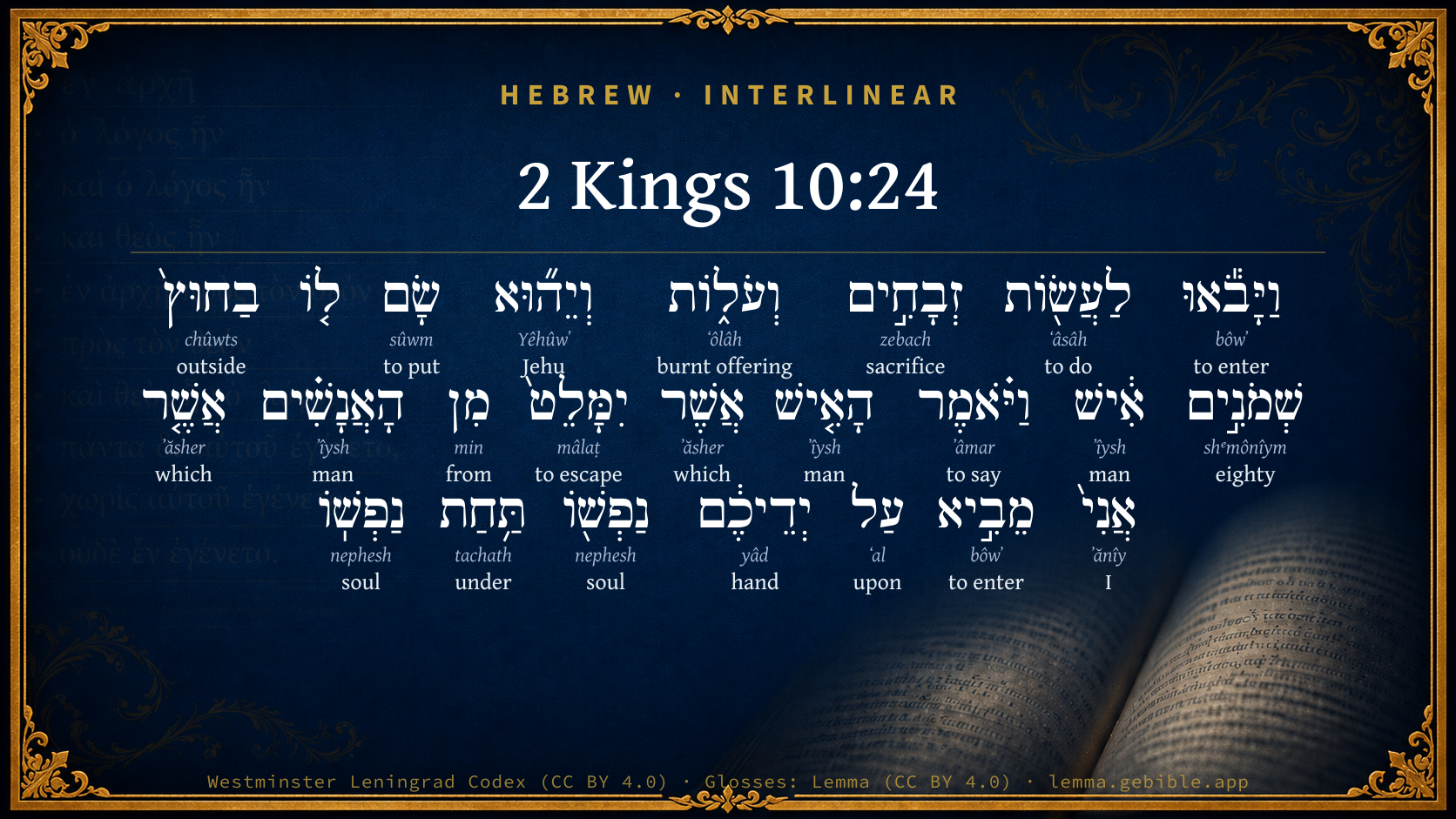
2 Kings 10:24

Hebrew (Westminster Leningrad Codex) 2 Kings 10:24 appears in the Hebrew Old Testament. The text above is from the Westminster Leningrad Codex. Each word links to its Strong’s number, a concise gloss, and parsing drawn from the Open Scriptures Hebrew Bible morphology. Click any word for its full Brown-Driver-Briggs (BDB) entry.
Download image
Cite this verse

2 Kings 10:24 (World English Bible). Public Domain. Lemma interlinear Bible study tool, https://lemma.gebible.app/v/2-kings/10/24.

Show BibTeX & RIS
BibTeX
RIS
English Translation
They went in to offer sacrifices and burnt offerings. Now Jehu had appointed him eighty men outside, and said, If any of the men whom I bring into your hands escape, [he who lets him go], his life shall be for the life of him.
World English Bible · Public Domain
Download a study sheet

One document with this verse’s original text, its word-by-word gloss line, the meaning frame, cross-references with their text, attributed commentary, and full source and license credits — printable, and it pastes into notes with its structure intact.

This verse Autodidact and up

Study sheet (.html) Plain text (.txt)

A passage Seminary Student

Up to 50 verses in one chapter. A passage sheet keeps up to 6 commentary sources and 12 cross-references per verse, in the order this page ranks them, and says so on the sheet whenever that leaves anything out. Ask for a single verse and you get the Autodidact verse sheet above.

Everything on this page stays free to read, with no account — the sheet is a download of what is already on screen, not access to it.

Want to remove ads? Support Godless Engineer
Compare translations 3

The same verse in 3 English versions, stacked beneath the original-language interlinear above. Click any original word for its lexicon entry.

Each is an independent rendering of the whole verse — the interlinear is not word-aligned to these translations.

Highlighted words mark where these versions differ — a whole-verse word diff, not a word-by-word alignment.

  • World English Bible Public Domain
    They went in to offer sacrifices and burnt offerings. Now Jehu had appointed him eighty men outside, and said, If any of the men whom I bring into your hands escape, [he who lets him go], his life shall be for the life of him.
  • King James Version Public Domain
    And when they went in to offer sacrifices and burnt offerings, Jehu appointed fourscore men without, and said, If any of the men whom I have brought into your hands escape, he that letteth him go, his life shall be for the life of him.
  • unfoldingWord Literal Text CC BY-SA 4.0
    And they came in to make sacrifices and burnt offerings. Now Jehu had stationed for himself 80 men outside, and he had said, “The man who escapes from the men whom I am bringing into your hands, his life in place of his life.”

unfoldingWord Literal Text — © unfoldingWord, licensed CC BY-SA 4.0. Word-aligned USFM3 via Door43 (git.door43.org/unfoldingWord/en_ult).

Versions to compare (up to 4)

3 of 4 selected

Show all 18 translations

Every available English version of this verse, each an independent rendering of the whole verse.

  • World English Bible Public Domain
    They went in to offer sacrifices and burnt offerings. Now Jehu had appointed him eighty men outside, and said, If any of the men whom I bring into your hands escape, [he who lets him go], his life shall be for the life of him.
  • Berean Standard Bible Public Domain
    And they went in to offer sacrifices and burnt offerings. Now Jehu had stationed eighty men outside and warned them, “If anyone allows one of the men I am delivering into your hands to escape, he will forfeit his life for theirs.”
  • Majority Standard Bible Public Domain
    And they went in to offer sacrifices and burnt offerings. Now Jehu had stationed eighty men outside and warned them, “If anyone allows one of the men I am delivering into your hands to escape, he will forfeit his life for theirs.”
  • King James Version Public Domain
    And when they went in to offer sacrifices and burnt offerings, Jehu appointed fourscore men without, and said, If any of the men whom I have brought into your hands escape, he that letteth him go, his life shall be for the life of him.
  • American Standard Version (1901) Public Domain
    And they went in to offer sacrifices and burnt-offerings. Now Jehu had appointed him fourscore men without, and said, If any of the men whom I bring into your hands escape, `he that letteth him go', his life shall be for the life of him.
  • Revised Version (1885) Public Domain
    And they went in to offer sacrifices and burnt offerings. Now Jehu had appointed him fourscore men without, and said, If any of the men whom I bring into your hands escape, he that letteth him go, his life shall be for the life of him.
  • Geneva Bible (1599) Public Domain
    And when they went in to make sacrifice and burnt offering, Iehu appoynted foure score men without, and sayd, If any of the men whome I haue brought into your hands, escape, his soule shalbe for his soule.
  • Douay-Rheims (1899) Public Domain
    And they went in to offer sacrifices and burnt offerings: but Jehu had prepared him fourscore men without, and said to them: If any of the men escape, whom I have brought into your hands, he that letteth him go shall answer life for life.
  • Young's Literal Translation Public Domain
    And they come in to make sacrifices and burnt-offerings, and Jehu hath set for himself in an out-place eighty men, and saith, `The man who letteth escape `any' of the men whom I am bringing in unto your hand -- his soul for his soul.'
  • Literal Standard Version CC BY-SA 4.0
    And they come in to make sacrifices and burnt-offerings, and Jehu has set eighty men for himself in an out-place, and says, “The man who lets [any] of the men whom I am bringing into your hand escape—his soul for his soul.”
  • Unlocked Literal Bible CC BY-SA 4.0
    Then they went in to offer sacrifices and burnt offerings. Now Jehu had chosen eighty men who were standing outside, and he told them, “If any of the men whom I bring into your hands escapes, whoever lets that man escape, his life will be taken for the life of the one who escaped.”
  • unfoldingWord Literal Text CC BY-SA 4.0
    And they came in to make sacrifices and burnt offerings. Now Jehu had stationed for himself 80 men outside, and he had said, “The man who escapes from the men whom I am bringing into your hands, his life in place of his life.”
  • Darby Bible Public Domain
    And they entered in to offer sacrifices and burnt-offerings. Now Jehu appointed eighty men without, and said, He that allows any of the men to escape that I have brought into your hands, his life shall be for the life of him.
  • World Messianic Bible Public Domain
    So they went in to offer sacrifices and burnt offerings. Now Jehu had appointed for himself eighty men outside, and said, “If any of the men whom I bring into your hands escape, he who lets him go, his life shall be for the life of him.”
  • Webster's Bible Public Domain
    And when they went in to offer sacrifices and burnt-offerings, Jehu appointed eighty men without, and said, If any of the men whom I have brought into your hands escape, he that letteth him go, his life shall be for the life of him.
  • Free Bible Version CC BY-SA 4.0
    They were inside presenting sacrifices and burnt offerings. Now Jehu had positioned eighty men outside and cautioned them, “I'm handing these men over to you. If you let any of them escape, you will pay for his life with yours.”
  • Bible in Basic English Public Domain
    Then they went in to make offerings and burned offerings. Now Jehu had put eighty men outside, and said to them, If any man whom I give into your hands gets away, the life of him who lets him go will be the price of his life.
  • JPS Tanakh (1917) Public Domain
    And they went in to offer sacrifices and burnt-offerings. Now Jehu had appointed him fourscore men without, and said: 'If any of the men whom I bring into your hands escape, his life shall be for the life of him.'

Literal Standard Version (2020), Covenant Press — licensed CC BY-SA 4.0. Text via the HelloAO Bible API (eBible.org). Unlocked Literal Bible (unfoldingWord) — licensed CC BY-SA 4.0. Text via the HelloAO Bible API (eBible.org). unfoldingWord Literal Text — © unfoldingWord, licensed CC BY-SA 4.0. Word-aligned USFM3 via Door43 (git.door43.org/unfoldingWord/en_ult). Free Bible Version, Dr. Jonathan Gallagher — licensed CC BY-SA 4.0. Text via the HelloAO Bible API (eBible.org).

Word by word

More ways to search: Search by grammar → Find every occurrence → Compare this word →

Practice this passage: Drill this verse → Learn its vocabulary →

שְׁמֹנִ֣ים
shᵉmônîym
H8084
“eighty”
Adjective, Cardinal number, Both, Plural, Absolute
Part of Speech
Adjective
Type
Cardinal number
Gender
Both
Number
Plural
State
Absolute
Full BDB Definition

Origin: mult from H8083

TWOT: 2411b

eighty, fourscore - eighty (as cardinal number) - eightieth (as ordinal number) - in combination with other numbers
  1. וַיָּבֹ֕אוּ bôwʼ H935 “and · to enter” Conjunction + Verb, Qal, Sequential Imperfect, 3rd Person, Masculine, Plural
  2. לַעֲשׂ֖וֹת ʻâsâh H6213 “to do” Preposition + Verb, Qal, Infinitive Construct
  3. זְבָחִ֣ים zebach H2077 “sacrifices” Noun, Common, Masculine, Plural, Absolute
  4. וְעֹל֑וֹת ʻôlâh H5930 “and · burnt offerings” Conjunction + Noun, Common, Feminine, Plural, Absolute
  5. וְיֵה֞וּא Yêhûwʼ H3058 “and · Jehu” Conjunction + Noun, Proper
  6. שָׂם sûwm H7760 “to put” Verb, Qal, Perfect, 3rd Person, Masculine, Singular
  7. בַחוּץ֙ chûwts H2351 “in/at the · outside” Preposition, Determined + Noun, Common, Masculine, Singular, Absolute
  8. אִ֔ישׁ ʼîysh H376 “man” Noun, Common, Masculine, Singular, Absolute
  9. וַיֹּ֗אמֶר ʼâmar H559 “and · to say” Conjunction + Verb, Qal, Sequential Imperfect, 3rd Person, Masculine, Singular
  10. הָאִ֤ישׁ ʼîysh H376 “the · man” Particle, Definite Article + Noun, Common, Masculine, Singular, Absolute
  11. אֲשֶׁר ʼăsher H834 “which” Particle, Relative
  12. יִמָּלֵט֙ mâlaṭ H4422 “to escape” Verb, Niphal, Imperfect, 3rd Person, Masculine, Singular
  13. מִן min H4480 “from” Preposition
  14. הָאֲנָשִׁ֗ים ʼîysh H376 “the · men” Particle, Definite Article + Noun, Common, Masculine, Plural, Absolute
  15. אֲשֶׁ֤ר ʼăsher H834 “which” Particle, Relative
  16. אֲנִי֙ ʼănîy H589 “I” Pronoun, Personal, 1st Person, Common, Singular
  17. מֵבִ֣יא bôwʼ H935 “entering” Verb, Hiphil, Participle Active, Masculine, Singular, Absolute
  18. עַל ʻal H5921 “upon” Preposition
  19. יְדֵיכֶ֔ם yâd H3027 “hands · your” Noun, Common, Both, Dual, Construct + Suffix, Personal, 2nd Person, Masculine, Plural
  20. נַפְשׁ֖וֹ nephesh H5315 “soul · his” Noun, Common, Both, Singular, Construct + Suffix, Personal, 3rd Person, Masculine, Singular
  21. תַּ֥חַת tachath H8478 “under” Preposition
  22. נַפְשֽׁוֹ nephesh H5315 “soul · his” Noun, Common, Both, Singular, Construct + Suffix, Personal, 3rd Person, Masculine, Singular

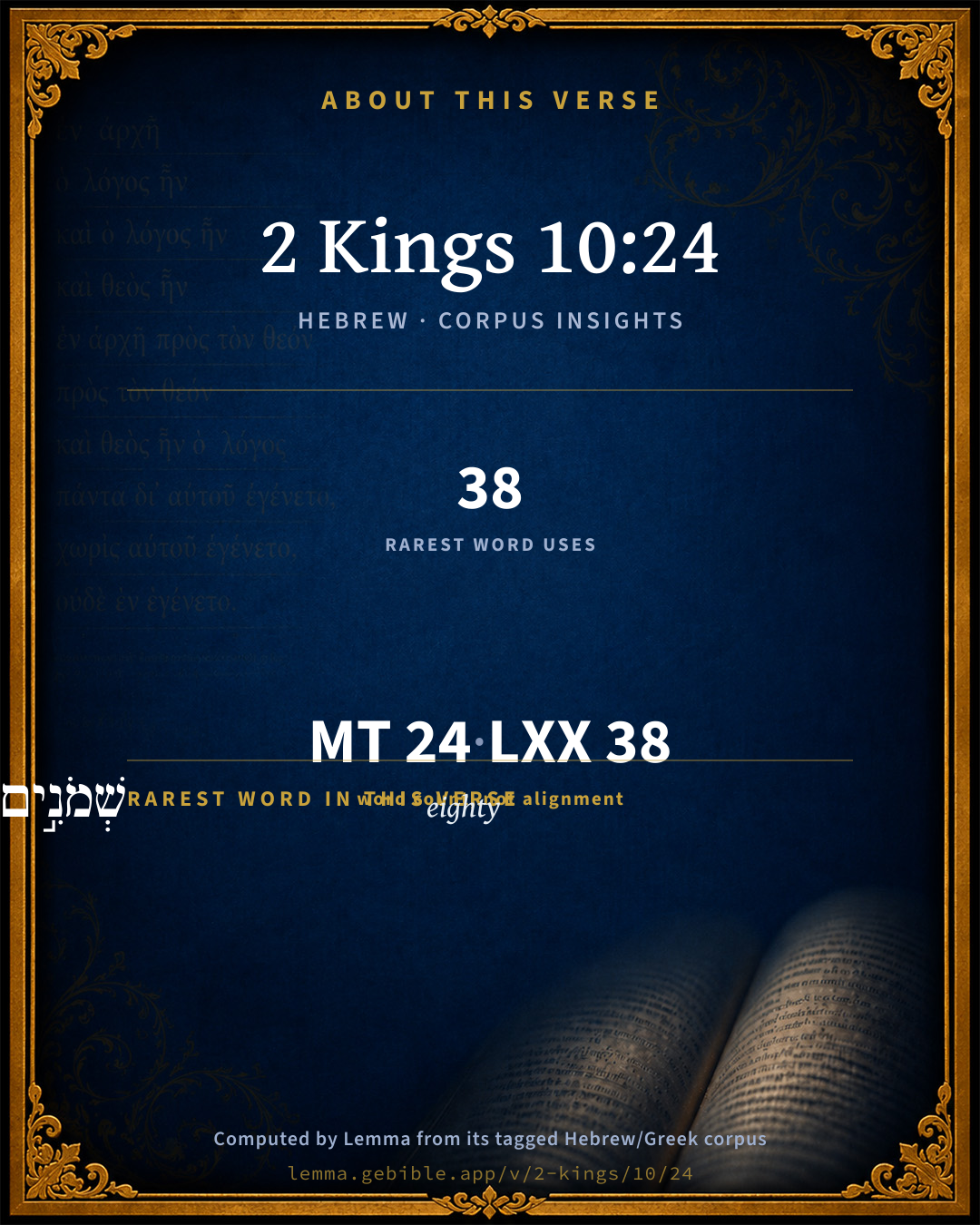
About this verse

These counts appear in no published source. They are computed here, from the morphology-tagged text and Lemma’s own curated glosses. What Lemma adds →

24
words
18
distinct lemmas
Historical
section

Shared distinctive vocabulary

שְׁמֹנִ֣ים eighty H8084 occurs in 37 verses of the Hebrew Bible. Also found in:

Grammatical profile

  • 6 verbs
  • 10 nouns
  • 1 adjective
  • 1 pronoun
  • 4 prepositions
  • 2 particles

Verb forms

  • וַיָּבֹ֕אוּ Qal · Sequential Imperfect
  • לַעֲשׂ֖וֹת Qal · Infinitive Construct
  • שָׂם Qal · Perfect
  • וַיֹּ֗אמֶר Qal · Sequential Imperfect
  • יִמָּלֵט֙ Niphal · Imperfect
  • מֵבִ֣יא Hiphil · Participle Active

Repetition

Words recur within this verse — often emphatic in Hebrew:

  • אִ֔ישׁ man H376 ×3
  • וַיָּבֹ֕אוּ to enter H935 ×2
  • נַפְשׁ֖וֹ soul H5315 ×2
  • אֲשֶׁר which H834 ×2

Hebrew & Septuagint length

In English translation the verse runs 45 words from the Hebrew and 47 from the Septuagint (LXX English) — closely comparable.

A rough comparison of the two English renderings, which tokenize alike — not a word-level alignment.

Word counts can differ between the Hebrew and the Greek without any difference in meaning — e.g. the Hebrew direct-object marker אֵת has no separate Greek word, and Greek often adds the article ὁ.

In the original languages it is 24 Hebrew tokens and 38 Greek tokens — but the two are counted differently (Hebrew bundles its prefixes and suffixes into one token; the Greek is in lemma form), so that isn’t a like-for-like length.

Cross-references

1

Topical passages linked to 2 Kings 10:24 in the Treasury of Scripture Knowledge — connected by theme and wording, ordered by reader-vote popularity; previews shown in the World English Bible.

  • 1 Kings 20:30–42 But the rest fled to Aphek, into the city; and the wall fell on twenty-seven thousand men who were left. Ben Hadad fled, and came into the city, into an inner chamber.

Cross-references courtesy of OpenBible.info (CC BY 4.0).

Hebrew and Greek witnesses Masoretic Hebrew ↔ Greek Septuagint

The same verse in the two great witnesses to the Old Testament, shown verse-for-verse.

These are two independent witnesses, not word-aligned to each other, and the Septuagint is shown in lemma (dictionary) form.

Hebrew 2 Kings 10:24 Masoretic · Westminster Leningrad Codex

וַיָּבֹ֕אוּ לַעֲשׂ֖וֹת זְבָחִ֣ים וְעֹל֑וֹת וְיֵה֞וּא שָׂם ל֤וֹ בַחוּץ֙ שְׁמֹנִ֣ים אִ֔ישׁ וַיֹּ֗אמֶר הָאִ֤ישׁ אֲשֶׁר יִמָּלֵט֙ מִן הָאֲנָשִׁ֗ים אֲשֶׁ֤ר אֲנִי֙ מֵבִ֣יא עַל יְדֵיכֶ֔ם נַפְשׁ֖וֹ תַּ֥חַת נַפְשֽׁוֹ

They went in to offer sacrifices and burnt offerings. Now Jehu had appointed him eighty men outside, and said, If any of the men whom I bring into your hands escape, [he who lets him go], his life shall be for the life of him.

World English Bible · Public Domain

Greek LXX 2 Kings 10:24 Septuagint · lemma form

καί εἰςἔρχομαι ὁ ποιέω ὁ θῦμα καί ὁ ὁλοκαύτωμα καί ιου τάσσω ἑαυτοῦ ἔξω ὀγδοήκοντα ἀνήρ καί εἶπον ἀνήρ ὅς ἐάν διασώζω ἀπό ὁ ἀνήρ ὅς ἐγώ ἀναἄγω ἐπί χείρ σύ ὁ ψυχή αὐτός ἀντί ὁ ψυχή αὐτός

And he went in to offer sacrifices and whole burnt offerings; and Ju set for himself eighty men without, and said, Every man who shall escape of the men whom I bring into your hand, the life of him that spares him shall go for his life.

LXX2012 (modern English Septuagint) · Public Domain

On this verse, The Cambridge Bible for Schools and Colleges discusses the Septuagint’s reading. Read the note in Commentary ↓

Hebrew: Westminster Leningrad Codex (CC BY 4.0). Greek: Septuagint (public domain); English from LXX2012 (modern English Septuagint) (Public Domain). How the Septuagint differs from the Hebrew →

Targum (Aramaic paraphrase)

1

The Targum is the ancient Jewish Aramaic paraphrase of the Hebrew Scriptures — an interpretive translation, not the Hebrew text itself. Onkelos (literal) and Pseudo-Jonathan (expansive) render the Torah, and Jonathan the Prophets. Coverage is partial: where no permissively-licensed English translation exists for a verse, only the Aramaic is shown. This is verse-level text, not a word-by-word alignment to the Hebrew.

  1. Targum Jonathan Prophets (Joshua–Malachi)
    וַאֲתוֹ לְמֶעְבַּד נִכְסַת קוּדְשִׁין וַעֲלַוָן וְיֵהוּא מַנֵי לֵיהּ בְּבָרָא תַּמְנִין גַבְרָא וַאֲמַר גַבְרָא דְיִשְׁתֵּיזֵיב מִן גַבְרָא דַאֲנָא מַעֵיל עַל יְדֵיכוֹן נַפְשֵׁיהּ חֲלַף נַפְשֵׁיהּ:

    (no public-domain English translation for this verse)

    Targum Jonathan — Aramaic: “Mikraot Gedolot” (public domain). English: “Sefaria Community Translation” (CC0 1.0 (public-domain dedication)); “London "Chaldee Paraphrase," 1871” (public domain). Text via Sefaria.

Commentary

Notes on 2 Kings 10:24 from classic Christian and Jewish commentators (each source and its license shown beneath its notes). The classic Christian expositions comment on the surrounding passage and are grouped to its opening verse, so a note may address several verses; the Jewish commentaries on the Tanakh (Rashi and others) are per-verse, so they appear only where the commentator wrote on this verse.

Lemma curates 59 commentaries, every one of them public domain or Creative Commons licensed, each selected and text-cleaned for this edition rather than reprinted as found. About our sources →

Trapp's Complete Commentary

John Trapp

2Ki 10:24 And when they went in to offer sacrifices and burnt offerings, Jehu appointed fourscore men without, and said, [If] any of the men whom I have brought into your hands escape, [he that letteth him go], his life [shall be] for the life of him.

Ver. 24. To offer sacrifices and burnt offerings.] They would needs symbolise with the true servants of God in an apish imitation of all. See on ver. 2Ki 10:19; 2Ki 10:22.

John Trapp, A Commentary or Exposition upon All the Books of the Old and New Testament (1647–1656) — public domain. Text from a community e-Sword module.

Joseph Benson's Commentary

2Ki 10:24-25. When they went in to offer sacrifices — When some went to the altar to offer in the name of the rest. Jehu appointed fourscore men without — Far more being, doubtless, in readiness to assist them in case of any opposition. As he had made an end of offering — That is, as the chief priest of Baal had made an end. So far Jehu suffered them to proceed, either because till then they were not all come into the house; or because, being taken in the very act of gross idolatry, their punishment would appear to be more just and reasonable. Jehu said to the guard and the captains — To the fourscore men and their officers. The guard, &c., cast them out — Cast their carcasses out, of the house. And went to the city of the house of Baal — To some buildings belonging to that house; which may be here called the city, because they were very numerous and capacious. For as there were divers chambers and rooms built without the temple, belonging to it, for the use of the priests and Levites; so it may probably be conceived that this famous temple of Baal had many such buildings, in some of which the priests of Baal, or of the groves, (whereof there were numbers belonging to the king’s court, 1Ki 18:19,) peradventure might dwell; and others of them might be for divers uses, belonging to the house and service of Baal: and to these buildings the guard might hastily go to surprise and put to death these inferior ministers of Baal, who were there employed in services belonging to that house, or that solemnity.

Joseph Benson's Commentary on the Old and New Testaments (1811–1818) — public domain. Text from a community e-Sword module.

Geneva Bible (1599)

Geneva Bible translators

Or, he shall die for him.

Geneva Bible (1599) marginal notes — public domain. Text via Bolls.life.

Ellicott's Commentary for English Readers

(24) When.—Omit.

They went in.—The priests and prophets went into the inner court of the Baal temple, which probably resembled in general construction that of Jehovah at Jerusalem.

Sacrifices and burnt offerings—i.e., peace offerings and burnt offerings, which could only be offered in an open court.

Jehu appointed fourscore men without.—Rather, now Jehu had set him on the outside (of the building) fourscore men.

If any of the men . . . life of him.—Literally, The man that escapeth of the men whom I am bringing into your hands—his life for his life! This is a little incoherent, as is natural in energetic speech, but the sense is clear. Thenius, however, suggests that the verb “escapeth” should be pointed as a transitive form (pihel instead of niphal). This gives: “The man that letteth escape any of the men,” &c., an improvement that may be right, although the old versions agree with the present Hebrew pointing of the word.

A Bible Commentary for English Readers, edited by Charles John Ellicott (1878–1897) — public domain. Text from a community e-Sword module.

The Cambridge Bible for Schools and Colleges

gen. ed. J. J. S. Perowne

24. And when they went in] R.V. omits ‘when’, and makes this clause an independent sentence. The LXX. has ‘and he went in’ (καἰ εἰσῆλθε).

Jehu appointed] In consequence of what has been done in the previous clause, R.V. renders ‘Now Jehu had appointed’. And as there is in the sentence a pronoun and preposition of which the A.V. takes no account, R.V. adds him = for himself, after ‘appointed’.

If any of the men whom I have brought] R.V. I bring. The sentence is very elliptical as will be seen from the italics of A.V. But the same words only are represented in LXX. For the phrase cf. 1Ki_20:39; 1Ki_20:42.

The Cambridge Bible for Schools and Colleges (gen. ed. J. J. S. Perowne; Cambridge University Press, 1878–1918) — public domain. Text from a community e-Sword module.

John Gill's Exposition

And when they went in to offer sacrifices and burnt offerings,.... To Baal, all things being ready for them:

Jehu appointed eighty men without; without the temple of Baal, at the several doors and avenues of it:

and said, if any of the men whom I have brought into your hands escape, he that letteth him go, his life shall be for the life of him; should be put to death for it in his room; the life of a watchman set to guard should go for the life of one that escaped.

John Gill's Exposition of the Whole Bible (1746–1763) — public domain (CC PDM 1.0). Text via the HelloAO Bible API.

Haydock's Catholic Bible Commentary

Life. These 80 were stationed at the doors, while the rest slaughtered the unhappy idolaters, (Menochius) who were all by themselves, like the reprobate separated from the elect, at the last day. (Haydock)

George Leo Haydock (1774–1849), Haydock's Catholic Family Bible and Commentary, 1859 edition — public domain. Excludes Psalms (Douay-Rheims chapter numbering differs from Protestant) and Deuterocanonical books (Catholic canon only).

Matthew Poole's English Annotations

When they went in; when some in the name of the rest went to the altar to offer sacrifice.

Jehu appointed fourscore men; far greater numbers being doubtless in readiness to assist then, in case of any opposition.

Matthew Poole's English Annotations on the Holy Bible (1683–1685) — public domain. Text from a community e-Sword/MySword module.

The Pulpit Commentary

And when they went in rather, when they had gone in; i.e. when the whole multitude of Baal-worshippers, priests and people, had entered within the precincts of the templeto offer sacrifices and burnt offerings. The priests officiate, but the offerings are regarded as conjointly made by priest and people. Jehu appointed four score men without.

Josephus says ("Ant. Jud:," 9:6. that they were the most trusty men of his body-guard, which is likely enough. They were no doubt also known to Jehu as attached to the worship of Jehovah. And said, If any of the men whom I have brought into your hands escape, he that letteth him go, his life shall be for the life of him. (comp. 1Ki_20:39) Gaolers were commonly put to death if a prisoner committed to their charge escaped them. (see Act_12:19 Act_16:27)

The Pulpit Commentary (1880–1919), ed. H.D.M. Spence-Jones & Joseph S. Exell — public domain. Text from a community e-Sword module.

Rashi

Rabbi Shlomo Yitzchaki (Rashi)

You will forfeit your life for his life. The life of the guard shall be [forfeit] for the life of the one who escapes.

Rashi on the Tanakh — English translations: “The Judaica Press complete Tanach with Rashi, translated by A. J. Rosenberg” (CC BY 4.0); “Pentateuch with Rashi's commentary by M. Rosenbaum and A.M. Silbermann, 1929-1934” (public domain); “The Metsudah Tanach series, Lakewood, N.J” (CC BY 4.0); and “The Book of Joshua, Metsudah Publications, 1997” (CC BY 4.0). Text via Sefaria.

Lesson kit

Teaching starters — assembled from the data on this page, not authored interpretation. Every prompt links to the verse data it draws on. Edit before teaching.

2 Kings, in the Historical, opens this verse with 24 words (18 distinct Hebrew lemmas). Its most distinctive word is shᵉmônîym (“eighty”). A historical commentator’s framing appears above. Read the whole chapter for the surrounding context.

Discussion questions

  1. The word shᵉmônîym carries the sense “eighty.” How does it shape the verse?
  2. How does Genesis 5:25, which shares the word «eighty», read alongside this verse?
  3. What does the repetition of “man” (3× in this one verse) do in this verse?
  4. The translations on this page render this verse differently — a whole-verse word diff, not a word-by-word alignment. What might account for the different wordings?
  5. «וַיָּבֹ֕אוּ» is a Qal Sequential Imperfect verb. How does that grammatical form shape the action described?
  6. Compare how Trapp's Complete Commentary and Joseph Benson's Commentary read this verse. Where do they agree or differ?

Things to notice

Reading settings

Reading text

Shown beneath each verse's original-language words.

Old Testament
Old Testament edition

Read the OT as the Masoretic Hebrew (MT) or the Greek Septuagint (LXX).

English shown for the Greek Septuagint (in the Hebrew ↔ Greek comparison).

Comparing translations? Open the Compare panel on any verse page to stack up to four side by side.