Isaiah 15:3

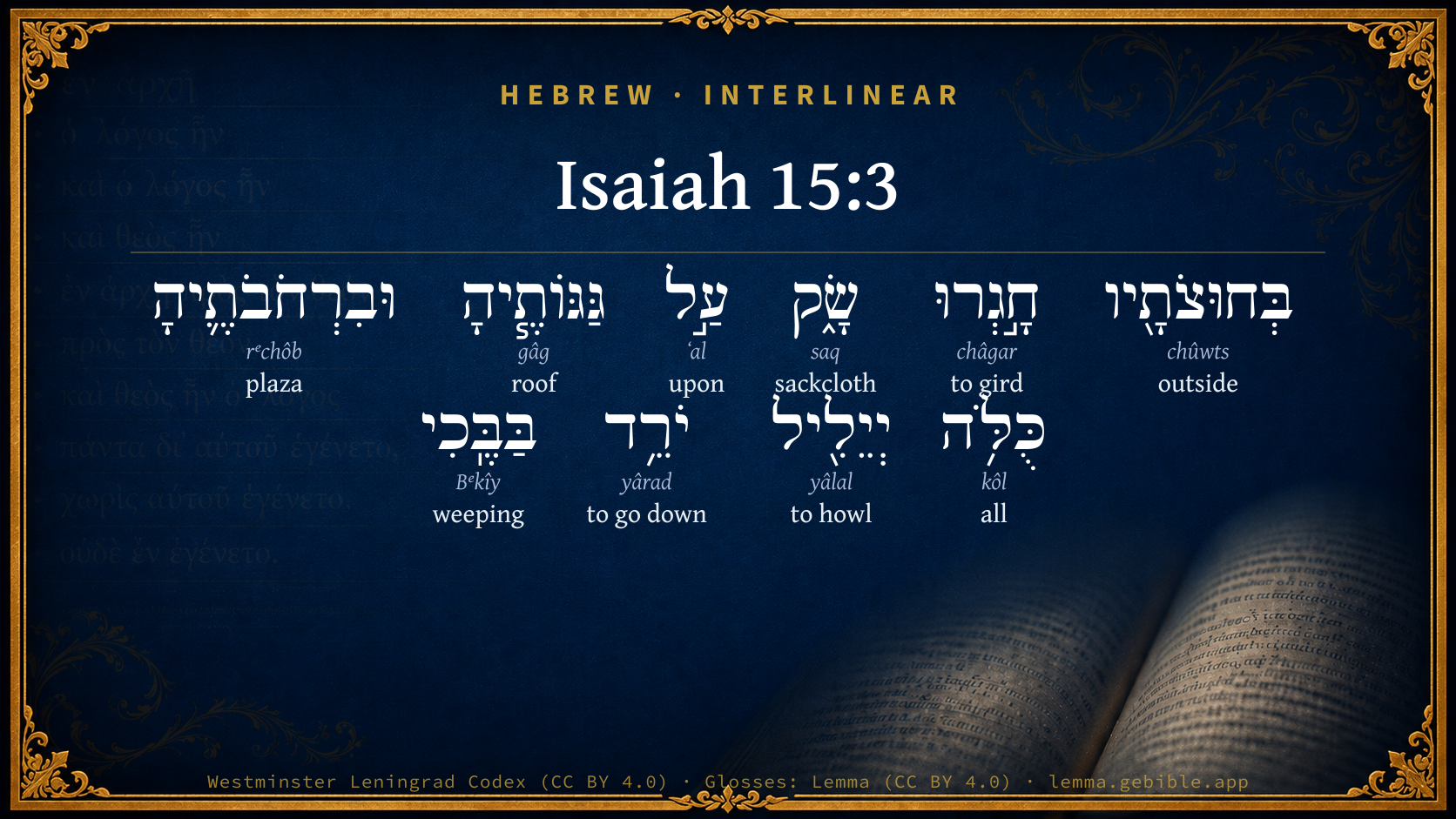
Hebrew (Westminster Leningrad Codex) Isaiah 15:3 appears in the Hebrew Old Testament. The text above is from the Westminster Leningrad Codex. Each word links to its Strong’s number, a concise gloss, and parsing drawn from the Open Scriptures Hebrew Bible morphology. Click any word for its full Brown-Driver-Briggs (BDB) entry.
Download image
Cite this verse

Isaiah 15:3 (World English Bible). Public Domain. Lemma interlinear Bible study tool, https://lemma.gebible.app/v/isaiah/15/3.

Show BibTeX & RIS
BibTeX
RIS
English Translation
In their streets they gird themselves with sackcloth; on their housetops, and in their broad places, everyone wails, weeping abundantly.
World English Bible · Public Domain
Download a study sheet

One document with this verse’s original text, its word-by-word gloss line, the meaning frame, cross-references with their text, attributed commentary, and full source and license credits — printable, and it pastes into notes with its structure intact.

This verse Autodidact and up

Study sheet (.html) Plain text (.txt)

A passage Seminary Student

Up to 50 verses in one chapter. A passage sheet keeps up to 6 commentary sources and 12 cross-references per verse, in the order this page ranks them, and says so on the sheet whenever that leaves anything out. Ask for a single verse and you get the Autodidact verse sheet above.

Everything on this page stays free to read, with no account — the sheet is a download of what is already on screen, not access to it.

Want to remove ads? Support Godless Engineer
Compare translations 3

The same verse in 3 English versions, stacked beneath the original-language interlinear above. Click any original word for its lexicon entry.

Each is an independent rendering of the whole verse — the interlinear is not word-aligned to these translations.

Highlighted words mark where these versions differ — a whole-verse word diff, not a word-by-word alignment.

  • World English Bible Public Domain
    In their streets they gird themselves with sackcloth; on their housetops, and in their broad places, everyone wails, weeping abundantly.
  • King James Version Public Domain
    In their streets they shall gird themselves with sackcloth: on the tops of their houses, and in their streets, every one shall howl, weeping abundantly.
  • unfoldingWord Literal Text CC BY-SA 4.0
    In its streets they gird on sackcloth. On its housetops and in its squares, all of it wails, coming down with weeping.

unfoldingWord Literal Text — © unfoldingWord, licensed CC BY-SA 4.0. Word-aligned USFM3 via Door43 (git.door43.org/unfoldingWord/en_ult).

Versions to compare (up to 4)

3 of 4 selected

Show all 18 translations

Every available English version of this verse, each an independent rendering of the whole verse.

  • World English Bible Public Domain
    In their streets they gird themselves with sackcloth; on their housetops, and in their broad places, everyone wails, weeping abundantly.
  • Berean Standard Bible Public Domain
    In its streets they wear sackcloth; on the rooftops and in the public squares they all wail, falling down weeping.
  • Majority Standard Bible Public Domain
    In its streets they wear sackcloth; on the rooftops and in the public squares they all wail, falling down weeping.
  • King James Version Public Domain
    In their streets they shall gird themselves with sackcloth: on the tops of their houses, and in their streets, every one shall howl, weeping abundantly.
  • American Standard Version (1901) Public Domain
    In their streets they gird themselves with sackcloth; on their housetops, and in their broad places, every one waileth, weeping abundantly.
  • Revised Version (1885) Public Domain
    In their streets they gird themselves with sackcloth: on their housetops, and in their broad places, every one howleth, weeping abundantly.
  • Geneva Bible (1599) Public Domain
    In their streetes shall they bee gilded with sackecloth: on the toppes of their houses, and in their streetes euery one shall howle, and come downe with weeping.
  • Douay-Rheims (1899) Public Domain
    In their streets they are girded with sackcloth: on the tops of their houses, and in their streets all shall howl and come down weeping.
  • Young's Literal Translation Public Domain
    In its out-places they girded on sackcloth, On its pinnacles, and in its broad places, Every one howleth -- going down with weeping.
  • Literal Standard Version CC BY-SA 4.0
    In its out-places they girded on sackcloth, || On its pinnacles, and in its broad places, || Everyone howls—going down with weeping.
  • Unlocked Literal Bible CC BY-SA 4.0
    In their streets they wear sackcloth; on their housetops and in the square everyone wails, melting in tears.
  • unfoldingWord Literal Text CC BY-SA 4.0
    In its streets they gird on sackcloth. On its housetops and in its squares, all of it wails, coming down with weeping.
  • Darby Bible Public Domain
    In their streets they are girded with sackcloth; on their roofs, and in their broadways, every one howleth, melted into tears.
  • World Messianic Bible Public Domain
    In their streets, they clothe themselves in sackcloth. In their streets and on their housetops, everyone wails, weeping abundantly.
  • Webster's Bible Public Domain
    In their streets they shall gird themselves with sackcloth: on the tops of their houses, and in their streets, every one shall howl, weeping abundantly.
  • Free Bible Version CC BY-SA 4.0
    They wear sackcloth in their streets. On the rooftops and in the open squares they all weep, falling down crying.
  • Bible in Basic English Public Domain
    In their streets they are covering themselves with haircloth: on the tops of their houses, and in their public places, there is crying and bitter weeping.
  • JPS Tanakh (1917) Public Domain
    In their streets they gird themselves with sackcloth; on their housetops, and in their broad places, every one howleth, weeping profusely.

Literal Standard Version (2020), Covenant Press — licensed CC BY-SA 4.0. Text via the HelloAO Bible API (eBible.org). Unlocked Literal Bible (unfoldingWord) — licensed CC BY-SA 4.0. Text via the HelloAO Bible API (eBible.org). unfoldingWord Literal Text — © unfoldingWord, licensed CC BY-SA 4.0. Word-aligned USFM3 via Door43 (git.door43.org/unfoldingWord/en_ult). Free Bible Version, Dr. Jonathan Gallagher — licensed CC BY-SA 4.0. Text via the HelloAO Bible API (eBible.org).

Word by word

More ways to search: Search by grammar → Find every occurrence → Compare this word →

Practice this passage: Drill this verse → Learn its vocabulary →

בַּבֶּֽכִי
Bᵉkîy
H1065
“in/at the · weeping”
Preposition, Determined + Noun, Common, Masculine, Singular, Absolute
Part of Speech
Preposition + Noun
Type
Common
Gender
Masculine
Number
Singular
State
Absolute
Full BDB Definition

Origin: from H1058

TWOT: 243b

a weeping, weeping
  1. בְּחוּצֹתָ֖יו chûwts H2351 “in/at · streets · his” Preposition + Noun, Common, Masculine, Plural, Construct + Suffix, Personal, 3rd Person, Masculine, Singular
  2. חָ֣גְרוּ châgar H2296 “to gird” Verb, Qal, Perfect, 3rd Person, Common, Plural
  3. שָׂ֑ק saq H8242 “sackcloth” Noun, Common, Masculine, Singular, Absolute
  4. עַ֣ל ʻal H5921 “upon” Preposition
  5. גַּגּוֹתֶ֧יהָ gâg H1406 “roofs · her” Noun, Common, Masculine, Plural, Construct + Suffix, Personal, 3rd Person, Feminine, Singular
  6. וּבִרְחֹבֹתֶ֛יהָ rᵉchôb H7339 “and · in/at · plazas · her” Conjunction + Preposition + Noun, Common, Feminine, Plural, Construct + Suffix, Personal, 3rd Person, Feminine, Singular
  7. כֻּלֹּ֥ה kôl H3605 “all · her” Noun, Common, Masculine, Singular, Construct + Suffix, Personal, 3rd Person, Feminine, Singular
  8. יְיֵלִ֖יל yâlal H3213 “to howl” Verb, Hiphil, Imperfect, 3rd Person, Masculine, Singular
  9. יֹרֵ֥ד yârad H3381 “going down” Verb, Qal, Participle Active, Masculine, Singular, Absolute

About this verse

These counts appear in no published source. They are computed here, from the morphology-tagged text and Lemma’s own curated glosses. What Lemma adds →

10
words
10
distinct lemmas
Prophets
section

Shared distinctive vocabulary

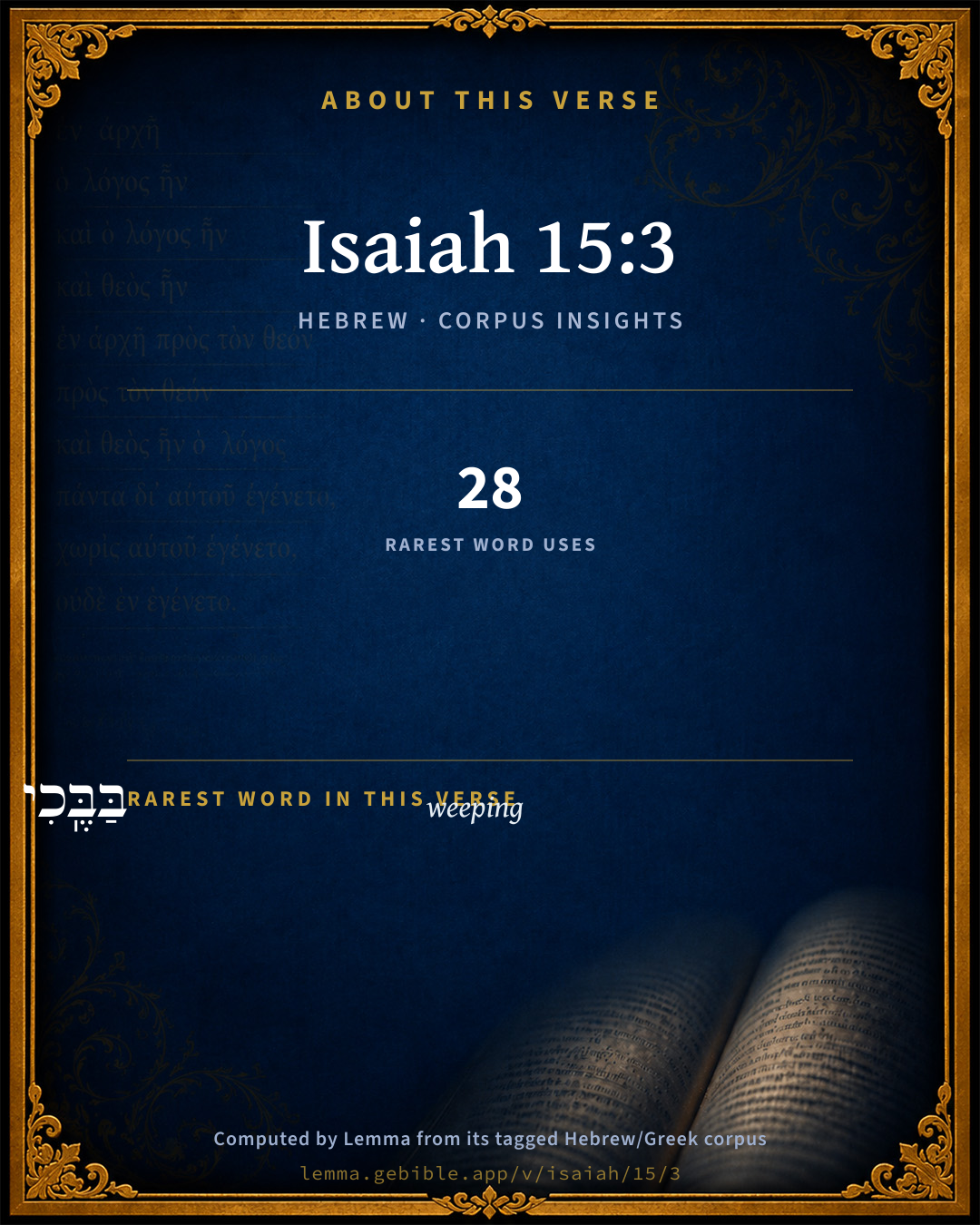
בַּבֶּֽכִי weeping H1065 occurs in 27 verses of the Hebrew Bible. Also found in:

Grammatical profile

  • 3 verbs
  • 6 nouns
  • 1 preposition

Verb forms

  • חָ֣גְרוּ Qal · Perfect
  • יְיֵלִ֖יל Hiphil · Imperfect
  • יֹרֵ֥ד Qal · Participle Active

Hebrew & Septuagint length

In English translation the verse runs 20 words from the Hebrew and 26 from the Septuagint (LXX English) — closely comparable.

A rough comparison of the two English renderings, which tokenize alike — not a word-level alignment.

Word counts can differ between the Hebrew and the Greek without any difference in meaning — e.g. the Hebrew direct-object marker אֵת has no separate Greek word, and Greek often adds the article ὁ.

Cross-references

10

Topical passages linked to Isaiah 15:3 in the Treasury of Scripture Knowledge — connected by theme and wording, ordered by reader-vote popularity; previews shown in the World English Bible.

  • Jonah 3:6–8 The news reached the king of Nineveh, and he arose from his throne, and took off his royal robe, covered himself with sackcloth, and sat in ashes.
  • Deuteronomy 22:8 When you build a new house, then you shall make a battlement for your roof, that you don't bring blood on your house, if any man fall from there.
  • 2 Samuel 3:31 David said to Joab, and to all the people who were with him, Tear your clothes, and gird you with sackcloth, and mourn before Abner. King David followed the bier.
  • 2 Kings 6:30 It happened, when the king heard the words of the woman, that he tore his clothes (now he was passing by on the wall); and the people looked, and, behold, he had sackcloth within on his flesh.
  • Isaiah 15:2 They are gone up to Bayith, and to Dibon, to the high places, to weep: Moab wails over Nebo, and over Medeba; on all their heads is baldness, every beard is cut off.
  • Isaiah 22:1 The burden of the valley of vision. What ails you now, that you are wholly gone up to the housetops?
  • Isaiah 22:4 Therefore said I, Look away from me, I will weep bitterly; don't labor to comfort me for the destruction of the daughter of my people.
  • Jeremiah 19:13 and the houses of Jerusalem, and the houses of the kings of Judah, which are defiled, shall be as the place of Topheth, even all the houses on whose roofs they have burned incense to all the host of the sky, and have poured out drink-offerings to other gods.
  • Jeremiah 48:38–39 On all the housetops of Moab and in the streets of it there is lamentation every where; for I have broken Moab like a vessel in which none delights, says Yahweh.
  • Matthew 11:21 "Woe to you, Chorazin! Woe to you, Bethsaida! For if the mighty works had been done in Tyre and Sidon which were done in you, they would have repented long ago in sackcloth and ashes.

Cross-references courtesy of OpenBible.info (CC BY 4.0).

Hebrew and Greek witnesses Masoretic Hebrew ↔ Greek Septuagint

The same verse in the two great witnesses to the Old Testament, shown verse-for-verse.

These are two independent witnesses, not word-aligned to each other, and the Septuagint is shown in lemma (dictionary) form.

Hebrew Isaiah 15:3 Masoretic · Westminster Leningrad Codex

בְּחוּצֹתָ֖יו חָ֣גְרוּ שָׂ֑ק עַ֣ל גַּגּוֹתֶ֧יהָ וּבִרְחֹבֹתֶ֛יהָ כֻּלֹּ֥ה יְיֵלִ֖יל יֹרֵ֥ד בַּבֶּֽכִי

In their streets they gird themselves with sackcloth; on their housetops, and in their broad places, everyone wails, weeping abundantly.

World English Bible · Public Domain

Greek LXX Isaiah 15:3 Septuagint · lemma form

ἐν ὁ πλατύς αὐτός περιζώννυμι σάκκος καί κόπτω ἐπί ὁ δῶμα αὐτός καί ἐν ὁ ῥύμη αὐτός πᾶς ὀλολύζω μετά κλαυθμός

Gird yourselves with sackcloth in her streets: and lament upon her roofs, and in her streets, and in her ways; howl all of you with weeping.

LXX2012 (modern English Septuagint) · Public Domain

Hebrew: Westminster Leningrad Codex (CC BY 4.0). Greek: Septuagint (public domain); English from LXX2012 (modern English Septuagint) (Public Domain). How the Septuagint differs from the Hebrew →

Targum (Aramaic paraphrase)

1

The Targum is the ancient Jewish Aramaic paraphrase of the Hebrew Scriptures — an interpretive translation, not the Hebrew text itself. Onkelos (literal) and Pseudo-Jonathan (expansive) render the Torah, and Jonathan the Prophets. Coverage is partial: where no permissively-licensed English translation exists for a verse, only the Aramaic is shown. This is verse-level text, not a word-by-word alignment to the Hebrew.

  1. Targum Jonathan Prophets (Joshua–Malachi)
    בְּשׁוֹקֵיהוֹן יִסְרוּן סַקִין עַל אִיגָרֵיהוֹן וּבִרְחוֹבֵיהוֹן כּוּלְהוֹן מְיַלְלִין מְצַוְחִין וּבָכָן:

    In their streets they shall gird themselves with sackcloth: on their house-tops, and in their broad-places all of them shall howl, crying and weeping.

    Targum Jonathan — Aramaic: “Mikraot Gedolot” (public domain). English: “Sefaria Community Translation” (CC0 1.0 (public-domain dedication)); “London "Chaldee Paraphrase," 1871” (public domain). Text via Sefaria.

Commentary

Notes on Isaiah 15:3 from classic Christian and Jewish commentators (each source and its license shown beneath its notes). The classic Christian expositions comment on the surrounding passage and are grouped to its opening verse, so a note may address several verses; the Jewish commentaries on the Tanakh (Rashi and others) are per-verse, so they appear only where the commentator wrote on this verse.

Lemma curates 59 commentaries, every one of them public domain or Creative Commons licensed, each selected and text-cleaned for this edition rather than reprinted as found. About our sources →

Trapp's Complete Commentary

John Trapp

Isa 15:3 In their streets they shall gird themselves with sackcloth: on the tops of their houses, and in their streets, every one shall howl, weeping abundantly.

Ver. 3. In their streets they shall gird themselves with sackcloth.] Saccum et silicium non curat Deus. God careth not for these externals where there is not a heart sprinkled with the blood of his Son. "The sacrifice of the wicked is abomination; how much more when he bringeth it with a wicked mind?" {Pro 21:27}

On the tops of their houses.] Thence, as it were, to require help from heaven.

Weeping abundantly.] Heb., Descending with weeping, like as with weeping they ascended; {a} they get nothing of their gods, though they cried to them. But he that goeth to the true God with an honest heart and lawful petitions is sure to speed. See Isa 45:19.

{a} Miseros ergo Papicolas, qui et ipsi cum fietu ad divos divasque suas ascendunt, cum ululatu descendunt. - Scultet.

John Trapp, A Commentary or Exposition upon All the Books of the Old and New Testament (1647–1656) — public domain. Text from a community e-Sword module.

Jamieson, Fausset & Brown

Robert Jamieson, A. R. Fausset & David Brown

tops of . . . houses--flat; places of resort for prayer, &c., in the East (Act 10:9).

weeping abundantly--"melting away in tears." HORSLEY prefers "descending to weep." Thus there is a "parallelism by alternate construction" [LOWTH], or chiasmus; "howl" refers to "tops of houses." "Descending to weep" to "streets" or squares, whither they descend from the housetops.

Jamieson, Fausset & Brown — Commentary Critical and Explanatory on the Whole Bible (1871) — public domain (CC PDM 1.0). Text via the HelloAO Bible API.

Adam Clarke's Commentary

Verse 3. With sackcloth] שק sak. The word is in the plural שקים sakkim, sacks, in one of De Rossi's MSS.

Adam Clarke's Commentary on the Bible (1810–1826) — public domain. Text from a community e-Sword/MySword module.

Ellicott's Commentary for English Readers

(3) In their streets . . .—The picture of lamentation is continued. The flat roofs of Eastern houses were a natural resort for such wailings (Isa_22:1). The “broad places,” the bazaars or market-places, were also, like the agora of Greek cities, a natural place of concourse. The prophet represents them as filled with the sound of wailing.

A Bible Commentary for English Readers, edited by Charles John Ellicott (1878–1897) — public domain. Text from a community e-Sword module.

The Cambridge Bible for Schools and Colleges

gen. ed. J. J. S. Perowne

3. (Jer_48:37 f.) on the tops of their houses] See on Isa_22:1. The word streets should not be used twice; substitute in the second case broad places (as in R.V.).

weeping abundantly] lit. “going down in weeping,” an unusually strong figure. In other passages the eye is said to “go down in tears” (Jer_9:18; Lam_1:16; Lam_3:48); but nowhere else is the whole being spoken of as dissolved in weeping.

The Cambridge Bible for Schools and Colleges (gen. ed. J. J. S. Perowne; Cambridge University Press, 1878–1918) — public domain. Text from a community e-Sword module.

John Gill's Exposition

In their streets they shall girt themselves with sackcloth,.... Instead of their fine clothes, with which they had used to deck themselves, being a very proud people; see Isa 16:6 this was usual in times of distress on any account, as well as a token of mourning for the dead; see Joe 1:8. The word for "streets" might be rendered "villages", as distinct from cities, that were "without" the walls of the cities, though adjacent to them; and the rather, seeing mention is made of streets afterwards:

on the tops of their houses; which were made flat, as the houses of the Jews were, on which were battlements, Deu 22:8 hither they went for safety from their enemies, or to see if they could spy the enemy, or any that could assist them, and deliver them; or rather, hither they went for devotion, to pray to their gods for help; for here it was usual to have altars erected, to burn incense on to their deities; see Kg2 23:12 and in such places the people of God were wont to pray, Act 10:9,

and in their streets; publicly, as well as privately, where they ran up and down to get from the enemy, and save themselves:

everyone shall howl, weeping abundantly: or, "descending with weeping": the tears running down his cheeks in great abundance, so that his whole body was as it were watered with them; or the meaning may be, that everyone that went up to the temples of the idols, and to the high places, Isa 15:2 or to the roofs of the houses, as here, to pray the assistance of their gods, should come down weeping and howling, having no success.

John Gill's Exposition of the Whole Bible (1746–1763) — public domain (CC PDM 1.0). Text via the HelloAO Bible API.

Albert Barnes' Notes on the Bible

In their streets - Publicly. Everywhere there shall be lamentation and grief. Some shall go into the streets, and some on the tops of the houses.

They shall gird themselves with sackcloth - The common token of mourning; and also worn usually in times of humiliation and fasting. It was one of the outward acts by which they expressed deep sorrow (Gen 37:34; 2Sa 3:31; 1Ki 21:27; 2Ki 19:1; Job 16:15; the note at Isa 3:24).

On the tops of the houses - The roofs of the houses in the East were, and still are, made flat, and were places of resort for prayer, for promenade, etc. The prophet here says, that all the usual places of resort would be filled with weeping and mourning. In the streets, and on the roofs of the houses, they would utter the voice of lamentation.

Shall howl - It is known that, in times of calamity in the East, it is common to raise an unnatural and forced howl, or long-continued shriek. Persons are often hired for this purpose Jer 9:17.

Weeping abundantly - Hebrew, ‘Descending into weeping;’ “that is,” going, as we would say, “deep into it,” or weeping much; immersed as it were in tears (compare Jer 13:17; Jer 14:17).

Albert Barnes' Notes on the Bible (1834–1885) — public domain. Text from a community e-Sword/MySword module.

Matthew Poole's English Annotations

Shall gird themselves with sackcloth: this was another practice of mourners.

The tops of their houses, which were made flat, Deu 22:8; to which men used to go up, either to walk, or to cry to God in heaven or to men for help.

In their streets; publicly, without shame; whereas in ordinary sorrows men are wont to seek secret places for their mourning.

Matthew Poole's English Annotations on the Holy Bible (1683–1685) — public domain. Text from a community e-Sword/MySword module.

The Pulpit Commentary

In their streets; literally, in his streets; i.e. the streets of Moab. They shall gird themselves with sackcloth. Another widely spread custom, known to the Assyrians, (Jon_3:5) the Syrians, (1Ki_20:31) the Persians, (Est_4:1, Est_4:2) the Israelites, (Neh_9:1) and, as we see here, to the Moabites. The modern wearing of black garments, especially crape, is representative of the old practice. Every one shall howl. "Howling" remains one of the chief tokens of mourning in the East. It was a practice of the Egyptians (Herod., 2:79), of the Persians (ibid., 8:99; 9:24), of the Babylonians, (Jer_51:8) and probably of the Orientals generally. Weeping abundantly; or, running down with tears. (comp. Jer_9:18 Jer_13:17; Herod., 8:99)

National distress.

The particular trouble causing such extreme grief was the destruction of the two chief cities of Moab, Ar and Kit. To destroy the capital of a kingdom is to strike the nation at its very heart. Conquerors can dictate peace when the chief city lies at their mercy. Illustrate from the recent German siege of Paris. This chapter vigorously pictures the distress throughout the land when Ar was taken, the rush of people to the border districts, the alarm of those whose property was imperiled, the wail of those who had lost their friends in the strife. Howling, weeping, plucking off the hair, covering with sackcloth, and other signs of despairing grief, were found everywhere; and the cries were all the more bitter because for so many generations Moab had dwelt secure. Here one kind of national distress brings before us that general subject, and sets upon considering

I ITS BEARING ON THE POOR. They are always the first to suffer from political or international conditions which affect manufacture, trade, or agriculture. Living upon daily wage, and, when thrifty, only able to provide in limited degrees for depressed times, the poor are most dependent on the preservation of peace, security, order, and mutual confidence. Demagogues urge the poor to a disturbance of social relations, with the promise of material advantage. In the interests of the poor themselves we plead that war, disturbance, revolutionary change, never even temporarily serve their interest. So grievous is the effect of political convulsions on the poor, that no class of the community should more intensely demand the knitting of laud to land by commerce and brotherhood, and the correction of social and political evils by processes which do not disturb the sense of national security. Of the poor the words may well be used, "In quietness and confidence shall be your strength.

II ITS BEARING ON THE RICH. They are always the aim of attack in lawless times, whether the evil come through aggressive enemies outside the nation, or through turbulent people inside the nation. The one wants "booty," and the other wants excuse for robbery. The rich need national security

(1) for the retention of what they have;

(2) for the increase of what they have;

(3) and for the enjoyment of what they have.

National distress becomes especially afflictive to the rich, because by training and association they are unfitted for self-help when their riches are taken away.

III ITS MISSION AS SENT BY GOD. It is often that which we find illustrated in the case of Moab. National distress, circumstances that unite the whole land in a common grief, and in a common sense of helplessness, is the Divine corrective of the evils which attend prolonged peace, security, and luxury. Those evils may be traced:

1. In the sphere of men"s thought. The material is exaggerated, the unseen and spiritual are at disadvantage, and cannot hold their due place and proportion.

2. In the sphere of social life. In prolonged times of peace and prosperity, the separations between classes of society are grievously widened, and there grows up a painful contrast between the few who are unduly rich and the many who are miserably poor. National distress brings rich and poor together, in mutual dependence and service.

3. In the spheres of religion. Like the voyager, men can easily dismiss the thought of God when, for long times together, seas are calm and heavens are clear; but when the skies are black, and the wild waves shake the frail ship, and fear whitens every face, the soul begins to cry for a sight of God and a touch of his protecting hand. We are with God as our little children are with their mothers. They run about and play, taking little heed of her, until the head aches, and the pulse is high, and pain wearies; and then there is nobody in all the world will do but their mother. National distress brings nations back to the thought and love of God. The atheist, the agnostic, and the secularist have their chance when the sun shines; nobody wants such vain helpers when the tempests rage. Then nobody will do but the God of our fathers.

IV ITS SHAME, IF CAUSED BY MAN"S WILFULNESS OR MAN"S NEGLECT. And these are too often the immediate causes of national distress. War is almost always the issue of somebody"s willfulness or masterfulness. Nobody would need to go to war if they did not hanker after something to which they had no right, or were not compelled to resist these envious, masterful folk. And such distresses as come by prevailing disease are usually traceable to men"s neglectings of social and family and household duty. God makes even man"s errors and sins serve his purpose, but he never ceases to declare woe unto him by whom the offence cometh. R.T.

The Pulpit Commentary (1880–1919), ed. H.D.M. Spence-Jones & Joseph S. Exell — public domain. Text from a community e-Sword module.

John Wesley's Explanatory Notes

On the tops - Which were made flat, to which men used to go up, to cry to God in heaven, or to men for help.

John Wesley, Explanatory Notes Upon the Whole Bible (1754–1765) — public domain. Text via the GEBible commentary corpus.

J. A. Alexander on Isaiah

Joseph Addison Alexander

“In its streets they are girded with sackcloth; on its roofs and in its squares (or broad places) all (literally, all of it) howls, coming down with weeping (from the house-tops or the temples).” In the Hebrew of this verse there is a singular alternation of masculine and feminine forms, all relating to Moab, sometimes considered as a country and sometimes as a nation. The last clause is explained by most modern writers, to mean melting into tears, as the eye is elsewhere said to run down tears or water (Jer 9:18; Lam 3:48). But as the eye is not here mentioned, and the preposition is inserted, making a marked difference between this and the alleged expressions, it is better to adhere to the old construction which supposes an antithesis between this clause and the ascent to the temples or the housetops. Sackcloth is mentioned as the usual mourning dress and a badge of deep humiliation.

Joseph Addison Alexander, The Prophecies of Isaiah (1846–1847; New York: Scribner, 1870–1878) — public domain. Text from a community e-Sword module.

unfoldingWord translationNotes

Door43 World Missions Community

General Information:

This continues the prophecy about the people of Moab. God describes events that will happen in the future as if it is happening in the present. (See: Isaiah 15:1-2)

they wear sackcloth

They do this to show their extreme sadness. AT: "they wear sackcloth and mourn" (See: Symbolic Action)

Heshbon ... Elealeh ... Jahaz

These are names of cities and towns. (See: How to Translate Names)

Heshbon and Elealeh call out

These city names represent the people of these cities. "The people of Heshbon and Elealeh call out" (See: Metonymy)

they tremble within themselves

Physical trembling is a symptom of fear and represents fear. AT: "they will be completely filled with fear" or "they tremble with fear" (See: Metonymy)

translationWords

sackcloth

unfoldingWord translationNotes — © Distant Shores Media and the Door43 World Missions Community, licensed CC BY-SA 4.0. Source: git.door43.org/Door43/en_tn.

Rashi

Rabbi Shlomo Yitzchaki (Rashi)

sighing Heb. יֹרֵד, sighing and roaring with weeping. Comp. (Judges 11:37) “And I will cry, (וְיָרַדְתִּי) on the mountains,” and (Lam. 3:19) “Remember my affliction and my cry (וּמְרוּדִי).”

Rashi on the Tanakh — English translations: “The Judaica Press complete Tanach with Rashi, translated by A. J. Rosenberg” (CC BY 4.0); “Pentateuch with Rashi's commentary by M. Rosenbaum and A.M. Silbermann, 1929-1934” (public domain); “The Metsudah Tanach series, Lakewood, N.J” (CC BY 4.0); and “The Book of Joshua, Metsudah Publications, 1997” (CC BY 4.0). Text via Sefaria.

Ibn Ezra

Rabbi Abraham ibn Ezra

In their streets. In the streets of the Moabites.

גגותיה Her roofs. The roofs of the country.

ייליל Shall howl. Comp. ייטיב he will do good (Job 24:31); in both cases the sounding of the radical is an anomaly.

Ibn Ezra on the Tanakh — English translations: “Sefaria Community Translation” (CC0 1.0 (public-domain dedication)); “Yalkut, Sifsei Chachomim Chumash, Metsudah Publications, 2009” (CC BY 4.0); and “Commentary of Ibn Ezra on Isaiah - trans. by M. Friedlander, 1873” (public domain). Text via Sefaria.

Lesson kit

Teaching starters — assembled from the data on this page, not authored interpretation. Every prompt links to the verse data it draws on. Edit before teaching.

Isaiah, in the Prophets, opens this verse with 10 words (10 distinct Hebrew lemmas). Its most distinctive word is Bᵉkîy (“weeping”). A historical commentator’s framing appears above. Read the whole chapter for the surrounding context.

Discussion questions

  1. What does “weeping” (Bᵉkîy) contribute to the verse as a whole?
  2. Genesis 45:2 shares the word «weeping» with this verse. How do the two illuminate each other?
  3. The translations on this page render this verse differently — a whole-verse word diff, not a word-by-word alignment. What might account for the different wordings?
  4. The verb «חָ֣גְרוּ» is Qal Perfect. How does its form color the action?
  5. Reading how Trapp's Complete Commentary and Jamieson, Fausset & Brown read this verse, where do the two commentators agree and where do they part?

Things to notice

Reading settings

Reading text

Shown beneath each verse's original-language words.

Old Testament
Old Testament edition

Read the OT as the Masoretic Hebrew (MT) or the Greek Septuagint (LXX).

English shown for the Greek Septuagint (in the Hebrew ↔ Greek comparison).

Comparing translations? Open the Compare panel on any verse page to stack up to four side by side.