
Jeremiah 14:16

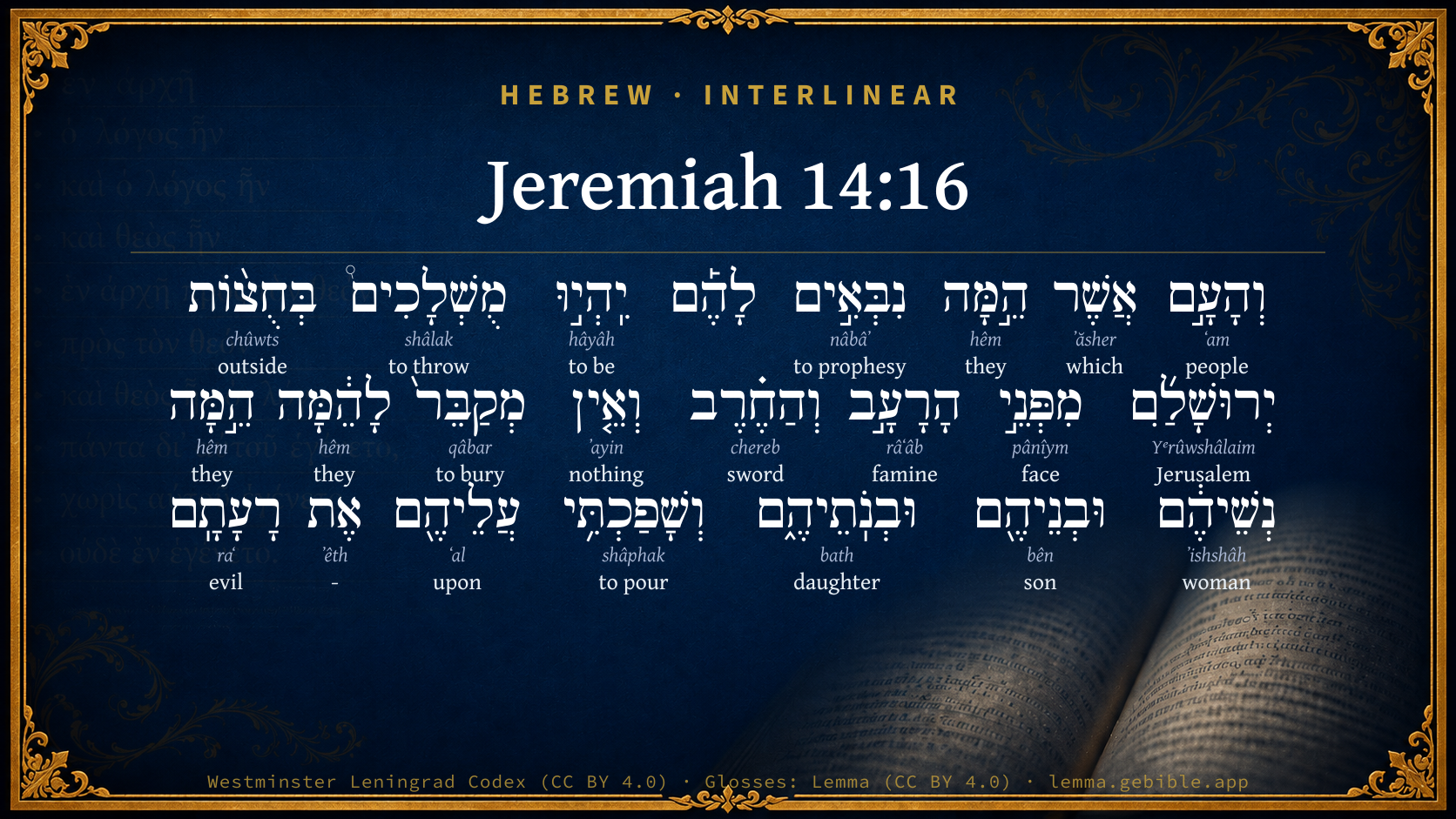
Hebrew (Westminster Leningrad Codex) Jeremiah 14:16 appears in the Hebrew Old Testament. The text above is from the Westminster Leningrad Codex. Each word links to its Strong’s number, a concise gloss, and parsing drawn from the Open Scriptures Hebrew Bible morphology. Click any word for its full Brown-Driver-Briggs (BDB) entry.
Download image
Cite this verse

Jeremiah 14:16 (World English Bible). Public Domain. Lemma interlinear Bible study tool, https://lemma.gebible.app/v/jeremiah/14/16.

Show BibTeX & RIS
BibTeX
RIS
English Translation
The people to whom they prophesy shall be cast out in the streets of Jerusalem because of the famine and the sword; and they shall have none to bury them-them, their wives, nor their sons, nor their daughters: for I will pour their wickedness on them.
World English Bible · Public Domain
Download a study sheet

One document with this verse’s original text, its word-by-word gloss line, the meaning frame, cross-references with their text, attributed commentary, and full source and license credits — printable, and it pastes into notes with its structure intact.

This verse Autodidact and up

Study sheet (.html) Plain text (.txt)

A passage Seminary Student

Up to 50 verses in one chapter. A passage sheet keeps up to 6 commentary sources and 12 cross-references per verse, in the order this page ranks them, and says so on the sheet whenever that leaves anything out. Ask for a single verse and you get the Autodidact verse sheet above.

Everything on this page stays free to read, with no account — the sheet is a download of what is already on screen, not access to it.

Want to remove ads? Support Godless Engineer
Compare translations 3

The same verse in 3 English versions, stacked beneath the original-language interlinear above. Click any original word for its lexicon entry.

Each is an independent rendering of the whole verse — the interlinear is not word-aligned to these translations.

Highlighted words mark where these versions differ — a whole-verse word diff, not a word-by-word alignment.

  • World English Bible Public Domain
    The people to whom they prophesy shall be cast out in the streets of Jerusalem because of the famine and the sword; and they shall have none to bury them-them, their wives, nor their sons, nor their daughters: for I will pour their wickedness on them.
  • King James Version Public Domain
    And the people to whom they prophesy shall be cast out in the streets of Jerusalem because of the famine and the sword; and they shall have none to bury them, them, their wives, nor their sons, nor their daughters: for I will pour their wickedness upon them.
  • unfoldingWord Literal Text CC BY-SA 4.0
    And the people whom they are prophesying to, them shall be the ones being cast out in the streets of Jerusalem because of the famine and the sword, and there will be no one burying for them—they, their wives nor their sons nor their daughters. And I will pour out upon them their evil.

unfoldingWord Literal Text — © unfoldingWord, licensed CC BY-SA 4.0. Word-aligned USFM3 via Door43 (git.door43.org/unfoldingWord/en_ult).

Versions to compare (up to 4)

3 of 4 selected

Show all 18 translations

Every available English version of this verse, each an independent rendering of the whole verse.

  • World English Bible Public Domain
    The people to whom they prophesy shall be cast out in the streets of Jerusalem because of the famine and the sword; and they shall have none to bury them-them, their wives, nor their sons, nor their daughters: for I will pour their wickedness on them.
  • Berean Standard Bible Public Domain
    And the people to whom they prophesy will be thrown into the streets of Jerusalem because of famine and sword. There will be no one to bury them or their wives, their sons or their daughters. I will pour out their own evil upon them.
  • Majority Standard Bible Public Domain
    And the people to whom they prophesy will be thrown into the streets of Jerusalem because of famine and sword. There will be no one to bury them or their wives, their sons or their daughters. I will pour out their own evil upon them.
  • King James Version Public Domain
    And the people to whom they prophesy shall be cast out in the streets of Jerusalem because of the famine and the sword; and they shall have none to bury them, them, their wives, nor their sons, nor their daughters: for I will pour their wickedness upon them.
  • American Standard Version (1901) Public Domain
    And the people to whom they prophesy shall be cast out in the streets of Jerusalem because of the famine and the sword; and they shall have none to bury them-them, their wives, nor their sons, nor their daughters: for I will pour their wickedness upon them.
  • Revised Version (1885) Public Domain
    And the people to whom they prophesy shall be cast out in the streets of Jerusalem because of the famine and the sword; and they shall have none to bury them, them, their wives, nor their sons, nor their daughters: for I will pour their wickedness upon them.
  • Geneva Bible (1599) Public Domain
    And the people to whome these prophets doe prophecie, shalbe cast out in the streetes of Ierusalem, because of the famine, and the sword, and there shall be none to bury them, both they, and their wiues, and their sonnes, and their daughters: for I wil powre their wickednes vpon them.
  • Douay-Rheims (1899) Public Domain
    And the people to whom they prophecy, shall be cast out in the streets of Jerusalem because of the fanmine and the sword, and there shall be none to bury them: they and their wives, their sons and their daughters, and I will pour out their wickedness upon them.
  • Young's Literal Translation Public Domain
    And the people to whom they are prophesying, Are cast into out-places of Jerusalem, Because of the famine, and of the sword, And they have none burying them, Them, their wives, and their sons, and their daughters, And I have poured out upon them this evil.
  • Literal Standard Version CC BY-SA 4.0
    And the people to whom they are prophesying are cast into out-places of Jerusalem, because of the famine and the sword, and they have none burying them—them, their wives, and their sons, and their daughters—and I have poured out their evil on them.
  • Unlocked Literal Bible CC BY-SA 4.0
    Then the people to whom they prophesied will be thrown out in the streets of Jerusalem because of famine and sword, for there will be no one to bury them—them, their wives, their sons, or their daughters—for I will pour out their wickedness on them.
  • unfoldingWord Literal Text CC BY-SA 4.0
    And the people whom they are prophesying to, them shall be the ones being cast out in the streets of Jerusalem because of the famine and the sword, and there will be no one burying for them—they, their wives nor their sons nor their daughters. And I will pour out upon them their evil.
  • Darby Bible Public Domain
    and the people to whom they prophesy shall be cast out in the streets of Jerusalem, because of the famine and the sword; and there shall be none to bury them, them, their wives, and their sons, and their daughters; and I will pour their wickedness upon them.
  • World Messianic Bible Public Domain
    The people to whom they prophesy will be cast out in the streets of Jerusalem because of the famine and the sword. They will have no one to bury them—them, their wives, their sons, or their daughters, for I will pour their wickedness on them.
  • Webster's Bible Public Domain
    And the people to whom they prophesy shall be cast out in the streets of Jerusalem, because of the famine, and the sword; and they shall have none to bury them, them, their wives, nor their sons, nor their daughters: for I will pour their wickedness upon them.
  • Free Bible Version CC BY-SA 4.0
    The bodies of the people they prophesied to will be thrown into the streets of Jerusalem because of famine and war. There won't be anyone to bury them or their wives, their sons or their daughters. I will pour out their own evil on them.
  • Bible in Basic English Public Domain
    And the people to whom they are prophets will be pushed out dead into the streets of Jerusalem, because there is no food, and because of the sword; and they will have no one to put their bodies into the earth, them or their wives or their sons or their daughters: for I will let loose their evil-doing on them.
  • JPS Tanakh (1917) Public Domain
    and the people to whom they prophesy shall be cast out in the streets of Jerusalem because of the famine and the sword; and they shall have none to bury them, them, their wives, nor their sons, nor their daughters; for I will pour their evil upon them.'

Literal Standard Version (2020), Covenant Press — licensed CC BY-SA 4.0. Text via the HelloAO Bible API (eBible.org). Unlocked Literal Bible (unfoldingWord) — licensed CC BY-SA 4.0. Text via the HelloAO Bible API (eBible.org). unfoldingWord Literal Text — © unfoldingWord, licensed CC BY-SA 4.0. Word-aligned USFM3 via Door43 (git.door43.org/unfoldingWord/en_ult). Free Bible Version, Dr. Jonathan Gallagher — licensed CC BY-SA 4.0. Text via the HelloAO Bible API (eBible.org).

Word by word

More ways to search: Search by grammar → Find every occurrence → Compare this word →

Practice this passage: Drill this verse → Learn its vocabulary →

הָרָעָ֣ב
râʻâb
H7458
“the · famine”
Particle, Definite Article + Noun, Common, Masculine, Singular, Absolute
Part of Speech
Particle + Noun
Type
Common
Gender
Masculine
Number
Singular
State
Absolute
Full BDB Definition

Origin: from H7456

TWOT: 2183a

famine, hunger - famine (in land, nation) - of Jehovah's word (figuratively) - hunger (of individuals)
  1. וְהָעָ֣ם ʻam H5971 “and · the · people” Conjunction + Particle, Definite Article + Noun, Common, Masculine, Singular, Absolute
  2. אֲשֶׁר ʼăsher H834 “which” Particle, Relative
  3. הֵ֣מָּה hêm H1992 “they” Pronoun, Personal, 3rd Person, Masculine, Plural
  4. נִבְּאִ֣ים nâbâʼ H5012 “prophesying” Verb, Niphal, Participle Active, Masculine, Plural, Absolute
  5. יִֽהְי֣וּ hâyâh H1961 “to be” Verb, Qal, Imperfect, 3rd Person, Masculine, Plural
  6. מֻשְׁלָכִים֩ shâlak H7993 “thrown” Verb, Hophal, Participle Passive, Masculine, Plural, Absolute
  7. בְּחֻצ֨וֹת chûwts H2351 “in/at · streets of” Preposition + Noun, Common, Masculine, Plural, Construct
  8. יְרוּשָׁלִַ֜ם Yᵉrûwshâlaim H3389 “Jerusalem” Noun, Proper
  9. מִפְּנֵ֣י pânîym H6440 “from · face(s) of” Preposition + Noun, Common, Both, Plural, Construct
  10. וְהַחֶ֗רֶב chereb H2719 “and · the · sword” Conjunction + Particle, Definite Article + Noun, Common, Feminine, Singular, Absolute
  11. וְאֵ֤ין ʼayin H369 “and · nothing” Conjunction + Particle, Negative
  12. מְקַבֵּר֙ qâbar H6912 “burying” Verb, Piel, Participle Active, Masculine, Singular, Absolute
  13. לָהֵ֔מָּה hêm H1992 “to/for · they” Preposition + Pronoun, Personal, 3rd Person, Masculine, Plural
  14. הֵ֣מָּה hêm H1992 “they” Pronoun, Personal, 3rd Person, Masculine, Plural
  15. נְשֵׁיהֶ֔ם ʼishshâh H802 “women · their” Noun, Common, Feminine, Plural, Construct + Suffix, Personal, 3rd Person, Masculine, Plural
  16. וּבְנֵיהֶ֖ם bên H1121 “and · sons · their” Conjunction + Noun, Common, Masculine, Plural, Construct + Suffix, Personal, 3rd Person, Masculine, Plural
  17. וּבְנֹֽתֵיהֶ֑ם bath H1323 “and · daughters · their” Conjunction + Noun, Common, Feminine, Plural, Construct + Suffix, Personal, 3rd Person, Masculine, Plural
  18. וְשָׁפַכְתִּ֥י shâphak H8210 “and · to pour” Conjunction + Verb, Qal, Sequential Perfect, 1st Person, Common, Singular
  19. עֲלֵיהֶ֖ם ʻal H5921 “upon · them” Preposition + Suffix, Personal, 3rd Person, Masculine, Plural
  20. אֶת ʼêth H853 “-” Particle, Direct Object
  21. רָעָתָֽם raʻ H7451 “evil · their” Noun, Common, Feminine, Singular, Construct + Suffix, Personal, 3rd Person, Masculine, Plural

About this verse

These counts appear in no published source. They are computed here, from the morphology-tagged text and Lemma’s own curated glosses. What Lemma adds →

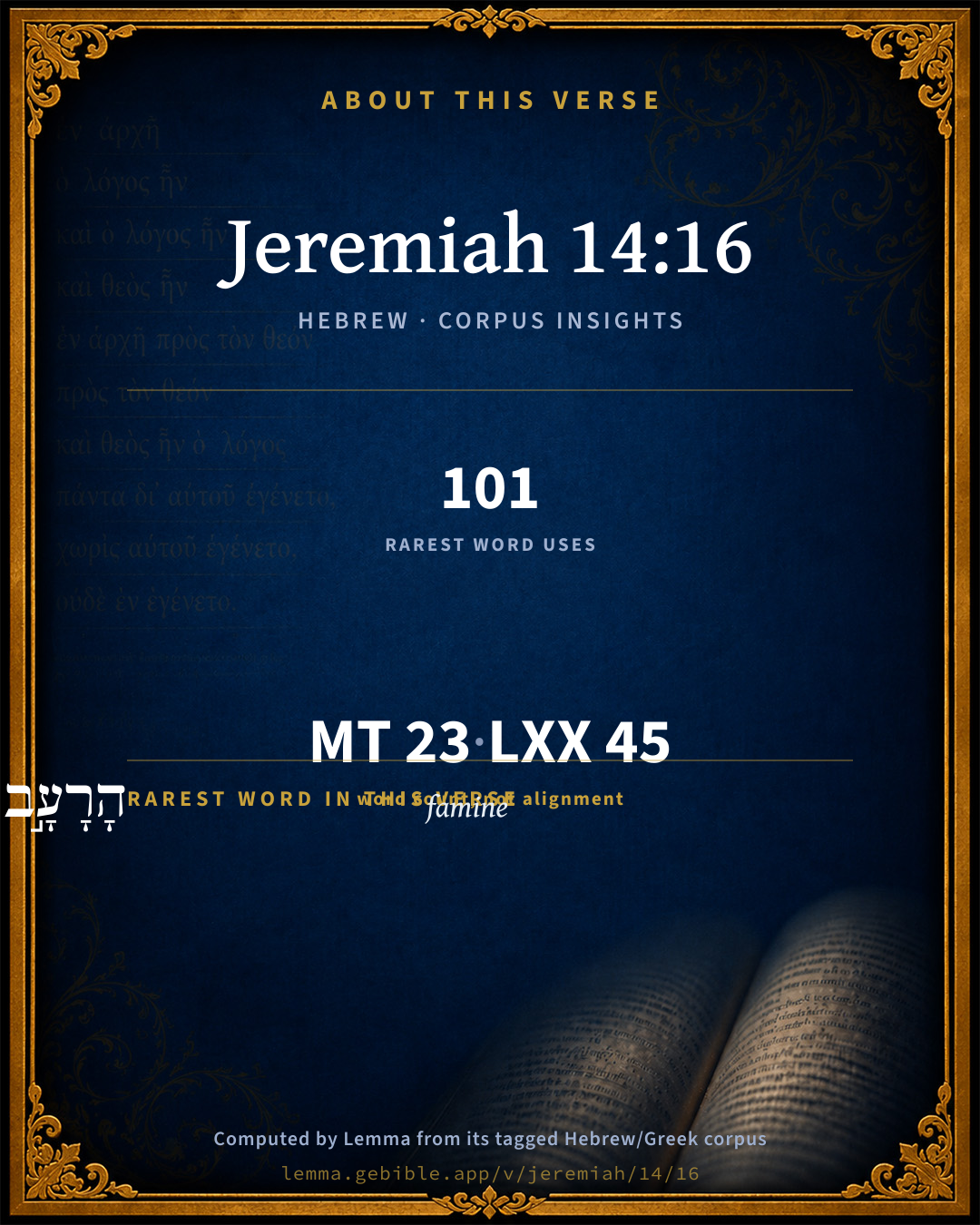
23
words
20
distinct lemmas
Prophets
section

Grammatical profile

  • 5 verbs
  • 10 nouns
  • 3 pronouns
  • 2 prepositions
  • 3 particles

Verb forms

  • נִבְּאִ֣ים Niphal · Participle Active
  • יִֽהְי֣וּ Qal · Imperfect
  • מֻשְׁלָכִים֩ Hophal · Participle Passive
  • מְקַבֵּר֙ Piel · Participle Active
  • וְשָׁפַכְתִּ֥י Qal · Sequential Perfect

Repetition

A word recurs within this verse — often emphatic in Hebrew:

  • הֵ֣מָּה they H1992 ×3

Hebrew & Septuagint length

In the original languages it is 23 Hebrew tokens and 45 Greek tokens — but the two are counted differently (Hebrew bundles its prefixes and suffixes into one token; the Greek is in lemma form), so that isn’t a like-for-like length.

Cross-references

15

Topical passages linked to Jeremiah 14:16 in the Treasury of Scripture Knowledge — connected by theme and wording, ordered by reader-vote popularity; previews shown in the World English Bible.

  • Psalms 79:2–3 They have given the dead bodies of your servants to be food for the birds of the sky, The flesh of your saints to the animals of the earth.
  • Proverbs 1:31 Therefore they will eat of the fruit of their own way, And be filled with their own schemes.
  • Jeremiah 7:33 The dead bodies of this people shall be food for the birds of the sky, and for the animals of the earth; and none shall frighten them away.
  • Jeremiah 15:2–3 It shall happen, when they tell you, Where shall we go forth? then you shall tell them, Thus says Yahweh: Such as are for death, to death; and such as are for the sword, to the sword; and such as are for the famine, to the famine; and such as are for captivity, to captivity.
  • Jeremiah 13:22–25 If you say in your heart, Why are these things come on me? for the greatness of your iniquity are your skirts uncovered, and your heels suffer violence.
  • Jeremiah 16:4 They shall die grievous deaths: they shall not be lamented, neither shall they be buried; they shall be as dung on the surface of the ground; and they shall be consumed by the sword, and by famine; and their dead bodies shall be food for the birds of the sky, and for the animals of the earth.
  • Jeremiah 18:21 Therefore deliver up their children to the famine, and give them over to the power of the sword; and let their wives become childless, and widows; and let their men be slain of death, [and] their young men struck of the sword in battle.
  • Isaiah 9:16 For those who lead this people cause them to err; and those who are led of them are destroyed.
  • Jeremiah 2:17–19 Haven't you procured this to yourself, in that you have forsaken Yahweh your God, when he led you by the way?
  • Jeremiah 4:18 Your way and your doings have procured these things to you; this is your wickedness; for it is bitter, for it reaches to your heart.
  • Jeremiah 5:31 the prophets prophesy falsely, and the priests bear rule by their means; and my people love to have it so: and what will you do in the end of it?
  • Jeremiah 9:22 Speak, Thus says Yahweh, The dead bodies of men shall fall as dung on the open field, and as the handful after the harvester; and none shall gather [them].
  • Jeremiah 19:6–7 therefore, behold, the days come, says Yahweh, that this place shall no more be called Topheth, nor The valley of the son of Hinnom, but The valley of Slaughter.
  • Matthew 15:14 Leave them alone. They are blind guides of the blind. If the blind guide the blind, both will fall into a pit."
  • Revelation 16:1 I heard a loud voice out of the temple, saying to the seven angels, "Go and pour out the seven bowls of the wrath of God on the earth!"

Cross-references courtesy of OpenBible.info (CC BY 4.0).

Hebrew and Greek witnesses Masoretic Hebrew ↔ Greek Septuagint

The same verse in the two great witnesses to the Old Testament, shown verse-for-verse.

These are two independent witnesses, not word-aligned to each other, and the Septuagint is shown in lemma (dictionary) form.

Hebrew Jeremiah 14:16 Masoretic · Westminster Leningrad Codex

וְהָעָ֣ם אֲשֶׁר הֵ֣מָּה נִבְּאִ֣ים לָהֶ֡ם יִֽהְי֣וּ מֻשְׁלָכִים֩ בְּחֻצ֨וֹת יְרוּשָׁלִַ֜ם מִפְּנֵ֣י הָרָעָ֣ב וְהַחֶ֗רֶב וְאֵ֤ין מְקַבֵּר֙ לָהֵ֔מָּה הֵ֣מָּה נְשֵׁיהֶ֔ם וּבְנֵיהֶ֖ם וּבְנֹֽתֵיהֶ֑ם וְשָׁפַכְתִּ֥י עֲלֵיהֶ֖ם אֶת רָעָתָֽם

The people to whom they prophesy shall be cast out in the streets of Jerusalem because of the famine and the sword; and they shall have none to bury them-them, their wives, nor their sons, nor their daughters: for I will pour their wickedness on them.

World English Bible · Public Domain

Greek LXX Structure differs

In the Septuagint, Jeremiah is about an eighth shorter than the Hebrew and arranges its material differently — the Oracles Against the Nations (Hebrew chapters 46–51) appear in the middle of the Greek book, after 25:13. Because the chapter and verse boundaries do not line up, a verse-for-verse comparison with the Hebrew is not shown.

A verse-for-verse comparison isn’t shown here because the chapters and verses don’t line up. Switch to the LXX edition with the MT / LXX toggle above to read the Greek directly.

Hebrew: Westminster Leningrad Codex (CC BY 4.0). Greek: Septuagint (public domain); English from a public-domain English Septuagint. How the Septuagint differs from the Hebrew →

Targum (Aramaic paraphrase)

1

The Targum is the ancient Jewish Aramaic paraphrase of the Hebrew Scriptures — an interpretive translation, not the Hebrew text itself. Onkelos (literal) and Pseudo-Jonathan (expansive) render the Torah, and Jonathan the Prophets. Coverage is partial: where no permissively-licensed English translation exists for a verse, only the Aramaic is shown. This is verse-level text, not a word-by-word alignment to the Hebrew.

  1. Targum Jonathan Prophets (Joshua–Malachi)
    וְעַמָא דְאִינוּן מִתְנַבָּן לְהוֹן יְהוֹן מְטָרְפִין רְמַן בְּשׁוּקֵי יְרוּשְׁלֵם מִן קֳדָם כַּפְנָא וְחַרְבָּא וְלֵית דִקְבַר לְהוֹן אִינוּן נְשֵׁיהוֹן בְּנֵיהוֹן וּבְנָתֵיהוֹן וְאֶשְׁפּוֹךְ עֲלֵיהוֹן יַת בִישַׁתְהוֹן:

    (no public-domain English translation for this verse)

    Targum Jonathan — Aramaic: “Mikraot Gedolot” (public domain). English: “Sefaria Community Translation” (CC0 1.0 (public-domain dedication)); “London "Chaldee Paraphrase," 1871” (public domain). Text via Sefaria.

Commentary

Notes on Jeremiah 14:16 from classic Christian and Jewish commentators (each source and its license shown beneath its notes). The classic Christian expositions comment on the surrounding passage and are grouped to its opening verse, so a note may address several verses; the Jewish commentaries on the Tanakh (Rashi and others) are per-verse, so they appear only where the commentator wrote on this verse.

Lemma curates 59 commentaries, every one of them public domain or Creative Commons licensed, each selected and text-cleaned for this edition rather than reprinted as found. About our sources →

Trapp's Complete Commentary

John Trapp

Jer 14:16 And the people to whom they prophesy shall be cast out in the streets of Jerusalem because of the famine and the sword; and they shall have none to bury them, them, their wives, nor their sons, nor their daughters: for I will pour their wickedness upon them.

Ver. 16. And the people to whom they prophesy shall be cast out.] They shall be no more excused by their having been deluded, than he that in his drink committeth adultery or murder is excused by his drunkenness. A drunkard, saith Aristotle, deserveth double punishment: {a} first for his drunkenness, and then for the sin committed in and by his drunkenness; so here. See on Jer 14:15.

{a} τοις μεθυουσι διπλα τα επιτιμια. - Ethic., lib. iii. cap. 5.

John Trapp, A Commentary or Exposition upon All the Books of the Old and New Testament (1647–1656) — public domain. Text from a community e-Sword module.

Jamieson, Fausset & Brown

Robert Jamieson, A. R. Fausset & David Brown

none to bury-- (Psa 79:3).

pour their wickedness--that is, the punishment incurred by their wickedness (Jer 2:19).

Jamieson, Fausset & Brown — Commentary Critical and Explanatory on the Whole Bible (1871) — public domain (CC PDM 1.0). Text via the HelloAO Bible API.

Adam Clarke's Commentary

Verse 16. And the people - shall be cast out] They shall be destroyed, because they preferred their lying words to my truth, proclaimed by thee.

Adam Clarke's Commentary on the Bible (1810–1826) — public domain. Text from a community e-Sword/MySword module.

John Calvin's Commentaries

This then was the reason why God so severely visited the Jews, who had been deceived by false teachers: it was owing to their previous impiety and ingratitude. And on this account also he adds at the end of the verse, I will pour forth upon them their wickedness Some think that the word רעה, roe, may denote punishment as well as wickedness, as עון, oun, also is taken for both. But the Prophet seems to give a reason why God had resolved to execute so dreadful a judgment on the Jews; and the reason was, because they were worthy of such a reward. I am therefore inclined to render the word wickedness, as though he had said, “A dreadful calamity indeed awaits this people; but that they may not complain of my severity, they shall receive the reward of their own wickedness.” However this may be, the Prophet no doubt wished here to close the mouths of the Jews, that they might not proceed in their evasions, as though God treated them with too little kindness. Hence then it appears, that God does not heedlessly execute his vengeance on the innocent; but that the teachers and the whole people, who approved of them, were involved in the same punishment.

And he says, They shall be cast out in the streets of Jerusalem by the famine and the sword, or on account of the famine and the sword. They shall then all of them, that is, their carcases, be cast out; for their carcases are evidently meant, as he immediately adds, and no one shall bury them; and he mentions their wives and children. And these had no excuse for themselves, for we have seen in the seventh chapter that this charge was brought against them, rothat the children gathered wood, that the parents kindled the fire, and that the women kneaded the dough to make cakes for their idols. The Prophet then intimates, that no one would escape, because they were all implicated in the same wickedness, some more and some less, but so far, however, that the children were not to go unpunished, because they followed their fathers, nor the wives, because they followed the example of their husbands. It follows —

John Calvin's Commentaries (1540-1563) — public domain. Text from the Calvin Translation Society English edition (1840s-50s) via the Christian Classics Ethereal Library (ccel.org). Calvin's coverage is partial (roughly two-thirds of the Bible); uncommented books and verses are honest gaps, never fabricated. The 19th-century editor's footnotes and remarks are omitted so the notes are faithfully Calvin's own voice.

The Cambridge Bible for Schools and Colleges

gen. ed. J. J. S. Perowne

16. their wickedness] This shall be itself their punishment. Cp. Jer_2:19.

The Cambridge Bible for Schools and Colleges (gen. ed. J. J. S. Perowne; Cambridge University Press, 1878–1918) — public domain. Text from a community e-Sword module.

John Gill's Exposition

And the people to whom they prophesy,.... That is, such of them as gave credit to their prophecies:

shall be cast out in the streets of Jerusalem, because of the famine and the sword; they dying of the famine and of the sword, their carcasses should be cast out of their houses into the open streets, and there lie unburied, as a punishment for disbelieving the words of the Lord, and giving heed to the lies of the false prophets:

and they shall have none to bury them; either through want of ability of body or substance, or through want of affection; or rather through want of persons to do it for them, all their relations being cut off with them, as follows:

them, their wives, nor their sons, nor their daughters; or rather, "they" (n), "their wives, and their sons, and their daughters"; these shall die by the famine and the sword, and shall be cast out in the streets of Jerusalem; so that they and their relatives all dying, there would be none to bury one another; and that all should suffer by these calamities were but just and righteous, since all were guilty both of idolatry, and of despising the prophets, and listening to the false ones; see Jer 7:18,

for I will pour their wickedness upon them; or, "their evil upon them" (o); not the evil of sin, but the evil of punishment; the meaning is, that he would abundantly punish them for their sins, and as they deserved, though not exceeding the bounds of justice: the phrase denotes that their wickedness was great; and that in proportion to it the vials of his wrath would be poured out upon them.

(n) "ipsi inquam", Pagninus, Montanus, Schmidt. (o) "suum malum", Vatablus, Pagninus, Montanus.

John Gill's Exposition of the Whole Bible (1746–1763) — public domain (CC PDM 1.0). Text via the HelloAO Bible API.

Albert Barnes' Notes on the Bible

I will pour ... - i. e., their wickedness shall be brought home to them.

Albert Barnes' Notes on the Bible (1834–1885) — public domain. Text from a community e-Sword/MySword module.

Matthew Poole's English Annotations

The security promised by these false prophets shall be no excuse to the people for giving credit to them; the prophets shall perish for prophesying falsely in my name, and the people that hearken to and believe what they say, practise accordingly, shall perish for their light and vain credulity. As the sinful commands of superiors in things civil will not free those from guilt that execute their commands, so the lies and false teachings of ministers will not excuse those that run into error upon the credit of their words: both the one and the other owe their first homage and allegiance to God, by whose word they ought to examine the precepts of the one, and the prophesyings of the other.

Matthew Poole's English Annotations on the Holy Bible (1683–1685) — public domain. Text from a community e-Sword/MySword module.

The Pulpit Commentary

I will pour their wickedness; i.e. the fruits of their wickedness. (comp. Jer_2:19, "Thine own wickedness shall correct thee

The Pulpit Commentary (1880–1919), ed. H.D.M. Spence-Jones & Joseph S. Exell — public domain. Text from a community e-Sword module.

Lesson kit

Teaching starters — assembled from the data on this page, not authored interpretation. Every prompt links to the verse data it draws on. Edit before teaching.

Jeremiah, in the Prophets, opens this verse with 23 words (20 distinct Hebrew lemmas). Its most distinctive word is râʻâb (“famine”). A historical commentator’s framing appears above. Read the whole chapter for the surrounding context.

Discussion questions

  1. What does “famine” (râʻâb) contribute to the verse as a whole?
  2. How does Psalms 79:2–3, which shares this passage’s theme, read alongside this verse?
  3. What does the repetition of “they” (3× in this one verse) do in this verse?
  4. The translations on this page render this verse differently — a whole-verse word diff, not a word-by-word alignment. What might account for the different wordings?
  5. «נִבְּאִ֣ים» is a Niphal Participle Active verb. How does that grammatical form shape the action described?
  6. Compare how Trapp's Complete Commentary and Jamieson, Fausset & Brown read this verse. Where do they agree or differ?

Things to notice

Reading settings

Reading text

Shown beneath each verse's original-language words.

Old Testament
Old Testament edition

Read the OT as the Masoretic Hebrew (MT) or the Greek Septuagint (LXX).

English shown for the Greek Septuagint (in the Hebrew ↔ Greek comparison).

Comparing translations? Open the Compare panel on any verse page to stack up to four side by side.