
Job 5:10

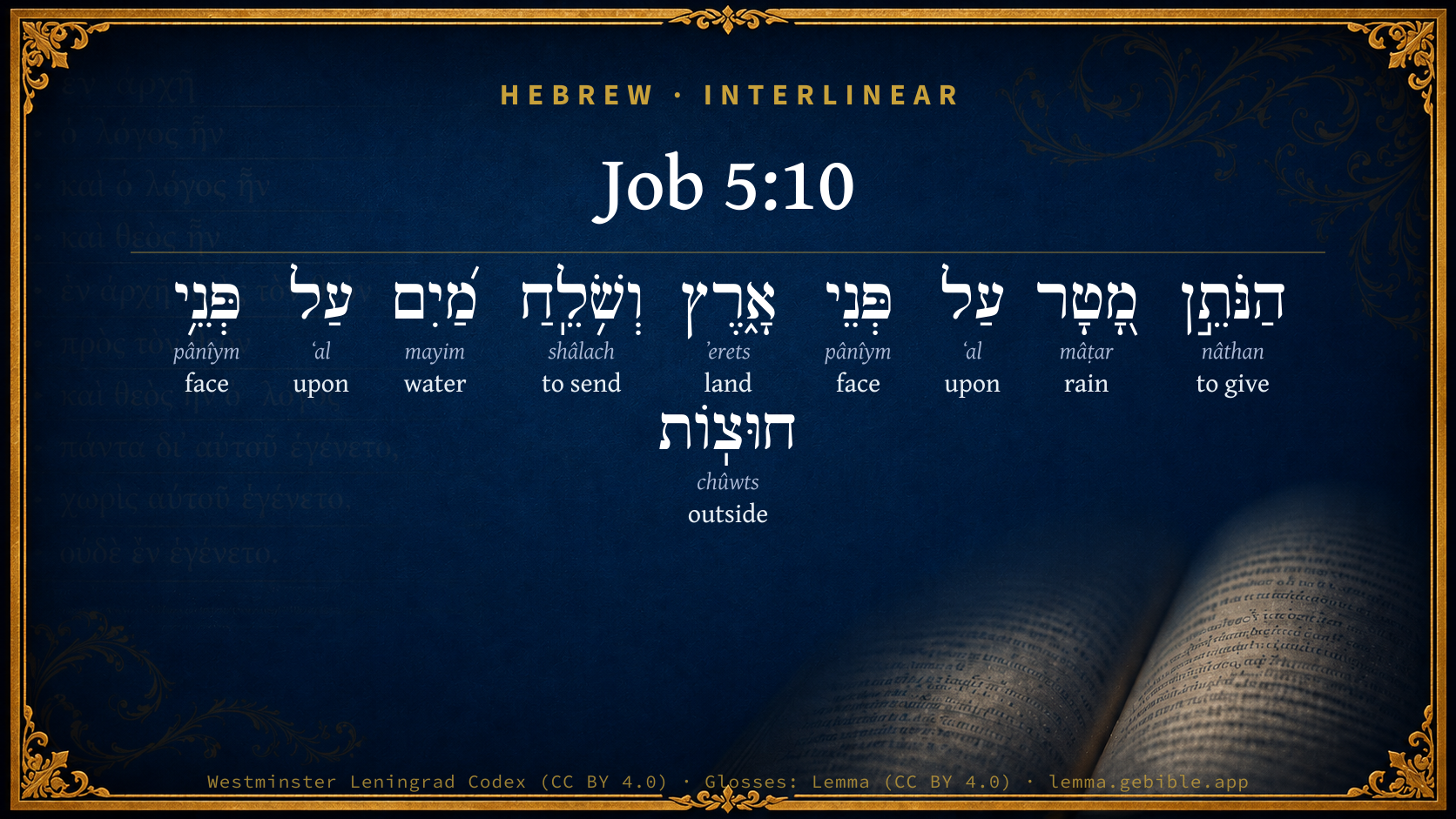
Hebrew (Westminster Leningrad Codex) Job 5:10 appears in the Hebrew Old Testament. The text above is from the Westminster Leningrad Codex. Each word links to its Strong’s number, a concise gloss, and parsing drawn from the Open Scriptures Hebrew Bible morphology. Click any word for its full Brown-Driver-Briggs (BDB) entry.
Download image
Cite this verse

Job 5:10 (World English Bible). Public Domain. Lemma interlinear Bible study tool, https://lemma.gebible.app/v/job/5/10.

Show BibTeX & RIS
BibTeX
RIS
English Translation
Who gives rain on the earth, And sends waters on the fields;
World English Bible · Public Domain
Download a study sheet

One document with this verse’s original text, its word-by-word gloss line, the meaning frame, cross-references with their text, attributed commentary, and full source and license credits — printable, and it pastes into notes with its structure intact.

This verse Autodidact and up

Study sheet (.html) Plain text (.txt)

A passage Seminary Student

Up to 50 verses in one chapter. A passage sheet keeps up to 6 commentary sources and 12 cross-references per verse, in the order this page ranks them, and says so on the sheet whenever that leaves anything out. Ask for a single verse and you get the Autodidact verse sheet above.

Everything on this page stays free to read, with no account — the sheet is a download of what is already on screen, not access to it.

Want to remove ads? Support Godless Engineer
Compare translations 3

The same verse in 3 English versions, stacked beneath the original-language interlinear above. Click any original word for its lexicon entry.

Each is an independent rendering of the whole verse — the interlinear is not word-aligned to these translations.

Highlighted words mark where these versions differ — a whole-verse word diff, not a word-by-word alignment.

  • World English Bible Public Domain
    Who gives rain on the earth, And sends waters on the fields;
  • King James Version Public Domain
    Who giveth rain upon the earth, and sendeth waters upon the fields:
  • unfoldingWord Literal Text CC BY-SA 4.0
    the one giving rain on the face of the earth and sending waters on the face of the fields,

unfoldingWord Literal Text — © unfoldingWord, licensed CC BY-SA 4.0. Word-aligned USFM3 via Door43 (git.door43.org/unfoldingWord/en_ult).

Versions to compare (up to 4)

3 of 4 selected

Show all 18 translations

Every available English version of this verse, each an independent rendering of the whole verse.

  • World English Bible Public Domain
    Who gives rain on the earth, And sends waters on the fields;
  • Berean Standard Bible Public Domain
    He gives rain to the earth and sends water upon the fields.
  • Majority Standard Bible Public Domain
    He gives rain to the earth and sends water upon the fields.
  • King James Version Public Domain
    Who giveth rain upon the earth, and sendeth waters upon the fields:
  • American Standard Version (1901) Public Domain
    Who giveth rain upon the earth, And sendeth waters upon the fields;
  • Revised Version (1885) Public Domain
    Who giveth rain upon the earth, and sendeth waters upon the fields:
  • Geneva Bible (1599) Public Domain
    He giueth raine vpon the earth, and powreth water vpon the streetes,
  • Douay-Rheims (1899) Public Domain
    Who giveth rain upon the face of the earth, and watereth all things with waters:
  • Young's Literal Translation Public Domain
    Who is giving rain on the face of the land, And is sending waters on the out-places.
  • Literal Standard Version CC BY-SA 4.0
    Who is giving rain on the face of the land, || And is sending waters on the out-places.
  • Unlocked Literal Bible CC BY-SA 4.0
    He gives rain on the earth, and sends water on the fields.
  • unfoldingWord Literal Text CC BY-SA 4.0
    the one giving rain on the face of the earth and sending waters on the face of the fields,
  • Darby Bible Public Domain
    Who giveth rain on the face of the earth, and sendeth waters on the face of the fields;
  • World Messianic Bible Public Domain
    who gives rain on the earth, and sends waters on the fields;
  • Webster's Bible Public Domain
    Who giveth rain upon the earth, and sendeth waters upon the fields:
  • Free Bible Version CC BY-SA 4.0
    He gives rain to the earth and sends water to the fields.
  • Bible in Basic English Public Domain
    Who gives rain on the earth, and sends water on the fields:
  • JPS Tanakh (1917) Public Domain
    Who giveth rain upon the earth, and sendeth waters upon the fields;

Literal Standard Version (2020), Covenant Press — licensed CC BY-SA 4.0. Text via the HelloAO Bible API (eBible.org). Unlocked Literal Bible (unfoldingWord) — licensed CC BY-SA 4.0. Text via the HelloAO Bible API (eBible.org). unfoldingWord Literal Text — © unfoldingWord, licensed CC BY-SA 4.0. Word-aligned USFM3 via Door43 (git.door43.org/unfoldingWord/en_ult). Free Bible Version, Dr. Jonathan Gallagher — licensed CC BY-SA 4.0. Text via the HelloAO Bible API (eBible.org).

Word by word

More ways to search: Search by grammar → Find every occurrence → Compare this word →

Practice this passage: Drill this verse → Learn its vocabulary →

About this verse

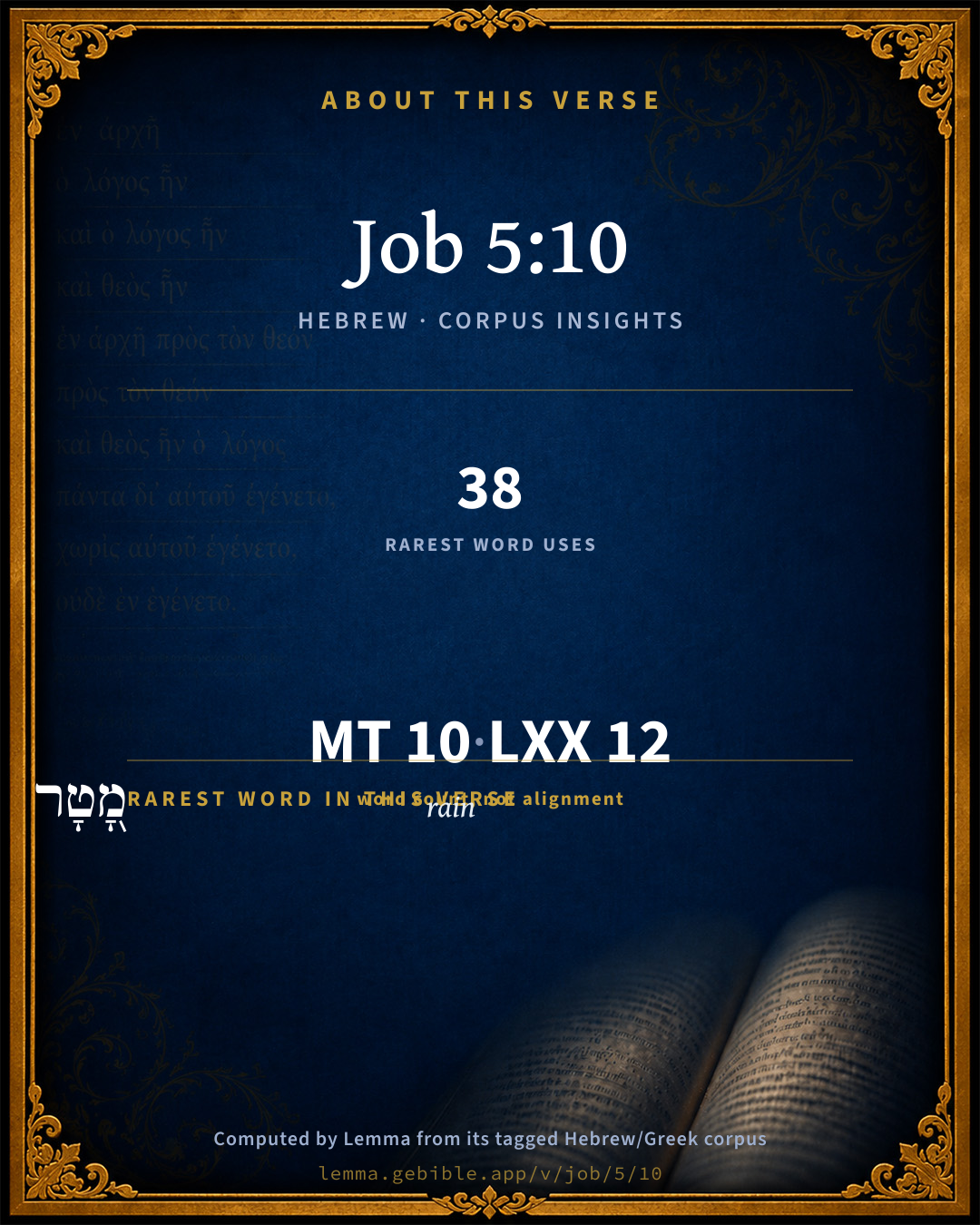
These counts appear in no published source. They are computed here, from the morphology-tagged text and Lemma’s own curated glosses. What Lemma adds →

10
words
8
distinct lemmas
Wisdom
section

Shared distinctive vocabulary

מָ֭טָר rain H4306 occurs in 36 verses of the Hebrew Bible. Also found in:

Grammatical profile

  • 2 verbs
  • 6 nouns
  • 2 prepositions

Verb forms

  • הַנֹּתֵ֣ן Qal · Participle Active
  • וְשֹׁ֥לֵֽחַ Qal · Participle Active

Repetition

Words recur within this verse — often emphatic in Hebrew:

  • עַל upon H5921 ×2
  • פְּנֵי face H6440 ×2

Hebrew & Septuagint length

In English translation the verse runs 12 words from the Hebrew and 11 from the Septuagint (LXX English) — closely comparable.

A rough comparison of the two English renderings, which tokenize alike — not a word-level alignment.

Word counts can differ between the Hebrew and the Greek without any difference in meaning — e.g. the Hebrew direct-object marker אֵת has no separate Greek word, and Greek often adds the article ὁ.

In the original languages it is 10 Hebrew tokens and 12 Greek tokens — but the two are counted differently (Hebrew bundles its prefixes and suffixes into one token; the Greek is in lemma form), so that isn’t a like-for-like length.

Cross-references

10

Topical passages linked to Job 5:10 in the Treasury of Scripture Knowledge — connected by theme and wording, ordered by reader-vote popularity; previews shown in the World English Bible.

  • Jeremiah 5:24 Neither say they in their heart, Let us now fear Yahweh our God, who gives rain, both the former and the latter, in its season; who preserves to us the appointed weeks of the harvest.
  • Acts 14:17 Yet he didn't leave himself without witness, in that he did good and gave you rains from the sky and fruitful seasons, filling our hearts with food and gladness."
  • Psalms 65:9–11 You visit the earth, and water it. You greatly enrich it. The river of God is full of water. You provide them grain, for so you have ordained it.
  • Psalms 147:8 Who covers the sky with clouds, Who prepares rain for the earth, Who makes grass grow on the mountains.
  • Jeremiah 14:22 Are there any among the vanities of the nations that can cause rain? or can the sky give showers? Aren't you he, Yahweh our God? therefore we will wait for you; for you have made all these things.
  • Job 28:26 When he made a decree for the rain, And a way for the lightning of the thunder;
  • Job 38:26–28 To cause it to rain on a land where no man is; On the wilderness, in which there is no man;
  • Jeremiah 10:13 when he utters his voice, there is a tumult of waters in the heavens, and he causes the vapors to ascend from the ends of the earth; he makes lightnings for the rain, and brings forth the wind out of his treasuries.
  • Amos 4:7 "I also have withheld the rain from you, When there were yet three months to the harvest; And I caused it to rain on one city, And caused it not to rain on another city. One place was rained on, And the piece where it didn't rain withered.
  • Job 36:28 Which the skies pour down And drop on man abundantly.

Cross-references courtesy of OpenBible.info (CC BY 4.0).

Hebrew and Greek witnesses Masoretic Hebrew ↔ Greek Septuagint

The same verse in the two great witnesses to the Old Testament, shown verse-for-verse.

These are two independent witnesses, not word-aligned to each other, and the Septuagint is shown in lemma (dictionary) form.

Hebrew Job 5:10 Masoretic · Westminster Leningrad Codex

הַנֹּתֵ֣ן מָ֭טָר עַל פְּנֵי אָ֑רֶץ וְשֹׁ֥לֵֽחַ מַ֝יִם עַל פְּנֵ֥י חוּצֽוֹת

Who gives rain on the earth, And sends waters on the fields;

World English Bible · Public Domain

Greek LXX Job 5:10 Septuagint · lemma form

ὁ δίδωμι ὑετός ἐπί ὁ γῆ ἀποστέλλω ὕδωρ ἐπί ὁ ὑπό οὐρανός

who gives rain upon the earth, sending water on the earth:

LXX2012 (modern English Septuagint) · Public Domain

Hebrew: Westminster Leningrad Codex (CC BY 4.0). Greek: Septuagint (public domain); English from LXX2012 (modern English Septuagint) (Public Domain). How the Septuagint differs from the Hebrew →

Commentary

Notes on Job 5:10 from classic Christian and Jewish commentators (each source and its license shown beneath its notes). The classic Christian expositions comment on the surrounding passage and are grouped to its opening verse, so a note may address several verses; the Jewish commentaries on the Tanakh (Rashi and others) are per-verse, so they appear only where the commentator wrote on this verse.

Lemma curates 59 commentaries, every one of them public domain or Creative Commons licensed, each selected and text-cleaned for this edition rather than reprinted as found. About our sources →

Trapp's Complete Commentary

John Trapp

Job 5:10 Who giveth rain upon the earth, and sendeth waters upon the fields:

Ver. 10. Who giveth rain upon the earth] This is reckoned, and rightly, among the marvellous works of God. See Job 28:26 Jer 10:13 Amo 5:8 Act 14:17. Rain is the flux of a moist cloud, which being dissolved by little and little by the heat of the sun, lets down rain by drops out of the middle region of the air: this is God’s gift. For Heb 1:1-14. Decreeth it, Job 28:26 2. .Prepareth it, Psa 147:8 3. Withholdeth it at his pleasure, stopping those bottles that should yield it, Amo 4:7 4. Sendeth it for the behoof and benefit of man and beast, as also for the demonstration of his power, wisdom, justice, and goodness, whereof he hath not left himself hereby without witness, Act 14:17, while he weigheth these waters above the firmament by measure, so that not one drop falleth in vain, or in a wrong place. In those hot countries, where rivers were scant, rain was highly valued; they called it the husband of the earth, because the earth can no more bear fruit without it than a woman children without the company of a man. The Egyptians were wont in mockery to tell the Greeks that if their god (whom they called cloud gathering Jupiter, νεφεληγερετα Zευς) should forget to give rain they might chance to starve for it. See the reason, Deu 11:8-12. Egypt was watered with the foot as a garden, by sluices from the Nile: not so Canaan.

He sendeth waters upon the fields] Irrigat aquis universa, saith the Vulgate, He moisteneth all places with waters; by the showers which, falling upon the grouud, run hither and thither, he divideth the fields, as it were, into streets and highways, so Beza paraphraseth. Another thus, It is he himself who watereth it, as well by those waters which fall from heaven as by those which he hath hidden in its entrails, and whose secret drains produce in a thousand places sources and rivers. Some render it, upon the out places, and understand it as wilderness, to set forth God’s bounty. Others render it, upon the face of the streets, and will have it meant of navigable rivers, which, by the passage upon them, do, after a sort, make streets and highway ways through several countries, to the which also they convey many commodities.

John Trapp, A Commentary or Exposition upon All the Books of the Old and New Testament (1647–1656) — public domain. Text from a community e-Sword module.

Joseph Benson's Commentary

Job 5:10. Who giveth rain upon the earth — He begins with this ordinary work of God, in which he implies that there is something wonderful, as indeed there is, in the rise of it from the earth, in the strange hanging of that heavy body in the air, and in the distribution of it as God sees fit; and how much more in the hidden paths of Divine Providence! And sendeth waters upon the fields — When the scorching heat of the sun is so strong and intense as to dry up and consume almost every herb of the field, every green thing upon the face of the earth, God, in great compassion, opens the windows of heaven, and pours down a gracious, refreshing, and long- wished-for rain; by which wonderful supply the springs and rivers, which were much exhausted, and, in a manner, had quite disappeared, do now rise and swell to their usual height; nay, are not only full, but overflow, so as to reach several distant places which waited, as it were, for refreshment from those superabundant treasures.

Joseph Benson's Commentary on the Old and New Testaments (1811–1818) — public domain. Text from a community e-Sword module.

Geneva Bible (1599)

Geneva Bible translators

He showeth by particular examples, what the works of God are.

Geneva Bible (1599) marginal notes — public domain. Text via Bolls.life.

Adam Clarke's Commentary

Verse 10. Who giveth rain upon the earth] The Chaldee gives this verse a fine turn: "Who gives rain on the face of the land of Israel, and sends waters on the face of the provinces of the people." Similar to our Lord's saying, which is expressed in the half of the compass: Your Father which is in heaven - SENDETH RAIN ON THE JUST AND ON THE UNJUST; Mt 5:45.

Sendeth waters upon the fields] The term חצות chutsoth, which we translate fields, and generally signifies streets, may here mean those plantations which are laid out in ridges or plats, in an orderly, regular manner. God does not only send rain upon the earth in a general manner, but, by an especial providence, waters the cultivated ground, so that not one ridge is destitute of its due proportion of fructifying moisture.

Adam Clarke's Commentary on the Bible (1810–1826) — public domain. Text from a community e-Sword/MySword module.

The Cambridge Bible for Schools and Colleges

gen. ed. J. J. S. Perowne

10. upon the earth] lit. upon the face of the earth; and so next clause, upon the face of the fields. He watereth the earth when it is thirsty, with a universal goodness.

The Cambridge Bible for Schools and Colleges (gen. ed. J. J. S. Perowne; Cambridge University Press, 1878–1918) — public domain. Text from a community e-Sword module.

John Gill's Exposition

Who giveth rain upon the earth,.... Not upon the land of Israel only, as the Targum and Jarchi, see Deu 11:11; but upon the whole earth; this is particularly mentioned as being of God, and which none of the vanities of the Gentiles can give; and it is a free gift of his, which tarries not for the desert of men, and is bestowed on the godly and ungodly; and is a great blessing of goodness, which enriches the earth, makes it fruitful, and through it, it produces plenty of good things for man and beast:

and sendeth water upon the fields; or "out places" (i); places outside of cities and towns, such as gardens, fields, and deserts, where showers of rain are sent of God to water them, many of which are not under the care of man, but are under the providence of God; the Targum and Jarchi interpret this of Gentile lands, as distinct from the land of Israel, to whom God "gives" rain, and to the other "sends" it; some render it, "upon the streets" (k), that is, upon persons that lie in the streets, and have no houses to dwell in, and to whom rain in hot and dry countries was welcome.

(i) "in geuere significat loca quae sunt foris", Piscator; "exteriora", Mercerus; "open fields", Broughton; "faciem viarum", Beza. (k) "Super faciem platearum", Pagninus, Mercerus, Boldueius, Cocceius, Schultens; "super facies platearum", Montanus, Schmidt; "super plateas", Vatablus, Michaelis.

John Gill's Exposition of the Whole Bible (1746–1763) — public domain (CC PDM 1.0). Text via the HelloAO Bible API.

Albert Barnes' Notes on the Bible

Who giveth rain upon the earth - In the previous verse, Eliphaz had said, in general, that God did wonderful things - things which are fitted to lead us to put our trust in him. In this and the succeeding verses, he descends to particulars, and specifies those things which show that God is worthy to be confided in. This enunciation continues to Job 5:16, and the general scope is, that the agency of God is seen everywhere; and that his providential dealings are adapted to impress man with elevated ideas of his justice and goodness. Eliphaz begins with the rain, and says that the fact that God sends it upon the earth was fitted to lead man to confide in him. He means, that while the sun, and moon, and seasons have stated times, and are governed by settled laws, the rain seems to be sent directly by God, and is imparted at such times as are best. It is wholly under his control, and furnishes a constant evidence of his benevolence. Without it, every vegetable would dry up, and every animal on the earth would soon die. The word earth here refers probably to the cultivated part of the earth - the fields that are under tillage. Thus, Eichhorn renders it, Angebauten Feldern. On the interest which the phenomena of rain excited among the ancient sages of Idumea, and the laws by which it is produced, see Job 37:6, note; Job 37:15-16, note; Job 38:22-28, note.

And sendeth waters - That is, showers.

Upon the fields - Margin, “out-places.” Hebrew חוצוּת chûtsôt - out of doors, outside, abroad, meaning the fields out of cities and towns. Eichhorn renders it, “the pastures,” auf Triften. The meaning is, that the whole country is watered; and the fact that God gives rain in this manner, is a reason why we should put confidence in him. It shows that he is a benevolent Being, since it contributes so essentially to human life and happiness, and since no other being but God can cause it.

Albert Barnes' Notes on the Bible (1834–1885) — public domain. Text from a community e-Sword/MySword module.

Matthew Poole's English Annotations

He beginneth with this ordinary and obvious work of God, in which he implies that there is something unsearchable and wonderful, as indeed there is in the rise of it from the earth, in the strange hanging of that heavy body in the air, and in the distribution of it as God sees fit, Amo 4:7; and how much more in the secret counsels and hidden paths of Divine Providence, which Job took the liberty to censure!

Waters; either fountains and rivers, which is another great and wonderful work of God; or rather, rain water, as the following words imply; the same thing being repeated in other words, after the manner.

Upon the fields, or, upon all places abroad, i.e. which have no covering to keep out the rain.

Matthew Poole's English Annotations on the Holy Bible (1683–1685) — public domain. Text from a community e-Sword/MySword module.

Whedon's Commentary on the Bible

Daniel D. Whedon

10. Giveth rain — The Koran often calls the rain “the flowing forth of divine power.” The devastations by droughts, so frequently experienced throughout the East, make the advent of rain a most signal event, illustrative both of the power and goodness of God. Psa_65:10; Jer_14:22; Act_14:17.

Daniel D. Whedon (gen. ed.), Commentary on the Old and New Testaments (1874–1909) — public domain. Text from a community e-Sword module.

The Pulpit Commentary

Who giveth rain upon the earth. To the dweller in the parched regions of South-Western Asia rain is the greatest of all blessings, and seems the greatest, of all marvels. When for months and months together the sun has blazed all day long out of a cloudless sky, when the heaven that is over his head has been brass, and the earth that is under him, (Deu_28:33) a great despair comes upon him, and that it should ever rain again seems almost an impossibility. Where is the rain to come from? From that cruel, glaring sky, which has pursued him with its hostility week after week, and month after month? Or from that parched earth in which, as it seems, no atom of moisture is left? When God at length gives rain, he scarcely believes his eyes. What? The blessed moisture is once more descending from the sky, and watering the earth, and quickening what seemed dead, and turning the desert into a garden! All Eastern poetry is full of the praises of rain, of its blessedness, of its marvellousness, and of its quickening power. Very naturally Eliphaz, in speaking of God"s marvellous works of mercy, mentions rain first, as, within his experience, one of the chief. And sendeth waters upon the fields. This is either the usual pleonastic repetition of the second hemistich, or (perhaps) a reference to the fountains and rills of water, which spring into being as a consequence of the rain.

The Pulpit Commentary (1880–1919), ed. H.D.M. Spence-Jones & Joseph S. Exell — public domain. Text from a community e-Sword module.

John Wesley's Explanatory Notes

Rain - He begins with this ordinary work of God, in which he implies that there is something wonderful, as indeed there is in the rise of it from the earth, in the strange hanging of that heavy body in the air, and in the distribution of it as God sees fit; and how much more in the hidden paths of Divine Providence?

John Wesley, Explanatory Notes Upon the Whole Bible (1754–1765) — public domain. Text via the GEBible commentary corpus.

Rashi

Rabbi Shlomo Yitzchaki (Rashi)

Who gives rain upon the face of the land The land of Israel.

and sends water upon the face of outside places through a messenger to other countries.

Rashi on the Tanakh — English translations: “The Judaica Press complete Tanach with Rashi, translated by A. J. Rosenberg” (CC BY 4.0); “Pentateuch with Rashi's commentary by M. Rosenbaum and A.M. Silbermann, 1929-1934” (public domain); “The Metsudah Tanach series, Lakewood, N.J” (CC BY 4.0); and “The Book of Joshua, Metsudah Publications, 1997” (CC BY 4.0). Text via Sefaria.

Lesson kit

Teaching starters — assembled from the data on this page, not authored interpretation. Every prompt links to the verse data it draws on. Edit before teaching.

Job, in the Wisdom, opens this verse with 10 words (8 distinct Hebrew lemmas). Its most distinctive word is mâṭar (“rain”). A historical commentator’s framing appears above. Read the whole chapter for the surrounding context.

Discussion questions

  1. How does “rain” (mâṭar) shape what this verse is saying?
  2. How does Exodus 9:33, which shares the word «rain», read alongside this verse?
  3. What does the repetition of “upon” (2× in this one verse) do in this verse?
  4. These translations render this verse differently. What is at stake in choosing one wording over another?
  5. «הַנֹּתֵ֣ן» is a Qal Participle Active verb. How does that grammatical form shape the action described?
  6. Compare how Trapp's Complete Commentary and Joseph Benson's Commentary read this verse. Where do they agree or differ?

Things to notice

Reading settings

Reading text

Shown beneath each verse's original-language words.

Old Testament
Old Testament edition

Read the OT as the Masoretic Hebrew (MT) or the Greek Septuagint (LXX).

English shown for the Greek Septuagint (in the Hebrew ↔ Greek comparison).

Comparing translations? Open the Compare panel on any verse page to stack up to four side by side.