Psalms 31:11

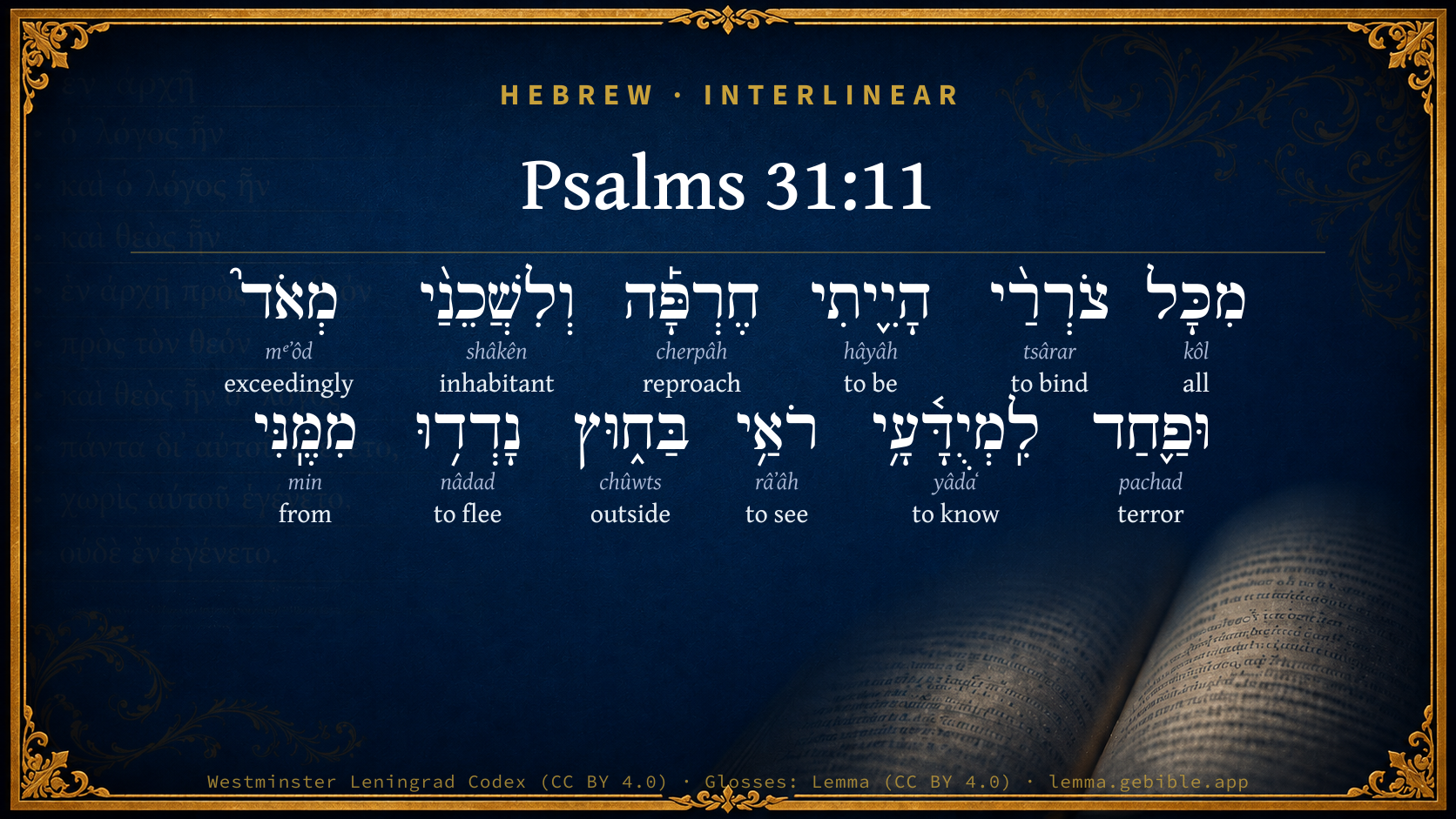
Hebrew (Westminster Leningrad Codex) Psalms 31:11 appears in the Hebrew Old Testament. The text above is from the Westminster Leningrad Codex. Each word links to its Strong’s number, a concise gloss, and parsing drawn from the Open Scriptures Hebrew Bible morphology. Click any word for its full Brown-Driver-Briggs (BDB) entry.
Download image
Cite this verse

Psalms 31:11 (World English Bible). Public Domain. Lemma interlinear Bible study tool, https://lemma.gebible.app/v/psalms/31/11.

Show BibTeX & RIS
BibTeX
RIS
English Translation
Because of all my adversaries I have become utterly contemptible to my neighbors, A fear to my acquaintances. Those who saw me on the street fled from me.
World English Bible · Public Domain
Download a study sheet

One document with this verse’s original text, its word-by-word gloss line, the meaning frame, cross-references with their text, attributed commentary, and full source and license credits — printable, and it pastes into notes with its structure intact.

This verse Autodidact and up

Study sheet (.html) Plain text (.txt)

A passage Seminary Student

Up to 50 verses in one chapter. A passage sheet keeps up to 6 commentary sources and 12 cross-references per verse, in the order this page ranks them, and says so on the sheet whenever that leaves anything out. Ask for a single verse and you get the Autodidact verse sheet above.

Everything on this page stays free to read, with no account — the sheet is a download of what is already on screen, not access to it.

Want to remove ads? Support Godless Engineer
Compare translations 3

The same verse in 3 English versions, stacked beneath the original-language interlinear above. Click any original word for its lexicon entry.

Each is an independent rendering of the whole verse — the interlinear is not word-aligned to these translations.

Highlighted words mark where these versions differ — a whole-verse word diff, not a word-by-word alignment.

  • World English Bible Public Domain
    Because of all my adversaries I have become utterly contemptible to my neighbors, A fear to my acquaintances. Those who saw me on the street fled from me.
  • King James Version Public Domain
    I was a reproach among all mine enemies, but especially among my neighbours, and a fear to mine acquaintance: they that did see me without fled from me.
  • unfoldingWord Literal Text CC BY-SA 4.0
    Among all of the ones being hostile to me I have become a reproach, and especially to my neighbors, and dread to the ones knowing me; the ones seeing me outside flee from me.

unfoldingWord Literal Text — © unfoldingWord, licensed CC BY-SA 4.0. Word-aligned USFM3 via Door43 (git.door43.org/unfoldingWord/en_ult).

Versions to compare (up to 4)

3 of 4 selected

Show all 18 translations

Every available English version of this verse, each an independent rendering of the whole verse.

  • World English Bible Public Domain
    Because of all my adversaries I have become utterly contemptible to my neighbors, A fear to my acquaintances. Those who saw me on the street fled from me.
  • Berean Standard Bible Public Domain
    Among all my enemies I am a disgrace, and among my neighbors even more. I am dreaded by my friends—they flee when they see me on the street.
  • Majority Standard Bible Public Domain
    Among all my enemies I am a disgrace, and among my neighbors even more. I am dreaded by my friends—they flee when they see me on the street.
  • King James Version Public Domain
    I was a reproach among all mine enemies, but especially among my neighbours, and a fear to mine acquaintance: they that did see me without fled from me.
  • American Standard Version (1901) Public Domain
    Because of all mine adversaries I am become a reproach, Yea, unto my neighbors exceedingly, And a fear to mine acquaintance: They that did see me without fled from me.
  • Revised Version (1885) Public Domain
    Because of all mine adversaries I am become a reproach, yea, unto my neighbours exceedingly, and a fear to mine acquaintance: they that did see me without fled from me.
  • Geneva Bible (1599) Public Domain
    I was a reproch among all mine enemies, but specially among my neighbours: and a feare to mine acquaintance, who seeing me in the streete, fled from me.
  • Douay-Rheims (1899) Public Domain
    For my life is wasted with grief: and my years in sighs. My strength is weakened through poverty and my bones are disturbed.
  • Young's Literal Translation Public Domain
    Among all mine adversaries I have been a reproach, And to my neighbours exceedingly, And a fear to mine acquaintances, Those seeing me without -- fled from me.
  • Literal Standard Version CC BY-SA 4.0
    I have been a reproach among all my adversaries, || And to my neighbors exceedingly, || And a fear to my acquaintances, || Those seeing me without—fled from me.
  • Unlocked Literal Bible CC BY-SA 4.0
    Because of all my enemies, people disdain me; my neighbors are appalled at my situation, and those who know me are horrified. Those who see me in the street run from me.
  • unfoldingWord Literal Text CC BY-SA 4.0
    Among all of the ones being hostile to me I have become a reproach, and especially to my neighbors, and dread to the ones knowing me; the ones seeing me outside flee from me.
  • Darby Bible Public Domain
    More than to all mine oppressors, I am become exceedingly a reproach, even to my neighbours, and a fear to mine acquaintance: they that see me without flee from me.
  • World Messianic Bible Public Domain
    Because of all my adversaries I have become utterly contemptible to my neighbors, a horror to my acquaintances. Those who saw me on the street fled from me.
  • Webster's Bible Public Domain
    \\31:10\\For my life is spent with grief, and my years with sighing: my strength faileth because of my iniquity, and my bones are consumed.
  • Free Bible Version CC BY-SA 4.0
    I am ridiculed by my enemies, particularly by my neighbors. My friends dread meeting me; people who see me in the street run the other way.
  • Bible in Basic English Public Domain
    Because of all those who are against me, I have become a word of shame to my neighbours; a cause of shaking the head and a fear to my friends: those who saw me in the street went in flight from me.
  • JPS Tanakh (1917) Public Domain
    (31-12) Because of all mine adversaries I am become a reproach, yea, unto my neighbours exceedingly, and a dread to mine acquaintance; they that see me without flee from me.

Literal Standard Version (2020), Covenant Press — licensed CC BY-SA 4.0. Text via the HelloAO Bible API (eBible.org). Unlocked Literal Bible (unfoldingWord) — licensed CC BY-SA 4.0. Text via the HelloAO Bible API (eBible.org). unfoldingWord Literal Text — © unfoldingWord, licensed CC BY-SA 4.0. Word-aligned USFM3 via Door43 (git.door43.org/unfoldingWord/en_ult). Free Bible Version, Dr. Jonathan Gallagher — licensed CC BY-SA 4.0. Text via the HelloAO Bible API (eBible.org).

Word by word

More ways to search: Search by grammar → Find every occurrence → Compare this word →

Practice this passage: Drill this verse → Learn its vocabulary →

וְלִשֲׁכֵנַ֨י
shâkên
H7934
“and · to/for · inhabitant · my”
Conjunction + Preposition + Adjective, Adjective, Masculine, Plural, Construct + Suffix, Personal, 1st Person, Common, Singular
Part of Speech
Conjunction + Preposition + Adjective
Type
Adjective
Gender
Masculine
Number
Plural
State
Construct
Full BDB Definition

Origin: from H7931

TWOT: 2387b

inhabitant, neighbour - inhabitant - neighbour
  1. מִכָּל kôl H3605 “from · all of” Preposition + Noun, Common, Masculine, Singular, Construct
  2. צֹרְרַ֨י tsârar H6887 “binding · me” Verb, Qal, Participle Active, Masculine, Plural, Construct + Suffix, Personal, 1st Person, Common, Singular
  3. הָיִ֪יתִי hâyâh H1961 “to be” Verb, Qal, Perfect, 1st Person, Common, Singular
  4. חֶרְפָּ֡ה cherpâh H2781 “reproach” Noun, Common, Feminine, Singular, Absolute
  5. מְאֹד֮ mᵉʼôd H3966 “exceedingly” Adverb
  6. וּפַ֪חַד pachad H6343 “and · terror” Conjunction + Noun, Common, Masculine, Singular, Absolute
  7. לִֽמְיֻדָּ֫עָ֥י yâdaʻ H3045 “to/for · known · me” Preposition + Verb, Pual, Participle Passive, Masculine, Plural, Construct + Suffix, Personal, 1st Person, Common, Singular
  8. רֹאַ֥י râʼâh H7200 “seeing · me” Verb, Qal, Participle Active, Masculine, Plural, Construct + Suffix, Personal, 1st Person, Common, Singular
  9. בַּח֑וּץ chûwts H2351 “in/at the · outside” Preposition, Determined + Noun, Common, Masculine, Singular, Absolute
  10. נָדְד֥וּ nâdad H5074 “to flee” Verb, Qal, Perfect, 3rd Person, Common, Plural
  11. מִמֶּֽנִּי min H4480 “from · me” Preposition + Suffix, Personal, 1st Person, Common, Singular

About this verse

These counts appear in no published source. They are computed here, from the morphology-tagged text and Lemma’s own curated glosses. What Lemma adds →

12
words
12
distinct lemmas
Wisdom
section

Notable vocabulary

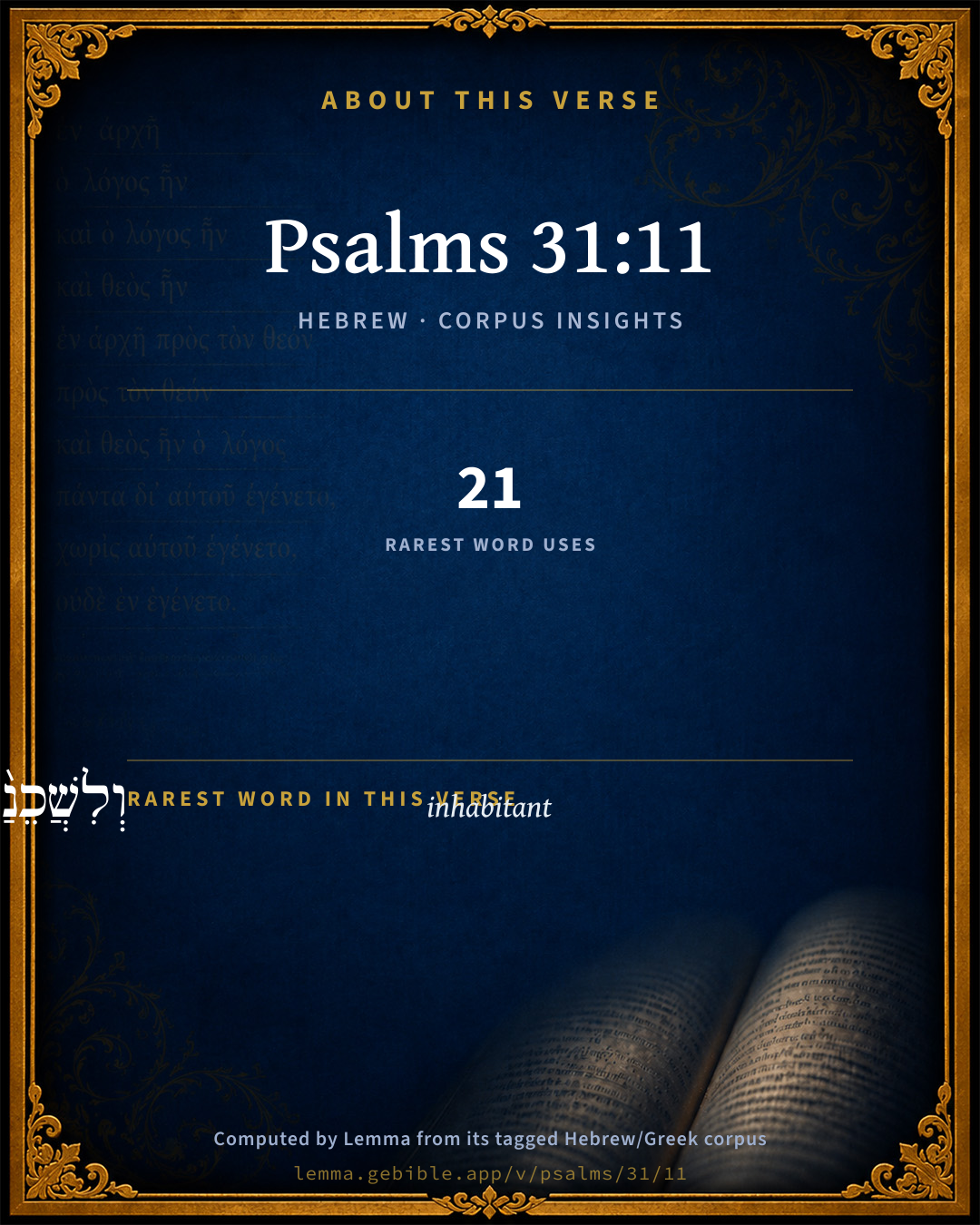
The rarest word here is וְלִשֲׁכֵנַ֨י inhabitant H7934 — appearing just 21 times in the whole Hebrew Bible.

Shared distinctive vocabulary

וְלִשֲׁכֵנַ֨י inhabitant H7934 occurs in 20 verses of the Hebrew Bible. Also found in:

Grammatical profile

  • 5 verbs
  • 4 nouns
  • 1 adjective
  • 1 preposition
  • 1 adverb

Verb forms

  • צֹרְרַ֨י Qal · Participle Active
  • הָיִ֪יתִי Qal · Perfect
  • לִֽמְיֻדָּ֫עָ֥י Pual · Participle Passive
  • רֹאַ֥י Qal · Participle Active
  • נָדְד֥וּ Qal · Perfect

Hebrew & Septuagint length

In English translation the verse runs 28 words from the Hebrew and 28 from the Septuagint (LXX English) — the same length.

A rough comparison of the two English renderings, which tokenize alike — not a word-level alignment.

Word counts can differ between the Hebrew and the Greek without any difference in meaning — e.g. the Hebrew direct-object marker אֵת has no separate Greek word, and Greek often adds the article ὁ.

Cross-references

24

Topical passages linked to Psalms 31:11 in the Treasury of Scripture Knowledge — connected by theme and wording, ordered by reader-vote popularity; previews shown in the World English Bible.

  • Psalms 38:11 My lovers and my friends stand aloof from my plague. My kinsmen stand far away.
  • Psalms 88:8 You have taken my friends from me. You have made me an abomination to them. I am confined, and I can't escape.
  • Psalms 88:18 You have put lover and friend far from me, And my friends into darkness.
  • Matthew 26:56 But all this has happened, that the Scriptures of the prophets might be fulfilled." Then all the disciples left him, and fled.
  • Job 19:13–14 "He has put my brothers far from me. My acquaintances are wholly estranged from me.
  • Psalms 41:8–9 "An evil disease," they say, "has afflicted him. Now that he lies he shall rise up no more."
  • Psalms 64:8 Their own tongues shall ruin them. All who see them will shake their heads.
  • Psalms 69:19–20 You know my reproach, my shame, and my dishonor. My adversaries are all before you.
  • Isaiah 49:7 Thus says Yahweh, the Redeemer of Israel, [and] his Holy One, to him whom man despises, to him whom the nation abhors, to a servant of rulers: Kings shall see and arise; princes, and they shall worship; because of Yahweh who is faithful, [even] the Holy One of Israel, who has chosen you.
  • Isaiah 53:3–5 He was despised, and rejected by men; a man of suffering, and acquainted with disease: and as one from whom men hide their face he was despised; and we didn't respect him.
  • Job 6:21–23 For now you are nothing. You see a terror, and are afraid.
  • Psalms 22:6 But I am a worm, and no man; A reproach of men, and despised by the people.
  • Psalms 89:50–51 Remember, Lord, the reproach of your servants, How I bear in my heart the taunts of all the mighty peoples,
  • Jeremiah 12:6 For even your brothers, and the house of your father, even they have dealt treacherously with you; even they have cried aloud after you: don't believe them, though they speak beautiful words to you.
  • Micah 7:6 For the son dishonors the father, The daughter rises up against her mother, The daughter-in-law against her mother-in-law; A man's enemies are the men of his own house.
  • Matthew 10:21–22 "Brother will deliver up brother to death, and the father his child. Children will rise up against parents, and cause them to be put to death.
  • Matthew 26:74 Then he began to curse and to swear, "I don't know the man!" Immediately the rooster crowed.
  • Matthew 27:39–44 Those who passed by blasphemed him, wagging their heads,
  • Mark 14:50 They all left him, and fled.
  • Romans 15:3 For even Christ didn't please himself. But, as it is written, "The reproaches of those who reproached you fell on me."
  • 2 Timothy 4:16 At my first defense, no one came to help me, but all left me. May it not be held against them.
  • Hebrews 11:36 Others were tried by mocking and scourging, yes, moreover by bonds and imprisonment.
  • Hebrews 13:13 Let us therefore go forth to him outside of the camp, bearing his reproach.
  • 1 Peter 4:14 If you are insulted for the name of Christ, blessed are you; because the Spirit of glory and of God rests on you. On their part he is blasphemed, but on your part he is glorified.

Cross-references courtesy of OpenBible.info (CC BY 4.0).

Hebrew and Greek witnesses Masoretic Hebrew ↔ Greek Septuagint

The same verse in the two great witnesses to the Old Testament, shown verse-for-verse.

You’re reading Greek Psalm 30 (Hebrew Psalm 31). The Septuagint counts the superscription, so verse numbers can differ from the Hebrew — chapter-level alignment, not verse-by-verse. Numbering follows Rahlfs.

These are two independent witnesses, not word-aligned to each other, and the Septuagint is shown in lemma (dictionary) form.

Hebrew Psalms 31:11 Masoretic · Westminster Leningrad Codex

מִכָּל צֹרְרַ֨י הָיִ֪יתִי חֶרְפָּ֡ה וְלִשֲׁכֵנַ֨י מְאֹד֮ וּפַ֪חַד לִֽמְיֻדָּ֫עָ֥י רֹאַ֥י בַּח֑וּץ נָדְד֥וּ מִמֶּֽנִּי

Because of all my adversaries I have become utterly contemptible to my neighbors, A fear to my acquaintances. Those who saw me on the street fled from me.

World English Bible · Public Domain

Greek LXX Greek Psalm 30:11 Septuagint · lemma form

ὅτι ἐκλείπω ἐν ὀδύνη ὁ ζωή ἐγώ καί ὁ ἔτος ἐγώ ἐν στεναγμός ἀσθενέω ἐν πτωχεία ὁ ἰσχύς ἐγώ καί ὁ ὀστέον ἐγώ ταράσσω

I became a reproach among all my enemies, but exceedingly so to my neighbors, and a fear to my acquaintance: they that saw me without fled from me.

LXX2012 (modern English Septuagint) · Public Domain

Hebrew: Westminster Leningrad Codex (CC BY 4.0). Greek: Septuagint (public domain); English from LXX2012 (modern English Septuagint) (Public Domain). How the Septuagint differs from the Hebrew →

Commentary

Notes on Psalms 31:11 from classic Christian and Jewish commentators (each source and its license shown beneath its notes). The classic Christian expositions comment on the surrounding passage and are grouped to its opening verse, so a note may address several verses; the Jewish commentaries on the Tanakh (Rashi and others) are per-verse, so they appear only where the commentator wrote on this verse.

Lemma curates 59 commentaries, every one of them public domain or Creative Commons licensed, each selected and text-cleaned for this edition rather than reprinted as found. About our sources →

Trapp's Complete Commentary

John Trapp

Psa 31:11 I was a reproach among all mine enemies, but especially among my neighbours, and a fear to mine acquaintance: they that did see me without fled from me.

Ver. 11. I was a reproach among all mine enemies] Such as Shimei, who now insulted lustily; Leoni mortuo vel mus insultat.

But especially among my neighbours] My near allies and friends, such as Absalom and Ahithophel; these most vexed me.

And a fear to mine acquaintance] It is no new thing that those which should most love men do sometimes, either for fear or flattery of others, make least account of them.

They that did see me without (or, in the streets) fled from me] To shift for themselves; since to own me, whom they could not help, was bootless, and, besides, perilous.

John Trapp, A Commentary or Exposition upon All the Books of the Old and New Testament (1647–1656) — public domain. Text from a community e-Sword module.

Joseph Benson's Commentary

Psa 31:11. I was a reproach among all mine enemies — That is, the subject of their reproaches and scoffs. “This,” said they, “is David, anointed to be king of Israel, a goodly monarch indeed! forsaken by God and men, and in a desperate and perishing condition. He pretends great piety to God, and loyalty to Saul; but, in truth, he is a great impostor, and a traitor and rebel to his king.” But especially among my neighbours — Though they have been witnesses of my integrity in all my actions. And a fear to mine acquaintance — Hebrew, פחד, pachad, a terror. They were afraid to give me any countenance or assistance, or to be seen in my company. They that did see me without — That met me in the highway; fled from me — To prevent their own danger and ruin, which might have been occasioned by their appearing to have any acquaintance with, or friendship for me.

Joseph Benson's Commentary on the Old and New Testaments (1811–1818) — public domain. Text from a community e-Sword module.

J. A. Alexander on Psalms

Joseph Addison Alexander

12. (Psa 31:11). By means of (or because of) all my adversaries I was a reproach, and to my neighbours very (much), and a fear to my acquaintances; seeing me in the street they fled from me (or those seeing me in the street fled from me). The first word properly means from or out of. It was from his enemies, both as the cause and the occasion, that his disgrace proceeded. A reproach, despised by others, and considered a disgrace to them. See above, on Psa 22:7 (6). In the second clause there is an obvious progression. He was so esteemed, not only by his fellow-men indefinitely, but by his neighbours, and that greatly (dxom;), which seems equivalent to saying, "and to none more than my neighbours," or, "above all to my neighbours." In the last clause the climax is completed. Not only were his neighbours ashamed of him; his acquaintances were afraid of him. See below, Psa 38:12 (11), Psa 69:9 (8), and compare Job 19:13-14.

Joseph Addison Alexander, The Psalms Translated and Explained (1850) — public domain. Text from a community e-Sword module.

Geneva Bible (1599)

Geneva Bible translators

They were afraid to show me any token of friendship.

Mine enemies had drawn all men to their part against me, even my chief friends.

Geneva Bible (1599) marginal notes — public domain. Text via Bolls.life.

Jamieson, Fausset & Brown

Robert Jamieson, A. R. Fausset & David Brown

among--or, literally, "from," or, "by" my enemies. The latter clauses describe the progress of his disgrace to the lowest degree, till,

Jamieson, Fausset & Brown — Commentary Critical and Explanatory on the Whole Bible (1871) — public domain (CC PDM 1.0). Text via the HelloAO Bible API.

Adam Clarke's Commentary

Verse 11. I was a reproach] When proscribed at the court of Saul, my enemies triumphed, and loaded me with execrations; my neighbours considered me as a dangerous man, now deservedly driven from society; my acquaintance, who knew me best, were afraid to hold any communication with me; and they who saw me in my exile avoided me as if affected with a contagious disorder,

Adam Clarke's Commentary on the Bible (1810–1826) — public domain. Text from a community e-Sword/MySword module.

John Calvin's Commentaries

11. I was a reproach by reason of all mine enemies. Others translate thus - more than mine enemies, and as the Hebrew letter מ, mem, is often used as a sign of comparison, they interpret this clause to mean that David’s friends and acquaintances reproached him more than all his enemies. But, in my opinion, he intended to express a different idea, namely, that as he was everywhere hated, and his enemies had induced almost the whole realm to take part with them against him, he had an evil name even among his friends and neighbors; just as popular opinion, like a violent tempest, usually carries all before it. I suppose, therefore, that the Hebrew copula ו, vau, is used for the sake of amplification, to show that David was an object of detestation, not only to strangers to whom he was formerly unknown, but also to his principal friends. He adds, likewise, that when they saw him abroad they fled from him By the adverb, abroad, he means to say, that they did not think the miserable man worthy of a near approach to them; nay, that they fled from the very sight of him, at however great a distance, lest the contagion of his misery should reach them, and because they reckoned it would be injurious and disgraceful to them to show him any sign of friendship.

John Calvin's Commentaries (1540-1563) — public domain. Text from the Calvin Translation Society English edition (1840s-50s) via the Christian Classics Ethereal Library (ccel.org). Calvin's coverage is partial (roughly two-thirds of the Bible); uncommented books and verses are honest gaps, never fabricated. The 19th-century editor's footnotes and remarks are omitted so the notes are faithfully Calvin's own voice.

Ellicott's Commentary for English Readers

(11) The adverb rendered especially seems out of place. It is therefore better to take it as a noun, in the sense of burden, a sense etymologically probable.

“Because of all mine oppressors I have become a reproach,

And to my neighbours a burden,

And a fear to my acquaintance.”

Fled.—Literally, fluttered away like frightened birds.

A Bible Commentary for English Readers, edited by Charles John Ellicott (1878–1897) — public domain. Text from a community e-Sword module.

The Cambridge Bible for Schools and Colleges

gen. ed. J. J. S. Perowne

11. Because of all mine adversaries I am become a reproach,

Yea, unto my neighbours exceedingly. (R.V.)

The original is as awkward as the translation, and we should probably connect because of all mine adversaries with the previous verse, and read, I am become a reproach unto my neighbours exceedingly: or else, with Lagarde, Cheyne, and others, read a shaking of head (Psa_44:14, cp. 13), in place of exceedingly. Cp. Psa_22:6-7; Jer_20:7-8.

they that did see me &c.] Those who met him in public avoided him, afraid of incurring persecution themselves by any sign of sympathy.

The Cambridge Bible for Schools and Colleges (gen. ed. J. J. S. Perowne; Cambridge University Press, 1878–1918) — public domain. Text from a community e-Sword module.

John Gill's Exposition

I was a reproach among all mine enemies,.... This is a common case of the people of God; and though it may be the least of their afflictions, yet it is not grateful to the flesh; and it is as it is made: under divine supports saints rejoice, and take pleasure in reproaches, that they are counted worthy to bear them, and esteem them as great riches; at other times they seize and feed upon their spirits, and are ready to break their hearts;

but especially among my neighbours; who knew him, and knew he did not deserve to be so treated; and who ought, as neighbours, to have loved him, and done all good offices to him; so that this is an aggravation both of their sin and his distress;

and a fear to mine acquaintance; not that they were afraid that he should do them any mischief; but they were afraid to own him, and to do him any service; unless the sense is, that they were afraid that evil would befall him, that he should not escape with his life; which, though it may express the affectionate concern of his friends, yet shows the danger he was exposed to;

they that did see me without fled from me; as if he had something very pestilential and infectious about him.

John Gill's Exposition of the Whole Bible (1746–1763) — public domain (CC PDM 1.0). Text via the HelloAO Bible API.

Albert Barnes' Notes on the Bible

I was a reproach among all mine enemies - That is, he was subjected to their reproaches, or was calumniated and reviled by them. See the notes at Psa 22:6.

But especially among my neighbors - I was reproached by none more than by my neighbors. They showed special distrust of me, and manifested special unkindness, even more than my enemies did. They turned away from me. They abandoned me. They would not associate with me. They regarded me as a disgrace to them, and forsook me. Compare Job 19:13-15, and the notes at that passage.

And a fear to mine acquaintance - An object of dread or terror, so that they fled from me.

They that did see me without - In the streets, or in public - out of my own house. Not only those in my own dwelling - the members of my family - regarded me in this manner, but passers in the streets - those whom I accidentally met - turned from me and fled in disgust and horror. It is not possible now to determine at what time in the life of the psalmist this occurred, or to ascertain the exact circumstances. There were, doubtless, times when with the saddest feelings he could say that all this was true of him. His troubles in the time of his persecutions by Saul, and still more probably his trials in the time when Absalom rebelled against him, and when he was driven away from his throne and his capital, would furnish an occasion when this would be true. If the latter was the occasion, then we can see how naturally he would connect all this with his “iniquity,” and regard it as the consequence of his sin in the matter of Uriah - a sin which would probably be always in his recollection, and which he would ever onward regard as lying at the foundation of all his afflictions.

Albert Barnes' Notes on the Bible (1834–1885) — public domain. Text from a community e-Sword/MySword module.

Matthew Poole's English Annotations

A reproach, i.e. the matter of their reproaches and scorns. This, said they, is David, anointed to be king of Israel, a goodly monarch indeed, forsaken by God and men, and in a perishing and desperate condition; he pretends great piety to God, and loyalty to Saul, but in truth he is a great impostor, and a traitor and rebel to his king. Especially among my neighbours; which aggravates their sin, and his misery, partly because they were obliged by the laws of neighbourhood to perform all friendly offices to him; and partly because they were daily witnesses of his integrity, and therefore sinned against their own knowledge. A fear; or, a terror. They were afraid to give me any countenance or assistance, or to be seen in my company; being warned by Ahimelech’s punishment for it, 1Sa 22.

Fled from me; either loathing me as a monster of men, and an unlucky spectacle, and such a villain as mine enemies represented me, and they believed me to be; or to prevent their own danger and ruin, which might be occasioned by it.

Matthew Poole's English Annotations on the Holy Bible (1683–1685) — public domain. Text from a community e-Sword/MySword module.

The Treasury of David

Charles H. Spurgeon

Ver. 11. I was a reproach among all mine enemies. They were pleased to have something to throw at me; my mournful estate was music to them, because they maliciously interpreted it to be a judgment from heaven upon me. Reproach is little thought of by those who are not called to endure it, but he who passes under its lash knows how deep it wounds. The best of men may have the bitterest foes, and be subject to the most cruel taunts. But especially among my neighbours. Those who are nearest can stab the sharpest. We feel most the slights of those who should have shown us sympathy. Perhaps David's friends feared to be identified with his declining fortunes, and therefore turned against him in order to win the mercy if not the favour of his opponents. Self interest rules the most of men: ties the most sacred are soon snapped by its influence, and actions of the utmost meanness are perpetrated without scruple. And a fear to mine acquaintance. The more intimate before, the more distant did they become. Our Lord was denied by Peter, betrayed by Judas, and forsaken by all in the hour of his utmost need. All the herd turn against a wounded deer. The milk of human kindness curdles when a despised believer is the victim of slanderous accusations. They that did see me without fled from me. Afraid to be seen in the company of a man so thoroughly despised, those who once courted his society hastened from him as though he had been infected with the plague. How villainous a thing is slander which can thus make an eminent saint, once the admiration of his people, to become the general butt, the universal aversion of mankind! To what extremities of dishonour may innocence be reduced!

Ver. 11. I was a reproach among all mine enemies. If anyone strives after patience and humility, he is a hypocrite. If he allows himself in the pleasures of this world, he is a glutton. If he seeks justice, he is impatient; if he seeks it not, he is a fool. If he would be prudent, he is stingy; if he would make others happy, he is dissolute. If he gives himself up to prayer, he is vainglorious. And this is the great loss of the church, that by means like these many are held back from goodness! which the psalmist lamenting says, I became a reproof among all mine enemies. Chrysostom, quoted by J.M. Neale.

Ver. 11. They that did see me without fled from me. I once heard the following relation from an old man of the world, and it occurs to me, as illustrative of what we are now considering. He was at a public assembly, and saw there an individual withdrawing herself from the crowd, and going into a corner of the room. He went up to her, she was an old and intimate friend of his; he addressed himself to hershe, with a sigh, said, "Oh, I have seen many days of trouble since we last met." What does the man of the world do? Immediately he withdrew himself from his sorrow stricken friend and hid himself in the crowd. Such is the sympathy of the world with Christ or his servants. Hamilton Verschoyle.

Ver. 11.. The good man evil spoken of.

Psalms 31:12*

Charles H. Spurgeon's The Treasury of David (1869–1885) — public domain. Psalms only. Text from a community e-Sword/MySword module.

Whedon's Commentary on the Bible

Daniel D. Whedon

11. Among all mine enemies—Literally, Because of all my oppressors, I have been a reproach. Psa_6:7. They had originated all his trouble and disgrace.

Especially among my neighbours, and… acquaintance— These who dwelt nearest to the places where, from time to time, he resorted. From the example of Nob, (1Sa_22:6-19,) it was death to them to harbour David, or give comfort and aid to his cause, or even to fail to give information to Saul if they knew of him. Thus he was a terror to them.

Daniel D. Whedon (gen. ed.), Commentary on the Old and New Testaments (1874–1909) — public domain. Text from a community e-Sword module.

The Pulpit Commentary

I was a reproach among all mine enemies; rather, I am become a reproach (Kay, Revised Version). The psalmist complains of the loss of his reputation. Absalom"s rebellion was preceded by a long course of calumnious accusation of David, (2Sa_15:1-4) whereby men"s hearts were stolen away from him, and his character blackened. His enemies made the most of these ill reports, and turned them to his reproach. (comp. Psa_69:18-20) But especially among my neighbours. Not that they reproached him more than others, hut that he felt their reproaches more keenly. And a fear to mine acquaintance. His acquaintances were afraid of being recognized as such, and involved in his ill repute. They that did sea me without; i.e. "out of doors," or "in the street." Fled from me. Avoided my contact, not wishing to be seen with me. (comp. Psa_88:8)

The Pulpit Commentary (1880–1919), ed. H.D.M. Spence-Jones & Joseph S. Exell — public domain. Text from a community e-Sword module.

John Wesley's Explanatory Notes

A fear - They were afraid to give me any countenance or assistance. Fled - To prevent their own danger and ruin.

John Wesley, Explanatory Notes Upon the Whole Bible (1754–1765) — public domain. Text via the GEBible commentary corpus.

Rashi

Rabbi Shlomo Yitzchaki (Rashi)

and my bones have decayed Heb. עששו, an expression of decay, as though a moth (עש) had eaten them.

Rashi on the Tanakh — English translations: “The Judaica Press complete Tanach with Rashi, translated by A. J. Rosenberg” (CC BY 4.0); “Pentateuch with Rashi's commentary by M. Rosenbaum and A.M. Silbermann, 1929-1934” (public domain); “The Metsudah Tanach series, Lakewood, N.J” (CC BY 4.0); and “The Book of Joshua, Metsudah Publications, 1997” (CC BY 4.0). Text via Sefaria.

Lesson kit

Teaching starters — assembled from the data on this page, not authored interpretation. Every prompt links to the verse data it draws on. Edit before teaching.

Psalms, in the Wisdom, opens this verse with 12 words (12 distinct Hebrew lemmas). Its most distinctive word is shâkên (“inhabitant”). A historical commentator’s framing appears above. Read the whole chapter for the surrounding context.

Discussion questions

  1. How does “inhabitant” (shâkên) shape what this verse is saying?
  2. Exodus 3:22 shares the word «inhabitant» with this verse. How do the two illuminate each other?
  3. These translations render this verse differently. What is at stake in choosing one wording over another?
  4. The verb «צֹרְרַ֨י» is Qal Participle Active. How does its form color the action?
  5. Reading how Trapp's Complete Commentary and Joseph Benson's Commentary read this verse, where do the two commentators agree and where do they part?

Things to notice

Reading settings

Reading text

Shown beneath each verse's original-language words.

Old Testament
Old Testament edition

Read the OT as the Masoretic Hebrew (MT) or the Greek Septuagint (LXX).

English shown for the Greek Septuagint (in the Hebrew ↔ Greek comparison).

Comparing translations? Open the Compare panel on any verse page to stack up to four side by side.