
Jeremiah 44:6

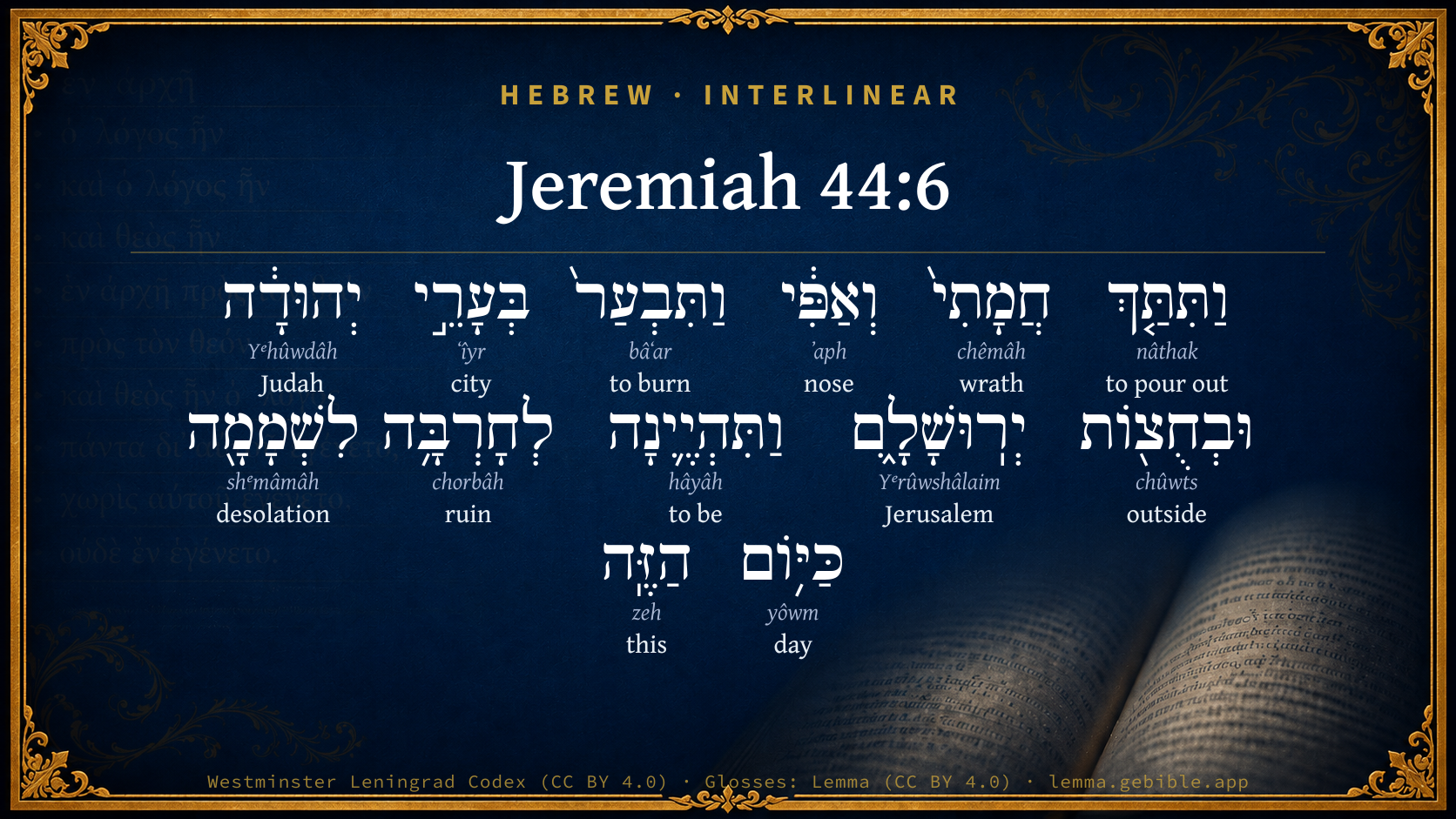
Hebrew (Westminster Leningrad Codex) Jeremiah 44:6 appears in the Hebrew Old Testament. The text above is from the Westminster Leningrad Codex. Each word links to its Strong’s number, a concise gloss, and parsing drawn from the Open Scriptures Hebrew Bible morphology. Click any word for its full Brown-Driver-Briggs (BDB) entry.
Download image
Cite this verse

Jeremiah 44:6 (World English Bible). Public Domain. Lemma interlinear Bible study tool, https://lemma.gebible.app/v/jeremiah/44/6.

Show BibTeX & RIS
BibTeX
RIS
English Translation
Therefore my wrath and my anger was poured forth, and was kindled in the cities of Judah and in the streets of Jerusalem; and they are wasted and desolate, as it is this day.
World English Bible · Public Domain
Download a study sheet

One document with this verse’s original text, its word-by-word gloss line, the meaning frame, cross-references with their text, attributed commentary, and full source and license credits — printable, and it pastes into notes with its structure intact.

This verse Autodidact and up

Study sheet (.html) Plain text (.txt)

A passage Seminary Student

Up to 50 verses in one chapter. A passage sheet keeps up to 6 commentary sources and 12 cross-references per verse, in the order this page ranks them, and says so on the sheet whenever that leaves anything out. Ask for a single verse and you get the Autodidact verse sheet above.

Everything on this page stays free to read, with no account — the sheet is a download of what is already on screen, not access to it.

Want to remove ads? Support Godless Engineer
Compare translations 3

The same verse in 3 English versions, stacked beneath the original-language interlinear above. Click any original word for its lexicon entry.

Each is an independent rendering of the whole verse — the interlinear is not word-aligned to these translations.

Highlighted words mark where these versions differ — a whole-verse word diff, not a word-by-word alignment.

  • World English Bible Public Domain
    Therefore my wrath and my anger was poured forth, and was kindled in the cities of Judah and in the streets of Jerusalem; and they are wasted and desolate, as it is this day.
  • King James Version Public Domain
    Wherefore my fury and mine anger was poured forth, and was kindled in the cities of Judah and in the streets of Jerusalem; and they are wasted and desolate, as at this day.
  • unfoldingWord Literal Text CC BY-SA 4.0
    So my fury and my wrath were poured out and kindled a fire in the cities of Judah and the streets of Jerusalem. So they became ruins and devastations, as at this present day.’

unfoldingWord Literal Text — © unfoldingWord, licensed CC BY-SA 4.0. Word-aligned USFM3 via Door43 (git.door43.org/unfoldingWord/en_ult).

Versions to compare (up to 4)

3 of 4 selected

Show all 18 translations

Every available English version of this verse, each an independent rendering of the whole verse.

  • World English Bible Public Domain
    Therefore my wrath and my anger was poured forth, and was kindled in the cities of Judah and in the streets of Jerusalem; and they are wasted and desolate, as it is this day.
  • Berean Standard Bible Public Domain
    Therefore My wrath and anger poured out and burned in the cities of Judah and in the streets of Jerusalem, so that they have become the desolate ruin they are today.
  • Majority Standard Bible Public Domain
    Therefore My wrath and anger poured out and burned in the cities of Judah and in the streets of Jerusalem, so that they have become the desolate ruin they are today.
  • King James Version Public Domain
    Wherefore my fury and mine anger was poured forth, and was kindled in the cities of Judah and in the streets of Jerusalem; and they are wasted and desolate, as at this day.
  • American Standard Version (1901) Public Domain
    Wherefore my wrath and mine anger was poured forth, and was kindled in the cities of Judah and in the streets of Jerusalem; and they are wasted and desolate, as it is this day.
  • Revised Version (1885) Public Domain
    Wherefore my fury and mine anger was poured forth, and was kindled in the cities of Judah and in the streets of Jerusalem; and they are wasted and desolate, as it is this day.
  • Geneva Bible (1599) Public Domain
    Wherefore my wrath, and mine anger was powred foorth and was kindled in the cities of Iudah, and in the streetes of Ierusalem, and they are desolate, and wasted, as appeareth this day.
  • Douay-Rheims (1899) Public Domain
    Wherefore my indignation and my fury was poured forth, and was kindled in the cities of Juda, and in the streets of Jerusalem: and they are turned to desolation and waste, as at this day.
  • Young's Literal Translation Public Domain
    and poured out is My fury, and Mine anger, and it burneth in cities of Judah, and in streets of Jerusalem, and they are for a waste, for a desolation, as `at' this day.
  • Literal Standard Version CC BY-SA 4.0
    and My fury is poured out, and My anger, and it burns in cities of Judah, and in streets of Jerusalem, and they are for a ruin, for a desolation, as [at] this day.
  • Unlocked Literal Bible CC BY-SA 4.0
    So my fury and my wrath were poured out and kindled a fire in the cities of Judah and the streets of Jerusalem. So they became ruins and devastations, as at this present day.'
  • unfoldingWord Literal Text CC BY-SA 4.0
    So my fury and my wrath were poured out and kindled a fire in the cities of Judah and the streets of Jerusalem. So they became ruins and devastations, as at this present day.’
  • Darby Bible Public Domain
    And my fury and mine anger was poured forth, and was kindled in the cities of Judah and in the streets of Jerusalem; and they are become a waste, a desolation, as at this day.
  • World Messianic Bible Public Domain
    Therefore my wrath and my anger was poured out, and was kindled in the cities of Judah and in the streets of Jerusalem; and they are wasted and desolate, as it is today.’
  • Webster's Bible Public Domain
    Wherefore my fury and my anger was poured forth, and was kindled in the cities of Judah and in the streets of Jerusalem; and they are wasted and desolate, as at this day.
  • Free Bible Version CC BY-SA 4.0
    That's why my furious anger poured out and set fire to the towns of Judah and burned in the streets of Jerusalem, making them the abandoned ruins they still are today.
  • Bible in Basic English Public Domain
    Because of this, my passion and my wrath were let loose, burning in the towns of Judah and in the streets of Jerusalem; and they are waste and unpeopled as at this day.
  • JPS Tanakh (1917) Public Domain
    Wherefore My fury and Mine anger was poured forth, and was kindled in the cities of Judah and in the streets of Jerusalem; and they are wasted and desolate, as at this day.

Literal Standard Version (2020), Covenant Press — licensed CC BY-SA 4.0. Text via the HelloAO Bible API (eBible.org). Unlocked Literal Bible (unfoldingWord) — licensed CC BY-SA 4.0. Text via the HelloAO Bible API (eBible.org). unfoldingWord Literal Text — © unfoldingWord, licensed CC BY-SA 4.0. Word-aligned USFM3 via Door43 (git.door43.org/unfoldingWord/en_ult). Free Bible Version, Dr. Jonathan Gallagher — licensed CC BY-SA 4.0. Text via the HelloAO Bible API (eBible.org).

Word by word

More ways to search: Search by grammar → Find every occurrence → Compare this word →

Practice this passage: Drill this verse → Learn its vocabulary →

וַתִּתַּ֤ךְ
nâthak
H5413
“and · to pour out”
Conjunction + Verb, Qal, Sequential Imperfect, 3rd Person, Feminine, Singular
Part of Speech
Conjunction + Verb
Stem
Qal
Form
Sequential Imperfect
Person
3rd Person
Gender
Feminine
Number
Singular
Full BDB Definition

Origin: a primitive root

TWOT: 1442

to pour out or forth, drop (or rain), be poured, be poured out, be melted, be molten - (Qal) to pour forth - (Niphal) to be poured, be poured out - (Hiphil) to pour out, melt - (Hophal) to be melted
  1. חֲמָתִי֙ chêmâh H2534 “wrath · my” Noun, Common, Feminine, Singular, Construct + Suffix, Personal, 1st Person, Common, Singular
  2. וְאַפִּ֔י ʼaph H639 “and · nose · my” Conjunction + Noun, Common, Masculine, Singular, Construct + Suffix, Personal, 1st Person, Common, Singular
  3. וַתִּבְעַר֙ bâʻar H1197 “and · to burn” Conjunction + Verb, Qal, Sequential Imperfect, 3rd Person, Feminine, Singular
  4. בְּעָרֵ֣י ʻîyr H5892 “in/at · cities of” Preposition + Noun, Common, Feminine, Plural, Construct
  5. יְהוּדָ֔ה Yᵉhûwdâh H3063 “Judah” Noun, Proper
  6. וּבְחֻצ֖וֹת chûwts H2351 “and · in/at · streets of” Conjunction + Preposition + Noun, Common, Masculine, Plural, Construct
  7. יְרֽוּשָׁלִָ֑ם Yᵉrûwshâlaim H3389 “Jerusalem” Noun, Proper
  8. וַתִּהְיֶ֛ינָה hâyâh H1961 “and · to be” Conjunction + Verb, Qal, Sequential Imperfect, 3rd Person, Feminine, Plural
  9. לְחָרְבָּ֥ה chorbâh H2723 “to/for · ruin” Preposition + Noun, Common, Feminine, Singular, Absolute
  10. לִשְׁמָמָ֖ה shᵉmâmâh H8077 “to/for · desolation” Preposition + Noun, Common, Feminine, Singular, Absolute
  11. כַּיּ֥וֹם yôwm H3117 “like/as the · day” Preposition, Determined + Noun, Common, Masculine, Singular, Absolute
  12. הַזֶּֽה zeh H2088 “the · this” Particle, Definite Article + Pronoun, Demonstrative, Masculine, Singular

About this verse

These counts appear in no published source. They are computed here, from the morphology-tagged text and Lemma’s own curated glosses. What Lemma adds →

13
words
13
distinct lemmas
Prophets
section

Notable vocabulary

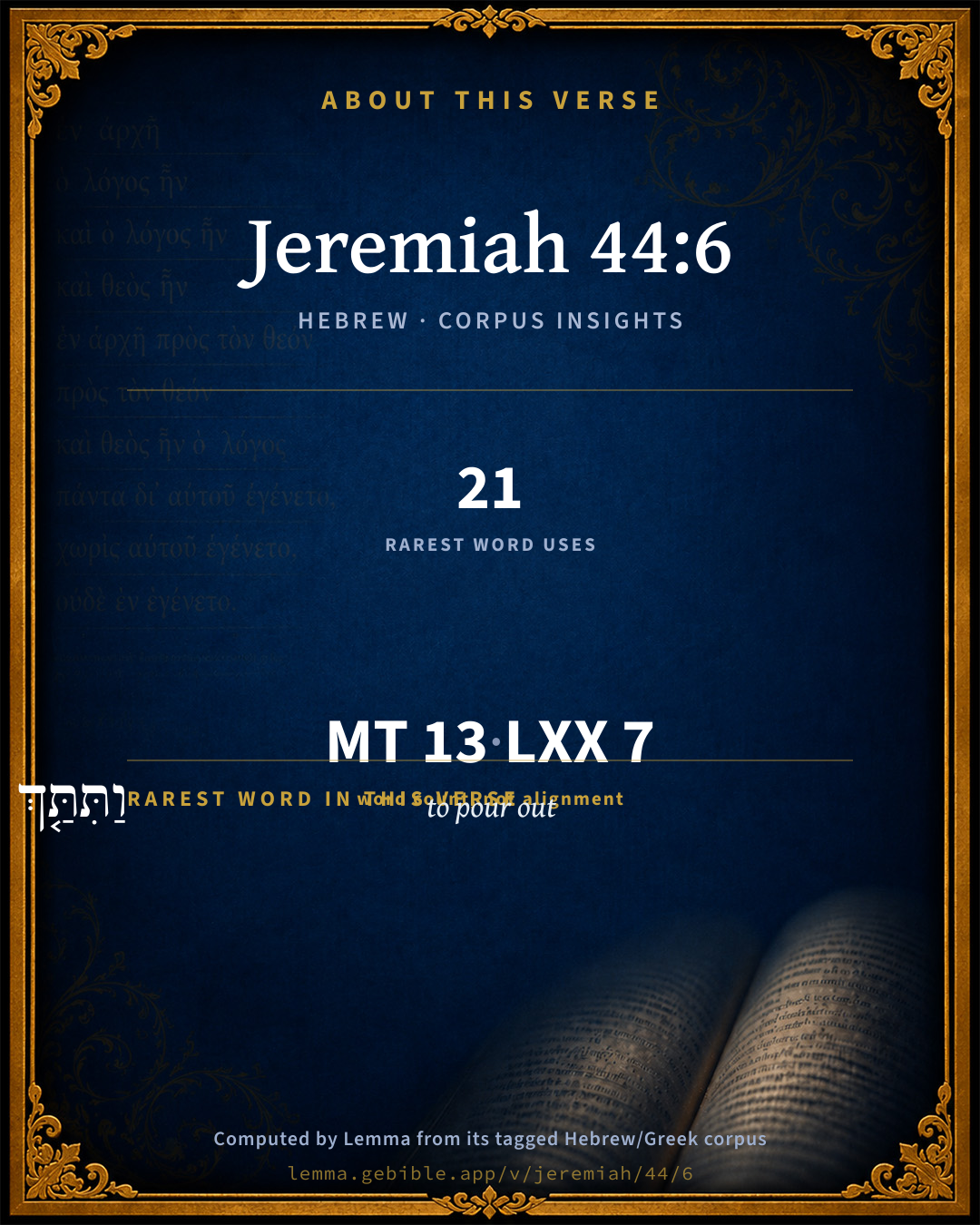
The rarest word here is וַתִּתַּ֤ךְ to pour out H5413 — appearing just 21 times in the whole Hebrew Bible.

Shared distinctive vocabulary

וַתִּתַּ֤ךְ to pour out H5413 occurs in 19 verses of the Hebrew Bible. Also found in:

Grammatical profile

  • 3 verbs
  • 9 nouns
  • 1 pronoun

Verb forms

  • וַתִּתַּ֤ךְ Qal · Sequential Imperfect
  • וַתִּבְעַר֙ Qal · Sequential Imperfect
  • וַתִּהְיֶ֛ינָה Qal · Sequential Imperfect

Hebrew & Septuagint length

In the original languages it is 13 Hebrew tokens and 7 Greek tokens — but the two are counted differently (Hebrew bundles its prefixes and suffixes into one token; the Greek is in lemma form), so that isn’t a like-for-like length.

Cross-references

20

Topical passages linked to Jeremiah 44:6 in the Treasury of Scripture Knowledge — connected by theme and wording, ordered by reader-vote popularity; previews shown in the World English Bible.

  • Jeremiah 7:20 Therefore thus says the Lord Yahweh: Behold, my anger and my wrath shall be poured out on this place, on man, and on animal, and on the trees of the field, and on the fruit of the ground; and it shall burn, and shall not be quenched.
  • Isaiah 6:11 Then I said, "Lord, how long?" He answered, "Until cities are waste without inhabitant, And houses without man, And the land becomes utterly waste,
  • Isaiah 51:17 Awake, awake, stand up, Jerusalem, that have drunk at the hand of Yahweh the cup of his wrath; you have drunken the bowl of the cup of staggering, and drained it.
  • Isaiah 51:20 Your sons have fainted, they lie at the head of all the streets, as an antelope in a net; they are full of the wrath of Yahweh, the rebuke of your God.
  • Jeremiah 7:34 Then will I cause to cease from the cities of Judah, and from the streets of Jerusalem, the voice of mirth and the voice of gladness, the voice of the bridegroom and the voice of the bride; for the land shall become a waste.
  • Jeremiah 21:5 I myself will fight against you with an outstretched hand and with a strong arm, even in anger, and in wrath, and in great indignation.
  • Jeremiah 42:18 For thus says Yahweh of Hosts, the God of Israel: As my anger and my wrath has been poured forth on the inhabitants of Jerusalem, so shall my wrath be poured forth on you, when you shall enter into Egypt; and you shall be an object of horror, and an astonishment, and a curse, and a reproach; and you shall see this place no more.
  • Ezekiel 8:18 Therefore will I also deal in wrath; my eye shall not spare, neither will I have pity; and though they cry in my ears with a loud voice, yet will I not hear them.
  • Leviticus 26:28 then I will walk contrary to you in wrath; and I also will chastise you seven times for your sins.
  • Jeremiah 4:4 Circumcise yourselves to Yahweh, and take away the foreskins of your heart, you men of Judah and inhabitants of Jerusalem; lest my wrath go forth like fire, and burn so that none can quench it, because of the evil of your doings.
  • Jeremiah 21:12 House of David, thus says Yahweh, Execute justice in the morning, and deliver him who is robbed out of the hand of the oppressor, lest my wrath go forth like fire, and burn so that none can quench it, because of the evil of your doings.
  • Jeremiah 36:7 It may be they will present their supplication before Yahweh, and will return everyone from his evil way; for great is the anger and the wrath that Yahweh has pronounced against this people.
  • Jeremiah 44:2–3 Thus says Yahweh of Hosts, the God of Israel: You have seen all the evil that I have brought on Jerusalem, and on all the cities of Judah; and, behold, this day they are a desolation, and no man dwells therein,
  • Ezekiel 5:13 Thus shall my anger be accomplished, and I will cause my wrath toward them to rest, and I shall be comforted; and they shall know that I, Yahweh, have spoken in my zeal, when I have accomplished my wrath on them.
  • Ezekiel 6:12 He who is far off shall die of the pestilence; and he who is near shall fall by the sword; and he who remains and is besieged shall die by the famine: thus will I accomplish my wrath on them.
  • Ezekiel 20:33 As I live, says the Lord Yahweh, surely with a mighty hand, and with an outstretched arm, and with wrath poured out, will I be king over you:
  • Ezekiel 24:8 That it may cause wrath to come up to take vengeance, I have set her blood on the bare rock, that it should not be covered.
  • Ezekiel 24:13 In your filthiness is lewdness: because I have cleansed you and you weren't cleansed, you shall not be cleansed from your filthiness any more, until I have caused my wrath toward you to rest.
  • Daniel 9:12 He has confirmed his words, which he spoke against us, and against our judges who judged us, by bringing on us a great evil; for under the whole sky has not been done as has been done on Jerusalem.
  • Nahum 1:2 Yahweh is a jealous God and avenges. Yahweh avenges and is full of wrath. Yahweh takes vengeance on his adversaries, and he maintains wrath against his enemies.

Cross-references courtesy of OpenBible.info (CC BY 4.0).

Hebrew and Greek witnesses Masoretic Hebrew ↔ Greek Septuagint

The same verse in the two great witnesses to the Old Testament, shown verse-for-verse.

These are two independent witnesses, not word-aligned to each other, and the Septuagint is shown in lemma (dictionary) form.

Hebrew Jeremiah 44:6 Masoretic · Westminster Leningrad Codex

וַתִּתַּ֤ךְ חֲמָתִי֙ וְאַפִּ֔י וַתִּבְעַר֙ בְּעָרֵ֣י יְהוּדָ֔ה וּבְחֻצ֖וֹת יְרֽוּשָׁלִָ֑ם וַתִּהְיֶ֛ינָה לְחָרְבָּ֥ה לִשְׁמָמָ֖ה כַּיּ֥וֹם הַזֶּֽה

Therefore my wrath and my anger was poured forth, and was kindled in the cities of Judah and in the streets of Jerusalem; and they are wasted and desolate, as it is this day.

World English Bible · Public Domain

Greek LXX Structure differs

In the Septuagint, Jeremiah is about an eighth shorter than the Hebrew and arranges its material differently — the Oracles Against the Nations (Hebrew chapters 46–51) appear in the middle of the Greek book, after 25:13. Because the chapter and verse boundaries do not line up, a verse-for-verse comparison with the Hebrew is not shown.

A verse-for-verse comparison isn’t shown here because the chapters and verses don’t line up. Switch to the LXX edition with the MT / LXX toggle above to read the Greek directly.

Hebrew: Westminster Leningrad Codex (CC BY 4.0). Greek: Septuagint (public domain); English from a public-domain English Septuagint. How the Septuagint differs from the Hebrew →

Targum (Aramaic paraphrase)

1

The Targum is the ancient Jewish Aramaic paraphrase of the Hebrew Scriptures — an interpretive translation, not the Hebrew text itself. Onkelos (literal) and Pseudo-Jonathan (expansive) render the Torah, and Jonathan the Prophets. Coverage is partial: where no permissively-licensed English translation exists for a verse, only the Aramaic is shown. This is verse-level text, not a word-by-word alignment to the Hebrew.

  1. Targum Jonathan Prophets (Joshua–Malachi)
    וְחָל רוּגְזִי וְחֵימְתִי וּדְלֵיק בְּקִרְוַיָא דְבֵית יְהוּדָה וּבְשׁוּקֵי יְרוּשְׁלֵם וַהֲוָאָה לְחוּרְבָא לְצָדוּ כְּיוֹמָא הָדֵין:

    (no public-domain English translation for this verse)

    Targum Jonathan — Aramaic: “Mikraot Gedolot” (public domain). English: “Sefaria Community Translation” (CC0 1.0 (public-domain dedication)); “London "Chaldee Paraphrase," 1871” (public domain). Text via Sefaria.

Commentary

Notes on Jeremiah 44:6 from classic Christian and Jewish commentators (each source and its license shown beneath its notes). The classic Christian expositions comment on the surrounding passage and are grouped to its opening verse, so a note may address several verses; the Jewish commentaries on the Tanakh (Rashi and others) are per-verse, so they appear only where the commentator wrote on this verse.

Lemma curates 59 commentaries, every one of them public domain or Creative Commons licensed, each selected and text-cleaned for this edition rather than reprinted as found. About our sources →

Trapp's Complete Commentary

John Trapp

Jer 44:6 Wherefore my fury and mine anger was poured forth, and was kindled in the cities of Judah and in the streets of Jerusalem; and they are wasted [and] desolate, as at this day.

Ver. 6. Wherefore my fury and mine anger was poured forth.] A metaphor from metals. See Jer 42:18.

John Trapp, A Commentary or Exposition upon All the Books of the Old and New Testament (1647–1656) — public domain. Text from a community e-Sword module.

Joseph Benson's Commentary

Jer 44:6-7. Wherefore my fury, &c., was poured forth, &c. — As if he had said, For these very reasons, their idolatry and contempt of my word by my prophets, the very sins you are now committing, I gave Judah and Jerusalem into the hand of the king of Babylon, and they are, as you see this day, waste and desolate. Wherefore commit ye this great evil? &c. — What sort of prudence is it that influences you to do such actions as these, by which you cannot injure God. but yourselves only? You are now but a few of many; what love can you have for your country while you take courses which will certainly tend to the utter extirpation of those few, so that there shall be none remaining of all the Jews? God designed that this remnant should have remained in Judea, and kept possession of it, when the rest of their brethren were carried away captive, Jer 42:10. But by their going into Egypt and defiling themselves with the idolatries of that nation, they provoked God to make an utter destruction of them.

Joseph Benson's Commentary on the Old and New Testaments (1811–1818) — public domain. Text from a community e-Sword module.

Geneva Bible (1599)

Geneva Bible translators

He setteth before their eyes God’s judgments against Judah and Jerusalem for their idolatry, that they might beware by their example, and not with the like wickedness provoke the Lord: for then they should be double punished.

Geneva Bible (1599) marginal notes — public domain. Text via Bolls.life.

John Calvin's Commentaries

Now he adds, On this account has my wrath and my fury been poured forth, and has burned through the cities of Judah, and through the streets of Jerusalem; and this day they are a waste and a desolation The word שממה, shimme, sometimes means amazement, as it has been before stated; but when it is connected with חרבה, cherebe, as here, it means desolation. As at this day; a dreadful waste was then at that time apparent, he again refers to this truth, that the Jews ought to have been so touched by that remarkable and memorable instance of God’s displeasure, as not to abandon themselves afterwards to new idolatries; they ought to have remembered so recent an example of punishment. As, then, they still persevered in their hardness, it was an evidence of extreme impiety. The Prophet says that the perverseness of the Jews had not been unpunished, for God’s wrath had been poured forth against the cities of Judah, nay, against Jerusalem itself, the sanctuary of God, so that all things had been reduced to desolation. The Jews then ought, on the one hand, seriously to have considered how inexcusable had been their impiety in having so perversely despised God; and then they ought on the other hand, to have entertained fear and dread, since they saw that God had taken such vengeance on those who had despised his teaching and violated his worship.

John Calvin's Commentaries (1540-1563) — public domain. Text from the Calvin Translation Society English edition (1840s-50s) via the Christian Classics Ethereal Library (ccel.org). Calvin's coverage is partial (roughly two-thirds of the Bible); uncommented books and verses are honest gaps, never fabricated. The 19th-century editor's footnotes and remarks are omitted so the notes are faithfully Calvin's own voice.

The Cambridge Bible for Schools and Colleges

gen. ed. J. J. S. Perowne

6. Cp. Jer_7:20, Jer_33:10, Jer_42:18.

The Cambridge Bible for Schools and Colleges (gen. ed. J. J. S. Perowne; Cambridge University Press, 1878–1918) — public domain. Text from a community e-Sword module.

John Gill's Exposition

Wherefore my fury and mine anger was poured forth,.... Like melted metal, scalding lead, liquefied pitch, or anything of a bituminous and sulphurous nature, which spreads, is consuming, and very intolerable; see Jer 42:18;

and was kindled in the cities of Judah, and in the streets of Jerusalem; which, like a fire, burnt up and destroyed these cities, and particularly the large and spacious city of Jerusalem:

and they are wasted and desolate, as at this day; now lie in ruins, as may be seen by everyone; the thing is notorious; this is their present case; they are become desolate, and so continue.

John Gill's Exposition of the Whole Bible (1746–1763) — public domain (CC PDM 1.0). Text via the HelloAO Bible API.

Haydock's Catholic Bible Commentary

Forth, drop by drop, chap. xlii. 18. I have repeatedly warned them by punishments. (Haydock)

George Leo Haydock (1774–1849), Haydock's Catholic Family Bible and Commentary, 1859 edition — public domain. Excludes Psalms (Douay-Rheims chapter numbering differs from Protestant) and Deuterocanonical books (Catholic canon only).

Matthew Poole's English Annotations

For these very reasons, their idolatry and contempt of my word by my prophets, the very sins you are now committing, I have given Judah and Jerusalem into the hand of the king of Babylon, and it is (as you at this day see it) waste and desolate.

Matthew Poole's English Annotations on the Holy Bible (1683–1685) — public domain. Text from a community e-Sword/MySword module.

The Pulpit Commentary

Was kindled in; rather, burned up.

The Pulpit Commentary (1880–1919), ed. H.D.M. Spence-Jones & Joseph S. Exell — public domain. Text from a community e-Sword module.

Lesson kit

Teaching starters — assembled from the data on this page, not authored interpretation. Every prompt links to the verse data it draws on. Edit before teaching.

Jeremiah, in the Prophets, opens this verse with 13 words (13 distinct Hebrew lemmas). Its most distinctive word is nâthak (“to pour out”). A historical commentator’s framing appears above. Read the whole chapter for the surrounding context.

Discussion questions

  1. What does “to pour out” (nâthak) contribute to the verse as a whole?
  2. How does Exodus 9:33, which shares the word «to pour out», read alongside this verse?
  3. These translations render this verse differently; the difference is in the English rendering, not the original. What questions does that raise?
  4. «וַתִּתַּ֤ךְ» is a Qal Sequential Imperfect verb. How does that grammatical form shape the action described?
  5. Compare how Trapp's Complete Commentary and Joseph Benson's Commentary read this verse. Where do they agree or differ?

Things to notice

Reading settings

Reading text

Shown beneath each verse's original-language words.

Old Testament
Old Testament edition

Read the OT as the Masoretic Hebrew (MT) or the Greek Septuagint (LXX).

English shown for the Greek Septuagint (in the Hebrew ↔ Greek comparison).

Comparing translations? Open the Compare panel on any verse page to stack up to four side by side.