
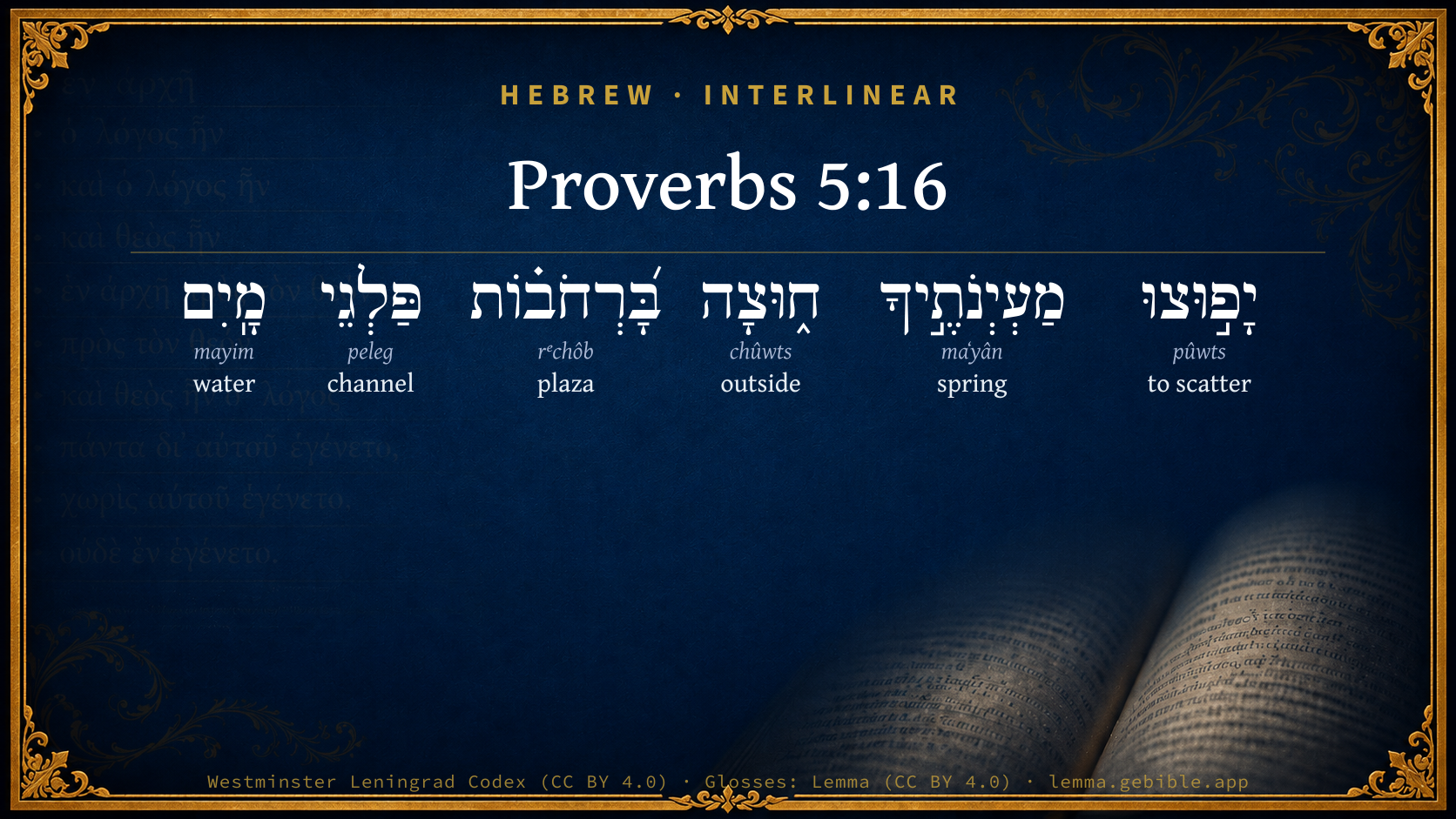
Proverbs 5:16

Hebrew (Westminster Leningrad Codex) Proverbs 5:16 appears in the Hebrew Old Testament. The text above is from the Westminster Leningrad Codex. Each word links to its Strong’s number, a concise gloss, and parsing drawn from the Open Scriptures Hebrew Bible morphology. Click any word for its full Brown-Driver-Briggs (BDB) entry.
Download image
Cite this verse

Proverbs 5:16 (World English Bible). Public Domain. Lemma interlinear Bible study tool, https://lemma.gebible.app/v/proverbs/5/16.

Show BibTeX & RIS
BibTeX
RIS
English Translation
Should your springs overflow in the streets, Streams of water in the public squares?
World English Bible · Public Domain
Download a study sheet

One document with this verse’s original text, its word-by-word gloss line, the meaning frame, cross-references with their text, attributed commentary, and full source and license credits — printable, and it pastes into notes with its structure intact.

This verse Autodidact and up

Study sheet (.html) Plain text (.txt)

A passage Seminary Student

Up to 50 verses in one chapter. A passage sheet keeps up to 6 commentary sources and 12 cross-references per verse, in the order this page ranks them, and says so on the sheet whenever that leaves anything out. Ask for a single verse and you get the Autodidact verse sheet above.

Everything on this page stays free to read, with no account — the sheet is a download of what is already on screen, not access to it.

Want to remove ads? Support Godless Engineer
Compare translations 3

The same verse in 3 English versions, stacked beneath the original-language interlinear above. Click any original word for its lexicon entry.

Each is an independent rendering of the whole verse — the interlinear is not word-aligned to these translations.

Highlighted words mark where these versions differ — a whole-verse word diff, not a word-by-word alignment.

  • World English Bible Public Domain
    Should your springs overflow in the streets, Streams of water in the public squares?
  • King James Version Public Domain
    Let thy fountains be dispersed abroad, and rivers of waters in the streets.
  • unfoldingWord Literal Text CC BY-SA 4.0
    Should your springs overflow outside, channels of water in the open areas?

unfoldingWord Literal Text — © unfoldingWord, licensed CC BY-SA 4.0. Word-aligned USFM3 via Door43 (git.door43.org/unfoldingWord/en_ult).

Versions to compare (up to 4)

3 of 4 selected

Show all 18 translations

Every available English version of this verse, each an independent rendering of the whole verse.

  • World English Bible Public Domain
    Should your springs overflow in the streets, Streams of water in the public squares?
  • Berean Standard Bible Public Domain
    Why should your springs flow in the streets, your streams of water in the public squares?
  • Majority Standard Bible Public Domain
    Why should your springs flow in the streets, your streams of water in the public squares?
  • King James Version Public Domain
    Let thy fountains be dispersed abroad, and rivers of waters in the streets.
  • American Standard Version (1901) Public Domain
    Should thy springs be dispersed abroad, And streams of water in the streets?
  • Revised Version (1885) Public Domain
    Should thy springs be dispersed abroad, and rivers of water in the streets?
  • Geneva Bible (1599) Public Domain
    Let thy fountaines flow foorth, and the riuers of waters in the streetes.
  • Douay-Rheims (1899) Public Domain
    Let thy fountains be conveyed abroad, and in the streets divide thy waters.
  • Young's Literal Translation Public Domain
    Let thy fountains be scattered abroad, In broad places rivulets of waters.
  • Literal Standard Version CC BY-SA 4.0
    Let your fountains be scattered abroad, || In broad places streams of waters.
  • Unlocked Literal Bible CC BY-SA 4.0
    Should your springs overflow everywhere and your streams of water flow in the public squares?
  • unfoldingWord Literal Text CC BY-SA 4.0
    Should your springs overflow outside, channels of water in the open areas?
  • Darby Bible Public Domain
    Thy fountains shall be poured forth, as water-brooks in the broadways.
  • World Messianic Bible Public Domain
    Should your springs overflow in the streets, streams of water in the public squares?
  • Webster's Bible Public Domain
    Let thy fountains be dispersed abroad, and rivers of waters in the streets.
  • Free Bible Version CC BY-SA 4.0
    Why should your springs be spilled outside, your streams of water poured out in the streets?
  • Bible in Basic English Public Domain
    Let not your springs be flowing in the streets, or your streams of water in the open places.
  • JPS Tanakh (1917) Public Domain
    Let thy springs be dispersed abroad, and courses of water in the streets.

Literal Standard Version (2020), Covenant Press — licensed CC BY-SA 4.0. Text via the HelloAO Bible API (eBible.org). Unlocked Literal Bible (unfoldingWord) — licensed CC BY-SA 4.0. Text via the HelloAO Bible API (eBible.org). unfoldingWord Literal Text — © unfoldingWord, licensed CC BY-SA 4.0. Word-aligned USFM3 via Door43 (git.door43.org/unfoldingWord/en_ult). Free Bible Version, Dr. Jonathan Gallagher — licensed CC BY-SA 4.0. Text via the HelloAO Bible API (eBible.org).

Word by word

More ways to search: Search by grammar → Find every occurrence → Compare this word →

Practice this passage: Drill this verse → Learn its vocabulary →

About this verse

These counts appear in no published source. They are computed here, from the morphology-tagged text and Lemma’s own curated glosses. What Lemma adds →

6
words
6
distinct lemmas
Wisdom
section

Notable vocabulary

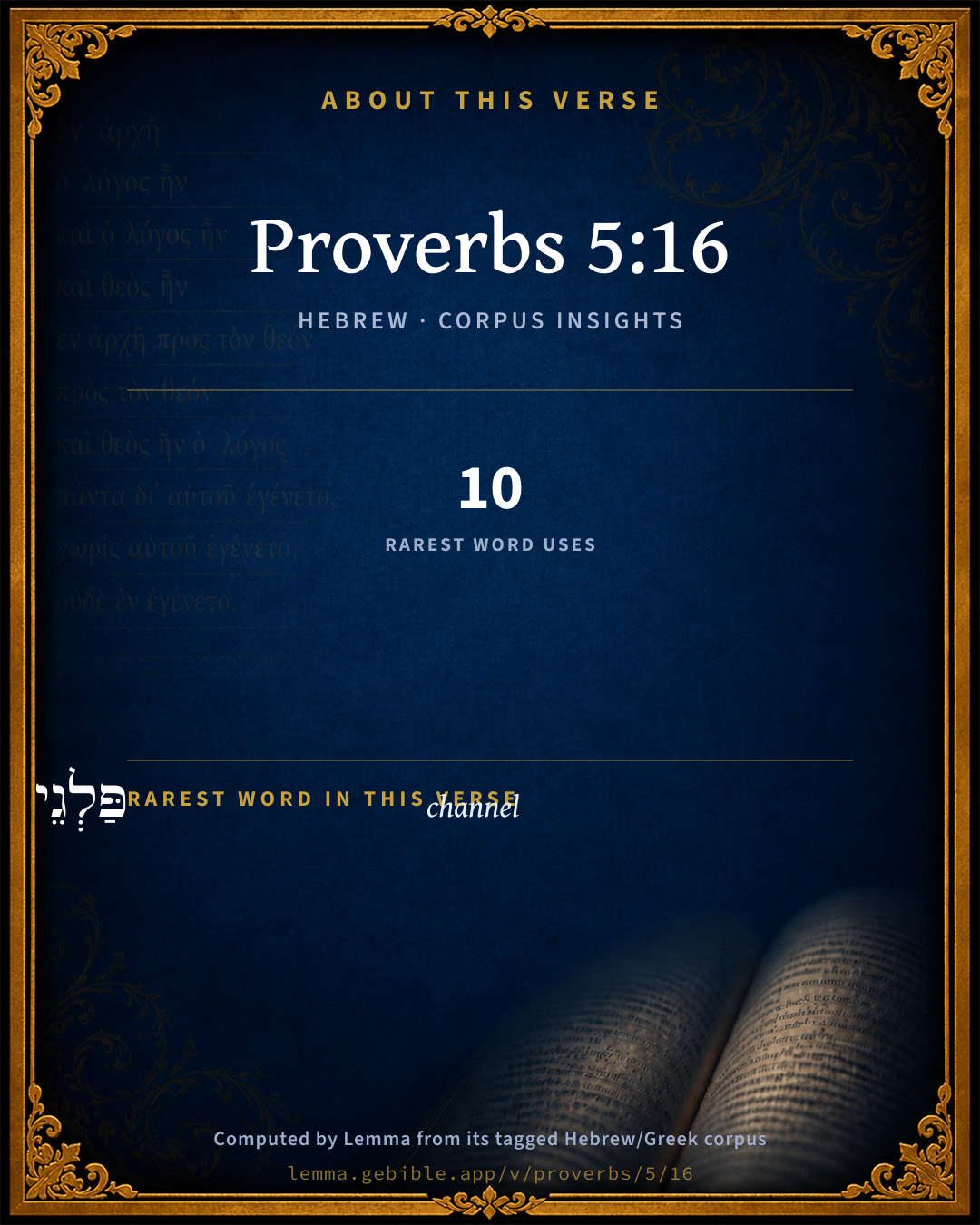
The rarest word here is פַּלְגֵי channel H6388 — appearing just 10 times in the whole Hebrew Bible.

Shared distinctive vocabulary

פַּלְגֵי channel H6388 occurs in 10 verses of the Hebrew Bible. Also found in:

Grammatical profile

  • 1 verb
  • 5 nouns

Verb forms

  • יָפ֣וּצוּ Qal · Imperfect

Hebrew & Septuagint length

In English translation the verse runs 14 words from the Hebrew and 19 from the Septuagint (LXX English) — closely comparable.

A rough comparison of the two English renderings, which tokenize alike — not a word-level alignment.

Word counts can differ between the Hebrew and the Greek without any difference in meaning — e.g. the Hebrew direct-object marker אֵת has no separate Greek word, and Greek often adds the article ὁ.

Cross-references

7

Topical passages linked to Proverbs 5:16 in the Treasury of Scripture Knowledge — connected by theme and wording, ordered by reader-vote popularity; previews shown in the World English Bible.

  • Psalms 128:3 Your wife will be as a fruitful vine, In the innermost parts of your house; Your children like olive plants, Around your table.
  • Psalms 127:3 Behold, children are a heritage of Yahweh. The fruit of the womb is his reward.
  • Genesis 24:60 They blessed Rebekah, and said to her, "Our sister, may you be the mother of thousands of ten thousands, and let your seed possess the gate of those who hate them."
  • Deuteronomy 33:28 Israel dwells in safety, The fountain of Jacob alone, In a land of grain and new wine; Yes, his heavens drop down dew.
  • Judges 12:9 He had thirty sons; and thirty daughters he sent abroad, and thirty daughters he brought in from abroad for his sons. He judged Israel seven years.
  • Psalms 68:26 "Bless God in the congregations, Even the Lord in the assembly of Israel!"
  • Isaiah 48:21 They didn't thirst when he led them through the deserts; he caused the waters to flow out of the rock for them; he split the rock also, and the waters gushed out.

Cross-references courtesy of OpenBible.info (CC BY 4.0).

Hebrew and Greek witnesses Masoretic Hebrew ↔ Greek Septuagint

The same verse in the two great witnesses to the Old Testament, shown verse-for-verse.

These are two independent witnesses, not word-aligned to each other, and the Septuagint is shown in lemma (dictionary) form.

Hebrew Proverbs 5:16 Masoretic · Westminster Leningrad Codex

יָפ֣וּצוּ מַעְיְנֹתֶ֣יךָ ח֑וּצָה בָּ֝רְחֹב֗וֹת פַּלְגֵי מָֽיִם

Should your springs overflow in the streets, Streams of water in the public squares?

World English Bible · Public Domain

Greek LXX Proverbs 5:16 Septuagint · lemma form

μή ὑπερ ἐκχέω σύ ὁ ὕδωρ ἐκ ὁ σός πηγή εἰς δέ σός πλατύς διαπορεύομαι ὁ σός ὕδωρ

Let not waters out of your fountain be spilled by you, but let your waters go into your streets.

LXX2012 (modern English Septuagint) · Public Domain

On this verse, Haydock's Catholic Bible Commentary discusses the Septuagint’s reading. Read the note in Commentary ↓

Hebrew: Westminster Leningrad Codex (CC BY 4.0). Greek: Septuagint (public domain); English from LXX2012 (modern English Septuagint) (Public Domain). How the Septuagint differs from the Hebrew →

Commentary

Notes on Proverbs 5:16 from classic Christian and Jewish commentators (each source and its license shown beneath its notes). The classic Christian expositions comment on the surrounding passage and are grouped to its opening verse, so a note may address several verses; the Jewish commentaries on the Tanakh (Rashi and others) are per-verse, so they appear only where the commentator wrote on this verse.

Lemma curates 59 commentaries, every one of them public domain or Creative Commons licensed, each selected and text-cleaned for this edition rather than reprinted as found. About our sources →

Trapp's Complete Commentary

John Trapp

Pro 5:16 Let thy fountains be dispersed abroad, [and] rivers of waters in the streets.

Ver. 16. Let thy fountains be dispersed.] "Thy fountains," that is, thy children. Let thine end in marrying be, that thou mayest have a numerous offspring, that may be as an infantry to the kingdom of heaven. Lawful marriage is usually blessed with many children; and the contrary. {Hos 4:10} Erasmus tells of one Combe, a young woman in Euboea, that being married to one whom she liked, became mother and grandmother to a hundred children. {a} The same author tells of an Englishman, a cripple, that married a blind woman, lived very lovingly with her, and had by her twelve lusty boys, that had no defect or deformity. {b}

{a} Erasm. in Chiliad.

{b} Erasm. De Instit. Matrim.

John Trapp, A Commentary or Exposition upon All the Books of the Old and New Testament (1647–1656) — public domain. Text from a community e-Sword module.

The Biblical Illustrator

Joseph S. Exell

Pro_5:16

Let thy fountains be dispersed abroad.

The children of marriage

Streams of children. Unlawful intercourse is often barren.

I. Children of lawful marriage are like rivers.

1. In plenty. Gods blessing goes with marriage.

2. In purity. Pure fountains bring forth pure streams.

3. In spreading abroad.

4. In profitableness.

II. Children are a great part of the comforts of marriage.

1. Because they are a part of both their parents.

2. Because they are a firm bond of love, peace, and reconciliation to both their parents.

III. Parents need not be ashamed of their children.

1. Because they come into the world Gods way, and that brings no shame with it.

2. Because there is hope that they will be good.

3. Being well-bred, they may come to preferment in the State.

4. They are likely to have honourable posterity. (Francis Taylor, B. D.)

The Biblical Illustrator, edited by Joseph S. Exell (c. 1880s–1900s) — public domain. Text from a community e-Sword module.

Joseph Benson's Commentary

Pro 5:16-17. Let thy fountains — Rather, thy streams, as Dr. Waterland renders the word, that is, thy children, proceeding from thy wife, called thy fountain, Pro 5:18, and from thyself; be dispersed abroad — They shall be multiplied, and in due time appear abroad in the world, to thy comfort and honour, and for the good of others; whereas harlots are commonly barren, and men are ashamed to own the children of whoredom. Let them be only thine own — “Children that acknowledge no other father, because they spring from one whom thou enjoyest (like a fountain in thy own ground) thyself alone: she being taught, by thy confining thyself to her, never to admit any stranger to thy bed.” — Bishop Patrick.

Joseph Benson's Commentary on the Old and New Testaments (1811–1818) — public domain. Text from a community e-Sword module.

Adam Clarke's Commentary

Verse 16. Let thy fountains be dispersed abroad] Let thy children lawfully begotten be numerous.

Adam Clarke's Commentary on the Bible (1810–1826) — public domain. Text from a community e-Sword/MySword module.

The Cambridge Bible for Schools and Colleges

gen. ed. J. J. S. Perowne

16. Let thy fountains] This rendering (retained in R.V. marg.) gives a good sense: purity of married life (Pro_5:15) will diffuse itself abroad like streams from a fountain, in a numerous family, and in wholesome influences: but only by such purity can these advantages be secured (Pro_5:17).

The rendering of R.V. text, Should thy springs &c. with a note of interrogation at the end of the verse, makes however the connection of thought in Pro_5:15-17 more clear, and is a return to the warning of the earlier verses of the chapter.

The Cambridge Bible for Schools and Colleges (gen. ed. J. J. S. Perowne; Cambridge University Press, 1878–1918) — public domain. Text from a community e-Sword module.

John Gill's Exposition

Let thy fountains be dispersed abroad,.... Or "shall abound", as the Targum; that is, streams of water from fountains; which Aben Ezra interprets of a multitude of children, namely, that are lawfully begotten: the "fountains" are the man and his wife in lawful marriage; the streams are their offspring lawfully procreated by them; which may be said to be "dispersed abroad", when being grown up they are disposed of in marriage in other families, and so become fountains to others, and public blessings;

and rivers of waters in the streets; meaning a numerous posterity as before; and such as a man is not ashamed publicly to own, whereas he is ashamed of such as are unlawfully begotten; but these are to his honour in the streets, and for public good; and particularly to those to whom they are given in marriage; see Isa 48:1. Jarchi interprets this of multiplying disciples, and of teaching them the law publicly, and of getting a name thereby; but it might be interpreted much better of spreading the doctrines of the Gospel, and of the public ministry and profession of that, for the good of others.

John Gill's Exposition of the Whole Bible (1746–1763) — public domain (CC PDM 1.0). Text via the HelloAO Bible API.

Albert Barnes' Notes on the Bible

Wedded love streams forth in blessing on all around, on children and on neighbors and ill the streets, precisely because the wife’s true love is given to the husband only.

Albert Barnes' Notes on the Bible (1834–1885) — public domain. Text from a community e-Sword/MySword module.

Haydock's Catholic Bible Commentary

Waters. Mayst thou have a numerous offspring, (ver. 10.) and be liberal. Many copies of the Septuagint, &c., have a negation, with Aquila, "let not thy," &c., (Calmet) though it my be read with and interrogation, "are the waters of thy fountain to be?" &c. (De Dieu) --- By not means. Origen (in Numbers xii.) acknowledges both readings. (Calmet) --- Good instructions must be given to those who are well disposed, but not to scoffers, or obstinate infidels. (Worthington) --- Husbands are exhorted to be content with their own wives, (ver. 15, 20.) so that the negative particle seems to be here wanting, as it is, chap. vi. 17., in Manuscript 60, (Kennicott) and chap. xiv. 33. (Septuagint, &c.) (Capellus)

George Leo Haydock (1774–1849), Haydock's Catholic Family Bible and Commentary, 1859 edition — public domain. Excludes Psalms (Douay-Rheims chapter numbering differs from Protestant) and Deuterocanonical books (Catholic canon only).

Matthew Poole's English Annotations

Thy fountains; thy children proceeding from thy wife, called thy fountain, Pro 5:18, and from thyself, as the Israelites are said to come from the fountain of Israel, Deu 33:28; Psa 68:26. Compare Isa 51:1. And fountains are here put for rivers flowing from them, as it is explained in the next clause, and as it is Psa 104:10, by a metonymy of the cause for the effect. And this title may be the more fitly given to children, because as they are rivers in respect of their parents, so when they grow up, they also become fountains to their children.

Be dispersed abroad; they shall be multiplied, and in due time appear abroad in the world to thy comfort and honour, and for the good of others; whereas whores are commonly barren, and men are ashamed to own the children of whoredom.

Matthew Poole's English Annotations on the Holy Bible (1683–1685) — public domain. Text from a community e-Sword/MySword module.

The Pulpit Commentary

Let thy fountains be dispersed abroad, and rivers of waters in the streets. The figurative language is still continued, and under the terms "fountains" and "rivers of waters," are to be understood children, the legitimate issue of lawful marriage. So Aben Ezra and the majority of modern commentators, Schultens, Doderlein, Holden, Muenscher, Noyes, Wardlaw, etc. The meaning appears to be, "Let thy marriage be blessed with many children, who may go forth abroad for the public good." Other interpretations have been adopted. Thus:

(1) Delitzsch takes the words fountans and "rivers of waters" as used figuratively for the procreative power, and renders, "Shall thy streams flow abroad, and water brooks in the streets?" and interprets, "Let generative power act freely and unrestrainedly within the marriage relation.

(2) Schultens and Dathe, followed by Holden, regard the verse as expressing a conclusion on the preceding, "Then shall thy springs be dispersed abroad, even rivers of waters in the streets." The objection to this is that it necessitates the insertion of the copulative vau (w) before the verb, yaphutzu, "be dispersed.

(3) Zockler and Hitzig read the verse interrogatively, "Shall thy streams flow abroad as water brooks in the streets?" on the analogy of Pro_6:30 and Psa_56:7.

(4) The reading of the LXX, adopted by Origen, Clemens Alexandrinus, places a negative before the verb, Mh uperekceisyw , i.e. "Let not thy waters flow beyond thy fountain;" i.e. "confine thyself to thy wife." Fountains. The Hebrew ma"yanim, plural of mayan, derived from ayin ("a fountain") with the formative men, is rather a stream or rill water flowing on the surface of the ground. It is used, however, of a fountain itself in Gen_7:11 Gen_8:2. Rivers of waters (Hebrew, pal"gey-mayim); rather, water courses, or water brooks. (cf. Job_38:25) The peleg represents the various streams into which the mayan, "fountain," divides itself at its source or in its course. We find the same expression, pal"gey-mayim, used of tears in Psa_119:136 Lam_3:48. It occurs again in our book in Pro_21:1, "The king"s heart is in the hand of the Lord as the rivers of waters (pal"gey mayim)." On "abroad" (Hebrew, khutz), and "in the streets" (r"khovoth), see Pro_1:20.

The Pulpit Commentary (1880–1919), ed. H.D.M. Spence-Jones & Joseph S. Exell — public domain. Text from a community e-Sword module.

John Wesley's Explanatory Notes

Fountains - Thy children proceeding from thy wife and from thyself. Fountains are here put for rivers flowing from them. Dispersed - They shall in due time appear abroad to thy comfort, and for the good of others.

John Wesley, Explanatory Notes Upon the Whole Bible (1754–1765) — public domain. Text via the GEBible commentary corpus.

Rashi

Rabbi Shlomo Yitzchaki (Rashi)

May your springs spread out In the end you will acquire disciples, and you will promulgate decisions in public, and you will gain a reputation.

in the squares of the city the rivulets of your water shall spread.

Rashi on the Tanakh — English translations: “The Judaica Press complete Tanach with Rashi, translated by A. J. Rosenberg” (CC BY 4.0); “Pentateuch with Rashi's commentary by M. Rosenbaum and A.M. Silbermann, 1929-1934” (public domain); “The Metsudah Tanach series, Lakewood, N.J” (CC BY 4.0); and “The Book of Joshua, Metsudah Publications, 1997” (CC BY 4.0). Text via Sefaria.

Lesson kit

Teaching starters — assembled from the data on this page, not authored interpretation. Every prompt links to the verse data it draws on. Edit before teaching.

Proverbs, in the Wisdom, opens this verse with 6 words (6 distinct Hebrew lemmas). Its most distinctive word is peleg (“channel”). A historical commentator’s framing appears above. Read the whole chapter for the surrounding context.

Discussion questions

  1. How does “channel” (peleg) shape what this verse is saying?
  2. How does Job 29:6, which shares the word «channel», read alongside this verse?
  3. These translations render this verse differently; the difference is in the English rendering, not the original. What questions does that raise?
  4. «יָפ֣וּצוּ» is a Qal Imperfect verb. How does that grammatical form shape the action described?
  5. Compare how Trapp's Complete Commentary and The Biblical Illustrator read this verse. Where do they agree or differ?

Things to notice

Reading settings

Reading text

Shown beneath each verse's original-language words.

Old Testament
Old Testament edition

Read the OT as the Masoretic Hebrew (MT) or the Greek Septuagint (LXX).

English shown for the Greek Septuagint (in the Hebrew ↔ Greek comparison).

Comparing translations? Open the Compare panel on any verse page to stack up to four side by side.