
Proverbs 22:13

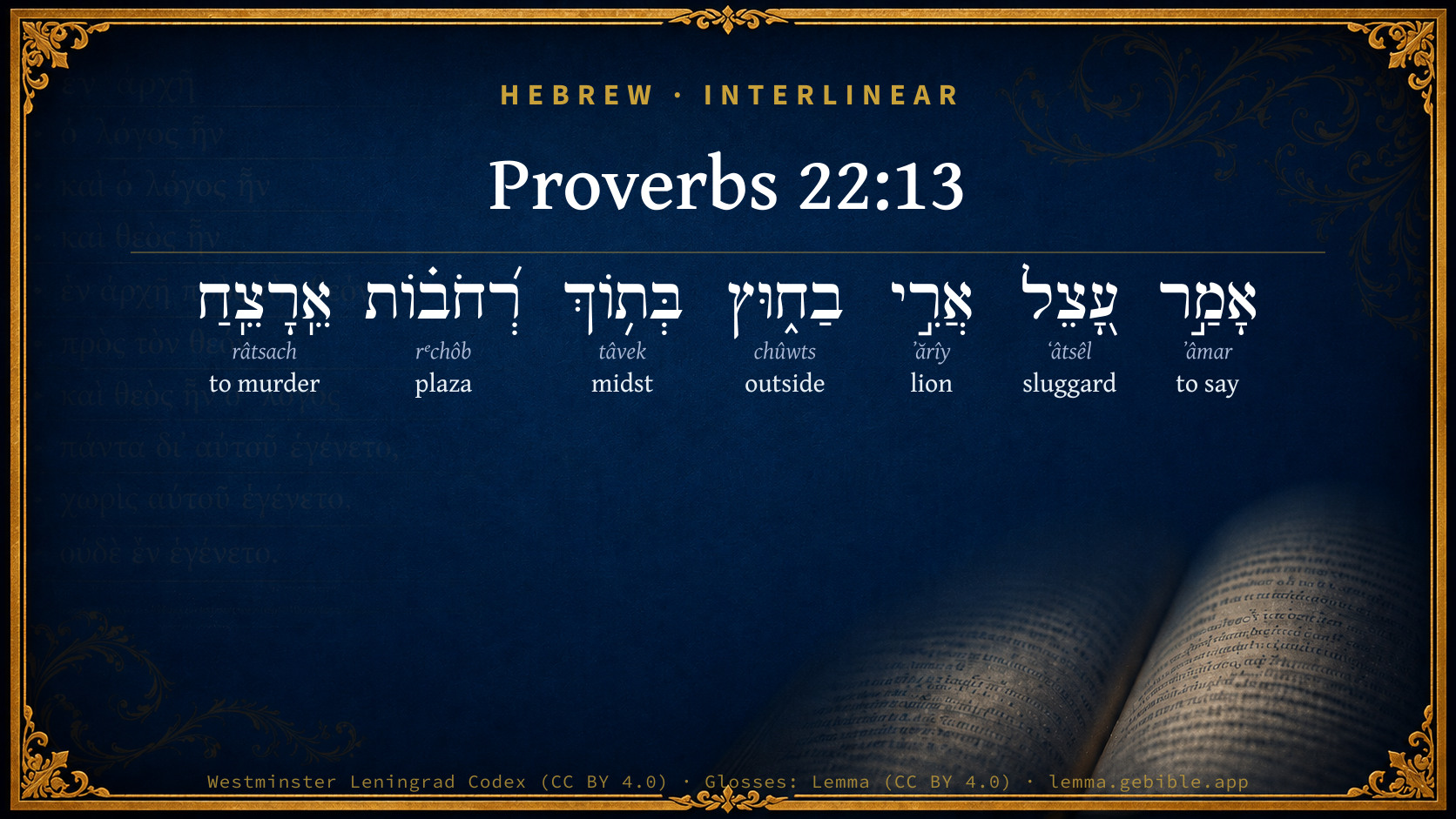
Hebrew (Westminster Leningrad Codex) Proverbs 22:13 appears in the Hebrew Old Testament. The text above is from the Westminster Leningrad Codex. Each word links to its Strong’s number, a concise gloss, and parsing drawn from the Open Scriptures Hebrew Bible morphology. Click any word for its full Brown-Driver-Briggs (BDB) entry.
Download image
Cite this verse

Proverbs 22:13 (World English Bible). Public Domain. Lemma interlinear Bible study tool, https://lemma.gebible.app/v/proverbs/22/13.

Show BibTeX & RIS
BibTeX
RIS
English Translation
The sluggard says, "There is a lion outside! I will be killed in the streets!"
World English Bible · Public Domain
Download a study sheet

One document with this verse’s original text, its word-by-word gloss line, the meaning frame, cross-references with their text, attributed commentary, and full source and license credits — printable, and it pastes into notes with its structure intact.

This verse Autodidact and up

Study sheet (.html) Plain text (.txt)

A passage Seminary Student

Up to 50 verses in one chapter. A passage sheet keeps up to 6 commentary sources and 12 cross-references per verse, in the order this page ranks them, and says so on the sheet whenever that leaves anything out. Ask for a single verse and you get the Autodidact verse sheet above.

Everything on this page stays free to read, with no account — the sheet is a download of what is already on screen, not access to it.

Want to remove ads? Support Godless Engineer
Compare translations 3

The same verse in 3 English versions, stacked beneath the original-language interlinear above. Click any original word for its lexicon entry.

Each is an independent rendering of the whole verse — the interlinear is not word-aligned to these translations.

Highlighted words mark where these versions differ — a whole-verse word diff, not a word-by-word alignment.

  • World English Bible Public Domain
    The sluggard says, "There is a lion outside! I will be killed in the streets!"
  • King James Version Public Domain
    The slothful man saith, There is a lion without, I shall be slain in the streets.
  • unfoldingWord Literal Text CC BY-SA 4.0
    A lazy one says, “A lion outside! I will be killed in the midst of the open areas!”

unfoldingWord Literal Text — © unfoldingWord, licensed CC BY-SA 4.0. Word-aligned USFM3 via Door43 (git.door43.org/unfoldingWord/en_ult).

Versions to compare (up to 4)

3 of 4 selected

Show all 18 translations

Every available English version of this verse, each an independent rendering of the whole verse.

  • World English Bible Public Domain
    The sluggard says, "There is a lion outside! I will be killed in the streets!"
  • Berean Standard Bible Public Domain
    The slacker says, “There is a lion outside! I will be slain in the streets!”
  • Majority Standard Bible Public Domain
    The slacker says, “There is a lion outside! I will be slain in the streets!”
  • King James Version Public Domain
    The slothful man saith, There is a lion without, I shall be slain in the streets.
  • American Standard Version (1901) Public Domain
    The sluggard saith, There is a lion without: I shall be slain in the streets.
  • Revised Version (1885) Public Domain
    The sluggard saith, There is a lion without: I shall be murdered in the streets.
  • Geneva Bible (1599) Public Domain
    The slouthfull man saith, A lyon is without, I shall be slaine in the streete.
  • Douay-Rheims (1899) Public Domain
    The slothful man saith: There is a lion without, I shall be slain in the midst of the streets.
  • Young's Literal Translation Public Domain
    The slothful hath said, `A lion `is' without, In the midst of the broad places I am slain.'
  • Literal Standard Version CC BY-SA 4.0
    The slothful has said, “A lion [is] outside, || I am slain in the midst of the broad places.”
  • Unlocked Literal Bible CC BY-SA 4.0
    The lazy person says, “There is a lion in the street! I will be killed in the open places.”
  • unfoldingWord Literal Text CC BY-SA 4.0
    A lazy one says, “A lion outside! I will be killed in the midst of the open areas!”
  • Darby Bible Public Domain
    The sluggard saith, There is a lion without, I shall be killed in the streets!
  • World Messianic Bible Public Domain
    The sluggard says, “There is a lion outside! I will be killed in the streets!”
  • Webster's Bible Public Domain
    The slothful man saith, There is a lion without, I shall be slain in the streets.
  • Free Bible Version CC BY-SA 4.0
    Lazy people make claims like, “There's a lion outside! I might be killed if I go out there!”
  • Bible in Basic English Public Domain
    The hater of work says, There is a lion outside: I will be put to death in the streets.
  • JPS Tanakh (1917) Public Domain
    The sluggard saith: 'There is a lion without; I shall be slain in the streets.'

Literal Standard Version (2020), Covenant Press — licensed CC BY-SA 4.0. Text via the HelloAO Bible API (eBible.org). Unlocked Literal Bible (unfoldingWord) — licensed CC BY-SA 4.0. Text via the HelloAO Bible API (eBible.org). unfoldingWord Literal Text — © unfoldingWord, licensed CC BY-SA 4.0. Word-aligned USFM3 via Door43 (git.door43.org/unfoldingWord/en_ult). Free Bible Version, Dr. Jonathan Gallagher — licensed CC BY-SA 4.0. Text via the HelloAO Bible API (eBible.org).

Word by word

More ways to search: Search by grammar → Find every occurrence → Compare this word →

Practice this passage: Drill this verse → Learn its vocabulary →

About this verse

These counts appear in no published source. They are computed here, from the morphology-tagged text and Lemma’s own curated glosses. What Lemma adds →

7
words
7
distinct lemmas
Wisdom
section

Notable vocabulary

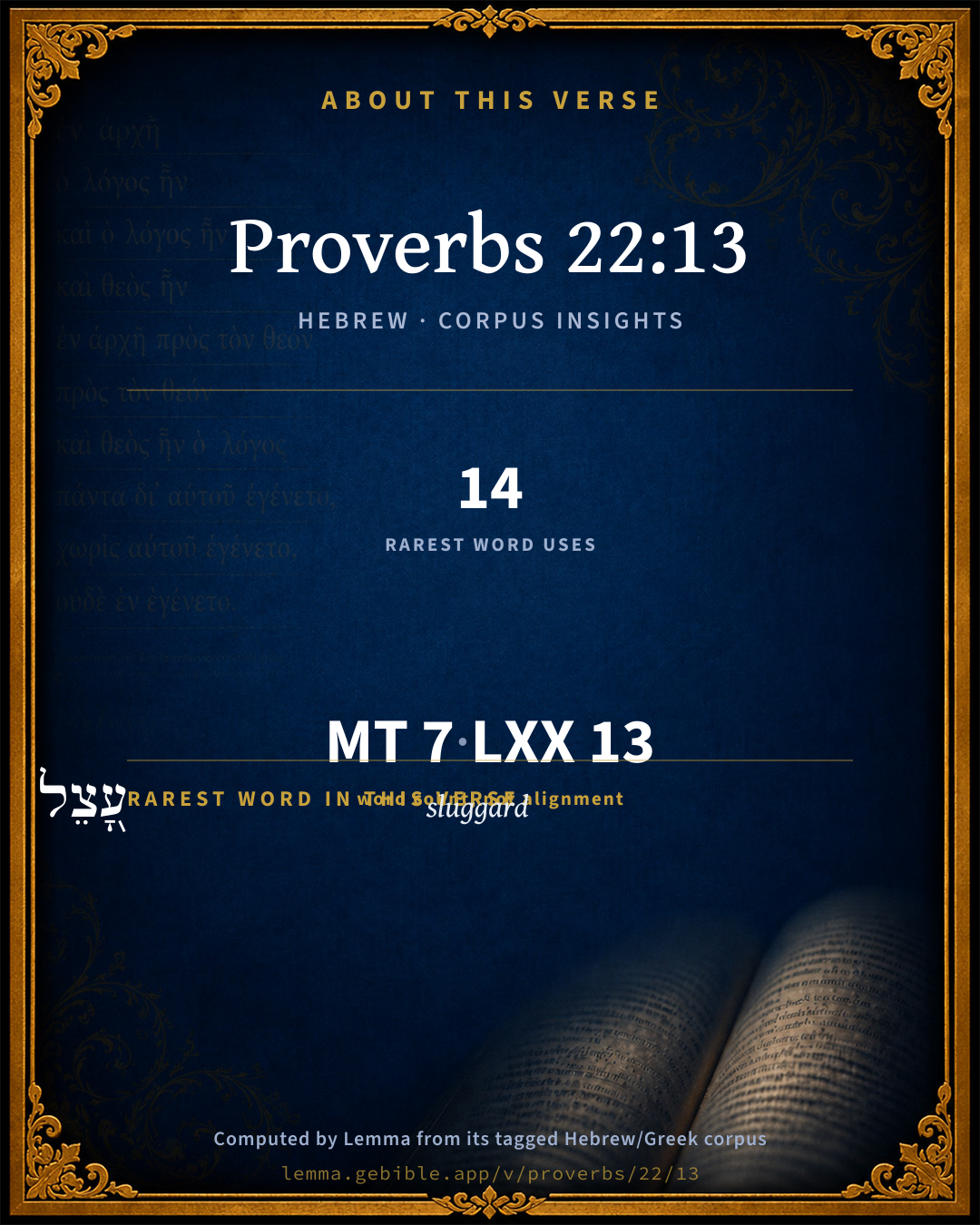
The rarest word here is עָ֭צֵל sluggard H6102 — appearing just 14 times in the whole Hebrew Bible.

Shared distinctive vocabulary

עָ֭צֵל sluggard H6102 occurs in 14 verses of the Hebrew Bible. Also found in:

Grammatical profile

  • 2 verbs
  • 4 nouns
  • 1 adjective

Verb forms

  • אָמַ֣ר Qal · Perfect
  • אֵֽרָצֵֽחַ Niphal · Imperfect

Hebrew & Septuagint length

In English translation the verse runs 15 words from the Hebrew and 18 from the Septuagint (LXX English) — closely comparable.

A rough comparison of the two English renderings, which tokenize alike — not a word-level alignment.

Word counts can differ between the Hebrew and the Greek without any difference in meaning — e.g. the Hebrew direct-object marker אֵת has no separate Greek word, and Greek often adds the article ὁ.

In the original languages it is 7 Hebrew tokens and 13 Greek tokens — but the two are counted differently (Hebrew bundles its prefixes and suffixes into one token; the Greek is in lemma form), so that isn’t a like-for-like length.

Cross-references

3

Topical passages linked to Proverbs 22:13 in the Treasury of Scripture Knowledge — connected by theme and wording, ordered by reader-vote popularity; previews shown in the World English Bible.

  • Proverbs 26:13–16 The sluggard says, "There is a lion in the road! A fierce lion roams the streets!"
  • Numbers 13:32–33 They brought up an evil report of the land which they had spied out to the children of Israel, saying, The land, through which we have gone to spy it out, is a land that eats up the inhabitants of it; and all the people who we saw in it are men of great stature.
  • Proverbs 15:19 The way of the sluggard is like a thorn patch, But the path of the upright is a highway.

Cross-references courtesy of OpenBible.info (CC BY 4.0).

Hebrew and Greek witnesses Masoretic Hebrew ↔ Greek Septuagint

The same verse in the two great witnesses to the Old Testament, shown verse-for-verse.

These are two independent witnesses, not word-aligned to each other, and the Septuagint is shown in lemma (dictionary) form.

Hebrew Proverbs 22:13 Masoretic · Westminster Leningrad Codex

אָמַ֣ר עָ֭צֵל אֲרִ֣י בַח֑וּץ בְּת֥וֹךְ רְ֝חֹב֗וֹת אֵֽרָצֵֽחַ

The sluggard says, "There is a lion outside! I will be killed in the streets!"

World English Bible · Public Domain

Greek LXX Proverbs 22:13 Septuagint · lemma form

προφασίζω καί λέγω ὀκνηρός λέων ἐν ὁ ὁδός ἐν δέ ὁ πλατύς φονευτής

The sluggard makes excuses, and says, There is a lion in the ways, and murderers in the streets.

LXX2012 (modern English Septuagint) · Public Domain

On this verse, The Pulpit Commentary discusses the Septuagint’s reading. Read the note in Commentary ↓

Hebrew: Westminster Leningrad Codex (CC BY 4.0). Greek: Septuagint (public domain); English from LXX2012 (modern English Septuagint) (Public Domain). How the Septuagint differs from the Hebrew →

Commentary

Notes on Proverbs 22:13 from classic Christian and Jewish commentators (each source and its license shown beneath its notes). The classic Christian expositions comment on the surrounding passage and are grouped to its opening verse, so a note may address several verses; the Jewish commentaries on the Tanakh (Rashi and others) are per-verse, so they appear only where the commentator wrote on this verse.

Lemma curates 59 commentaries, every one of them public domain or Creative Commons licensed, each selected and text-cleaned for this edition rather than reprinted as found. About our sources →

Trapp's Complete Commentary

John Trapp

Pro 22:13 The slothful [man] saith, [There is] a lion without, I shall be slain in the streets.

Ver. 13. The slothful man saith, There is a lion, &c.] ‘The lion is not so fierce as is painted,’ saith the Spanish proverb; much less this sluggard’s lion, a mere fiction of his own brain to cover and colour over his idleness. He pretends two lions for failing; first, Leo est foris, There is a lion abroad, or in the field, where his work lies, {Psa 104:23} and another in the streets; - a likely matter; lions haunt not in streets, but in woods and wildernesses. Here is no talk of Satan, "that roaring lion," that lies couchant in the sluggard’s bed with him, and prompts him to these senseless excuses. Nor yet of the "lion of the tribe of Judah," who will one day send out summons for sleepers, and tearing the very caul of their hearts in sunder, send them packing to their place in hell. {Mat 10:28} But to hell never came any yet that had not some pretence for their coming thither. The flesh never wants excuses. Corrupt nature needs not be taught to tell her own tale. Sin and shifting came into the world together; and as there is no wool so coarse but will take some colour: so no sin so gross but admits of a defence. Sin and Satan are alike in this, they cannot abide to appear in their own likeness. Some deal with their souls as others deal with their bodies; when their beauty is decayed, they desire to hide it from themselves by false glasses, and from others by painting; so their sins from themselves by false glosses, and from others by idle excuses.

John Trapp, A Commentary or Exposition upon All the Books of the Old and New Testament (1647–1656) — public domain. Text from a community e-Sword module.

The Biblical Illustrator

Joseph S. Exell

Pro_22:13

The slothful man saith, There is a lion without.

One lion; two lions; no lion at all

This slothful man seems to cherish that one dread of his about the lions as if it were his favourite aversion and he felt it to be too much trouble to invent another excuse. Perhaps he hugs it to his soul all the more because it is home-born fear, conjured up by his own imagination. At any rate, it serves him as a passable excuse for laziness, and that is what he wants. When a man is slothful as a servant he is unjust to his employers; and when he is in business on his own account, idleness is usually a wrong to his wife and family. When a man is thoroughly eaten up with the dry-rot of laziness he generally finds some kind of excuse, though his crime is really inexcusable. We have many spiritual sluggards, and it is to them that I speak. They are not sceptics, or confirmed infidels, or opposers of the gospel: perhaps their sluggish nature saves them from anything like energetic opposition to goodness.

1. The sluggards tongue is not slothful. The man who is lazy all over is generally busy with his tongue. There are no people that have so much to say as those that have little to do.

2. His imagination also is not idle. There were no lions in the streets. Laziness is a great lion-maker. He who does little dreams much. His imagination could create a whole menagerie of wild beasts.

3. He takes great pains to escape from pains. This slothful man had to use his inventive ability to get himself excused from doing his duty. It is an old proverb that lazy people generally take the most trouble, and so they do and when men are unwilling to come to Christ, it is very wonderful what trouble they will take to keep away from Him.

I. A lion. The man means that there is a great difficulty--a terrible difficulty, quite too much of a difficulty for him to overcome. He has not the strength to attack this dreadful enemy; the terrible difficulty which he foresees is more than he can face. The real lion after all is sluggishness itself, aversion to the things of God.

II. Two lions. In the second text there are two lions instead of one (chap. 26:13). He has waited because of that one lion, and now he fancies that there are two. He has made a bad bargain of his delay. It was inconvenient then because there was a lion. Is it more convenient now? Procrastination never profits; difficulties are doubled, dangers thicken.

III. No lion at all. If there be a man who would have Christ, there is no lion in the way to prevent his having Christ. There are a thousand difficulties, says one. If thou desirest Christ truly, there is no effectual difficulty that can really block thee from coming to Him. There are no lions except in your own imagination. (C. H. Spurgeon.)

The characteristics of laziness

To Solomon laziness was one of the greatest evils in the character of man. How frequently does he depict it with graphic force! How often does he denounce it with firm energy! Idleness, says Colton, is the grand pacific ocean of life, and in that stagnant abyss, the most salutary things produce no good, the most obnoxious no evil. Vice, indeed, abstractedly considered, may be, and often is, engendered in idleness; but the moment it becomes sufficiently vice, it must quit its cradle, and cease to be idle. Two of the evils connected with indolence are suggested in the text.

I. It creates false excuses. There is a lion without. The lion in the streets is a fiction of his own lazy brain. The slothful man is ever acting thus--

1. In the secular sphere. Is he a farmer? He neglects the cultivation of his fields, because the weather is too cold or too hot, too cloudy, too dry or too wet. Is he a tradesman? He finds imaginary excuses in the condition of the market. Commodities are too high or too low. Is he an artizan? He finds difficulties in the place, the tools, or the materials. The industrious farmer finds no difficulties in the weather.

2. In the spiritual sphere. When the unregenerate man is urged to the renunciation of his own principles and habits, and the adoption of new spirit and methods, slothfulness urges him to make imaginary excuses. Sometimes he pleads the decrees of God, sometimes the greatness of his sins, sometimes the inconvenience of the season--too soon or too late.

II. It creates unmanly excuses, The very excuse he pleads, though imaginary, if true would be a strong reason for immediate action. A lion in the streets! Why, if he had a spark of manhood in him, a bit of the stuff that makes heroes, he should rouse every power. There is no heroism in the heart of indolence. To true souls difficulties are a challenge, not a check to action. (D. Thomas, D.D.)

The Biblical Illustrator, edited by Joseph S. Exell (c. 1880s–1900s) — public domain. Text from a community e-Sword module.

Joseph Benson's Commentary

Pro 22:13. The slothful man saith — Alleges as his excuse to them who upbraid him with idleness, or persuade him to diligence; There is a lion without — There are extreme dangers and invincible difficulties in my way; I shall be slain — By that lion, or some other way; in the streets — This is added to show the ridiculousness of his excuse; for lions abide in the woods, or fields, not in the streets of towns or cities.

Joseph Benson's Commentary on the Old and New Testaments (1811–1818) — public domain. Text from a community e-Sword module.

The Preacher's Complete Homiletical Commentary

Joseph S. Exell (gen. ed.)

MAIN HOMILETICS OF Pro_22:13

AN ACTIVE IMAGINATION

I. Inactivity of will may cause a too great activity of the imagination. Man is made for action, and if he refuses to employ his powers in doing some useful and real work, it is probable that he will put forth some morbid effort in another direction. If his limbs are not at work, his mind will probably be active, and if he does not occupy it with objects which are worthy, it will be filled with thoughts that are sinful, and imaginations that are false. It will be especially apt to invent excuses for sloth, by magnifying the difficulties which stand in the way of effort. Every obstacle will be magnified into an insurmountable hindrance, and little risks will be looked at through a medium which will make them look like dangers to be avoided at any sacrifice of duty. The wish is often father to the thought, and the slothful man welcomes and nurses the deception which is born of his own indolence. And the sluggard is an easy prey also to the suggestions of the tempter, who will not be slow to do what he can to inflame the imagination and distort the judgment.

II. The sluggard rightly apprehends danger, but mistakes the source whence it will come. There is a devouring enemy which will slay him if he do not take care, but it is not without him, but within him. He has a foe who endangers his life, but that foe is his own sloth; or, as we saw on chap. Pro_21:25, his own unsatisfied desire. While his eyes are turned on the highway, and he is seeking to avoid the lion which he fancies is there, he is nursing in his bosom the indolence which will be his ruin. He has more to fear from himself than from the most terrible manslayer that ever crossed the path of any human being. But it is with him as with slaves to other forms of sin—he is ready to lay the blame of his disobedience to God’s commands anywhere, rather than upon his own unwillingness to comply with them.

OUTLINES AND SUGGESTIVE COMMENTS

“Saith,” really a preterite. These proverbs have usually the future. The future is a present continuing forward. Here we have a present tracing itself backward. The impenitent have always been saying the same thing. Age has not changed. Men have stuck to it for near a century.… “There is a lion” at the mercy-seat. So that the minister quits answering the sluggard’s cavils, and tells each man plainly—“These cries are symptomatic.” There is no lion in the case. And a heart that will shape these phantoms would shape others, if these were laid. The difficulty is sloth. In truth, there is a “lion,” but it is a bad heart, crouching against itself, and lurking to destroy the poor unwary sinner.—Miller.

This is a very odd excuse for his laziness. Lions are seldom found in the fields in the day time, and it is a very extraordinary thing if they be found in the streets. Does the sluggard himself believe there is any truth in it? If he does, why does he sleep in his house, since it is possible that it may be set on fire by some accident in the night? Why does he ever take a meal, for some have been choked by the bread which they put into their mouths? When we are employed in the duties of our calling, we need not vex ourselves with the apprehension of lions. “I will give mine angels charge over thee,” says God, “and they shall keep thee in all thy ways.” Thou shalt tread upon the lion and adder, the young lion and the dragon shalt thou trample under thy feet. But let the sluggard remember that there is a lion in that bed where he dozes away his time, and in that chamber where he sits folding his arms together. The devil goes about like a roaring lion seeking whom he may devour, and he rejoices greatly when he lights upon a sluggard, for he looks upon him to be a sure prey. We are safe from the lions in the way of duty, and never safe when we avoid it. Lions, when they met David feeding his sheep, were torn in pieces by him like kids. A lion unexpectedly came upon that young man of the sons of prophets, who declined his duty when he was commanded to smite his neighbour, and rent him in pieces.—Lawson.

Here is no talk of Satan, “that roaring lion” that lies couchant in the sluggard’s bed with him, and prompts him to these senseless excuses. Nor yet of the “Lion of the tribe of Judah,” who will one day send out summonses for sleepers, and tearing the very caul of their hearts asunder send them packing to their place in hell. But to hell never came any as yet that had not some pretence for their coming hither. The flesh never wants excuses, and needs not to be taught to tell her own tale. Sin and shifting came into the world together; and as there is no wool so coarse but will take some colour, so no sin so gross but admits of a defence. Sin and Satan are alike in this, they cannot abide to appear in their own likeness.—Trapp.

The tongue is seldom slothful, even in the slothful man himself. That will bestir itself to find excuses, and to plead pretences for the defence of sloth. That will be diligent to allege reasons that the sluggard may be negligent.… If the lion had been within, if the courage and nobleness of the lion had been in the sluggard’s heart, he would never have talked of a lion without. No, it was the cold snail that was within; and unless the slothful man’s house may be removed with him, he will not stir to go out of it. Thus he that feareth to be slain, without cause, delighteth to be slain by his own laziness.—Jermin.

The Preacher's Complete Homiletical Commentary (gen. ed. Joseph S. Exell; Funk & Wagnalls, c. 1892) — public domain (pre-1929). A full-Bible homiletical/sermon-outline anthology covering 65 of 66 books (2 John is absent from the source module). Text from a community e-Sword module.

Tyndale Open Study Notes

Tyndale Open Resources

22:13 Of the many proverbs on laziness (10:4-6, 26; 12:11; 13:4; 14:4; 15:19; 18:9; 19:15, 24; 20:4, 13; 21:25; 26:13), this is among the funniest. Lazy people will come up with any outlandish excuse for not working.

Tyndale Open Study Notes — © Tyndale Open Resources, licensed CC BY-SA 4.0. Text via the HelloAO Bible API.

Geneva Bible (1599)

Geneva Bible translators

He derideth them that invent vain excuses, because they would not do their duty.

Geneva Bible (1599) marginal notes — public domain. Text via Bolls.life.

Matthew Henry's Commentary

Note, 1. Those that have no love for their business will never want excuses to shake it off. Multitudes are ruined, both for soul and body, by their slothfulness, and yet still they have something or other to say for themselves, so ingenious are men in putting a cheat upon their own souls. And who, I pray, will be the gainer at last, when the pretences will be all rejected as vain and frivolous? 2. Many frighten themselves from real duties by imaginary difficulties: The slothful man has work to do without in the fields, but he fancies there is a lion there; nay, he pretends he dares not go along the streets for fear somebody or other should meet him and kill him. He does not himself think so; he only says so to those that call him up. He talks of a lion without, but considers not his real danger from the devil, that roaring lion, which is in bed with him, and from his own slothfulness, which kills him.

Matthew Henry's Commentary on the Whole Bible (1708–1710) — public domain (CC PDM 1.0). Text via the HelloAO Bible API.

Jamieson, Fausset & Brown

Robert Jamieson, A. R. Fausset & David Brown

Frivolous excuses satisfy the indolent man's conscience.

Jamieson, Fausset & Brown — Commentary Critical and Explanatory on the Whole Bible (1871) — public domain (CC PDM 1.0). Text via the HelloAO Bible API.

Adam Clarke's Commentary

Verse 13. The slothful man saith, There is a lion without] But why does he say so? Because he is a slothful man. Remove his slothfulness, and these imaginary difficulties and dangers will be no more. He will not go abroad to work in the fields, because he thinks there is a lion in the way; he will not go out into the town for employment, as he fears to be assassinated in the streets! From both these circumstances he seeks total cessation from activity.

Adam Clarke's Commentary on the Bible (1810–1826) — public domain. Text from a community e-Sword/MySword module.

Ellicott's Commentary for English Readers

(13) The slothful man saith, There is a lion without . . .—No excuses are too absurd for him, he fears to meet a lion in the open country, or, he might be murdered in the streets.

A Bible Commentary for English Readers, edited by Charles John Ellicott (1878–1897) — public domain. Text from a community e-Sword module.

The Cambridge Bible for Schools and Colleges

gen. ed. J. J. S. Perowne

13. slain] or, more in accordance with the usual meaning of the Heb. word, murdered, R.V. The sluggard then offers two absurd excuses for not going forth to his business. ‘Without,’ he says, beyond the city walls, in the open country, ‘there is a lion,’ ready to tear me in pieces (comp. Jer_5:6); even into ‘the streets’ I dare not venture, lest there some ruffian should ‘murder’ me.”

When, however, the proverb recurs (Pro_26:13), it is the lion that is the professed object of dread within the city:

The sluggard saith, There is a lion in the way,

A lion is in the streets.

The Cambridge Bible for Schools and Colleges (gen. ed. J. J. S. Perowne; Cambridge University Press, 1878–1918) — public domain. Text from a community e-Sword module.

John Gill's Exposition

The slothful man saith, there is a lion without,.... Or, "in the street". This he says within himself; or to those who call out to him, and put him on doing the business of his proper calling, whether in the field or elsewhere, which, through his slothfulness, he has a disinclination to; and therefore frames excuses, and suggests this and that difficulty or danger in the way, expressed by a "lion without"; and which shows the folly and weakness of his excuses, since lions do not usually walk in cities, towns, and villages, and in the streets of them, but in woods and mountains;

I shall be slain in the streets; by the lion there; or I shall never be able to get over the difficulties, and through the dangers, which attending to business will expose me to. Some apply this to the difficulties that slothful persons imagine in the learning of languages, arts, and sciences; as Jarchi applies it to the learning of the law.

John Gill's Exposition of the Whole Bible (1746–1763) — public domain (CC PDM 1.0). Text via the HelloAO Bible API.

Albert Barnes' Notes on the Bible

The point of the satire is the ingenuity with which the slothful man devises the most improbable alarms. He hears that “there is a lion without,” i. e., in the broad open country; he is afraid of being slain in the very streets of the city.

Albert Barnes' Notes on the Bible (1834–1885) — public domain. Text from a community e-Sword/MySword module.

Haydock's Catholic Bible Commentary

Streets. Vain excuses of sloth!

George Leo Haydock (1774–1849), Haydock's Catholic Family Bible and Commentary, 1859 edition — public domain. Excludes Psalms (Douay-Rheims chapter numbering differs from Protestant) and Deuterocanonical books (Catholic canon only).

Matthew Poole's English Annotations

Saith, allegeth as his excuse to them who upbraid him with idleness, or persuade him to diligence,

There is a lion without; there are extreme dangers and invincible difficulties in my way.

I shall be slain, by that lion, or some other way.

In the streets; which is added to show the ridiculousness of his excuse; for lions abide in the woods or fields, not in the streets of towns or cities.

Matthew Poole's English Annotations on the Holy Bible (1683–1685) — public domain. Text from a community e-Sword/MySword module.

Whedon's Commentary on the Bible

Daniel D. Whedon

13. There is a lion without — The plain meaning of this is, that an indolent man will make all manner of excuses for not doing his duty; will raise difficulties out of his own fancy when there are none, and render himself ridiculous by his absurd apprehensions.

Daniel D. Whedon (gen. ed.), Commentary on the Old and New Testaments (1874–1909) — public domain. Text from a community e-Sword module.

The Pulpit Commentary

The slothful man saith, There is a lion without. (Pro_26:13) The absurd nature of the sluggard"s excuse is hardly understood by the casual reader. The supposed lion is without, in the open country, and yet he professes to be in danger in the midst of the town. I shall be slain in the streets. Others consider that the sluggard makes two excuses for his inactivity. If work calls him abroad, he may meet the lion which report says is prowling in the neighbourhood; if he has to go into the streets, he may be attacked and murdered by ruffians for motives of plunder or revenge. "Sluggards are prophets," says the Hebrew proverb. Septuagint, "The sluggard maketh excuses, and saith, A lion is in the ways, there are murderers in the streets." Lions, though now extinct in Palestine, seem to have lingered till the time of the Crusades, and such of them as became man eaters, the old or feeble, were a real danger in the vicinity of villages. (comp. Jer_49:19 Jer_50:44)

Vers. 13-16. Hindrances to the attainment of a good name.

I SLOTH. (Ver. 13) It is full of ridiculous excuses here satirized. While a noble energy refuses to own the word "impossible," it is ever on the lips of the indolent. As in the Arabic fable of the ostrich, or "camel bird," they said to it, "Carry!" It answered, "I cannot, for I am a bird." They said, "Fly!" It answered, "I cannot, for I am a camel." Always, "I cannot!" He who in false regard to his own soul refuses to go out into the world and do God"s work, will end by corrupting and losing his soul itself. (Joh_12:25)

II PROFLIGACY. (Ver. 14) Lust digs its own grave. Health goes, reputation follows, and presently the life, self-consumed by the deadly fire, sinks into ruin and ashes. If men saw how plainly the curse of God is written on vice, it would surely become as odious to them as to him.

III UNGOVERNED FOLLY. (Ver. 15) Nothing mere pitiable than an old fool, whose folly seems to stand in clear relief against the background of years. Hence, again, the urgent need of firm discipline for the young. And what occasion for thankfulness to him who, in his wise chastisements, will not "let us alone," but prunes and tills the soul by affliction, and plucks up our follies by the root!

IV OPPRESSIVENESS. (Ver. 16) To become rich at the expense of other"s loss is no real gain. The attempt cuts at the root of sound trade and true sociality. Hastily gotten will hardly be honestly gotten. The Spaniards say, "He who will be rich in a year, at the half-year they hang him." Mammon, which more than anything else men are tempted to think God does not concern himself about, is given and taken away by him according to his righteousness given sometimes to his enemies and for their greater punishment, that under its fatal influence they may grow worse and worse (Trench). J.

Excuses.

Few things are oftener on human lips than excuses. Men are continually excusing themselves from doing what they know in their hearts they ought to do. There is no sphere from which they are excluded, and there is hardly any evil to which they do not lead.

I THE SPHERES IS WHICH THEY ARE FOUND. The child excuses himself from the obedience which he should be rendering to his parents; the scholar, from the application he should be giving to his studies; the apprentice, from the attention he should be devoting to his business; the agriculturist, from the labour he should be putting forth in the fields; the captain, from setting sail on the troubled waters; the unsuccessful tradesman or merchant, from investigating his books and seeing how he really stands; the failing manufacturer, from closing his mill; the statesman from bringing forward his perilous measure; the minister, from seeking his delicate and difficult interview; the soul not yet reconciled to God, from a searching inquiry into its own spiritual condition and present obligation.

II THEIR MORAL CHARACTER.

1. There is a decided ingredient of falsehood about them. Those who fashion them know in their hearts that there is something, if not much, that is imaginary about them. The lion is not without; the slothful man wilt not be slain in the streets. The evil which is anticipated in all cases of excuse is exaggerated, if it is not invented. We do not, at such times, tell ourselves the whole, truth; we "deceive our own selves.

2. There is something of meanness or unmanliness about them; we "let "I dare not" wait upon "I would. We allow a craven feeling of apprehension to enter in, to take possession, to prevail over our better self.

3. There is an element of disobedience and unfaithfulness. We shrink from doing the thing which is our duty to do; we relegate to the rear that which we should keep in the front; we prefer that which is agreeable to that which is obligatory; we obey the lower voice; we leave unfulfilled the will of God.

III THE FATE OF THOSE WHO INDULGE THEM.

1. To have a very pitiable retrospect; to have to look back, self-condemned, on work left undone, on a life not well lived.

2. To lose all that might have been gained by energy and decision, and which has been lost by sloth and weakness. And who shall say what this amounts to in the years of a long life?

3. To miss the "Well done" of the Master, if not, indeed, to receive his final and sorrowful condemnation. C.

The Pulpit Commentary (1880–1919), ed. H.D.M. Spence-Jones & Joseph S. Exell — public domain. Text from a community e-Sword module.

Keil & Delitzsch

C. F. Keil & F. Delitzsch

13 The sluggard saith, "A lion is without,

I shall be slain in the midst of the streets."

Otherwise rendered, Pro 26:13. There, as here, the perf. אמר has the meaning of an abstract present, Gesen. 126. 3. The activity of the industrious has its nearest sphere at home; but here a work is supposed which requires him to go forth (Psa 104:3) into the field (Pro 24:27). Therefore חוּץ stands first, a word of wide signification, which here denotes the open country outside the city, where the sluggard fears to meet a lion, as in the streets, i.e., the rows of houses forming them, to meet a רצח (מרצּח), i.e., a murder from motives of robbery of revenge. This strong word, properly to destroy, crush, Arab. raḍkh, is intentionally chosen: there is designed to be set forth the ridiculous hyperbolical pretence which the sluggard seeks for his slothfulness (Fleischer). Luther right well: "I might be murdered on the streets." But there is intentionally the absence of אוּלי [perhaps] and of פּן [lest]. Meri here quotes a passage of the moralists: ממופתי העצל הנבואה (prophesying) belongs to the evidences of the sluggard; and Euchel, the proverb העצלים מתנבאים (the sluggard's prophecy), i.e., the sluggard acts like a prophet, that he may palliate his slothfulness.

Keil & Delitzsch — Biblical Commentary on the Old Testament (1861–1891) — public domain (CC PDM 1.0). Text via the HelloAO Bible API. (Old Testament only.)

Bridges on Proverbs

Charles Bridges

13 The slothful man saith, There is a lion without, I shall be slain in the streets. (Pro 26:13 .)

’This sentence belongs to those who flinch from the cross.’†1 Real difficulties in the way of heaven exercise faith. And such there are, far too great for those, who have never "counted the cost," or who "go to the warfare at any time at their own charges."†2 But imaginary difficulties are the indulgence of sloth. The slothful man is a coward. He has no love for his work, and therefore he is always ready to put a cheat upon his soul, ’inventing some vain excuse, because he will not do his duty.’†3 He shrinks from every work likely to involve trouble. (Pro 15:19 ; Pro 19:24 .) Fancied dangers frighten him from real and present duties. There is a lion without; I shall be slain in the streets — an absurd excuse! — as if public streets, except in special cases, were the haunts of wild beasts. (Psa 104:20-22 .) He is afraid of being slain without, when he willingly gives himself up to be slain within. (Pro 21:25 .) Thus the unbelieving spies, when holding up to view the exuberant fruit of Canaan, added — But we be not able to go up against the people. The cities are walled up to heaven; and the giants are there. (Num 13:27-33 .) As if the promise of God was not a stronger ground of faith, than the giants of fear!†4 But much more sad is it to see Moses shrinking,†5 — nay — Jonah running away, from the LORD’s work.†6 All excuses against doing it partake of this cowardly spirit. And who has not felt the temptation, when called to a plain but self-denying duty; to encounter painful opposition to the gospel, or to a faithful rebuke of sin? — There is a lion without. True. But hast thou forgotten the promise in the ways of God? "Thou shalt tread upon the lion and adder; the young lion and the dragon shalt thou trample under feet"? (Psa 91:11-13 .) Does not our Master call us to follow him in a life of self-devoted conflict and energy? Ponder the terms of discipleship. "If any man will come after me, let him deny himself, and take up his cross daily, and follow me." (Luk 9:23 .) Godly courage, "endurance of hardness," "standing in the whole armor of God"†7 — all this is needed; all this must be daily and hourly sought for, not only by those who stand in the forefront of the battle, but by the meanest soldier of the cross; else, though "armed, and carrying the bow, he will turn back" disgracefully "in the day of battle." (Psa 78:9 .)

Footnotes:

†1 Melancthon in loco.

†2 Mat 8:19-20, with Mat 11:12 . Luk 14:28-30 .

†3 Reformer’s Notes.

†4 Num 14:6-8, with Gen 12:7 .

†5 Exo 4:10-14.

†6 Jon 1:1-3.

†7 2Ti 2:3 . Eph 6:11, Eph 6:13 . ’Invictus ad labores; fortis ad periculum; durus adversus illecebras.’ Ambrose - a fine exhibition of Christian energy.

Charles Bridges, An Exposition of the Book of Proverbs (1846) — public domain. Text from a community e-Sword module.

Kretzmann's Popular Commentary

Paul E. Kretzmann

v. 13. The slothful man saith, eagerly making use of every shadow of an excuse to abstain from work, senseless though it may be, There is a lion without, I shall be slain in the streets, so he prefers not to take any chances, but continues to indulge his laziness.

Paul E. Kretzmann, Popular Commentary of the Bible (1921–1924) — public domain. Text from a community e-Sword module.

unfoldingWord translationNotes

Door43 World Missions Community

The lazy person says

The quote that follows is a lie and an excuse for not working. If your language introduces false statements in a special way, you can use that here.

The mouth of an adulteress is a deep pit

The word "mouth" is a metonym for the words that come out of the mouth. The writer speaks of a person being unable to escape having people punish him for evil deeds as if that person had fallen into a hole someone had dug in the ground from which he could not escape. AT: "The words spoken by an adulteress will draw you in, and it will be as if you have fallen into a deep and dangerous pit" (See: Metonymy and Metaphor)

an adulteress

See how you translated this in Proverbs 5:3.

Yahweh's anger is stirred up

Here "stirred up" means that his anger increased. AT: "Yahweh is angry" (See: Idiom)

falls into it

Adultery is spoken of as if it is something that a person can fall into. AT: "sins because of the adulteress" (See: Metaphor)

translationWords

lions

adultery

pit

Yahweh

anger

unfoldingWord translationNotes — © Distant Shores Media and the Door43 World Missions Community, licensed CC BY-SA 4.0. Source: git.door43.org/Door43/en_tn.

Rashi

Rabbi Shlomo Yitzchaki (Rashi)

The lazy man says, “There is a lion outside...” How will I go out to learn Torah?

Rashi on the Tanakh — English translations: “The Judaica Press complete Tanach with Rashi, translated by A. J. Rosenberg” (CC BY 4.0); “Pentateuch with Rashi's commentary by M. Rosenbaum and A.M. Silbermann, 1929-1934” (public domain); “The Metsudah Tanach series, Lakewood, N.J” (CC BY 4.0); and “The Book of Joshua, Metsudah Publications, 1997” (CC BY 4.0). Text via Sefaria.

Lesson kit

Teaching starters — assembled from the data on this page, not authored interpretation. Every prompt links to the verse data it draws on. Edit before teaching.

Proverbs, in the Wisdom, opens this verse with 7 words (7 distinct Hebrew lemmas). Its most distinctive word is ʻâtsêl (“sluggard”). A historical commentator’s framing appears above. Read the whole chapter for the surrounding context.

Discussion questions

  1. How does “sluggard” (ʻâtsêl) shape what this verse is saying?
  2. How does Proverbs 6:6, which shares the word «sluggard», read alongside this verse?
  3. These translations render this verse differently. What is at stake in choosing one wording over another?
  4. «אָמַ֣ר» is a Qal Perfect verb. How does that grammatical form shape the action described?
  5. Compare how Trapp's Complete Commentary and The Biblical Illustrator read this verse. Where do they agree or differ?

Things to notice

Reading settings

Reading text

Shown beneath each verse's original-language words.

Old Testament
Old Testament edition

Read the OT as the Masoretic Hebrew (MT) or the Greek Septuagint (LXX).

English shown for the Greek Septuagint (in the Hebrew ↔ Greek comparison).

Comparing translations? Open the Compare panel on any verse page to stack up to four side by side.