
Ezekiel 40:5

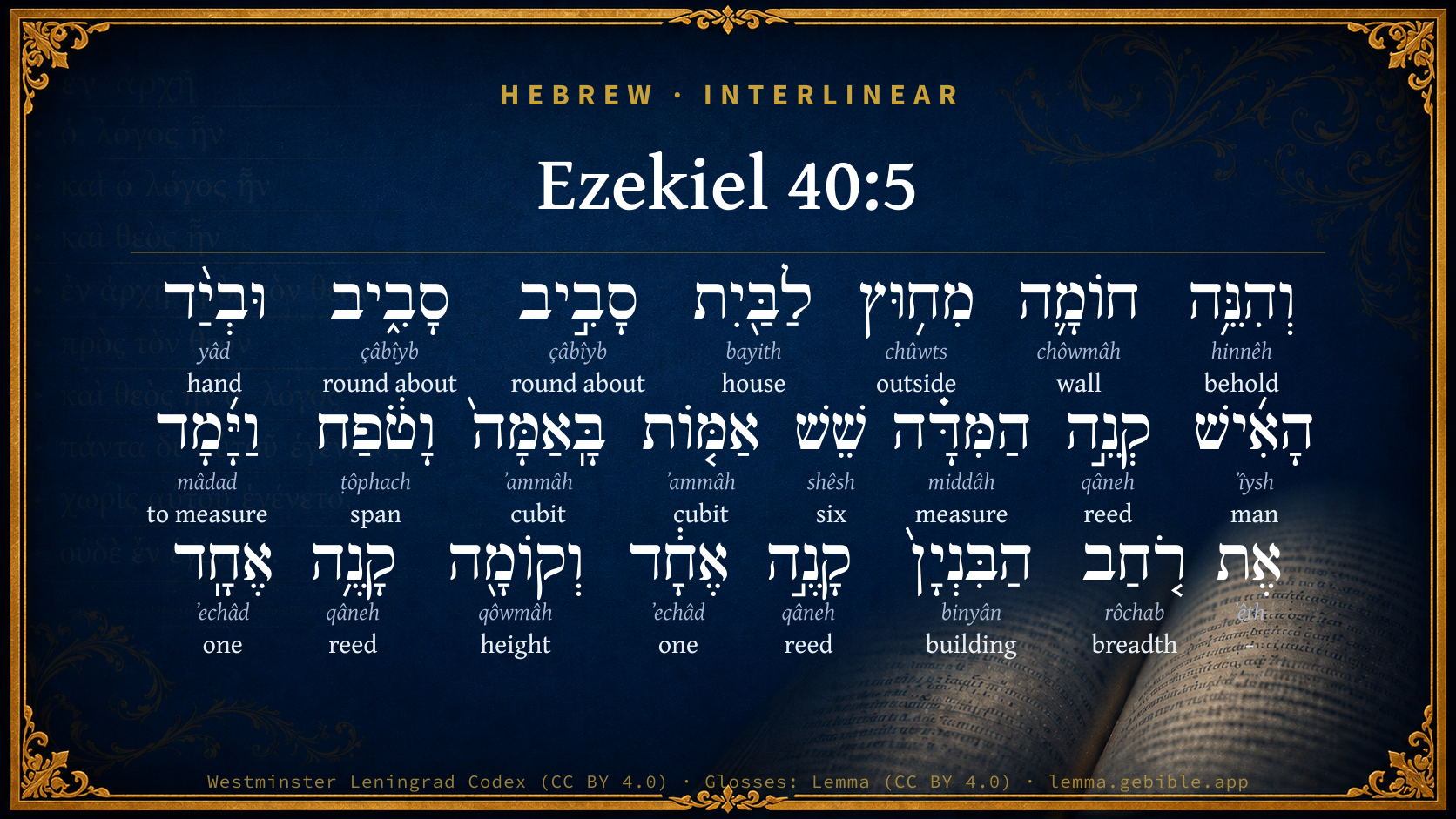
Hebrew (Westminster Leningrad Codex) Ezekiel 40:5 appears in the Hebrew Old Testament. The text above is from the Westminster Leningrad Codex. Each word links to its Strong’s number, a concise gloss, and parsing drawn from the Open Scriptures Hebrew Bible morphology. Click any word for its full Brown-Driver-Briggs (BDB) entry.
Download image
Cite this verse

Ezekiel 40:5 (World English Bible). Public Domain. Lemma interlinear Bible study tool, https://lemma.gebible.app/v/ezekiel/40/5.

Show BibTeX & RIS
BibTeX
RIS
English Translation
Behold, a wall on the outside of the house round about, and in the man's hand a measuring reed six cubits long, of a cubit and a handbreadth each: so he measured the thickness of the building, one reed; and the height, one reed.
World English Bible · Public Domain
Highlights
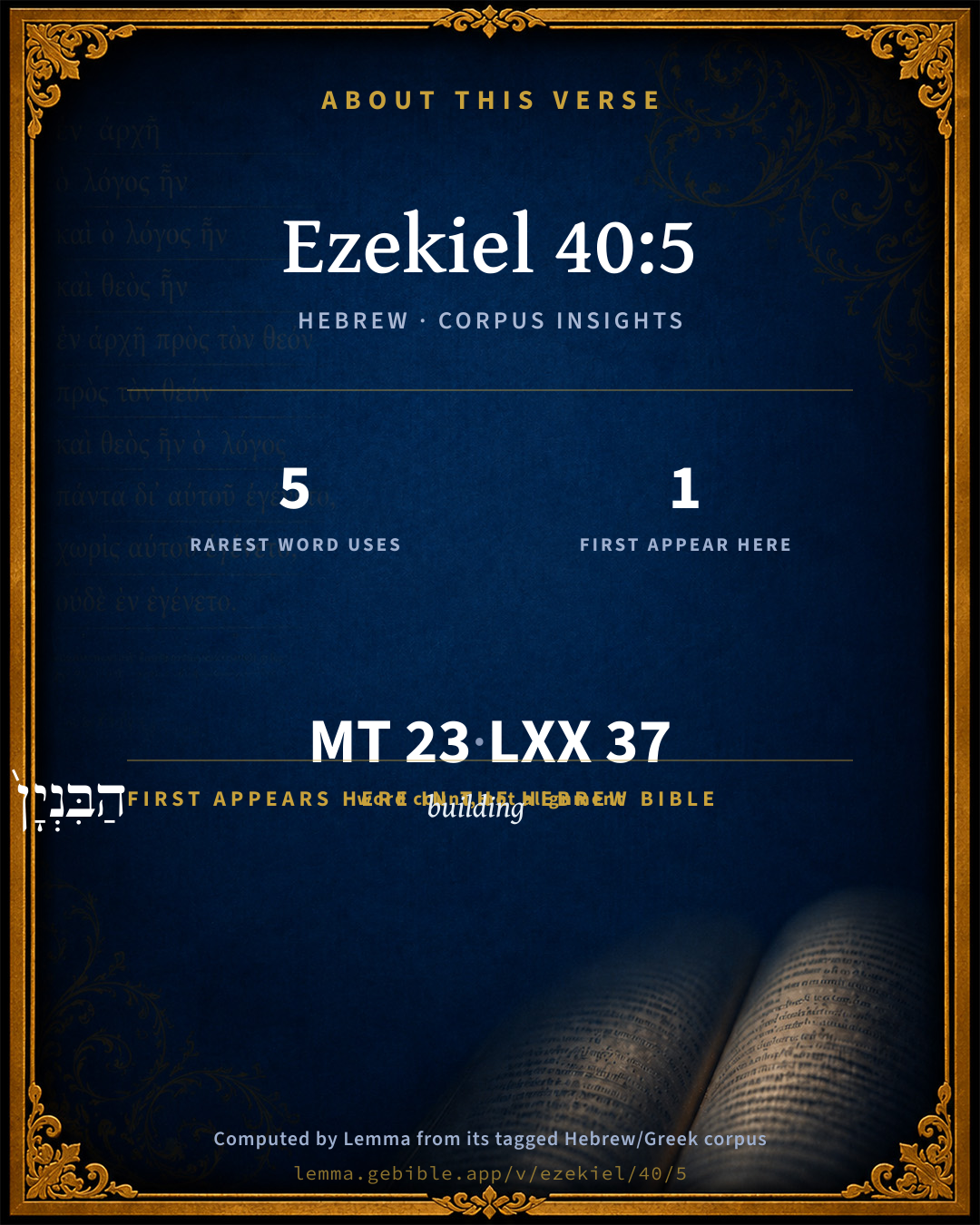
  • 1 first appearance in the Hebrew Bible
Full analysis ↓
Download a study sheet

One document with this verse’s original text, its word-by-word gloss line, the meaning frame, cross-references with their text, attributed commentary, and full source and license credits — printable, and it pastes into notes with its structure intact.

This verse Autodidact and up

Study sheet (.html) Plain text (.txt)

A passage Seminary Student

Up to 50 verses in one chapter. A passage sheet keeps up to 6 commentary sources and 12 cross-references per verse, in the order this page ranks them, and says so on the sheet whenever that leaves anything out. Ask for a single verse and you get the Autodidact verse sheet above.

Everything on this page stays free to read, with no account — the sheet is a download of what is already on screen, not access to it.

Want to remove ads? Support Godless Engineer
Compare translations 3

The same verse in 3 English versions, stacked beneath the original-language interlinear above. Click any original word for its lexicon entry.

Each is an independent rendering of the whole verse — the interlinear is not word-aligned to these translations.

Highlighted words mark where these versions differ — a whole-verse word diff, not a word-by-word alignment.

  • World English Bible Public Domain
    Behold, a wall on the outside of the house round about, and in the man's hand a measuring reed six cubits long, of a cubit and a handbreadth each: so he measured the thickness of the building, one reed; and the height, one reed.
  • King James Version Public Domain
    And behold a wall on the outside of the house round about, and in the man's hand a measuring reed of six cubits long by the cubit and an hand breadth: so he measured the breadth of the building, one reed; and the height, one reed.
  • unfoldingWord Literal Text CC BY-SA 4.0
    There was a wall surrounding the temple area. The length of the measuring stick in the man’s hand was six long cubits. Each long cubit was a cubit and a handbreadth in length. So he measured the wall, and it was one measuring stick thick and one rod high.

unfoldingWord Literal Text — © unfoldingWord, licensed CC BY-SA 4.0. Word-aligned USFM3 via Door43 (git.door43.org/unfoldingWord/en_ult).

Versions to compare (up to 4)

3 of 4 selected

Show all 18 translations

Every available English version of this verse, each an independent rendering of the whole verse.

  • World English Bible Public Domain
    Behold, a wall on the outside of the house round about, and in the man's hand a measuring reed six cubits long, of a cubit and a handbreadth each: so he measured the thickness of the building, one reed; and the height, one reed.
  • Berean Standard Bible Public Domain
    And I saw a wall surrounding the temple area. Now the length of the measuring rod in the man’s hand was six long cubits (each measuring a cubit and a handbreadth), and he measured the wall to be one rod thick and one rod high.
  • Majority Standard Bible Public Domain
    And I saw a wall surrounding the temple area. Now the length of the measuring rod in the man’s hand was six long cubits (each measuring a cubit and a handbreadth), and he measured the wall to be one rod thick and one rod high.
  • King James Version Public Domain
    And behold a wall on the outside of the house round about, and in the man's hand a measuring reed of six cubits long by the cubit and an hand breadth: so he measured the breadth of the building, one reed; and the height, one reed.
  • American Standard Version (1901) Public Domain
    And, behold, a wall on the outside of the house round about, and in the man's hand a measuring reed six cubits long, of a cubit and a handbreadth each: so he measured the thickness of the building, one reed; and the height, one reed.
  • Revised Version (1885) Public Domain
    And behold, a wall on the outside of the house round about, and in the man’s hand a measuring reed of six cubits long, of a cubit and an handbreadth each: so he measured the thickness of the building, one reed; and the height, one reed.
  • Geneva Bible (1599) Public Domain
    And beholde, I sawe a wall on the outside of the house round about: and in the mans hand was a reede to measure with, of sixe cubites long, by the cubite, and an hand breadth: so he measured the breadth of the buylding with one reede, and the height with one reede.
  • Douay-Rheims (1899) Public Domain
    And behold there was a wall on the outside of the house round about, and in the man's hand a measuring reed of six cubits and a handbreadth: and he measured the breadth of the building one reed, and the height one reed.
  • Young's Literal Translation Public Domain
    And lo, a wall on the outside of the house all round about, and in the hand of the man a measuring-reed, six cubits by a cubit and a handbreadth, and he measureth the breadth of the building one reed, and the height one reed.
  • Literal Standard Version CC BY-SA 4.0
    And behold, a wall all around on the outside of the house, and a measuring-reed in the hand of the man, six cubits by a cubit and a handbreadth, and he measures the breadth of the building—one reed, and the height—one reed.
  • Unlocked Literal Bible CC BY-SA 4.0
    There was a wall surrounding the temple area. The length of the measuring stick in the man's hand was six long cubits. Each long cubit was a cubit and a handbreadth in length. So he measured the wall, and it was one measuring stick thick and one rod high.
  • unfoldingWord Literal Text CC BY-SA 4.0
    There was a wall surrounding the temple area. The length of the measuring stick in the man’s hand was six long cubits. Each long cubit was a cubit and a handbreadth in length. So he measured the wall, and it was one measuring stick thick and one rod high.
  • Darby Bible Public Domain
    And behold, there was a wall on the outside of the house round about, and in the man's hand a measuring-reed of six cubits, [each] of one cubit and a hand breadth. And he measured the breadth of the building, one reed; and the height, one reed.
  • World Messianic Bible Public Domain
    Behold, there was a wall on the outside of the house all around, and in the man’s hand a measuring reed six cubits long, of a cubit and a hand width each. So he measured the thickness of the building, one reed; and the height, one reed.
  • Webster's Bible Public Domain
    And behold a wall on the outside of the house around, and in the man's hand a measuring reed of six cubits long by the cubit and a hand-breadth: so he measured the breadth of the building, one reed: and the hight, one reed.
  • Free Bible Version CC BY-SA 4.0
    I could see a wall that surrounded the Temple. The measuring rod the man was holding was six long cubits in length (a long cubit is a cubit plus a handbreadth). He measured the wall as six cubits thick and six cubits high.
  • Bible in Basic English Public Domain
    And there was a wall on the outside of the house all round, and in the man's hand there was a measuring rod six cubits long by a cubit and a hand's measure: so he took the measure of the building from side to side, one rod; and from base to top, one rod.
  • JPS Tanakh (1917) Public Domain
    And behold a wall on the outside of the house round about, and in the man's hand a measuring reed of six cubits long, of a cubit and a hand-breadth each; so he measured the breadth of the building, one reed, and the height, one reed.

Literal Standard Version (2020), Covenant Press — licensed CC BY-SA 4.0. Text via the HelloAO Bible API (eBible.org). Unlocked Literal Bible (unfoldingWord) — licensed CC BY-SA 4.0. Text via the HelloAO Bible API (eBible.org). unfoldingWord Literal Text — © unfoldingWord, licensed CC BY-SA 4.0. Word-aligned USFM3 via Door43 (git.door43.org/unfoldingWord/en_ult). Free Bible Version, Dr. Jonathan Gallagher — licensed CC BY-SA 4.0. Text via the HelloAO Bible API (eBible.org).

Word by word

More ways to search: Search by grammar → Find every occurrence → Compare this word →

Practice this passage: Drill this verse → Learn its vocabulary →

וָטֹ֔פַח
ṭôphach
H2948
“and · span”
Conjunction + Noun, Common, Masculine, Singular, Absolute
Part of Speech
Conjunction + Noun
Type
Common
Gender
Masculine
Number
Singular
State
Absolute
Full BDB Definition

Origin: from H2946 (the same as H2947 )

TWOT: 818c

span, hand breadth
  1. וְהִנֵּ֥ה hinnêh H2009 “and · behold” Conjunction + Particle, Demonstrative
  2. חוֹמָ֛ה chôwmâh H2346 “wall” Noun, Common, Feminine, Singular, Absolute
  3. מִח֥וּץ chûwts H2351 “from · outside” Preposition + Noun, Common, Masculine, Singular, Absolute
  4. לַבַּ֖יִת bayith H1004 “to/for the · house” Preposition, Determined + Noun, Common, Masculine, Singular, Absolute
  5. סָבִ֣יב çâbîyb H5439 “round about” Noun, Common, Both, Singular, Absolute
  6. סָבִ֑יב çâbîyb H5439 “round about” Noun, Common, Both, Singular, Absolute
  7. וּבְיַ֨ד yâd H3027 “and · in/at · hand of” Conjunction + Preposition + Noun, Common, Both, Singular, Construct
  8. הָאִ֜ישׁ ʼîysh H376 “the · man” Particle, Definite Article + Noun, Common, Masculine, Singular, Absolute
  9. קְנֵ֣ה qâneh H7070 “reed of” Noun, Common, Masculine, Singular, Construct
  10. הַמִּדָּ֗ה middâh H4060 “the · measure” Particle, Definite Article + Noun, Common, Feminine, Singular, Absolute
  11. שֵׁשׁ shêsh H8337 “six” Adjective, Cardinal number, Feminine, Singular, Absolute
  12. אַמּ֤וֹת ʼammâh H520 “cubits” Noun, Common, Feminine, Plural, Absolute
  13. בָּֽאַמָּה֙ ʼammâh H520 “in/at the · cubit” Preposition, Determined + Noun, Common, Feminine, Singular, Absolute
  14. וַיָּ֜מָד mâdad H4058 “and · to measure” Conjunction + Verb, Qal, Sequential Imperfect, 3rd Person, Masculine, Singular
  15. אֶת ʼêth H853 “-” Particle, Direct Object
  16. רֹ֤חַב rôchab H7341 “breadth of” Noun, Common, Masculine, Singular, Construct
  17. הַבִּנְיָן֙ binyân H1146 “the · building” Particle, Definite Article + Noun, Common, Masculine, Singular, Absolute
  18. קָנֶ֣ה qâneh H7070 “reed” Noun, Common, Masculine, Singular, Absolute
  19. אֶחָ֔ד ʼechâd H259 “one” Adjective, Cardinal number, Masculine, Singular, Absolute
  20. וְקוֹמָ֖ה qôwmâh H6967 “and · height” Conjunction + Noun, Common, Feminine, Singular, Absolute
  21. קָנֶ֥ה qâneh H7070 “reed” Noun, Common, Masculine, Singular, Absolute
  22. אֶחָֽד ʼechâd H259 “one” Adjective, Cardinal number, Masculine, Singular, Absolute

About this verse

These counts appear in no published source. They are computed here, from the morphology-tagged text and Lemma’s own curated glosses. What Lemma adds →

23
words
18
distinct lemmas
Prophets
section

Notable vocabulary

The rarest word here is וָטֹ֔פַח span H2948 — appearing just 5 times in the whole Hebrew Bible.

First appearance in Scripture

This word makes its first canonical appearance in the Hebrew Bible here:

  • הַבִּנְיָן֙ building H1146

Shared distinctive vocabulary

וָטֹ֔פַח span H2948 occurs in 5 verses of the Hebrew Bible. Also found in:

Grammatical profile

  • 1 verb
  • 17 nouns
  • 3 adjectives
  • 2 particles

Verb forms

  • וַיָּ֜מָד Qal · Sequential Imperfect

Repetition

Words recur within this verse — often emphatic in Hebrew:

  • קְנֵ֣ה reed H7070 ×3
  • סָבִ֣יב round about H5439 ×2
  • אַמּ֤וֹת cubit H520 ×2
  • אֶחָ֔ד one H259 ×2

Hebrew & Septuagint length

In English translation the verse runs 44 words from the Hebrew and 52 from the Septuagint (LXX English) — closely comparable.

A rough comparison of the two English renderings, which tokenize alike — not a word-level alignment.

Word counts can differ between the Hebrew and the Greek without any difference in meaning — e.g. the Hebrew direct-object marker אֵת has no separate Greek word, and Greek often adds the article ὁ.

In the original languages it is 23 Hebrew tokens and 37 Greek tokens — but the two are counted differently (Hebrew bundles its prefixes and suffixes into one token; the Greek is in lemma form), so that isn’t a like-for-like length.

Cross-references

7

Topical passages linked to Ezekiel 40:5 in the Treasury of Scripture Knowledge — connected by theme and wording, ordered by reader-vote popularity; previews shown in the World English Bible.

  • Ezekiel 42:20 He measured it on the four sides: it had a wall round about, the length five hundred, and the breadth five hundred, to make a separation between that which was holy and that which was common.
  • Isaiah 26:1 In that day shall this song be sung in the land of Judah: we have a strong city; salvation will he appoint for walls and bulwarks.
  • Deuteronomy 3:11 (For only Og king of Bashan remained of the remnant of the Rephaim; behold, his bedstead was a bedstead of iron; isn't it in Rabbah of the children of Ammon? nine cubits was the length of it, and four cubits the breadth of it, after the cubit of a man.)
  • Psalms 125:2 As the mountains surround Jerusalem, So Yahweh surrounds his people from this time forth and forevermore.
  • Isaiah 60:18 Violence shall no more be heard in your land, desolation nor destruction within your borders; but you shall call your walls Salvation, and your gates Praise.
  • Zechariah 2:5 For I,' says Yahweh, 'will be to her a wall of fire around it, and I will be the glory in the midst of her.
  • Revelation 21:12 having a great and high wall; having twelve gates, and at the gates twelve angels; and names written on them, which are the names of the twelve tribes of the children of Israel.

Cross-references courtesy of OpenBible.info (CC BY 4.0).

Hebrew and Greek witnesses Masoretic Hebrew ↔ Greek Septuagint

The same verse in the two great witnesses to the Old Testament, shown verse-for-verse.

These are two independent witnesses, not word-aligned to each other, and the Septuagint is shown in lemma (dictionary) form.

Hebrew Ezekiel 40:5 Masoretic · Westminster Leningrad Codex

וְהִנֵּ֥ה חוֹמָ֛ה מִח֥וּץ לַבַּ֖יִת סָבִ֣יב סָבִ֑יב וּבְיַ֨ד הָאִ֜ישׁ קְנֵ֣ה הַמִּדָּ֗ה שֵׁשׁ אַמּ֤וֹת בָּֽאַמָּה֙ וָטֹ֔פַח וַיָּ֜מָד אֶת רֹ֤חַב הַבִּנְיָן֙ קָנֶ֣ה אֶחָ֔ד וְקוֹמָ֖ה קָנֶ֥ה אֶחָֽד

Behold, a wall on the outside of the house round about, and in the man's hand a measuring reed six cubits long, of a cubit and a handbreadth each: so he measured the thickness of the building, one reed; and the height, one reed.

World English Bible · Public Domain

Greek LXX Ezekiel 40:5 Septuagint · lemma form

καί ἰδού περίβολος ἔξωθεν ὁ οἶκος κύκλος καί ἐν ὁ χείρ ὁ ἀνήρ κάλαμος ὁ μέτρον πηχύς ἕξ ἐν πῆχυς καί παλαιστή καί διαμετρέω ὁ προτείχισμα πλάτος ἴσος ὁ κάλαμος καί ὁ ὕψος αὐτός ἴσος ὁ κάλαμος

And behold a wall round about the house without, and in the man's hand a reed, the measure of it was six cubits by the cubit, and a span: and he measured across the front wall; the breadth was equal to the reed, and the length of it equal to the reed.

LXX2012 (modern English Septuagint) · Public Domain

On this verse, Fairbairn on Ezekiel, Jonah & the Pastoral Epistles discusses the Septuagint’s reading. Read the note in Commentary ↓

Hebrew: Westminster Leningrad Codex (CC BY 4.0). Greek: Septuagint (public domain); English from LXX2012 (modern English Septuagint) (Public Domain). How the Septuagint differs from the Hebrew →

Targum (Aramaic paraphrase)

1

The Targum is the ancient Jewish Aramaic paraphrase of the Hebrew Scriptures — an interpretive translation, not the Hebrew text itself. Onkelos (literal) and Pseudo-Jonathan (expansive) render the Torah, and Jonathan the Prophets. Coverage is partial: where no permissively-licensed English translation exists for a verse, only the Aramaic is shown. This is verse-level text, not a word-by-word alignment to the Hebrew.

  1. Targum Jonathan Prophets (Joshua–Malachi)
    וְהָא שׁוּרָא מִבָּרָא לְבֵיתָא סְחוֹר סְחוֹר וּבְיַד גַבְרָא קְנֵי מְשַׁחְתָּא דְחַד מִנְהוֹן שִׁית אַמִין בְּאַמְתָא דְהִיא אַמָה וּפְשַׁךְ וּמְשַׁח יַת פּוּתְיָא דְבִנְיָנָא קַנְיָא חַד וְרוּמָא קַנְיָא חַד:

    (no public-domain English translation for this verse)

    Targum Jonathan — Aramaic: “Mikraot Gedolot” (public domain). English: “Sefaria Community Translation” (CC0 1.0 (public-domain dedication)); “London "Chaldee Paraphrase," 1871” (public domain). Text via Sefaria.

Commentary

Notes on Ezekiel 40:5 from classic Christian and Jewish commentators (each source and its license shown beneath its notes). The classic Christian expositions comment on the surrounding passage and are grouped to its opening verse, so a note may address several verses; the Jewish commentaries on the Tanakh (Rashi and others) are per-verse, so they appear only where the commentator wrote on this verse.

Lemma curates 59 commentaries, every one of them public domain or Creative Commons licensed, each selected and text-cleaned for this edition rather than reprinted as found. About our sources →

Matthew Henry's Commentary

The measuring-reed which was in the hand of the surveyor-general was mentioned before, Eze 40:3. Here we are told (Eze 40:5) what was the exact length of it, which must be observed, because the house was measured by it. It was six cubits long, reckoning, not by the common cubit, but the cubit of the sanctuary, the sacred cubit, by which it was fit that this holy house should be measured, and that was a hand-breadth (that it, four inches) longer than the common cubit: the common cubit was eighteen inches, this twenty-two, see Eze 43:13. Yet some of the critics contend that this measuring-reed was but six common cubits in length, and one handbreadth added to the whole. The former seems more probable. Here is an account,

I. Of the outer wall of the house, which encompassed it round, which was three yards thick and three yards high, which denotes the separation between the church and the world on every side and the divine protection which the church is under. If a wall of this vast thickness will not secure it, God himself will be a wall of fire round about it; whoever attack it will do so at their peril.

II. Of the several gates with the chambers adjoining to them. Here is no mention of the outer court of all, which was called the court of the Gentiles, some think because in gospel-times there should be such a vast confluence of Gentiles to the church that their court should be left unmeasured, to signify that the worshippers in that court should be unnumbered, Rev 7:9, Rev 7:11, Rev 7:12.

1. He begins with the east gate, because that was the usual way of entering into the lower end of the temple, the holy of holies being at the west end, in opposition to the idolatrous heathen that worshipped towards the east. Now, in the account of this gate, observe, (1.) That he went up to it by stairs (Eze 40:6), for the gospel-church was exalted above that of the Old Testament, and when we go to worship God we must ascend; so is the call, Rev 4:1. Come up hither. Sursum corda - Up with your hearts. (2.) That the chambers adjoining to the gates were but little chambers, about ten feet square, Eze 40:7. These were for those to lodge in who attended the service of the house. And it becomes such as are made spiritual priests to God to content themselves with little chambers and not to seek great things to themselves; so that we may but have a place within the verge of God's court we have reason to be thankful though it be in a little chamber, a mean apartment, though we be but door-keepers there. (3.) The chambers, as they were each of them four-square, denoting their stability and due proportion and their exact agreement with the rule (for they were each of them one reed long and one reed broad), so they were all of one measure, that there might be an equality among the attendants on the service of the house. (4.) The chambers were very many; for in our Father's house there are many mansions (Joh 14:2), in his house above, and in that here on earth. In the secret of his tabernacle shall those be hid, and in a safe pavilion, whose desire is to dwell in the house of the Lord all the days of their life, Psa 27:4, Psa 27:5. Some make these chambers to represent the particular congregations of believers, which are parts of the great temple, the universal church, which are, and must be, framed by the scripture-line and rule, and which Jesus Christ takes the measure of, that is, takes cognizance of, for he walks in the midst of the seven golden candle-sticks. (5.) It is said (Eze 40:14), He made also the posts. He that now measured them was the same that made them; for Christ is the builder of his church and therefore is best able to give us the knowledge of it. And his reducing them to the rule and standard is called his making them, for no account is made of them further than they agree with that. To the law and to the testimony. (6.) Here are posts of sixty cubits, which, some think, was literally fulfilled when Cyrus, in his edict for rebuilding the temple at Jerusalem, ordered that the height thereof should be sixty cubits, that is, thirty yards and more, Ezr 6:3. (7.) Here were windows to the little chambers, and windows to the posts and arches (that is, to the cloisters below), and windows round about (Eze 40:16), to signify the light from heaven with which the church is illuminated; divine revelation is let into it for instruction, direction, and comfort, to those that dwell in God's house, light to work by, light to walk by, light to see themselves and one another by. There were lights to the little chambers; even the least, and least considerable, parts and members of the church, shall have light afforded them. All thy children shall be taught of the Lord. But they are narrow windows, as those in the temple, Kg1 6:4. The discoveries made to the church on earth are but narrow and scanty compared with what shall be in the future state, when we shall no longer see through a glass darkly. (8.) Divers courts are here spoken of, an outermost of all, then an outer court, then an inner, and then the innermost of all, into which the priests only entered, which (some think) may put us in mind "of the diversities of gifts, and graces, and offices, in the several members of Christ's mystical body here, as also of the several degrees of glory in the courts and mansions of heaven, as there are stars in several spheres and stars of several magnitudes in the fixed firmament." English Annotations. Some draw nearer to God than others and have a more intimate acquaintance with divine things; but to a child of God a day in any of his courts is better than a thousand elsewhere. These courts had porches, or piazzas, round them, for the shelter of those that attended in them from wind and weather; for when we are in the way of our duty to God we may believe ourselves to be under his special protection, that he will graciously provide for us, nay, that he will himself be to us a covert from the storm and tempest, Isa 4:5, Isa 4:6. (9.) On the posts were palm-trees engraven (Eze 40:16), to signify that the righteous shall flourish like the palm-tree in the courts of God's house, Psa 92:12. The more they are depressed with the burden of affliction the more strongly do they grow, as they say of the palm-trees. It likewise intimates the saints' victory and triumph over their spiritual enemies; they have palms in their hands (Rev 7:9); but lest they should drop these, or have them snatched out of their hands, they are here engraven upon the posts of the temple as perpetual monuments of their honour. Thanks be to God, who always causes us to triumph. Nay, believers shall themselves be made pillars in the temple of our God, and shall go no more out, and shall have his name engraven on them, which will be their brightest ornament and honour, Rev 3:12. (10.) Notice is here taken of the pavement of the court, Eze 40:17, Eze 40:18. The word intimates that the pavement was made of porphyry-stone, which was of the colour of burning coals; for the brightest and most sparkling glories of this world should be put and kept under our feet when we draw near to God and are attending upon him. The stars are, as it were, the burning coals, or stones of a fiery colour, with which the pavement of God's celestial temple is laid; and, if the pavement of the court be so bright and glittering, how glorious must we conclude the mansions of that house to be!

2. The gates that looked towards the north (Eze 40:20) and towards the south (Eze 40:24), with their appurtenances, are much the same with that towards the east, after the measure of the first gate, Eze 40:21. But the description is repeated very particularly. And thus largely was the structure of the tabernacle related in Exodus, and of the temple in the books of Kings and Chronicles, to signify the special notice God does take, and his ministers should take, of all that belong to his church. His delight is in them; his eye is upon them. He knows all that are his, all his living temples and all that belongs to them. Observe, (1.) This temple had not only a gate towards the east, to let into it the children of the east, that were famous for their wealth and wisdom, but it had a gate to the north, and another to the south, for the admission of the poorer and less civilized nations. The new Jerusalem has twelve gates, three towards each quarter of the world (Rev 21:13); for many shall come from all parts to sit down there, Mat 8:11. (2.) To those gates they went up by steps, seven steps (Eze 40:22-26), which, as some observe, may remind us of the necessity of advancing in grace and holiness, adding one grace to another, going from step to step, from strength to strength, still pressing forward towards perfection - upward, upward, towards heaven, the temple above.

Matthew Henry's Commentary on the Whole Bible (1708–1710) — public domain (CC PDM 1.0). Text via the HelloAO Bible API.

Jamieson, Fausset & Brown

Robert Jamieson, A. R. Fausset & David Brown

Measures were mostly taken from the human body. The greater cubit, the length from the elbow to the end of the middle finger, a little more than two feet: exceeding the ordinary cubit (from the elbow to the wrist) by an hand-breadth, that is, twenty-one inches in all. Compare Eze 43:13, with Eze 40:5. The palm was the full breadth of the hand, three and a half inches.

breadth of the building--that is, the boundary wall. The imperfections in the old temple's boundary wall were to have no place here. The buildings attached to it had been sometimes turned to common uses; for example, Jeremiah was imprisoned in one (Jer 20:2; Jer 29:26). But now all these were to be holy to the Lord. The gates and doorways to the city of God were to be imprinted in their architecture with the idea of the exclusion of everything defiled (Rev 21:27). The east gate was to be especially sacred, as it was through it the glory of God had departed (Eze 11:23), and through it the glory was to return (Eze 43:1-2; Eze 44:2-3).

Jamieson, Fausset & Brown — Commentary Critical and Explanatory on the Whole Bible (1871) — public domain (CC PDM 1.0). Text via the HelloAO Bible API.

Trapp's Complete Commentary

John Trapp

Eze 40:5 And behold a wall on the outside of the house round about, and in the man’s hand a measuring reed of six cubits [long] by the cubit and an hand breadth: so he measured the breadth of the building, one reed; and the height, one reed.

Ver. 5. And behold a wall on the outside of the house.] Betokening God’s almighty protection of his Church and chosen. {Isa 26:1 Zec 2:9 Job 1:10 Psa 125:1-2; Psa 46:1-3}

John Trapp, A Commentary or Exposition upon All the Books of the Old and New Testament (1647–1656) — public domain. Text from a community e-Sword module.

Fairbairn on Ezekiel, Jonah & the Pastoral Epistles

Patrick Fairbairn

Eze 40:5. And behold a wall outside the house (viz. the house of God) round about, and in the man’s hand a measuring rod of six cubits, by the cubit and an handbreadth; (The exact proportions of the Hebrew measures of length cannot be ascertained with absolute correctness, as they were derived from parts of the human body, which necessarily vary. But the most careful inquiries have led to the conclusion that the ordinary Hebrew cubit was to a nearness 21 inches; and consequently the one employed here being an handbreadth or 3½ inches more, will make the cubit somewhere about 2 feet of our reckoning, and the rod about 12 feet. This must have been very near the length of each. (See Winer’s Real-Wört., art. Elle, and Kitto’s Bib. Cyclop., art. Cubit.)) and he measured the breadth of the building (the boundary-wall) one rod, and the height one rod.

Eze 40:6. And he came to the gate which looks toward the east, and went up on its (seven) steps, and measured the threshold (more exactly, sill) of the gate, one rod broad; even the one threshold, one rod broad. (It is impossible to make sense of our English version here, which renders, “and the other threshold of the gate, which was one reed broad.” What other threshold? There could be but one sill or threshold to each gate. Ewald arbitrarily substitutes אַחַר for אֶחָד, and renders, “the back threshold was one rod broad,” as if their could properly be two thresholds, or the dimensions behind were to be different from those in front. The true meaning is undoubtedly that adopted by Böttcher, and followed by Häv., that the prophet in this clause calls attention to the ample dimensions of the threshold of the gate, the breadth (one rod, or 12 feet, the height of the wall) being sufficient to let numbers pass and repass at once. There was no break or division; even the one gate had its threshold a rod-breadth.)

Eze 40:7. And the chamber, one rod long, and one rod broad; and between the chambers, five cubits; and the threshold of the gate beside the porch of the gate within, one rod.

Eze 40:8. And he measured the porch of the gate within, one rod.

Eze 40:9. And he measured the porch of the gate, eight cubits; and its pillars, two cubits; and the porch of the gate within.

Eze 40:10. And the chambers of the gate toward the east were three on the one side, and three on the other; all three of one measure; and the pillars had one measure on both sides.

Eze 40:11. And he measured the breadth of the gate entry, ten cubits; the length of the gate was thirteen cubits.

Eze 40:12. And a boundary-mark was before the chambers, one cubit; and on the other side a boundary-mark of one cubit; and the chambers, six cubits on this side, and six cubits on that.

Eze 40:13. And he measured the gate from the roof of one chamber to the roof of another, the breadth five-and-twenty cubits, door against door.

Eze 40:14. And he made pillars of sixty cubits, even unto the pillar of the court of the gate, round and round.

Eze 40:15. And from the front of the outer gate to the front of the inner gate porch were fifty cubits.

Eze 40:16. And there were closed (or fixed) windows to the chambers and their pillars within the gate round and round; and also to the porches; and windows were all round about inward; and upon each pillar palm-trees. (The whole of these verses (Eze 40:7-16) are taken up with a description of the east gate, and the buildings connected with it; but from certain obscurities in the terms, and the vagueness in some parts of the description itself, it is not possible to speak definitely and minutely of the plan—not at least without taking great liberties with the text. Some parts of the description are intelligible enough—as that there was a porch with pillars, or some sort of ornamental work, to the gate; that on each side there were three chambers (by which are plainly to be understood guard chambers, such as also belonged to the old temple buildings, 1Ch 9:26-27; 1Ch 26:12; 2Ki 22:4); that these chambers were each a rod or six cubits long by as much in breadth, separated from each other by a wall of five cubits, and having windows somehow fixed in them. These are the more prominent points. But when we ask, how the chambers stood precisely to the gate—whether longitudinally or transversely, projecting altogether outwards from the wall, or altogether inwards, or partly both; how the threshold could be found in Eze 40:7 one rod or six cubits broad, and in Eze 40:9 could be said to be eight cubits; what precisely were the אֵילִם, translated pillars, though they are themselves said to have posts (Eze 40:49), or how they, as well as the guard-chambers, could have had windows, in Eze 40:16; what could be the use of windows, especially to the porches; how the measurement of the chambers from roof to roof could have been managed so as to make twenty-five cubits; and how the pillars of sixty cubits are to be understood, whether as rising aloft to this enormous height or placed horizontally: these, and several other points, are involved in hopeless obscurity, partly from the terms not being sufficiently understood, and partly from the relative positions of the objects not being distinctly enough marked. Ewald and Hitzig endeavour to make something of it by occasionally altering the text, supporting themselves to some extent by the LXX.; but I prefer saying, I don t find the text such as I can fully explain, to making a text which needs little or no explanation. I have no doubt that the original would have been more precise and definite if this had been necessary to our getting the instruction it was intended to convey. I deem it, therefore, quite unnecessary to enter into the minutiæ, of the different terms, which can lead to no satisfactory result.)

In this description, as stated in the note below, there are obscurities in regard to several of the particulars mentioned which we have not the means of satisfactorily clearing up. But we may not the less apprehend the general import of this part of the description. It marks a very decided superiority in the new pattern presented to the eye of Ezekiel over that which had previously existed; the imperfections of the one should have no place in the other. And this, first, in regard to the wall that enclosed the sacred edifice. It is probable that the temple of Solomon was surrounded by such a boundary wall, as something of this kind was customary in ancient temples; but there is no appearance of that having formed part of the Divine plan, or possessing strictly a sacred character. Hence various alterations were made from time to time in that respect, and new gates opened (2Ki 15:35; Jer 36:10), for the purpose, no doubt, of suiting more fully the convenience of the worshippers. Something of an irregular, adventitious, of a common or profane character was thus brought into close contact with the affairs of the temple; and on this account no scruple was made of turning apartments in the buildings raised on these sacred precincts to the commonest uses. It was in one of these that Jeremiah was detained as in a prison (Jer 20:2, Jer 29:26). But now, according to the new and better state of things seen in vision by the prophet, this imperfection and arbitrariness were to be done away. The whole summit of the temple mount was to be set off as an holy place to the Lord; and the wall enclosing it, and the gates and erections connected with it, were all, equally with the temple itself, to bear on them the stamp of Divine perfection.

The wall, as described by the prophet, does not seem to have been planned with any other view than to convey this impression of sacredness. As usual in Divine measurements (for example, the most holy place in the sanctuary, and the city in Rev 21:16), it bears the square form, as broad as it is high; but this being only twelve feet at the utmost, it was manifestly not designed to present by its altitude an imposing aspect, or by its strength to constitute a bulwark of safety. In these respects it could not for a moment be compared with many of the mural erections which existed in antiquity. But as the boundary line between the sacred and the profane, which, being drawn by the hand of God, must therefore remain free from all interference on the part of man, it is precisely such as might have been expected. Something more, however, needed to be expressed in the construction of the gates. These being the channels of intercourse with what was within the door-ways out and in to what might be called emphatically the city of the living God—they must be formed so as adequately to provide for the due preservation of the sacred character of the house. This is the point chiefly brought out in the plans and measurements connected with them. There are not wanting in the description signs of beauty and magnificence—porticoes, pillars, turrets, carved and ornamented, so as to convey the impression that the way through them conducted to the palace of the great King. But furnished as they were so amply with guard-chambers for those who should be charged with maintaining the sanctity of the house (Eze 44:11, Eze 44:14), they were formed more especially with a view to the holiness, which must be the all-pervading characteristic of the place. It was imprinting on the architecture of this portion of the buildings the solemn truth “that there shall in nowise enter into it anything that defileth, neither worketh abomination, or maketh a lie” (Rev 21:27)—a truth which in past times, partly from defective arrangements, partly from the wilful disregard of such as existed, had been most grievously suffered to fall into abeyance. But henceforth it must be made known to all that holiness becometh God’s house, and that they only who possess this shall be allowed to come and minister before him.

While this character attaches substantially to each of the four gates, it is brought out most especially and distinctly in connection with the eastern gate, because this was the one that looked straight to the door of the temple, and to it, therefore, belonged a place of pre-eminence. It was through that gate that the prophet in a former vision had seen the glory of the Lord departing (Eze 11:23), and through this also it was to return; whence the access through it was to be reserved for special occasions (Eze 44:2-3). The more intimate connection between this and the peculiar manifestations of Deity imparted to it a character of deeper sacredness.

Patrick Fairbairn — An Exposition of Ezekiel (1851), Jonah (1849), and The Pastoral Epistles (1874) — public domain. Text from a community e-Sword module.

Tyndale Open Study Notes

Tyndale Open Resources

40:5-16 The exact architectural details of the Temple are difficult to translate, but the overall impression of these gates was unmistakable. They were fortress-like constructions, designed to keep out unauthorized intruders. The eastern gateway is described first since it was the most important. It lay on the sacred east–west axis of the Temple along which the entire construction was oriented, and it was the gate through which the glory of the Lord would finally return (43:1-5).

40:5 a wall completely surrounding the Temple area: Walls regulate and define space, marking an “inside” and an “outside.” This wall was substantial; its function was to separate the “profane” area outside the Temple from the holy area inside so that this crucial distinction would never again be blurred (see 22:26).

Tyndale Open Study Notes — © Tyndale Open Resources, licensed CC BY-SA 4.0. Text via the HelloAO Bible API.

Adam Clarke's Commentary

Verse 5. A measuring reed of six cubits long] The Hebrew cubit is supposed to be about twenty and a half inches; and a palm, about three inches more; the length of the rod about ten feet six inches.

The breadth-one reed; and the height, one reed.] As this wall was as broad as it was high, it must have been a kind of parapet, which was carried, of the same dimensions, all round the temple. See AAAA in the plan. Eze 48:35

Adam Clarke's Commentary on the Bible (1810–1826) — public domain. Text from a community e-Sword/MySword module.

Ellicott's Commentary for English Readers

(5) By the cubit and an hand breadth.—The sense will be more clearly conveyed by reading, “each being a cubit and a hand-breadth,” i.e., each of the six cubits which made up the reed was an ordinary cubit and a hand-breadth more. It is difficult or impossible to fix with precision the length of the cubit of Scripture, more especially as the value of the measure appears to have changed in the course of ages. In 2Ch_3:3 the measurements of Solomon’s Temple are given “by cubits after the first [or ancient] measure.” It appears, therefore, that the cubit in common use at the time of the compilation of that book (after the return from the captivity) was different from the standard Mosaic cubit. Ezekiel evidently intends to use the latter in his Temple measurements, and therefore adds “an hand breadth” to the common cubit. Different writers vary in their estimate of the length of the measure thus obtained from eighteen to twenty-four inches. By considering it twenty inches we shall have a convenient number for use, and cannot be far wrong. The “reed of six cubits” was therefore about ten feet long.

The breadth of the building—i.e., the thickness of the wall surrounding the court. The length of this wall is not given until Eze_40:47. The thickness and height are made equal, evidently for the sake of the symmetry of the measures. (Comp. Rev_21:16.)

A Bible Commentary for English Readers, edited by Charles John Ellicott (1878–1897) — public domain. Text from a community e-Sword module.

The Cambridge Bible for Schools and Colleges

gen. ed. J. J. S. Perowne

5. A wall surrounded the whole temple buildings (Eze_42:20). This wall was a reed broad or thick and a reed high. The reed was six cubits, each cubit being a cubit and a handbreadth, i.e. a handbreadth larger than the lesser cubit in use. This larger cubit was probably about 18 inches, and the reed 9 feet. Others, the Egyp. ell, 20½ in.

by the cubit and] Six cubits long, each of one cubit and, &c.

The Cambridge Bible for Schools and Colleges (gen. ed. J. J. S. Perowne; Cambridge University Press, 1878–1918) — public domain. Text from a community e-Sword module.

John Gill's Exposition

And behold, a wall on the outside of the house round about,.... The first thing that presents itself to the view of the prophet, after the sight of the architect or chief builder, is a wall encompassing this strange and wondrous building; which was like the frame of a city, as before observed: this wall was five hundred reeds long, and five hundred broad; see Eze 42:20, now this wall was both for separation and protection; that it was for separation is certain from Eze 42:20, it was to separate between the sanctuary land the profane place; that is, between the church and the world: the people of God were always a distinct and separate people; they were so from eternity, are so in time, and will be so to all eternity; they were distinguished from others by the everlasting love, of God; by his eternal choice of them, and taking them into the covenant of his grace, in consequence of it; and by the redeeming grace of Christ, who has redeemed them out of every kindred, people, and nation; and by the efficacious grace of God, in the effectual calling, by which they are separated from the world, and become a distinct people from them; and so they will be in the resurrection morn, and in the day of judgment, and in heaven for evermore: and what separates and distinguishes them is not any native goodness in them, nor any good thing done by them; but the purpose and grace of God, like a wall built firm and sure; not upon the works of men, but the will of God; and is unalterable and eternal; a wall that can never be battered down: it is this by which the church is enclosed as a vineyard and garden, to which it is sometimes compared, because separate and distinct from the waste, common, and field of the world; as here to a building encompassed by a wall, and divided from it: the church of Christ in all ages does or should consist of persons gathered out of the world, separated from it by the grace of God; but in the latter day it will more visibly appear to consist of such: it will be openly distinguished from the world, by the purity of its doctrines; by the faithful administration of ordinances; strictness of its discipline, and by the holy lives of the members of it; these, by the grace of God, will be a wall of separation round about it, to keep out profane persons and things; moreover, a wail is for protection, preservation, and safety; and such a wall the Lord himself will be to his people; he will be round about them, on their side, and on every side of them: yea, a wall of fire to enlighten, warm, and comfort them, and to consume their enemies, Zac 2:5 he will be a wall about his church in his love to them, with which he encompasses them; and which is built, not on their loveliness, love, or obedience, but upon his sovereign will and pleasure; and the dimensions of which, its length, breadth, height, and depth, are unmeasurable: it is a wall impregnable; it can never be broken down, and secures from all enemies whatever; and so he will be in his power, by which his saints are kept as persons in a garrison, or any fortified place well walled about, and which is invincible; to which may be added salvation by Jesus Christ, which will be for the walls and bulwarks of the city and church of God in the latter day, to which belong the prophecies in Isa 26:1, which salvation flows from the love of God; is secured by his purpose; established in his covenant; wrought out by Christ, and is an everlasting one; and is the firm security and safety of his church and people now, hereafter, and to all eternity:

and in the man's hand a measuring reed of six cubits long by the cubit, and an hand breadth; as in Eze 40:3 and this being the measure used in taking the dimensions of the whole building, it was proper it should be explained what it was, before they are taken, and the account given: it consisted of six cubits; but then as these differ, there being a common cubit, and a sacred or royal one, it was necessary it should be clearly pointed at, as it is; by observing that these cubits were to be understood of a cubit and a hand's breadth; the common cubit were eighteen inches, a foot and a half, or half a yard; and a hand's breadth were three inches; so that this measure consisted of three yards and a half. Some indeed are of opinion that the hand's breadth is to be added only to the six cubits, and not to each of them; but the text is clear and express that these cubits were by or according to a cubit and a hand's breadth. So the Targum paraphrases it,

"and in the man's hand measuring reeds, one of which was six cubits by a cubit, which is a cubit and a hand's breadth;''

and this is confirmed by what is said in Eze 43:13,

the cubit is a cubit and a hand's breadth; to which may be added, that such was the royal cubit at Babylon, where Ezekiel now was, according to Herodotus (q); who says,

"the royal cubit is larger by three fingers than that which was usually measured with, or the common cubit;''

in this way Jarchi and Kimchi understand it; though they make the common cubit to be but five hands' breadth, or fifteen inches, and this six hands' breadth, or eighteen inches: what this mystically signifies; see Gill on Eze 40:3,

so he measured the breadth of the building one reed, and the height one reed; not of the whole building of the house or temple, but of the wall before mentioned; the breadth or thickness of which was one reed, or three yards and a half; and the height of it was the same; denoting the great security, safe protection, and strong defence of the church of God.

(q) Clio, sive l. 1. c. 178.

John Gill's Exposition of the Whole Bible (1746–1763) — public domain (CC PDM 1.0). Text via the HelloAO Bible API.

Albert Barnes' Notes on the Bible

The boundary wall of the temple-courts. See Plan II.

A wall on the outside of the house - The wall enclosing the courts in which were the entrance gates.

By the cubit and an hand breadth - The Jews first used a cubit of fifteen inches, applying it principally to the vessels and furniture of the temple; next a cubit of eighteen inches (“a hand-breadth” longer than the former cubit); and lastly, after the captivity, the Babylonian cubit of twenty-one inches (a “hand-breadth” more). In the temple measurements they used only the cubit of eighteen inches; hence, the “cubit and hand-breadth” is the cubit of eighteen inches.

Albert Barnes' Notes on the Bible (1834–1885) — public domain. Text from a community e-Sword/MySword module.

Haydock's Catholic Bible Commentary

Breadth. Hebrew, Chaldean, Septuagint, "of six cubits, in a cubit and a palm;" imitating that the sacred cubit contained six palms, while the common one had only five, (chap. xliii. 13.; Worthington) being half a yard; (Arbuthnot) or the Hebrew cubit was a hand’s breadth larger than the Babylonian, or about 21½ inches, (Calmet) which may be styled (Menochius) the sacred cubit. (Arbuthnot) (Haydock) --- Reed. This outer wall (Calmet; Menochius) was to prevent any from falling down the precipice. It was about four yards nine inches in height and thickness, being so solid in order that the ground might not give way. Josephus describes prodigious walls, (Haydock) reaching to the bottom of the mountain, three hundred cubits on the south and west; but then the temple was much enlarged. (Calmet)

George Leo Haydock (1774–1849), Haydock's Catholic Family Bible and Commentary, 1859 edition — public domain. Excludes Psalms (Douay-Rheims chapter numbering differs from Protestant) and Deuterocanonical books (Catholic canon only).

Matthew Poole's English Annotations

A wall: this was that outmost wall, which did encompass the whole ground on which the temple stood, and the courts that belonged to the temple; a wall that encompassed the whole Mount Zion, upon whose top the temple stood.

On the outside: this passage clears which wall it was, viz. the outermost of three, which the floor of the temple and the mount was encircled with.

Of the house; house of God, the temple, as Eze 10:4; 2Ch 2:1,5.

In the man’s hand: the prophet is called to see and hear, but the standard is not put into his hand: Christ who is this man, hath and keeps the reed in his own hand, as the only fit person to take the measures of all.

Reed, or cane, for this measuring rod or staff was of those canes growing in that country, straight, long, and light, and which architects did make use of.

Of six cubits long; each cubit consisting of eighteen inches in our common account; and though there is much wrangling about the exact dimensions of this cubit, I will not intermeddle with the dispute, it was about one Roman foot and half, which comes very near to our English foot and half, or eighteen inches, or one half-yard.

An hand breadth, added to each six cubits, not, as some have supposed, to each cubit.

The breadth; the thickness of the walls, which were one reed and one hand’s breadth, or three yards and three inches, thick.

The height; and the height equal, taking the measure, not from the bottom of the wall in the valley on the outside, which was of different height, as the valley was of different depth, but taking the measure from the area, or floor, on the inside of the wall, it was in the whole circuit of equal height, as here.

Matthew Poole's English Annotations on the Holy Bible (1683–1685) — public domain. Text from a community e-Sword/MySword module.

Whedon's Commentary on the Bible

Daniel D. Whedon

5. The length of the measuring reed has been variously estimated, according to the supposed length of Ezekiel’s cubit. The Hebrew cubit has usually been reckoned at about eighteen inches, while it is now known that the ordinary ancient Babylonian cubit contained about twenty. This, however, is not material. The symbolism expressed by these measurements does not depend upon the exact length in inches of the cubit or reed. The reed was six cubits long, “of a cubit and a handbreadth each” (R.V.); but as the ordinary cubit was six handbreadths (according to the Mishna, Chilim, Eze_17:9; and Josephus, Antiquities, Eze_3:6; Eze_3:5) this sacred cubit must therefore have been seven handbreadths long and the symbolic measuring reed of six sacred cubits would be equal in length to seven ordinary cubits. Gudea, king of Babylon about 2500 B.C., has upon his lap a scale in which the reed is reckoned as equal to six great cubits, each cubit being equal to sixty finger lengths. Nebuchadnezzar is called in a cuneiform inscription, “the possessor of the reed of augury” (W.A.I., Eze_4:14), and both Jews and Babylonians alike were able to understand this symbolism of number. The peculiar sacredness of the number seven may be noticed everywhere, in both literatures. The number seven in Hebrew (sheveh) is from a root meaning to be full, satisfied. In the tabernacle, ten, the number of perfect symmetry, seems to be the governing number; in the temple of Solomon and in the Christian Church the heavenly number twelve is the symbolic unit (compare twelve tribes, twelve disciples, and see Revelation xxi), while the sacred cubit, seven handbreadths long, and the sacred reed, seven ordinary cubits in length, control the measure of Ezekiel’s temple. (See further in Introduction, “Symbolism,” and closing note chap. 40.) The wall (A.V., “building”) in-closing the area, when measured by this symbolic reed, was seen to be of the most sacred dimensions: seven cubits broad and seven cubits high. (Compare Rev_21:16.)

Daniel D. Whedon (gen. ed.), Commentary on the Old and New Testaments (1874–1909) — public domain. Text from a community e-Sword module.

The Pulpit Commentary

Ver. 5-27The outer court, with its gates and chambers:

(1) the enclosing wall (ver. 5);

(2) the east gate (ver. 5-16);

(3) the outer court (ver. 17-19);

(4) the north gale (ver. 20-23);

(5) the south gate (ver. 24-27).

The enclosing wall. And behold a wall on the outside of the house round about. The "house tyiBh with the article was the temple as the dwelling-place of Jehovah; only not the temple proper, but the whole complex structure. The "wall" belonged to the outer court; that of the inner court being afterwards mentioned. (Eze_42:7) In having a "wall round about" Jehovah"s sanctuary resembled both Greek and Babylonian shrines (see Herod., 1:18; " Records of the Past," vol. 5:126), but differed from both the tabernacle, which had none, and from the Solomonic temple, whose "wall" formed no essential part of the sacred structure, but was more or less of arbitrary erection on the part of Solomon and later kings. Here, however, the wall constituted an integral portion of the whole; and was designed, like that in Eze_42:20, "to make a separation between the sanctuary and the profane place," as the Greeks distinguished between the be) and the iJeron (see Thucyd., 4:95). Its breadth and height were the same (comp. Rev_21:16) one reed, of six cubits by the cubit and a hand-breadth; that is to say, each cubit measured an ordinary cubit and a hand-breadth. (comp. Eze_43:13) Hengstenberg suggests that the greater cubit of Ezekiel was borrowed from the Chaldeans; and certainly Herodotus (1. 178) speaks of a royal cubit in Babylon which was three finger-breadths longer than the ordinary measure, while in Egypt also two such cubits of varying lengths were current (Bockhart, "Metrol. Untersuch," p. 212); "from which it might be supposed," says Smend, "that the same thing held good for Asia Minor." Still, the hypothesis is likelier that the cubit in question was the old Mosaic cubit the cubit of a man, (Deu_2:11) equal to the length of the forearm from the elbow to the end of the longest finger which was employed in the building of the Solomonic temple. (2Ch_3:3) Assuming the cubit to have been eighteen inches, the height and breadth of the wall would be nine feet no great elevation, and presenting a striking contrast to the colossal proportions of city walls in Babylon and in Greece (see Herod., 1:170; " Records of the Past," vol. 5:127, 1st series), and even of the walls of the first temple in Jerusalem (see Josephus, "Wars," 5:1); but in this, perhaps, lay a special significance, since, as the city-like temple stood in no need of walls and bulwarks for defense, the lowness of its walls would permit it the more easily to be seen, would, in fact, make it a conspicuous object to all who might approach it for worship.

Vers. 5-27God"s kingdom divinely organized.

It is no part of God"s procedure to provide a sketch-plan for his kingdom and allow others to supply the details. In the kingdom of material nature his matchless wisdom has designed the minutest parts. In the construction of the human body he has taken care to do the best in the articulation of every joint in the interaction of the most delicate organ. So in the building of his spiritual kingdom he has laid down all the essential principles that are to be embodied and perpetuated. At the same time, there is ample provision for the adaptation of these principles to the changes incident to the development of human character and incident to the needs of human society.

I THE LEADING IDEA OF THE TEMPLE IS SEPARATION, "Behold a wall on the outside of the house round about." The etymological meaning of the word "temple" conveys this lesson. It is a place "cut off," i.e. cut off from secular uses. The temple of God is capacious enough to include mankind; yet it excludes whatever is selfish, base, corrupting, or perishable. There is exclusion as well as inclusion. Its mission upon the earth is to separate the precious elements from the vile in very man. It is designed to elevate and purify what is excellent in men; but mere dross it purges out. In this work of separation the separation of the evil from the good it is a pattern of the heavenly city. Gates are for exclusion and for safety.

II GOD"S TEMPLE CONVEYS THE IDEA OF ELEVATION. "Then came he to the gate... and went up the stairs thereof." The mind of man is, in many respects, dependent upon his body. As by steps we find an easy method for bodily elevation, so with spiritual ascent. An important lesson is left upon the mind. The elevation of the body aids the elevation of the soul. On the great occasions on which God descended and held intercourse with men, the scene was the summit of a mount. On Horeb God manifested himself to Moses. From Gerizim and Ebal the Law was to be proclaimed. On Moriah Abraham was to present the great sacrifice of faith. On Nebo Moses was to close his earthly career. On a mountain (probably Hermon) Jesus was transfigured. From the slopes of Olivet the Savior ascended to his throne. Without question temple-worship helps to lift the soul into a higher life. The more we are with God the purer and nobler we become.

III GOD"S TEMPLE OFFERS EASY ACCESS TO MEN. The gates were many. They were wide. They looked in all directions. These facts impressed men with the truth that God desires the society of men. He has not retired from men into remote seclusion. He invites them to the most intimate friendship. His dwelling shall have capacious gates. As with a hundred voices, they seem to accord a hearty welcome. We cannot come too often. We cannot presume too much on his friendship. "God is known in his palaces for a Refuge." The gates of his palace open to every point north, south, east, and west.

IV GOD"S TEMPLE IS EMBELLISHED WITH BEAUTY. Between the arches and upon the posts were palm trees. "Strength and beauty are in his sanctuary." All beauty has its fount in God. He finds delight in the outward forms of beauty. All his works partake of beauty. But material beauty is only the shadow of the really beautiful. Holiness is beauty. Goodness is beauty. Love is beauty. Therefore in God"s house the beautiful should everywhere appear.

V GOD"S TEMPLE PROVIDES FOR PLENTIFUL LIGHT. In the gates "there were windows, and in the arches thereof round about." However small the chamber, it had a window. For every department of human life and service God provides light. It is an essential for human progress and for human sanctity. As fast as we appropriate God"s spiritual light he supplies more. "Then shall we know, if we follow on to know the Lord.

VI GOD"S TEMPLE HAS STAGES IN THE WAY OF APPROACHING GOD. There was court within court an outer court and an inner. The proselytes from the Gentiles might not come so near the altars of God as the Hebrews. The people of the tribe of Levi might approach nearer than those of other tribes. The high priest might, once a year, come into closer access to God than any other man on earth. All these arrangements were types of better things, lessons of high spiritual import. God will not tolerate a rebellious will, nor allow, in his presence, falsehood or impurity. The barriers imposed served to teach men the real and tremendous evil of sin; they served to encourage men in the abandonment of sin, that they might have the friendship of God. So far as men are in league with sin they separate themselves from God and from hope and from heaven. It is not easy to regain moral purity after it has been corrupted. It is impossible without God"s help. But it is worth a lifelong effort to get back to God, and to live as a child in the sunshine of his smile. The method God has adopted to teach us this lesson is a singular accommodation of his grace to our ignorance and to our weakness. D.

The Pulpit Commentary (1880–1919), ed. H.D.M. Spence-Jones & Joseph S. Exell — public domain. Text from a community e-Sword module.

John Wesley's Explanatory Notes

A wall - This was that outmost wall, that compassed the whole mount Sion, upon whose top the temple stood. The man's hand - Christ, hath, and keeps the reed in his own hand, as the only fit person to take the measures of all. A measuring reed - Or cane, for this measuring rod was of those canes growing in that country, long, and light, which architects made use of. Six cubits long - Each cubit consisting of eighteen inches in our common account. An hand breadth - Added to each six cubits. The breadth - The thickness of the walls, which were one reed, and one hand's breadth, or three yards, and three inches thick. Height - And the height equal, taking the measure from the floor on the inside of the wall.

John Wesley, Explanatory Notes Upon the Whole Bible (1754–1765) — public domain. Text via the GEBible commentary corpus.

Keil & Delitzsch

C. F. Keil & F. Delitzsch

The Surrounding Wall

And, behold, a wall (ran) on the outside round the house; and in the man's hand was the measuring rod of six cubits, each a cubit and a handbreadth; and he measured the breadth of the building a rod, and the height a rod. - The description of the temple (for, according to what follows, הבּית is the house of Jehovah) (cf. Eze 43:7) commences with the surrounding wall of the outer court, whose breadth (i.e., thickness) and height are measured (see the illustration, Plate I a a a a), the length of the measuring rod having first been given by way of parenthesis. This was six cubits (sc., measured) by the cubit and handbreadth - that is to say, six cubits, each of which was of the length of a (common) cubit and a handbreadth (cf. Eze 43:13); in all, therefore, six cubits and six handbreadths. The ordinary or common cubit, judging from the statement in Ch2 3:3, that the measure of Solomon's temple was regulated according to the earlier measure, had become shorter in the course of time than the old Mosaic or sacred cubit. Fro the new temple, therefore, the measure is regulated according to a longer cubit, in all probability according to the old sacred cubit of the Mosaic law, which was a handbreadth longer than the common cubit according to the passage before us, or seven handbreadths of the ordinary cubit. הבּנין, the masonry, is the building of the wall, which was one rod broad, i.e., thick, and the same in height. The length of this wall is not given, and can only be learned from the further description of the whole wall (see the comm. on Eze 40:27).

Keil & Delitzsch — Biblical Commentary on the Old Testament (1861–1891) — public domain (CC PDM 1.0). Text via the HelloAO Bible API. (Old Testament only.)

unfoldingWord translationNotes

Door43 World Missions Community

surrounding the temple area

"entirely around the temple area"

Each long cubit was a cubit and a handbreadth in length

Each "long cubit" was about 54 centimeters. You may choose not to include this information if you give modern measurements instead of "cubits" as the UDB does. AT: "These were the long cubits, which were the length of a regular cubit plus a handbreadth" (See: Biblical Distance)

a handbreadth

"the width of a hand." This was about 8 centimeters. (See: Biblical Distance)

one stick

"it was one stick wide." This was about 3.2 meters.

the temple gate that faced east

This gate was part of the wall that surrounded the temple area. It was not part of the temple building itself. AT: "the gate on the eastern side of the wall surrounding the temple" or "the gate on the eastern wall of the temple courtyard"

up its steps

"up the steps of the gate"

in depth

"from the front edge of the threshold to its back edge"

The guard chambers

These were rooms that were built inside of the gate where guards stayed to protect the gate.

five cubits

about 2.7 meters (See: Biblical Distance)

there were five cubits between any two of the chambers

"the chambers next to each other were five cubits apart" or "there were five cubits between a chamber and the one next to it"

the chambers

"the rooms"

portico

This was a covering in front of an entrance with columns or posts for support. See how you translated this in Ezekiel 8:16.

translationWords

temple

gate

threshold

unfoldingWord translationNotes — © Distant Shores Media and the Door43 World Missions Community, licensed CC BY-SA 4.0. Source: git.door43.org/Door43/en_tn.

Rashi

Rabbi Shlomo Yitzchaki (Rashi)

And behold a wall outside the House He showed me the structure of one building on the north side of the mountain and a wall on the outside going all around. It is delineated as such at the end of the Book that the city is in the south and the House in the north.

six cubits by a cubit and a handbreadth “Six cubits of a cubit that is a cubit and a handbreadth.” So did Jonathan render it. This is a cubit of medium length which equals a cubit and a handbreadth using a cubit that equals five handbreadths.

the width of the structure the thickness of the wall.

and the height one rod And this was the outside wall, which surrounds the Temple Mount, and it was low, as we learned (in Middoth 2:4): All the walls that were there were high except for the eastern wall, for the priest who would burn the [Red] Cow would stand on the Mount of Olives [and would look directly at the entrance to the Temple proper at the time of the sprinkling of the blood].

Rashi on the Tanakh — English translations: “The Judaica Press complete Tanach with Rashi, translated by A. J. Rosenberg” (CC BY 4.0); “Pentateuch with Rashi's commentary by M. Rosenbaum and A.M. Silbermann, 1929-1934” (public domain); “The Metsudah Tanach series, Lakewood, N.J” (CC BY 4.0); and “The Book of Joshua, Metsudah Publications, 1997” (CC BY 4.0). Text via Sefaria.

Lesson kit

Teaching starters — assembled from the data on this page, not authored interpretation. Every prompt links to the verse data it draws on. Edit before teaching.

Ezekiel, in the Prophets, opens this verse with 23 words (18 distinct Hebrew lemmas). Its most distinctive word is ṭôphach (“span”). A historical commentator’s framing appears above. Read the whole chapter for the surrounding context.

Discussion questions

  1. The word ṭôphach carries the sense “span.” How does it shape the verse?
  2. The word “building” first appears here in Scripture. What is being introduced at this debut?
  3. Exodus 25:25 shares the word «span» with this verse. How do the two illuminate each other?
  4. “reed” occurs 3× in this one verse. What is the effect of the repetition?
  5. These translations render this verse differently. What is at stake in choosing one wording over another?
  6. The verb «וַיָּ֜מָד» is Qal Sequential Imperfect. How does its form color the action?
  7. Reading how Matthew Henry's Commentary and Jamieson, Fausset & Brown read this verse, where do the two commentators agree and where do they part?

Things to notice

Reading settings

Reading text

Shown beneath each verse's original-language words.

Old Testament
Old Testament edition

Read the OT as the Masoretic Hebrew (MT) or the Greek Septuagint (LXX).

English shown for the Greek Septuagint (in the Hebrew ↔ Greek comparison).

Comparing translations? Open the Compare panel on any verse page to stack up to four side by side.