Lamentations 4:8

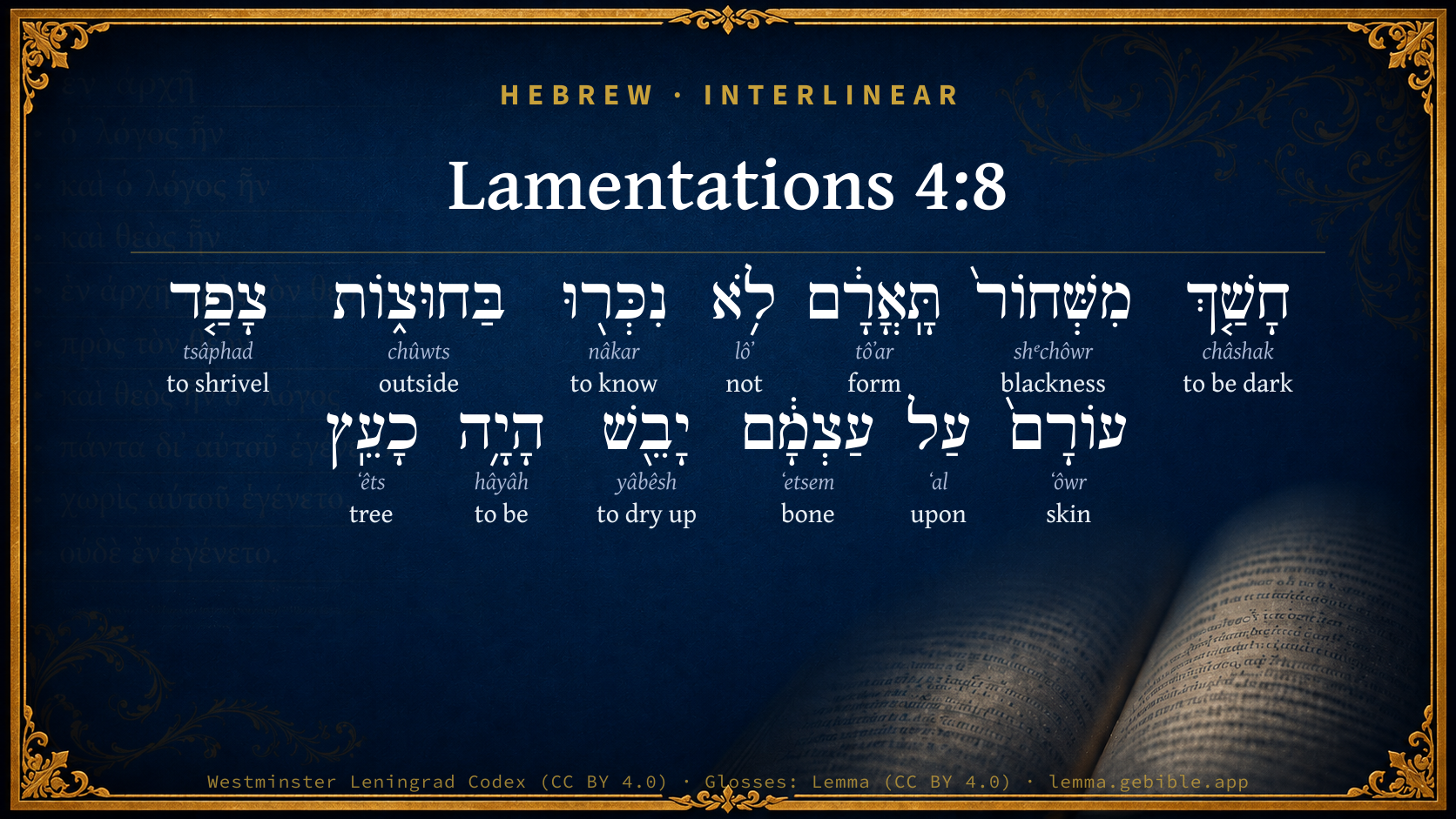
Hebrew (Westminster Leningrad Codex) Lamentations 4:8 appears in the Hebrew Old Testament. The text above is from the Westminster Leningrad Codex. Each word links to its Strong’s number, a concise gloss, and parsing drawn from the Open Scriptures Hebrew Bible morphology. Click any word for its full Brown-Driver-Briggs (BDB) entry.
Download image
Cite this verse

Lamentations 4:8 (World English Bible). Public Domain. Lemma interlinear Bible study tool, https://lemma.gebible.app/v/lamentations/4/8.

Show BibTeX & RIS
BibTeX
RIS
English Translation
Their visage is blacker than a coal; they are not known in the streets: Their skin cleaves to their bones; it is withered, it is become like a stick.
World English Bible · Public Domain
Highlights
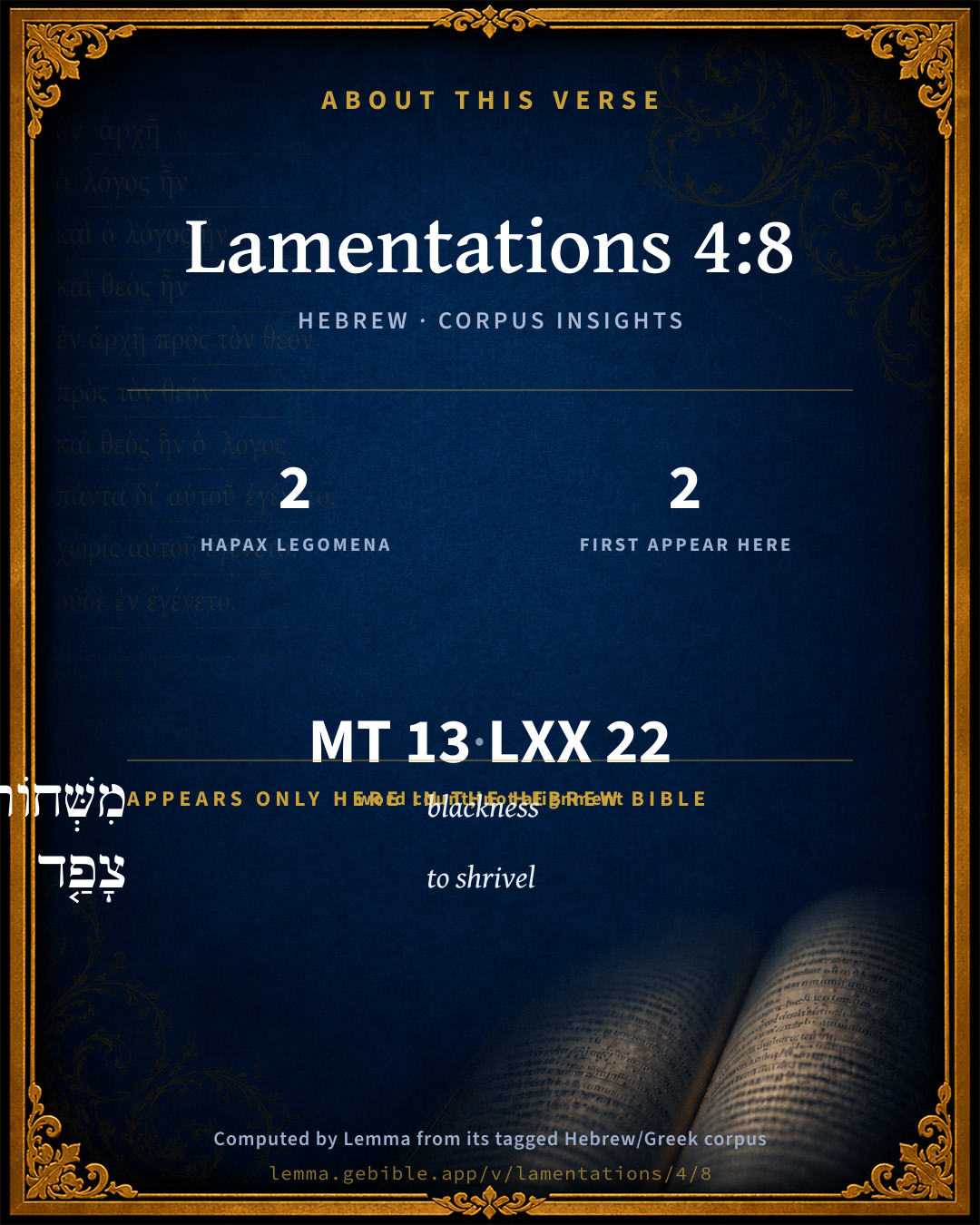
  • 2 hapax legomena — only here in the Hebrew Bible
  • 2 first appearances in the Hebrew Bible
Full analysis ↓
Download a study sheet

One document with this verse’s original text, its word-by-word gloss line, the meaning frame, cross-references with their text, attributed commentary, and full source and license credits — printable, and it pastes into notes with its structure intact.

This verse Autodidact and up

Study sheet (.html) Plain text (.txt)

A passage Seminary Student

Up to 50 verses in one chapter. A passage sheet keeps up to 6 commentary sources and 12 cross-references per verse, in the order this page ranks them, and says so on the sheet whenever that leaves anything out. Ask for a single verse and you get the Autodidact verse sheet above.

Everything on this page stays free to read, with no account — the sheet is a download of what is already on screen, not access to it.

Want to remove ads? Support Godless Engineer
Compare translations 3

The same verse in 3 English versions, stacked beneath the original-language interlinear above. Click any original word for its lexicon entry.

Each is an independent rendering of the whole verse — the interlinear is not word-aligned to these translations.

Highlighted words mark where these versions differ — a whole-verse word diff, not a word-by-word alignment.

  • World English Bible Public Domain
    Their visage is blacker than a coal; they are not known in the streets: Their skin cleaves to their bones; it is withered, it is become like a stick.
  • King James Version Public Domain
    Their visage is blacker than a coal; they are not known in the streets: their skin cleaveth to their bones; it is withered, it is become like a stick.
  • unfoldingWord Literal Text CC BY-SA 4.0
    Their appearance is darker than soot; they are not recognized in the streets. Their skin has shriveled on their bones; it has become dry as wood. TETH

unfoldingWord Literal Text — © unfoldingWord, licensed CC BY-SA 4.0. Word-aligned USFM3 via Door43 (git.door43.org/unfoldingWord/en_ult).

Versions to compare (up to 4)

3 of 4 selected

Show all 18 translations

Every available English version of this verse, each an independent rendering of the whole verse.

  • World English Bible Public Domain
    Their visage is blacker than a coal; they are not known in the streets: Their skin cleaves to their bones; it is withered, it is become like a stick.
  • Berean Standard Bible Public Domain
    But now their appearance is blacker than soot; they are not recognized in the streets. Their skin has shriveled on their bones; it has become as dry as a stick.
  • Majority Standard Bible Public Domain
    But now their appearance is blacker than soot; they are not recognized in the streets. Their skin has shriveled on their bones; it has become as dry as a stick.
  • King James Version Public Domain
    Their visage is blacker than a coal; they are not known in the streets: their skin cleaveth to their bones; it is withered, it is become like a stick.
  • American Standard Version (1901) Public Domain
    Their visage is blacker than a coal; they are not known in the streets: Their skin cleaveth to their bones; it is withered, it is become like a stick.
  • Revised Version (1885) Public Domain
    Their visage is blacker than a coal; they are not known in the streets: their skin cleaveth to their bones; it is withered, it is become like a stick.
  • Geneva Bible (1599) Public Domain
    Nowe their visage is blacker then a cole: they can not knowe them in the streetes: their skinne cleaueth to their bones: it is withered like a stocke.
  • Douay-Rheims (1899) Public Domain
    Heth. Their face is now made blacker than coals, and they are not known in the streets: their skin hath stuck to their bones, it is withered, and is become like wood.
  • Young's Literal Translation Public Domain
    Darker than blackness hath been their visage, They have not been known in out-places, Cleaved hath their skin unto their bone, It hath withered -- it hath been as wood.
  • Literal Standard Version CC BY-SA 4.0
    Their face has been darker than blackness, || They have not been known in out-places, || Their skin has cleaved to their bone, || It has withered—it has been as wood.
  • Unlocked Literal Bible CC BY-SA 4.0
    Their appearance now is darker than soot; they are not recognized in the streets. Their skin has shriveled on their bones; it has become as dry as wood.
  • unfoldingWord Literal Text CC BY-SA 4.0
    Their appearance is darker than soot; they are not recognized in the streets. Their skin has shriveled on their bones; it has become dry as wood. TETH
  • Darby Bible Public Domain
    Their visage is darker than blackness, they are not known in the streets; their skin cleaveth to their bones, it is withered, it is become like a stick.
  • World Messianic Bible Public Domain
    Their appearance is blacker than a coal. They are not known in the streets. Their skin clings to their bones. It is withered. It has become like wood.
  • Webster's Bible Public Domain
    Their visage is blacker than a coal; they are not known in the streets: their skin cleaveth to their bones; it is withered, it is become like a stick.
  • Free Bible Version CC BY-SA 4.0
    But now they look blacker than soot; no one recognizes them in the street. Their skin has shrunk to their bones and is as dry as wood.
  • Bible in Basic English Public Domain
    Their face is blacker than night; in the streets no one has knowledge of them: their skin is hanging on their bones, they are dry, they have become like wood.
  • JPS Tanakh (1917) Public Domain
    Their visage is blacker than coal; they are not known in the streets; their skin is shrivelled upon their bones; it is withered, it is become like a stick.

Literal Standard Version (2020), Covenant Press — licensed CC BY-SA 4.0. Text via the HelloAO Bible API (eBible.org). Unlocked Literal Bible (unfoldingWord) — licensed CC BY-SA 4.0. Text via the HelloAO Bible API (eBible.org). unfoldingWord Literal Text — © unfoldingWord, licensed CC BY-SA 4.0. Word-aligned USFM3 via Door43 (git.door43.org/unfoldingWord/en_ult). Free Bible Version, Dr. Jonathan Gallagher — licensed CC BY-SA 4.0. Text via the HelloAO Bible API (eBible.org).

Word by word

More ways to search: Search by grammar → Find every occurrence → Compare this word →

Practice this passage: Drill this verse → Learn its vocabulary →

מִשְּׁחוֹר֙
shᵉchôwr
H7815
“from · blackness”
Preposition + Noun, Common, Masculine, Singular, Absolute
Part of Speech
Preposition + Noun
Type
Common
Gender
Masculine
Number
Singular
State
Absolute
Full BDB Definition

Origin: from H7835

TWOT: 2368a

blackness - (CLBL) pit
  1. חָשַׁ֤ךְ châshak H2821 “to be dark” Verb, Qal, Perfect, 3rd Person, Masculine, Singular
  2. תָּֽאֳרָ֔ם tôʼar H8389 “form · their” Noun, Common, Masculine, Singular, Construct + Suffix, Personal, 3rd Person, Masculine, Plural
  3. לֹ֥א lôʼ H3808 “not” Particle, Negative
  4. נִכְּר֖וּ nâkar H5234 “to know” Verb, Niphal, Perfect, 3rd Person, Common, Plural
  5. בַּחוּצ֑וֹת chûwts H2351 “in/at the · streets” Preposition, Determined + Noun, Common, Masculine, Plural, Absolute
  6. צָפַ֤ד tsâphad H6821 “to shrivel” Verb, Qal, Perfect, 3rd Person, Masculine, Singular
  7. עוֹרָם֙ ʻôwr H5785 “skin · their” Noun, Common, Masculine, Singular, Construct + Suffix, Personal, 3rd Person, Masculine, Plural
  8. עַל ʻal H5921 “upon” Preposition
  9. עַצְמָ֔ם ʻetsem H6106 “bone · their” Noun, Common, Feminine, Singular, Construct + Suffix, Personal, 3rd Person, Masculine, Plural
  10. יָבֵ֖שׁ yâbêsh H3001 “to dry up” Verb, Qal, Perfect, 3rd Person, Masculine, Singular
  11. הָיָ֥ה hâyâh H1961 “to be” Verb, Qal, Perfect, 3rd Person, Masculine, Singular
  12. כָעֵֽץ ʻêts H6086 “like/as the · tree” Preposition, Determined + Noun, Common, Masculine, Singular, Absolute

About this verse

These counts appear in no published source. They are computed here, from the morphology-tagged text and Lemma’s own curated glosses. What Lemma adds →

13
words
13
distinct lemmas
Prophets
section

Notable vocabulary

2 hapax legomena — words that appear only here in the entire Hebrew Bible:

  • מִשְּׁחוֹר֙ blackness H7815
  • צָפַ֤ד to shrivel H6821

First appearance in Scripture

These words make their first canonical appearance in the Hebrew Bible here:

  • מִשְּׁחוֹר֙ blackness H7815
  • צָפַ֤ד to shrivel H6821

Shared distinctive vocabulary

תָּֽאֳרָ֔ם form H8389 occurs in 15 verses of the Hebrew Bible. Also found in:

Grammatical profile

  • 5 verbs
  • 6 nouns
  • 1 preposition
  • 1 particle

Verb forms

  • חָשַׁ֤ךְ Qal · Perfect
  • נִכְּר֖וּ Niphal · Perfect
  • צָפַ֤ד Qal · Perfect
  • יָבֵ֖שׁ Qal · Perfect
  • הָיָ֥ה Qal · Perfect

Hebrew & Septuagint length

In English translation the verse runs 29 words from the Hebrew and 31 from the Septuagint (LXX English) — closely comparable.

A rough comparison of the two English renderings, which tokenize alike — not a word-level alignment.

Word counts can differ between the Hebrew and the Greek without any difference in meaning — e.g. the Hebrew direct-object marker אֵת has no separate Greek word, and Greek often adds the article ὁ.

In the original languages it is 13 Hebrew tokens and 22 Greek tokens — but the two are counted differently (Hebrew bundles its prefixes and suffixes into one token; the Greek is in lemma form), so that isn’t a like-for-like length.

Cross-references

16

Topical passages linked to Lamentations 4:8 in the Treasury of Scripture Knowledge — connected by theme and wording, ordered by reader-vote popularity; previews shown in the World English Bible.

  • Lamentations 5:10 Our skin is black like an oven, Because of the burning heat of famine.
  • Job 30:30 My skin grows black and peels from me. My bones are burned with heat.
  • Psalms 102:3–5 For my days consume away like smoke. My bones are burned as a firebrand.
  • Job 19:20 My bones stick to my skin and to my flesh. I have escaped by the skin of my teeth.
  • Psalms 119:83 For I have become like a wineskin in the smoke. I don't forget your statutes.
  • Ruth 1:19–20 So they two went until they came to Bethlehem. It happened, when they were come to Bethlehem, that all the city was moved about them, and [the women] said, Is this Naomi?
  • Job 2:12 When they lifted up their eyes from a distance, and didn't recognize him, they raised their voices, and wept; and they each tore his robe, and sprinkled dust on their heads toward the sky.
  • Job 30:17–19 In the night season my bones are pierced in me, And the pains that gnaw me take no rest.
  • Job 33:21 His flesh is so consumed away, that it can't be seen; His bones that were not seen stick out.
  • Psalms 32:4 For day and night your hand was heavy on me. My strength was sapped in the heat of summer. Selah.
  • Psalms 38:3 There is no soundness in my flesh because of your indignation, Neither is there any health in my bones because of my sin.
  • Psalms 102:11 My days are like a long shadow. I have withered like grass.
  • Isaiah 52:14 Like as many were astonished at you (his visage was so marred more than any man, and his form more than the sons of men),
  • Lamentations 4:1–2 How is the gold become dim! [how] is the most pure gold changed! The stones of the sanctuary are poured out at the head of every street.
  • Joel 2:6 At their presence the peoples are in anguish. All faces have grown pale.
  • Nahum 2:10 She is empty, void, and waste. The heart melts, the knees knock together, their bodies and faces have grown pale.

Cross-references courtesy of OpenBible.info (CC BY 4.0).

Hebrew and Greek witnesses Masoretic Hebrew ↔ Greek Septuagint

The same verse in the two great witnesses to the Old Testament, shown verse-for-verse.

These are two independent witnesses, not word-aligned to each other, and the Septuagint is shown in lemma (dictionary) form.

Hebrew Lamentations 4:8 Masoretic · Westminster Leningrad Codex

חָשַׁ֤ךְ מִשְּׁחוֹר֙ תָּֽאֳרָ֔ם לֹ֥א נִכְּר֖וּ בַּחוּצ֑וֹת צָפַ֤ד עוֹרָם֙ עַל עַצְמָ֔ם יָבֵ֖שׁ הָיָ֥ה כָעֵֽץ

Their visage is blacker than a coal; they are not known in the streets: Their skin cleaves to their bones; it is withered, it is become like a stick.

World English Bible · Public Domain

Greek LXX Lamentations 4:8 Septuagint · lemma form

σκοτάζω ὑπέρ ἀσβόλη ὁ εἶδος αὐτός οὐ ἐπιγιγνώσκω ἐν ὁ ἔξοδος πήγνυμι δέρμα αὐτός ἐπί ὁ ὀστέον αὐτός ξηραίνω γίγνομαι ὥσπερ ξύλον

HETH. Their countenance is become blacker than smoke; they are not known in the streets: their skin has cleaved to their bones; they are withered, they are become as a stick.

LXX2012 (modern English Septuagint) · Public Domain

On this verse, Haydock's Catholic Bible Commentary discusses the Septuagint’s reading. Read the note in Commentary ↓

Hebrew: Westminster Leningrad Codex (CC BY 4.0). Greek: Septuagint (public domain); English from LXX2012 (modern English Septuagint) (Public Domain). How the Septuagint differs from the Hebrew →

Commentary

Notes on Lamentations 4:8 from classic Christian and Jewish commentators (each source and its license shown beneath its notes). The classic Christian expositions comment on the surrounding passage and are grouped to its opening verse, so a note may address several verses; the Jewish commentaries on the Tanakh (Rashi and others) are per-verse, so they appear only where the commentator wrote on this verse.

Lemma curates 59 commentaries, every one of them public domain or Creative Commons licensed, each selected and text-cleaned for this edition rather than reprinted as found. About our sources →

Trapp's Complete Commentary

John Trapp

Lam 4:8 Their visage is blacker than a coal; they are not known in the streets: their skin cleaveth to their bones; it is withered, it is become like a stick.

Ver. 8. Their visage is blacker than a coal.] Heb., Their visage is more darkened than blackness - scil., With famine, fear, grief, and care; those vultures have so fed upon them that all sightliness and loveliness is lost. Think the same of apostates, God may complain of such. {as Mic 2:8}

John Trapp, A Commentary or Exposition upon All the Books of the Old and New Testament (1647–1656) — public domain. Text from a community e-Sword module.

Tyndale Open Study Notes

Tyndale Open Resources

4:8 Skin sticking to bones is symptomatic of the final stages of starvation, just before death.

Tyndale Open Study Notes — © Tyndale Open Resources, licensed CC BY-SA 4.0. Text via the HelloAO Bible API.

Geneva Bible (1599)

Geneva Bible translators

They that were before most in God’s favor, are now in greatest abomination unto him.

Geneva Bible (1599) marginal notes — public domain. Text via Bolls.life.

Jamieson, Fausset & Brown

Robert Jamieson, A. R. Fausset & David Brown

blacker than . . . coal--or, "than blackness" itself (Joe 2:6; Nah 2:10).

like a stick--as withered as a dry stick.

Jamieson, Fausset & Brown — Commentary Critical and Explanatory on the Whole Bible (1871) — public domain (CC PDM 1.0). Text via the HelloAO Bible API.

John Calvin's Commentaries

Now, on the contrary, he says that the Nazarites were become withered, that their skin clave to their bones, that, in short, they were so deformed that they could not be known, not only in obscure corners, but even in the open street, hi the middle of the market-place. We hence learn that as the favor of God had before appeared as to the Nazarites, so now also his vengeance might be certainly known, because they had fallen off from their vigor, and were reduced to a degrading deformity.

The Prophet at the same time shews that worship according to the law had in a manner deteriorated on account of the vices of the people; and this is the design of the whole, as I reminded you at the beginning. For there is no doubt but that he wished to rouse the Jews, that they might at length raise up their eyes to God; for they had long grown torpid in their vices, and had been even inflated with diabolical pride; hence was their inveterate obstinacy. As long as the Temple stood, they thought that they satisfied God by the sacrifices they offered. When the Prophet now tells them that the stones of the Temple were thrown down, it hence follows that the Temple was profaned’ whence this profanation? from the wickedness of the people. The Chaldeans, indeed, thought that they brought a great reproach on God when they demolished the Temple; but, as long pollution had preceded, our Prophet now represents to the Jews their sins as in a mirror or a living form; for they had polluted the Temple before the Chaldeans. So also he shews that the worship according to the law was no longer pleasing to God, for they had mocked him with empty specters; for it was only a vain display when there was no integrity within. The Prophet then shews to them what, he could before by no means have persuaded them to believe, that God was in no way pleased with the external worship of the Jews, while they were audaciously violating the whole law. It afterwards follows, —

John Calvin's Commentaries (1540-1563) — public domain. Text from the Calvin Translation Society English edition (1840s-50s) via the Christian Classics Ethereal Library (ccel.org). Calvin's coverage is partial (roughly two-thirds of the Bible); uncommented books and verses are honest gaps, never fabricated. The 19th-century editor's footnotes and remarks are omitted so the notes are faithfully Calvin's own voice.

Ellicott's Commentary for English Readers

(8) Their visage is blacker . . .—We look, as it were, on the two pictures: the bloom and beauty of health, the wan, worn, spectral looks of starvation.

A Bible Commentary for English Readers, edited by Charles John Ellicott (1878–1897) — public domain. Text from a community e-Sword module.

The Cambridge Bible for Schools and Colleges

gen. ed. J. J. S. Perowne

8. blacker than a coal] lit. as mg. darker than blackness.

Their skin cleaveth to their bones] Cp. Job_19:20.

The Cambridge Bible for Schools and Colleges (gen. ed. J. J. S. Perowne; Cambridge University Press, 1878–1918) — public domain. Text from a community e-Sword module.

John Gill's Exposition

Their visage is blacker than a coal,.... Or, "darker than blackness"; or, "dark through blackness" (y); by reason of the famine, and because of grief and trouble for themselves and their friends, which changed their complexions, countenances, and skins; they that looked before as pure as snow, as white as milk, as clear as pearls, as polished as sapphire, now as black as charcoal, as blackness itself:

they are not known in the streets; not taken notice of in a distinguished manner; no respect shown them as they walk the streets, as used to be; nay, their countenances were so altered, and their apparel so sordid, as not to be known by their friends, when they met them in public:

their skin cleaveth to their bones; have nothing but skin and bone, who used to be plump and fat:

it is withered, it is become like a stick; the skin wrinkled and shrivelled up, the flesh being gone; and the bone became like a stick, or a dry piece of wood, its moisture and marrow being dried up.

(y) "obscurior ipsa nigredine", Tigurine version; "magis quam nigredo vel carbo", Vatablus; "prae caligines", Calvin; "ex nigredine", Piscator.

John Gill's Exposition of the Whole Bible (1746–1763) — public domain (CC PDM 1.0). Text via the HelloAO Bible API.

Albert Barnes' Notes on the Bible

Their visage ... - Their form (their whole person, see 1Sa 28:14)... as in the margin. See Job 30:30.

It is withered, it is become like a stick - Or, It has become dry like a piece of wood.

Albert Barnes' Notes on the Bible (1834–1885) — public domain. Text from a community e-Sword/MySword module.

Haydock's Catholic Bible Commentary

Coals. Hebrew, "blackness." Septuagint, "soot." (Haydock) --- The people were naturally brown. Fasting and distress cause them to turn black, chap. v. 10., and Joel ii. 6. (Calmet) --- They were so changed, that old acquaintances knew not one another. (Worthington)

George Leo Haydock (1774–1849), Haydock's Catholic Family Bible and Commentary, 1859 edition — public domain. Excludes Psalms (Douay-Rheims chapter numbering differs from Protestant) and Deuterocanonical books (Catholic canon only).

Matthew Poole's English Annotations

They that in the prosperity of the city were fair, plump, and ruddy, look now black for want of fit nourishment, and through sorrow and grief; insomuch that those who before knew them by their countenances, garbs, and habits, did not now know them. And by reason of the famine (for he speaketh with relation to the famine during the siege) they are almost starved, their skin is withered and hard, and even sticketh to their bones.

Matthew Poole's English Annotations on the Holy Bible (1683–1685) — public domain. Text from a community e-Sword/MySword module.

The Pulpit Commentary

Their visage is blacker than a coal; rather, their appearance is darker than blackness one of the hyperboles which seem to indicate that the poem was not written at the very moment of the calamity described. (comp. Job_30:30) Not known in the streets. Another point of contact with the Book of Job. (Job_2:12) Their skin, etc. Again we must compare the lamentations of Job. (Job_19:20 Job_30:30) Psa_102:5 may also be quoted; for the second half of the verse is toe short unless we insert "to my skin" before "to my flesh."

The Pulpit Commentary (1880–1919), ed. H.D.M. Spence-Jones & Joseph S. Exell — public domain. Text from a community e-Sword module.

John Wesley's Explanatory Notes

Not known - So that those who before knew them, do not know them now.

John Wesley, Explanatory Notes Upon the Whole Bible (1754–1765) — public domain. Text via the GEBible commentary corpus.

Rashi

Rabbi Shlomo Yitzchaki (Rashi)

than charcoal Heb. מִשְּׁחוֹר. This is charcoal.

appearance Heb. עֶצֶם, an expression of appearance, like (Exod. 24:10): “like the appearance of (וּכְעֶצֶם) the heavens in purity”; couleur in French, color, complexion.

is shriveled Heb. צָפַד, shriveled and adhered, and there is no similar word.

Rashi on the Tanakh — English translations: “The Judaica Press complete Tanach with Rashi, translated by A. J. Rosenberg” (CC BY 4.0); “Pentateuch with Rashi's commentary by M. Rosenbaum and A.M. Silbermann, 1929-1934” (public domain); “The Metsudah Tanach series, Lakewood, N.J” (CC BY 4.0); and “The Book of Joshua, Metsudah Publications, 1997” (CC BY 4.0). Text via Sefaria.

Lesson kit

Teaching starters — assembled from the data on this page, not authored interpretation. Every prompt links to the verse data it draws on. Edit before teaching.

Lamentations, in the Prophets, opens this verse with 13 words (13 distinct Hebrew lemmas). Its most distinctive word is shᵉchôwr (“blackness”). A historical commentator’s framing appears above. Read the whole chapter for the surrounding context.

Discussion questions

  1. How does “blackness” (shᵉchôwr) shape what this verse is saying?
  2. 2 words here appear nowhere else in the Hebrew Bible. Why might the author reach for such rare wording?
  3. 2 words make their first appearance in Scripture here. What does this debut establish?
  4. How does Genesis 29:17, which shares the word «form», read alongside this verse?
  5. The translations on this page render this verse differently — a whole-verse word diff, not a word-by-word alignment. What might account for the different wordings?
  6. «חָשַׁ֤ךְ» is a Qal Perfect verb. How does that grammatical form shape the action described?
  7. Compare how Trapp's Complete Commentary and Tyndale Open Study Notes read this verse. Where do they agree or differ?

Things to notice

Reading settings

Reading text

Shown beneath each verse's original-language words.

Old Testament
Old Testament edition

Read the OT as the Masoretic Hebrew (MT) or the Greek Septuagint (LXX).

English shown for the Greek Septuagint (in the Hebrew ↔ Greek comparison).

Comparing translations? Open the Compare panel on any verse page to stack up to four side by side.