Numbers 31:13

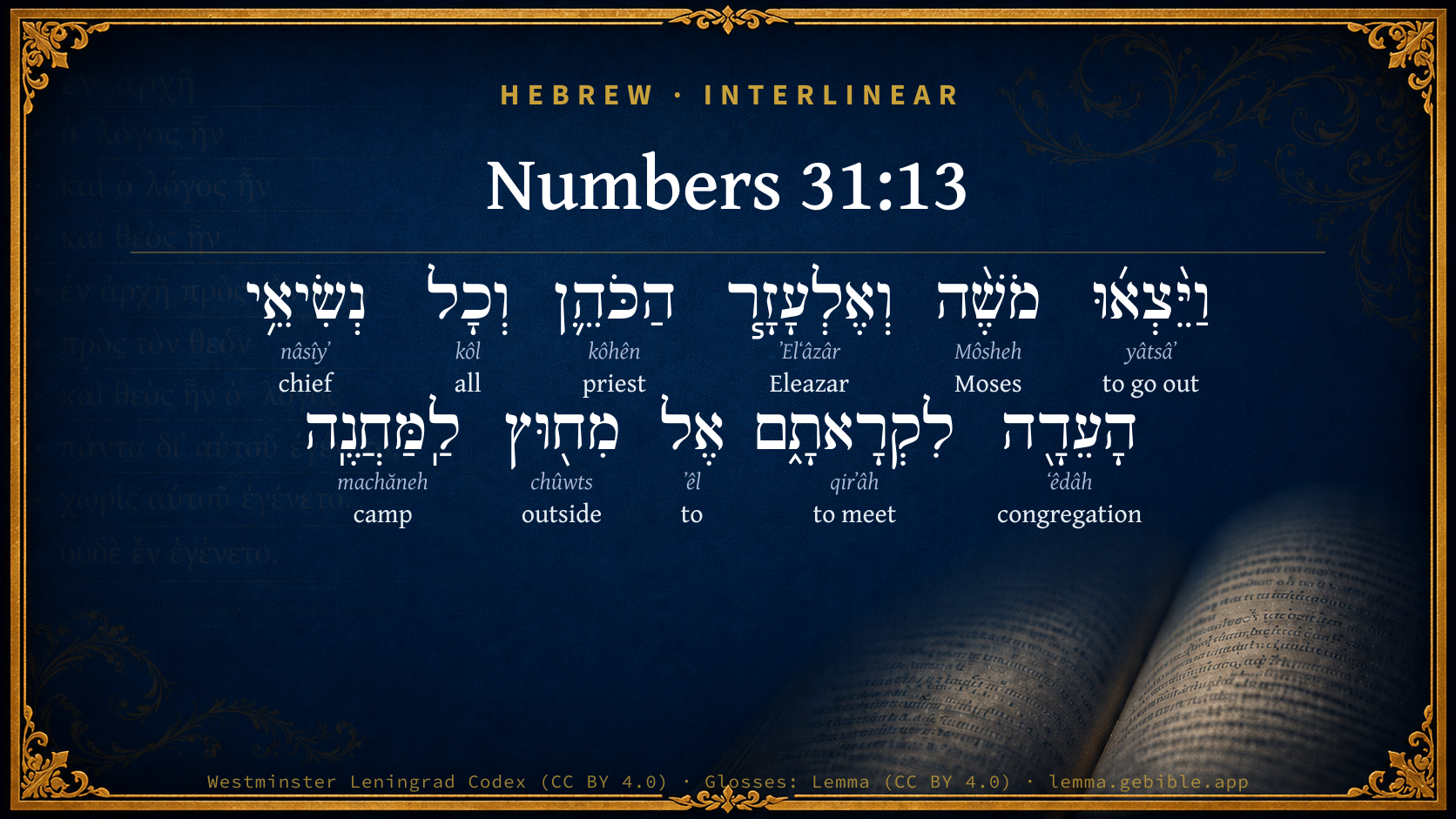
Hebrew (Westminster Leningrad Codex) Numbers 31:13 appears in the Hebrew Old Testament. The text above is from the Westminster Leningrad Codex. Each word links to its Strong’s number, a concise gloss, and parsing drawn from the Open Scriptures Hebrew Bible morphology. Click any word for its full Brown-Driver-Briggs (BDB) entry.
Download image
Cite this verse

Numbers 31:13 (World English Bible). Public Domain. Lemma interlinear Bible study tool, https://lemma.gebible.app/v/numbers/31/13.

Show BibTeX & RIS
BibTeX
RIS
English Translation
Moses, and Eleazar the priest, and all the princes of the congregation, went forth to meet them outside of the camp.
World English Bible · Public Domain
Download a study sheet

One document with this verse’s original text, its word-by-word gloss line, the meaning frame, cross-references with their text, attributed commentary, and full source and license credits — printable, and it pastes into notes with its structure intact.

This verse Autodidact and up

Study sheet (.html) Plain text (.txt)

A passage Seminary Student

Up to 50 verses in one chapter. A passage sheet keeps up to 6 commentary sources and 12 cross-references per verse, in the order this page ranks them, and says so on the sheet whenever that leaves anything out. Ask for a single verse and you get the Autodidact verse sheet above.

Everything on this page stays free to read, with no account — the sheet is a download of what is already on screen, not access to it.

Want to remove ads? Support Godless Engineer
Compare translations 3

The same verse in 3 English versions, stacked beneath the original-language interlinear above. Click any original word for its lexicon entry.

Each is an independent rendering of the whole verse — the interlinear is not word-aligned to these translations.

Highlighted words mark where these versions differ — a whole-verse word diff, not a word-by-word alignment.

  • World English Bible Public Domain
    Moses, and Eleazar the priest, and all the princes of the congregation, went forth to meet them outside of the camp.
  • King James Version Public Domain
    And Moses, and Eleazar the priest, and all the princes of the congregation, went forth to meet them without the camp.
  • unfoldingWord Literal Text CC BY-SA 4.0
    And Moses and Eleazar the priest and all the leaders of the congregation went out to meet them at the outside of the camp.

unfoldingWord Literal Text — © unfoldingWord, licensed CC BY-SA 4.0. Word-aligned USFM3 via Door43 (git.door43.org/unfoldingWord/en_ult).

Versions to compare (up to 4)

3 of 4 selected

Show all 18 translations

Every available English version of this verse, each an independent rendering of the whole verse.

  • World English Bible Public Domain
    Moses, and Eleazar the priest, and all the princes of the congregation, went forth to meet them outside of the camp.
  • Berean Standard Bible Public Domain
    And Moses, Eleazar the priest, and all the leaders of the congregation went to meet them outside the camp.
  • Majority Standard Bible Public Domain
    And Moses, Eleazar the priest, and all the leaders of the congregation went to meet them outside the camp.
  • King James Version Public Domain
    And Moses, and Eleazar the priest, and all the princes of the congregation, went forth to meet them without the camp.
  • American Standard Version (1901) Public Domain
    And Moses, and Eleazar the priest, and all the princes of the congregation, went forth to meet them without the camp.
  • Revised Version (1885) Public Domain
    And Moses, and Eleazar the priest, and all the princes of the congregation, went forth to meet them without the camp.
  • Geneva Bible (1599) Public Domain
    Then Moses and Eleazar the Priest, and all the princes of the Congregation went out of the campe to meete them.
  • Douay-Rheims (1899) Public Domain
    And Moses and Eleazar the priest and all the princes of the synagogue went forth to meet them without the camp.
  • Young's Literal Translation Public Domain
    And Moses, and Eleazar the priest, and all the princes of the company, go out to meet them, unto the outside of the camp,
  • Literal Standard Version CC BY-SA 4.0
    And Moses, and Eleazar the priest, and all the princes of the congregation, go out to meet them, to the outside of the camp,
  • Unlocked Literal Bible CC BY-SA 4.0
    Moses, Eleazar the priest, and all the leaders of the community went to meet them outside the camp.
  • unfoldingWord Literal Text CC BY-SA 4.0
    And Moses and Eleazar the priest and all the leaders of the congregation went out to meet them at the outside of the camp.
  • Darby Bible Public Domain
    And Moses and Eleazar the priest and all the princes of the assembly went forth to meet them outside the camp.
  • World Messianic Bible Public Domain
    Moses and Eleazar the priest, with all the princes of the congregation, went out to meet them outside of the camp.
  • Webster's Bible Public Domain
    And Moses, and Eleazar the priest, and all the princes of the congregation, went forth to meet them without the camp.
  • Free Bible Version CC BY-SA 4.0
    Moses, Eleazar the priest, and all the Israelite leaders went out of the camp to meet them.
  • Bible in Basic English Public Domain
    Then Moses and Eleazar the priest and the chiefs of the people went out to them before they had come into the tent-circle.
  • JPS Tanakh (1917) Public Domain
    And Moses, and Eleazar the priest, and all the princes of the congregation, went forth to meet them without the camp.

Literal Standard Version (2020), Covenant Press — licensed CC BY-SA 4.0. Text via the HelloAO Bible API (eBible.org). Unlocked Literal Bible (unfoldingWord) — licensed CC BY-SA 4.0. Text via the HelloAO Bible API (eBible.org). unfoldingWord Literal Text — © unfoldingWord, licensed CC BY-SA 4.0. Word-aligned USFM3 via Door43 (git.door43.org/unfoldingWord/en_ult). Free Bible Version, Dr. Jonathan Gallagher — licensed CC BY-SA 4.0. Text via the HelloAO Bible API (eBible.org).

Word by word

More ways to search: Search by grammar → Find every occurrence → Compare this word →

Practice this passage: Drill this verse → Learn its vocabulary →

וְאֶלְעָזָ֧ר
ʼElʻâzâr
H499
“and · Eleazar”
Conjunction + Noun, Proper
Part of Speech
Conjunction + Noun
Type
Proper
Full BDB Definition

Origin: from H410 and H5826

TWOT: None

Eleazar = "God has helped" - the high priest son of Aaron - Abinadab's son who cared for the ark - the priest who rebuilt and dedicated the restored walls of Jerusalem in time of Ezra - one of David's mighty warriors - a Levite - one of the line of Parosh
  1. וַיֵּ֨צְא֜וּ yâtsâʼ H3318 “and · to go out” Conjunction + Verb, Qal, Sequential Imperfect, 3rd Person, Masculine, Plural
  2. מֹשֶׁ֨ה Môsheh H4872 “Moses” Noun, Proper
  3. הַכֹּהֵ֛ן kôhên H3548 “the · priest” Particle, Definite Article + Noun, Common, Masculine, Singular, Absolute
  4. וְכָל kôl H3605 “and · all of” Conjunction + Noun, Common, Masculine, Singular, Construct
  5. נְשִׂיאֵ֥י nâsîyʼ H5387 “chiefs of” Noun, Common, Masculine, Plural, Construct
  6. הָעֵדָ֖ה ʻêdâh H5712 “the · congregation” Particle, Definite Article + Noun, Common, Feminine, Singular, Absolute
  7. לִקְרָאתָ֑ם qirʼâh H7125 “to meet · them” Preposition + Verb, Qal, Infinitive Construct + Suffix, Personal, 3rd Person, Masculine, Plural
  8. אֶל ʼêl H413 “to” Preposition
  9. מִח֖וּץ chûwts H2351 “from · outside” Preposition + Noun, Common, Masculine, Singular, Absolute
  10. לַֽמַּחֲנֶֽה machăneh H4264 “to/for the · camp” Preposition, Determined + Noun, Common, Both, Singular, Absolute

About this verse

These counts appear in no published source. They are computed here, from the morphology-tagged text and Lemma’s own curated glosses. What Lemma adds →

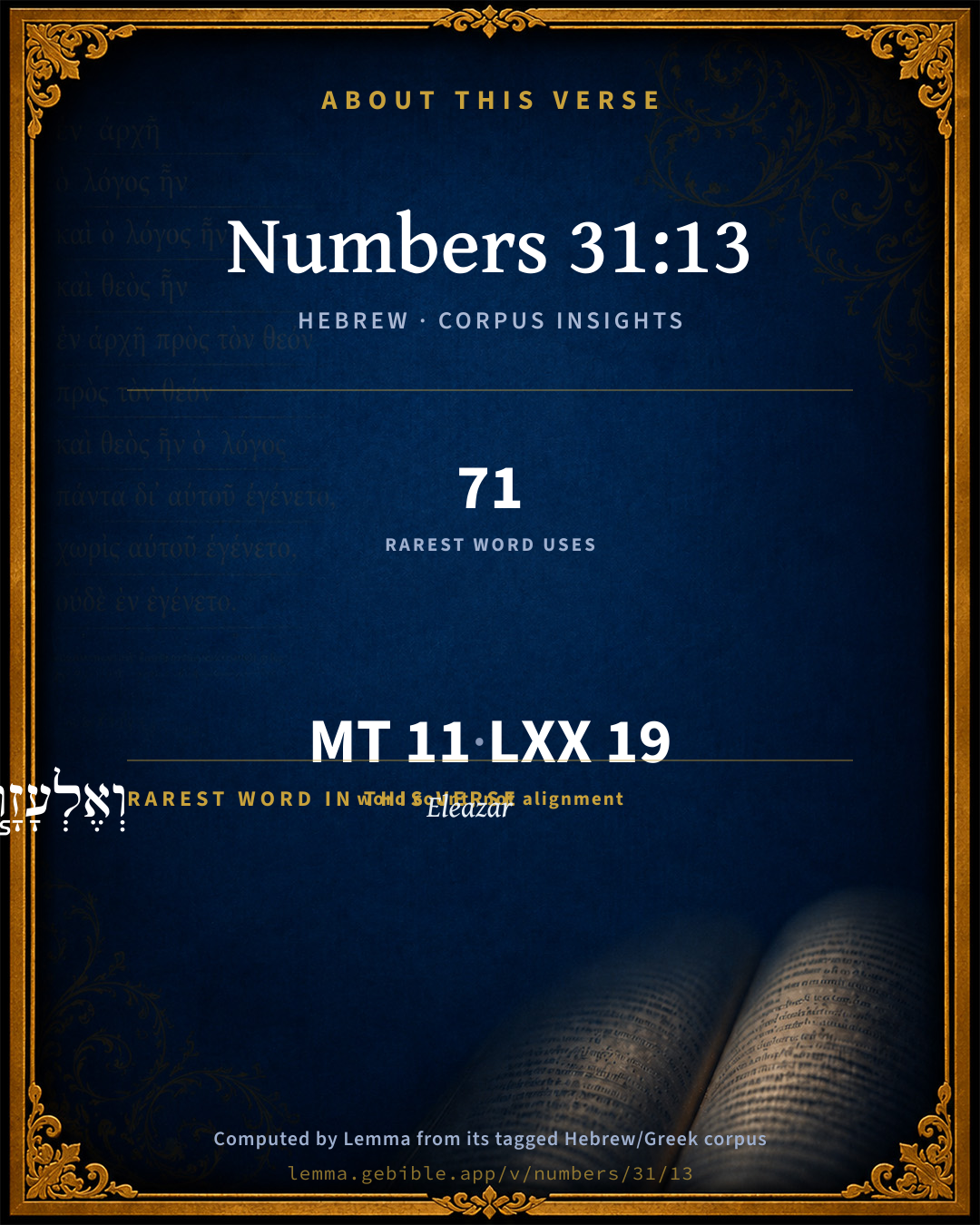
11
words
11
distinct lemmas
Pentateuch
section

Grammatical profile

  • 2 verbs
  • 8 nouns
  • 1 preposition

Verb forms

  • וַיֵּ֨צְא֜וּ Qal · Sequential Imperfect
  • לִקְרָאתָ֑ם Qal · Infinitive Construct

Hebrew & Septuagint length

In English translation the verse runs 21 words from the Hebrew and 22 from the Septuagint (LXX English) — closely comparable.

A rough comparison of the two English renderings, which tokenize alike — not a word-level alignment.

Word counts can differ between the Hebrew and the Greek without any difference in meaning — e.g. the Hebrew direct-object marker אֵת has no separate Greek word, and Greek often adds the article ὁ.

In the original languages it is 11 Hebrew tokens and 19 Greek tokens — but the two are counted differently (Hebrew bundles its prefixes and suffixes into one token; the Greek is in lemma form), so that isn’t a like-for-like length.

Cross-references

7

Topical passages linked to Numbers 31:13 in the Treasury of Scripture Knowledge — connected by theme and wording, ordered by reader-vote popularity; previews shown in the World English Bible.

  • Genesis 14:17 The king of Sodom went out to meet him, after his return from the slaughter of Chedorlaomer and the kings who were with him, at the valley of Shaveh (the same is the King's Valley).
  • Numbers 5:2 "Command the children of Israel that they put out of the camp every leper, and everyone who has an issue, and whoever is unclean by the dead.
  • Numbers 19:11 He who touches the dead body of any man shall be unclean seven days:
  • Numbers 31:12 They brought the captives, and the prey, and the spoil, to Moses, and to Eleazar the priest, and to the congregation of the children of Israel, to the camp at the plains of Moab, which are by the Jordan at Jericho.
  • Numbers 31:22–24 however the gold, and the silver, the brass, the iron, the tin, and the lead,
  • 1 Samuel 15:12 Samuel rose early to meet Saul in the morning; and it was told Samuel, saying, Saul came to Carmel, and, behold, he set him up a monument, and turned, and passed on, and went down to Gilgal.
  • 1 Samuel 30:21 David came to the two hundred men, who were so faint that they could not follow David, whom also they had made to abide at the brook Besor; and they went forth to meet David, and to meet the people who were with him: and when David came near to the people, he greeted them.

Cross-references courtesy of OpenBible.info (CC BY 4.0).

Hebrew and Greek witnesses Masoretic Hebrew ↔ Greek Septuagint

The same verse in the two great witnesses to the Old Testament, shown verse-for-verse.

These are two independent witnesses, not word-aligned to each other, and the Septuagint is shown in lemma (dictionary) form.

Hebrew Numbers 31:13 Masoretic · Westminster Leningrad Codex

וַיֵּ֨צְא֜וּ מֹשֶׁ֨ה וְאֶלְעָזָ֧ר הַכֹּהֵ֛ן וְכָל נְשִׂיאֵ֥י הָעֵדָ֖ה לִקְרָאתָ֑ם אֶל מִח֖וּץ לַֽמַּחֲנֶֽה

Moses, and Eleazar the priest, and all the princes of the congregation, went forth to meet them outside of the camp.

World English Bible · Public Domain

Greek LXX Numbers 31:13 Septuagint · lemma form

καί ἐκἔρχομαι μωυσῆς καί ελεαζαρ ὁ ἱερεύς καί πᾶς ὁ ἄρχων ὁ συναγωγή εἰς συνάντησις αὐτός ἔξω ὁ παρεμβολή

And Moses and Eleazar the priest and all the rulers of the synagogue went forth out of the camp to meet them.

LXX2012 (modern English Septuagint) · Public Domain

Hebrew: Westminster Leningrad Codex (CC BY 4.0). Greek: Septuagint (public domain); English from LXX2012 (modern English Septuagint) (Public Domain). How the Septuagint differs from the Hebrew →

Targum (Aramaic paraphrase)

2

The Targum is the ancient Jewish Aramaic paraphrase of the Hebrew Scriptures — an interpretive translation, not the Hebrew text itself. Onkelos (literal) and Pseudo-Jonathan (expansive) render the Torah, and Jonathan the Prophets. Coverage is partial: where no permissively-licensed English translation exists for a verse, only the Aramaic is shown. This is verse-level text, not a word-by-word alignment to the Hebrew.

  1. Targum Onkelos Torah (Genesis–Deuteronomy)
    וּנְפָקוּ משֶׁה וְאֶלְעָזָר כַּהֲנָא וְכָל רַבְרְבֵי כְנִשְׁתָּא לְקֳדָמוּתְהוֹן לְמִבָּרָא לְמַשְׁרִיתָא

    (no public-domain English translation for this verse)

    Targum Onkelos — Aramaic: “Onkelos Genesis” (public domain); “Onkelos Exodus” (public domain); “Onkelos Leviticus” (public domain); “Onkelos Numbers” (public domain); “Onkelos Deuteronomy” (public domain). English: “Sefaria Community Translation” (CC0 1.0 (public-domain dedication)); “J.W. Etheridge. The Targums of Onkelos and Jonathan Ben Uzziel on the Pentateuch. London: Longmans, Green, 1862” (public domain). Text via Sefaria.

  2. Targum Pseudo-Jonathan Torah (Genesis–Deuteronomy)
    וּנְפָקוּ משֶׁה וְאֶלְעָזָר כַּהֲנָא וְכָל אֲמַרְכְּלֵי כְּנִשְׁתָּא לִקְדָמוּתְהוֹן לְמִבָּרָא לְמַשְׁרִיתָא

    And Mosheh and Elazar the priest, with all the heads of the congregation, went forth to meet them without the camp.

    Targum Pseudo-Jonathan — Aramaic: “Targum Jonathan on Genesis” (public domain); “Targum Jonathan on Exodus” (public domain); “Targum Jonathan on Leviticus” (public domain); “Targum Jonathan on Numbers” (public domain); “Targum Jonathan on Deuteronomy” (public domain). English: “The Targum of Jonathan ben Uzziel, trans. J. W. Etheridge, London, 1862” (public domain). Text via Sefaria.

Commentary

Notes on Numbers 31:13 from classic Christian and Jewish commentators (each source and its license shown beneath its notes). The classic Christian expositions comment on the surrounding passage and are grouped to its opening verse, so a note may address several verses; the Jewish commentaries on the Tanakh (Rashi and others) are per-verse, so they appear only where the commentator wrote on this verse.

Lemma curates 59 commentaries, every one of them public domain or Creative Commons licensed, each selected and text-cleaned for this edition rather than reprinted as found. About our sources →

Trapp's Complete Commentary

John Trapp

Num 31:13 And Moses, and Eleazar the priest, and all the princes of the congregation, went forth to meet them without the camp.

Ver. 13. Went forth to meet them.] As Melchisedec went forth to meet Abraham returning with victory; {Gen 14:18} as Archbishop Hubert met our Richard I returning from the Holy Land, (as they called it,) both of them first falling to the earth, rose again and ran into each other’s arms, comforting themselves with mutual embraces, and weeping with joy. {a}

{a} Speed, Hist., fol. 540.

John Trapp, A Commentary or Exposition upon All the Books of the Old and New Testament (1647–1656) — public domain. Text from a community e-Sword module.

Joseph Benson's Commentary

Num 31:13-14. Went forth to meet them — Partly to put respect upon them, and congratulate them on their happy success; and partly to prevent the pollution of the camp by the untimely entrance of the warriors into it.

Moses was wroth with the officers — Because they had spared those who were most criminal, and who, by the law of God, were worthy of death, as idolaters, and as persons who had seduced God’s people to idolatry, Num 25:6; Num 25:17-18.

Joseph Benson's Commentary on the Old and New Testaments (1811–1818) — public domain. Text from a community e-Sword module.

Whedon's Commentary on the Bible

Daniel D. Whedon

TREATMENT OF THE PRISONERS, Num_31:13-18.

13. Went forth to meet them — As Melchizedek, king and priest, met Abram after the slaughter of the kings, (Gen_14:18,) to bless the victor and receive tithes. Moreover, the law required the cleansing of the soldiers after a battle before entering the holy camp of Israel. Num_5:2-3; Num_19:11-18, notes.

Daniel D. Whedon (gen. ed.), Commentary on the Old and New Testaments (1874–1909) — public domain. Text from a community e-Sword module.

Tyndale Open Study Notes

Tyndale Open Resources

31:13 outside the camp: Probably to keep from contaminating the Tabernacle and all of the people, the returning troops were subjected to purification rituals because of their contact with corpses (31:19-24).

Tyndale Open Study Notes — © Tyndale Open Resources, licensed CC BY-SA 4.0. Text via the HelloAO Bible API.

Jamieson, Fausset & Brown

Robert Jamieson, A. R. Fausset & David Brown

Moses, and Eleazar the priest, . . . went forth to meet them without the camp--partly as a token of respect and congratulation on their victory, partly to see how they had executed the Lord's commands, and partly to prevent the defilement of the camp by the entrance of warriors stained with blood.

Jamieson, Fausset & Brown — Commentary Critical and Explanatory on the Whole Bible (1871) — public domain (CC PDM 1.0). Text via the HelloAO Bible API.

John Gill's Exposition

And Moses was wroth with the officers of the host,.... The general officers who had the command of the army, for there does not appear to be anyone that was one general over the whole, otherwise the displeasure would have fallen upon him:

with the captains over thousands, and captains over hundreds, which came from the battle; rather "with" should be left out, not being in the text; and these captains only explain who the officers were, and these were one hundred and thirty two, as Aben Ezra observes; twelve who were captains over thousands, and were more properly the general officers; and one hundred and twenty over so many hundreds, into which the whole were subdivided.

John Gill's Exposition of the Whole Bible (1746–1763) — public domain (CC PDM 1.0). Text via the HelloAO Bible API.

Haydock's Catholic Bible Commentary

Camp. They had sent news of their victory, and of the plunder which they were bringing to the camp, (Haydock) to be divided equally among their fellow soldiers, when they were met by Moses, &c., who came to congratulate with them, and to examine how they executed their commission, as well as to admonish them to be purified before they entered the camp, ver. 19. (Calmet)

George Leo Haydock (1774–1849), Haydock's Catholic Family Bible and Commentary, 1859 edition — public domain. Excludes Psalms (Douay-Rheims chapter numbering differs from Protestant) and Deuterocanonical books (Catholic canon only).

Matthew Poole's English Annotations

Partly to put respect upon them, and congratulate with them for their happy success; and partly to prevent the pollution of the camp by the untimely entrance of the warriors into it.

Matthew Poole's English Annotations on the Holy Bible (1683–1685) — public domain. Text from a community e-Sword/MySword module.

John Wesley's Explanatory Notes

Without the camp - Partly to put respect upon them, and congratulate with them for their happy success; and partly to prevent the pollution of the camp by the untimely entrance of the warriors into it.

John Wesley, Explanatory Notes Upon the Whole Bible (1754–1765) — public domain. Text via the GEBible commentary corpus.

Keil & Delitzsch

C. F. Keil & F. Delitzsch

Treatment of the Prisoners. - When Moses went out to the front of the camp with Eleazar and the princes of the congregation to meet the returning warriors, he was angry with the commanders, because they had left all the women alive, since it was they who had been the cause, at Balaam's instigation, of the falling away of the Israelites from Jehovah to worship Peor; and he commanded all the male children to be slain, and every woman who had lain with a man, and only the young girls who had hitherto had no connection with a man to be left alive. החיל פּקוּדי, lit., the appointed persons, i.e., the officers of the army, who were then divided into princes (captains) over thousands and hundreds. - "Which came from the battle," i.e., who had returned. The question in Num 31:15, "Have ye left all the women alive?" is an expression of dissatisfaction, and reproof for their having done this. למסר־מעל...היוּ, "they have become to the Israelites to work unfaithfulness towards Jehovah," i.e., they have induced them to commit an act of unfaithfulness towards Jehovah. The word מסר, which only occurs in this chapter, viz., in Num 31:5 and Num 31:16, appears to be used in the sense of giving, delivering, and then, like נתן, doing, making, effecting. On the fact itself, see Num 25:6. The object of the command to put all the male children to death, was to exterminate the whole nation, as it could not be perpetuated in the women. Of the female sex, all were to be put to death who had known the lying with a man, and therefore might possibly have been engaged in the licentious worship of Peor (Num 25:2), to preserve the congregation from all contamination from that abominable idolatry.

Keil & Delitzsch — Biblical Commentary on the Old Testament (1861–1891) — public domain (CC PDM 1.0). Text via the HelloAO Bible API. (Old Testament only.)

Kretzmann's Popular Commentary

Paul E. Kretzmann

The Manner of Dealing with the Captives

v. 13. And Moses and Eleazar, the priest, and all the princes of the congregation went forth to meet them without the camp, full of eagerness to see the evidence of God’s avenging justice.

v. 14. And Moses was wroth with the officers of the host, with the captains over thousands and captains over hundreds which came from the battle.

v. 15. And Moses said unto them, Have ye saved all the women alive? It was a decided expression of disapproval at this course of action.

v. 16. Behold, these caused the children of Israel, through the counsel of Balaam, to commit trespass against the Lord, they had given the Israelites occasion to become unfaithful to Jehovah, in the matter of Peor, in the immoral service of this idol, Numbers 25, and there was a plague among the congregation of the Lord.

v. 17. Now, therefore, kill every male among the little ones, to prevent the reestablishment of the nation, and kill every woman that hath known man by lying with him, in carnal intercourse, for there was the danger that any one of these women may have been engaged in the shameless practices connected with the service of Peor and that the children of Israel would thus be contaminated by these women.

v. 18. But all the women children that have not known a man by lying with him keep alive for yourselves, as slaves or handmaids, for marriage with such was not forbidden. The great God is terrible in His judgments, a fact which should teach us to fear His wrath and not act contrary to His commandments.

Paul E. Kretzmann, Popular Commentary of the Bible (1921–1924) — public domain. Text from a community e-Sword module.

unfoldingWord translationNotes

Door43 World Missions Community

the commanders of thousands and the captains of hundreds

Possible meanings are 1) these numbers represent the exact amount of soldiers that these commanders and captains led. AT: "the commanders of 1,000 soldiers and the captains of 100 soldiers" or 2) the words translated as "thousands" and "hundreds" do not represent exact numbers, but are the names of larger and smaller military divisions. AT: "the commanders of large military divisions and the captains of smaller military divisions" (See: Numbers)

Have you let all the women live?

The law was explicit on who would be permitted to live. The army violated the law by allowing all the women and children to live. This was a rebuke to the army leaders. (See: Rhetorical Question)

translationWords

commander

unfoldingWord translationNotes — © Distant Shores Media and the Door43 World Missions Community, licensed CC BY-SA 4.0. Source: git.door43.org/Door43/en_tn.

Rashi

Rabbi Shlomo Yitzchaki (Rashi)

ויצאו משה ואלעזר הכהן AND MOSES AND ELEAZAR THE PRIEST WENT FORTH, because they saw the young men of Israel going out to snatch the spoil (Sifrei Bamidbar 157:5).

Rashi on the Tanakh — English translations: “The Judaica Press complete Tanach with Rashi, translated by A. J. Rosenberg” (CC BY 4.0); “Pentateuch with Rashi's commentary by M. Rosenbaum and A.M. Silbermann, 1929-1934” (public domain); “The Metsudah Tanach series, Lakewood, N.J” (CC BY 4.0); and “The Book of Joshua, Metsudah Publications, 1997” (CC BY 4.0). Text via Sefaria.

Lesson kit

Teaching starters — assembled from the data on this page, not authored interpretation. Every prompt links to the verse data it draws on. Edit before teaching.

Numbers, in the Pentateuch, opens this verse with 11 words (11 distinct Hebrew lemmas). Its most distinctive word is ʼElʻâzâr (“Eleazar”). A historical commentator’s framing appears above. Read the whole chapter for the surrounding context.

Discussion questions

  1. What does “Eleazar” (ʼElʻâzâr) contribute to the verse as a whole?
  2. Genesis 14:17 shares this passage’s theme. How do the two illuminate each other?
  3. The translations on this page render this verse differently — a whole-verse word diff, not a word-by-word alignment. What might account for the different wordings?
  4. The verb «וַיֵּ֨צְא֜וּ» is Qal Sequential Imperfect. How does its form color the action?
  5. Reading how Trapp's Complete Commentary and Joseph Benson's Commentary read this verse, where do the two commentators agree and where do they part?

Things to notice

Reading settings

Reading text

Shown beneath each verse's original-language words.

Old Testament
Old Testament edition

Read the OT as the Masoretic Hebrew (MT) or the Greek Septuagint (LXX).

English shown for the Greek Septuagint (in the Hebrew ↔ Greek comparison).

Comparing translations? Open the Compare panel on any verse page to stack up to four side by side.