
Nehemiah 13:8

Hebrew (Westminster Leningrad Codex) Nehemiah 13:8 appears in the Hebrew Old Testament. The text above is from the Westminster Leningrad Codex. Each word links to its Strong’s number, a concise gloss, and parsing drawn from the Open Scriptures Hebrew Bible morphology. Click any word for its full Brown-Driver-Briggs (BDB) entry.
Download image
Cite this verse

Nehemiah 13:8 (World English Bible). Public Domain. Lemma interlinear Bible study tool, https://lemma.gebible.app/v/nehemiah/13/8.

Show BibTeX & RIS
BibTeX
RIS
English Translation
It grieved me sore: therefore I cast forth all the household stuff of Tobiah out of the chamber.
World English Bible · Public Domain
Download a study sheet

One document with this verse’s original text, its word-by-word gloss line, the meaning frame, cross-references with their text, attributed commentary, and full source and license credits — printable, and it pastes into notes with its structure intact.

This verse Autodidact and up

Study sheet (.html) Plain text (.txt)

A passage Seminary Student

Up to 50 verses in one chapter. A passage sheet keeps up to 6 commentary sources and 12 cross-references per verse, in the order this page ranks them, and says so on the sheet whenever that leaves anything out. Ask for a single verse and you get the Autodidact verse sheet above.

Everything on this page stays free to read, with no account — the sheet is a download of what is already on screen, not access to it.

Want to remove ads? Support Godless Engineer
Compare translations 3

The same verse in 3 English versions, stacked beneath the original-language interlinear above. Click any original word for its lexicon entry.

Each is an independent rendering of the whole verse — the interlinear is not word-aligned to these translations.

Highlighted words mark where these versions differ — a whole-verse word diff, not a word-by-word alignment.

  • World English Bible Public Domain
    It grieved me sore: therefore I cast forth all the household stuff of Tobiah out of the chamber.
  • King James Version Public Domain
    And it grieved me sore: therefore I cast forth all the household stuff to Tobiah out of the chamber.
  • unfoldingWord Literal Text CC BY-SA 4.0
    And it was extremely evil to me, and I cast out all the things of the house of Tobiah from the storeroom to the outside.

unfoldingWord Literal Text — © unfoldingWord, licensed CC BY-SA 4.0. Word-aligned USFM3 via Door43 (git.door43.org/unfoldingWord/en_ult).

Versions to compare (up to 4)

3 of 4 selected

Show all 18 translations

Every available English version of this verse, each an independent rendering of the whole verse.

  • World English Bible Public Domain
    It grieved me sore: therefore I cast forth all the household stuff of Tobiah out of the chamber.
  • Berean Standard Bible Public Domain
    And I was greatly displeased and threw all of Tobiah’s household goods out of the room.
  • Majority Standard Bible Public Domain
    And I was greatly displeased and threw all of Tobiah’s household goods out of the room.
  • King James Version Public Domain
    And it grieved me sore: therefore I cast forth all the household stuff to Tobiah out of the chamber.
  • American Standard Version (1901) Public Domain
    And it grieved me sore: therefore I cast forth all the household stuff of Tobiah out of the chamber.
  • Revised Version (1885) Public Domain
    And it grieved me sore: therefore I cast forth all the household stuff of Tobiah out of the chamber.
  • Geneva Bible (1599) Public Domain
    And it grieued me sore: therefore I cast forth all the vessels of the house of Tobiah out of the chamber.
  • Douay-Rheims (1899) Public Domain
    And it seemed to me exceeding evil. And I cast forth the vessels of the house of Tobias out of the storehouse.
  • Young's Literal Translation Public Domain
    and it is very displeasing to me, and I cast all the vessels of the house of Tobiah without, out of the chamber,
  • Literal Standard Version CC BY-SA 4.0
    and it is very displeasing to me, and I cast all the vessels of the house of Tobiah outside, out of the chamber,
  • Unlocked Literal Bible CC BY-SA 4.0
    I was very angry and I threw all Tobiah's household articles out of the storeroom.
  • unfoldingWord Literal Text CC BY-SA 4.0
    And it was extremely evil to me, and I cast out all the things of the house of Tobiah from the storeroom to the outside.
  • Darby Bible Public Domain
    And it grieved me much, and I cast forth all the household stuff of Tobijah out of the chamber.
  • World Messianic Bible Public Domain
    It grieved me severely. Therefore I threw all Tobiah’s household stuff out of the room.
  • Webster's Bible Public Domain
    And it grieved me greatly: therefore I cast forth all the household stuff of Tobiah out of the chamber.
  • Free Bible Version CC BY-SA 4.0
    I was extremely upset, and I went and threw out everything that was in Tobiah's room.
  • Bible in Basic English Public Domain
    And it was evil in my eyes: so I had all Tobiah's things put out of the room.
  • JPS Tanakh (1917) Public Domain
    And it grieved me sore; therefore I cast forth all the household stuff of Tobiah out of the chamber.

Literal Standard Version (2020), Covenant Press — licensed CC BY-SA 4.0. Text via the HelloAO Bible API (eBible.org). Unlocked Literal Bible (unfoldingWord) — licensed CC BY-SA 4.0. Text via the HelloAO Bible API (eBible.org). unfoldingWord Literal Text — © unfoldingWord, licensed CC BY-SA 4.0. Word-aligned USFM3 via Door43 (git.door43.org/unfoldingWord/en_ult). Free Bible Version, Dr. Jonathan Gallagher — licensed CC BY-SA 4.0. Text via the HelloAO Bible API (eBible.org).

Word by word

More ways to search: Search by grammar → Find every occurrence → Compare this word →

Practice this passage: Drill this verse → Learn its vocabulary →

טוֹבִיָּ֛ה
Ṭôwbîyâh
H2900
“Tobiah”
Noun, Proper
Part of Speech
Noun
Type
Proper
Full BDB Definition

Origin: from H2896 and H3050

TWOT: None

Tobiah = "Jehovah is good" - head of a family who returned from exile with Zerubbabel but who were unable to prove their connection with Israel - the Ammonite who with Sanballat opposed the rebuilding of Jerusalem - a Levite in the reign of Jehoshaphat - a chief of the returning exiles
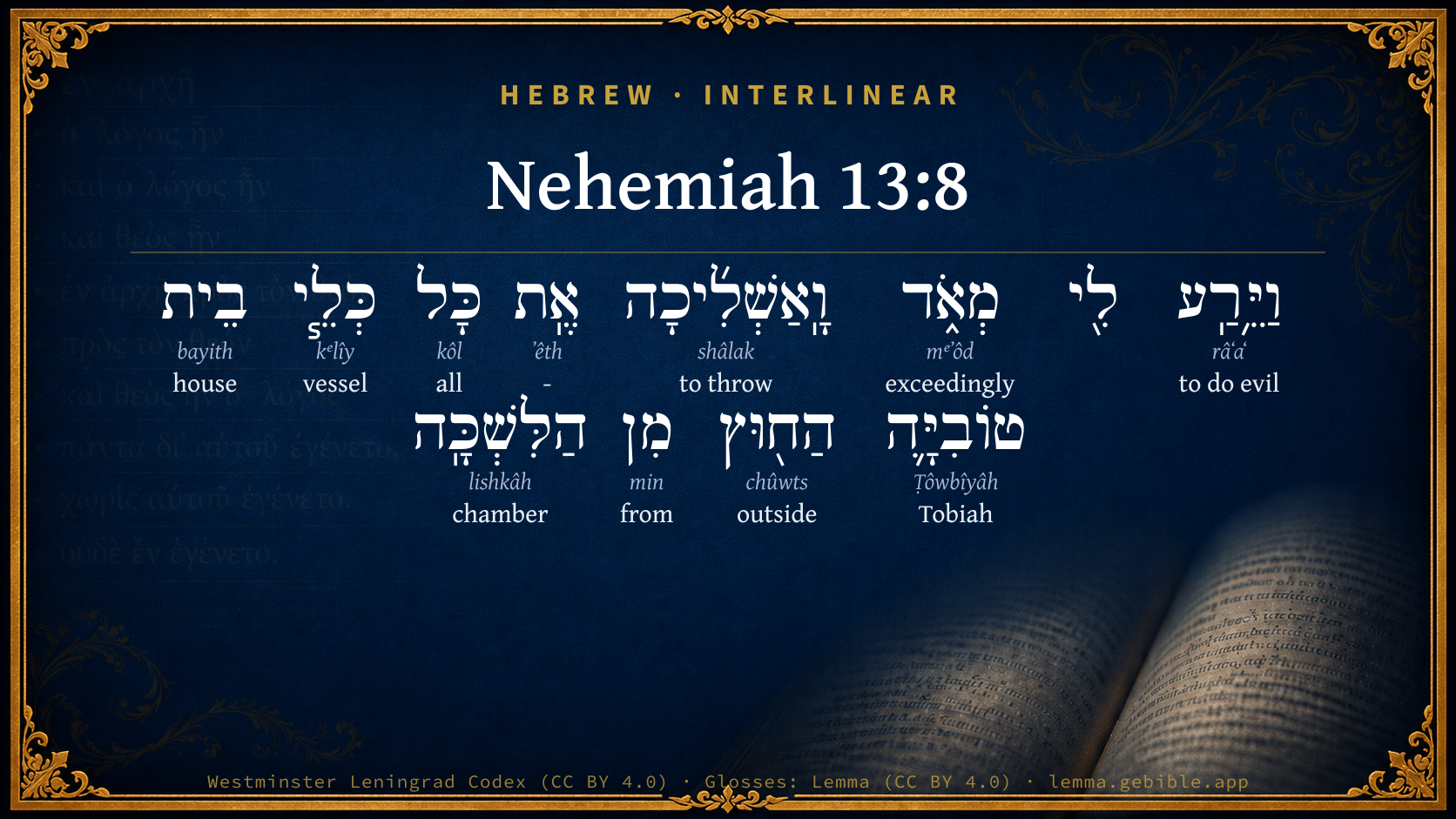
  1. וַיֵּ֥רַֽע râʻaʻ H7489 “and · to do evil” Conjunction + Verb, Qal, Sequential Imperfect, 3rd Person, Masculine, Singular
  2. מְאֹ֑ד mᵉʼôd H3966 “exceedingly” Adverb
  3. וָֽאַשְׁלִ֜יכָה shâlak H7993 “and · to throw” Conjunction + Verb, Hiphil, Sequential Imperfect, 1st Person, Common, Singular + Suffix, h
  4. אֶֽת ʼêth H853 “-” Particle, Direct Object
  5. כָּל kôl H3605 “all of” Noun, Common, Masculine, Singular, Construct
  6. כְּלֵ֧י kᵉlîy H3627 “vessels of” Noun, Common, Masculine, Plural, Construct
  7. בֵית bayith H1004 “house of” Noun, Common, Masculine, Singular, Construct
  8. הַח֖וּץ chûwts H2351 “the · outside” Particle, Definite Article + Noun, Common, Masculine, Singular, Absolute
  9. מִן min H4480 “from” Preposition
  10. הַלִּשְׁכָּֽה lishkâh H3957 “the · chamber” Particle, Definite Article + Noun, Common, Feminine, Singular, Absolute

About this verse

These counts appear in no published source. They are computed here, from the morphology-tagged text and Lemma’s own curated glosses. What Lemma adds →

12
words
11
distinct lemmas
Historical
section

Notable vocabulary

The rarest word here is טוֹבִיָּ֛ה Tobiah H2900 — appearing just 18 times in the whole Hebrew Bible.

Shared distinctive vocabulary

טוֹבִיָּ֛ה Tobiah H2900 occurs in 17 verses of the Hebrew Bible. Also found in:

Grammatical profile

  • 2 verbs
  • 6 nouns
  • 2 prepositions
  • 1 adverb
  • 1 particle

Verb forms

  • וַיֵּ֥רַֽע Qal · Sequential Imperfect
  • וָֽאַשְׁלִ֜יכָה Hiphil · Sequential Imperfect

Cross-references

5

Topical passages linked to Nehemiah 13:8 in the Treasury of Scripture Knowledge — connected by theme and wording, ordered by reader-vote popularity; previews shown in the World English Bible.

  • Ezra 9:3–4 When I heard this thing, I tore my garment and my robe, and plucked off the hair of my head and of my beard, and sat down confounded.
  • Ezra 10:1 Now while Ezra prayed and made confession, weeping and casting himself down before the house of God, there was gathered together to him out of Israel a very great assembly of men and women and children; for the people wept very sore.
  • Psalms 69:9 For the zeal of your house consumes me. The reproaches of those who reproach you have fallen on me.
  • Mark 11:15–17 They came to Jerusalem, and Jesus entered into the temple, and began to throw out those who sold and those who bought in the temple, and overthrew the tables of the money-changers, and the seats of those who sold the doves.
  • John 2:13–17 The Passover of the Jews was at hand, and Jesus went up to Jerusalem.

Cross-references courtesy of OpenBible.info (CC BY 4.0).

Hebrew and Greek witnesses Masoretic Hebrew ↔ Greek Septuagint

The same verse in the two great witnesses to the Old Testament, shown verse-for-verse.

These are two independent witnesses, not word-aligned to each other, and the Septuagint is shown in lemma (dictionary) form.

Hebrew Nehemiah 13:8 Masoretic · Westminster Leningrad Codex

וַיֵּ֥רַֽע לִ֖י מְאֹ֑ד וָֽאַשְׁלִ֜יכָה אֶֽת כָּל כְּלֵ֧י בֵית טוֹבִיָּ֛ה הַח֖וּץ מִן הַלִּשְׁכָּֽה

It grieved me sore: therefore I cast forth all the household stuff of Tobiah out of the chamber.

World English Bible · Public Domain

Greek LXX Structure differs

The Septuagint has no separate book of Nehemiah. Its Greek text is the second half of Esdras B (2 Esdras), chapters 11–23; Ezra is the first half (1–10).

A verse-for-verse comparison isn’t shown here because the chapters and verses don’t line up. Switch to the LXX edition with the MT / LXX toggle above to read the Greek directly.

Hebrew: Westminster Leningrad Codex (CC BY 4.0). Greek: Septuagint (public domain); English from a public-domain English Septuagint. How the Septuagint differs from the Hebrew →

Commentary

Notes on Nehemiah 13:8 from classic Christian and Jewish commentators (each source and its license shown beneath its notes). The classic Christian expositions comment on the surrounding passage and are grouped to its opening verse, so a note may address several verses; the Jewish commentaries on the Tanakh (Rashi and others) are per-verse, so they appear only where the commentator wrote on this verse.

Lemma curates 59 commentaries, every one of them public domain or Creative Commons licensed, each selected and text-cleaned for this edition rather than reprinted as found. About our sources →

Trapp's Complete Commentary

John Trapp

Neh 13:8 And it grieved me sore: therefore I cast forth all the household stuff of Tobiah out of the chamber.

Ver. 8. And it grieved me sore] Such was his zeal for God that he could not bear it; no more could Phineas those two naughty packs, nor Paul the idolatry of Athens, Act 17:16, his spirit was moved, he was in a fit, yea, almost besides himself, as the word παοωξυνετο signifieth. This the mad world counteth madness, 2Co 5:13, but madness in this case is better than mopishness, and the true zealot may answer his adversaries as David did Michal, 2Sa 6:21, or as Basil did the threatening prefect, who told him that he was mad, Opto me in aeternum sic delirare, I wish I may be so mad to my life’s end.

Therefore I cast forth all the household stuff of Tobiah] As a profane thing, not fit to be in so holy a place. True zeal, as fire, is active, and saith, Shall I budge, stop, or step back, because hoc Ithacus velit? remit my diligence for fear of a frown, loss, or mischief? Out of doors with this bondwoman and her son; down with this piece of grass, let Adonijah die, though Bathsheba intercede for him, &c.

John Trapp, A Commentary or Exposition upon All the Books of the Old and New Testament (1647–1656) — public domain. Text from a community e-Sword module.

Joseph Benson's Commentary

Neh 13:8. It grieved me sore — That so sacred a place should be polluted by one who, on many accounts, ought not to have come there, being no priest, a stranger, an Ammonite, and one of the worst of that people; and that all this should be done by the permission and order of the high-priest.

Joseph Benson's Commentary on the Old and New Testaments (1811–1818) — public domain. Text from a community e-Sword module.

Tyndale Open Study Notes

Tyndale Open Resources

13:8-9 I became very upset. . . . I demanded: When people rejected God’s instructions, Nehemiah refused to be silent. • Everything associated with the Temple had to be purified and consecrated to God. The clothes that the priests and Levites wore (Exod 29), the priests themselves (Lev 8–9), the Temple building and altars (Lev 16:15-33), and all the holy things (1 Chr 23:28) were purified (cp. 2 Chr 29:5, 15-19).

Tyndale Open Study Notes — © Tyndale Open Resources, licensed CC BY-SA 4.0. Text via the HelloAO Bible API.

Adam Clarke's Commentary

Verse 8. I cast forth all the household stuff of Tobiah] He acted as Jesus Christ did when he found the courts of the Lord's house profaned: He overthrew the tables of the moneychangers, and the seats of those who sold doves.

Adam Clarke's Commentary on the Bible (1810–1826) — public domain. Text from a community e-Sword/MySword module.

Ellicott's Commentary for English Readers

(8) It grieved me sore.—The second time we read of Nehemiah’s deep emotion: first, because of the utter dissoluteness of which this was a token; and secondly, because it was a priestly desecration.

A Bible Commentary for English Readers, edited by Charles John Ellicott (1878–1897) — public domain. Text from a community e-Sword module.

The Cambridge Bible for Schools and Colleges

gen. ed. J. J. S. Perowne

8. it grieved me sore] Cf. Neh_2:10, ‘it grieved them exceedingly.’

all the household stuff] Literally, ‘all the vessels of the house.’ ‘Stuff’ = the furniture, an old English word. For ‘stuff’ in this sense cf. Gen_31:37; Gen_45:20; 1Sa_10:22. Aldis Wright (Bible Word-Book, ed, 1, p. 463) cites, in illustration of this word, Hall (Hen. IV. fol. 26 b), ‘Sir Thomas Rampston knight the kynges vice-chamberlain with all his chamber stuffe, And apparell;’ and Shakespeare (Com. of Errors IV. 4), ‘Therefore away to get our stuffe aboard.’

The Cambridge Bible for Schools and Colleges (gen. ed. J. J. S. Perowne; Cambridge University Press, 1878–1918) — public domain. Text from a community e-Sword module.

John Gill's Exposition

Then I commanded, and they cleansed the chambers,.... By which it appears there were more than one, or that several were thrown into one; which was done not only by washing them, but as this was a ceremonial uncleanness, contracted by the habitation of an Heathen in them, their purification might be by the water of separation, Num 19:9

and thither brought I again the vessels of the house of God, with the meat offering and the frankincense; replaced them where they were before.

John Gill's Exposition of the Whole Bible (1746–1763) — public domain (CC PDM 1.0). Text via the HelloAO Bible API.

Haydock's Catholic Bible Commentary

And I. Nehemias acted as governor, and performed the duty which the high priest neglected. (Calmet)

George Leo Haydock (1774–1849), Haydock's Catholic Family Bible and Commentary, 1859 edition — public domain. Excludes Psalms (Douay-Rheims chapter numbering differs from Protestant) and Deuterocanonical books (Catholic canon only).

Matthew Poole's English Annotations

It grieved me sore, that so sacred a place should be polluted by one who in many respects ought not to have come there, being no priest, a stranger, an Ammonite, and one of the worst of that people; and that all this should be done by the permission and order of the high priest, who by his office should have punished and reformed these things in others.

Matthew Poole's English Annotations on the Holy Bible (1683–1685) — public domain. Text from a community e-Sword/MySword module.

Whedon's Commentary on the Bible

Daniel D. Whedon

8. I cast forth all the household stuff — The violence of the act was expressive of his indignation and grief. The mention of household stuff shows that Tobiah had used the chamber for his residence while at Jerusalem.

Daniel D. Whedon (gen. ed.), Commentary on the Old and New Testaments (1874–1909) — public domain. Text from a community e-Sword module.

The Pulpit Commentary

Therefore cast I forth all the household stuff. Tobiah had furnished his "chamber" as a dwelling-house, filling it with "household stuff" of various kinds. Nehemiah, of his own authority, had the whole of it turned out of doors.

The Pulpit Commentary (1880–1919), ed. H.D.M. Spence-Jones & Joseph S. Exell — public domain. Text from a community e-Sword module.

John Wesley's Explanatory Notes

Grieved me - That so sacred a place should be polluted by one who in many respects ought not to come there, being no priest, a stranger, an Ammonite, and one of the worst of that people; and that all this should be done by the permission and order of the high-priest.

John Wesley, Explanatory Notes Upon the Whole Bible (1754–1765) — public domain. Text via the GEBible commentary corpus.

Keil & Delitzsch

C. F. Keil & F. Delitzsch

This so greatly displeased him, that he cast out all the household stuff of Tobiah, and commanded the chamber to be purified, and the vessels of the house of God, the meat-offering and the frankincense, and probably the tenths and heave-offerings also, the enumeration being here only abbreviated, to be again brought into it. From the words household stuff, it appears that Tobiah used the chamber as a dwelling when he came from time to time to Jerusalem.

Keil & Delitzsch — Biblical Commentary on the Old Testament (1861–1891) — public domain (CC PDM 1.0). Text via the HelloAO Bible API. (Old Testament only.)

unfoldingWord translationNotes

Door43 World Missions Community

translationWords

anger

household

pure

house of God

grain offering

incense

unfoldingWord translationNotes — © Distant Shores Media and the Door43 World Missions Community, licensed CC BY-SA 4.0. Source: git.door43.org/Door43/en_tn.

Lesson kit

Teaching starters — assembled from the data on this page, not authored interpretation. Every prompt links to the verse data it draws on. Edit before teaching.

Nehemiah, in the Historical, opens this verse with 12 words (11 distinct Hebrew lemmas). Its most distinctive word is Ṭôwbîyâh (“Tobiah”). A historical commentator’s framing appears above. Read the whole chapter for the surrounding context.

Discussion questions

  1. What does “Tobiah” (Ṭôwbîyâh) contribute to the verse as a whole?
  2. How does 2 Chronicles 17:8, which shares the word «Tobiah», read alongside this verse?
  3. These translations render this verse differently; the difference is in the English rendering, not the original. What questions does that raise?
  4. «וַיֵּ֥רַֽע» is a Qal Sequential Imperfect verb. How does that grammatical form shape the action described?
  5. Compare how Trapp's Complete Commentary and Joseph Benson's Commentary read this verse. Where do they agree or differ?

Things to notice

Reading settings

Reading text

Shown beneath each verse's original-language words.

Old Testament
Old Testament edition

Read the OT as the Masoretic Hebrew (MT) or the Greek Septuagint (LXX).

English shown for the Greek Septuagint (in the Hebrew ↔ Greek comparison).

Comparing translations? Open the Compare panel on any verse page to stack up to four side by side.