Leviticus 13:46

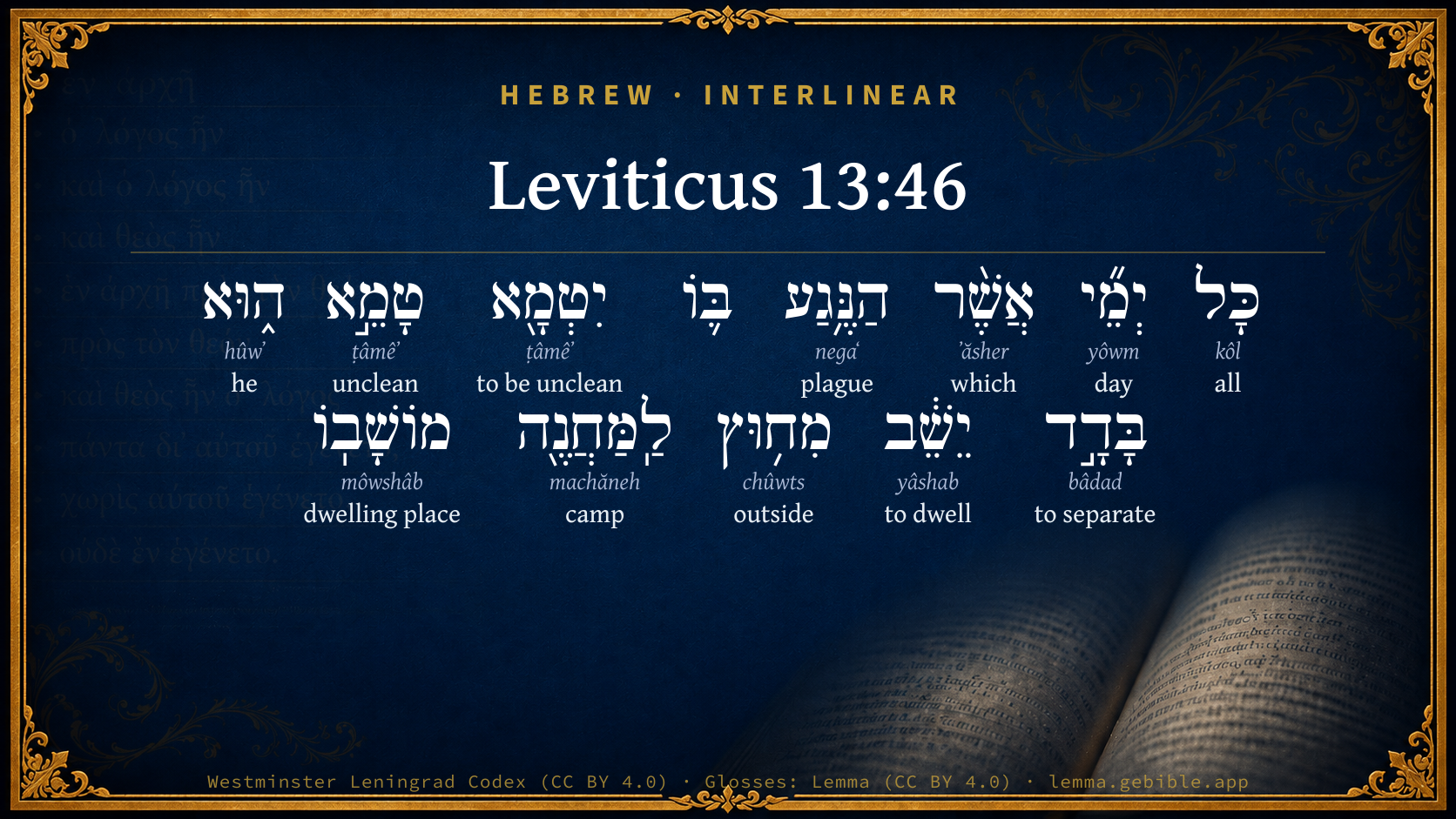
Hebrew (Westminster Leningrad Codex) Leviticus 13:46 appears in the Hebrew Old Testament. The text above is from the Westminster Leningrad Codex. Each word links to its Strong’s number, a concise gloss, and parsing drawn from the Open Scriptures Hebrew Bible morphology. Click any word for its full Brown-Driver-Briggs (BDB) entry.
Download image
Cite this verse

Leviticus 13:46 (World English Bible). Public Domain. Lemma interlinear Bible study tool, https://lemma.gebible.app/v/leviticus/13/46.

Show BibTeX & RIS
BibTeX
RIS
English Translation
All the days in which the plague is in him he shall be unclean. He is unclean. He shall dwell alone. Outside of the camp shall be his dwelling.
World English Bible · Public Domain
Highlights
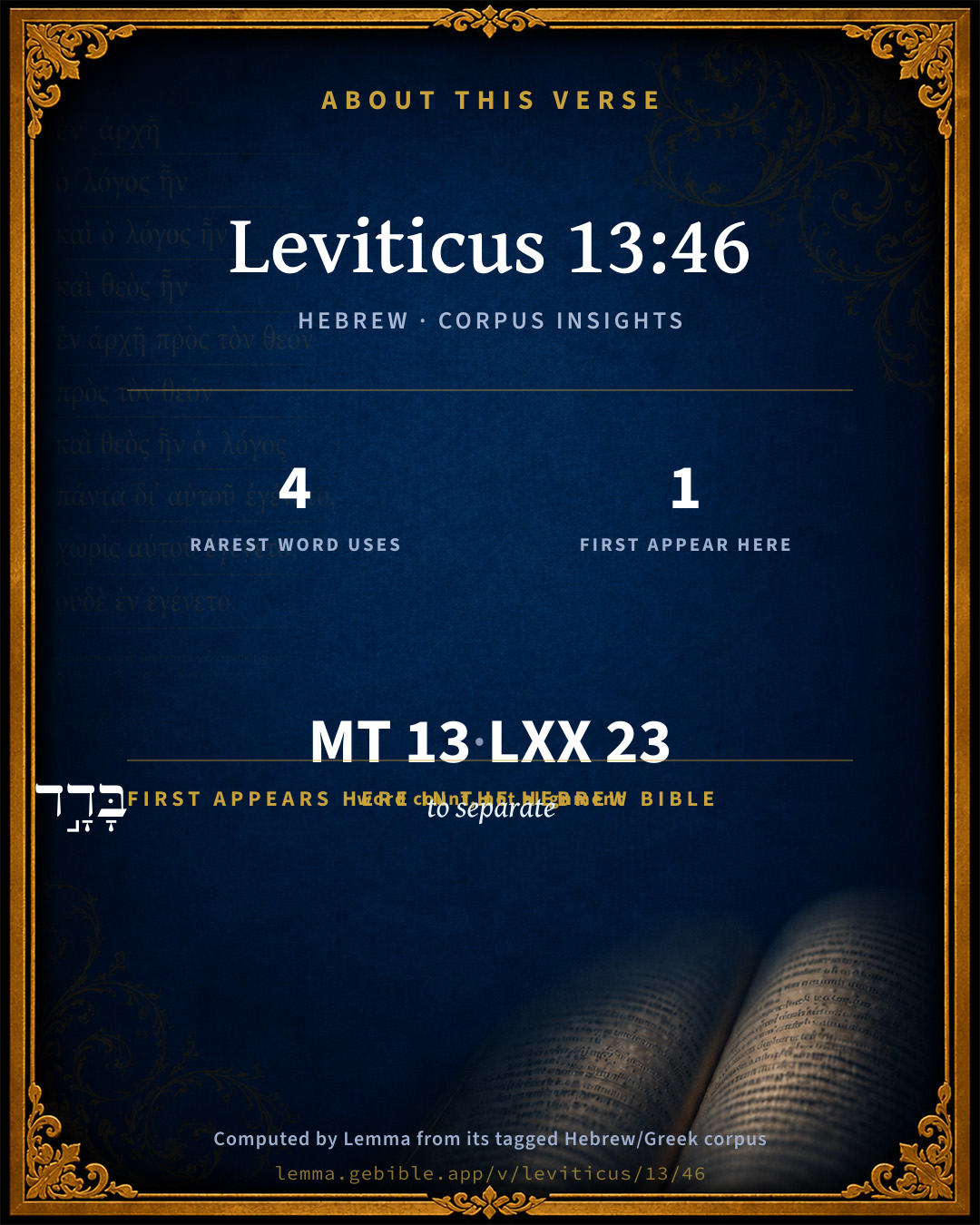
  • 1 first appearance in the Hebrew Bible
Full analysis ↓
Download a study sheet

One document with this verse’s original text, its word-by-word gloss line, the meaning frame, cross-references with their text, attributed commentary, and full source and license credits — printable, and it pastes into notes with its structure intact.

This verse Autodidact and up

Study sheet (.html) Plain text (.txt)

A passage Seminary Student

Up to 50 verses in one chapter. A passage sheet keeps up to 6 commentary sources and 12 cross-references per verse, in the order this page ranks them, and says so on the sheet whenever that leaves anything out. Ask for a single verse and you get the Autodidact verse sheet above.

Everything on this page stays free to read, with no account — the sheet is a download of what is already on screen, not access to it.

Want to remove ads? Support Godless Engineer
Compare translations 3

The same verse in 3 English versions, stacked beneath the original-language interlinear above. Click any original word for its lexicon entry.

Each is an independent rendering of the whole verse — the interlinear is not word-aligned to these translations.

Highlighted words mark where these versions differ — a whole-verse word diff, not a word-by-word alignment.

  • World English Bible Public Domain
    All the days in which the plague is in him he shall be unclean. He is unclean. He shall dwell alone. Outside of the camp shall be his dwelling.
  • King James Version Public Domain
    All the days wherein the plague shall be in him he shall be defiled; he is unclean: he shall dwell alone; without the camp shall his habitation be.
  • unfoldingWord Literal Text CC BY-SA 4.0
    All the days that the infection on him he will be unclean. He unclean. He shall dwell alone; his dwelling outside the camp.

unfoldingWord Literal Text — © unfoldingWord, licensed CC BY-SA 4.0. Word-aligned USFM3 via Door43 (git.door43.org/unfoldingWord/en_ult).

Versions to compare (up to 4)

3 of 4 selected

Show all 18 translations

Every available English version of this verse, each an independent rendering of the whole verse.

  • World English Bible Public Domain
    All the days in which the plague is in him he shall be unclean. He is unclean. He shall dwell alone. Outside of the camp shall be his dwelling.
  • Berean Standard Bible Public Domain
    As long as he has the infection, he remains unclean. He must live alone in a place outside the camp.
  • Majority Standard Bible Public Domain
    As long as he has the infection, he remains unclean. He must live alone in a place outside the camp.
  • King James Version Public Domain
    All the days wherein the plague shall be in him he shall be defiled; he is unclean: he shall dwell alone; without the camp shall his habitation be.
  • American Standard Version (1901) Public Domain
    All the days wherein the plague is in him he shall be unclean; he is unclean: he shall dwell alone; without the camp shall his dwelling be.
  • Revised Version (1885) Public Domain
    All the days wherein the plague is in him he shall be unclean; he is unclean: he shall dwell alone; without the camp shall his dwelling be.
  • Geneva Bible (1599) Public Domain
    As long as the disease shall be vpon him, he shalbe polluted, for he is vncleane: he shall dwell alone, without the campe shall his habitation be.
  • Douay-Rheims (1899) Public Domain
    All the time that he is a leper and unclean, he shall dwell alone without the camp.
  • Young's Literal Translation Public Domain
    all the days that the plague `is' in him he is unclean; he `is' unclean, alone he doth dwell, at the outside of the camp `is' his dwelling.
  • Literal Standard Version CC BY-SA 4.0
    He is unclean all the days that the plague [is] in him; he [is] unclean. He dwells alone; his dwelling [is] at the outside of the camp.
  • Unlocked Literal Bible CC BY-SA 4.0
    All the days that he has the infectious disease he will be unclean. Because he is unclean with a disease that can spread, he must live alone. He must live outside the camp.
  • unfoldingWord Literal Text CC BY-SA 4.0
    All the days that the infection on him he will be unclean. He unclean. He shall dwell alone; his dwelling outside the camp.
  • Darby Bible Public Domain
    All the days that the sore shall be in him he shall be unclean: he is unclean; he shall dwell apart; outside the camp shall his dwelling be.
  • World Messianic Bible Public Domain
    All the days in which the plague is in him he shall be unclean. He is unclean. He shall dwell alone. His dwelling shall be outside of the camp.
  • Webster's Bible Public Domain
    All the days in which the plague shall be in him he shall be defiled; he is unclean: he shall dwell alone, without the camp shall his habitation be.
  • Free Bible Version CC BY-SA 4.0
    They remain unclean as long as the infection lasts. They have to live alone somewhere outside the camp.
  • Bible in Basic English Public Domain
    While the disease is on him, he will be unclean. He is unclean: let him keep by himself, living outside the tent-circle.
  • JPS Tanakh (1917) Public Domain
    All the days wherein the plague is in him he shall be unclean; he is unclean; he shall dwell alone; without the camp shall his dwelling be.

Literal Standard Version (2020), Covenant Press — licensed CC BY-SA 4.0. Text via the HelloAO Bible API (eBible.org). Unlocked Literal Bible (unfoldingWord) — licensed CC BY-SA 4.0. Text via the HelloAO Bible API (eBible.org). unfoldingWord Literal Text — © unfoldingWord, licensed CC BY-SA 4.0. Word-aligned USFM3 via Door43 (git.door43.org/unfoldingWord/en_ult). Free Bible Version, Dr. Jonathan Gallagher — licensed CC BY-SA 4.0. Text via the HelloAO Bible API (eBible.org).

Word by word

More ways to search: Search by grammar → Find every occurrence → Compare this word →

Practice this passage: Drill this verse → Learn its vocabulary →

בָּדָ֣ד
bâdad
H909
“alone”
Noun, Common, Masculine, Singular, Absolute
Part of Speech
Noun
Type
Common
Gender
Masculine
Number
Singular
State
Absolute
Full BDB Definition

Origin: a primitive root

TWOT: 201

to withdraw, be separate, be isolated - (Qal) an army straggler (participle) - of Ephraim (metaphorically) - (TWOT) alone
  1. כָּל kôl H3605 “all of” Noun, Common, Masculine, Singular, Construct
  2. יְמֵ֞י yôwm H3117 “days of” Noun, Common, Masculine, Plural, Construct
  3. אֲשֶׁ֨ר ʼăsher H834 “which” Particle, Relative
  4. הַנֶּ֥גַע negaʻ H5061 “the · plague” Particle, Definite Article + Noun, Common, Masculine, Singular, Absolute
  5. יִטְמָ֖א ṭâmêʼ H2930 “to be unclean” Verb, Qal, Imperfect, 3rd Person, Masculine, Singular
  6. טָמֵ֣א ṭâmêʼ H2931 “unclean” Adjective, Adjective, Masculine, Singular, Absolute
  7. ה֑וּא hûwʼ H1931 “he” Pronoun, Personal, 3rd Person, Masculine, Singular
  8. יֵשֵׁ֔ב yâshab H3427 “to dwell” Verb, Qal, Imperfect, 3rd Person, Masculine, Singular
  9. מִח֥וּץ chûwts H2351 “from · outside” Preposition + Noun, Common, Masculine, Singular, Absolute
  10. לַֽמַּחֲנֶ֖ה machăneh H4264 “to/for the · camp” Preposition, Determined + Noun, Common, Both, Singular, Absolute
  11. מוֹשָׁבֽוֹ môwshâb H4186 “dwelling place · his” Noun, Common, Masculine, Singular, Construct + Suffix, Personal, 3rd Person, Masculine, Singular

About this verse

These counts appear in no published source. They are computed here, from the morphology-tagged text and Lemma’s own curated glosses. What Lemma adds →

13
words
12
distinct lemmas
Pentateuch
section

Notable vocabulary

The rarest word here is בָּדָ֣ד to separate H909 — appearing just 4 times in the whole Hebrew Bible.

First appearance in Scripture

This word makes its first canonical appearance in the Hebrew Bible here:

  • בָּדָ֣ד to separate H909

Shared distinctive vocabulary

בָּדָ֣ד to separate H909 occurs in 4 verses of the Hebrew Bible. Also found in:

Grammatical profile

  • 2 verbs
  • 7 nouns
  • 1 adjective
  • 1 pronoun
  • 1 preposition
  • 1 particle

Verb forms

  • יִטְמָ֖א Qal · Imperfect
  • יֵשֵׁ֔ב Qal · Imperfect

Hebrew & Septuagint length

In English translation the verse runs 29 words from the Hebrew and 31 from the Septuagint (LXX English) — closely comparable.

A rough comparison of the two English renderings, which tokenize alike — not a word-level alignment.

Word counts can differ between the Hebrew and the Greek without any difference in meaning — e.g. the Hebrew direct-object marker אֵת has no separate Greek word, and Greek often adds the article ὁ.

In the original languages it is 13 Hebrew tokens and 23 Greek tokens — but the two are counted differently (Hebrew bundles its prefixes and suffixes into one token; the Greek is in lemma form), so that isn’t a like-for-like length.

Cross-references

17

Topical passages linked to Leviticus 13:46 in the Treasury of Scripture Knowledge — connected by theme and wording, ordered by reader-vote popularity; previews shown in the World English Bible.

  • 2 Kings 7:3 Now there were four leprous men at the entrance of the gate: and they said one to another, Why sit we here until we die?
  • 2 Kings 15:5 Yahweh struck the king, so that he was a leper to the day of his death, and lived in a separate house. Jotham the king's son was over the household, judging the people of the land.
  • Numbers 12:14–15 Yahweh said to Moses, If her father had but spit in her face, shouldn't she be ashamed seven days? let her be shut up outside of the camp seven days, and after that she shall be brought in again.
  • 2 Chronicles 26:21 Uzziah the king was a leper to the day of his death, and lived in a separate house, being a leper; for he was cut off from the house of Yahweh: and Jotham his son was over the king's house, judging the people of the land.
  • Numbers 5:1–4 Yahweh spoke to Moses, saying,
  • Proverbs 30:12 There is a generation that is pure in their own eyes, Yet are not washed from their filthiness.
  • Lamentations 1:1 How does the city sit solitary, that was full of people! She has become as a widow, who was great among the nations! She who was a princess among the provinces is become tributary!
  • Lamentations 1:8 Jerusalem has grievously sinned; therefore she is become as an unclean thing; All who honored her despise her, because they have seen her nakedness: Yes, she sighs, and turns backward.
  • Luke 17:12 As he entered into a certain village, ten men who were lepers met him, who stood at a distance.
  • 1 Corinthians 5:5 are to deliver such a one to Satan for the destruction of the flesh, that the spirit may be saved in the day of the Lord Jesus.
  • 1 Corinthians 5:9–13 I wrote to you in my letter to have no company with sexual sinners;
  • 2 Thessalonians 3:6 Now we command you, brothers, in the name of our Lord Jesus Christ, that you withdraw yourselves from every brother who walks in rebellion, and not after the tradition which they received from us.
  • 2 Thessalonians 3:14 If any man doesn't obey our word in this letter, note that man, that you have no company with him, to the end that he may be ashamed.
  • 1 Timothy 6:5 constant friction of people of corrupt minds and destitute of the truth, who suppose that godliness is a means of gain. Withdraw yourself from such.
  • Hebrews 12:15–16 looking carefully lest there be any man who falls short of the grace of God; lest any root of bitterness springing up trouble you, and thereby the many be defiled;
  • Revelation 21:27 There will in no way enter into it anything profane, or one who causes an abomination or a lie, but only those who are written in the Lamb's book of life.
  • Revelation 22:15 Outside are the dogs, the sorcerers, the sexually immoral, the murderers, the idolaters, and everyone who loves and practices falsehood.

Cross-references courtesy of OpenBible.info (CC BY 4.0).

Hebrew and Greek witnesses Masoretic Hebrew ↔ Greek Septuagint

The same verse in the two great witnesses to the Old Testament, shown verse-for-verse.

These are two independent witnesses, not word-aligned to each other, and the Septuagint is shown in lemma (dictionary) form.

Hebrew Leviticus 13:46 Masoretic · Westminster Leningrad Codex

כָּל יְמֵ֞י אֲשֶׁ֨ר הַנֶּ֥גַע בּ֛וֹ יִטְמָ֖א טָמֵ֣א ה֑וּא בָּדָ֣ד יֵשֵׁ֔ב מִח֥וּץ לַֽמַּחֲנֶ֖ה מוֹשָׁבֽוֹ

All the days in which the plague is in him he shall be unclean. He is unclean. He shall dwell alone. Outside of the camp shall be his dwelling.

World English Bible · Public Domain

Greek LXX Leviticus 13:46 Septuagint · lemma form

πᾶς ὁ ἡμέρα ὅσος ἄν εἰμί ἐπί αὐτός ὁ ἁφή ἀκάθαρτος εἰμί ἀκάθαρτος εἰμί χωρίζω καταἧμαι ἔξω ὁ παρεμβολή εἰμί αὐτός ὁ διατριβή

All the days in which the plague shall be upon him, being unclean, he shall be esteemed unclean; he shall dwell apart, his place of sojourn shall be without the camp.

LXX2012 (modern English Septuagint) · Public Domain

Hebrew: Westminster Leningrad Codex (CC BY 4.0). Greek: Septuagint (public domain); English from LXX2012 (modern English Septuagint) (Public Domain). How the Septuagint differs from the Hebrew →

Targum (Aramaic paraphrase)

2

The Targum is the ancient Jewish Aramaic paraphrase of the Hebrew Scriptures — an interpretive translation, not the Hebrew text itself. Onkelos (literal) and Pseudo-Jonathan (expansive) render the Torah, and Jonathan the Prophets. Coverage is partial: where no permissively-licensed English translation exists for a verse, only the Aramaic is shown. This is verse-level text, not a word-by-word alignment to the Hebrew.

  1. Targum Onkelos Torah (Genesis–Deuteronomy)
    כָּל יוֹמֵי דִי מַכְתָּשָּׁא בֵהּ יְהֵי מְסָאָב מְסָאָב הוּא בִּלְחוֹדוֹהִי יֵיתֵב מִבָּרָא לְמַשְׁרִיתָא מוֹתְבֵהּ

    (no public-domain English translation for this verse)

    Targum Onkelos — Aramaic: “Onkelos Genesis” (public domain); “Onkelos Exodus” (public domain); “Onkelos Leviticus” (public domain); “Onkelos Numbers” (public domain); “Onkelos Deuteronomy” (public domain). English: “Sefaria Community Translation” (CC0 1.0 (public-domain dedication)); “J.W. Etheridge. The Targums of Onkelos and Jonathan Ben Uzziel on the Pentateuch. London: Longmans, Green, 1862” (public domain). Text via Sefaria.

  2. Targum Pseudo-Jonathan Torah (Genesis–Deuteronomy)
    כָּל יוֹמִין דְמַכְתְּשָׁא בֵיהּ יְהֵי מְסָאָב מְטוּל דִמְסָאָב הוּא בִּלְחוֹדוֹי יְתוּב וּלְצַד אִינְתְּתֵיהּ לָא יִתְקְרֵב מִבָּרָא לְמַשְׁרִיתָא מוֹתְבֵיהּ

    All the days that the plague is in him he shall be unclean, for unclean he is; he shall dwell alone by himself, to the side of his wife he must not come nigh, and his habitation shall be without the camp.

    Targum Pseudo-Jonathan — Aramaic: “Targum Jonathan on Genesis” (public domain); “Targum Jonathan on Exodus” (public domain); “Targum Jonathan on Leviticus” (public domain); “Targum Jonathan on Numbers” (public domain); “Targum Jonathan on Deuteronomy” (public domain). English: “The Targum of Jonathan ben Uzziel, trans. J. W. Etheridge, London, 1862” (public domain). Text via Sefaria.

Commentary

Notes on Leviticus 13:46 from classic Christian and Jewish commentators (each source and its license shown beneath its notes). The classic Christian expositions comment on the surrounding passage and are grouped to its opening verse, so a note may address several verses; the Jewish commentaries on the Tanakh (Rashi and others) are per-verse, so they appear only where the commentator wrote on this verse.

Lemma curates 59 commentaries, every one of them public domain or Creative Commons licensed, each selected and text-cleaned for this edition rather than reprinted as found. About our sources →

Trapp's Complete Commentary

John Trapp

Lev 13:46 All the days wherein the plague [shall be] in him he shall be defiled; he [is] unclean: he shall dwell alone; without the camp [shall] his habitation [be].

Ver. 46. Without the camp.] And that utterly, if incurable, as Uzzias. A lively type of excommunication, which the apostle describeth in 2Co 5:11-12, and our Saviour in Mat 18:17.

John Trapp, A Commentary or Exposition upon All the Books of the Old and New Testament (1647–1656) — public domain. Text from a community e-Sword module.

Joseph Benson's Commentary

Lev 13:46. He shall dwell alone — For his humiliation, to prevent the infection of others, and to show the danger of converse with spiritual lepers, or notorious sinners. Without the camp shall his habitation be — See Num 5:2. In after times they were shut out of the cities, as now out of the camp, (2Ki 7:3,) and there they dwelt by themselves, 2Ki 15:5; and so it was among other nations.

Joseph Benson's Commentary on the Old and New Testaments (1811–1818) — public domain. Text from a community e-Sword module.

Tyndale Open Study Notes

Tyndale Open Resources

13:46 The Tabernacle containing the Ark was in the center of the camp so that God could be considered as being in the camp (Deut 23:14). As long as an individual’s skin disorder persisted, he or she was to stay in isolation . . . outside the camp. This ensured that the infection would not spread to others and that the uncleanness would not come in contact with holy things. Even Miriam, sister of Moses and Aaron, had to spend seven days outside the camp (Num 12:15). This area was not exclusive to those suffering from skin disorders. The uneaten sin offering was taken there and burned (Lev 4:21). Criminals were executed there (24:14, 23), and corpses were carried there to avoid contaminating the area where the people lived (10:4-5). Even bodily functions were attended to outside the camp (Deut 23:12-14).

Tyndale Open Study Notes — © Tyndale Open Resources, licensed CC BY-SA 4.0. Text via the HelloAO Bible API.

Jamieson, Fausset & Brown

Robert Jamieson, A. R. Fausset & David Brown

he shall dwell alone; without the camp--in a lazaretto by himself, or associated with other lepers (Kg2 7:3, Kg2 7:8).

Jamieson, Fausset & Brown — Commentary Critical and Explanatory on the Whole Bible (1871) — public domain (CC PDM 1.0). Text via the HelloAO Bible API.

Ellicott's Commentary for English Readers

(46) He shall dwell alone.—In consequence of his extreme defilement, the leper had to live in seclusion outside the camp or city (Num_5:1-4; Num_13:10-15; 2Ki_7:3, &c.). According to the legislation during the second Temple, if he stood under a tree and a clean person happened to pass by, he defiled the passer by. In the synagogue which he wished to attend they were obliged to make him a separate compartment, ten handbreadths high and four cubits long and broad. He had to be the first to go in and the last to leave the synagogue. Hence, leprosy was regarded as a living death, and as an awful punishment from the Lord (2Ki_5:7; 2Ch_26:20), which they invoked upon all their mortal enemies (2Sa_3:29; 2Ki_5:27). The leper was debarred from conjugal intercourse. These ancient Rabbinic laws were imported into the Christian Church during the Middle Ages. When any one was afflicted with this distemper, the priest, wearing his stole and holding the crucifix, conducted him into the church, where the leper had to exchange his clothes for a peculiar black garment, and the mass was read over him and the service for the dead. He was then taken to a sequestered house, where earth was thrown upon his feet as a sign of burial, and was admonished never to appear otherwise than in his black garment and barefooted. He was not allowed to enter a church, or any place where there was a mill or bread was baked, or come near a well or fountain. He forfeited both the right of inheritance and of disposing of his property, for he was considered a dead man.

A Bible Commentary for English Readers, edited by Charles John Ellicott (1878–1897) — public domain. Text from a community e-Sword module.

John Gill's Exposition

Whether it be in the warp, or woof, of linen, or of woollen,.... When these are woven and mixed together, it seems difficult, if not impossible, to judge whether the plague of leprosy was in the one or in the other; one would think it should be unavoidably in both; wherefore Castalio renders the words, whether "in the outer part of it, or in the inner"; in the outside or inside, or what we call the right side or the wrong side of the cloth: but to me it seems that the warp and woof, whether of linen or woollen, are here distinguished not only from garments made of them, but from the cloth itself, of which they are made, and even to be considered before they are wrought together in the loom; and, according to the Jews, when upon the spindle (m):

whether in a skin, or anything made of skin; that is, whether in unwrought skin, which is not made up in anything, or in anything that is made of skins, as tents, bottles, &c. but skins of fishes, according to the Jewish traditions, are excepted; for so they say (n), sea skins, i.e. skins of fishes, are not defiled by plagues (of leprosy); for which the commentators (o) give this reason, that as wool and linen are of things which grow out of the earth, so must the skins be; that is, of such animals as live by grass, that springs out of the earth; but if anything was joined unto them, which grew out of the earth, though but a thread, that received uncleanness, it was defiled.

(m) Misn. Negaim, c. 11. sect. 8. (n) Misn. Negaim, c. 11. sect. 1. (o) Maimon. & Bartenora in Misn. Edait, c. 7. sect. 8.

John Gill's Exposition of the Whole Bible (1746–1763) — public domain (CC PDM 1.0). Text via the HelloAO Bible API.

Albert Barnes' Notes on the Bible

Dwell alone - More properly, dwell apart; that is, separated from the people.

Though thus excluded from general contact with society, it is not likely that lepers ceased to be objects of sympathy and kindness, such as they now are in those Christian and Moslem countries in which the leprosy prevails. That they associated together in the holy land, as they do at present, is evident from 2Ki 7:3; Luk 17:12. It has been conjectured that a habitation was provided for them outside Jerusalem, on the hill Gareb (Bezetha), which is mentioned only in Jer 31:39.

Without the camp - Compare the margin reference. A leper polluted everything in the house which he entered. A separate space used to be provided for lepers in the synagogues.

Albert Barnes' Notes on the Bible (1834–1885) — public domain. Text from a community e-Sword/MySword module.

Haydock's Catholic Bible Commentary

Camp, or city, unless some great man, like king Ozias, might be permitted to dwell there in a house, secluded from all society, 4 Kings xv. 5. --- 2 Paralipomenon xxvi. 21.

George Leo Haydock (1774–1849), Haydock's Catholic Family Bible and Commentary, 1859 edition — public domain. Excludes Psalms (Douay-Rheims chapter numbering differs from Protestant) and Deuterocanonical books (Catholic canon only).

Matthew Poole's English Annotations

Partly, for his humiliation; partly, to prevent the infection of others; and partly, to show the danger of converse with spiritual lepers or notorious sinners. This rule excludes the society of sound persons, but not of lepers. See 2Ki 15:5; 2Ch 26:21.

Without the camp; so Num 12:14; and afterward without cities and places of great concourse, whereof we have examples, 2Ki 7:3; Luk 17:12.

Matthew Poole's English Annotations on the Holy Bible (1683–1685) — public domain. Text from a community e-Sword/MySword module.

Whedon's Commentary on the Bible

Daniel D. Whedon

LEPROSY IN A GARMENT, Lev_13:47-59.

Moses proceeds to describe a leprous garment in the very words used to describe the leprosy in a man — plague or stroke of leprosy. This has moved the mirth of some and the wonder of others. For it is evident that the garments of the leper are not intended. 1.) The method of purifying these is described in Lev_14:8. 2.) The infection is described as visibly spreading in the garment. This is totally unlike “the garment spotted with the flesh.” 3.) It is subject to priestly inspection and condemnation before it is to be destroyed. 4.) No connexion of the leprous garment with a leprous wearer is hinted at. There must therefore be possible in garments something analogous to the loathsome leprosy in mankind. Here modern science comes to our aid in vindication of the accuracy of the Mosaic account. It is well known that there are some skin-diseases which originate in a genus of small spiders called acarus, embracing the mites and ticks, and other cutaneous disorders proceeding from a fungus. The analogy between the insect which frets the human skin and that which frets the garment is close enough for the proposes of the ceremonial law.

47. Woollen… or linen — Garments composed of the wool of sheep or of flax were, according to Jewish canons, exposed to this ceremonial impurity. Silk, hemp, camel’s hair, and other substances are not liable to the plague. But mixed fabrics in which wool or flax predominates are capable of contracting this impurity.

48. Anything made of skin — Dyed skins and garments are not rendered unclean by leprosy.

Warp or woof — The vermin or animalculae may eat the threads of either, leaving the other untouched. Michaelis in his researches upon this subject found an intelligent woollen manufacturer in Germany who testified that when dead wool, or the wool of sheep which have died of disease, is used for either the warp or the woof, vermin are apt to establish themselves in it, particularly when it is worn close to the body and warmed thereby. The cloth woven of such wool not only becomes very soon bare, but first full of little depressions and then holes.

The Jews, from want of linen and from poverty, always wore woollen next the skin; hence their flesh was specially exposed to pollution from these infinitesimal insects of the moth genus. It has been suggested that the leprosy in linen is mildew, which spreads in partially coloured spots, till it gradually eats up the garment. In leather a delicate fungus or cryptogam eats holes under certain circumstances.

49. Greenish or reddish — Moths by eating away the nap produce a slight discoloration, but mildew and rust cause spots of these colours.

51. A fretting leprosy — Properly an inveterate or exasperated leprosy or corrosion.

55. It is unclean — Here we observe that the spreading of the spot is not a required indication of uncleanness, but simply the continuance of the stain after washing and drying. Indelible rust or mildew would therefore render a garment unclean.

Fret inward — Literally, it is a hollow in its back-baldness or in its front-baldness — a depression of the front or back side of the cloth, caused by eating off the nap. This scrupulous care of garments was a part of that process by which the idea of spiritual purity was to be developed through physical purity. First, the natural, afterward the spiritual. 1Co_15:46. 4.) The leprous garment is not treated as contagious, since washing would develop the infection. 5.) According to Jewish law a minor, a heathen, a proselyte, a leprous garment, and a leprous house of a non-Israelite, do not render unclean, nor does a bridegroom seized with leprosy defile any one during the first seven days of his marriage. 6.) Naaman, a leper, commanded the armies of Syria; Gehazi conversed with the king of Israel; and the leper in later times was not shut out from the synagogue nor from the Christian churches. We conclude, therefore, that the treatment of the leprosy prescribed by Moses was not sanitary, but ceremonial, like the separation and uncleanness of menstruous women, and other defilements under the Mosaic law as touching the dead, and having an issue, (Num_5:2,) the treatment of which had a far deeper reason than sanitary caution.

(3.) This view suggests the important question, Of what is the leprosy the type? It is not surprising that the Holy Scriptures, especially the New Testament, affords no direct answer, for there are some types, like some parables, whose spiritual import is so obvious that they need no further explanation. All minds instantly appreciate the intended moral lesson. It is enough for us to know that the principle is laid down in the Epistle to the Hebrews that the whole of the Jewish dispensation was typical — a shadow of good things to come in the Gospel. Hence we are not to expect that every type in the Levitical ritual will be explained in detail, and that its antitype be indicated in express terms by the spirit of inspiration. The leprosy, the only disease which rendered a person unclean, is an impressive type of the great moral malady, sin. This plague corrupts and destroys the soul, excludes from the society of the holy, and banishes the incurable to the eternal pest-house of hell. For this the only cleansing is the blood of Jesus Christ, as typically set forth in the cleansing of the leper in the next chapter. Says Hengstenberg, “Every leper was a living sermon, a loud admonition to keep unspotted from the world. The exclusion of lepers from the camp, from the holy city, conveyed figuratively the same lesson as is done in the New Testament passages. See notes on Mat_6:24; Col_3:5; Rev_21:27; Eph_5:5. It is only when we take this view of the leprosy that we account for the fact that just this disease so frequently occurs as the theocratic punishment of sin. The image of sin is best suited for reflecting it; he who is a sinner before God is represented as a sinner in the eyes of man also by the circumstance that he must exhibit before men the image of sin. God took care that the image and the thing itself were perfectly coincident, although, no doubt, there were exceptions.”

Leprosy is a living death, poisoning all the springs and corrupting all the humours of life, dissolving little by little the whole body, so that limb actually falls away from limb through decay. Hence the leper is the type of one dead in sin; the emblems of his misery are the same as those of mourning for the dead; and the means of cleansing him are the same as those prescribed for one who has touched a corpse, and which were never used except on these two occasions. The penitent cry of David, after his deadly sins, “Purge me with hyssop,” (Psa_51:7,) indicates a sense of utter spiritual defilement, faintly symbolized by the loathsome leprosy which was ceremonially cleansed with hyssop.

As the new-born children of leprous parents are often as pretty and as healthy in appearance as any others before the workings of the disease become visible in some of the signs described in this chapter, so the leprosy is a striking type of original or inborn depravity. If the sin principle in the sweetest babe is left unchecked by power divine he may unfold into a Nero, a Cesar Borgia, or a Robespierre.

46. Dwell alone — “The camp was afraid of contagion. Save the untouched by expelling the defiled.” The picture of a leper is a forlorn man with bare head, sitting in his booth without the camp, with his pitcher of water and loaf of bread by his side — supplies kindly left daily where he can find them, by his kindred within the camp or city. Where there is a number they were not forbidden to associate, as is seen 2Ki_7:3; Luk_17:12. Such separated unclean persons may be still seen in the east. Dr. Thomson saw one on a rocky hill living in a booth of green branches. There she passed wearisome days and lonely nights till death released her. “We remonstrated against such barbarity, and the men consented to have her brought into a hired room, where we could provide suitable food and prescribe for her disease. But the women rose in furious clamour and rebellion against the proposal, and it had to be abandoned. I was amazed at the barbarity of the women. They passed her by until she died; then, however, they assembled in troops, and screamed, and tossed their arms, and tore their hair, with boisterous lamentations.”

Daniel D. Whedon (gen. ed.), Commentary on the Old and New Testaments (1874–1909) — public domain. Text from a community e-Sword module.

The Pulpit Commentary

The right and duty of excommunication.

"He shall dwell alone; without the camp shall his habitation be." The right of expulsion from the Jewish camp would be founded, in the mind of Moses, on the Divine commandment. (text; Num_5:2, etc.) That was all-sufficient for the great legislator. We may, however, "justify the ways of God to men" to our mind by the considerations:

1. That if the disease were not positively contagious, the dread of contagion would be most harmful to the community.

2. That the exceeding repulsiveness of the leper was ample reason for his being kept from the sight of men, women, and children.

3. That the most important and salutary lesson concerning sin was thereby vividly enforced, viz. that the sinner is, through his iniquity, separated from all that is purest and best. Unquestionably, with this and other clear commandments from Jehovah, it was both the right and the duty of the Hebrew commonwealth to expel the leper from the comp. Excommunication from human society is a sad and severe measure; but it is, in many cases, lawful and even obligatory. The foul and the "unclean" must be separated sometimes, even now and here, from the holy and the pure. Excommunication may be

I THE RIGHT AND DUTY OF THE NATION.

1. The nation has a right to transport or imprison those of its members who have committed crime, and who have shown that their presence "in the camp" is noxious and dangerous to the rest.

2. The nation is bound to exclude from town and city those who endanger its morals. The opium-seller, as such, is righteously excluded; the man who would sell poisons without restriction is disallowed; and an unlimited number of dram shops, with their terrible enticements, is (or, surely; should be) prohibited. A community has the right to say, "We will not allow any man, for the sake of gain, seriously to imperil the morals, the health, and the lives of the people; if you want to practice these things, you must go "without the comp.

II THE RIGHT AND DUTY OF THE SOCIAL AND THE FAMILY CIRCLE.

1. We ought not to admit to our intimacy any "unclean" human spirit. We should fence our social circles so that no man sits down to our table or our hearth to infect and poison our own minds.

2. But it is, in an especial degree, both cur right and our duty, as parents, to guard the family circle from the intrusion of "the unclean." What untold evils, what unimaginable sorrows, have befallen family life, because parents have not, with holy vigilance, saved their sons and daughters from the companionship of the corrupt! Of every "unclean" soul let the human father say, with sternest inflexibility, "Without the camp shall his habitation be.

III THE RIGHT AND DUTY OF THE CHURCH. There can be no doubt of this.

1. It is the divinely appointed way. It was instituted by our Lord himself. (Mat_18:17, Mat_18:18) It was enjoined by the Apostle Paul; (1Co_5:2, 1Co_5:5, 11Ti 3:10) it was also practiced by him. (1Ti_1:20)

2. It is the legitimate and becoming method. Any interference by a Christian Church with civil rights goes beyond the Word of the Lord, brings the Church into conflict with the secular power, and is likely to lead to confusion and trouble. Exclusion from its own fellowship is a natural and incontestable right.

3. It is sometimes the only course that is open. It is needful for the purity of the Church itself; the leaven must not injure the whole lump. It is needful also for the offender. And it is well to remember these two things in such a sad necessity: viz.

(1) that excommunication was resorted to in apostolic times with a distinct view to the benefit of the offender; (1Co_5:5 1Ti_1:20) and

(2) that of two cases reported in Scripture, one relates the restoration of the excommunicated member. (2Co_2:6-8) Let the Church make paramount the preservation of its own purity, but let it encourage, expect, and welcome penitence. C.

The Pulpit Commentary (1880–1919), ed. H.D.M. Spence-Jones & Joseph S. Exell — public domain. Text from a community e-Sword module.

John Wesley's Explanatory Notes

He shall dwell alone - Partly for his humiliation; partly to prevent the infection of others; and partly to shew the danger of converse with spiritual lepers, or notorious sinners.

John Wesley, Explanatory Notes Upon the Whole Bible (1754–1765) — public domain. Text via the GEBible commentary corpus.

Rashi

Rabbi Shlomo Yitzchaki (Rashi)

בדד ישב HE SHALL ABIDE SOLITARY — This means that people who are unclean from other causes than that of leprosy shall not abide with him (Pesachim 67a; cf. Sifra). Our Rabbis said: Why is he (the leper) treated differently from other unclean persons that he should abide solitary? They replied: Because he, by slanderous statements, (cf. Numbers 12:10) parted man and wife, or a man from his friend, he must be parted from everybody (Arakhin 16b).

מחוץ למחנה WITHOUT THE CAMP — outside the three camps (see Rashi on Leviticus 4:12; cf. Sifra, Tazria Parashat Nega'im, Chapter 13 14 and Pesachim 67a).

Rashi on the Tanakh — English translations: “The Judaica Press complete Tanach with Rashi, translated by A. J. Rosenberg” (CC BY 4.0); “Pentateuch with Rashi's commentary by M. Rosenbaum and A.M. Silbermann, 1929-1934” (public domain); “The Metsudah Tanach series, Lakewood, N.J” (CC BY 4.0); and “The Book of Joshua, Metsudah Publications, 1997” (CC BY 4.0). Text via Sefaria.

Lesson kit

Teaching starters — assembled from the data on this page, not authored interpretation. Every prompt links to the verse data it draws on. Edit before teaching.

Leviticus, in the Pentateuch, opens this verse with 13 words (12 distinct Hebrew lemmas). Its most distinctive word is bâdad (“to separate”). A historical commentator’s framing appears above. Read the whole chapter for the surrounding context.

Discussion questions

  1. How does “to separate” (bâdad) shape what this verse is saying?
  2. The word “to separate” first appears here in Scripture. What is being introduced at this debut?
  3. Psalms 102:7 shares the word «to separate» with this verse. How do the two illuminate each other?
  4. These translations render this verse differently; the difference is in the English rendering, not the original. What questions does that raise?
  5. The verb «יִטְמָ֖א» is Qal Imperfect. How does its form color the action?
  6. Reading how Trapp's Complete Commentary and Joseph Benson's Commentary read this verse, where do the two commentators agree and where do they part?

Things to notice

Reading settings

Reading text

Shown beneath each verse's original-language words.

Old Testament
Old Testament edition

Read the OT as the Masoretic Hebrew (MT) or the Greek Septuagint (LXX).

English shown for the Greek Septuagint (in the Hebrew ↔ Greek comparison).

Comparing translations? Open the Compare panel on any verse page to stack up to four side by side.