
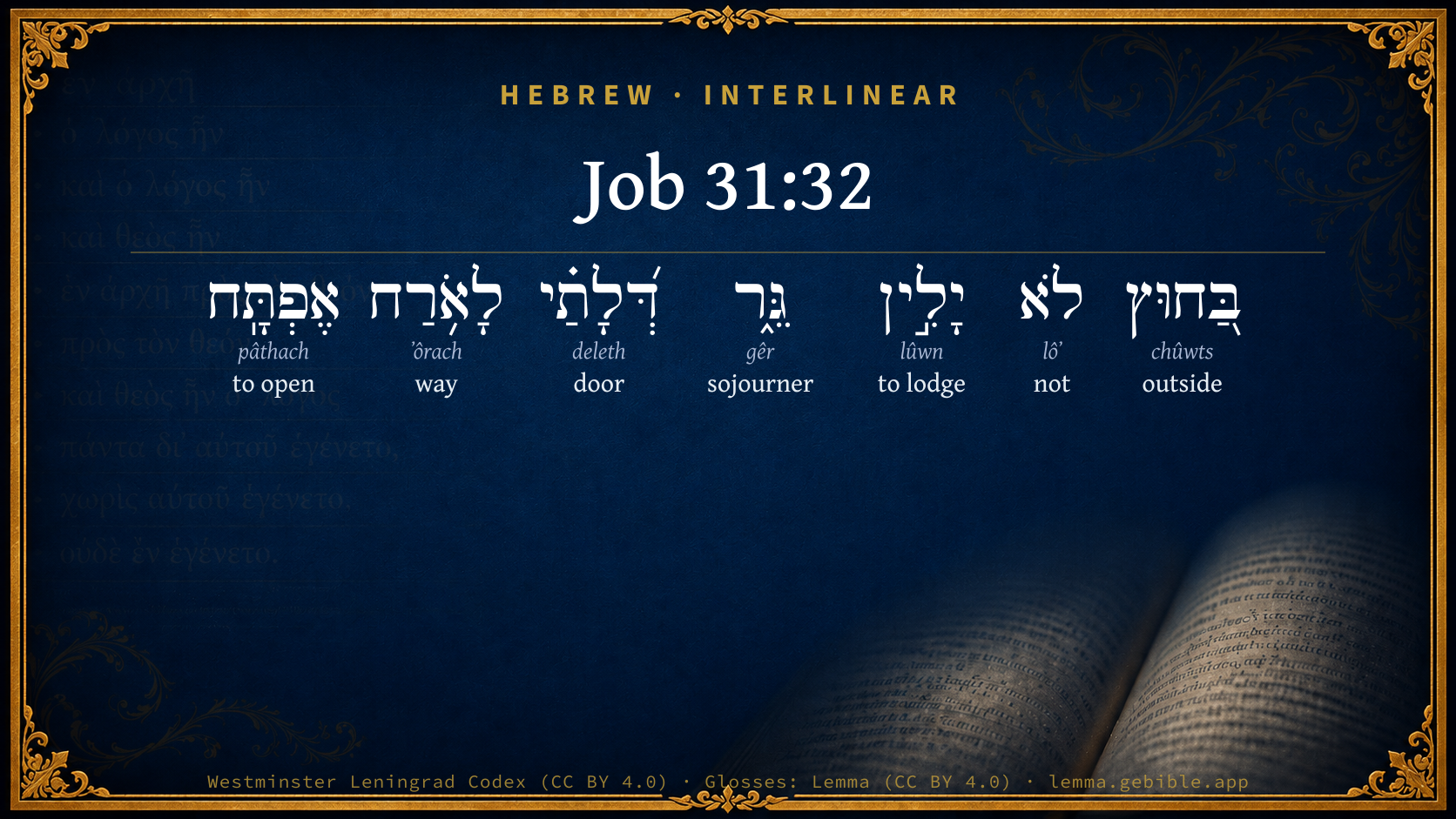
Job 31:32

Hebrew (Westminster Leningrad Codex) Job 31:32 appears in the Hebrew Old Testament. The text above is from the Westminster Leningrad Codex. Each word links to its Strong’s number, a concise gloss, and parsing drawn from the Open Scriptures Hebrew Bible morphology. Click any word for its full Brown-Driver-Briggs (BDB) entry.
Download image
Cite this verse

Job 31:32 (World English Bible). Public Domain. Lemma interlinear Bible study tool, https://lemma.gebible.app/v/job/31/32.

Show BibTeX & RIS
BibTeX
RIS
English Translation
(The foreigner has not lodged in the street; But I have opened my doors to the traveler);
World English Bible · Public Domain
Download a study sheet

One document with this verse’s original text, its word-by-word gloss line, the meaning frame, cross-references with their text, attributed commentary, and full source and license credits — printable, and it pastes into notes with its structure intact.

This verse Autodidact and up

Study sheet (.html) Plain text (.txt)

A passage Seminary Student

Up to 50 verses in one chapter. A passage sheet keeps up to 6 commentary sources and 12 cross-references per verse, in the order this page ranks them, and says so on the sheet whenever that leaves anything out. Ask for a single verse and you get the Autodidact verse sheet above.

Everything on this page stays free to read, with no account — the sheet is a download of what is already on screen, not access to it.

Want to remove ads? Support Godless Engineer
Compare translations 3

The same verse in 3 English versions, stacked beneath the original-language interlinear above. Click any original word for its lexicon entry.

Each is an independent rendering of the whole verse — the interlinear is not word-aligned to these translations.

Highlighted words mark where these versions differ — a whole-verse word diff, not a word-by-word alignment.

  • World English Bible Public Domain
    (The foreigner has not lodged in the street; But I have opened my doors to the traveler);
  • King James Version Public Domain
    The stranger did not lodge in the street: but I opened my doors to the traveller.
  • unfoldingWord Literal Text CC BY-SA 4.0
    The sojourner has not stayed overnight in the outdoors; I have opened my doors to the traveler.

unfoldingWord Literal Text — © unfoldingWord, licensed CC BY-SA 4.0. Word-aligned USFM3 via Door43 (git.door43.org/unfoldingWord/en_ult).

Versions to compare (up to 4)

3 of 4 selected

Show all 18 translations

Every available English version of this verse, each an independent rendering of the whole verse.

  • World English Bible Public Domain
    (The foreigner has not lodged in the street; But I have opened my doors to the traveler);
  • Berean Standard Bible Public Domain
    but no stranger had to lodge on the street, for my door has been open to the traveler—
  • Majority Standard Bible Public Domain
    but no stranger had to lodge on the street, for my door has been open to the traveler—
  • King James Version Public Domain
    The stranger did not lodge in the street: but I opened my doors to the traveller.
  • American Standard Version (1901) Public Domain
    (The sojourner hath not lodged in the street; But I have opened my doors to the traveller);
  • Revised Version (1885) Public Domain
    The stranger did not lodge in the street; but I opened my doors to the traveller;
  • Geneva Bible (1599) Public Domain
    The stranger did not lodge in the streete, but I opened my doores vnto him, that went by the way.
  • Douay-Rheims (1899) Public Domain
    The stranger did not stay without, my door was open to the traveller.
  • Young's Literal Translation Public Domain
    In the street doth not lodge a stranger, My doors to the traveller I open.
  • Literal Standard Version CC BY-SA 4.0
    A stranger does not lodge in the street, || I open my doors to the traveler.
  • Unlocked Literal Bible CC BY-SA 4.0
    (even the foreigner has never had to stay in the city square, because I have always opened my doors to the traveler), and if that is not so, then bring charges against me!
  • unfoldingWord Literal Text CC BY-SA 4.0
    The sojourner has not stayed overnight in the outdoors; I have opened my doors to the traveler.
  • Darby Bible Public Domain
    The stranger did not lodge without; I opened my doors to the pathway.
  • World Messianic Bible Public Domain
    (the foreigner has not camped in the street, but I have opened my doors to the traveler);
  • Webster's Bible Public Domain
    The stranger did not lodge in the street: but I opened my doors to the traveler.
  • Free Bible Version CC BY-SA 4.0
    I have never let strangers sleep in the street; I have opened my doors to travelers.
  • Bible in Basic English Public Domain
    The traveller did not take his night's rest in the street, and my doors were open to anyone on a journey;
  • JPS Tanakh (1917) Public Domain
    The stranger did not lodge in the street; my doors I opened to the roadside.

Literal Standard Version (2020), Covenant Press — licensed CC BY-SA 4.0. Text via the HelloAO Bible API (eBible.org). Unlocked Literal Bible (unfoldingWord) — licensed CC BY-SA 4.0. Text via the HelloAO Bible API (eBible.org). unfoldingWord Literal Text — © unfoldingWord, licensed CC BY-SA 4.0. Word-aligned USFM3 via Door43 (git.door43.org/unfoldingWord/en_ult). Free Bible Version, Dr. Jonathan Gallagher — licensed CC BY-SA 4.0. Text via the HelloAO Bible API (eBible.org).

Word by word

More ways to search: Search by grammar → Find every occurrence → Compare this word →

Practice this passage: Drill this verse → Learn its vocabulary →

About this verse

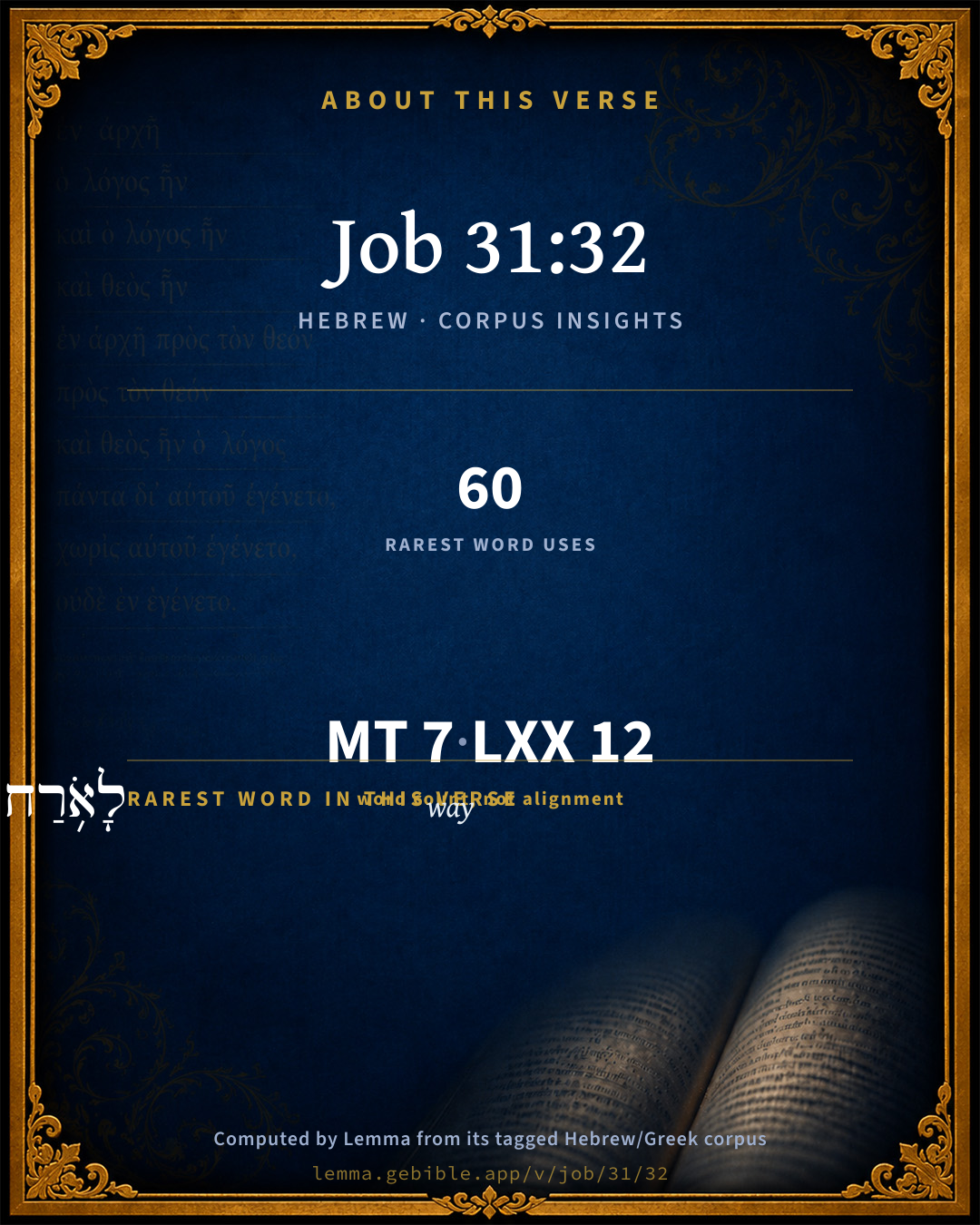
These counts appear in no published source. They are computed here, from the morphology-tagged text and Lemma’s own curated glosses. What Lemma adds →

7
words
7
distinct lemmas
Wisdom
section

Shared distinctive vocabulary

לָאֹ֥רַח way H734 occurs in 58 verses of the Hebrew Bible. Also found in:

Grammatical profile

  • 2 verbs
  • 4 nouns
  • 1 particle

Verb forms

  • יָלִ֣ין Qal · Imperfect
  • אֶפְתָּֽח Qal · Imperfect

Hebrew & Septuagint length

In English translation the verse runs 17 words from the Hebrew and 17 from the Septuagint (LXX English) — the same length.

A rough comparison of the two English renderings, which tokenize alike — not a word-level alignment.

Word counts can differ between the Hebrew and the Greek without any difference in meaning — e.g. the Hebrew direct-object marker אֵת has no separate Greek word, and Greek often adds the article ὁ.

In the original languages it is 7 Hebrew tokens and 12 Greek tokens — but the two are counted differently (Hebrew bundles its prefixes and suffixes into one token; the Greek is in lemma form), so that isn’t a like-for-like length.

Cross-references

12

Topical passages linked to Job 31:32 in the Treasury of Scripture Knowledge — connected by theme and wording, ordered by reader-vote popularity; previews shown in the World English Bible.

  • Hebrews 13:2 Don't forget to show hospitality to strangers, for in doing so, some have entertained angels without knowing it.
  • Genesis 19:2–3 and he said, "See now, my lords, please turn aside into your servant's house, stay all night, wash your feet, and you will rise up early, and go on your way." They said, "No, but we will stay in the street all night."
  • Judges 19:20–21 The old man said, Peace be to you; howsoever let all your wants lie on me; only don't lodge in the street.
  • Isaiah 58:7 Isn't it to deal your bread to the hungry, and that you bring the poor who are cast out to your house? when you see the naked, that you cover him; and that you not hide yourself from your own flesh?
  • Matthew 25:35 for I was hungry, and you gave me food to eat; I was thirsty, and you gave me drink; I was a stranger, and you took me in;
  • Romans 12:13 contributing to the needs of the saints; given to hospitality.
  • 1 Peter 4:9 Be hospitable one to another without grumbling.
  • Judges 19:15 They turned aside there, to go in to lodge in Gibeah: and he went in, and sat him down in the street of the city; for there was no man who took them into his house to lodge.
  • Job 31:17–18 Or have eaten my morsel alone, And the fatherless has not eaten of it
  • Matthew 25:40 "The King will answer them, 'Most assuredly I tell you, inasmuch as you did it to one of the least of these my brothers, you did it to me.'
  • Matthew 25:44–45 "Then they will also answer, saying, 'Lord, when did we see you hungry, or thirsty, or a stranger, or naked, or sick, or in prison, and didn't help you?'
  • 1 Timothy 5:10 being approved by good works, if she has brought up children, if she has been hospitable to strangers, if she has washed the saints' feet, if she has relieved the afflicted, and if she has diligently followed every good work.

Cross-references courtesy of OpenBible.info (CC BY 4.0).

Hebrew and Greek witnesses Masoretic Hebrew ↔ Greek Septuagint

The same verse in the two great witnesses to the Old Testament, shown verse-for-verse.

These are two independent witnesses, not word-aligned to each other, and the Septuagint is shown in lemma (dictionary) form.

Hebrew Job 31:32 Masoretic · Westminster Leningrad Codex

בַּ֭חוּץ לֹא יָלִ֣ין גֵּ֑ר דְּ֝לָתַ֗י לָאֹ֥רַח אֶפְתָּֽח

(The foreigner has not lodged in the street; But I have opened my doors to the traveler);

World English Bible · Public Domain

Greek LXX Job 31:32 Septuagint · lemma form

ἔξω δέ οὐ αὐλίζω ξένος ὁ δέ θύρα ἐγώ πᾶς ἔρχομαι ἀναοἴγω

for the stranger did not lodge without, and my door was opened to every one that came:)

LXX2012 (modern English Septuagint) · Public Domain

On this verse, Albert Barnes' Notes on the Bible discusses the Septuagint’s reading. Read the note in Commentary ↓

Hebrew: Westminster Leningrad Codex (CC BY 4.0). Greek: Septuagint (public domain); English from LXX2012 (modern English Septuagint) (Public Domain). How the Septuagint differs from the Hebrew →

Commentary

Notes on Job 31:32 from classic Christian and Jewish commentators (each source and its license shown beneath its notes). The classic Christian expositions comment on the surrounding passage and are grouped to its opening verse, so a note may address several verses; the Jewish commentaries on the Tanakh (Rashi and others) are per-verse, so they appear only where the commentator wrote on this verse.

Lemma curates 59 commentaries, every one of them public domain or Creative Commons licensed, each selected and text-cleaned for this edition rather than reprinted as found. About our sources →

Trapp's Complete Commentary

John Trapp

Job 31:32 The stranger did not lodge in the street: [but] I opened my doors to the traveller.

Ver. 32. The stranger did not lodge in the street] Job was so far from liking and commending those enraged stomachs of his servants, that be would not suffer strangers to lodge abroad in the night season. Gregory noteth here, that he speaketh first of his pacific disposition toward his enemies, and then of his hospitality; because, saith he, the heart must first be freed from malice and wrath, and then charity is to be exercised, that we might be accepted. Abraham neither set up an altar to God nor showed himself forward to entertain strangers, till Lot and he were reconciled. Hospitality is commended to our practice, both by the prophet Isaiah, Isa 58:7, by St Paul, Rom 12:13 Heb 13:2, and by St Peter, 1Pe 4:9. Of Cranmer, Tremellius testifietb, that he was homo Fιλοξενος nec minus φιλολογος, humane and hospitable, after the example of Abraham and Lot, whom Synesius therefore calleth Yεου εστιατορας, God entertainers. Julian the apostate reckoneth the hospitality of the primitive Christians among those three things that caused their religion to be so generally embraced. Of the Waldenses also, those ancient Protestants in Germany, it is reported that they could travel from Colen to Milan in Italy, and every night lodge with hosts of their own profession, who would bid them heartily welcome (Chrys. in Joan. της περι τους ξενους φιλανθρωπιας. Hinc tot olim Xenodochia).

But I opened my doors to the traveller] I bid the weary wayfaring man welcome to my house, and kept a good table for such. Mensa res sacra est, per quam Deus honoratur praeses amicitiae et hospitii. Job was known to be a good housekeeper, and was much resorted to; he set open his gate in the highway; so Beza, after Mercer, rendereth this text. It was his will, that that part of his house which bounded upon the highway side should always lie open, to harbour passengers, Jupiter φιλιος, τε και ξενιος dicebatur. Ad viam, vel versus viam.

John Trapp, A Commentary or Exposition upon All the Books of the Old and New Testament (1647–1656) — public domain. Text from a community e-Sword module.

Jamieson, Fausset & Brown

Robert Jamieson, A. R. Fausset & David Brown

traveller--literally, "way," that is, wayfarers; so expressed to include all of every kind (Sa2 12:4).

Jamieson, Fausset & Brown — Commentary Critical and Explanatory on the Whole Bible (1871) — public domain (CC PDM 1.0). Text via the HelloAO Bible API.

Adam Clarke's Commentary

Verse 32. The stranger did not lodge in the street] My kindness did not extend merely to my family, domestics, and friends; the stranger - he who was to me perfectly unknown, and the traveller - he who was on his journey to some other district, found my doors ever open to receive them, and were refreshed with my bed and my board.

Adam Clarke's Commentary on the Bible (1810–1826) — public domain. Text from a community e-Sword/MySword module.

Ellicott's Commentary for English Readers

(32) I opened my doors to the traveller.—The manners of Gen_19:2-3, Jdg_19:20-21, if not the incidents there recorded, are here implied. “The traveller” is literally the road or way: i.e., the wayfarer.

A Bible Commentary for English Readers, edited by Charles John Ellicott (1878–1897) — public domain. Text from a community e-Sword module.

The Cambridge Bible for Schools and Colleges

gen. ed. J. J. S. Perowne

32. to the traveller] The word might mean to the way, the street; the general sense is the same. The verse confirms Job’s universal hospitality and liberality.

The Cambridge Bible for Schools and Colleges (gen. ed. J. J. S. Perowne; Cambridge University Press, 1878–1918) — public domain. Text from a community e-Sword module.

John Gill's Exposition

Did I fear a great multitude?.... No, they did not deter him from confessing his sin in the most public manner, when sensible or convicted of it, and when such a public acknowledgment was necessary:

or did the contempt of families terrify me? no, the contempt he might suppose he should be had in by some families that knew him, and he was well acquainted with, did not terrify him from making a free and ingenuous confession of his sins:

that I kept silence; or "did I keep silence",

and went not out of the door? so as not to open his mouth by confession in public, but kept within doors through fear and shame; or else the sense is, that he was not intimidated from doing his duty as a civil magistrate, administering justice to the poor and oppressed; neither the dread of a clamorous mob, nor the contempt of families of note, or great personages, could deter him from the execution of his office with uprightness, so as to cause him to be silent, and keep at home; but without any regard to the fear of the one, or the contempt of the other, he went out from his house through the street to the court of judicature, took his place on the bench, and gave judgment in favour of those that were oppressed, though the multitude was against them, and even persons and families of note: or thus, though I could have put a great multitude to fear, yet the most contemptible persons in any family, so Aben Ezra and Ben Gersom interpret that phrase, the meanest person, or but a beggar, if his cause was just, terrified him; or such was the fear of God upon him, that he durst do no other than to do him justice; so that he could not open his mouth against him, or stir out of doors to do him the tease; injury; though perhaps it may be best of all, with Schultens, to consider these words as an imprecation, that if what he had said before from Job 31:24 was not true; if he was not clear from idolatry figurative, and literal, from a malicious and revengeful spirit, from inhospitality and unkindness to strangers, from palliating, excusing, and extenuating his sins; then as if he should say, may I be frightened with a tumult, or a multitude of people, and terrified with the public contempt of families; may I be as silent as a mope in my own house, and never dare to stir out of doors, or show my thee, or see face of any man any more: and then, before he had quite finished his account of himself, breaks out in the following manner.

John Gill's Exposition of the Whole Bible (1746–1763) — public domain (CC PDM 1.0). Text via the HelloAO Bible API.

Albert Barnes' Notes on the Bible

The stranger did not lodge in the street - This is designed to illustrate the sentiment in the previous verse, and to express his consciousness that he had showed the most generous hospitality.

But I opened my doors to the traveler - Margin, or way. The word used here ארח 'ôrach means properly way, path, road; but it also denotes those who travel on such a way; see Job 6:19, “The troops of Tema looked,” Hebrew ארח תימא têymâ' 'ôrach - the ways, or paths of Tema; that is, those who traveled in those paths. Vulgate here, viatori. Septuagint, “To everyone that came” - παντί ἐλθόντι panti elthonti. This was one of the methods of hospitality - the central and crowning virtue among the Arabs to this day, and among the Orientals in all ages. Among the boasts of hospitality, showing the place which this virtue had in their estimation, and the methods by which it was practiced, we may refer to such expressions as the following: “I occupy the public way with my tent;” that is, to every traveler without distinction, my tent is open and my table is spread. “He makes the public path the place for the cords of his tent;” that is, he fixed the pins and cords of his tent in the midst of the public highway, so that every traveler might enter. These examples are quoted by Schultens from the Hamasa. Another beautiful example may be taken from the same collection of Arabic poems. I give the Latin translation of Schultens:

Quam saepe latratum imitanti viatori, cui resonabat echo

Suscitavi ignem, cujus lignum luculentum

Properusque surrexi ad eum, ut praedae mihi loco esset,

Prae metu ne populus mens eum ante me occuparet.

That is, “How often to the traveler, imitating the bark of the dog, and the echo of whose voice was heard, have I kindled a fire, the shining wood of which I quick raised up to him, as one would hasten to the prey, in fear lest someone of my own people should anticipate me in the privileges and rites of hospitality.” The allusion to the imitation of the barking of a dog here, refers to the custom of travelers at night, who make this noise when they need a place of rest. This sound is responded to by the dogs which watch around the tents of their masters, and the sound is the signal for a general rush to show hospitality to the stranger. Burckhardt, speaking of the inhabitants of the Houran - the country east of the Jordan, and south of Damascus, says, “A traveler may alight at any house he pleases; a mat will be immediately spread for him, coffee made, and a breakfast or dinner set before him. In entering a village it has often happened to me, that several persons presented themselves, each begging that I would lodge at his house. It is a point of honor with the host never to receive the smallest return from a guest. Besides the private habitations, which offer to every traveler a secure night’s shelter, there is in every village the Medhafe of the Sheikh, where all strangers of decent appearance are received and entertained. It is the duty of the Sheikh to maintain this Medhafe, which is like a tavern, with the difference that the host himself pays the bill. The Sheikh has public allowance to defray these expenses, and hence a man of the Houran, intending to travel about for a fortnight never thinks of putting a single para in his pocket; he is sure of being every where well received, and of living better, perhaps, than at his own home.” Travels in Syria, pp. 294, 295.

Albert Barnes' Notes on the Bible (1834–1885) — public domain. Text from a community e-Sword/MySword module.

Matthew Poole's English Annotations

The stranger; or, traveller as it follows.

Did not lodge in the street; but in my house, according to the laws of hospitality, and the usage of those times, when there were no public inns provided for the conveniency of such persons: see Gen 18:3; 19:2; Jdg 19:15,21.

Matthew Poole's English Annotations on the Holy Bible (1683–1685) — public domain. Text from a community e-Sword/MySword module.

Whedon's Commentary on the Bible

Daniel D. Whedon

32. To the traveller — Literally, to the way. The Mishna has a precept, “Let thy house be open to the way, and may the poor be thy guests.” Christ was crucified near to the way. “Certainly the place of his execution was upon a frequented way.” (Meyer on Mat_27:39.) His heart is open for all wayfaring, sorrowing ones.

Daniel D. Whedon (gen. ed.), Commentary on the Old and New Testaments (1874–1909) — public domain. Text from a community e-Sword module.

The Pulpit Commentary

The stranger did not lodge in the street; i.e. "I did not suffer any stranger who came under my notice to lodge in the street, but, like Abraham, (Gen_18:2-8) went out to him, and invited him in, to partake of my hospitality." This is still the practice of Arab sheikhs in Syria, Palestine, and the adjacent countries (see Dr. Cunningham Geikie"s "Holy Land and the Bible," vol. 1. p. 283). But I opened my doors to the traveller; literally, to the way; i.e. "my house gave on the street, and I kept my house door open." Compare the Mishna, "Let thy house be open to the street" ("Pirke Aboth,"

The Pulpit Commentary (1880–1919), ed. H.D.M. Spence-Jones & Joseph S. Exell — public domain. Text from a community e-Sword module.

Rashi

Rabbi Shlomo Yitzchaki (Rashi)

to the road The doors of my house were not inside and enclosed by a gatehouse outside, or surrounded by corners to stop the wayfarers from coming, but open to the crossroads so that whoever wishes to come may do so.

Rashi on the Tanakh — English translations: “The Judaica Press complete Tanach with Rashi, translated by A. J. Rosenberg” (CC BY 4.0); “Pentateuch with Rashi's commentary by M. Rosenbaum and A.M. Silbermann, 1929-1934” (public domain); “The Metsudah Tanach series, Lakewood, N.J” (CC BY 4.0); and “The Book of Joshua, Metsudah Publications, 1997” (CC BY 4.0). Text via Sefaria.

Lesson kit

Teaching starters — assembled from the data on this page, not authored interpretation. Every prompt links to the verse data it draws on. Edit before teaching.

Job, in the Wisdom, opens this verse with 7 words (7 distinct Hebrew lemmas). Its most distinctive word is ʼôrach (“way”). A historical commentator’s framing appears above. Read the whole chapter for the surrounding context.

Discussion questions

  1. The word ʼôrach carries the sense “way.” How does it shape the verse?
  2. Genesis 18:11 shares the word «way» with this verse. How do the two illuminate each other?
  3. These translations render this verse differently; the difference is in the English rendering, not the original. What questions does that raise?
  4. The verb «יָלִ֣ין» is Qal Imperfect. How does its form color the action?
  5. Reading how Trapp's Complete Commentary and Jamieson, Fausset & Brown read this verse, where do the two commentators agree and where do they part?

Things to notice

Reading settings

Reading text

Shown beneath each verse's original-language words.

Old Testament
Old Testament edition

Read the OT as the Masoretic Hebrew (MT) or the Greek Septuagint (LXX).

English shown for the Greek Septuagint (in the Hebrew ↔ Greek comparison).

Comparing translations? Open the Compare panel on any verse page to stack up to four side by side.