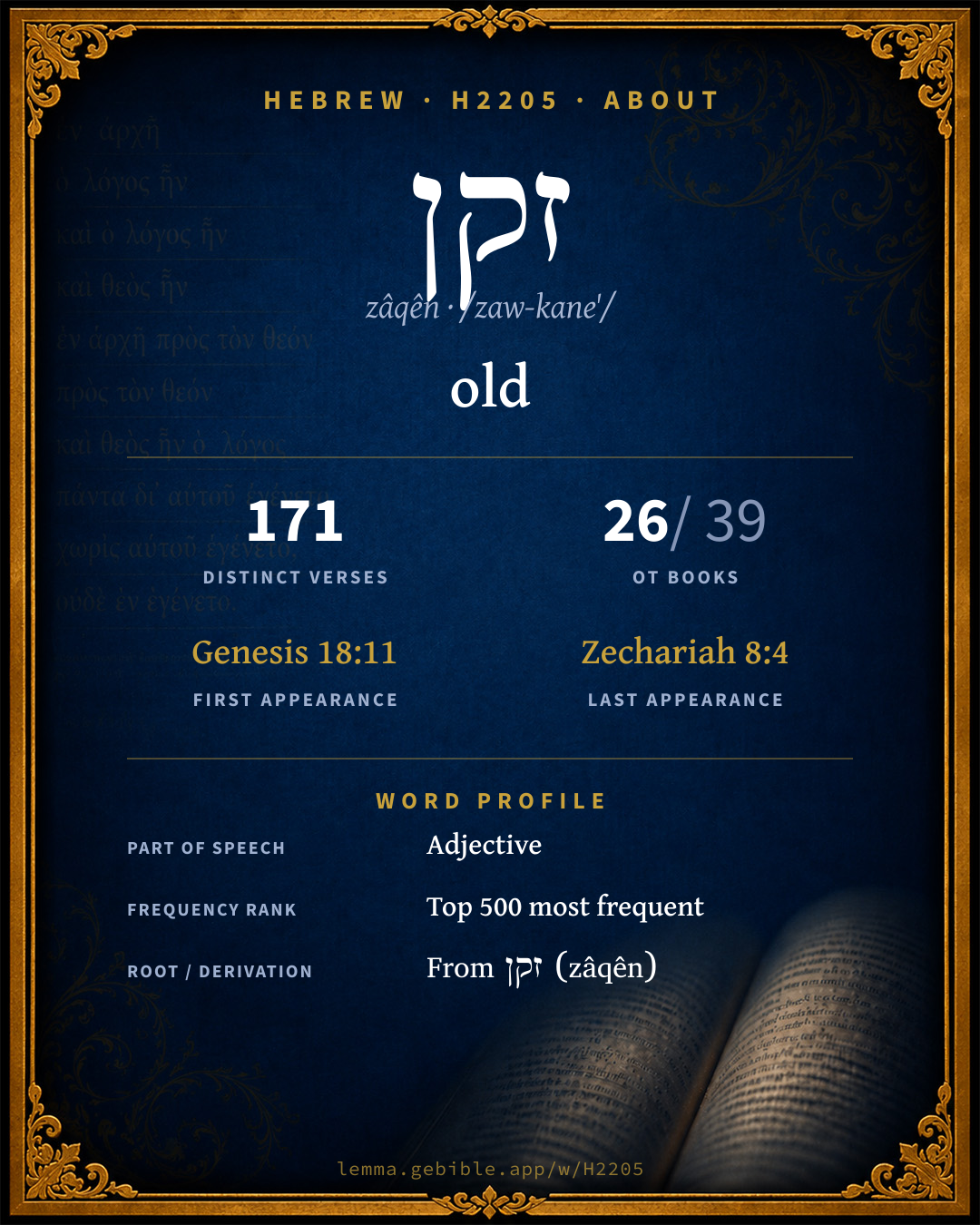
זָקֵן
old
‘old’ is one of 3 main senses fuller range ↓
Full lexicon entry — Brown-Driver-Briggs (BDB)
From Brown-Driver-Briggs (BDB)
Where this word appears
See every Construct-state word in the Hebrew Bible →
Grammar key — what these labels mean
Part of speech
- Adjective
- A word that describes or qualifies a noun.
State
- Construct
- A noun bound to a following noun in a possessive / “of” relationship (the construct chain).
- Absolute
- The independent form of a noun, not bound to a following word.
Gender
- Masculine
- Grammatically masculine.
- Feminine
- Grammatically feminine.
Number
- Plural
- More than one (in Hebrew, generally three or more).
- Singular
- One.
Grammatical forms
- Adjective, Adjective, Masculine, Plural, Construct 100 times (56%)
- Adjective, Adjective, Masculine, Plural, Absolute 46 times (26%)
- Adjective, Adjective, Masculine, Singular, Absolute 31 times (17%)
- Adjective, Adjective, Masculine, Singular, Construct 1 time (1%)
- Adjective, Adjective, Feminine, Plural, Absolute 1 time (1%)
Parsed forms decoded from the imported morphology (morphhb / Westminster Leningrad Codex — WLC text public domain, morphhb tagging CC BY 4.0), counted across 179 parsed occurrences — not distinct verses.
Every verse where H2205 appears — 171 distinct verses across 26 books. Click any verse to open its interlinear word-by-word view. Verse text shown in the World English Bible for context — . Each verse’s Hebrew form is shown with its reference; the English is not keyword-highlighted, since the data carries no word-level English alignment. Use “Compare translations” on any verse to read it across multiple English versions. This concordance covers the Hebrew Bible; Septuagint (Greek Old Testament) occurrences are not indexed here.
Genesis 8 verses
- Genesis 18:11 זְקֵנִ֔ים adj Adjective mp Now Abraham and Sarah were old, well advanced in age. It had ceased to be with Sarah after the manner of women.
- Genesis 19:4 זָקֵ֑ן adj Adjective ms But before they lay down, the men of the city, the men of Sodom, surrounded the house, both young and old, all the people from every quarter.
- Genesis 24:2 זְקַ֣ן adj Adjective ms cs Abraham said to his servant, the elder of his house, who ruled over all that he had, "Please put your hand under my thigh.
- Genesis 25:8 זָקֵ֣ן adj Adjective ms Abraham gave up the spirit, and died in a good old age, an old man, and full of years, and was gathered to his people.
- Genesis 35:29 זָקֵ֖ן adj Adjective ms Isaac gave up the spirit, and died, and was gathered to his people, old and full of days. Esau and Jacob, his sons, buried him.
- Genesis 43:27 הַ/זָּקֵ֖ן ptcl def.art + Adjective Adjective ms He asked them of their welfare, and said, "Is your father well, the old man of whom you spoke? Is he yet alive?"
- Genesis 44:20 זָקֵ֔ן adj Adjective ms We said to my lord, 'We have a father, an old man, and a child of his old age, a little one; and his brother is dead, and he alone is left of his mother; and his father loves him.'
- Genesis 50:7 זִקְנֵ֣י זִקְנֵ֥י adj Adjective mp cs adj Adjective mp cs Joseph went up to bury his father; and with him went up all the servants of Pharaoh, the elders of his house, all the elders of the land of Egypt,
Exodus 12 verses
- Exodus 3:16 זִקְנֵ֣י adj Adjective mp cs Go, and gather the elders of Israel together, and tell them, 'Yahweh, the God of your fathers, the God of Abraham, of Isaac, and of Jacob, has appeared to me, saying, "I have surely visited you, and seen that which is done to you in Egypt;
- Exodus 3:18 וְ/זִקְנֵ֨י conj + Adjective Adjective mp cs They will listen to your voice, and you shall come, you and the elders of Israel, to the king of Egypt, and you shall tell him, 'Yahweh, the God of the Hebrews, has met with us. Now please let us go three days' journey into the wilderness, that we may sacrifice to Yahweh, our God.'
- Exodus 4:29 זִקְנֵ֖י adj Adjective mp cs Moses and Aaron went and gathered together all the elders of the children of Israel.
- Exodus 10:9 וּ/בִ/זְקֵנֵ֖י/נוּ conj + prep + Adjective Adjective mp cs + sfx pers 1cp Moses said, "We will go with our young and with our old; with our sons and with our daughters, with our flocks and with our herds will we go; for we must hold a feast to Yahweh."
- Exodus 12:21 זִקְנֵ֥י adj Adjective mp cs Then Moses called for all the elders of Israel, and said to them, "Draw out, and take lambs according to your families, and kill the Passover.
- Exodus 17:5 מִ/זִּקְנֵ֣י prep + Adjective Adjective mp cs Yahweh said to Moses, "Walk on before the people, and take the elders of Israel with you, and take the rod in your hand with which you struck the Nile, and go.
- Exodus 17:6 זִקְנֵ֥י adj Adjective mp cs Behold, I will stand before you there on the rock in Horeb. You shall strike the rock, and water will come out of it, that the people may drink." Moses did so in the sight of the elders of Israel.
- Exodus 18:12 זִקְנֵ֣י adj Adjective mp cs Jethro, Moses' father-in-law, took a burnt offering and sacrifices for God. Aaron came with all of the elders of Israel, to eat bread with Moses' father-in-law before God.
- Exodus 19:7 לְ/זִקְנֵ֣י prep + Adjective Adjective mp cs Moses came and called for the elders of the people, and set before them all these words which Yahweh commanded him.
- Exodus 24:1 מִ/זִּקְנֵ֣י prep + Adjective Adjective mp cs He said to Moses, "Come up to Yahweh, you, and Aaron, Nadab, and Abihu, and seventy of the elders of Israel; and worship from a distance.
- Exodus 24:9 מִ/זִּקְנֵ֥י prep + Adjective Adjective mp cs Then Moses, Aaron, Nadab, Abihu, and seventy of the elders of Israel went up.
- Exodus 24:14 הַ/זְּקֵנִ֤ים ptcl def.art + Adjective Adjective mp He said to the elders, "Wait here for us, until we come again to you. Behold, Aaron and Hur are with you. Whoever is involved in a dispute can go to them."
Leviticus 3 verses
- Leviticus 4:15 זִקְנֵ֨י adj Adjective mp cs The elders of the congregation shall lay their hands on the head of the bull before Yahweh; and the bull shall be killed before Yahweh.
- Leviticus 9:1 וּ/לְ/זִקְנֵ֖י conj + prep + Adjective Adjective mp cs It happened on the eighth day, that Moses called Aaron and his sons, and the elders of Israel;
- Leviticus 19:32 זָקֵ֑ן adj Adjective ms You shall rise up before the gray head, and honor the face of an old man, and you shall fear your God. I am Yahweh.
Numbers 7 verses
- Numbers 11:16 מִ/זִּקְנֵ֣י זִקְנֵ֥י prep + Adjective Adjective mp cs adj Adjective mp cs Yahweh said to Moses, Gather to me seventy men of the elders of Israel, whom you know to be the elders of the people, and officers over them; and bring them to the tent of meeting, that they may stand there with you.
- Numbers 11:24 מִ/זִּקְנֵ֣י prep + Adjective Adjective mp cs Moses went out, and told the people the words of Yahweh: and he gathered seventy men of the elders of the people, and set them round about the Tent.
- Numbers 11:25 הַ/זְּקֵנִ֑ים ptcl def.art + Adjective Adjective mp Yahweh came down in the cloud, and spoke to him, and took of the Spirit that was on him, and put it on the seventy elders: and it happened that when the Spirit rested on them, they prophesied, but they did so no more.
- Numbers 11:30 וְ/זִקְנֵ֥י conj + Adjective Adjective mp cs Moses got him into the camp, he and the elders of Israel.
- Numbers 16:25 זִקְנֵ֥י adj Adjective mp cs Moses rose up and went to Dathan and Abiram; and the elders of Israel followed him.
- Numbers 22:4 זִקְנֵ֣י adj Adjective mp cs Moab said to the elders of Midian, Now will this multitude lick up all that is round about us, as the ox licks up the grass of the field. Balak the son of Zippor was king of Moab at that time.
- Numbers 22:7 זִקְנֵ֤י וְ/זִקְנֵ֣י adj Adjective mp cs conj + Adjective Adjective mp cs The elders of Moab and the elders of Midian departed with the rewards of divination in their hand; and they came to Balaam, and spoke to him the words of Balak.
Deuteronomy 21 verses
- Deuteronomy 5:23 וְ/זִקְנֵי/כֶֽם conj + Adjective Adjective mp cs + sfx pers 2mp It happened, when you heard the voice out of the midst of the darkness, while the mountain was burning with fire, that you came near to me, even all the heads of your tribes, and your elders;
- Deuteronomy 19:12 זִקְנֵ֣י adj Adjective mp cs then the elders of his city shall send and bring him there, and deliver him into the hand of the avenger of blood, that he may die.
- Deuteronomy 21:2 זְקֵנֶ֖י/ךָ adj Adjective mp cs + sfx pers 2ms then your elders and your judges shall come forth, and they shall measure to the cities which are round about him who is slain:
- Deuteronomy 21:3 זִקְנֵי֩ adj Adjective mp cs and it shall be, that the city which is nearest to the slain man, even the elders of that city shall take a heifer of the herd, which hasn't been worked with, and which has not drawn in the yoke;
- Deuteronomy 21:4 זִקְנֵי֩ adj Adjective mp cs and the elders of that city shall bring down the heifer to a valley with running water, which is neither plowed nor sown, and shall break the heifer's neck there in the valley.
- Deuteronomy 21:6 זִקְנֵי֙ adj Adjective mp cs All the elders of that city, who are nearest to the slain man, shall wash their hands over the heifer whose neck was broken in the valley;
- Deuteronomy 21:19 זִקְנֵ֥י adj Adjective mp cs then shall his father and his mother lay hold on him, and bring him out to the elders of his city, and to the gate of his place;
- Deuteronomy 21:20 זִקְנֵ֣י adj Adjective mp cs and they shall tell the elders of his city, This our son is stubborn and rebellious, he will not obey our voice; he is a glutton, and a drunkard.
- Deuteronomy 22:15 זִקְנֵ֥י adj Adjective mp cs then shall the father of the young lady, and her mother, take and bring forth the tokens of the young lady's virginity to the elders of the city in the gate;
- Deuteronomy 22:16 הַ/זְּקֵנִ֑ים ptcl def.art + Adjective Adjective mp and the young lady's father shall tell the elders, I gave my daughter to this man to wife, and he hates her;
- Deuteronomy 22:17 זִקְנֵ֥י adj Adjective mp cs and, behold, he has laid shameful things [to her charge], saying, I didn't find in your daughter the tokens of virginity; and yet these are the tokens of my daughter's virginity. They shall spread the garment before the elders of the city.
- Deuteronomy 22:18 זִקְנֵ֥י adj Adjective mp cs The elders of that city shall take the man and chastise him;
- Deuteronomy 25:7 הַ/זְּקֵנִ֗ים ptcl def.art + Adjective Adjective mp If the man doesn't want to take his brother's wife, then his brother's wife shall go up to the gate to the elders, and say, My husband's brother refuses to raise up to his brother a name in Israel; he will not perform the duty of a husband's brother to me.
- Deuteronomy 25:8 זִקְנֵי adj Adjective mp cs Then the elders of his city shall call him, and speak to him: and if he stand, and say, I don't want to take her;
- Deuteronomy 25:9 הַ/זְּקֵנִים֒ ptcl def.art + Adjective Adjective mp then his brother's wife shall come to him in the presence of the elders, and loose his shoe from off his foot, and spit in his face; and she shall answer and say, So shall it be done to the man who does not build up his brother's house.
- Deuteronomy 27:1 וְ/זִקְנֵ֣י conj + Adjective Adjective mp cs Moses and the elders of Israel commanded the people, saying, Keep all the commandment which I command you this day.
- Deuteronomy 28:50 לְ/זָקֵ֔ן prep + Adjective Adjective ms a nation of fierce facial expressions, that shall not regard the person of the old, nor show favor to the young,
- Deuteronomy 29:10 זִקְנֵי/כֶם֙ adj Adjective mp cs + sfx pers 2mp You stand this day all of you before Yahweh your God; your heads, your tribes, your elders, and your officers, even all the men of Israel,
- Deuteronomy 31:9 זִקְנֵ֖י adj Adjective mp cs Moses wrote this law, and delivered it to the priests the sons of Levi, who bore the ark of the covenant of Yahweh, and to all the elders of Israel.
- Deuteronomy 31:28 זִקְנֵ֥י adj Adjective mp cs Assemble to me all the elders of your tribes, and your officers, that I may speak these words in their ears, and call heaven and earth to witness against them.
- Deuteronomy 32:7 זְקֵנֶ֖י/ךָ adj Adjective mp cs + sfx pers 2ms Remember the days of old, Consider the years of many generations: Ask your father, and he will show you; Your elders, and they will tell you.
Joshua 9 verses
- Joshua 6:21 זָקֵ֑ן adj Adjective ms They utterly destroyed all that was in the city, both man and woman, both young and old, and ox, and sheep, and donkey, with the edge of the sword.
- Joshua 7:6 וְ/זִקְנֵ֣י conj + Adjective Adjective mp cs Joshua tore his clothes, and fell to the earth on his face before the ark of Yahweh until the evening, he and the elders of Israel; and they put dust on their heads.
- Joshua 8:10 וְ/זִקְנֵ֧י conj + Adjective Adjective mp cs Joshua arose up early in the morning, and mustered the people, and went up, he and the elders of Israel, before the people to Ai.
- Joshua 8:33 וּ/זְקֵנָ֡י/ו conj + Adjective Adjective mp cs + sfx pers 3ms All Israel, and their elders and officers, and their judges, stood on this side of the ark and on that side before the priests the Levites, who bore the ark of the covenant of Yahweh, as well the foreigner as the native; half of them in front of Mount Gerizim, and half of them in front of Mount Ebal; as Moses the servant of Yahweh had commanded at the first, that they should bless the people of Israel.
- Joshua 9:11 זְֽקֵינֵי/נוּ֩ adj Adjective mp cs + sfx pers 1cp Our elders and all the inhabitants of our country spoke to us, saying, Take provision in your hand for the journey, and go to meet them, and tell them, We are your servants: and now make you a covenant with us.
- Joshua 20:4 זִקְנֵ֥י adj Adjective mp cs He shall flee to one of those cities, and shall stand at the entrance of the gate of the city, and declare his cause in the ears of the elders of that city; and they shall take him into the city to them, and give him a place, that he may dwell among them.
- Joshua 23:2 לִ/זְקֵנָי/ו֙ prep + Adjective Adjective mp cs + sfx pers 3ms that Joshua called for all Israel, for their elders and for their heads, and for their judges and for their officers, and said to them, I am old and well stricken in years:
- Joshua 24:1 לְ/זִקְנֵ֨י prep + Adjective Adjective mp cs Joshua gathered all the tribes of Israel to Shechem, and called for the elders of Israel, and for their heads, and for their judges, and for their officers; and they presented themselves before God.
- Joshua 24:31 הַ/זְּקֵנִ֗ים ptcl def.art + Adjective Adjective mp Israel served Yahweh all the days of Joshua, and all the days of the elders who outlived Joshua, and had known all the work of Yahweh, that he had worked for Israel.
Judges 14 verses
- Judges 2:7 הַ/זְּקֵנִ֗ים ptcl def.art + Adjective Adjective mp The people served Yahweh all the days of Joshua, and all the days of the elders who outlived Joshua, who had seen all the great work of Yahweh that he had worked for Israel.
- Judges 8:14 זְקֵנֶ֔י/הָ adj Adjective mp cs + sfx pers 3fs He caught a young man of the men of Succoth, and inquired of him: and he described for him the princes of Succoth, and the elders of it, seventy-seven men.
- Judges 8:16 זִקְנֵ֣י adj Adjective mp cs He took the elders of the city, and thorns of the wilderness and briers, and with them he taught the men of Succoth.
- Judges 11:5 זִקְנֵ֣י adj Adjective mp cs It was so, that when the children of Ammon made war against Israel, the elders of Gilead went to get Jephthah out of the land of Tob;
- Judges 11:7 לְ/זִקְנֵ֣י prep + Adjective Adjective mp cs Jephthah said to the elders of Gilead, Didn't you hate me, and drive me out of my father's house? and why are you come to me now when you are in distress?
- Judges 11:8 זִקְנֵ֨י adj Adjective mp cs The elders of Gilead said to Jephthah, Therefore are we turned again to you now, that you may go with us, and fight with the children of Ammon; and you shall be our head over all the inhabitants of Gilead.
- Judges 11:9 זִקְנֵ֣י adj Adjective mp cs Jephthah said to the elders of Gilead, If you bring me home again to fight with the children of Ammon, and Yahweh deliver them before me, shall I be your head?
- Judges 11:10 זִקְנֵֽי adj Adjective mp cs The elders of Gilead said to Jephthah, Yahweh shall be witness between us; surely according to your word so will we do.
- Judges 11:11 זִקְנֵ֣י adj Adjective mp cs Then Jephthah went with the elders of Gilead, and the people made him head and chief over them: and Jephthah spoke all his words before Yahweh in Mizpah.
- Judges 19:16 זָקֵ֗ן adj Adjective ms Behold, there came an old man from his work out of the field at even: now the man was of the hill-country of Ephraim, and he sojourned in Gibeah; but the men of the place were Benjamites.
- Judges 19:17 הַ/זָּקֵ֛ן ptcl def.art + Adjective Adjective ms He lifted up his eyes, and saw the wayfaring man in the street of the city; and the old man said, Where go you? and whence come you?
- Judges 19:20 הַ/זָּקֵן֙ ptcl def.art + Adjective Adjective ms The old man said, Peace be to you; howsoever let all your wants lie on me; only don't lodge in the street.
- Judges 19:22 הַ/זָּקֵן֙ ptcl def.art + Adjective Adjective ms As they were making their hearts merry, behold, the men of the city, certain base fellows, beset the house round about, beating at the door; and they spoke to the master of the house, the old man, saying, Bring forth the man who came into your house, that we may know him.
- Judges 21:16 זִקְנֵ֣י adj Adjective mp cs Then the elders of the congregation said, How shall we do for wives for those who remain, seeing the women are destroyed out of Benjamin?
Ruth 4 verses
- Ruth 4:2 מִ/זִּקְנֵ֥י prep + Adjective Adjective mp cs He took ten men of the elders of the city, and said, Sit you down here. They sat down.
- Ruth 4:4 זִקְנֵ֣י adj Adjective mp cs I thought to disclose it to you, saying, Buy it before those who sit here, and before the elders of my people. If you will redeem it, redeem it: but if you will not redeem it, then tell me, that I may know; for there is none to redeem it besides you; and I am after you. He said, I will redeem it.
- Ruth 4:9 לַ/זְּקֵנִ֜ים prep det + Adjective Adjective mp Boaz said to the elders, and to all the people, You are witnesses this day, that I have bought all that was Elimelech's, and all that was Chilion's and Mahlon's, of the hand of Naomi.
- Ruth 4:11 וְ/הַ/זְּקֵנִ֖ים conj + ptcl def.art + Adjective Adjective mp All the people who were in the gate, and the elders, said, We are witnesses. Yahweh make the woman who has come into your house like Rachel and like Leah, which two built the house of Israel: and do you worthily in Ephrathah, and be famous in Bethlehem:
1 Samuel 9 verses
- 1 Samuel 2:31 זָקֵ֖ן adj Adjective ms Behold, the days come, that I will cut off your arm, and the arm of your father's house, that there shall not be an old man in your house.
- 1 Samuel 2:32 זָקֵ֛ן adj Adjective ms You shall see the affliction of [my] habitation, in all the wealth which [God] shall give Israel; and there shall not be an old man in your house forever.
- 1 Samuel 4:3 זִקְנֵ֣י adj Adjective mp cs When the people were come into the camp, the elders of Israel said, Why has Yahweh struck us today before the Philistines? Let us get the ark of the covenant of Yahweh out of Shiloh to us, that it may come among us, and save us out of the hand of our enemies.
- 1 Samuel 8:4 זִקְנֵ֣י adj Adjective mp cs Then all the elders of Israel gathered themselves together, and came to Samuel to Ramah;
- 1 Samuel 11:3 זִקְנֵ֣י adj Adjective mp cs The elders of Jabesh said to him, Give us seven days' respite, that we may send messengers to all the borders of Israel; and then, if there be none to save us, we will come out to you.
- 1 Samuel 15:30 זִקְנֵֽי adj Adjective mp cs Then he said, I have sinned: yet honor me now, Please, before the elders of my people, and before Israel, and turn again with me, that I may worship Yahweh your God.
- 1 Samuel 16:4 זִקְנֵ֤י adj Adjective mp cs Samuel did that which Yahweh spoke, and came to Bethlehem. The elders of the city came to meet him trembling, and said, Come you peaceably?
- 1 Samuel 28:14 זָקֵן֙ adj Adjective ms He said to her, What form is he of? She said, An old man comes up; and he is covered with a robe. Saul perceived that it was Samuel, and he bowed with his face to the ground, and did obeisance.
- 1 Samuel 30:26 לְ/זִקְנֵ֥י prep + Adjective Adjective mp cs When David came to Ziklag, he sent of the spoil to the elders of Judah, even to his friends, saying, Behold, a present for you of the spoil of the enemies of Yahweh:
2 Samuel 6 verses
- 2 Samuel 3:17 זִקְנֵ֥י adj Adjective mp cs Abner had communication with the elders of Israel, saying, In times past you sought for David to be king over you:
- 2 Samuel 5:3 זִקְנֵ֨י adj Adjective mp cs So all the elders of Israel came to the king to Hebron; and king David made a covenant with them in Hebron before Yahweh: and they anointed David king over Israel.
- 2 Samuel 12:17 זִקְנֵ֤י adj Adjective mp cs The elders of his house arose, [and stood] beside him, to raise him up from the earth: but he would not, neither did he eat bread with them.
- 2 Samuel 17:4 זִקְנֵ֥י adj Adjective mp cs The saying pleased Absalom well, and all the elders of Israel.
- 2 Samuel 17:15 זִקְנֵ֣י adj Adjective mp cs Then said Hushai to Zadok and to Abiathar the priests, Thus and thus did Ahithophel counsel Absalom and the elders of Israel; and thus and thus have I counseled.
- 2 Samuel 19:11 זִקְנֵ֤י adj Adjective mp cs King David sent to Zadok and to Abiathar the priests, saying, Speak to the elders of Judah, saying, Why are you the last to bring the king back to his house? seeing the speech of all Israel is come to the king, [to bring him] to his house.
1 Kings 12 verses
- 1 Kings 8:1 זִקְנֵ֣י adj Adjective mp cs Then Solomon assembled the elders of Israel, and all the heads of the tribes, the princes of the fathers' [houses] of the children of Israel, to king Solomon in Jerusalem, to bring up the ark of the covenant of Yahweh out of the city of David, which is Zion.
- 1 Kings 8:3 זִקְנֵ֣י adj Adjective mp cs All the elders of Israel came, and the priests took up the ark.
- 1 Kings 12:6 הַ/זְּקֵנִים֙ ptcl def.art + Adjective Adjective mp King Rehoboam took counsel with the old men, who had stood before Solomon his father while he yet lived, saying, What counsel give you me to return answer to this people?
- 1 Kings 12:8 הַ/זְּקֵנִ֖ים ptcl def.art + Adjective Adjective mp But he forsook the counsel of the old men which they had given him, and took counsel with the young men who had grown up with him, who stood before him.
- 1 Kings 12:13 הַ/זְּקֵנִ֖ים ptcl def.art + Adjective Adjective mp The king answered the people roughly, and forsook the counsel of the old men which they had given him,
- 1 Kings 13:11 זָקֵ֔ן adj Adjective ms Now there lived an old prophet in Bethel; and one of his sons came and told him all the works that the man of God had done that day in Bethel: the words which he had spoken to the king, them also they told to their father.
- 1 Kings 13:25 הַ/זָּקֵ֖ן ptcl def.art + Adjective Adjective ms Behold, men passed by, and saw the body cast in the way, and the lion standing by the body; and they came and told it in the city where the old prophet lived.
- 1 Kings 13:29 הַ/זָּקֵ֔ן ptcl def.art + Adjective Adjective ms The prophet took up the body of the man of God, and laid it on the donkey, and brought it back; and he came to the city of the old prophet, to mourn, and to bury him.
- 1 Kings 20:7 זִקְנֵ֣י adj Adjective mp cs Then the king of Israel called all the elders of the land, and said, Please notice how this man seeks mischief: for he sent to me for my wives, and for my children, and for my silver, and for my gold; and I didn't deny him.
- 1 Kings 20:8 הַ/זְּקֵנִ֖ים ptcl def.art + Adjective Adjective mp All the elders and all the people said to him, Don't you listen, neither consent.
- 1 Kings 21:8 הַ/זְקֵנִ֤ים ptcl def.art + Adjective Adjective mp So she wrote letters in Ahab's name, and sealed them with his seal, and sent the letters to the elders and to the nobles who were in his city, [and] who lived with Naboth.
- 1 Kings 21:11 הַ/זְּקֵנִ֣ים ptcl def.art + Adjective Adjective mp The men of his city, even the elders and the nobles who lived in his city, did as Jezebel had sent to them, according as it was written in the letters which she had sent to them.
2 Kings 5 verses
- 2 Kings 6:32 וְ/הַ/זְּקֵנִ֖ים הַ/זְּקֵנִ֗ים conj + ptcl def.art + Adjective Adjective mp ptcl def.art + Adjective Adjective mp But Elisha was sitting in his house, and the elders were sitting with him; and [the king] sent a man from before him: but before the messenger came to him, he said to the elders, See you how this son of a murderer has sent to take away my head? behold, when the messenger comes, shut the door, and hold the door fast against him: isn't the sound of his master's feet behind him?
- 2 Kings 10:1 הַ/זְּקֵנִ֔ים ptcl def.art + Adjective Adjective mp Now Ahab had seventy sons in Samaria. Jehu wrote letters, and sent to Samaria, to the rulers of Jezreel, even the elders, and to those who brought up [the sons of] Ahab, saying,
- 2 Kings 10:5 וְ/הַ/זְּקֵנִים֩ conj + ptcl def.art + Adjective Adjective mp He who was over the household, and he who was over the city, the elders also, and those who brought up [the children], sent to Jehu, saying, We are your servants, and will do all that you shall bid us; we will not make any man king: you do that which is good in your eyes.
- 2 Kings 19:2 זִקְנֵ֣י adj Adjective mp cs He sent Eliakim, who was over the household, and Shebna the scribe, and the elders of the priests, covered with sackcloth, to Isaiah the prophet the son of Amoz.
- 2 Kings 23:1 זִקְנֵ֥י adj Adjective mp cs The king sent, and they gathered to him all the elders of Judah and of Jerusalem.
1 Chronicles 3 verses
- 1 Chronicles 11:3 זִקְנֵ֨י adj Adjective mp cs So all the elders of Israel came to the king to Hebron; and David made a covenant with them in Hebron before Yahweh; and they anointed David king over Israel, according to the word of Yahweh by Samuel.
- 1 Chronicles 15:25 וְ/זִקְנֵ֥י conj + Adjective Adjective mp cs So David, and the elders of Israel, and the captains over thousands, went to bring up the ark of the covenant of Yahweh out of the house of Obed-edom with joy.
- 1 Chronicles 21:16 וְ/הַ/זְּקֵנִ֛ים conj + ptcl def.art + Adjective Adjective mp David lifted up his eyes, and saw the angel of Yahweh standing between earth and the sky, having a drawn sword in his hand stretched out over Jerusalem. Then David and the elders, clothed in sackcloth, fell on their faces.
2 Chronicles 7 verses
- 2 Chronicles 5:2 זִקְנֵ֣י adj Adjective mp cs Then Solomon assembled the elders of Israel, and all the heads of the tribes, the princes of the fathers' [houses] of the children of Israel, to Jerusalem, to bring up the ark of the covenant of Yahweh out of the city of David, which is Zion.
- 2 Chronicles 5:4 זִקְנֵ֣י adj Adjective mp cs All the elders of Israel came: and the Levites took up the ark;
- 2 Chronicles 10:6 הַ/זְּקֵנִים֙ ptcl def.art + Adjective Adjective mp King Rehoboam took counsel with the old men, who had stood before Solomon his father while he yet lived, saying, What counsel give you me to return answer to this people?
- 2 Chronicles 10:8 הַ/זְּקֵנִ֖ים ptcl def.art + Adjective Adjective mp But he forsook the counsel of the old men which they had given him, and took counsel with the young men who had grown up with him, who stood before him.
- 2 Chronicles 10:13 הַ/זְּקֵנִֽים ptcl def.art + Adjective Adjective mp The king answered them roughly; and king Rehoboam forsook the counsel of the old men,
- 2 Chronicles 34:29 זִקְנֵ֥י adj Adjective mp cs Then the king sent and gathered together all the elders of Judah and Jerusalem.
- 2 Chronicles 36:17 זָקֵ֣ן adj Adjective ms Therefore he brought on them the king of the Chaldeans, who killed their young men with the sword in the house of their sanctuary, and had no compassion on young man or virgin, old man or gray-headed: he gave them all into his hand.
Ezra 3 verses
- Ezra 3:12 הַ/זְּקֵנִ֗ים ptcl def.art + Adjective Adjective mp But many of the priests and Levites and heads of fathers' [houses], the old men who had seen the first house, when the foundation of this house was laid before their eyes, wept with a loud voice; and many shouted aloud for joy:
- Ezra 10:8 וְ/הַ/זְּקֵנִ֔ים conj + ptcl def.art + Adjective Adjective mp and that whoever didn't come within three days, according to the counsel of the princes and the elders, all his substance should be forfeited, and himself separated from the assembly of the captivity.
- Ezra 10:14 זִקְנֵי adj Adjective mp cs Let now our princes be appointed for all the assembly, and let all those who are in our cities who have married foreign women come at appointed times, and with them the elders of every city, and the judges of it, until the fierce wrath of our God be turned from us, until this matter be dispatched.
Esther 1 verse
Job 4 verses
- Job 12:20 זְקֵנִ֣ים adj Adjective mp He removes the speech of those who are trusted, And takes away the understanding of the elders.
- Job 32:4 זְֽקֵנִים adj Adjective mp Now Elihu had waited to speak to Job, because they were elder than he.
- Job 32:9 וּ֝/זְקֵנִ֗ים conj + Adjective Adjective mp It is not the great who are wise, Nor the aged who understand justice.
- Job 42:17 זָקֵ֖ן adj Adjective ms So Job died, being old and full of days.
Psalms 4 verses
- Psalms 105:22 וּ/זְקֵנָ֥י/ו conj + Adjective Adjective mp cs + sfx pers 3ms To discipline his princes at his pleasure, And to teach his elders wisdom.
- Psalms 107:32 זְקֵנִ֣ים adj Adjective mp Let them exalt him also in the assembly of the people, And praise him in the seat of the elders.
- Psalms 119:100 מִ/זְּקֵנִ֥ים prep + Adjective Adjective mp I understand more than the aged, Because I have kept your precepts.
- Psalms 148:12 זְ֝קֵנִ֗ים adj Adjective mp Both young men and maidens; Old men and children:
Proverbs 3 verses
- Proverbs 17:6 זְ֭קֵנִים adj Adjective mp Children's children are the crown of old men; The glory of children are their parents.
- Proverbs 20:29 זְקֵנִ֣ים adj Adjective mp The glory of young men is their strength. The splendor of old men is their gray hair.
- Proverbs 31:23 זִקְנֵי adj Adjective mp cs Her husband is respected in the gates, When he sits among the elders of the land.
Ecclesiastes 1 verse
Isaiah 9 verses
- Isaiah 3:2 וְ/זָקֵֽן conj + Adjective Adjective ms The mighty man, The man of war, The judge, The prophet, The diviner, The elder,
- Isaiah 3:5 בַּ/זָּקֵ֔ן prep det + Adjective Adjective ms The people will be oppressed, Everyone by another, And everyone by his neighbor. The child will behave himself proudly against the old man, And the base against the honorable.
- Isaiah 3:14 זִקְנֵ֥י adj Adjective mp cs Yahweh will enter into judgment with the elders of his people, And their leaders: "It is you who have eaten up the vineyard. The spoil of the poor is in your houses.
- Isaiah 9:15 זָקֵ֥ן adj Adjective ms The elder and the honorable man, he is the head; and the prophet who teaches lies, he is the tail.
- Isaiah 20:4 וּ/זְקֵנִ֖ים conj + Adjective Adjective mp so shall the king of Assyria lead away the captives of Egypt, and the exiles of Ethiopia, young and old, naked and barefoot, and with buttocks uncovered, to the shame of Egypt.
- Isaiah 24:23 זְקֵנָ֖י/ו adj Adjective mp cs + sfx pers 3ms Then the moon shall be confounded, and the sun ashamed; for Yahweh of Hosts will reign on Mount Zion, and in Jerusalem; and before his elders shall be glory.
- Isaiah 37:2 זִקְנֵ֣י adj Adjective mp cs He sent Eliakim, who was over the household, and Shebna the scribe, and the elders of the priests, covered with sackcloth, to Isaiah the prophet the son of Amoz.
- Isaiah 47:6 זָקֵ֕ן adj Adjective ms I was angry with my people, I profaned my inheritance, and gave them into your hand: you did show them no mercy; on the aged have you very heavily laid your yoke.
- Isaiah 65:20 וְ/זָקֵ֔ן conj + Adjective Adjective ms There shall be no more there an infant of days, nor an old man who has not filled his days; for the child shall die one hundred years old, and the sinner being one hundred years old shall be accursed.
Jeremiah 6 verses
- Jeremiah 6:11 זָקֵ֖ן adj Adjective ms Therefore I am full of the wrath of Yahweh; I am weary with holding in: pour it out on the children in the street, and on the assembly of young men together; for even the husband with the wife shall be taken, the aged with him who is full of days.
- Jeremiah 19:1 וּ/מִ/זִּקְנֵ֣י וּ/מִ/זִּקְנֵ֖י conj + prep + Adjective Adjective mp cs conj + prep + Adjective Adjective mp cs Thus said Yahweh, Go, and buy a potter's earthen bottle, and [take] of the elders of the people, and of the elders of the priests;
- Jeremiah 26:17 מִ/זִּקְנֵ֖י prep + Adjective Adjective mp cs Then rose up certain of the elders of the land, and spoke to all the assembly of the people, saying,
- Jeremiah 29:1 זִקְנֵ֣י adj Adjective mp cs Now these are the words of the letter that Jeremiah the prophet sent from Jerusalem to the residue of the elders of the captivity, and to the priests, and to the prophets, and to all the people, whom Nebuchadnezzar had carried away captive from Jerusalem to Babylon,
- Jeremiah 31:13 וּ/זְקֵנִ֖ים conj + Adjective Adjective mp Then shall the virgin rejoice in the dance, and the young men and the old together; for I will turn their mourning into joy, and will comfort them, and make them rejoice from their sorrow.
- Jeremiah 51:22 זָקֵ֣ן adj Adjective ms and with you will I break in pieces the chariot and him who rides therein; and with you will I break in pieces man and woman; and with you will I break in pieces the old man and the youth; and with you will I break in pieces the young man and the virgin;
Lamentations 6 verses
- Lamentations 1:19 וּ/זְקֵנַ֖/י conj + Adjective Adjective mp cs + sfx pers 1cs I called for my lovers, [but] they deceived me: My priests and my elders gave up the spirit in the city, While they sought them food to refresh their souls.
- Lamentations 2:10 זִקְנֵ֣י adj Adjective mp cs The elders of the daughter of Zion sit on the ground, they keep silence; They have cast up dust on their heads; they have girded themselves with sackcloth: The virgins of Jerusalem hang down their heads to the ground.
- Lamentations 2:21 וְ/זָקֵ֔ן conj + Adjective Adjective ms The youth and the old man lie on the ground in the streets; My virgins and my young men are fallen by the sword: You have killed them in the day of your anger; you have slaughtered, [and] not pitied.
- Lamentations 4:16 זקנים וּ/זְקֵנִ֖ים adj Adjective mp conj + Adjective Adjective mp The anger of Yahweh has scattered them; he will no more regard them: They didn't respect the persons of the priests, they didn't favor the elders.
- Lamentations 5:12 זְקֵנִ֖ים adj Adjective mp Princes were hanged up by their hand: The faces of elders were not honored.
- Lamentations 5:14 זְקֵנִים֙ adj Adjective mp The elders have ceased from the gate, The young men from their music.
Ezekiel 9 verses
- Ezekiel 7:26 מִ/זְּקֵנִֽים prep + Adjective Adjective mp Mischief shall come on mischief, and rumor shall be on rumor; and they shall seek a vision of the prophet; but the law shall perish from the priest, and counsel from the elders.
- Ezekiel 8:1 וְ/זִקְנֵ֥י conj + Adjective Adjective mp cs It happened in the sixth year, in the sixth [month], in the fifth [day] of the month, as I sat in my house, and the elders of Judah sat before me, that the hand of the Lord Yahweh fell there on me.
- Ezekiel 8:11 מִ/זִּקְנֵ֣י prep + Adjective Adjective mp cs There stood before them seventy men of the elders of the house of Israel; and in the midst of them stood Jaazaniah the son of Shaphan, every man with his censer in his hand; and the odor of the cloud of incense went up.
- Ezekiel 8:12 זִקְנֵ֤י adj Adjective mp cs Then said he to me, Son of man, have you seen what the elders of the house of Israel do in the dark, every man in his chambers of imagery? for they say, Yahweh doesn't see us; Yahweh has forsaken the land.
- Ezekiel 9:6 זָקֵ֡ן הַ/זְּקֵנִ֔ים adj Adjective ms ptcl def.art + Adjective Adjective mp kill utterly the old man, the young man and the virgin, and little children and women; but don't come near any man on whom is the mark: and begin at my sanctuary. Then they began at the old men that were before the house.
- Ezekiel 14:1 מִ/זִּקְנֵ֖י prep + Adjective Adjective mp cs Then came certain of the elders of Israel to me, and sat before me.
- Ezekiel 20:1 מִ/זִּקְנֵ֥י prep + Adjective Adjective mp cs It happened in the seventh year, in the fifth [month], the tenth [day] of the month, that certain of the elders of Israel came to inquire of Yahweh, and sat before me.
- Ezekiel 20:3 זִקְנֵ֤י adj Adjective mp cs Son of man, speak to the elders of Israel, and tell them, Thus says the Lord Yahweh: Is it to inquire of me that you have come? As I live, says the Lord Yahweh, I will not be inquired of by you.
- Ezekiel 27:9 זִקְנֵ֨י adj Adjective mp cs The old men of Gebal and the wise men of it were in you your repairers of ship seams: all the ships of the sea with their mariners were in you to deal in your merchandise.
Joel 4 verses
- Joel 1:2 הַ/זְּקֵנִ֔ים ptcl def.art + Adjective Adjective mp Hear this, you elders, And listen, all you inhabitants of the land. Has this ever happened in your days, Or in the days of your fathers?
- Joel 1:14 זְקֵנִ֗ים adj Adjective mp Sanctify a fast. Call a solemn assembly. Gather the elders, And all the inhabitants of the land, to the house of Yahweh, your God, And cry to Yahweh.
- Joel 2:16 זְקֵנִ֔ים adj Adjective mp Gather the people. Sanctify the assembly. Assemble the elders. Gather the children, and those who suck the breasts. Let the bridegroom go forth from his room, And the bride out of her chamber.
- Joel 2:28 זִקְנֵי/כֶם֙ adj Adjective mp cs + sfx pers 2mp "It will happen afterward, that I will pour out my Spirit on all flesh; And your sons and your daughters will prophesy. Your old men will dream dreams. Your young men will see visions.
Zechariah 1 verse
About this entry
At a glance — auto-summarized from this page’s data, not written by a person. Every figure links to its source below. This summary describes the numbers; it doesn’t interpret them.
At its core, זקן (zâqên) means “old.” Older and newer Bibles part ways — “elders” in the King James Version, “elders of” (unfoldingWord Literal Text) in modern versions. See the renderings breakdown. It appears 171 verses across 26 books of the Hebrew Bible, among its common vocabulary. Scripture first uses it in Genesis 18:11. Not a single-sense word: explore its full sense range. Each statement above links to its evidence; the full detail follows below.
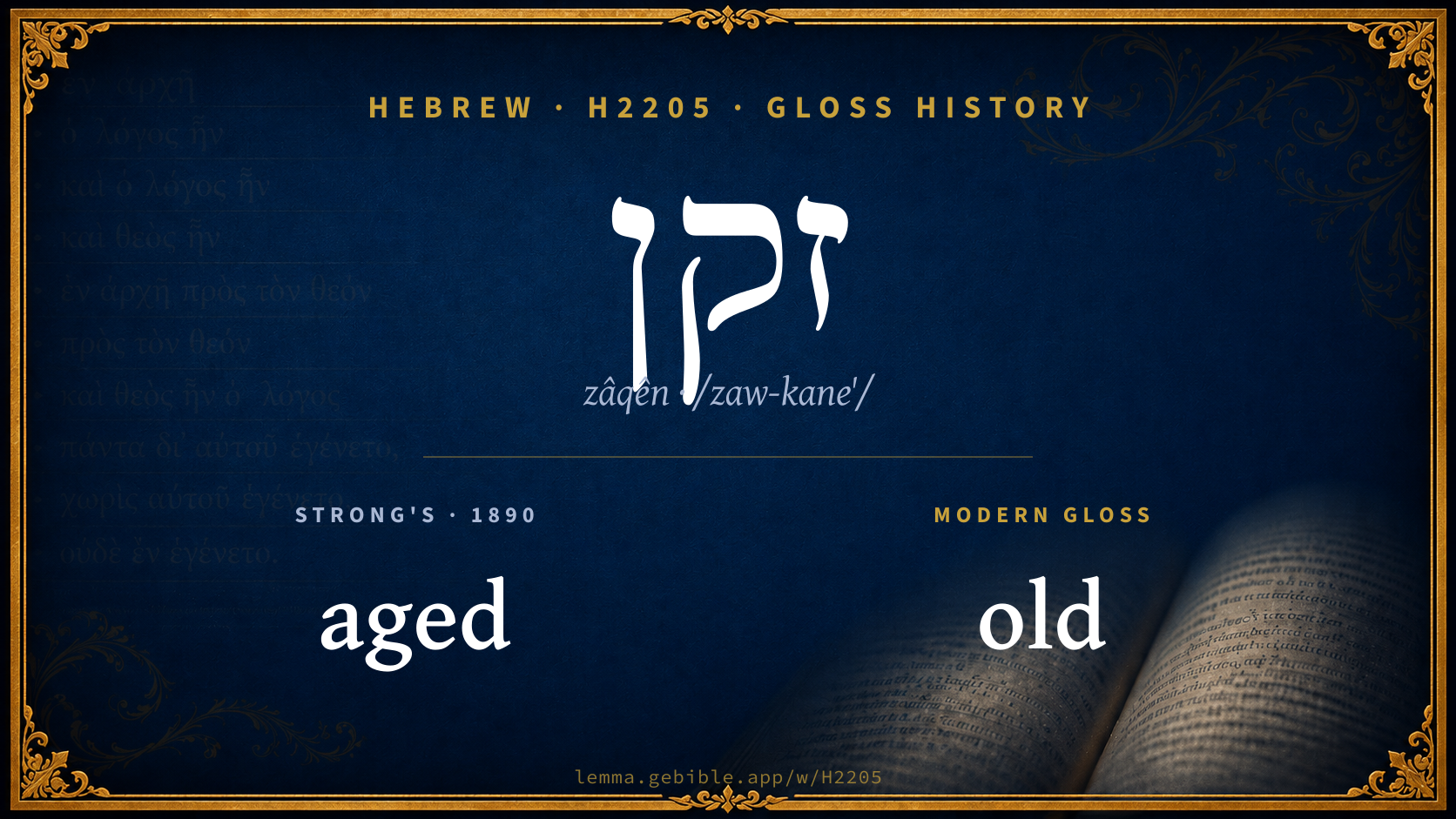
Gloss history
Strong's 1890 vs modern scholarship
About this word
Strong's H2205 catalogs a Hebrew word from the Hebrew Old Testament.
These counts are not copied from any lexicon or concordance. They are computed here, from the morphology-tagged Hebrew Old Testament. What Lemma adds →
- 171
- distinct verses
- The word appears in 171 distinct verses.
- 26 / 39
- OT books
- The word appears in 26 of 39 Old Testament books.
- #261
- by frequency
- Top 500 most frequent Hebrew words (rank 261 of 8,640 Hebrew words by occurrence).
View all 171 occurrences in the concordance →
Most concentrated in
- Deuteronomy 21 verses 12%
- Judges 14 verses 8%
- Exodus 12 verses 7%
By section of the Old Testament
By traditional corpus
Conventional, traditional groupings — biblical authorship is debated, so this is a traditional corpus grouping, not an authorship claim. Each share is this word’s portion of its verses in that division of the Hebrew canon. Each figure is a share of the word’s 171 distinct verses.
- Prophets (Nevi'im) 84 verses · 49%
- Torah (Pentateuch) 51 verses · 30%
- Writings (Ketuvim) 36 verses · 21%
How translations render this word
Counts come from each version’s own published word-to-Strong’s tagging or interlinear alignment — an approximate guide to how each version renders this word, not a word-level alignment the data otherwise carries. Because each total is that version’s own tagged count, the per-version totals vary from one another and need not match the appearance or distinct-verse counts above. These counts may also differ from a printed concordance because Lemma counts each distinctly tagged rendering and does not collapse phrase taggings into a single head-word total. This is a fixed set of word-tagged versions (KJV, ASV, BSB, ULT) and does not change with the reading translation you choose elsewhere. Each version’s license is shown beside its name below (and on Sources).
BDB lists this Strong’s number as 2 distinct words (homographs). Each count above pools all of them and is not split by sense — see the Senses section below. A low-frequency rendering may belong to a different one of those words, not the primary meaning.
- King James Version†: Elders 86×, Old 18×, All the elders 17×
- American Standard Version†: Elders 88×, Old 21×, All the elders 17×
- Berean Standard Bible†: Elders 112×, Old 21×, Some of the elders 4×
- unfoldingWord Literal Text†: Elders of 69×, Elders 58×, Old 20×
King James Version Public Domain
Renders H2205 across 178† tagged occurrences — most commonly:
Plus 24 renderings that appear only once — usually multi-word phrases or single function words the recovered tagging swept in, not distinct renderings.
American Standard Version Public Domain
Renders H2205 across 178† tagged occurrences — most commonly:
Plus 25 renderings that appear only once — usually multi-word phrases or single function words the recovered tagging swept in, not distinct renderings.
Berean Standard Bible Public Domain
Renders H2205 across 175† tagged occurrences — most commonly:
Plus 24 renderings that appear only once — usually multi-word phrases or single function words the recovered tagging swept in, not distinct renderings. Not rendered by a distinct English word in 3 further occurrences.
unfoldingWord Literal Text CC BY-SA 4.0
Renders H2205 across 181† tagged occurrences — most commonly:
Plus 15 renderings that appear only once — usually multi-word phrases or single function words the recovered tagging swept in, not distinct renderings.
Senses in the full BDB
Hebrew verbs can shift meaning by stem (binyan): Qal is the basic action, Niphal is often passive or reflexive, Piel often intensifies or makes it factitive, and Hiphil is typically causative. The senses below are grouped under the stem BDB assigns to each.
What do BDB’s symbols mean?
BDB uses these scholarly abbreviations:
| Symbol | Meaning |
|---|---|
| 𝔊 | the Septuagint (the ancient Greek translation, LXX) |
| 𝔙 | the Vulgate (the Latin translation) |
| 𝔖 | the Syriac version (the Peshitta) |
| 𝔗 | the Targum (the Aramaic translation) |
| ψ | the Psalms |
| √ | root (the underlying root or stem) |
| ‖ | parallel passage (a synonymous or contrasted parallel) |
| † | the dagger: every passage where the word occurs is cited |
The 6 senses and sub-senses the full Brown-Driver-Briggs lexicon distinguishes for this word, in lexicon order (not ranked by frequency), with BDB’s own verbatim wording and sub-sense lettering. Shown in Hebrew script with BDB’s own scholarly abbreviations. The condensed entry is in the Lexicon Entry tab. See also the Forms in the corpus table below.
זקן I be or become old (cf., according to Thes, Arabic ذَقُونٌa she-camal that lets her lower lip hang down, 3, v. Lane 968
Qal
- Pf. 3 ms. זָקֵן Gn 18:12 + 14 times (often hard to disting. from pred. adj. זָקֵן q.v.); 3 fs. זָֽקְנָה Pr 23:22; 2 ms. זָקַנְתָּ 1 S 8:5; זָקַ֫נְתָּה Jos 13:1; 1 s. זָקַנְתִּי Jos 23:2 + 3 times; זָקַ֑נְתִּי Gn 18:13; 27:2; Impf. וַיִּזְקַן 2 Ch 24:15;—be (or become) old Gn 18:12, 13; 19:31; 27:1, 2 (all J), 1 S 2:22; 4:18; 8:1, 5; 12:2; 17:12 2 S 19:33 1 K 1:1, 15 2 K 4:14; also Gn 24:1 (‖ בא בימים), so Jos 13:1(×2); 23:1, 2 (‖ here בָּאתִי בימים), 1 Ch 23:1 (‖ שָׂבַע ימים), 2 Ch 24:15 (‖ id.); Pr 23:22 ψ 37:25 (opp. היה נער); note especially זָקַנְתִּי מִהְיוֹת לאישׁ Ru 1:12 I am too old to belong to a man (husband). e.g. Genesis 18:12
Hiphil
- only Impf. 3 ms. יַזְקִין inchoat. shew age, grow old = senescere Ew.§ 122c, cf. Di; of youth Pr 22:6; of tree-root Jb 14:8. e.g. Proverbs 22:6
זקן II old, abs. ז׳ Gn 19
- 1. old, of human beings, as adj. pred. Gn 18:11 (J), Jb 32:4 (ז׳ מִמֶּנּוּ לְיָמִים, in compar.), or attrib. אָב זָקֵן Gn 44:20 (J), אִישׁ ז׳ Ju 19:16, 17, 20, 22, נָבִיא ז׳ 1 K 13:11, 25, 29, מֶלֶךְ ז׳ Ec 4:13; prob. also ז׳ וּשְׂבַע ימים Gn 35:29 (P), Jb 42:17 and Gn 25:8 (P) according to 𝔊 Sam Di; cf. also Ezr 3:12. e.g. Genesis 18:11
- 2. usually as subst.: a. old man (or woman), b. elder;
- a. old man Gn 43:27 (J), Lv 19:32 (H), Dt 28:50; 32:7 (‖ אָב), 1 S 2:31, 32; 28:14 Is 47:6 Jb 12:20; 32:9 Pr 17:6; 20:29 ψ 119:100 Jo 1:2; old men and old women Zc 8:4(×2); cf. זְקַן בֵּיתוֹ Gn 24:2 (J), זִקְנֵי בֵיתוֹ 2 S 12:17; especially opp. נַעַר Ex 10:9 (E), Is 3:5; 20:4 Je 51:22 La 2:21 ψ 148:12, and in phr. מִנַּעַר וְעַד זָקֵן Gn 19:4 (J), Jos 6:21 (JE), Est 3:13; opp. ילדים 1 K 12:6, 8, 13 = 2 Ch 10:6, 8, 13; opp. בַּחוּרִים Je 31:13 Ez 9:6 Jo 3:1, cf. 2 Ch 36:17 (+ יָשֵׁשׁ) and Je 6:11 (+ מְלֵא ימים); opp. עוּל ימים Is 65:20; opp. יונקי שׁדים and עוללים Jo 2:16. e.g. Genesis 43:27
- b. usually pl. elders, as having authority, term techn. (100 times +); elders of a people, especially Israel Ex 3:16, 18; 12:21 (all J), 17:5, 6; 18:12; 19:7; 24:1, 9, 14 Jos 24:1 (all E), Nu 11:16(×2) (שֹׁטְרָיו), v 24, 25, 30; 16:25 Jos 7:6; 8:10; 9:11 (all JE), Dt 5:20 (‖ רָאשֵׁי שִׁבְטֵיכֶם), 27:1; 29:9 (‖ ראשׁי שׁבטיכם, שֹׁטְרֵיכֶם), 31:9, 28 Jos 8:33 (‖ שֹׁטְרִים וְשֹׁפְטָיו), 23:2 (‖ רָאשׁיו, שֹׁפְטָיו, שֹׁטְרָיו); cf. also prob. Jos 24:31 = Ju 2:7 (all D); Lv 9:1, cf. זִקְנֵי הָעֵדָה Lv 4:15 (†both P), Ju 21:16; see also 1 S 4:3; 8:4; 15:30 2 S 3:17; 5:3 = 1 Ch 11:3, 2 S 17:4, 15 1 K 8:1, 3 = 2 Ch 5:2, 4, also 1 Ch 15:25; 21:16; cf. Is 3:2 (גִּבּוֹר וְאִישׁ מִלְחָמָ֑ה שׁוֹפֵט וְנָבִיא וְקֹסֵם וְז׳), 9:14 (‖ נְשׂוּא־פָנִים, but v. prob. gloss, cf. Ew Che Di Du al.); elders of one tribe (Judah) 1 S 30:26 2 S 19:12, so of Gilead Ju 11:5, 7, 8, 9, 10, 11; after the division of the kingdoms, of N. Isr. זקני הארץ 1 K 20:7 cf. v 8, also 2 K 6:32(×2), 10:1 (‖ שָׂרִים etc.) cf. v 5; under Josiah זקני יְהוּדָה 2 K 23:1 = 2 Ch 34:29; see also ז׳ הארץ Je 26:17, cf. זקני ארץ Pr 31:23, cf. La 1:19; 2:10; 4:16; 5:12, 14 (‖ שׂרים; + שַׁעַר); often in Ezek.: Ez 7:26 (‖ כהן), of Judah 8:1, of Isr. 8:11, 12; 14:1; 20:1, 3, also 9:6 (but del. Co). Exil. ז׳ הַגּוֹלָה Je 29:1 (‖ הכהנים, הנביאים); post-exile Ezr 10:8 (‖ שׂרים), poss. also Jo 1:14; elders of י׳ Is 24:23 (cf. Ex 24:1, 9), זִקְנֵי הַכֹּהֲנִים 2 K 19:2 = Is 37:2, so Je 19:1 (‖ זקני העם); of other peoples, Midian Nu 22:4, 7, Moab v 7 (all E), Egypt ψ 105:22 (‖ שׂרים); of Gebal Ez 27:9; elders of a city, especially as sitting in the gate to judge Dt 19:12; 21:2 (+ שֹׁפְטֶיךָ) v 3, 4, 6, 19 (+ שַׁעַר־מְקֹמוֹ), v 20; 22:15 (+ הַשָּׁ֑עְרָה), v 16, 17, 18; 25:7 (+ הַשַּׁ֫עֲרָה), v 8, 9 (all in Dt. code, and only so therein), Ru 4:2, 4, 9, 11 (cf. שַׁעַר v 1, 11), מוֹשַׁב זְקֵנִים ψ 107:32 (‖ קְהַל־עָ֑ם); Ju 8:14 (‖ שׂרים), v 16 1 S 11:3; 16:4 1 K 21:8, 11 Ezr 10:14. e.g. Exodus 3:16
Senses from the full Brown-Driver-Briggs lexicon (Brown, Driver, Briggs; Oxford 1906 — public domain), digitized via Sefaria, supplemented by the OpenScriptures HebrewLexicon (CC BY 4.0). Full attribution on Sources.
Word origin
I. vb. be or become old (cf., according to Thes, Arabic ذَقُونٌa she-camal that lets her lower lip hang down, 3, v. Lane 968; ذِقْنٌ decrepit man)—
II. adj. old, abs. ז׳ Gn 19:4 + 30 times (on distinct. from vb. v. supr.); cstr. זְקַן Gn 24:2; pl. זְקֵנִים Gn 18:11 + 44 times; זְקֵנוֹת Zc 8:4; cstr. זִקְנֵי Gn 50:7 + 85 times; sf. זְקֵנַי La 1:19, זְקֵנֶיךָ Dt 21:2; 32:7, זְקֵנָיו Jos 8:33 + 3 times, זְקֵנֶיהָ Ju 8:14, זְקֵנֵינוּ Ex 10:9 Jos 9:11, זִקְנֵיכֶם Dt 5:20 + 2 times;—
— Brown-Driver-Briggs (Oxford 1906, public domain), digitized via Sefaria, supplemented by the OpenScriptures HebrewLexicon (CC BY 4.0). See Sources.
Derived from זקן (zâqên) (H2204) — to be old.
Jastrow Dictionary
A second Hebrew/Aramaic lexicon for comparison, covering Aramaic and post-biblical (Talmudic, Targumic, Midrashic) usage that the biblical-Hebrew BDB does not. Matched by lemma rather than by Strong’s number, so a lemma may carry more than one Jastrow headword (shown separately below), and the entries cover usage well beyond the Bible.
זָקֵן I
- (b. h.) [to be thin, shrunk, hard,] to be old. Gen. R. s. 48 (ref. to Gen. XVIII, 13) ואני זָקַנְתִּי מלעשות וכ׳ am I (the Lord) too old to do wonders? e.g. Genesis 18:13
- 1. to grow old. Snh. 100ᵇ הִזְקִינָה שמא וכ׳ when she arrives at old age, he is afraid lest &c. Erub. 56ᵃ מַזְקִינִים בחצי וכ׳ they age in the middle of their days (prematurely). Sabb. 152ᵃ כל זמן שמַזְקִינִין the older they grow; a. fr.
- 2. to make old, consider old (feeble). Gen. R. s. 48 אתם … ומזקינים חביריכם you consider each himself young, and each his partner old (Yalk. ib. 82 ומז׳ אדניכם and believe your Lord too old [to do wonders]); v. supra.
- 1. to become old, weak, frail. Y. Ber. IX, end 14ᶜ (ref. to prov. XXIII, 22) אם נִזְדַּקְּנָה אומתך וכ׳ if thy nation is decaying (in faith), stand up and fence her in (prevent her being trodden upon); Yalk. Prov. 960.—2) (cmp. דקדק) to be maturely considered, be clear (beyond doubt);
- 3. (cmp. קשיש) to be hard, difficult. Tosef. Snh. VII, 7 (the presiding judge declares) (נִיזְקַן) נִזְקַן הדין ed. Zuck. (Var. נזדקן, נזדקק); discussed in Snh. 42ᵃ מאי נזד׳ הדין what does nizdakken mean? Does it mean קש דינא the case is hard (difficult, so as to demand a reconsideration)?… It means חכם דינא the case is clear; Y. Snh. V, end, 23ᵃ
זָקֵן II
- preced.)
- 1. old man. Gen. R. s. 39, opp. בחור. Y. Bicc. III, 65ᶜ bot. עמידת ז׳ (Yalk. Lev. 670 מצות ז׳) the duty of standing up before an old man. Ḥag. 14ᵃ; a. fr.
- 2. elder, judge, scholar. Ib. (ref. to Is. III, 2) ז׳ זה שראוי וכ׳ zaken means one fit to sit in college sessions. Ber. 8ᵇ ז׳ ששכח וכ׳ a scholar who forgot what he had learned, &c., v. אוֹנֶס. Kidd. 32ᵇ אין ז׳ אלא חכם under zaken (Lev. XIX, 32) a scholar is meant; Sifra K’dosh. Par. 3, ch. VII אין ז̇ק̇ן̇ אלא ז̇ה שק̇נ̇ה חכמה a zaken is he who has acquired wisdom (through study).—ז׳ אשמאי, v. אַשְׁמַאי. Yoma 28ᵇ ז׳ ויושב בישיבה a scholar and member of college. Y. M Kat. III, beg. 81ᶜ איני מכירך ז׳ I shall not recognize thee as (give thee the diploma of) a zaken; a. fr.—Pl. זְקֵנִים. Snh. I, 3, v. סְמִיכָה. Num. R. s. 14 מצות הז׳ rabbinical law. Ber. 11ᵃ זִקְנֵי ב"ש the graduates of the Shammai school; a. v. fr. e.g. Isaiah 3:2
- 3. grandfather, ancestor. Ex. R. s. 1 מעשה זְקֵנָן the conduct of their ancestor (Abraham). Pesik. Zakh., p. 27ᵇ; a. fr.—Fem. זְקֵנָה, זְקֵינָה. 1) old woman. Gen. R. s. 39.—Nidd. 9ᵃ ז׳ one who is past the change of life. Ib. 9ᵇ; a. fr.—2) grandmother, ancestress. Kidd. 31ᵇ הוה ליה ההיא אמא זקי׳ had a grandmother. Gen. R. s. 93 זְקֵינָתוֹ של זה this man’s (my) ancestress (Sarah); a. e.—3) (sub. נְטִיעָה) old plantation. Tosef. Shebi. I, 2; a. e., opp. נטיעה young plantation.—Pl. זְקֵינוֹת. Y. ib. I, 33ᵇ bot.; a. e.
זָקָן
- beard, hair-covered spot. Ber. 11ᵃ זְקָנְךָ וכ׳ thy beard is &c., v. גָּדַל. Snh. VIII, 1 (68ᵇ) עד שיקיף ז׳ התחתון וכ׳ until he grows a beard, by which is meant the hair of the genitals &c.; a. fr.—Pl. זְקָנִים. Lev. R. s. 3.
A Dictionary of the Targumim, the Talmud Babli and Yerushalmi, and the Midrashic Literature (Marcus Jastrow; London, Luzac, 1903) — Public Domain. Digitized via Sefaria. Digitized via Sefaria. Full attribution on Sources.
Forms in the corpus
The 82 distinct written forms H2205 takes in the Hebrew Bible, most frequent first — each parse links to that state’s occurrences in the concordance. Hebrew forms include their vowel points and cantillation, so a single lemma takes many written forms.
The 60 most common forms are shown; 22 rarer forms follow in the full concordance.
Same root — word family
Other BDB entries built from the same root as H2205, grouped by Strong’s listed origin. These share a root / origin per the lexicon — not necessarily a shared meaning. Each links to that word’s own entry.
Derives from
Shares the same root
Derived from this word
Compare all same-root words → Showing 4 of 6 — not the complete family. They share a root, not necessarily a meaning.
Septuagint verse parallels
This word appears in 166 verses that also exist in the Greek Old Testament (Septuagint), out of the 171 Hebrew verses it occurs in. You can read those verses in Greek by switching the Old Testament edition to the Septuagint.
Read these verses in the Septuagint
- Genesis 18:11
- Exodus 3:16
- Leviticus 4:15
- Numbers 11:16
- Deuteronomy 5:23
- Joshua 6:21
- Judges 2:7
- Ruth 4:2
- 1 Samuel 2:31
- 2 Samuel 3:17
- 1 Kings 8:1
- 2 Kings 6:32
This is a verse-level parallel only — the same verses exist in both the Hebrew and Greek Old Testaments. No word-level Hebrew↔Greek correspondence is claimed: the data carries no such alignment, so no Greek word is shown as this Hebrew word’s translation. Coverage is not total — the Septuagint omits the deuterocanon and renumbers the Psalms, so some Hebrew verses have no direct Greek parallel.