
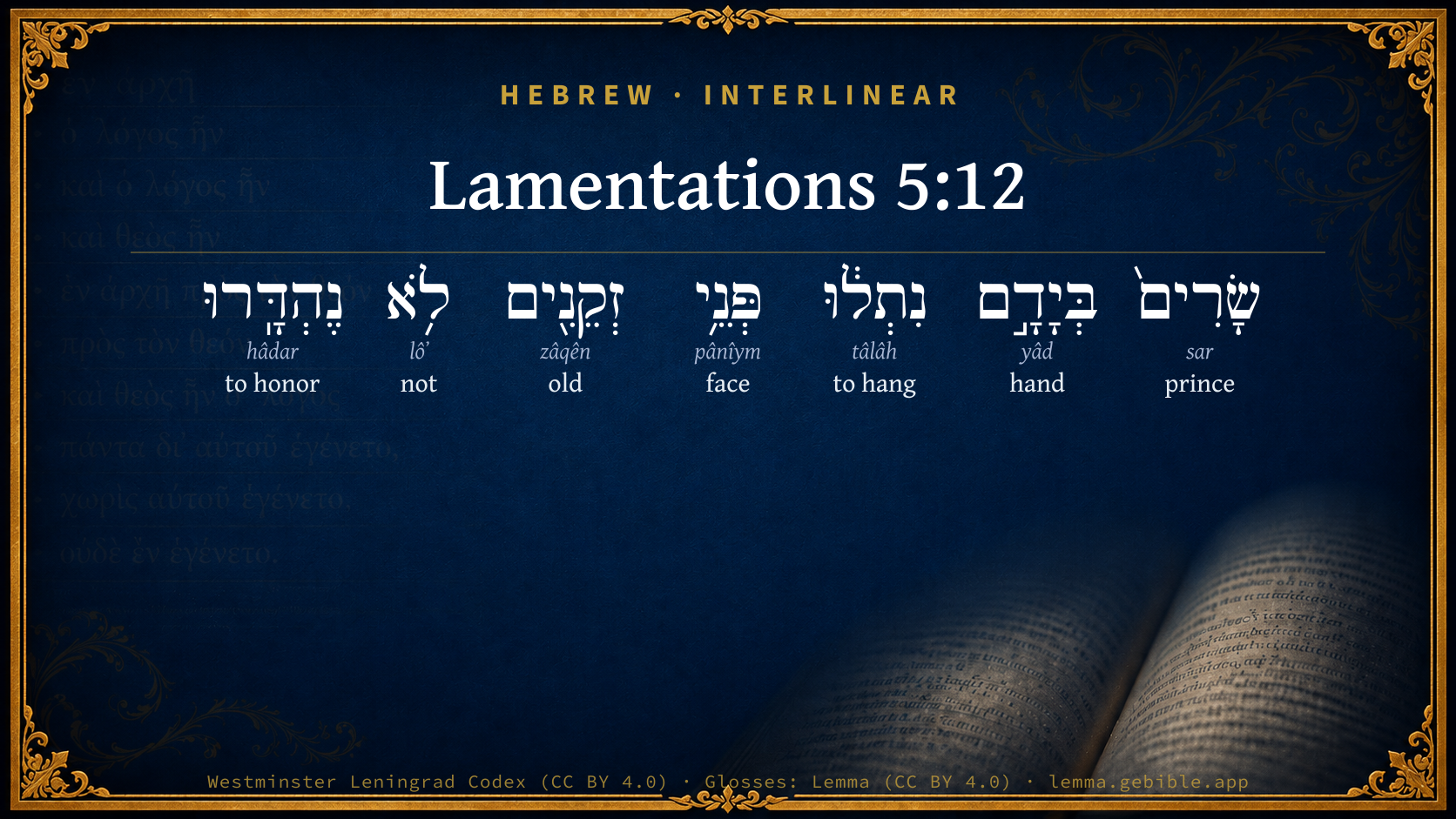
Lamentations 5:12

Hebrew (Westminster Leningrad Codex) Lamentations 5:12 appears in the Hebrew Old Testament. The text above is from the Westminster Leningrad Codex. Each word links to its Strong’s number, a concise gloss, and parsing drawn from the Open Scriptures Hebrew Bible morphology. Click any word for its full Brown-Driver-Briggs (BDB) entry.
Download image
Cite this verse

Lamentations 5:12 (World English Bible). Public Domain. Lemma interlinear Bible study tool, https://lemma.gebible.app/v/lamentations/5/12.

Show BibTeX & RIS
BibTeX
RIS
English Translation
Princes were hanged up by their hand: The faces of elders were not honored.
World English Bible · Public Domain
Download a study sheet

One document with this verse’s original text, its word-by-word gloss line, the meaning frame, cross-references with their text, attributed commentary, and full source and license credits — printable, and it pastes into notes with its structure intact.

This verse Autodidact and up

Study sheet (.html) Plain text (.txt)

A passage Seminary Student

Up to 50 verses in one chapter. A passage sheet keeps up to 6 commentary sources and 12 cross-references per verse, in the order this page ranks them, and says so on the sheet whenever that leaves anything out. Ask for a single verse and you get the Autodidact verse sheet above.

Everything on this page stays free to read, with no account — the sheet is a download of what is already on screen, not access to it.

Want to remove ads? Support Godless Engineer
Compare translations 3

The same verse in 3 English versions, stacked beneath the original-language interlinear above. Click any original word for its lexicon entry.

Each is an independent rendering of the whole verse — the interlinear is not word-aligned to these translations.

Highlighted words mark where these versions differ — a whole-verse word diff, not a word-by-word alignment.

  • World English Bible Public Domain
    Princes were hanged up by their hand: The faces of elders were not honored.
  • King James Version Public Domain
    Princes are hanged up by their hand: the faces of elders were not honoured.
  • unfoldingWord Literal Text CC BY-SA 4.0
    Princes are hung by their hands; the faces of elders are not honored.

unfoldingWord Literal Text — © unfoldingWord, licensed CC BY-SA 4.0. Word-aligned USFM3 via Door43 (git.door43.org/unfoldingWord/en_ult).

Versions to compare (up to 4)

3 of 4 selected

Show all 18 translations

Every available English version of this verse, each an independent rendering of the whole verse.

  • World English Bible Public Domain
    Princes were hanged up by their hand: The faces of elders were not honored.
  • Berean Standard Bible Public Domain
    Princes have been hung up by their hands; elders receive no respect.
  • Majority Standard Bible Public Domain
    Princes have been hung up by their hands; elders receive no respect.
  • King James Version Public Domain
    Princes are hanged up by their hand: the faces of elders were not honoured.
  • American Standard Version (1901) Public Domain
    Princes were hanged up by their hand: The faces of elders were not honored.
  • Revised Version (1885) Public Domain
    Princes were hanged up by their hand: the faces of elders were not honoured.
  • Geneva Bible (1599) Public Domain
    The princes are hanged vp by their hande: the faces of the elders were not had in honour.
  • Douay-Rheims (1899) Public Domain
    The princes were hanged up by their hand: they did not respect the persons of the ancient.
  • Young's Literal Translation Public Domain
    Princes by their hand have been hanged, The faces of elders have not been honoured.
  • Literal Standard Version CC BY-SA 4.0
    Princes have been hanged by their hand, || Elderly faces have not been honored.
  • Unlocked Literal Bible CC BY-SA 4.0
    Princes are hung up by their own hands, and no honor is shown to the elders.
  • unfoldingWord Literal Text CC BY-SA 4.0
    Princes are hung by their hands; the faces of elders are not honored.
  • Darby Bible Public Domain
    Princes were hanged up by their hand; the faces of elders were not honoured.
  • World Messianic Bible Public Domain
    Princes were hanged up by their hands. The faces of elders were not honored.
  • Webster's Bible Public Domain
    Princes were hanged by their hand: the faces of elders were not honored.
  • Free Bible Version CC BY-SA 4.0
    Princes have been hung up by their hands; they show elders no respect.
  • Bible in Basic English Public Domain
    Their hands put princes to death by hanging: the faces of old men were not honoured.
  • JPS Tanakh (1917) Public Domain
    Princes are hanged up by their hand; the faces of elders are not honoured.

Literal Standard Version (2020), Covenant Press — licensed CC BY-SA 4.0. Text via the HelloAO Bible API (eBible.org). Unlocked Literal Bible (unfoldingWord) — licensed CC BY-SA 4.0. Text via the HelloAO Bible API (eBible.org). unfoldingWord Literal Text — © unfoldingWord, licensed CC BY-SA 4.0. Word-aligned USFM3 via Door43 (git.door43.org/unfoldingWord/en_ult). Free Bible Version, Dr. Jonathan Gallagher — licensed CC BY-SA 4.0. Text via the HelloAO Bible API (eBible.org).

Word by word

More ways to search: Search by grammar → Find every occurrence → Compare this word →

Practice this passage: Drill this verse → Learn its vocabulary →

About this verse

These counts appear in no published source. They are computed here, from the morphology-tagged text and Lemma’s own curated glosses. What Lemma adds →

7
words
7
distinct lemmas
Prophets
section

Notable vocabulary

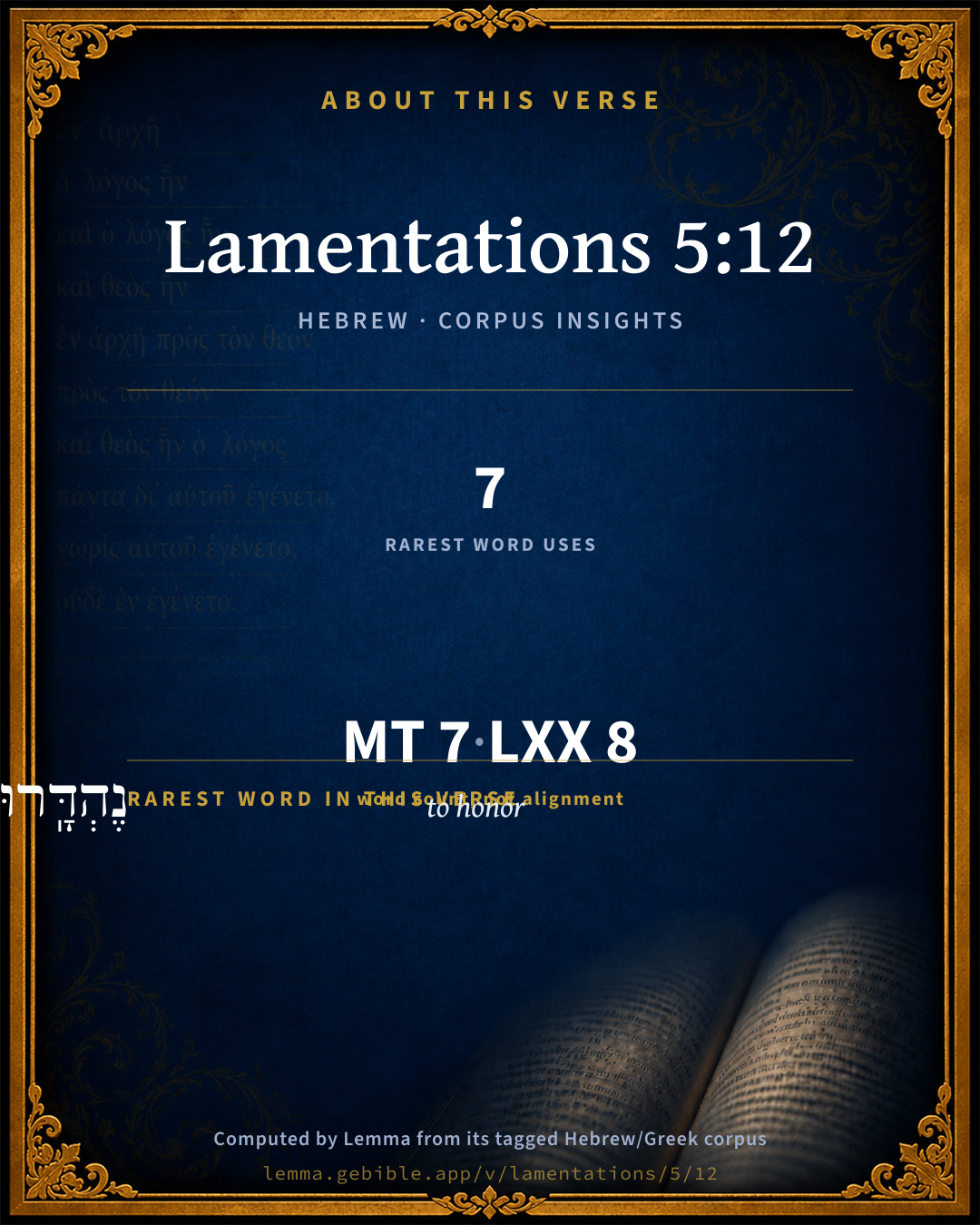
The rarest word here is נֶהְדָּֽרוּ to honor H1921 — appearing just 7 times in the whole Hebrew Bible.

Shared distinctive vocabulary

נֶהְדָּֽרוּ to honor H1921 occurs in 7 verses of the Hebrew Bible. Also found in:

Grammatical profile

  • 2 verbs
  • 3 nouns
  • 1 adjective
  • 1 particle

Verb forms

  • נִתְל֔וּ Niphal · Perfect
  • נֶהְדָּֽרוּ Niphal · Perfect

Hebrew & Septuagint length

In English translation the verse runs 14 words from the Hebrew and 12 from the Septuagint (LXX English) — closely comparable.

A rough comparison of the two English renderings, which tokenize alike — not a word-level alignment.

Word counts can differ between the Hebrew and the Greek without any difference in meaning — e.g. the Hebrew direct-object marker אֵת has no separate Greek word, and Greek often adds the article ὁ.

In the original languages it is 7 Hebrew tokens and 8 Greek tokens — but the two are counted differently (Hebrew bundles its prefixes and suffixes into one token; the Greek is in lemma form), so that isn’t a like-for-like length.

Cross-references

7

Topical passages linked to Lamentations 5:12 in the Treasury of Scripture Knowledge — connected by theme and wording, ordered by reader-vote popularity; previews shown in the World English Bible.

  • Lamentations 4:16 The anger of Yahweh has scattered them; he will no more regard them: They didn't respect the persons of the priests, they didn't favor the elders.
  • Isaiah 47:6 I was angry with my people, I profaned my inheritance, and gave them into your hand: you did show them no mercy; on the aged have you very heavily laid your yoke.
  • Jeremiah 39:6–7 Then the king of Babylon killed the sons of Zedekiah in Riblah before his eyes: also the king of Babylon killed all the nobles of Judah.
  • Jeremiah 52:10–11 The king of Babylon killed the sons of Zedekiah before his eyes: he killed also all the princes of Judah in Riblah.
  • Jeremiah 52:25–27 and out of the city he took an officer who was set over the men of war; and seven men of those who saw the king's face, who were found in the city; and the scribe of the captain of the host, who mustered the people of the land; and sixty men of the people of the land, who were found in the midst of the city.
  • Lamentations 2:10 The elders of the daughter of Zion sit on the ground, they keep silence; They have cast up dust on their heads; they have girded themselves with sackcloth: The virgins of Jerusalem hang down their heads to the ground.
  • Lamentations 2:20 Look, Yahweh, and see to whom you have done thus! Shall the women eat their fruit, the children that are dandled in the hands? Shall the priest and the prophet be killed in the sanctuary of the Lord?

Cross-references courtesy of OpenBible.info (CC BY 4.0).

Hebrew and Greek witnesses Masoretic Hebrew ↔ Greek Septuagint

The same verse in the two great witnesses to the Old Testament, shown verse-for-verse.

These are two independent witnesses, not word-aligned to each other, and the Septuagint is shown in lemma (dictionary) form.

Hebrew Lamentations 5:12 Masoretic · Westminster Leningrad Codex

שָׂרִים֙ בְּיָדָ֣ם נִתְל֔וּ פְּנֵ֥י זְקֵנִ֖ים לֹ֥א נֶהְדָּֽרוּ

Princes were hanged up by their hand: The faces of elders were not honored.

World English Bible · Public Domain

Greek LXX Lamentations 5:12 Septuagint · lemma form

ἄρχων ἐν χείρ αὐτός κρεμάζω πρεσβύτερος οὐ δοξάζω

Princes were hanged up by their hands: the elders were not honored.

LXX2012 (modern English Septuagint) · Public Domain

Hebrew: Westminster Leningrad Codex (CC BY 4.0). Greek: Septuagint (public domain); English from LXX2012 (modern English Septuagint) (Public Domain). How the Septuagint differs from the Hebrew →

Commentary

Notes on Lamentations 5:12 from classic Christian and Jewish commentators (each source and its license shown beneath its notes). The classic Christian expositions comment on the surrounding passage and are grouped to its opening verse, so a note may address several verses; the Jewish commentaries on the Tanakh (Rashi and others) are per-verse, so they appear only where the commentator wrote on this verse.

Lemma curates 59 commentaries, every one of them public domain or Creative Commons licensed, each selected and text-cleaned for this edition rather than reprinted as found. About our sources →

Trapp's Complete Commentary

John Trapp

Lam 5:12 Princes are hanged up by their hand: the faces of elders were not honoured.

Ver. 12. Princes are hanged up by the hand.] Made to die a dog’s death, and, as some {a} will have it, by their own hands, αυτοχειρες.

The faces of the elders were not honoured.]

“ Magna fuit quondam capitis reverentia cani:

Inque suo precio ruga senilis erat, ” - Ovid.

But now it was otherwise with the Jewish elders, who haply were not worthy of their years, as we say; like as the princes had done wickedly with both hands earnestly, and were therefore not undeservedly hanged up hy the hand; but if Quakers among us might have their way, our families, saith one, would soon be like the cabins of the Lestringonians in Sicily, where everybody was at liberty, and none regarded or reverenced their seniors or superiors.

{a} Calvin.

John Trapp, A Commentary or Exposition upon All the Books of the Old and New Testament (1647–1656) — public domain. Text from a community e-Sword module.

The Biblical Illustrator

Joseph S. Exell

Lam_5:12-18

The elders have ceased from the gate.

The seat of justice overthrown

1. It is a grievous plague unto a people when the seat of justice is overthrown from among them.

(1) Reasons.

(a) It bringeth in all confusion and disorder.

(b) No man can enjoy anything as his own.

(c) Every one lieth open to the violence of spoilers, and hath no succour nor redress.

(2) Uses.

(a) Better have tyrants govern us, than be void of all government.

(b) Pray unto God for the government under which we live, that in the prosperity thereof we may have peace.

(c) Acknowledge all lawful magistrates to be the special ordinances of God, appointed for our good, and therefore to be obeyed and reverenced.

2. The overthrow of magistracy among a people taketh all occasions of rejoicing from all sorts of people. The young men from their music.

(1) Reasons.

(a) Many great blessings are lost, and many griefs come upon them which will make the heart heavy.

(b) They have no safety, but have cause every one to fear another, and to stand upon his own guard, as though he were in the midst of his enemies.

(2) Use. Pray to God that He would never leave us without those heads and governors that may take care to protect us in peace; for if He do, our life will be more bitter than death itself.

3. Honest recreations and delights are to be esteemed among the good blessings that God giveth His people in this life.

(1) It is here accounted by the Holy Ghost a grievous thing that they are deprived of them.

(2) Neither body nor mind can continue able and apt to their duties without some intermission, but it is never lawful to be idle. (J. Udall.)

The joy of our heart is ceased, our dance is turned into mourning.

Gods people may apprehend themselves stripped of all cause of joy

This is the condition of these distressed creatures in the land of Babylon; whilst they were in Judea, they used to rejoice in their harvest, and to shout at their vintage (Isa_16:10). They had the mirth of tabrets and their harps melodiously sounding in their streets (Isa_24:8). But now there is a crying for wine in all quarters, their joy is darkened, and the mirth of the land is gone (Isa_24:11). All causes of joy are sometimes taken from Gods: precious saints; thus it fared with Israel upon the pursuit of Pharaoh, when she was passing out of Egypt into the land of Canaan (Exo_14:10). Neither was it better with Job in the time of his affliction (Job_30:17-18; Job_30:31). Do but look upon the sweet singer of Israel, and you shall find him in as bad a condition; for the sorrows of death encompassed him, the pains of hell got hold upon him, and he found nothing but trouble and sorrow (Psa_116:1-19). The Lord takes away all cause of rejoicing from, that He may the more deeply humble them for the evil of their ways. Great afflictions effect the like submissions, with strong cries to the God of heaven (Jdg_6:6; Jdg_10:13-15). Gods great design in thus dealing with them, is to purge them from their dross (Isa_27:9), to make them cast off the sin of their souls; you know gold, that it may be refined, must as it were be encompassed with flames (Zec_13:8-9). The best are prone to rest upon the reeds of Egypt, to rely too much upon worldly vanities, therefore God makes the joy of their hearts to cease, that He may take them off from dependency upon creature comforts (Jer_3:22-23; Hos_14:2-3). Beware of sin, it will cause both sad looks and heavy hearts (Gen_4:7; Amo_8:8-10). Keep your eye upon heaven (2Ch_20:12), it is only a ray of His favour that can cheer your hearts (Psa_9:9-10). Disclaim help from others, trust not to yourselves (Isa_30:1-3; Isa_31:1; Psa_20:7; 2Co_1:9). Created substances are but vanities.

I. The precious sons of Zion may be much discouraged in their sufferings. And when Zion was in affliction, did she not as one in despair cry out, My strength and my hope is perished from the Lord (Lam_3:17-18)?

(1) Sudden and boisterous storms sometimes make stout-hearted seamen to give up all for gone (Psa_88:3-8; Isa_54:11; Mat_27:46).

(2) Feeble things are soon thrown down, they want strength, it is weakness of faith that dejects their spirits (Mat_8:24-26). Give a check to the heaviness, to the sadness of your souls, when you are in afflictions (Psa_43:5). The apostles carried themselves gallantly with much cheerfulness in the worst of times (Rom_5:3; Act_21:13).

Now that you may come near them in the same spirit, consider--

(1) That the sorrows of our Saviour were very dolorous (Mat_26:38; Luk_22:42).

(2) That what befalls you is incident to the best of saints (1Co_10:13; Son_2:2).

(3) That death will put a period to all your troubles.

(4) That God hath promised to deliver His chosen ones (Psa_126:5-6; Job_16:33). Brag not of what spirit you will be when you come to suffer; you have but a little strength in yourselves, your hearts may come to deceive you, to fail you when troubles come with a strong current upon you; thus did Peter, yet denied his Master (Mar_14:29; Mar_14:31; Mar_14:68, etc).

2. Keep up your heads, your hearts above the waters of sorrow, let them not sink your spirits, but under the worst of evils, retain your joy, and in patience possess your souls (Lam_3:26; Psa_27:13-14). (D. Swift.)

The crown is fallen from our head: woe unto us, that we have sinned!--

Mans fall from love into selfishness

The secret of mans perfection may be summed up in these short words, Love to God. The secret of mans sin may be stated as shortly, Defect of love to God. As the former implied truth and holiness, and purity of motive, and unity of wilt with His will, so this latter implies the departure of all these graces. But not only this. The heart allows no vacuum: sin is not a negative only, but a positive condition; where love has departed, there the opposite of love enters, namely, selfishness, with all its baneful consequences. And the essence of selfishness is, that a man lives not for and in another, be that other his neighbour, or his God, hut for and in himself. Now notice, that this selfishness, arising out of defect of love to God, and in God to others, is not an act, or a series of acts in man, but a state, out of which spring, as the symptoms out of a disease, those sinful acts of selfishness, which we call sins. Selfishness has turned love into lust, dignity into pride, humility into meanness, zeal into ambition, charity into ostentation; has made the strong man into a tyrant, the womanly into the womanish character, the childlike into the childish; has turned family and friendly love into partisanship, patriotism into faction, religion itself into bigotry. It penetrates into, and infiltrates every thought, every desire, every word, every act; so that whatsoever is of it, and not of faith, is sin. And its seat is in the noblest, the godlike, the immortal and responsible spirit of man. So that it is no longer worthy of that noble title of the Spirit, reminding us of God; but they who are thus, are named in Scripture unspiritual, and their whole state is called the flesh; not that it springs from the flesh, but because it sinks them into the flesh. Another degrading consequence results from this usurpation by self of the place of God within us. Man placed under love, though in bond and covenant to God and his neighbour, was really and essentially free; a child of Gods family; his will and Gods will being one, law became to him liberty. But under selfishness, though he has broken loose from covenant with God and his neighbour, he is to all intents and purposes, a slave; in bondage to his own desires and passions, which he ought to be, and wishes to be, ruling. The truth, declares our Lord, shall make you free; but all sin is a lie, It practically denies God,--whose being, and whose power, and whose love constitute the great truth of this universe: this is the negative side of its falsehood; and it sets up self and other creatures in Gods place as lord and guide of mans being: this is its positive side. It apes the perfections and attributes of God, and makes man into a miserable counterfeit, betraying, by that which he wishes to appear, that which he really ought to be. Well then, it now comes before us as a solemn question, seeing that our whole nature, the nature of each man, is thus gone astray, and that every one of us has an abiding tendency to selfishness and to evil--Whence came this tendency? How had it its beginning? This tendency is a departure from God who made us; and cannot therefore have been Gods work. And this departure can only have begun by an act of the will of man. God created us free, gave our first parents a command to keep, which very fact implied that they had power to break it. Now there was no reasonable ground for breaking it, but every imaginable reason against such conduct; the departure was not an act of the convinced reason, but an act of that which we know as self-will--a leaning to self in spite of reason and conscience. So that sin had its practical beginning in the will of man. And this beginning we read of in Scripture in the history of the Fall. At once mans personality, the inner soul of his nature, passes into a different relation to God: it is torn out of the covenant of His love; stands over against Him as His enemy; trembles at His approach. All peace, all innocence, is gone. The body, Gods beautiful and wonderful work, becomes the seat of shame. Man, knowing that he is naked, flies from God and hides himself. And as the spirit of man has renounced its allegiance to God, so have now the animal soul and the body thrown off their allegiance to the spirit. Anarchy enters into his being, and holds wild misrule. The gravitation of the spiritual world is overthrown, its laws of attraction are suspended; the lower revolts against the higher, the lowest against the lower. And as in man, so in mans world. In a moment the poison spreads, electric, over the kingdom which he should have ruled; the elements disown him, the beasts of the forest glare upon him, the ground is cursed for his sake. The king of nature is self-deposed,--his palace is broken up, his delights are scattered, his sweet fellowship with his helpmate is marred,--and he is driven out a wanderer. Then first sprung forth the bitter fountains of tears, destined to furrow the cheeks of untold generations; then first the hands were clenched, and the brow grasped, and the breast beaten,--and the vastness of inward woe sought relief in outward gesture. Verily, the crown had fallen from his head; woe unto him, that he had sinned. (Dean Alford.)

The Biblical Illustrator, edited by Joseph S. Exell (c. 1880s–1900s) — public domain. Text from a community e-Sword module.

Joseph Benson's Commentary

Lam 5:12-16. Princes are hanged up by their hand — By the hand of their enemies. They took the young men to grind — To grind at the mill was the common employment of slaves, Exo 11:5. The children fell under the wood — They made children turn the handle of the mill till they fell down through weariness: so some explain it with relation to the former part of the verse. But the expression may be understood of making them carry such heavy burdens of wood that they fainted under the load. The elders have ceased from the gate — The elders no more sit in the gates of the cities, to administer justice to every one, and keep things in order. The young men from their music — Those songs of mirth and joy which used to be heard in our nation are heard no longer. The joy of our heart is ceased — Since the enemy came in upon us like a flood, we have been strangers to all comfort. Our dance is turned into mourning — Instead of leaping for joy, as formerly, we sink and lie down in sorrow. This may refer especially to the joy of their solemn feasts: this was now turned into mourning, which was doubled on their festival days, in remembrance of their former delights and comforts. The crown is fallen from our head — At their feasts, at their marriages, and other seasons of festivity, they used to crown themselves with flowers. The prophet most probably alludes to this custom, as we may gather from the preceding verses. The general meaning is, “All our glory is at an end, together with the advantages of being thy people, and enjoying thy presence, by which we were distinguished from the rest of the world.” — Lowth.

Joseph Benson's Commentary on the Old and New Testaments (1811–1818) — public domain. Text from a community e-Sword module.

Tyndale Open Study Notes

Tyndale Open Resources

5:12-17 These terrible things happened because the people had sinned (see Isa 24:7-12; Jer 7:24; 13:18; 25:10-11; Amos 8:10).

Tyndale Open Study Notes — © Tyndale Open Resources, licensed CC BY-SA 4.0. Text via the HelloAO Bible API.

Geneva Bible (1599)

Geneva Bible translators

That is, by the enemy’s hand.

Geneva Bible (1599) marginal notes — public domain. Text via Bolls.life.

Jamieson, Fausset & Brown

Robert Jamieson, A. R. Fausset & David Brown

hanged . . . by their hand--a piece of wanton cruelty invented by the Chaldeans. GROTIUS translates, "Princes were hung by the hand of the enemy"; hanging was a usual mode of execution (Gen 40:19).

elders--officials (Lam 4:16).

Jamieson, Fausset & Brown — Commentary Critical and Explanatory on the Whole Bible (1871) — public domain (CC PDM 1.0). Text via the HelloAO Bible API.

Adam Clarke's Commentary

Verse 12. Princes are hanged up by their hand] It is very probable that this was a species of punishment. They were suspended from hooks in the wall by their hands till they died through torture and exhaustion. The body of Saul was fastened to the wall of Bethshan, probably in the same way; but his head had already been taken off. They were hung in this way that they might be devoured by the fowls of the air. It was a custom with the Persians after they had slain, strangled, or beheaded their enemies, to hang their bodies upon poles, or empale them. In this way they treated Histiaeus of Miletum, and Leonidas of Lacedaemon. See Herodot. lib. vi. c. 30, lib. vii. c. 238.

Adam Clarke's Commentary on the Bible (1810–1826) — public domain. Text from a community e-Sword/MySword module.

John Calvin's Commentaries

The beginning of the verse may be explained in two ways. All render thus, “The princes have been slain by their hand,” that is, of their enemies. But I wonder how it never occurred to them, that it was far more grievous, that they were slain by their own hand. I certainly do not doubt but that the Prophet says here, that some of the princes had laid violent hands on themselves. For it would be a frigid expression, that the princes were hung by the hand of enemies; but if we read, that the princes were hung by their own hand, this would be far more atrocious, as we have before seen that even women, excelling in humanity, devoured their own offspring. So he says now that princes were hung, not by enemies, for it was a common thing for the conquered to be slain by their enemies, and be also hung by way of reproach; but the Prophet, as it appears to me, meant to express something more atrocious, even that the miserable princes were constrained to lay violent hands on themselves.

He adds, that the faces of the aged were not honored; which is also a thing not natural; for we know that some honor is always rendered to old age, and that time of life is commonly regarded with reverence. When, therefore, no respect is shown to the aged, the greatest barbarity must necessarily prevail. It is the same, then, as though the Prophet had said that the people had been so disgracefully treated, that their enemies had not even spared the aged. We also now understand why he adds this, for it would have otherwise appeared incredible, that the princes hung themselves by their own hand. But he here intimates that there was no escape for them, except they in despair sought death for themselves, because all humanity had disappeared. It follows, —

John Calvin's Commentaries (1540-1563) — public domain. Text from the Calvin Translation Society English edition (1840s-50s) via the Christian Classics Ethereal Library (ccel.org). Calvin's coverage is partial (roughly two-thirds of the Bible); uncommented books and verses are honest gaps, never fabricated. The 19th-century editor's footnotes and remarks are omitted so the notes are faithfully Calvin's own voice.

Ellicott's Commentary for English Readers

(12) Princes are hanged . . .—The words point to the shameless exposure of the bodies of the dead. (Comp. the treatment of Saul and his sons in 1Sa_31:10-12.) This was the common practice of the Assyrian kings (Records of the Past, i. 38). Neither age nor dignity (both are implied in the word “elders”) was any safeguard against atrocities, either in life or death.

A Bible Commentary for English Readers, edited by Charles John Ellicott (1878–1897) — public domain. Text from a community e-Sword module.

The Cambridge Bible for Schools and Colleges

gen. ed. J. J. S. Perowne

12. The reference may either be to impalement after death, or to torture in order, as Pe. suggests, to obtain information as to hidden treasure. Both death by crucifixion and subsequent impalement were regarded with the utmost abhorrence by the Jews. For the former see Deu_21:23.

The Cambridge Bible for Schools and Colleges (gen. ed. J. J. S. Perowne; Cambridge University Press, 1878–1918) — public domain. Text from a community e-Sword module.

John Gill's Exposition

Princes are hanged up by their hand,.... According to some, as Aben Ezra observes, by the hand of the servants before mentioned; however, by the hand of the Chaldeans or Babylonians; see Jer 52:10. Some understand it of their own hands, as if they laid violent hands upon themselves, not being able to bear the hardships and disgrace they were subjected to but I should rather think this is to be understood of hanging them, not by the neck, but by the hand, could any instance be given of such a kind of punishment so early used, and by this people; which has been in other nations, and in more modern times:

the faces of elders were not honoured; no reverence or respect were shown to elders in age or office, or on account of either; but were treated with rudeness and contempt.

John Gill's Exposition of the Whole Bible (1746–1763) — public domain (CC PDM 1.0). Text via the HelloAO Bible API.

Albert Barnes' Notes on the Bible

After the princes had been put to death their bodies were hung up by the hand to expose them to public contumely. Old age, again, no more availed to shield men from shameful treatment than the high rank of the princes. Such treatment of conquered enemies was not uncommon in ancient warfare.

Albert Barnes' Notes on the Bible (1834–1885) — public domain. Text from a community e-Sword/MySword module.

Haydock's Catholic Bible Commentary

Hand. Thus Leonidas was treated, after his head was cut off, by Xerxes. (Herodotus vii. 238.)

George Leo Haydock (1774–1849), Haydock's Catholic Family Bible and Commentary, 1859 edition — public domain. Excludes Psalms (Douay-Rheims chapter numbering differs from Protestant) and Deuterocanonical books (Catholic canon only).

Matthew Poole's English Annotations

Most probably by the enemies’ hands, though some would have it by their hands, intimating a more sharp and lingering death. Hanging was an ancient way in the Eastern countries of putting malefactors to death, Gen 40:19.

Matthew Poole's English Annotations on the Holy Bible (1683–1685) — public domain. Text from a community e-Sword/MySword module.

The Pulpit Commentary

Princes are hanged up by their hand; i.e. by the hand of the enemy. Impalement after death was a common punishment with the Assyrians and Babylonians. Thus Sennacherib says that, after capturing rebellious Ekron, he hung the bodies of the chief men on stakes all round the city ("Records of the Past," 1:38). Benomi gives a picture of such an impalement from one of the plates in Botta"s great work ("Nineveh and its Palaces," p. 192).

The Pulpit Commentary (1880–1919), ed. H.D.M. Spence-Jones & Joseph S. Exell — public domain. Text from a community e-Sword module.

Lesson kit

Teaching starters — assembled from the data on this page, not authored interpretation. Every prompt links to the verse data it draws on. Edit before teaching.

Lamentations, in the Prophets, opens this verse with 7 words (7 distinct Hebrew lemmas). Its most distinctive word is hâdar (“to honor”). A historical commentator’s framing appears above. Read the whole chapter for the surrounding context.

Discussion questions

  1. The word hâdar carries the sense “to honor.” How does it shape the verse?
  2. How does Exodus 23:3, which shares the word «to honor», read alongside this verse?
  3. The translations on this page render this verse differently — a whole-verse word diff, not a word-by-word alignment. What might account for the different wordings?
  4. «נִתְל֔וּ» is a Niphal Perfect verb. How does that grammatical form shape the action described?
  5. Compare how Trapp's Complete Commentary and The Biblical Illustrator read this verse. Where do they agree or differ?

Things to notice

Reading settings

Reading text

Shown beneath each verse's original-language words.

Old Testament
Old Testament edition

Read the OT as the Masoretic Hebrew (MT) or the Greek Septuagint (LXX).

English shown for the Greek Septuagint (in the Hebrew ↔ Greek comparison).

Comparing translations? Open the Compare panel on any verse page to stack up to four side by side.