
Ezra 10:8

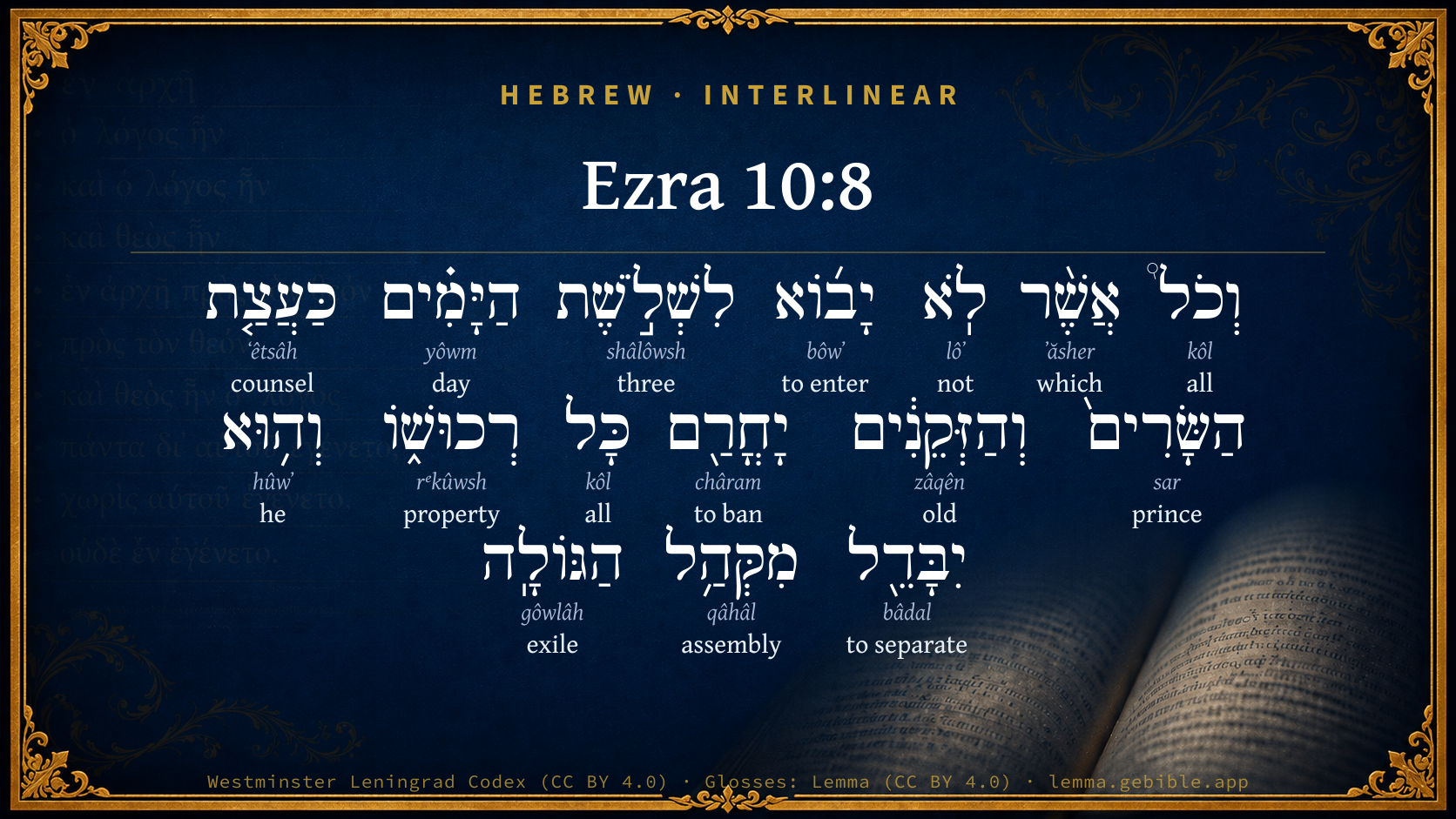
Hebrew (Westminster Leningrad Codex) Ezra 10:8 appears in the Hebrew Old Testament. The text above is from the Westminster Leningrad Codex. Each word links to its Strong’s number, a concise gloss, and parsing drawn from the Open Scriptures Hebrew Bible morphology. Click any word for its full Brown-Driver-Briggs (BDB) entry.
Download image
Cite this verse

Ezra 10:8 (World English Bible). Public Domain. Lemma interlinear Bible study tool, https://lemma.gebible.app/v/ezra/10/8.

Show BibTeX & RIS
BibTeX
RIS
English Translation
and that whoever didn't come within three days, according to the counsel of the princes and the elders, all his substance should be forfeited, and himself separated from the assembly of the captivity.
World English Bible · Public Domain
Download a study sheet

One document with this verse’s original text, its word-by-word gloss line, the meaning frame, cross-references with their text, attributed commentary, and full source and license credits — printable, and it pastes into notes with its structure intact.

This verse Autodidact and up

Study sheet (.html) Plain text (.txt)

A passage Seminary Student

Up to 50 verses in one chapter. A passage sheet keeps up to 6 commentary sources and 12 cross-references per verse, in the order this page ranks them, and says so on the sheet whenever that leaves anything out. Ask for a single verse and you get the Autodidact verse sheet above.

Everything on this page stays free to read, with no account — the sheet is a download of what is already on screen, not access to it.

Want to remove ads? Support Godless Engineer
Compare translations 3

The same verse in 3 English versions, stacked beneath the original-language interlinear above. Click any original word for its lexicon entry.

Each is an independent rendering of the whole verse — the interlinear is not word-aligned to these translations.

Highlighted words mark where these versions differ — a whole-verse word diff, not a word-by-word alignment.

  • World English Bible Public Domain
    and that whoever didn't come within three days, according to the counsel of the princes and the elders, all his substance should be forfeited, and himself separated from the assembly of the captivity.
  • King James Version Public Domain
    And that whosoever would not come within three days, according to the counsel of the princes and the elders, all his substance should be forfeited, and himself separated from the congregation of those that had been carried away.
  • unfoldingWord Literal Text CC BY-SA 4.0
    And for all who did not come in three days according to the counsel of the leaders and the elders, all his property would be devoted to the ban. And he himself would be separated from the assembly of the exiles.

unfoldingWord Literal Text — © unfoldingWord, licensed CC BY-SA 4.0. Word-aligned USFM3 via Door43 (git.door43.org/unfoldingWord/en_ult).

Versions to compare (up to 4)

3 of 4 selected

Show all 18 translations

Every available English version of this verse, each an independent rendering of the whole verse.

  • World English Bible Public Domain
    and that whoever didn't come within three days, according to the counsel of the princes and the elders, all his substance should be forfeited, and himself separated from the assembly of the captivity.
  • Berean Standard Bible Public Domain
    Whoever failed to appear within three days would forfeit all his property, according to the counsel of the leaders and elders, and would himself be expelled from the assembly of the exiles.
  • Majority Standard Bible Public Domain
    Whoever failed to appear within three days would forfeit all his property, according to the counsel of the leaders and elders, and would himself be expelled from the assembly of the exiles.
  • King James Version Public Domain
    And that whosoever would not come within three days, according to the counsel of the princes and the elders, all his substance should be forfeited, and himself separated from the congregation of those that had been carried away.
  • American Standard Version (1901) Public Domain
    and that whosoever came not within three days, according to the counsel of the princes and the elders, all his substance should be forfeited, and himself separated from the assembly of the captivity.
  • Revised Version (1885) Public Domain
    and that whosoever came not within three days, according to the counsel of the princes and the elders, all his substance should be forfeited, and himself separated from the congregation of the captivity.
  • Geneva Bible (1599) Public Domain
    And whosoeuer woulde not come within three dayes according to the counsel of the Princes and Elders, all his substance should be forfait, and he should be separate from the Congregation of them of the captiuitie.
  • Douay-Rheims (1899) Public Domain
    And that whosoever would not come within three days, according to the counsel of the princes and the ancients, all his substance should be taken away, and he should be cast out of the company of them that were returned from captivity.
  • Young's Literal Translation Public Domain
    and every one who cometh not in by the third day, according to the counsel of the heads and of the elders, all his substance is devoted, and himself separated from the assembly of the removal.
  • Literal Standard Version CC BY-SA 4.0
    and everyone who does not come in by the third day, according to the counsel of the heads and the elderly, all his substance is devoted, and himself separated from the assembly of the expulsion.
  • Unlocked Literal Bible CC BY-SA 4.0
    Anyone who did not come in three days according to the instructions from the officials and elders forfeited all of his possessions and would be excluded from the great assembly of the people who had come back from exile.
  • unfoldingWord Literal Text CC BY-SA 4.0
    And for all who did not come in three days according to the counsel of the leaders and the elders, all his property would be devoted to the ban. And he himself would be separated from the assembly of the exiles.
  • Darby Bible Public Domain
    and that whosoever would not come within three days, according to the counsel of the princes and the elders, all his substance should be confiscated, and himself separated from the congregation of those that had been carried away.
  • World Messianic Bible Public Domain
    and that whoever didn’t come within three days, according to the counsel of the princes and the elders, all his possessions should be forfeited, and he himself separated from the assembly of the captivity.
  • Webster's Bible Public Domain
    And that whoever would not come within three days, according to the counsel of the princes and the elders, all his substance should be forfeited, and himself separated from the congregation of those that had been carried away.
  • Free Bible Version CC BY-SA 4.0
    Anyone who did not come within three days would have all their property confiscated, and would be banned from the assembly of the exiles. This was the decision of the leaders and elders.
  • Bible in Basic English Public Domain
    And that if anyone did not come before three days were past, as ordered by the rulers and the responsible men, all his goods would be put under the curse, and he himself would be cut off from the meeting of the people who had come back.
  • JPS Tanakh (1917) Public Domain
    and that whosoever came not within three days, according to the counsel of the princes and the elders, all his substance should be forfeited, and himself separated from the congregation of the captivity.

Literal Standard Version (2020), Covenant Press — licensed CC BY-SA 4.0. Text via the HelloAO Bible API (eBible.org). Unlocked Literal Bible (unfoldingWord) — licensed CC BY-SA 4.0. Text via the HelloAO Bible API (eBible.org). unfoldingWord Literal Text — © unfoldingWord, licensed CC BY-SA 4.0. Word-aligned USFM3 via Door43 (git.door43.org/unfoldingWord/en_ult). Free Bible Version, Dr. Jonathan Gallagher — licensed CC BY-SA 4.0. Text via the HelloAO Bible API (eBible.org).

Word by word

More ways to search: Search by grammar → Find every occurrence → Compare this word →

Practice this passage: Drill this verse → Learn its vocabulary →

רְכוּשׁ֑וֹ
rᵉkûwsh
H7399
“property · his”
Noun, Common, Masculine, Singular, Construct + Suffix, Personal, 3rd Person, Masculine, Singular
Part of Speech
Noun
Type
Common
Gender
Masculine
Number
Singular
State
Construct
Full BDB Definition

Origin: from pass part of H7408

TWOT: 2167b

property, goods, possessions - property, goods - general term for all movable goods - of livestock - of stores, utensils, etc
  1. וְכֹל֩ kôl H3605 “and · all” Conjunction + Noun, Common, Masculine, Singular, Absolute
  2. אֲשֶׁ֨ר ʼăsher H834 “which” Particle, Relative
  3. לֹֽא lôʼ H3808 “not” Particle, Negative
  4. יָב֜וֹא bôwʼ H935 “to enter” Verb, Qal, Imperfect, 3rd Person, Masculine, Singular
  5. לִשְׁלֹ֣שֶׁת shâlôwsh H7969 “to/for · three” Preposition + Adjective, Cardinal number, Masculine, Singular, Construct
  6. הַיָּמִ֗ים yôwm H3117 “the · days” Particle, Definite Article + Noun, Common, Masculine, Plural, Absolute
  7. כַּעֲצַ֤ת ʻêtsâh H6098 “like/as · counsel of” Preposition + Noun, Common, Feminine, Singular, Construct
  8. הַשָּׂרִים֙ sar H8269 “the · princes” Particle, Definite Article + Noun, Common, Masculine, Plural, Absolute
  9. וְהַזְּקֵנִ֔ים zâqên H2205 “and · the · old” Conjunction + Particle, Definite Article + Adjective, Adjective, Masculine, Plural, Absolute
  10. יָחֳרַ֖ם châram H2763 “to ban” Verb, Hophal, Imperfect, 3rd Person, Masculine, Singular
  11. כָּל kôl H3605 “all of” Noun, Common, Masculine, Singular, Construct
  12. וְה֥וּא hûwʼ H1931 “and · he” Conjunction + Pronoun, Personal, 3rd Person, Masculine, Singular
  13. יִבָּדֵ֖ל bâdal H914 “to separate” Verb, Niphal, Imperfect, 3rd Person, Masculine, Singular
  14. מִקְּהַ֥ל qâhâl H6951 “from · assembly of” Preposition + Noun, Common, Masculine, Singular, Construct
  15. הַגּוֹלָֽה gôwlâh H1473 “the · exile” Particle, Definite Article + Noun, Common, Feminine, Singular, Absolute

About this verse

These counts appear in no published source. They are computed here, from the morphology-tagged text and Lemma’s own curated glosses. What Lemma adds →

16
words
15
distinct lemmas
Historical
section

Shared distinctive vocabulary

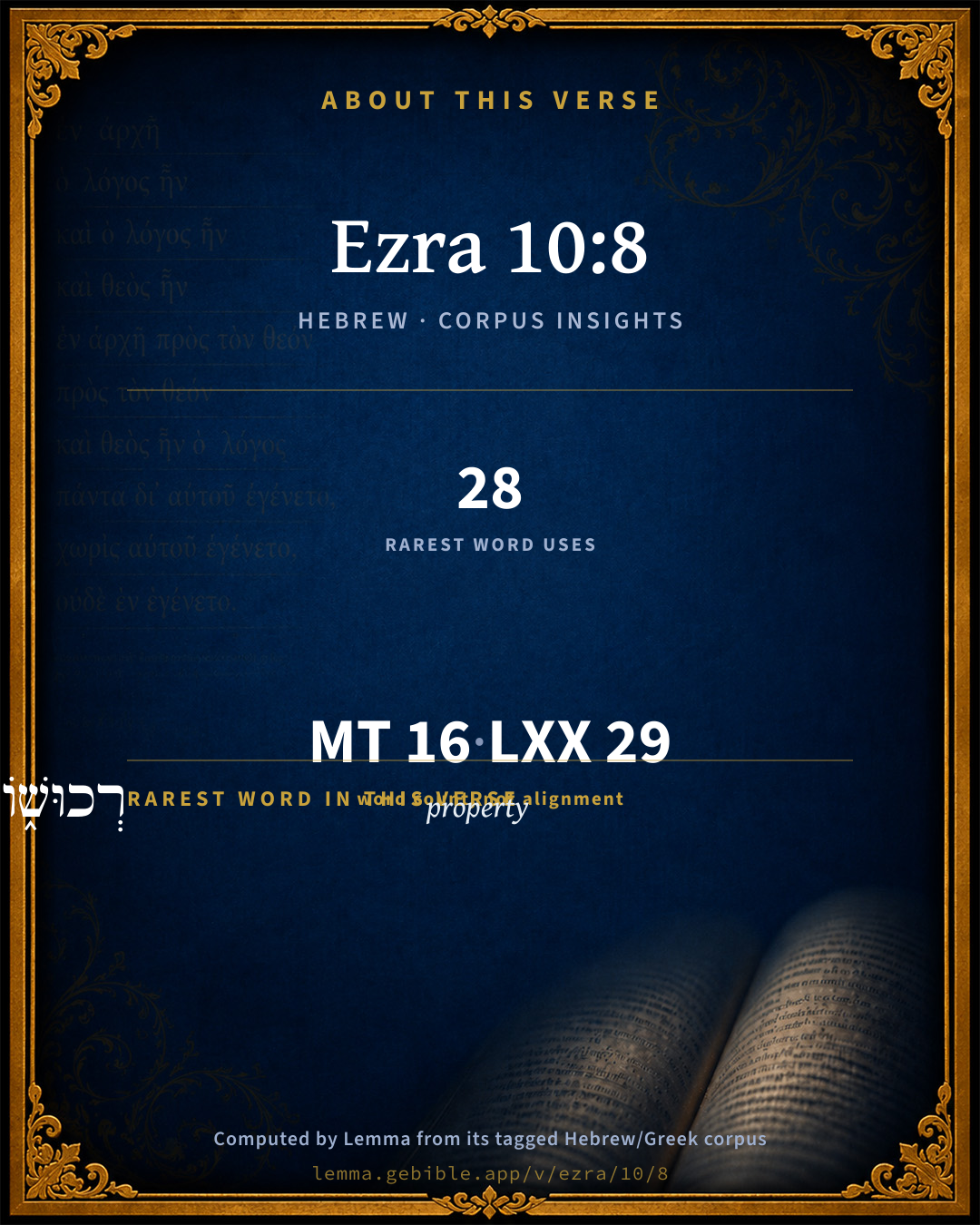
רְכוּשׁ֑וֹ property H7399 occurs in 27 verses of the Hebrew Bible. Also found in:

Grammatical profile

  • 3 verbs
  • 8 nouns
  • 2 adjectives
  • 1 pronoun
  • 2 particles

Verb forms

  • יָב֜וֹא Qal · Imperfect
  • יָחֳרַ֖ם Hophal · Imperfect
  • יִבָּדֵ֖ל Niphal · Imperfect

Repetition

A word recurs within this verse — often emphatic in Hebrew:

  • וְכֹל֩ all H3605 ×2

Hebrew & Septuagint length

In English translation the verse runs 33 words from the Hebrew and 36 from the Septuagint (LXX English) — closely comparable.

A rough comparison of the two English renderings, which tokenize alike — not a word-level alignment.

Word counts can differ between the Hebrew and the Greek without any difference in meaning — e.g. the Hebrew direct-object marker אֵת has no separate Greek word, and Greek often adds the article ὁ.

In the original languages it is 16 Hebrew tokens and 29 Greek tokens — but the two are counted differently (Hebrew bundles its prefixes and suffixes into one token; the Greek is in lemma form), so that isn’t a like-for-like length.

Cross-references

11

Topical passages linked to Ezra 10:8 in the Treasury of Scripture Knowledge — connected by theme and wording, ordered by reader-vote popularity; previews shown in the World English Bible.

  • Ezra 7:26 Whoever will not do the law of your God, and the law of the king, let judgment be executed on him with all diligence, whether it be to death, or to banishment, or to confiscation of goods, or to imprisonment.
  • Leviticus 27:28 "'Notwithstanding, no devoted thing, that a man shall devote to Yahweh of all that he has, whether of man or animal, or of the field of his possession, shall be sold or redeemed: every devoted thing is most holy to Yahweh.
  • Joshua 6:19 But all the silver, and gold, and vessels of brass and iron, are holy to Yahweh: they shall come into the treasury of Yahweh.
  • Judges 21:5 The children of Israel said, Who is there among all the tribes of Israel who didn't come up in the assembly to Yahweh? For they had made a great oath concerning him who didn't come up to Yahweh to Mizpah, saying, He shall surely be put to death.
  • 1 Samuel 11:7 He took a yoke of oxen, and cut them in pieces, and sent them throughout all the borders of Israel by the hand of messengers, saying, Whoever doesn't come forth after Saul and after Samuel, so shall it be done to his oxen. The dread of Yahweh fell on the people, and they came out as one man.
  • Nehemiah 13:3 It came to pass, when they had heard the law, that they separated from Israel all the mixed multitude.
  • Matthew 18:17 If he refuses to listen to them, tell it to the assembly. If he refuses to hear the assembly also, let him be to you as a Gentile or a tax collector.
  • John 9:22 His parents said these things because they feared the Jews; for the Jews had already agreed that if any man would confess him as Christ, he would be put out of the synagogue.
  • John 9:34 They answered him, "You were altogether born in sins, and do you teach us?" They threw him out.
  • John 16:2 They will put you out of the synagogues. Yes, the time comes that whoever kills you will think that he offers service to God.
  • 1 Corinthians 5:13 But those who are outside, God judges. "Put away the wicked man from among yourselves."

Cross-references courtesy of OpenBible.info (CC BY 4.0).

Hebrew and Greek witnesses Masoretic Hebrew ↔ Greek Septuagint

The same verse in the two great witnesses to the Old Testament, shown verse-for-verse.

These are two independent witnesses, not word-aligned to each other, and the Septuagint is shown in lemma (dictionary) form.

Hebrew Ezra 10:8 Masoretic · Westminster Leningrad Codex

וְכֹל֩ אֲשֶׁ֨ר לֹֽא יָב֜וֹא לִשְׁלֹ֣שֶׁת הַיָּמִ֗ים כַּעֲצַ֤ת הַשָּׂרִים֙ וְהַזְּקֵנִ֔ים יָחֳרַ֖ם כָּל רְכוּשׁ֑וֹ וְה֥וּא יִבָּדֵ֖ל מִקְּהַ֥ל הַגּוֹלָֽה

and that whoever didn't come within three days, according to the counsel of the princes and the elders, all his substance should be forfeited, and himself separated from the assembly of the captivity.

World English Bible · Public Domain

Greek LXX Ezra 10:8 Septuagint · lemma form

καί πᾶς ὅς ἄν μή ἔρχομαι εἰς τρεῖς ἡμέρα ὡς ὁ βουλή ὁ ἄρχων καί ὁ πρεσβύτερος ἀναθεματίζω πᾶς ὁ ὕπαρξις αὐτός καί αὐτός διαστέλλω ἀπό ἐκκλησία ὁ ἀποικία

Every one who shall not arrive within three days, as is the counsel of the rulers and the elders, all his substance shall be forfeited, and he shall be separated from the congregation of the captivity.

LXX2012 (modern English Septuagint) · Public Domain

In the Septuagint this is one book — Esdras B (2 Esdras): Ezra is chapters 1–10, Nehemiah 11–23.

On this verse, Adam Clarke's Commentary discusses the Septuagint’s reading. Read the note in Commentary ↓

Hebrew: Westminster Leningrad Codex (CC BY 4.0). Greek: Septuagint (public domain); English from LXX2012 (modern English Septuagint) (Public Domain). How the Septuagint differs from the Hebrew →

Commentary

Notes on Ezra 10:8 from classic Christian and Jewish commentators (each source and its license shown beneath its notes). The classic Christian expositions comment on the surrounding passage and are grouped to its opening verse, so a note may address several verses; the Jewish commentaries on the Tanakh (Rashi and others) are per-verse, so they appear only where the commentator wrote on this verse.

Lemma curates 59 commentaries, every one of them public domain or Creative Commons licensed, each selected and text-cleaned for this edition rather than reprinted as found. About our sources →

Trapp's Complete Commentary

John Trapp

Ezr 10:8 And that whosoever would not come within three days, according to the counsel of the princes and the elders, all his substance should be forfeited, and himself separated from the congregation of those that had been carried away.

Ver. 8. And that whosoever would not come, &c.] Laws, if they be not penal and compulsory, will soon be slighted by lawless, aweless persons. Howbeit, flies must not be killed upon men’s brows with beetles; peccadillos must not be punished as heinous crimes. Draco made it a capital offence to be idle, to steal pot herbs, &c. Of his laws Aristotle saith that they were not worthy of remembrance, but only for their too great severity; Ezra’s laws were more mild.

All his substance shall be forfeited] This, to men of their metal, was a forcible motive. When some have a loss in their riches, it is, as it were, raked out of their bellies; a piece of their very heart goes with it, Job 20:15, and they are filled with unmedicinable sorrows, Ecc 5:12.

And himself separated from the congregation] Banished the land, or at least cast out of the Church. Woe be to those that separate themselves, Jdg 1:19, Cainites you may call them, Gen 4:16; our church forsakers, worship scorners, that last brood of Beelzebub.

John Trapp, A Commentary or Exposition upon All the Books of the Old and New Testament (1647–1656) — public domain. Text from a community e-Sword module.

Joseph Benson's Commentary

Ezr 10:8. That whosoever would not come, &c., all his substance should be forfeited — In the Hebrew it is devoted, which signifies that his goods were to be so forfeited as to become sacred to God, and so rendered incapable of being restored to the former owner, being put into the treasury of God’s house. And himself separated from the congregation, &c. — No longer counted a Hebrew, but looked upon as a Gentile, and excluded all communication with the Israelites: shut out from the church, and people, and house, and public worship of God: “excommunicated,” says Mr. Locke, “by which he was excluded from all society; was not permitted to come within four cubits of the altar till absolved upon repentance. After sixty days contumacy, the anathema or execration followed, which, however, was rescinded upon repentance: nevertheless, it was not allowable for any one to kill the person under such an anathema, but he might be supported in a tent or cottage entirely separated from all society.” See Dodd.

Joseph Benson's Commentary on the Old and New Testaments (1811–1818) — public domain. Text from a community e-Sword module.

Tyndale Open Study Notes

Tyndale Open Resources

10:8 if the leaders and elders so decided: It was reasonable for Ezra to add this exception clause because it might simply be impossible for some people to come to Jerusalem to participate in settling this matter.

Tyndale Open Study Notes — © Tyndale Open Resources, licensed CC BY-SA 4.0. Text via the HelloAO Bible API.

Geneva Bible (1599)

Geneva Bible translators

Or, condemned.

Geneva Bible (1599) marginal notes — public domain. Text via Bolls.life.

Adam Clarke's Commentary

Verse 8. All his substance should be forfeited] To the use of the temple. So the Septuagint understood the place: Αναθεματισθησεται πασα ἡ ὑπαρξις αυτου, "All his substance shall be devoted to a holy use."

Himself separated] Excommunicated from the Church of God, and exiled from Israel.

Adam Clarke's Commentary on the Bible (1810–1826) — public domain. Text from a community e-Sword/MySword module.

The Cambridge Bible for Schools and Colleges

gen. ed. J. J. S. Perowne

8. and that whosoever would not come] R.V. and that whosoever came not, i.e. whosoever failed (not, whosoever refused) to appear. The causes for non-appearance are not hinted at. All defaulters were to be treated as contumacious.

within three days] An expression which shows within what narrow limits the new community was established. The mention of Bethel (Ezr_2:28), Lod (Ezr_2:33), and Jericho (Ezr_2:34) as some of the most distant towns belonging to the Jews, shows that the requirement to be in Jerusalem within three days made no impossible demand upon the powers of an ordinarily active man.

according to the counsel of the princes and the elders] The real administrative body in Jerusalem. The representatives of the chief households and families. On the elders cf. Ezr_5:5.

all his substance should be forfeited] R.V. marg. Heb. devoted. A man’s substance is his possessions, ‘goods’. Cf. Ezr_1:4. The first part of the penalty was confiscation of property and the appropriation of the money, realized from its sale, by the Temple treasury. On ‘devotion’ (ḥerem) see Lev_27:28-29. In early times ‘devotion’ was tantamount to ‘destruction’ (cf. Exo_22:20; Jos_7:1-26, &c.; 1Sa_15:8; 1Sa_15:33).

and himself separated] The sentence of excommunication (see on Neh_13:28). To be separated from the congregation was no mere decree of banishment. A man with such a sentence was to be outlawed and disowned by his own race. The community was a religious one. Its heaviest punishment was exclusion from its privileged ranks.

from the congregation of those that had been carried away] R.V. from the congregation of the captivity.

The Cambridge Bible for Schools and Colleges (gen. ed. J. J. S. Perowne; Cambridge University Press, 1878–1918) — public domain. Text from a community e-Sword module.

John Gill's Exposition

And that whosoever would not come within three days,.... Or at the end of three days, as Jarchi, this was the space of time allowed, and which was decided upon for the quick dispatch of this affair, to prevent any schemes that might be formed to obstruct it, and lest those who had agreed to it, and promised to assist in it, should repent and go from their word:

according to the counsel of the princes, and of the elders; for though Ezra had a commission at large from the king of Persia, to inquire into and reform all abuses, he chose not to act of himself, but to have the opinion and consent of the senate of the nation; this he prudently did to avoid their envy, and that he might have less opposition, and better success:

his substance should be forfeited; or "devoted" (p) to sacred uses, to be put into the treasury of the temple, and used in the service of it, and therefore never to be returned:

and himself separated from the congregation of those that had been carried away; into captivity, but now returned from it; that is, should be excommunicated from them as a church, and be no more reckoned of the body politic, or a freeman of Israel, and so deprived of all privileges both in church and state.

(p) "anathema erit vel fore", Montanus, Junius & Tremellius, Piscator; "devoveretur", Michaelis.

John Gill's Exposition of the Whole Bible (1746–1763) — public domain (CC PDM 1.0). Text via the HelloAO Bible API.

Albert Barnes' Notes on the Bible

Separated from the congregation - i. e., “excommunicated” (compare Exo 12:19; Num 19:20, etc.). The power assigned to Ezra is stated in Ezr 7:25-26.

Albert Barnes' Notes on the Bible (1834–1885) — public domain. Text from a community e-Sword/MySword module.

Haydock's Catholic Bible Commentary

Away. Hebrew and Septuagint, "subjected to anathema," (Calmet) and utterly destroyed; (Haydock) or, according to some editions of the Septuagint and Josephus, "consecrated to the temple." Esdras exercised the power which had been entrusted to him, chap. vii. 16.

George Leo Haydock (1774–1849), Haydock's Catholic Family Bible and Commentary, 1859 edition — public domain. Excludes Psalms (Douay-Rheims chapter numbering differs from Protestant) and Deuterocanonical books (Catholic canon only).

Matthew Poole's English Annotations

Either by banishment; or rather, by excommunication from the church, and people, and house, and public worship of God.

Matthew Poole's English Annotations on the Holy Bible (1683–1685) — public domain. Text from a community e-Sword/MySword module.

Whedon's Commentary on the Bible

Daniel D. Whedon

8. Forfeited — Placed under ban, and thereby devoted to Jehovah. See note on Jos_6:17.

Daniel D. Whedon (gen. ed.), Commentary on the Old and New Testaments (1874–1909) — public domain. Text from a community e-Sword module.

The Pulpit Commentary

Within three days. The limits of Judaea at this time appear to have been Bethel on the north, Beersheba on the south, Jericho on the east, and the Mediterranean upon the west. As the frontier was nowhere much more than forty miles from Jerusalem, three days from the day that they heard the proclamation would be sufficient time to allow all the able-bodied men to reach the capital. Forfeited. Literally, "devoted," i.e. confiscated to the temple treasury. Separated from the congregation. i.e. excommunicated.

The Pulpit Commentary (1880–1919), ed. H.D.M. Spence-Jones & Joseph S. Exell — public domain. Text from a community e-Sword module.

Rashi

Rabbi Shlomo Yitzchaki (Rashi)

by three days at the end of three days.

Rashi on the Tanakh — English translations: “The Judaica Press complete Tanach with Rashi, translated by A. J. Rosenberg” (CC BY 4.0); “Pentateuch with Rashi's commentary by M. Rosenbaum and A.M. Silbermann, 1929-1934” (public domain); “The Metsudah Tanach series, Lakewood, N.J” (CC BY 4.0); and “The Book of Joshua, Metsudah Publications, 1997” (CC BY 4.0). Text via Sefaria.

Lesson kit

Teaching starters — assembled from the data on this page, not authored interpretation. Every prompt links to the verse data it draws on. Edit before teaching.

Ezra, in the Historical, opens this verse with 16 words (15 distinct Hebrew lemmas). Its most distinctive word is rᵉkûwsh (“property”). A historical commentator’s framing appears above. Read the whole chapter for the surrounding context.

Discussion questions

  1. How does “property” (rᵉkûwsh) shape what this verse is saying?
  2. How does Genesis 12:5, which shares the word «property», read alongside this verse?
  3. What does the repetition of “all” (2× in this one verse) do in this verse?
  4. These translations render this verse differently. What is at stake in choosing one wording over another?
  5. «יָב֜וֹא» is a Qal Imperfect verb. How does that grammatical form shape the action described?
  6. Compare how Trapp's Complete Commentary and Joseph Benson's Commentary read this verse. Where do they agree or differ?

Things to notice

Reading settings

Reading text

Shown beneath each verse's original-language words.

Old Testament
Old Testament edition

Read the OT as the Masoretic Hebrew (MT) or the Greek Septuagint (LXX).

English shown for the Greek Septuagint (in the Hebrew ↔ Greek comparison).

Comparing translations? Open the Compare panel on any verse page to stack up to four side by side.