
Judges 11:9

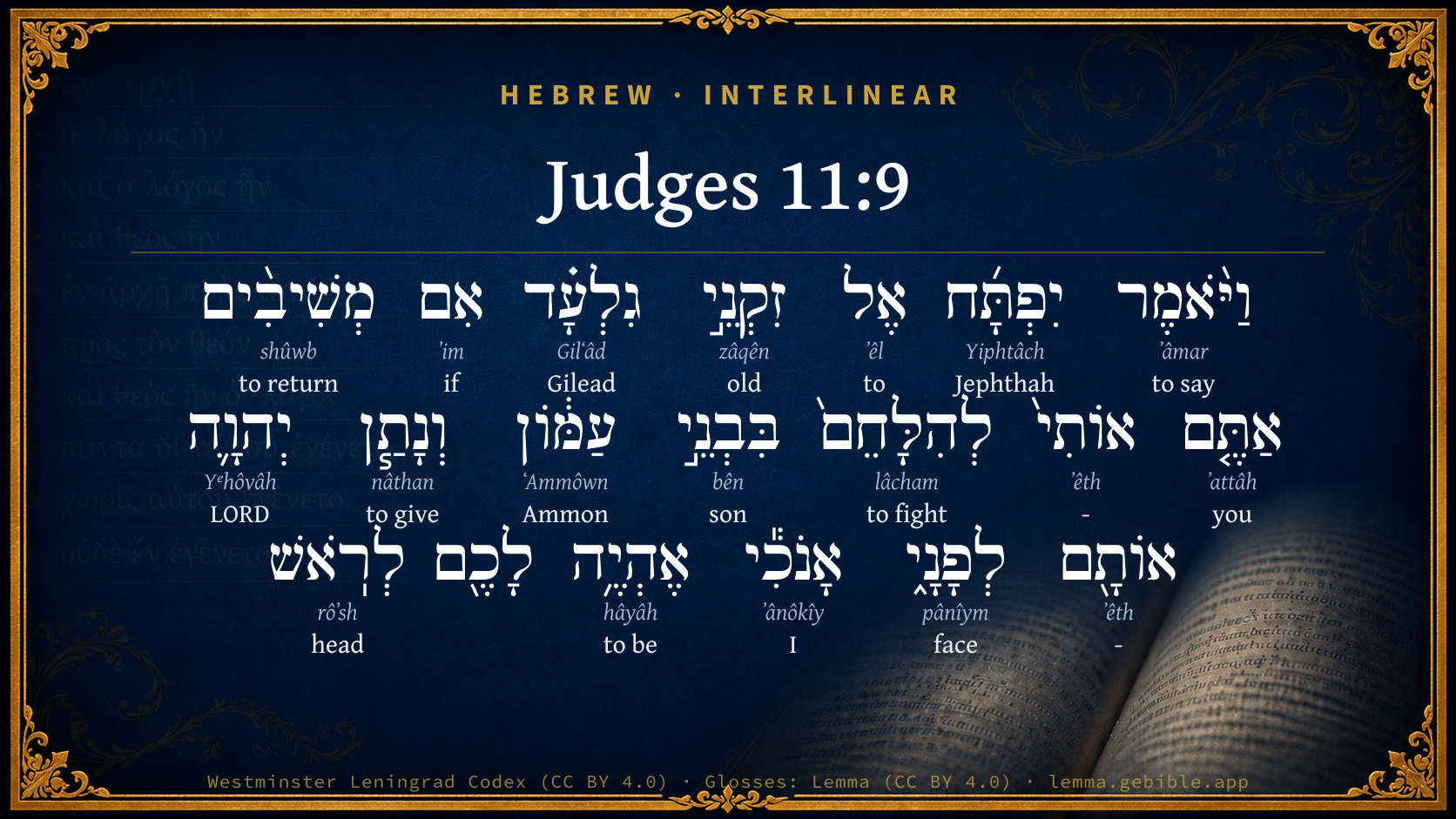
Hebrew (Westminster Leningrad Codex) Judges 11:9 appears in the Hebrew Old Testament. The text above is from the Westminster Leningrad Codex. Each word links to its Strong’s number, a concise gloss, and parsing drawn from the Open Scriptures Hebrew Bible morphology. Click any word for its full Brown-Driver-Briggs (BDB) entry.
Download image
Cite this verse

Judges 11:9 (World English Bible). Public Domain. Lemma interlinear Bible study tool, https://lemma.gebible.app/v/judges/11/9.

Show BibTeX & RIS
BibTeX
RIS
English Translation
Jephthah said to the elders of Gilead, If you bring me home again to fight with the children of Ammon, and Yahweh deliver them before me, shall I be your head?
World English Bible · Public Domain
Download a study sheet

One document with this verse’s original text, its word-by-word gloss line, the meaning frame, cross-references with their text, attributed commentary, and full source and license credits — printable, and it pastes into notes with its structure intact.

This verse Autodidact and up

Study sheet (.html) Plain text (.txt)

A passage Seminary Student

Up to 50 verses in one chapter. A passage sheet keeps up to 6 commentary sources and 12 cross-references per verse, in the order this page ranks them, and says so on the sheet whenever that leaves anything out. Ask for a single verse and you get the Autodidact verse sheet above.

Everything on this page stays free to read, with no account — the sheet is a download of what is already on screen, not access to it.

Want to remove ads? Support Godless Engineer
Compare translations 3

The same verse in 3 English versions, stacked beneath the original-language interlinear above. Click any original word for its lexicon entry.

Each is an independent rendering of the whole verse — the interlinear is not word-aligned to these translations.

Highlighted words mark where these versions differ — a whole-verse word diff, not a word-by-word alignment.

  • World English Bible Public Domain
    Jephthah said to the elders of Gilead, If you bring me home again to fight with the children of Ammon, and Yahweh deliver them before me, shall I be your head?
  • King James Version Public Domain
    And Jephthah said unto the elders of Gilead, If ye bring me home again to fight against the children of Ammon, and the LORD deliver them before me, shall I be your head?
  • unfoldingWord Literal Text CC BY-SA 4.0
    Then Jephthah said to the elders of Gilead, “If you have brought me back to fight with the sons of Ammon and Yahweh gives them over to my face, I will be the head for you.”

unfoldingWord Literal Text — © unfoldingWord, licensed CC BY-SA 4.0. Word-aligned USFM3 via Door43 (git.door43.org/unfoldingWord/en_ult).

Versions to compare (up to 4)

3 of 4 selected

Show all 18 translations

Every available English version of this verse, each an independent rendering of the whole verse.

  • World English Bible Public Domain
    Jephthah said to the elders of Gilead, If you bring me home again to fight with the children of Ammon, and Yahweh deliver them before me, shall I be your head?
  • Berean Standard Bible Public Domain
    But Jephthah asked them, “If you take me back to fight the Ammonites and the LORD gives them to me, will I really be your leader?”
  • Majority Standard Bible Public Domain
    But Jephthah asked them, “If you take me back to fight the Ammonites and the LORD gives them to me, will I really be your leader?”
  • King James Version Public Domain
    And Jephthah said unto the elders of Gilead, If ye bring me home again to fight against the children of Ammon, and the LORD deliver them before me, shall I be your head?
  • American Standard Version (1901) Public Domain
    And Jephthah said unto the elders of Gilead, If ye bring me home again to fight with the children of Ammon, and Jehovah deliver them before me, shall I be your head?
  • Revised Version (1885) Public Domain
    And Jephthah said unto the elders of Gilead, If ye bring me home again to fight with the children of Ammon, and the LORD deliver them before me, shall I be your head?
  • Geneva Bible (1599) Public Domain
    And Iphtah said vnto the Elders of Gilead, If ye bring me home againe to fight against the children of Ammon, if the Lord giue them before me, shall I be your head?
  • Douay-Rheims (1899) Public Domain
    Jephte also said to them: If you be come to me sincerely, that I should fight for you against the children of Ammon, and the Lord shall deliver them into my band, shall I be your prince?
  • Young's Literal Translation Public Domain
    And Jephthah saith unto the elders of Gilead, `If ye are taking me back to fight against the Bene-Ammon, and Jehovah hath given them before me -- I, am I to you for a head?'
  • Literal Standard Version CC BY-SA 4.0
    And Jephthah says to [the] elderly of Gilead, “If you are taking me back to fight against the sons of Ammon, and YHWH has given them before me—am I for a head to you?”
  • Unlocked Literal Bible CC BY-SA 4.0
    Jephthah said to the elders of Gilead, “If you bring me home again to fight against the people of Ammon, and if Yahweh gives us victory over them, I will be your leader.”
  • unfoldingWord Literal Text CC BY-SA 4.0
    Then Jephthah said to the elders of Gilead, “If you have brought me back to fight with the sons of Ammon and Yahweh gives them over to my face, I will be the head for you.”
  • Darby Bible Public Domain
    Jephthah said to the elders of Gilead, "If you bring me home again to fight with the Ammonites, and the LORD gives them over to me, I will be your head."
  • World Messianic Bible Public Domain
    Jephthah said to the elders of Gilead, “If you bring me home again to fight with the children of Ammon, and the LORD delivers them before me, will I be your head?”
  • Webster's Bible Public Domain
    And Jephthah said to the elders of Gilead, If ye bring me home again to fight against the children of Ammon, and the LORD deliver them before me, shall I be your head?
  • Free Bible Version CC BY-SA 4.0
    “So if I go back with you and fight the Ammonites, and the Lord makes me victorious, then I'll be your leader?” Jephthah asked the elders of Gilead.
  • Bible in Basic English Public Domain
    Then Jephthah said to the responsible men of Gilead, If you take me back to make war against the children of Ammon, and if with the help of the Lord I overcome them, will you make me your head?
  • JPS Tanakh (1917) Public Domain
    And Jephthah said unto the elders of Gilead: 'If ye bring me back home to fight with the children of Ammon, and the LORD deliver them before me, I will be your head.'

Literal Standard Version (2020), Covenant Press — licensed CC BY-SA 4.0. Text via the HelloAO Bible API (eBible.org). Unlocked Literal Bible (unfoldingWord) — licensed CC BY-SA 4.0. Text via the HelloAO Bible API (eBible.org). unfoldingWord Literal Text — © unfoldingWord, licensed CC BY-SA 4.0. Word-aligned USFM3 via Door43 (git.door43.org/unfoldingWord/en_ult). Free Bible Version, Dr. Jonathan Gallagher — licensed CC BY-SA 4.0. Text via the HelloAO Bible API (eBible.org).

Word by word

More ways to search: Search by grammar → Find every occurrence → Compare this word →

Practice this passage: Drill this verse → Learn its vocabulary →

יִפְתָּ֜ח
Yiphtâch
H3316
“Jephthah”
Noun, Proper
Part of Speech
Noun
Type
Proper
Full BDB Definition

Origin: from H6605

TWOT: None

Jephthah or Jiphtah = "he opens" - a son of Gilead and a concubine and the judge who defeated the Ammonites; after the victory because of a vow taken before the battle he sacrificed his daughter as a burnt offering (noun proper masculine) - a city in Judah (noun proper locative)
  1. וַיֹּ֨אמֶר ʼâmar H559 “and · to say” Conjunction + Verb, Qal, Sequential Imperfect, 3rd Person, Masculine, Singular
  2. אֶל ʼêl H413 “to” Preposition
  3. זִקְנֵ֣י zâqên H2205 “old of” Adjective, Adjective, Masculine, Plural, Construct
  4. גִלְעָ֗ד Gilʻâd H1568 “Gilead” Noun, Proper
  5. אִם ʼim H518 “if” Conjunction
  6. מְשִׁיבִ֨ים shûwb H7725 “returning” Verb, Hiphil, Participle Active, Masculine, Plural, Absolute
  7. אַתֶּ֤ם ʼattâh H859 “you” Pronoun, Personal, 2nd Person, Masculine, Plural
  8. אוֹתִי֙ ʼêth H853 “- · me” Particle, Direct Object + Suffix, Personal, 1st Person, Common, Singular
  9. לְהִלָּחֵם֙ lâcham H3898 “to fight” Preposition + Verb, Niphal, Infinitive Construct
  10. בִּבְנֵ֣י bên H1121 “in/at · sons of” Preposition + Noun, Common, Masculine, Plural, Construct
  11. עַמּ֔וֹן ʻAmmôwn H5983 “Ammon” Noun, Proper
  12. וְנָתַ֧ן nâthan H5414 “and · to give” Conjunction + Verb, Qal, Sequential Perfect, 3rd Person, Masculine, Singular
  13. יְהוָ֛ה Yᵉhôvâh H3068 “LORD” Noun, Proper
  14. אוֹתָ֖ם ʼêth H853 “- · them” Particle, Direct Object + Suffix, Personal, 3rd Person, Masculine, Plural
  15. לְפָנָ֑י pânîym H6440 “to/for · face(s) · my” Preposition + Noun, Common, Both, Plural, Construct + Suffix, Personal, 1st Person, Common, Singular
  16. אָנֹכִ֕י ʼânôkîy H595 “I” Pronoun, Personal, 1st Person, Common, Singular
  17. אֶהְיֶ֥ה hâyâh H1961 “to be” Verb, Qal, Imperfect, 1st Person, Common, Singular
  18. לְרֹֽאשׁ rôʼsh H7218 “to/for · head” Preposition + Noun, Common, Masculine, Singular, Absolute

About this verse

These counts appear in no published source. They are computed here, from the morphology-tagged text and Lemma’s own curated glosses. What Lemma adds →

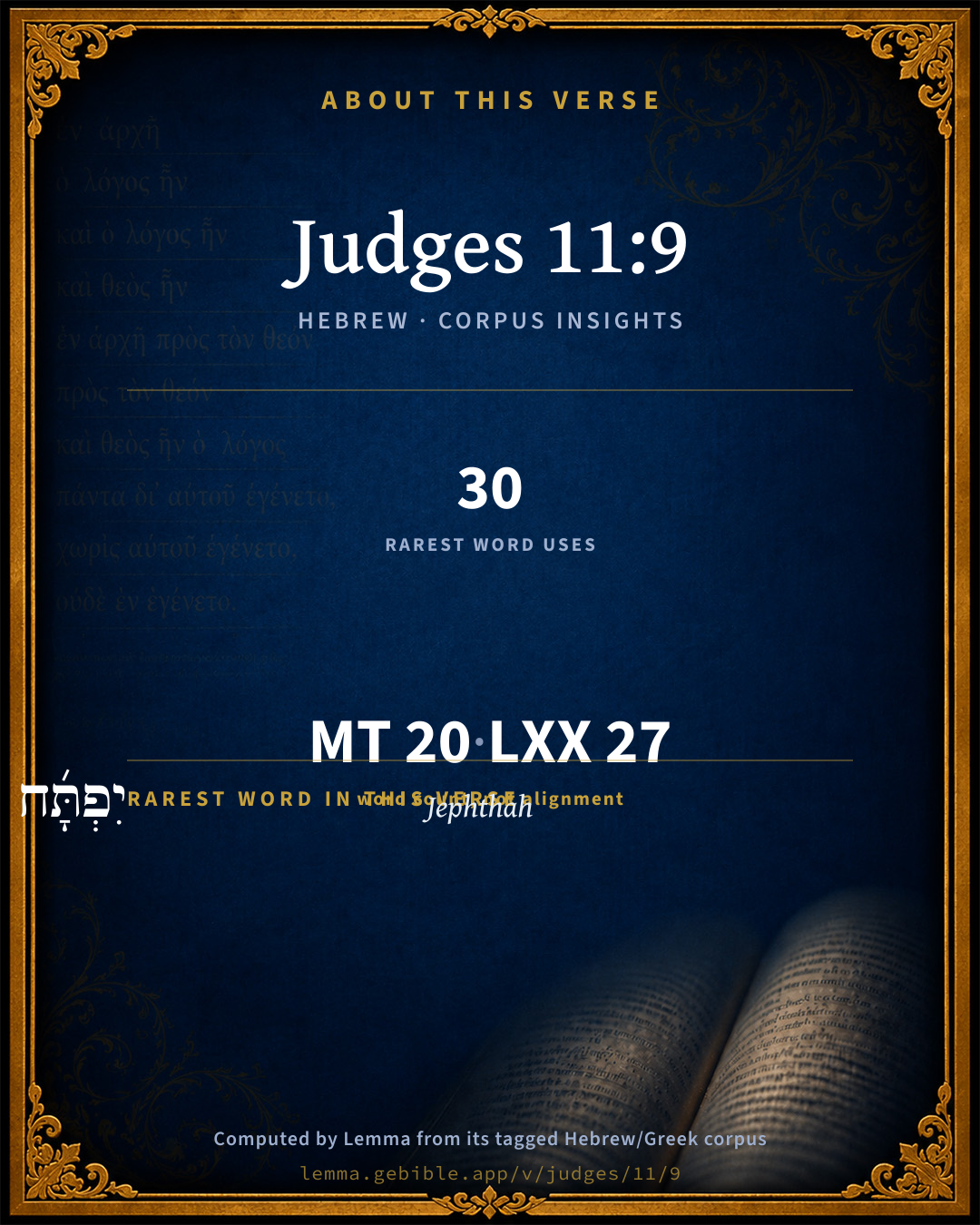
20
words
18
distinct lemmas
Historical
section

Shared distinctive vocabulary

יִפְתָּ֜ח Jephthah H3316 occurs in 26 verses of the Hebrew Bible. Also found in:

Grammatical profile

  • 5 verbs
  • 7 nouns
  • 1 adjective
  • 2 pronouns
  • 2 prepositions
  • 1 conjunction
  • 2 particles

Verb forms

  • וַיֹּ֨אמֶר Qal · Sequential Imperfect
  • מְשִׁיבִ֨ים Hiphil · Participle Active
  • לְהִלָּחֵם֙ Niphal · Infinitive Construct
  • וְנָתַ֧ן Qal · Sequential Perfect
  • אֶהְיֶ֥ה Qal · Imperfect

Hebrew & Septuagint length

In English translation the verse runs 31 words from the Hebrew and 34 from the Septuagint (LXX English) — closely comparable.

A rough comparison of the two English renderings, which tokenize alike — not a word-level alignment.

Word counts can differ between the Hebrew and the Greek without any difference in meaning — e.g. the Hebrew direct-object marker אֵת has no separate Greek word, and Greek often adds the article ὁ.

In the original languages it is 20 Hebrew tokens and 27 Greek tokens — but the two are counted differently (Hebrew bundles its prefixes and suffixes into one token; the Greek is in lemma form), so that isn’t a like-for-like length.

Cross-references

1

Topical passages linked to Judges 11:9 in the Treasury of Scripture Knowledge — connected by theme and wording, ordered by reader-vote popularity; previews shown in the World English Bible.

  • Numbers 32:20–29 Moses said to them, If you will do this thing, if you will arm yourselves to go before Yahweh to the war,

Cross-references courtesy of OpenBible.info (CC BY 4.0).

Hebrew and Greek witnesses Masoretic Hebrew ↔ Greek Septuagint

The same verse in the two great witnesses to the Old Testament, shown verse-for-verse.

These are two independent witnesses, not word-aligned to each other, and the Septuagint is shown in lemma (dictionary) form.

Hebrew Judges 11:9 Masoretic · Westminster Leningrad Codex

וַיֹּ֨אמֶר יִפְתָּ֜ח אֶל זִקְנֵ֣י גִלְעָ֗ד אִם מְשִׁיבִ֨ים אַתֶּ֤ם אוֹתִי֙ לְהִלָּחֵם֙ בִּבְנֵ֣י עַמּ֔וֹן וְנָתַ֧ן יְהוָ֛ה אוֹתָ֖ם לְפָנָ֑י אָנֹכִ֕י אֶהְיֶ֥ה לָכֶ֖ם לְרֹֽאשׁ

Jephthah said to the elders of Gilead, If you bring me home again to fight with the children of Ammon, and Yahweh deliver them before me, shall I be your head?

World English Bible · Public Domain

Greek LXX Judges 11:9 Septuagint · lemma form

καί εἶπον ιεφθαε πρός ὁ πρεσβύτερος γαλαάδ εἰ ἐπιστρέφω ἐγώ σύ παρατάσσω ἐν υἱός αμμων καί παραδίδωμι κύριος αὐτός ἐνώπιον ἐγώ καί ἐγώ εἰμί σύ εἰς ἄρχων

And Jephthae said to the elders of Galaad, If you⌃ turn me back to fight with the children of Ammon, and the Lord should deliver them before me, then will I be your head.

LXX2012 (modern English Septuagint) · Public Domain

Hebrew: Westminster Leningrad Codex (CC BY 4.0). Greek: Septuagint (public domain); English from LXX2012 (modern English Septuagint) (Public Domain). How the Septuagint differs from the Hebrew →

Targum (Aramaic paraphrase)

1

The Targum is the ancient Jewish Aramaic paraphrase of the Hebrew Scriptures — an interpretive translation, not the Hebrew text itself. Onkelos (literal) and Pseudo-Jonathan (expansive) render the Torah, and Jonathan the Prophets. Coverage is partial: where no permissively-licensed English translation exists for a verse, only the Aramaic is shown. This is verse-level text, not a word-by-word alignment to the Hebrew.

  1. Targum Jonathan Prophets (Joshua–Malachi)
    וַאֲמַר יִפְתָּח לְסָבֵי גִלְעָד אִם מְתִיבִין אַתּוּן יָתִי לְאַגָחָא קְרָבָא בִּבְנֵי עַמוֹן וְיִמְסַר יְיָ יַתְהוֹן קֳדָמַי אֲנָא אֱהֶוֵי לְכוֹן לְרֵישׁ:

    (no public-domain English translation for this verse)

    Targum Jonathan — Aramaic: “Mikraot Gedolot” (public domain). English: “Sefaria Community Translation” (CC0 1.0 (public-domain dedication)); “London "Chaldee Paraphrase," 1871” (public domain). Text via Sefaria.

Commentary

Notes on Judges 11:9 from classic Christian and Jewish commentators (each source and its license shown beneath its notes). The classic Christian expositions comment on the surrounding passage and are grouped to its opening verse, so a note may address several verses; the Jewish commentaries on the Tanakh (Rashi and others) are per-verse, so they appear only where the commentator wrote on this verse.

Lemma curates 59 commentaries, every one of them public domain or Creative Commons licensed, each selected and text-cleaned for this edition rather than reprinted as found. About our sources →

Trapp's Complete Commentary

John Trapp

Jdg 11:9 And Jephthah said unto the elders of Gilead, If ye bring me home again to fight against the children of Ammon, and the LORD deliver them before me, shall I be your head?

Ver. 9. Shall I be your head?] He would make his bargain wisely, to prevent all differences for the future, and the rather because he had been before but coarsely used by them.

John Trapp, A Commentary or Exposition upon All the Books of the Old and New Testament (1647–1656) — public domain. Text from a community e-Sword module.

Joseph Benson's Commentary

Jdg 11:9. If ye bring me home — If ye recall me from this place where I am now settled to the place whence I was expelled. Shall I be your head? — Will you really make good this promise? Jephthah was so solicitous in this case, either from his zeal for the public good, which required that he should be so; or from the law of self-preservation, that he might secure himself from his brethren; whose ill-will he had experienced, and whose injuries he could not prevent, if, after he had served their ends, he had been reduced to his private capacity.

Joseph Benson's Commentary on the Old and New Testaments (1811–1818) — public domain. Text from a community e-Sword module.

Ellicott's Commentary for English Readers

(9) Shall I be your head?—We must not be surprised if Jephthah does not display a disinterested patriotism. He was only half an Israelite; he had been wronged by his father’s kin; he had spent long years of his manhood among heathens and outlaws, who gained their livelihood by brigandage or mercenary warfare. “As Gideon is the highest pitch of greatness to which this period reaches,” says Dean Stanley. “Jephthah and Samson are the lowest points to which it descends.” Since, then, we have marked elements of ferocity and religious ignorance and ambition even in the noble character of Gideon, we must remember that we might naturally make allowance for a still lower level of attainment in one who had been so unfavourably circumstanced as Jephthah. Apart from the Syrian influences which had told upon him, the whole condition of the pastoral tribes on the east of the Jordan was far below that of the agricultural western tribes.

A Bible Commentary for English Readers, edited by Charles John Ellicott (1878–1897) — public domain. Text from a community e-Sword module.

The Cambridge Bible for Schools and Colleges

gen. ed. J. J. S. Perowne

9. shall I be …?] Rather it is I who am to be your head, accepting the agreement in Jdg_11:6.

The Cambridge Bible for Schools and Colleges (gen. ed. J. J. S. Perowne; Cambridge University Press, 1878–1918) — public domain. Text from a community e-Sword module.

John Gill's Exposition

And Jephthah said unto the elders of Gilead,.... Considering the former usage he had met with from them, and the character which he himself bore, and the fickleness of men, when their turn is served, was willing to make a sure bargain with them:

if ye bring me home again to fight against the children of Ammon; that is, should he consent to go along with them, and fight their battle for them:

and the Lord deliver them before me; or into his hands, on whom he depended for success, and not on his own courage and valour, and military skill:

shall I be your head? not only captain general of their forces during the war, but the chief ruler of them when that was ended.

John Gill's Exposition of the Whole Bible (1746–1763) — public domain (CC PDM 1.0). Text via the HelloAO Bible API.

Albert Barnes' Notes on the Bible

Jephthah made his own aggrandisement the condition of his delivering; his country. The circumstances of his birth and long residence in a pagan land were little favorable to the formation of the highest type of character. Yet he has his record among the faithful Heb 11:32.

Albert Barnes' Notes on the Bible (1834–1885) — public domain. Text from a community e-Sword/MySword module.

Matthew Poole's English Annotations

If ye bring me home again; if you recall me from this place where I am now settled, to the place whence I was expelled.

Shall I be your head? will you really make good this promise? Jephthah was so solicitous in this case, either from his zeal for the public good, which required that he should be so; or from the law of self-preservation, that he might secure himself from his brethren; whose ill will he had experienced, and whose injuries he could not prevent, if, after he had served their ends, he had been reduced to his private capacity: or there might be some tincture of ambition in him; for which God therefore severely, though paternally, chastiseth him, as we see afterwards.

Matthew Poole's English Annotations on the Holy Bible (1683–1685) — public domain. Text from a community e-Sword/MySword module.

Whedon's Commentary on the Bible

Daniel D. Whedon

9. Shall I be your head — Better to make this a positive declaration, I will be your head; for the response of the elders in the next verse is not so much an answer to a question, as an expression of submission to Jephthah’s will.

Daniel D. Whedon (gen. ed.), Commentary on the Old and New Testaments (1874–1909) — public domain. Text from a community e-Sword module.

The Pulpit Commentary

Shall I be, etc. There is no interrogative in the Hebrew. The words may be taken as the laying down of the condition by Jephthah, to which in the following verse the elders express their assent.

The Pulpit Commentary (1880–1919), ed. H.D.M. Spence-Jones & Joseph S. Exell — public domain. Text from a community e-Sword module.

John Wesley's Explanatory Notes

If, &c. - If you recall me from this place where I am now settled, to the place whence I was expelled. Shall I, &c. - Will you really make good this promise? Jephthah was so solicitous in this case, either from his zeal for the public good, which required that he should be so; or from the law of self-preservation, that he might secure himself from his brethren; whose ill-will he had experienced, and whose injuries he could not prevent, if, after he had served their ends, he had been reduced to his private capacity.

John Wesley, Explanatory Notes Upon the Whole Bible (1754–1765) — public domain. Text via the GEBible commentary corpus.

Keil & Delitzsch

C. F. Keil & F. Delitzsch

Jephthah assented to this: "If ye will take me back to make war upon the Ammonites, and Jehovah shall give them up to me (lit. 'before me,' as in Jos 10:12; Deu 2:31, etc.), I will be your head." "I" is emphatic as distinguished from he; and there is no necessity to regard the sentence as a question, with which the expression in Jdg 11:10, "according to thy words," which presuppose an affirmative statement on the part of Jephthah, and not a question, would be altogether irreconcilable.

Keil & Delitzsch — Biblical Commentary on the Old Testament (1861–1891) — public domain (CC PDM 1.0). Text via the HelloAO Bible API. (Old Testament only.)

unfoldingWord translationNotes

Door43 World Missions Community

leader and commander

These two words basically have the same meaning repeated to emphasize how important Jephthah had became. You can combine the two words. AT: "commander" (See: Doublet)

When he was before Yahweh in Mizpah, Jephthah repeated all the promises he made

This is an idiom. Here the phrase "before Yahwheh" means that he repeated his promises as a vow before Yahweh. AT: "When Jephthah was in Mizpah he repeated all of these promises as a vow before Yahweh" (See: Idiom)

all the promises he made

This refers to the promises he made to the leaders of Gilead about becoming their leader.

translationWords

Jephthah

elder

Gilead

Ammon

Yahweh

testimony

commander

Mizpah

promise

unfoldingWord translationNotes — © Distant Shores Media and the Door43 World Missions Community, licensed CC BY-SA 4.0. Source: git.door43.org/Door43/en_tn.

Lesson kit

Teaching starters — assembled from the data on this page, not authored interpretation. Every prompt links to the verse data it draws on. Edit before teaching.

Judges, in the Historical, opens this verse with 20 words (18 distinct Hebrew lemmas). Its most distinctive word is Yiphtâch (“Jephthah”). A historical commentator’s framing appears above. Read the whole chapter for the surrounding context.

Discussion questions

  1. How does “Jephthah” (Yiphtâch) shape what this verse is saying?
  2. How does Joshua 15:43, which shares the word «Jephthah», read alongside this verse?
  3. The translations on this page render this verse differently — a whole-verse word diff, not a word-by-word alignment. What might account for the different wordings?
  4. «וַיֹּ֨אמֶר» is a Qal Sequential Imperfect verb. How does that grammatical form shape the action described?
  5. Compare how Trapp's Complete Commentary and Joseph Benson's Commentary read this verse. Where do they agree or differ?

Things to notice

Reading settings

Reading text

Shown beneath each verse's original-language words.

Old Testament
Old Testament edition

Read the OT as the Masoretic Hebrew (MT) or the Greek Septuagint (LXX).

English shown for the Greek Septuagint (in the Hebrew ↔ Greek comparison).

Comparing translations? Open the Compare panel on any verse page to stack up to four side by side.