
Judges 11:7

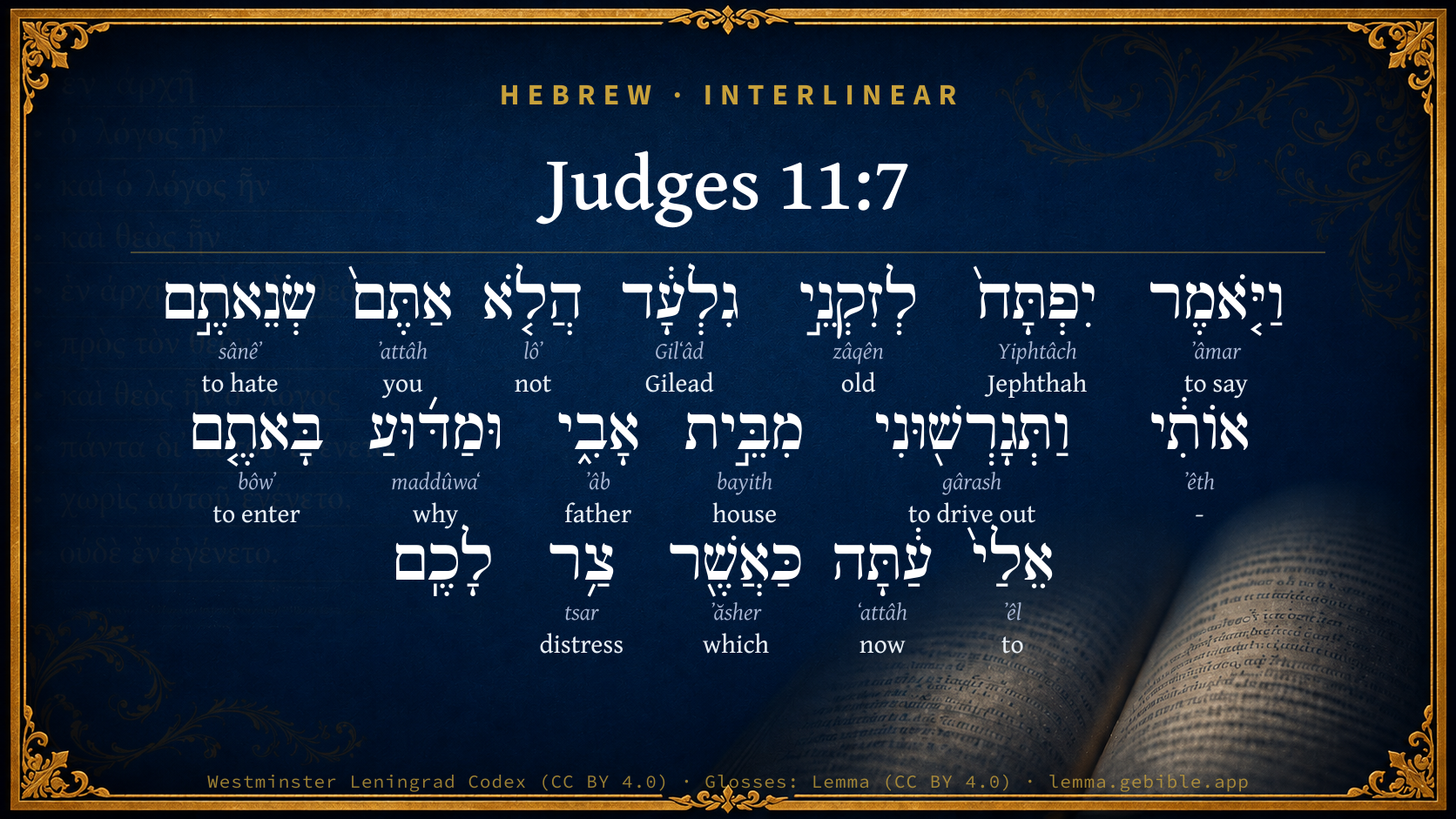
Hebrew (Westminster Leningrad Codex) Judges 11:7 appears in the Hebrew Old Testament. The text above is from the Westminster Leningrad Codex. Each word links to its Strong’s number, a concise gloss, and parsing drawn from the Open Scriptures Hebrew Bible morphology. Click any word for its full Brown-Driver-Briggs (BDB) entry.
Download image
Cite this verse

Judges 11:7 (World English Bible). Public Domain. Lemma interlinear Bible study tool, https://lemma.gebible.app/v/judges/11/7.

Show BibTeX & RIS
BibTeX
RIS
English Translation
Jephthah said to the elders of Gilead, Didn't you hate me, and drive me out of my father's house? and why are you come to me now when you are in distress?
World English Bible · Public Domain
Download a study sheet

One document with this verse’s original text, its word-by-word gloss line, the meaning frame, cross-references with their text, attributed commentary, and full source and license credits — printable, and it pastes into notes with its structure intact.

This verse Autodidact and up

Study sheet (.html) Plain text (.txt)

A passage Seminary Student

Up to 50 verses in one chapter. A passage sheet keeps up to 6 commentary sources and 12 cross-references per verse, in the order this page ranks them, and says so on the sheet whenever that leaves anything out. Ask for a single verse and you get the Autodidact verse sheet above.

Everything on this page stays free to read, with no account — the sheet is a download of what is already on screen, not access to it.

Want to remove ads? Support Godless Engineer
Compare translations 3

The same verse in 3 English versions, stacked beneath the original-language interlinear above. Click any original word for its lexicon entry.

Each is an independent rendering of the whole verse — the interlinear is not word-aligned to these translations.

Highlighted words mark where these versions differ — a whole-verse word diff, not a word-by-word alignment.

  • World English Bible Public Domain
    Jephthah said to the elders of Gilead, Didn't you hate me, and drive me out of my father's house? and why are you come to me now when you are in distress?
  • King James Version Public Domain
    And Jephthah said unto the elders of Gilead, Did not ye hate me, and expel me out of my father's house? and why are ye come unto me now when ye are in distress?
  • unfoldingWord Literal Text CC BY-SA 4.0
    But Jephthah said to the elders of Gilead, “Do you not hate me, since you drove me from the house of my father? So why have you come to me now, when trouble to you?”

unfoldingWord Literal Text — © unfoldingWord, licensed CC BY-SA 4.0. Word-aligned USFM3 via Door43 (git.door43.org/unfoldingWord/en_ult).

Versions to compare (up to 4)

3 of 4 selected

Show all 18 translations

Every available English version of this verse, each an independent rendering of the whole verse.

  • World English Bible Public Domain
    Jephthah said to the elders of Gilead, Didn't you hate me, and drive me out of my father's house? and why are you come to me now when you are in distress?
  • Berean Standard Bible Public Domain
    Jephthah replied to the elders of Gilead, “Did you not hate me and expel me from my father’s house? Why then have you come to me now, when you are in distress?”
  • Majority Standard Bible Public Domain
    Jephthah replied to the elders of Gilead, “Did you not hate me and expel me from my father’s house? Why then have you come to me now, when you are in distress?”
  • King James Version Public Domain
    And Jephthah said unto the elders of Gilead, Did not ye hate me, and expel me out of my father's house? and why are ye come unto me now when ye are in distress?
  • American Standard Version (1901) Public Domain
    And Jephthah said unto the elders of Gilead, Did not ye hate me, and drive me out of my father's house? and why are ye come unto me now when ye are in distress?
  • Revised Version (1885) Public Domain
    And Jephthah said unto the elders of Gilead, Did not ye hate me, and drive me out of my father’s house? and why are ye come unto me now when ye are in distress?
  • Geneva Bible (1599) Public Domain
    Iphtah then answered the Elders of Gilead, Did not ye hate me, and expell me out of my fathers house? how then come you vnto me now in time of your tribulation?
  • Douay-Rheims (1899) Public Domain
    And he answered them: Are not you the men that hated me, and cast me out of my father's house, and now you are come to me constrained by necessity?
  • Young's Literal Translation Public Domain
    And Jephthah saith to the elders of Gilead, `Have not ye hated me? and ye cast me out from the house of my father, and wherefore have ye come unto me now when ye are in distress?'
  • Literal Standard Version CC BY-SA 4.0
    And Jephthah says to [the] elderly of Gilead, “Have you not hated me? And you cast me out from the house of my father, and why have you come to me now when you are in distress?”
  • Unlocked Literal Bible CC BY-SA 4.0
    Jephthah said to the leaders of Gilead, “You hated me and forced me to leave my father's house. Why do you come to me now when you are in trouble?”
  • unfoldingWord Literal Text CC BY-SA 4.0
    But Jephthah said to the elders of Gilead, “Do you not hate me, since you drove me from the house of my father? So why have you come to me now, when trouble to you?”
  • Darby Bible Public Domain
    But Jephthah said to the elders of Gilead, "Did you not hate me, and drive me out of my father's house? Why have you come to me now when you are in trouble?"
  • World Messianic Bible Public Domain
    Jephthah said to the elders of Gilead, “Didn’t you hate me, and drive me out of my father’s house? Why have you come to me now when you are in distress?”
  • Webster's Bible Public Domain
    And Jephthah said to the elders of Gilead, Did ye not hate me, and expel me from my father's house; and why have ye come to me now when ye are in distress?
  • Free Bible Version CC BY-SA 4.0
    “Weren't you the ones who hated me and drove me from my father's house?” Jephthah asked them. “Why are you coming to me now you're in trouble?”
  • Bible in Basic English Public Domain
    But Jephthah said to the responsible men of Gilead, Did you not, in your hate for me, send me away from my father's house? Why do you come to me now when you are in trouble?
  • JPS Tanakh (1917) Public Domain
    And Jephthah said unto the elders of Gilead: 'Did not ye hate me, and drive me out of my father's house? and why are ye come unto me now when ye are in distress?'

Literal Standard Version (2020), Covenant Press — licensed CC BY-SA 4.0. Text via the HelloAO Bible API (eBible.org). Unlocked Literal Bible (unfoldingWord) — licensed CC BY-SA 4.0. Text via the HelloAO Bible API (eBible.org). unfoldingWord Literal Text — © unfoldingWord, licensed CC BY-SA 4.0. Word-aligned USFM3 via Door43 (git.door43.org/unfoldingWord/en_ult). Free Bible Version, Dr. Jonathan Gallagher — licensed CC BY-SA 4.0. Text via the HelloAO Bible API (eBible.org).

Word by word

More ways to search: Search by grammar → Find every occurrence → Compare this word →

Practice this passage: Drill this verse → Learn its vocabulary →

יִפְתָּח֙
Yiphtâch
H3316
“Jephthah”
Noun, Proper
Part of Speech
Noun
Type
Proper
Full BDB Definition

Origin: from H6605

TWOT: None

Jephthah or Jiphtah = "he opens" - a son of Gilead and a concubine and the judge who defeated the Ammonites; after the victory because of a vow taken before the battle he sacrificed his daughter as a burnt offering (noun proper masculine) - a city in Judah (noun proper locative)
  1. וַיֹּ֤אמֶר ʼâmar H559 “and · to say” Conjunction + Verb, Qal, Sequential Imperfect, 3rd Person, Masculine, Singular
  2. לְזִקְנֵ֣י zâqên H2205 “to/for · old of” Preposition + Adjective, Adjective, Masculine, Plural, Construct
  3. גִלְעָ֔ד Gilʻâd H1568 “Gilead” Noun, Proper
  4. הֲלֹ֤א lôʼ H3808 “not” Particle, Interrogative + Particle, Negative
  5. אַתֶּם֙ ʼattâh H859 “you” Pronoun, Personal, 2nd Person, Masculine, Plural
  6. שְׂנֵאתֶ֣ם sânêʼ H8130 “to hate” Verb, Qal, Perfect, 2nd Person, Masculine, Plural
  7. אוֹתִ֔י ʼêth H853 “- · me” Particle, Direct Object + Suffix, Personal, 1st Person, Common, Singular
  8. וַתְּגָרְשׁ֖וּנִי gârash H1644 “and · to drive out · me” Conjunction + Verb, Piel, Sequential Imperfect, 2nd Person, Masculine, Plural + Suffix, Personal, 1st Person, Common, Singular
  9. מִבֵּ֣ית bayith H1004 “from · house of” Preposition + Noun, Common, Masculine, Singular, Construct
  10. אָבִ֑י ʼâb H1 “father · my” Noun, Common, Masculine, Singular, Construct + Suffix, Personal, 1st Person, Common, Singular
  11. וּמַדּ֜וּעַ maddûwaʻ H4069 “and · why” Conjunction + Adverb
  12. בָּאתֶ֤ם bôwʼ H935 “to enter” Verb, Qal, Perfect, 2nd Person, Masculine, Plural
  13. אֵלַי֙ ʼêl H413 “to · me” Preposition + Suffix, Personal, 1st Person, Common, Singular
  14. עַ֔תָּה ʻattâh H6258 “now” Adverb
  15. כַּאֲשֶׁ֖ר ʼăsher H834 “like/as · which” Preposition + Particle, Relative
  16. צַ֥ר tsar H6862 “distress” Verb, Qal, Perfect, 3rd Person, Masculine, Singular

About this verse

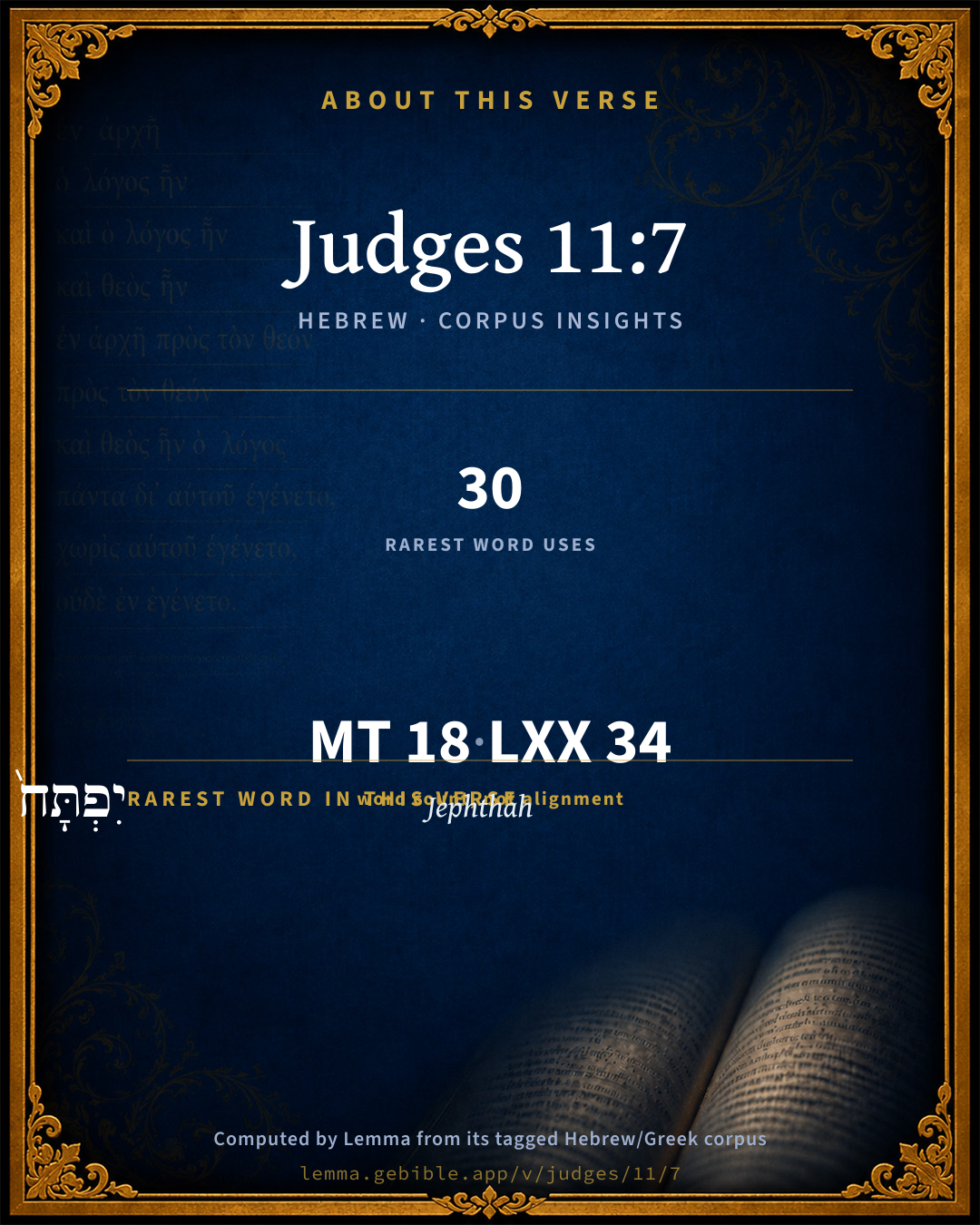
These counts appear in no published source. They are computed here, from the morphology-tagged text and Lemma’s own curated glosses. What Lemma adds →

18
words
17
distinct lemmas
Historical
section

Shared distinctive vocabulary

יִפְתָּח֙ Jephthah H3316 occurs in 26 verses of the Hebrew Bible. Also found in:

Grammatical profile

  • 5 verbs
  • 4 nouns
  • 1 adjective
  • 1 pronoun
  • 2 prepositions
  • 2 adverbs
  • 3 particles

Verb forms

  • וַיֹּ֤אמֶר Qal · Sequential Imperfect
  • שְׂנֵאתֶ֣ם Qal · Perfect
  • וַתְּגָרְשׁ֖וּנִי Piel · Sequential Imperfect
  • בָּאתֶ֤ם Qal · Perfect
  • צַ֥ר Qal · Perfect

Hebrew & Septuagint length

In English translation the verse runs 32 words from the Hebrew and 38 from the Septuagint (LXX English) — closely comparable.

A rough comparison of the two English renderings, which tokenize alike — not a word-level alignment.

Word counts can differ between the Hebrew and the Greek without any difference in meaning — e.g. the Hebrew direct-object marker אֵת has no separate Greek word, and Greek often adds the article ὁ.

In the original languages it is 18 Hebrew tokens and 34 Greek tokens — but the two are counted differently (Hebrew bundles its prefixes and suffixes into one token; the Greek is in lemma form), so that isn’t a like-for-like length.

Cross-references

7

Topical passages linked to Judges 11:7 in the Treasury of Scripture Knowledge — connected by theme and wording, ordered by reader-vote popularity; previews shown in the World English Bible.

  • Genesis 45:4–5 Joseph said to his brothers, "Come near to me, please." They came near. "He said, I am Joseph, your brother, whom you sold into Egypt.
  • Proverbs 17:17 A friend loves at all times; And a brother is born for adversity.
  • Revelation 3:9 Behold, I give of the synagogue of Satan, of those who say they are Jews, and they are not, but lie. Behold, I will make them to come and worship before your feet, and to know that I have loved you.
  • Isaiah 60:14 The sons of those who afflicted you shall come bending to you; and all those who despised you shall bow themselves down at the soles of your feet; and they shall call you The city of Yahweh, The Zion of the Holy One of Israel.
  • Acts 7:9–14 "The patriarchs, moved with jealousy against Joseph, sold him into Egypt. God was with him,
  • Genesis 26:27 Isaac said to them, "Why have you come to me, since you hate me, and have sent me away from you?"
  • Genesis 37:27 Come, and let's sell him to the Ishmaelites, and not let our hand be on him; for he is our brother, our flesh." His brothers listened to him.

Cross-references courtesy of OpenBible.info (CC BY 4.0).

Hebrew and Greek witnesses Masoretic Hebrew ↔ Greek Septuagint

The same verse in the two great witnesses to the Old Testament, shown verse-for-verse.

These are two independent witnesses, not word-aligned to each other, and the Septuagint is shown in lemma (dictionary) form.

Hebrew Judges 11:7 Masoretic · Westminster Leningrad Codex

וַיֹּ֤אמֶר יִפְתָּח֙ לְזִקְנֵ֣י גִלְעָ֔ד הֲלֹ֤א אַתֶּם֙ שְׂנֵאתֶ֣ם אוֹתִ֔י וַתְּגָרְשׁ֖וּנִי מִבֵּ֣ית אָבִ֑י וּמַדּ֜וּעַ בָּאתֶ֤ם אֵלַי֙ עַ֔תָּה כַּאֲשֶׁ֖ר צַ֥ר לָכֶֽם

Jephthah said to the elders of Gilead, Didn't you hate me, and drive me out of my father's house? and why are you come to me now when you are in distress?

World English Bible · Public Domain

Greek LXX Judges 11:7 Septuagint · lemma form

καί εἶπον ιεφθαε ὁ πρεσβύτερος γαλαάδ οὐ σύ μισέω ἐγώ καί ἐκβάλλω ἐγώ ἐκ ὁ οἶκος ὁ πατήρ ἐγώ καί ἐκ ἀποστέλλω ἐγώ ἀπό σύ καί διά τίς ἔρχομαι πρός ἐγώ νῦν ἡνίκα χρῄζω

And Jephthae said to the elders of Galaad, Did you⌃ not hate me, and cast me out of my father's house, and banish me from you? and therefore are you⌃ come to me now when you⌃ lack me?

LXX2012 (modern English Septuagint) · Public Domain

Hebrew: Westminster Leningrad Codex (CC BY 4.0). Greek: Septuagint (public domain); English from LXX2012 (modern English Septuagint) (Public Domain). How the Septuagint differs from the Hebrew →

Targum (Aramaic paraphrase)

1

The Targum is the ancient Jewish Aramaic paraphrase of the Hebrew Scriptures — an interpretive translation, not the Hebrew text itself. Onkelos (literal) and Pseudo-Jonathan (expansive) render the Torah, and Jonathan the Prophets. Coverage is partial: where no permissively-licensed English translation exists for a verse, only the Aramaic is shown. This is verse-level text, not a word-by-word alignment to the Hebrew.

  1. Targum Jonathan Prophets (Joshua–Malachi)
    וַאֲמַר יִפְתָּח לְסָבֵי גִלְעָד הֲלָא אַתּוּן סְנֵיתוּן יָתִי וְתָרִיכְתּוּנִי מִבֵּית אַבָּא וּמָא דֵין אֲתֵיתוּן לְוָתִי כְּעַן כַּד עָקַת לְכוֹן:

    (no public-domain English translation for this verse)

    Targum Jonathan — Aramaic: “Mikraot Gedolot” (public domain). English: “Sefaria Community Translation” (CC0 1.0 (public-domain dedication)); “London "Chaldee Paraphrase," 1871” (public domain). Text via Sefaria.

Commentary

Notes on Judges 11:7 from classic Christian and Jewish commentators (each source and its license shown beneath its notes). The classic Christian expositions comment on the surrounding passage and are grouped to its opening verse, so a note may address several verses; the Jewish commentaries on the Tanakh (Rashi and others) are per-verse, so they appear only where the commentator wrote on this verse.

Lemma curates 59 commentaries, every one of them public domain or Creative Commons licensed, each selected and text-cleaned for this edition rather than reprinted as found. About our sources →

Trapp's Complete Commentary

John Trapp

Jdg 11:7 And Jephthah said unto the elders of Gilead, Did not ye hate me, and expel me out of my father’s house? and why are ye come unto me now when ye are in distress?

Ver. 7. Did not ye hate me, and expel me?] It may be some of his brethren were elders, or at least they cast him out formula iuris, by an order of the elders giving judgment against him.

And why are ye come unto me now when ye are in distress?] May not God justly say as much to most of us? we seldom seek to him till needs must. It was a trim saying and very true of General Vere to the King of Denmark, that kings cared not for soldiers until such times as their crowns hung on the one side of their head.

John Trapp, A Commentary or Exposition upon All the Books of the Old and New Testament (1647–1656) — public domain. Text from a community e-Sword module.

Joseph Benson's Commentary

Jdg 11:7. Did ye not hate me, and expel me — And deprive me of all share in my father’s goods, which, though a bastard, was due to me? This expulsion of him was the act of his brethren; but he here ascribes it to the elders of Gilead; either because some of his brethren were among these elders, as is very probable from the dignity of this family; or because this act, though desired by his brethren, was executed by the decree of the elders, to whom the determination of all controversies about inheritances belonged; and therefore it was their faults they did not protect him from the injuries of his brethren.

Joseph Benson's Commentary on the Old and New Testaments (1811–1818) — public domain. Text from a community e-Sword module.

Geneva Bible (1599)

Geneva Bible translators

Oft times those things which men reject, God chooseth to do great enterprises by.

Geneva Bible (1599) marginal notes — public domain. Text via Bolls.life.

Jamieson, Fausset & Brown

Robert Jamieson, A. R. Fausset & David Brown

Jephthah said, Did not ye hate me?--He gave them at first a haughty and cold reception. It is probable that he saw some of his brothers among the deputies. Jephthah was now in circumstances to make his own terms. With his former experience, he would have shown little wisdom or prudence without binding them to a clear and specific engagement to invest him with unlimited authority, the more especially as he was about to imperil his life in their cause. Although ambition might, to a certain degree, have stimulated his ready compliance, it is impossible to overlook the piety of his language, which creates a favorable impression that his roving life, in a state of social manners so different from ours, was not incompatible with habits of personal religion.

Jamieson, Fausset & Brown — Commentary Critical and Explanatory on the Whole Bible (1871) — public domain (CC PDM 1.0). Text via the HelloAO Bible API.

Ellicott's Commentary for English Readers

(7) Did not ye hate me?—The elders of Gilead must at least have permitted his expulsion by his brethren.

Therefore.—i.e., with the express desire to repair the old wrong.

A Bible Commentary for English Readers, edited by Charles John Ellicott (1878–1897) — public domain. Text from a community e-Sword module.

The Cambridge Bible for Schools and Colleges

gen. ed. J. J. S. Perowne

7. and drive me out of my father’s house] See Jdg_11:2 n. Apparently custom allowed certain rights to the sons of concubines, as in the ancient Babylonian code of Ḫammurabi; S. A. Cook, Moses and Ḫammurabi, p. 141.

The Cambridge Bible for Schools and Colleges (gen. ed. J. J. S. Perowne; Cambridge University Press, 1878–1918) — public domain. Text from a community e-Sword module.

John Gill's Exposition

And Jephthah said unto the elders of Gilead,.... In answer to their request; who though not backward to engage in the war with them, yet thought it proper to take this opportunity to upbraid them with their former unkindness to him:

did not ye hate me, and expel me out of my father's house? for it seems some of these elders at least were his brethren; for who else could be thought to hate him, and through hatred to thrust him out of his father's house, but they? nor is it at all improbable that they were among the elders of Gilead, considering what family they were of: though indeed the magistrates of the city might be assisting to Jephthah's brethren in the expulsion of him, or however connived at it, when they should, as he thought, have protected him, and taken care that he had justice done him; for even though illegitimate, a maintenance was due to him:

and why are ye come unto me now, when ye are in distress? intimating, that it was not love and respect to him, but necessity, that brought them to him with this request; and that since they used him so ill, they could not reasonably expect he should have any regard unto them.

John Gill's Exposition of the Whole Bible (1746–1763) — public domain (CC PDM 1.0). Text via the HelloAO Bible API.

Albert Barnes' Notes on the Bible

This gives a wider signification to Jdg 11:2-3, and shows that Jephthah’s “brethren” include his fellow tribesmen.

Albert Barnes' Notes on the Bible (1834–1885) — public domain. Text from a community e-Sword/MySword module.

Haydock's Catholic Bible Commentary

House. Perhaps he saw some of his brothers among them: though he might speak thus to the magistrates, because they had not prevented this injustice, (Calmet) as it was their duty to do. (Haydock)

George Leo Haydock (1774–1849), Haydock's Catholic Family Bible and Commentary, 1859 edition — public domain. Excludes Psalms (Douay-Rheims chapter numbering differs from Protestant) and Deuterocanonical books (Catholic canon only).

Matthew Poole's English Annotations

Did not ye expel me out of my father’s house, and deprive me of all share in my father’s goods, which, though a bastard, was due to me? This expulsion of him was the act of his brethren; but he here ascribes it to the elders of Gilead; either because some of them were among these elders, as is very probable from the dignity of this family; or because this act, though desired and promoted by his brethren, was executed by the decree of the elders, to whom the determination of all controversies about inheritances belonged; and therefore it was their fault that they did not protect him from the injuries of his brethren, as their duty was.

Matthew Poole's English Annotations on the Holy Bible (1683–1685) — public domain. Text from a community e-Sword/MySword module.

Whedon's Commentary on the Bible

Daniel D. Whedon

7. Did not ye hate me — Jephthah treats all the Gileadites as partakers in the abuse and violence which expelled him from his father’s house. Probably the act of Gilead’s sons in thrusting out Jephthah was generally approved by the elders, for in the next verse they seem to acknowledge their wrong.

Daniel D. Whedon (gen. ed.), Commentary on the Old and New Testaments (1874–1909) — public domain. Text from a community e-Sword module.

The Pulpit Commentary

Did not ye hate me, etc. Jephthah"s reproach to the "elders of Gilead" strongly favours the idea that "his brethren" in ver. 3, and the "father"s house" in ver. 2, are to be taken in the wider sense of fellow-tribesmen and "house of fathers," and that his expulsion was not the private act of his own brothers training him out of the house they lived in, but a tribal act (taking tribe in the sense of house of fathers), in which the elders of Gilead bad taken a part. If this is so, it removes a great difficulty about Jephthah being Gilead"s son, which it is very hard to reconcile with chronology.

The friend in need.

I THE VALUE OF A TRUE FRIEND IS SEEN IN THE TIME OF ADVERSITY. Jephthah was hated by the elders of Israel in prosperous times, but when trouble came he was discovered to be their best friend. The wise man will endeavour to cultivate the friendship of the good and great. It is foolish to let valued friends pass away from us through negligence or slight offence. There are few forms of earthly riches more valuable than that of a treasury of friendships. We may be careless of this in circumstances of ease; but if so, trouble will reveal our mistake. Christ is a Friend who sticketh closer than a brother, too often neglected in prosperity, but found to be the one needed Helper in the hour of darkness. (Isa_32:2)

II THE BEST FRIEND IS NOT ALWAYS THE MOST POPULAR. He may be poor, unpretending, eccentric, or dull It is foolish to choose our friends by the superficial attractions of social amusement. The boon companion may prove a shallow friend. Sterling qualities of fidelity, self-denying devotion, etc. are not always accompanied by brilliant conversational gifts and such other pleasing characteristics as shine in festive scenes. Christ, the best of friends, was despised and rejected of men. It may be that the very excellency of the friend is the cause of his unpopularity. He will not lend himself to low pursuits, and so is considered morose; he refuses to flatter our weakness, perhaps bravely and disinterestedly rebukes our faults, and is therefore thought censorious and offensive; he aims at raising us to what is worthy of our efforts, and is voted "a bore." The time of trouble will destroy this unjust estimate, but it would be more wise and generous in us to value our friends at all times for their best qualities, even though the sobriety of them may appear dull.

III THE TRUE FRIEND WILL NOT REFUSE HELP IN NEED, ALTHOUGH HE MAY HAVE RECEIVED UNWORTHY TREATMENT IN PROSPEROUS TIMES. Jephthah naturally reproaches the elders of Israel, but he is too noble to refuse to come to their help. True friendship is generous, unselfish, and forgiving. It does not stand "on its rights," "on its dignity." It is more concerned with the welfare of those in whom it is interested than with their deserts. The patriot will not let his country suffer because he is personally piqued at the conduct of its leaders. The Christian should learn not to injure the cause of Christ through the pride and offence which the wrong conduct of responsible persons in the Church may excite. Israel is larger than the elders of Israel. The Church is greater than her doctors and ministers. Jephthah is a type of Christ, who does not refuse to help us though we have rejected him in the past. A.

The Pulpit Commentary (1880–1919), ed. H.D.M. Spence-Jones & Joseph S. Exell — public domain. Text from a community e-Sword module.

John Wesley's Explanatory Notes

Expel me - And deprive me of all share in my father's goods, which, though a bastard, was due to me. This expulsion of him was the act of his brethren; but he here ascribes it to the elders of Gilead; either because some of them were among these elders, as is very probable from the dignity of this family; or because this act, though desired by his brethren, was executed by the decree of the elders, to whom the determination of all controversies about inheritance belonged; and therefore it was their faults they did not protect him from the injuries of his brethren.

John Wesley, Explanatory Notes Upon the Whole Bible (1754–1765) — public domain. Text via the GEBible commentary corpus.

Keil & Delitzsch

C. F. Keil & F. Delitzsch

Jephthah expressed to the elders his astonishment that they had formerly hated and expelled him, and now came to him in their distress, sc., to make him their leader in time of war. Thus he lays his expulsion upon the shoulders of the elders of Gilead, although it was only by his brethren that he had been driven away from his father's house, inasmuch as they had either approved of it, or at all events had not interfered as magistrates to prevent it. We cannot indeed infer from this reproach, that the expulsion and disinheriting of Jephthah was a legal wrong; but so much at all events is implied, namely, that Jephthah looked upon the thing as a wrong that had been done to him, and found the reason in the hatred of his brethren. The Mosaic law contained no regulation upon this matter, since the rule laid down in Deu 21:15-17 simply applied to the sons of different wives, and not to a son by a harlot.

Keil & Delitzsch — Biblical Commentary on the Old Testament (1861–1891) — public domain (CC PDM 1.0). Text via the HelloAO Bible API. (Old Testament only.)

unfoldingWord translationNotes

Door43 World Missions Community

my father's house

Here "house" refers to people living in the house. AT: "my family" (See: Metonymy)

That is why we are turning to you now

The word "that" refers to what Jephthah said about about them being in trouble. The full meaning of this statement can be made clear. AT: "We are turning to you now because we are in trouble" (See: Assumed Knowledge and Implicit Information)

fight with the people of Ammon

"fight against the people of Ammon"

translationWords

Jephthah

Gilead

house

trouble

elder

Ammon

unfoldingWord translationNotes — © Distant Shores Media and the Door43 World Missions Community, licensed CC BY-SA 4.0. Source: git.door43.org/Door43/en_tn.

Lesson kit

Teaching starters — assembled from the data on this page, not authored interpretation. Every prompt links to the verse data it draws on. Edit before teaching.

Judges, in the Historical, opens this verse with 18 words (17 distinct Hebrew lemmas). Its most distinctive word is Yiphtâch (“Jephthah”). A historical commentator’s framing appears above. Read the whole chapter for the surrounding context.

Discussion questions

  1. What does “Jephthah” (Yiphtâch) contribute to the verse as a whole?
  2. How does Joshua 15:43, which shares the word «Jephthah», read alongside this verse?
  3. These translations render this verse differently. What is at stake in choosing one wording over another?
  4. «וַיֹּ֤אמֶר» is a Qal Sequential Imperfect verb. How does that grammatical form shape the action described?
  5. Compare how Trapp's Complete Commentary and Joseph Benson's Commentary read this verse. Where do they agree or differ?

Things to notice

Reading settings

Reading text

Shown beneath each verse's original-language words.

Old Testament
Old Testament edition

Read the OT as the Masoretic Hebrew (MT) or the Greek Septuagint (LXX).

English shown for the Greek Septuagint (in the Hebrew ↔ Greek comparison).

Comparing translations? Open the Compare panel on any verse page to stack up to four side by side.