
Isaiah 37:2

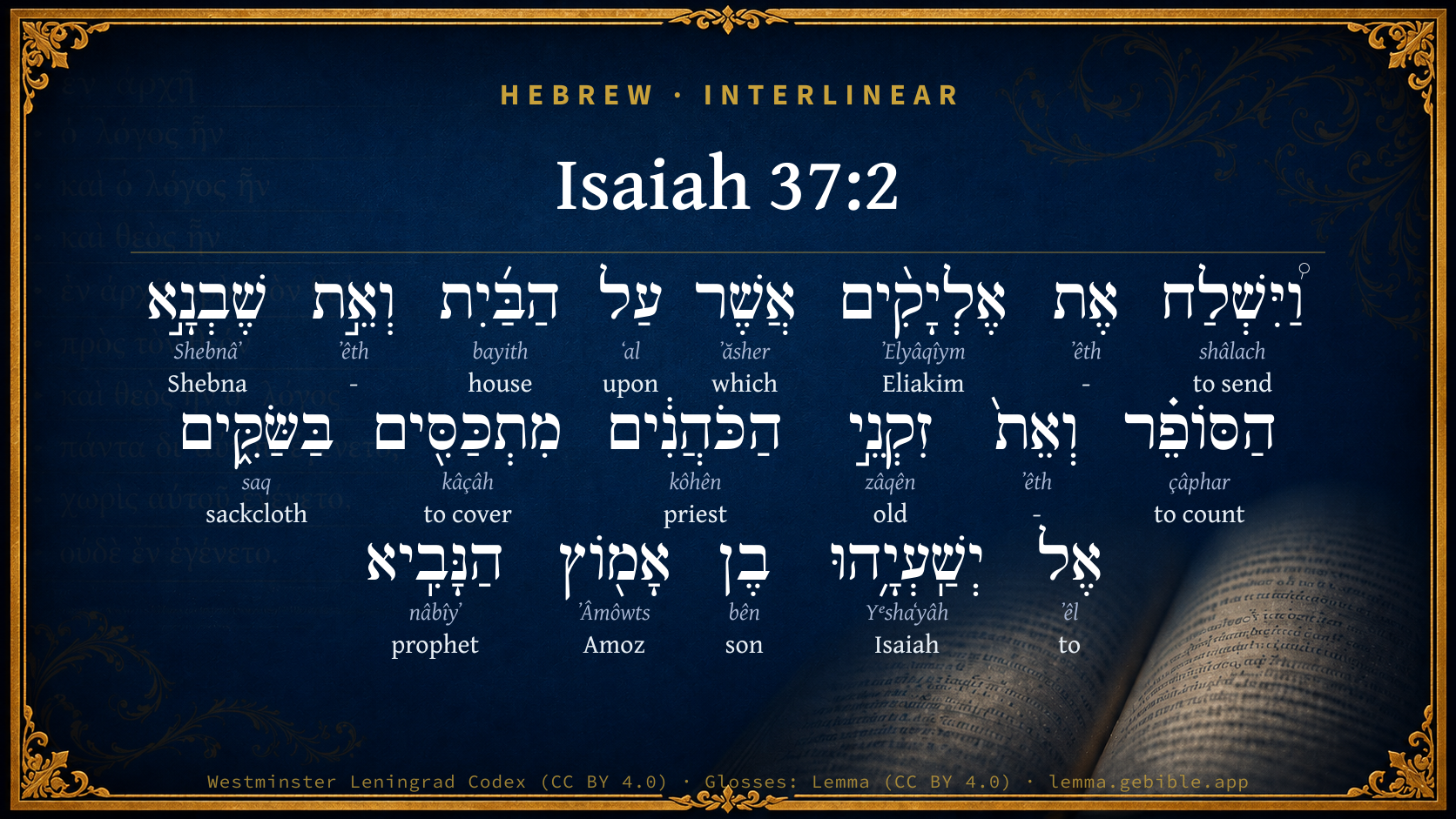
Hebrew (Westminster Leningrad Codex) Isaiah 37:2 appears in the Hebrew Old Testament. The text above is from the Westminster Leningrad Codex. Each word links to its Strong’s number, a concise gloss, and parsing drawn from the Open Scriptures Hebrew Bible morphology. Click any word for its full Brown-Driver-Briggs (BDB) entry.
Download image
Cite this verse

Isaiah 37:2 (World English Bible). Public Domain. Lemma interlinear Bible study tool, https://lemma.gebible.app/v/isaiah/37/2.

Show BibTeX & RIS
BibTeX
RIS
English Translation
He sent Eliakim, who was over the household, and Shebna the scribe, and the elders of the priests, covered with sackcloth, to Isaiah the prophet the son of Amoz.
World English Bible · Public Domain
Download a study sheet

One document with this verse’s original text, its word-by-word gloss line, the meaning frame, cross-references with their text, attributed commentary, and full source and license credits — printable, and it pastes into notes with its structure intact.

This verse Autodidact and up

Study sheet (.html) Plain text (.txt)

A passage Seminary Student

Up to 50 verses in one chapter. A passage sheet keeps up to 6 commentary sources and 12 cross-references per verse, in the order this page ranks them, and says so on the sheet whenever that leaves anything out. Ask for a single verse and you get the Autodidact verse sheet above.

Everything on this page stays free to read, with no account — the sheet is a download of what is already on screen, not access to it.

Want to remove ads? Support Godless Engineer
Compare translations 3

The same verse in 3 English versions, stacked beneath the original-language interlinear above. Click any original word for its lexicon entry.

Each is an independent rendering of the whole verse — the interlinear is not word-aligned to these translations.

Highlighted words mark where these versions differ — a whole-verse word diff, not a word-by-word alignment.

  • World English Bible Public Domain
    He sent Eliakim, who was over the household, and Shebna the scribe, and the elders of the priests, covered with sackcloth, to Isaiah the prophet the son of Amoz.
  • King James Version Public Domain
    And he sent Eliakim, who was over the household, and Shebna the scribe, and the elders of the priests covered with sackcloth, unto Isaiah the prophet the son of Amoz.
  • unfoldingWord Literal Text CC BY-SA 4.0
    And he sent Eliakim, who over the house, and Shebna the scribe and the elders of the priests, having covered themselves with sackcloth, to Isaiah, the son of Amoz, the prophet.

unfoldingWord Literal Text — © unfoldingWord, licensed CC BY-SA 4.0. Word-aligned USFM3 via Door43 (git.door43.org/unfoldingWord/en_ult).

Versions to compare (up to 4)

3 of 4 selected

Show all 18 translations

Every available English version of this verse, each an independent rendering of the whole verse.

  • World English Bible Public Domain
    He sent Eliakim, who was over the household, and Shebna the scribe, and the elders of the priests, covered with sackcloth, to Isaiah the prophet the son of Amoz.
  • Berean Standard Bible Public Domain
    And he sent Eliakim the palace administrator, Shebna the scribe, and the leading priests, all wearing sackcloth, to the prophet Isaiah son of Amoz
  • Majority Standard Bible Public Domain
    And he sent Eliakim the palace administrator, Shebna the scribe, and the leading priests, all wearing sackcloth, to the prophet Isaiah son of Amoz
  • King James Version Public Domain
    And he sent Eliakim, who was over the household, and Shebna the scribe, and the elders of the priests covered with sackcloth, unto Isaiah the prophet the son of Amoz.
  • American Standard Version (1901) Public Domain
    And he sent Eliakim, who was over the household, and Shebna the scribe, and the elders of the priests, covered with sackcloth, unto Isaiah the prophet the son of Amoz.
  • Revised Version (1885) Public Domain
    And he sent Eliakim, who was over the household, and Shebna the scribe, and the elders of the priests, covered with sackcloth, unto Isaiah the prophet the son of Amoz.
  • Geneva Bible (1599) Public Domain
    And he sent Eliakim the stewarde of the house, aud Shebna the chanceller, with the Elders of the Priestes, clothed in sackcloth vnto Isaiah the Prophet, the sonne of Amoz.
  • Douay-Rheims (1899) Public Domain
    And he sent Eliacim who was over the house, and Sobna the scribe, and the ancients of the priests covered with sackcloth, to Isaias the son of Amos the prophet.
  • Young's Literal Translation Public Domain
    and sendeth Eliakim, who `is' over the house, and Shebna the scribe, and the elders of the priests, covering themselves with sackcloth, unto Isaiah son of Amoz the prophet,
  • Literal Standard Version CC BY-SA 4.0
    and sends Eliakim, who [is] over the house, and Shebna the scribe, and [the] elderly of the priests, covering themselves with sackcloth, to Isaiah son of Amoz the prophet,
  • Unlocked Literal Bible CC BY-SA 4.0
    He sent Eliakim, who was over the household, and Shebna the scribe, and the elders of the priests, all covered with sackcloth, to Isaiah son of Amoz, the prophet.
  • unfoldingWord Literal Text CC BY-SA 4.0
    And he sent Eliakim, who over the house, and Shebna the scribe and the elders of the priests, having covered themselves with sackcloth, to Isaiah, the son of Amoz, the prophet.
  • Darby Bible Public Domain
    And he sent Eliakim, who was over the household, and Shebna the scribe, and the elders of the priests, covered with sackcloth, to the prophet Isaiah the son of Amoz.
  • World Messianic Bible Public Domain
    He sent Eliakim, who was over the household, and Shebna the scribe, and the elders of the priests, covered with sackcloth, to Isaiah the prophet, the son of Amoz.
  • Webster's Bible Public Domain
    And he sent Eliakim, who was over the household, and Shebna the scribe, and the elders of the priests covered with sackcloth, to Isaiah the prophet the son of Amoz.
  • Free Bible Version CC BY-SA 4.0
    He sent Eliakim the palace manager, Shebna, the scribe, and the leading priests, all wearing sackcloth, to see the prophet Isaiah, son of Amoz.
  • Bible in Basic English Public Domain
    And he sent Eliakim, who was over the house, and Shebna the scribe, and the chief priests, dressed in haircloth, to Isaiah the prophet, the son of Amoz.
  • JPS Tanakh (1917) Public Domain
    And he sent Eliakim, who was over the household, and Shebna the scribe, and the elders of the priests, covered with sackcloth, unto Isaiah the prophet the son of Amoz.

Literal Standard Version (2020), Covenant Press — licensed CC BY-SA 4.0. Text via the HelloAO Bible API (eBible.org). Unlocked Literal Bible (unfoldingWord) — licensed CC BY-SA 4.0. Text via the HelloAO Bible API (eBible.org). unfoldingWord Literal Text — © unfoldingWord, licensed CC BY-SA 4.0. Word-aligned USFM3 via Door43 (git.door43.org/unfoldingWord/en_ult). Free Bible Version, Dr. Jonathan Gallagher — licensed CC BY-SA 4.0. Text via the HelloAO Bible API (eBible.org).

Word by word

More ways to search: Search by grammar → Find every occurrence → Compare this word →

Practice this passage: Drill this verse → Learn its vocabulary →

שֶׁבְנָ֣א
Shebnâʼ
H7644
“Shebna”
Noun, Proper
Part of Speech
Noun
Type
Proper
Full BDB Definition

Origin: from an unused root meaning to grow

TWOT: None

Shebna = "vigour" - a person of high position in the court of king Hezekiah of Judah; subsequently the secretary of Hezekiah
  1. וַ֠יִּשְׁלַח shâlach H7971 “and · to send” Conjunction + Verb, Qal, Sequential Imperfect, 3rd Person, Masculine, Singular
  2. אֶת ʼêth H853 “-” Particle, Direct Object
  3. אֶלְיָקִ֨ים ʼElyâqîym H471 “Eliakim” Noun, Proper
  4. אֲשֶׁר ʼăsher H834 “which” Particle, Relative
  5. עַל ʻal H5921 “upon” Preposition
  6. הַבַּ֜יִת bayith H1004 “the · house” Particle, Definite Article + Noun, Common, Masculine, Singular, Absolute
  7. וְאֵ֣ת ʼêth H853 “and · -” Conjunction + Particle, Direct Object
  8. הַסּוֹפֵ֗ר çâphar H5608 “the · scribe” Particle, Definite Article + Noun, Common, Masculine, Singular, Absolute
  9. וְאֵת֙ ʼêth H853 “and · -” Conjunction + Particle, Direct Object
  10. זִקְנֵ֣י zâqên H2205 “old of” Adjective, Adjective, Masculine, Plural, Construct
  11. הַכֹּהֲנִ֔ים kôhên H3548 “the · priests” Particle, Definite Article + Noun, Common, Masculine, Plural, Absolute
  12. מִתְכַּסִּ֖ים kâçâh H3680 “covering” Verb, Hithpael, Participle Active, Masculine, Plural, Absolute
  13. בַּשַּׂקִּ֑ים saq H8242 “in/at the · sacks” Preposition, Determined + Noun, Common, Masculine, Plural, Absolute
  14. אֶל ʼêl H413 “to” Preposition
  15. יְשַֽׁעְיָ֥הוּ Yᵉshaʻyâh H3470 “Isaiah” Noun, Proper
  16. בֶן bên H1121 “son of” Noun, Common, Masculine, Singular, Construct
  17. אָמ֖וֹץ ʼÂmôwts H531 “Amoz” Noun, Proper
  18. הַנָּבִֽיא nâbîyʼ H5030 “the · prophet” Particle, Definite Article + Noun, Common, Masculine, Singular, Absolute

About this verse

These counts appear in no published source. They are computed here, from the morphology-tagged text and Lemma’s own curated glosses. What Lemma adds →

19
words
17
distinct lemmas
Prophets
section

Notable vocabulary

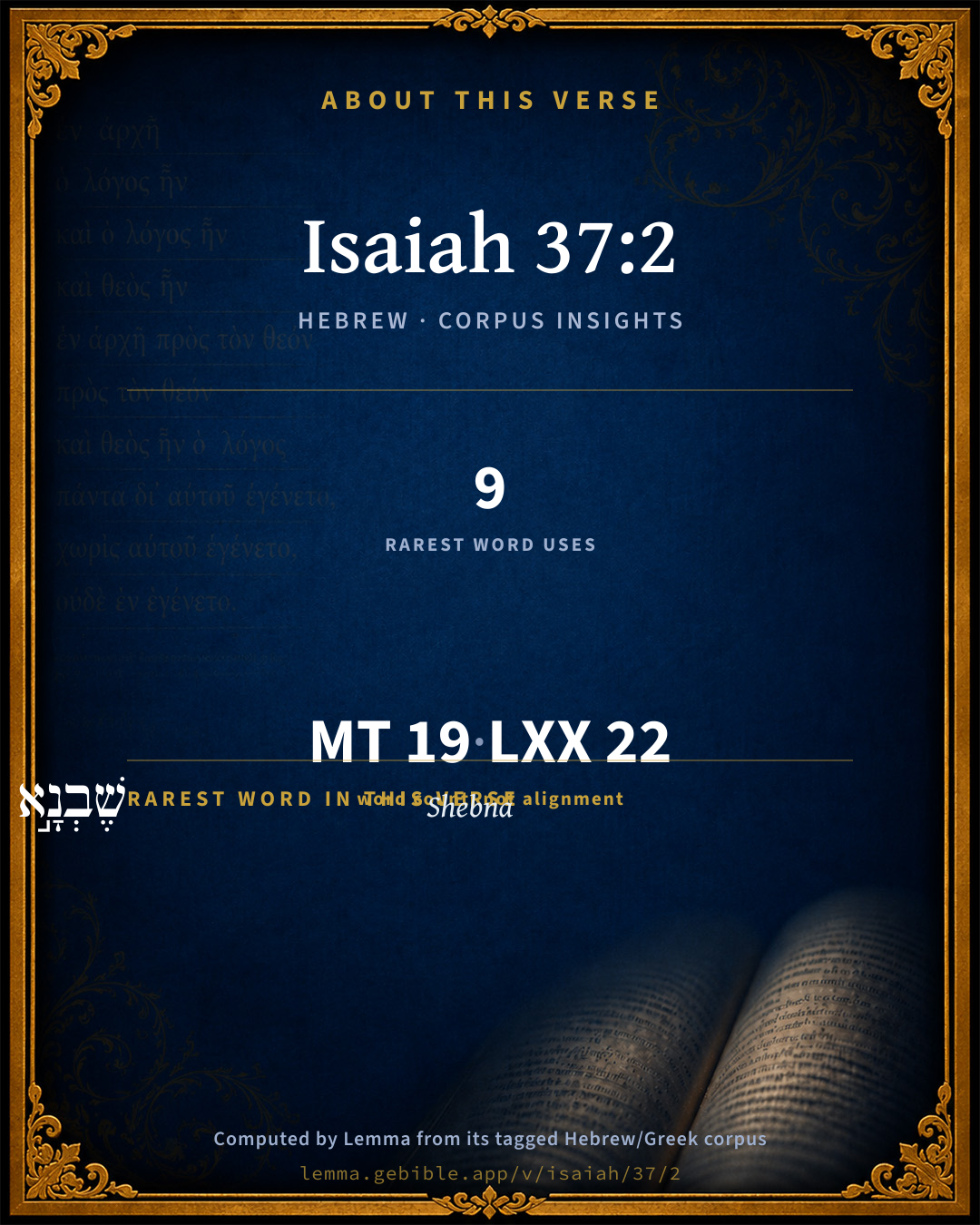
The rarest word here is שֶׁבְנָ֣א Shebna H7644 — appearing just 9 times in the whole Hebrew Bible.

Shared distinctive vocabulary

שֶׁבְנָ֣א Shebna H7644 occurs in 9 verses of the Hebrew Bible. Also found in:

Grammatical profile

  • 2 verbs
  • 10 nouns
  • 1 adjective
  • 2 prepositions
  • 4 particles

Verb forms

  • וַ֠יִּשְׁלַח Qal · Sequential Imperfect
  • מִתְכַּסִּ֖ים Hithpael · Participle Active

Hebrew & Septuagint length

In English translation the verse runs 29 words from the Hebrew and 35 from the Septuagint (LXX English) — closely comparable.

A rough comparison of the two English renderings, which tokenize alike — not a word-level alignment.

Word counts can differ between the Hebrew and the Greek without any difference in meaning — e.g. the Hebrew direct-object marker אֵת has no separate Greek word, and Greek often adds the article ὁ.

In the original languages it is 19 Hebrew tokens and 22 Greek tokens — but the two are counted differently (Hebrew bundles its prefixes and suffixes into one token; the Greek is in lemma form), so that isn’t a like-for-like length.

Cross-references

8

Topical passages linked to Isaiah 37:2 in the Treasury of Scripture Knowledge — connected by theme and wording, ordered by reader-vote popularity; previews shown in the World English Bible.

  • Isaiah 1:1 The vision of Isaiah the son of Amoz, which he saw concerning Judah and Jerusalem, in the days of Uzziah, Jotham, Ahaz, and Hezekiah, kings of Judah.
  • 2 Kings 18:18 When they had called to the king, there came out to them Eliakim the son of Hilkiah, who was over the household, and Shebnah the scribe, and Joah the son of Asaph the recorder.
  • 2 Kings 19:2 He sent Eliakim, who was over the household, and Shebna the scribe, and the elders of the priests, covered with sackcloth, to Isaiah the prophet the son of Amoz.
  • 2 Kings 22:12–14 The king commanded Hilkiah the priest, and Ahikam the son of Shaphan, and Achbor the son of Micaiah, and Shaphan the scribe, and Asaiah the king's servant, saying,
  • 2 Chronicles 20:20 They rose early in the morning, and went forth into the wilderness of Tekoa: and as they went forth, Jehoshaphat stood and said, Hear me, Judah, and you inhabitants of Jerusalem: believe in Yahweh your God, so shall you be established; believe his prophets, so shall you prosper.
  • Isaiah 36:3 Then came forth to him Eliakim the son of Hilkiah, who was over the household, and Shebna the scribe, and Joah, the son of Asaph, the recorder.
  • Isaiah 37:14 Hezekiah received the letter from the hand of the messengers, and read it; and Hezekiah went up to the house of Yahweh, and spread it before Yahweh.
  • Joel 1:13 Put on sackcloth and mourn, you priests! Wail, you ministers of the altar. Come, lie all night in sackcloth, you ministers of my God, For the meal offering and the drink offering are withheld from your God's house.

Cross-references courtesy of OpenBible.info (CC BY 4.0).

Hebrew and Greek witnesses Masoretic Hebrew ↔ Greek Septuagint

The same verse in the two great witnesses to the Old Testament, shown verse-for-verse.

These are two independent witnesses, not word-aligned to each other, and the Septuagint is shown in lemma (dictionary) form.

Hebrew Isaiah 37:2 Masoretic · Westminster Leningrad Codex

וַ֠יִּשְׁלַח אֶת אֶלְיָקִ֨ים אֲשֶׁר עַל הַבַּ֜יִת וְאֵ֣ת שֶׁבְנָ֣א הַסּוֹפֵ֗ר וְאֵת֙ זִקְנֵ֣י הַכֹּהֲנִ֔ים מִתְכַּסִּ֖ים בַּשַּׂקִּ֑ים אֶל יְשַֽׁעְיָ֥הוּ בֶן אָמ֖וֹץ הַנָּבִֽיא

He sent Eliakim, who was over the household, and Shebna the scribe, and the elders of the priests, covered with sackcloth, to Isaiah the prophet the son of Amoz.

World English Bible · Public Domain

Greek LXX Isaiah 37:2 Septuagint · lemma form

καί ἀποστέλλω ελιακιμ ὁ οἰκονόμος καί σομνας ὁ γραμματεύς καί ὁ πρεσβύτερος ὁ ἱερεύς περιβάλλω σάκκος πρός ησαιας υἱός αμως ὁ προφήτης

And he sent Heliakim the steward, and Somnas the scribe, and the elders of the priests clothed with sackcloth, to Esaias the son of Amos, the prophet. And they said to him, Thus says Ezekias,

LXX2012 (modern English Septuagint) · Public Domain

Hebrew: Westminster Leningrad Codex (CC BY 4.0). Greek: Septuagint (public domain); English from LXX2012 (modern English Septuagint) (Public Domain). How the Septuagint differs from the Hebrew →

Targum (Aramaic paraphrase)

1

The Targum is the ancient Jewish Aramaic paraphrase of the Hebrew Scriptures — an interpretive translation, not the Hebrew text itself. Onkelos (literal) and Pseudo-Jonathan (expansive) render the Torah, and Jonathan the Prophets. Coverage is partial: where no permissively-licensed English translation exists for a verse, only the Aramaic is shown. This is verse-level text, not a word-by-word alignment to the Hebrew.

  1. Targum Jonathan Prophets (Joshua–Malachi)
    וּשְׁלַח יַת אֶלְיָקִים דִי מְמַנָא עַל בֵּיתָא וְיַת שֶׁבְנָא סַפְרָא וְיַת סָבֵי כַּהֲנַיָא כַּד מְכַסָן סַקְיָא לְוַת יְשַׁעְיָהוּ בַּר אָמוֹץ נְבִיָא:

    And he sent Eliakim, who was appointed over the household, and Shebna the scribe, and the elders of the priests, thus covered with sackcloth, unto Isaiah the prophet, the son of Amoz.

    Targum Jonathan — Aramaic: “Mikraot Gedolot” (public domain). English: “Sefaria Community Translation” (CC0 1.0 (public-domain dedication)); “London "Chaldee Paraphrase," 1871” (public domain). Text via Sefaria.

Commentary

Notes on Isaiah 37:2 from classic Christian and Jewish commentators (each source and its license shown beneath its notes). The classic Christian expositions comment on the surrounding passage and are grouped to its opening verse, so a note may address several verses; the Jewish commentaries on the Tanakh (Rashi and others) are per-verse, so they appear only where the commentator wrote on this verse.

Lemma curates 59 commentaries, every one of them public domain or Creative Commons licensed, each selected and text-cleaned for this edition rather than reprinted as found. About our sources →

Geneva Bible (1599)

Geneva Bible translators

To have comfort of him by the word of God, that his faith might be confirmed and so his prayer be more earnest: teaching hereby that in all dangers these two are the only remedies, to seek unto God and his ministers.

Geneva Bible (1599) marginal notes — public domain. Text via Bolls.life.

Jamieson, Fausset & Brown

Robert Jamieson, A. R. Fausset & David Brown

unto Isaiah--implying the importance of the prophet's position at the time; the chief officers of the court are deputed to wait on him (compare Kg2 22:12-14).

Jamieson, Fausset & Brown — Commentary Critical and Explanatory on the Whole Bible (1871) — public domain (CC PDM 1.0). Text via the HelloAO Bible API.

Ellicott's Commentary for English Readers

(2) Unto Isaiah the prophet.—At last, then, the people did “see their teacher” (Isa_30:20). In that supreme hour of calamity the prophet, who had been despised and derided, was their one resource. What could he do to extricate them from the evil net which was closing round them, and to vindicate the honour of his God?

A Bible Commentary for English Readers, edited by Charles John Ellicott (1878–1897) — public domain. Text from a community e-Sword module.

The Cambridge Bible for Schools and Colleges

gen. ed. J. J. S. Perowne

2. The embassy consists of the two chief ministers, and the “elders of the priests.” The appearance of Shebna on such an errand was a striking evidence of the completeness of Isaiah’s moral victory (ch. Isa_22:15 ff.).

The Cambridge Bible for Schools and Colleges (gen. ed. J. J. S. Perowne; Cambridge University Press, 1878–1918) — public domain. Text from a community e-Sword module.

John Gill's Exposition

And he sent Eliakim, who was over the household, and Shebna the scribe,.... Two of the commissioners sent to Rabshakeh, and who heard his insolence and blasphemy, and were capable of giving a full account of it, to Isaiah the prophet:

and the elders of the priests; as the chief of those that were concerned in civil affairs, so the chief of those that were employed in sacred things, were sent: this was a very honourable embassy; and it was showing great respect to the prophet, to send such personages to him:

covered with sackcloth; as the king himself was, following his example; and this is to be understood not of the elders of the priests only, but of Eliakim and Shebna also. These, so clad, were sent by the king

unto Isaiah the prophet, the son of Amoz; to give him an account of the present situation of affairs, of the distress he was in, and to desire his prayers: a very proper person to apply to, a prophet, one highly dear to God, and honoured by him, had near access unto him, and knew much of his mind.

John Gill's Exposition of the Whole Bible (1746–1763) — public domain (CC PDM 1.0). Text via the HelloAO Bible API.

Albert Barnes' Notes on the Bible

And he sent Eliakim - (See the note at Isa 36:3).

And the elders of the priests - It was a case of deep importance, and one that pertained in a special manner to the interests of religion; and he, therefore, selected the most respectable embassage that he could to present the case to the prophet.

Covered with sackcloth - Religion had been insulted. The God whom the priests served had been blasphemed, and the very temple was threatened, and it was proper that the priests should go with the habiliments of mourning.

Unto Isaiah - It was customary on occasions of danger to consult prophets, as those who had direct communication with God, and seek counsel from them. Thus Balak sent messengers to Balaam to consult him in a time of perplexity (Num 22:5 ff); thus Jehoshaphat and the king of Israel consulted Micaiah in time of danger from Syria 1Ki 22:1-13; thus Ahaziah, when sick, sent to consult Elijah 2Ki 1:1-9; and thus Josiah sent an embassage to Huldah the prophetess to inquire in regard to the book which was found in the temple of the Lord 2Ki 22:14)

Albert Barnes' Notes on the Bible (1834–1885) — public domain. Text from a community e-Sword/MySword module.

Whedon's Commentary on the Bible

Daniel D. Whedon

2, 3. He sent Eliakim… Shebna — Two of the previous commissioners, together with the elders of the priests, or heads of Levitical families, unto Isaiah, whose sacred teaching, as a great prophet in Jerusalem, was of vast weight with him. The kind of embassy to Isaiah is proof of this. The proof, too, of the king’s extreme sense of the need of divine help is the strong metaphor which closes his message to the prophet.

Daniel D. Whedon (gen. ed.), Commentary on the Old and New Testaments (1874–1909) — public domain. Text from a community e-Sword module.

The Pulpit Commentary

He sent Eliakim... and Shebna... and the elders of the priests. A dignified embassy, showing how much Isaiah was held in honour. (2Ki_22:14 and Jer_38:3; and contrast, on the other hand, the rudeness of Ahab in sending a single eunuch to bring Micaiah into his presence, 1Ki_22:9) The prophets, as representatives of Jehovah, were entitled to respect and observance even from kings.

The Pulpit Commentary (1880–1919), ed. H.D.M. Spence-Jones & Joseph S. Exell — public domain. Text from a community e-Sword module.

J. A. Alexander on Isaiah

Joseph Addison Alexander

“And he sent Eliakim who was over the household, and Shebna the scribe, and the elders of the priests, covered with sackcloth, unto Isaiah, the son of Amoz, the prophet.” While he himself resorted to the temple, he sent to ask the counsel and the intercessions of the Prophet. Eliakim and Shebna are again employed in this case, as being qualified to make an exact report of what had happened, and in order to put honor on the prophet by an embassy of distinguished men. In the place of Joash, he sends the elders of the priests, (i.e., the heads of the sacerdotal families). The king applies to the prophet as the authorized expounder of the will of God. Similar applications are recorded elsewhere with sufficient frequency to show that they were customary and that the prophets were regarded in this light. Thus Josiah sent to Huldah (2Ki 22:14), Zedekiah to Jeremiah (Jer 37:3), etc. The impious Ahab required Micaiah to come to him, and that only at the earnest request of King Jehoshaphat (1Ki 22:9). Of the king’s prompt appeal to God in his extremity, Gill quaintly says: "Hezekiah does not sit down to consider Rabshakeh’s speech, to take it in pieces, and give an answer to it, but he applies unto God."

Joseph Addison Alexander, The Prophecies of Isaiah (1846–1847; New York: Scribner, 1870–1878) — public domain. Text from a community e-Sword module.

Lesson kit

Teaching starters — assembled from the data on this page, not authored interpretation. Every prompt links to the verse data it draws on. Edit before teaching.

Isaiah, in the Prophets, opens this verse with 19 words (17 distinct Hebrew lemmas). Its most distinctive word is Shebnâʼ (“Shebna”). A historical commentator’s framing appears above. Read the whole chapter for the surrounding context.

Discussion questions

  1. The word Shebnâʼ carries the sense “Shebna.” How does it shape the verse?
  2. How does 2 Kings 18:18, which shares the word «Shebna», read alongside this verse?
  3. These translations render this verse differently. What is at stake in choosing one wording over another?
  4. «וַ֠יִּשְׁלַח» is a Qal Sequential Imperfect verb. How does that grammatical form shape the action described?
  5. Compare how Geneva Bible (1599) and Jamieson, Fausset & Brown read this verse. Where do they agree or differ?

Things to notice

Reading settings

Reading text

Shown beneath each verse's original-language words.

Old Testament
Old Testament edition

Read the OT as the Masoretic Hebrew (MT) or the Greek Septuagint (LXX).

English shown for the Greek Septuagint (in the Hebrew ↔ Greek comparison).

Comparing translations? Open the Compare panel on any verse page to stack up to four side by side.