
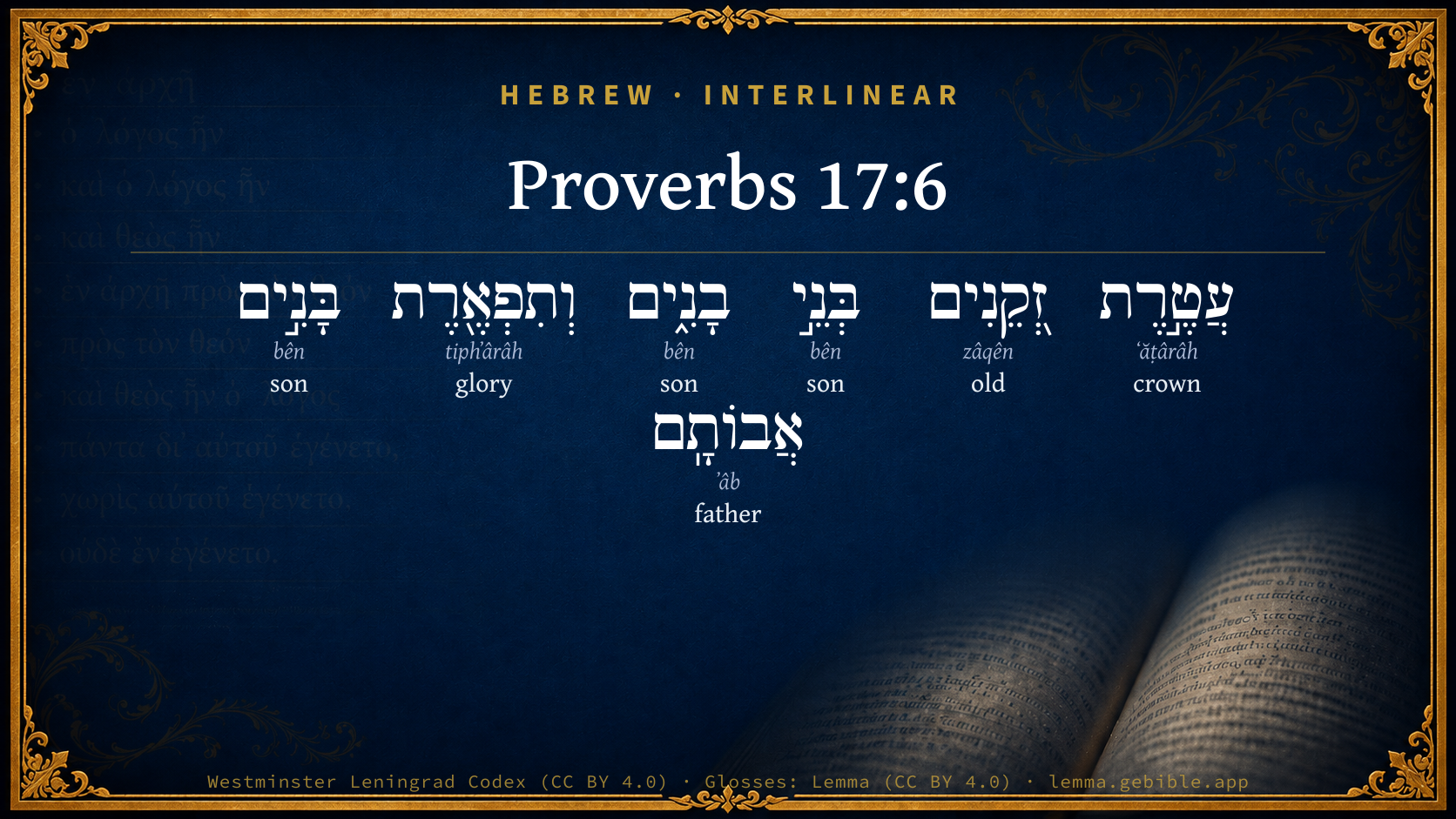
Proverbs 17:6

Hebrew (Westminster Leningrad Codex) Proverbs 17:6 appears in the Hebrew Old Testament. The text above is from the Westminster Leningrad Codex. Each word links to its Strong’s number, a concise gloss, and parsing drawn from the Open Scriptures Hebrew Bible morphology. Click any word for its full Brown-Driver-Briggs (BDB) entry.
Download image
Cite this verse

Proverbs 17:6 (World English Bible). Public Domain. Lemma interlinear Bible study tool, https://lemma.gebible.app/v/proverbs/17/6.

Show BibTeX & RIS
BibTeX
RIS
English Translation
Children's children are the crown of old men; The glory of children are their parents.
World English Bible · Public Domain
Download a study sheet

One document with this verse’s original text, its word-by-word gloss line, the meaning frame, cross-references with their text, attributed commentary, and full source and license credits — printable, and it pastes into notes with its structure intact.

This verse Autodidact and up

Study sheet (.html) Plain text (.txt)

A passage Seminary Student

Up to 50 verses in one chapter. A passage sheet keeps up to 6 commentary sources and 12 cross-references per verse, in the order this page ranks them, and says so on the sheet whenever that leaves anything out. Ask for a single verse and you get the Autodidact verse sheet above.

Everything on this page stays free to read, with no account — the sheet is a download of what is already on screen, not access to it.

Want to remove ads? Support Godless Engineer
Compare translations 3

The same verse in 3 English versions, stacked beneath the original-language interlinear above. Click any original word for its lexicon entry.

Each is an independent rendering of the whole verse — the interlinear is not word-aligned to these translations.

Highlighted words mark where these versions differ — a whole-verse word diff, not a word-by-word alignment.

  • World English Bible Public Domain
    Children's children are the crown of old men; The glory of children are their parents.
  • King James Version Public Domain
    Children's children are the crown of old men; and the glory of children are their fathers.
  • unfoldingWord Literal Text CC BY-SA 4.0
    The crown of the old sons of sons, and the splendor of sons their fathers.

unfoldingWord Literal Text — © unfoldingWord, licensed CC BY-SA 4.0. Word-aligned USFM3 via Door43 (git.door43.org/unfoldingWord/en_ult).

Versions to compare (up to 4)

3 of 4 selected

Show all 18 translations

Every available English version of this verse, each an independent rendering of the whole verse.

  • World English Bible Public Domain
    Children's children are the crown of old men; The glory of children are their parents.
  • Berean Standard Bible Public Domain
    Grandchildren are the crown of the aged, and the glory of a son is his father.
  • Majority Standard Bible Public Domain
    Grandchildren are the crown of the aged, and the glory of a son is his father.
  • King James Version Public Domain
    Children's children are the crown of old men; and the glory of children are their fathers.
  • American Standard Version (1901) Public Domain
    Children's children are the crown of old men; And the glory of children are their fathers.
  • Revised Version (1885) Public Domain
    Children’s children are the crown of old men; and the glory of children are their fathers.
  • Geneva Bible (1599) Public Domain
    Childres children are the crowne of the elders: and the glory of ye children are their fathers.
  • Douay-Rheims (1899) Public Domain
    Children's children are the crown of old men: and the glory of children are their fathers.
  • Young's Literal Translation Public Domain
    Sons' sons `are' the crown of old men, And the glory of sons `are' their fathers.
  • Literal Standard Version CC BY-SA 4.0
    Sons’ sons [are] the crown of old men, || And the glory of sons [are] their fathers.
  • Unlocked Literal Bible CC BY-SA 4.0
    Grandchildren are the crown of the aged and parents bring honor to their children.
  • unfoldingWord Literal Text CC BY-SA 4.0
    The crown of the old sons of sons, and the splendor of sons their fathers.
  • Darby Bible Public Domain
    Children's children are the crown of old men; and the glory of children are their fathers.
  • World Messianic Bible Public Domain
    Children’s children are the crown of old men; the glory of children is their parents.
  • Webster's Bible Public Domain
    Children's children are the crown of old men; and the glory of children is their fathers.
  • Free Bible Version CC BY-SA 4.0
    Old people are proud of their grandchildren, and children are proud of their parents.
  • Bible in Basic English Public Domain
    Children's children are the crown of old men, and the glory of children is their fathers.
  • JPS Tanakh (1917) Public Domain
    Children's children are the crown of old men; and the glory of children are their fathers.

Literal Standard Version (2020), Covenant Press — licensed CC BY-SA 4.0. Text via the HelloAO Bible API (eBible.org). Unlocked Literal Bible (unfoldingWord) — licensed CC BY-SA 4.0. Text via the HelloAO Bible API (eBible.org). unfoldingWord Literal Text — © unfoldingWord, licensed CC BY-SA 4.0. Word-aligned USFM3 via Door43 (git.door43.org/unfoldingWord/en_ult). Free Bible Version, Dr. Jonathan Gallagher — licensed CC BY-SA 4.0. Text via the HelloAO Bible API (eBible.org).

Word by word

More ways to search: Search by grammar → Find every occurrence → Compare this word →

Practice this passage: Drill this verse → Learn its vocabulary →

About this verse

These counts appear in no published source. They are computed here, from the morphology-tagged text and Lemma’s own curated glosses. What Lemma adds →

7
words
5
distinct lemmas
Wisdom
section

Notable vocabulary

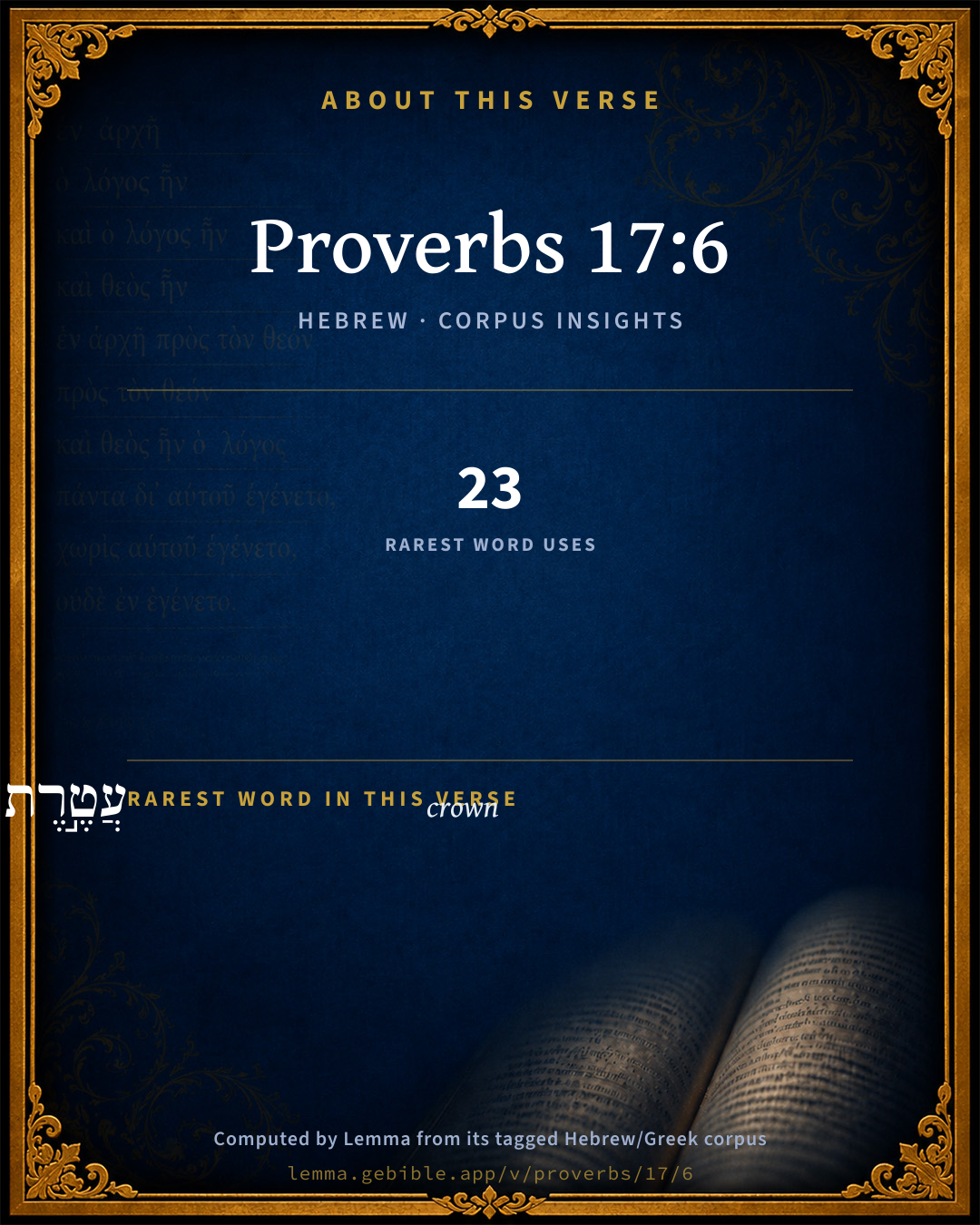
The rarest word here is עֲטֶ֣רֶת crown H5850 — appearing just 23 times in the whole Hebrew Bible.

Shared distinctive vocabulary

עֲטֶ֣רֶת crown H5850 occurs in 23 verses of the Hebrew Bible. Also found in:

Grammatical profile

  • 6 nouns
  • 1 adjective

Repetition

A word recurs within this verse — often emphatic in Hebrew:

  • בְּנֵ֣י son H1121 ×3

Hebrew & Septuagint length

In English translation the verse runs 15 words from the Hebrew and 32 from the Septuagint (LXX English) — the Septuagint runs noticeably longer here. See the side-by-side →

A rough comparison of the two English renderings, which tokenize alike — not a word-level alignment.

Word counts can differ between the Hebrew and the Greek without any difference in meaning — e.g. the Hebrew direct-object marker אֵת has no separate Greek word, and Greek often adds the article ὁ.

Cross-references

9

Topical passages linked to Proverbs 17:6 in the Treasury of Scripture Knowledge — connected by theme and wording, ordered by reader-vote popularity; previews shown in the World English Bible.

  • Psalms 127:3–5 Behold, children are a heritage of Yahweh. The fruit of the womb is his reward.
  • Proverbs 16:31 Gray hair is a crown of glory. It is attained by a life of righteousness.
  • Proverbs 13:22 A good man leaves an inheritance to his children's children, But the wealth of the sinner is stored for the righteous.
  • Psalms 128:3–6 Your wife will be as a fruitful vine, In the innermost parts of your house; Your children like olive plants, Around your table.
  • Exodus 3:14–15 God said to Moses, "I AM WHO I AM," and he said, "You shall tell the children of Israel this: "I AM has sent me to you."
  • Genesis 50:23 Joseph saw Ephraim's children to the third generation. The children also of Machir, the son of Manasseh, were born on Joseph's knees.
  • 1 Kings 11:12 Notwithstanding in your days I will not do it, for David your father's sake: but I will tear it out of the hand of your son.
  • 1 Kings 15:4 Nevertheless for David's sake did Yahweh his God give him a lamp in Jerusalem, to set up his son after him, and to establish Jerusalem;
  • Job 42:16–17 After this Job lived one hundred forty years, and saw his sons, and his sons' sons, to four generations.

Cross-references courtesy of OpenBible.info (CC BY 4.0).

Hebrew and Greek witnesses Masoretic Hebrew ↔ Greek Septuagint

The same verse in the two great witnesses to the Old Testament, shown verse-for-verse.

Here the Septuagint runs noticeably longer than the Hebrew — LXX2012 (modern English Septuagint) 32 words vs World English Bible 15. A rough length comparison of the two English translations, not a word-level alignment — read both below.

These are two independent witnesses, not word-aligned to each other, and the Septuagint is shown in lemma (dictionary) form.

Hebrew Proverbs 17:6 Masoretic · Westminster Leningrad Codex

עֲטֶ֣רֶת זְ֭קֵנִים בְּנֵ֣י בָנִ֑ים וְתִפְאֶ֖רֶת בָּנִ֣ים אֲבוֹתָֽם

Children's children are the crown of old men; The glory of children are their parents.

World English Bible · Public Domain

Greek LXX Proverbs 17:6 Septuagint · lemma form

στέφανος γέρων τέκνον τέκνον καύχημα δέ τέκνον πατήρ αὐτός ὁ πιστός ὅλος ὁ κόσμος ὁ χρῆμα ὁ δέ ἄπιστος οὐδέ ὀβολός

Children's children are the crown of old men; and their fathers are the glory of children. The faithful has the whole world full of wealth; but the faithless not even a farthing.

LXX2012 (modern English Septuagint) · Public Domain

On this verse, Keil & Delitzsch discusses the Septuagint’s reading. Read the note in Commentary ↓

Hebrew: Westminster Leningrad Codex (CC BY 4.0). Greek: Septuagint (public domain); English from LXX2012 (modern English Septuagint) (Public Domain). How the Septuagint differs from the Hebrew →

Commentary

Notes on Proverbs 17:6 from classic Christian and Jewish commentators (each source and its license shown beneath its notes). The classic Christian expositions comment on the surrounding passage and are grouped to its opening verse, so a note may address several verses; the Jewish commentaries on the Tanakh (Rashi and others) are per-verse, so they appear only where the commentator wrote on this verse.

Lemma curates 59 commentaries, every one of them public domain or Creative Commons licensed, each selected and text-cleaned for this edition rather than reprinted as found. About our sources →

Trapp's Complete Commentary

John Trapp

Pro 17:6 Children’s children [are] the crown of old men; and the glory of children [are] their fathers.

Ver. 6. Children’s children are the crown of old men.] That is, if they be not children those who "cause shame," as Pro 17:2, and who disgrace their ancestors - stain their blood; if they obey their parents’ counsel and follow their good example; for otherwise they prove not crowns, but corrosives, to their aged sires, as did Esau, Absalom, Andronicus, and others.

And the glory of children are their parents.] If those children so well descended do not degenerate, as Jonathan the son of Gershom, the son of Manasseh - or rather of Moses, as the Hebrews read it with a nun suspensum {Jdg 18:31} - and as Eli’s, Samuel’s, and some of David’s sons did. Heroum filii noxae. Manasseh had a good father, but he degenerated into his grandfather Ahaz, as if there had been no intervention of a Hezekiah. So we have seen the kernel of a well-fruited plant degenerate into that crab or willow that gave the original to his stock. But what an honour was it to Jacob that he could swear "by the fear of his father Isaac!" - to David, that he could, in a real and heavenly compliment, say to his Maker, "Truly, Lord, I am thy servant; I am thy servant, and the son of thy handmaid!" {Psa 116:16} - to Timothy, that the same faith that was in him had dwelt first "in his grandmother Lois, and his mother Eunice!" {2Ti 1:5} - to the children of the elect lady! &c. - to Mark, that he was Barnabas’s sister’s son! - to Alexander and Rufus, men mentioned only, Mar 15:21, but famously known in the Church to be the sons of Simon of Cyrene! - to the sons of Constantine the Great, to come of such a father, whom they did wholly put on, saith Eusebius, {a} and exactly resemble! - to be descended of those glorious martyrs and confessors that suffered here in Queen Mary’s days!

{a} ολον ενεδυσαντο το Kονσταντιν. - Euseb.

John Trapp, A Commentary or Exposition upon All the Books of the Old and New Testament (1647–1656) — public domain. Text from a community e-Sword module.

Joseph Benson's Commentary

Pro 17:6. Children’s children are the crown of old men — It is an honour to parents, when they are old, to leave children, and children’s children growing up, that tread in the steps of their virtues, and are likely to maintain and advance the reputation of their families, and to serve their generation according to the will of God; and the glory of children are their fathers — Namely, fathers that are wise and godly. To have such parents is an honour to children, and to have them continued to them even after they are themselves grown up, and settled in the world. Those are unnatural children indeed who reckon their aged parents a burden to them, and think they live too long; whereas, if children be wise and good, it is their greatest honour, that thereby they are comforts to their parents in the unpleasant days of their old age.

Joseph Benson's Commentary on the Old and New Testaments (1811–1818) — public domain. Text from a community e-Sword module.

The Preacher's Complete Homiletical Commentary

Joseph S. Exell (gen. ed.)

MAIN HOMILETICS OF Pro_17:6

FATHERS AND CHILDREN

Two things are implied in this proberb:—First, that the fathers are good men. An aged man who is not a godly man cannot in any sense reflect any glory upon his descendants. Secondly, that the children are also godly and true, otherwise they are anything but a crown to their parents. The Wise Man is here speaking of those who are in both relations what God intended them to be. When such is the case—

I. The children bring honour to their parents. They testify that the parents have trained them in the way that they should go—that they have given them a good example as well as good advice, and every child is then like a separate mirror, reflecting the character of the godly parent by whose influence he has become what he now is. And the greater number of these mirrors there are, the more brilliant is the crown of honour which is worn by the godly ancestor whose virtues are thus reproduced in his children and in his children’s children, even long after he has left the world. Every tribute of respect that is paid to the children is another jewel placed in the crown of the godly ancestor.

II. The parents are the glory of their children. Men glory in being descended from ancestors who have been great warriors or who have left them a vast inheritance of material wealth, but an inheritance of goodness reflects as much more glory upon those who are its heirs as the glory of heaven exceeds that of earth. Goodness holds a very old patent of nobility, and when children can boast of a long line of God-fearing ancestors, they can boast of a dignity which is as old as God. To be the descendants of those who are now before the throne of God is a glory before which all earthly glory fades away.

The Preacher's Complete Homiletical Commentary (gen. ed. Joseph S. Exell; Funk & Wagnalls, c. 1892) — public domain (pre-1929). A full-Bible homiletical/sermon-outline anthology covering 65 of 66 books (2 John is absent from the source module). Text from a community e-Sword module.

Keil & Delitzsch

C. F. Keil & F. Delitzsch

With this verse this series of proverbs closes as it began:

A diadem of the old are children's children,

And the glory of children are their parents.

Children are a blessing from God (Ps 127-128); thus, a family circle consisting of children and grandchildren (including great-grandchildren) is as a crown of glory surrounding the grey-haired patriarch; and again, children have glory and honour in their parents, for to have a man of an honoured name, or of a blessed memory, as a father, is the most effective commendation, and has for the son, even though he is unlike his father, always important and beneficial consequences. In 6b a fact of experience is expressed, from which has proceeded the rank of inherited nobility recognised among men - one may abnegate his social rights, but yet he himself is and remains a part of the moral order of the world. The lxx has a distich after Pro 17:4 the Vatican text places it after Pro 17:6 : "The whole world of wealth belongs to the faithful, but to the unfaithful not even an obolus." Lagarde supposes that ὄλος ὁ κόσμος τῶν χρημάτων is a translation of שׁפעת יתר, instead of שׂפת יתר, 7a. But this ingenious conjecture does not amount to the regarding of this distich as a variation of Pro 17:7.

Keil & Delitzsch — Biblical Commentary on the Old Testament (1861–1891) — public domain (CC PDM 1.0). Text via the HelloAO Bible API. (Old Testament only.)

Tyndale Open Study Notes

Tyndale Open Resources

17:6 Only those who have been blessed with a long life live to become grandparents, and the continuation of the family line is a sign of God’s blessing (see Gen 12:1-3). • parents: Literally fathers. This proverb applies to both fathers and mothers.

Tyndale Open Study Notes — © Tyndale Open Resources, licensed CC BY-SA 4.0. Text via the HelloAO Bible API.

Matthew Henry's Commentary

They are so, that is, they should be so, and, if they conduct themselves worthily, they are so. 1. It is an honour to parents when they are old to leave children, and children's children, growing up, that tread in the steps of their virtues, and are likely to maintain and advance the reputation of their families. It is an honour to a man to live so long as to see his children's children (Psa 128:6; Gen 50:23), to see his house built up in them, and to see them likely to serve their generation according to the will of God. This crowns and completes their comfort in this world. 2. It is an honour to children to have wise and godly parents, and to have them continued to them even after they have themselves grown up and settled in the world. Those are unnatural children who reckon their aged parents a burden to them, and think they live too long; whereas, if the children be wise and good, it is as much their honour as can be that thereby they are comforts to their parents in the unpleasant days of their old age.

Matthew Henry's Commentary on the Whole Bible (1708–1710) — public domain (CC PDM 1.0). Text via the HelloAO Bible API.

Jamieson, Fausset & Brown

Robert Jamieson, A. R. Fausset & David Brown

Prolonged posterity is a blessing, its cutting off a curse (Pro 13:22; Psa 109:13-15), hence children may glory in virtuous ancestry.

Jamieson, Fausset & Brown — Commentary Critical and Explanatory on the Whole Bible (1871) — public domain (CC PDM 1.0). Text via the HelloAO Bible API.

Ellicott's Commentary for English Readers

(6) Children’s children are the crown of old men.—Comp. Psalms 127, 128.

The glory of children are their fathers.—And, as such, to be honoured by them. For the blessing which parents bring to children, comp. 1Ki_11:13; 1Ki_15:4; Jer_33:21.

A Bible Commentary for English Readers, edited by Charles John Ellicott (1878–1897) — public domain. Text from a community e-Sword module.

The Cambridge Bible for Schools and Colleges

gen. ed. J. J. S. Perowne

6. “A beautiful family picture of linked and mutually blessed “generations.” Horton.

The Cambridge Bible for Schools and Colleges (gen. ed. J. J. S. Perowne; Cambridge University Press, 1878–1918) — public domain. Text from a community e-Sword module.

John Gill's Exposition

Children's children are the crown of old men,.... Ancient parents. Grandfathers with the Jews are called old men, as Buxtorf (d) observes. A numerous progeny was reckoned a great blessing to a man; to have his table surrounded with children, as olive plants; to be encircled with a large family was a crown of glory (e); and to live to see children's children, a large number of grandchildren, was still a greater glory; and especially, as Jarchi observes, when these children, or children's children, were walking in a good way, in the good ways of religion and godliness, they trained them up in. Christ is the Ancient of days, the everlasting Father; and it is his glory, as Mediator, to see his seed, to have a numerous off spring; and which will endure for ever, as the days of heaven: ministers of the Gospel are spiritual fathers; and those who have been converted under their ministry wilt be their joy and "crown of rejoicing" at the last day, Th1 2:19;

and the glory of children are their fathers; who are wise, as Aben Ezra observes; and righteous, as Jarchi: if they are wise and good men, it is an honour to their children that they descend from them; nor are they ashamed to own their relation to them, but glory in it, as the Jews did in Abraham, saying, "We have Abraham for our father", Mat 3:9, Luk 3:8, but, on the contrary, if their fathers are foolish or wicked, their children are ashamed of them, and do not care to acknowledge their descent from them; and such parents, who are an honour to their children, their children should be careful to tread in their steps, that they reflect no dishonour on them; particularly as it is our great honour and glory to have God for our father, to be his adopted sons and daughters, we should be followers of him as dear children, and be obedient ones.

(d) In Lex. Talmud. col. 684. (e) "Te felix natorum turba coronat", Claudian. de Raptu Prosperp. l. 1. v. 109.

John Gill's Exposition of the Whole Bible (1746–1763) — public domain (CC PDM 1.0). Text via the HelloAO Bible API.

Albert Barnes' Notes on the Bible

The reciprocity of good in sustained family relationships. A long line of children’s children is the glory of old age, a long line of ancestors the glory of their descendants.

Albert Barnes' Notes on the Bible (1834–1885) — public domain. Text from a community e-Sword/MySword module.

Haydock's Catholic Bible Commentary

Fathers. Whose virtues they are bound to imitate.

George Leo Haydock (1774–1849), Haydock's Catholic Family Bible and Commentary, 1859 edition — public domain. Excludes Psalms (Douay-Rheims chapter numbering differs from Protestant) and Deuterocanonical books (Catholic canon only).

Matthew Poole's English Annotations

The crown of old men; their honour and happiness, because they are in themselves blessings of God, and testimonies of God’s favour, although sometimes they may become the shame of their father’s house.

Their fathers; namely, such fathers as are wise and godly, as is evident from the nature of the thing, for wicked parents bring infamy upon their children.

Matthew Poole's English Annotations on the Holy Bible (1683–1685) — public domain. Text from a community e-Sword/MySword module.

Whedon's Commentary on the Bible

Daniel D. Whedon

6. Crown of old men — He has had an illustration of this proverb who has met, as the writer has, a venerable patriarch, honoured both for his piety and his intelligence, who counted his children, grandchildren, and great grandchildren by scores if not by hundreds, and to whom they all looked up with that veneration and affection which were becoming his years and character. He was as particular about his ספר תולדות, (sepher toledhoth,) book of genealogy — family record — as one of the patriarchs of old, and enjoined on every branch of his family to report the birth of every child, to be entered in its appropriate place in the family register. Compare on first clause Psa_127:5; Psa_128:3.

Daniel D. Whedon (gen. ed.), Commentary on the Old and New Testaments (1874–1909) — public domain. Text from a community e-Sword module.

The Pulpit Commentary

Children"s children are the crown of old men. (comp. Ps 127 Ps 128) (For the term "crown," comp. Pro_16:18) Thus St. Paul calls his converts his "joy and crown." (Php_4:1 1Th_2:19) In the East a large number of children is considered a great blessing, being a guarantee of the stability of the family. Thus writes Euripides ("Iph. Taur.," 57) Stuloi ga . "Male children are the pillars of the house.

The glory of children are their fathers. A long line of good or celebrated ancestors is the glory of their descendants, and brings a blessing on them. (see 1Ki_11:13 1Ki_15:4) Hereditary nobility, based on descent from some eminent progenitor, may be a source of not unseemly pride, and a spur to a life worthy of such excellent ancestry.

Vers. 6, 21, 25. Fatherhood and sonship.

Certainly, some of our very greatest mercies are those that come to us in our domestic relationships.

I THE JOY AND CROWN OF FATHERHOOD AND OF GRANDFATHERHOOD. Our Lord speaks of the mother forgetting her anguish "for joy that a man is born into the world". (Joh_16:21) The joy of parentage is keen, and it is common; it may, indeed, be said to be universal. And it is pure and good; it elevates and enlarges the soul, taking thought and care away from self to another, and by so doing it distinctly benefits and blesses the nature. And, like all pure joys, it is lasting; it does not evaporate with time; on the other hand, it grows and deepens as the child of its affection develops and matures. Moreover, in the kind providence of God, it is renewable in another generation; for the grandfather has almost as much delight in his grandson as the father in his child. (text; Gen_50:23 Psa_128:6) Fatherhood (motherhood) is:

1. A natural desire of the human heart.

2. Often the reward which God gives to patient industry and virtue in earlier days; for the setting up of a home is, in many if not in most cases, the attainment of a hope for which the young have striven and waited.

3. Sometimes a source of grievous disappointment and saddest sorrow (vers. 21, 25). There is no one in the world who can pierce our souls with such bitter anguish as can our own child when he or she goes astray from wisdom and righteousness.

4. Always an entail of the most serious responsibility; for what we are inspirit and in character it is most likely that our children will become.

5. Therefore a noble opportunity; for it is in our power, by wisdom and virtue, by kindness and piety, to lead our sons into the gates of privilege and up to the gates of the kingdom of Christ.

6. And therefore usually a source of profoundest gratitude and gladness, and the means by which we can hand down our principles and our influence, through our own direct endeavours, to the second and the third generation.

II THE GLORY OF CHILDHOOD. "The glory of children are their fathers.

1. It is the greatest of all earthly heritages to have parents that can be esteemed and loved. Happy is the son who, as his judgment matures, can honour his father with an undiminishing or even a growing regard and deepening joy.

2. It is a very real delight to be able to look back, through all the later years of life, and recall the memories of the beloved and revered parents who have "passed into the skies

3. It is the duty of childhood to make the very best response it can make for the love, care, pains, patience, prayerful solicitude, its parents have expended upon it.

4. It will remain a lasting, source of thankfulness and joy that every possible filial attention was paid that could be paid; lighting and smoothing the path of the parents to the very door of heaven. C.

The Pulpit Commentary (1880–1919), ed. H.D.M. Spence-Jones & Joseph S. Exell — public domain. Text from a community e-Sword module.

Bridges on Proverbs

Charles Bridges

This Proverb has its limit. What a crown of thorns to each other are an ungodly progeny and graceless parents! Little glory indeed did Rehoboam and his son add to their fathers.†1 As little was the godly Hezekiah dignified by his reprobate parent.†2 Gehazi brought shame, not glory, to his children.†3 But in the ordinary course gracious children and parents reflect honour upon each other. Such parents rejoice in the number and growth of their children. Such children regard their father’s name as their glory. Joseph was indeed a crown to his aged father (Gen 47:11-12 ); as was Jacob himself the glory of his child, even in a Heathen nation. (Gen 47:7-10 .) ’A good root maketh the branches to flourish, by virtue of the lively sap that it sendeth up. And flourishing branches win praise to the root, for the pleasant fruit which they bring forth.’†4

The Old Testament promise — "length of days" (Pro 3:2, Pro 3:16 ) — was enhanced, when accompanied with the blessing of children; yet more — when crowned with the increase of children’s children.†5 The true blessing, however, could only be known, when children, early brought up into God’s covenant, were trained in his ways, and "declared them to their children, that they might set their hope in God." (Psa 78:5-7 .) "Happy was the man, who had his quiver full of such children." (Psa 127:5 .) Happy the children, thus crowned with the example of such fathers! Abraham was the honourable, though delusive, boast of his seed.†6 David was the glory of his children, preserving to them the throne of Judah for seventeen generations.†7 And may not godly parents, under a larger dispensation of grace educating their children by example, no less than by precept — may they not look for a "godly seed" — the children of the covenant,†8 who shall acknowledge infinite, eternal obligations to parental faith and godliness?†9

Footnotes:

†1 1Ki 12:1-33

†2 2 Chronicles 28. 29.

†3 2Ki 5:27 .

†4 Clever on Pro 1:1 .

†5 Gen 48:11; Gen 50:23 . Job 42:16 . Psa 128:6 .

†6 Mat 3:9. Joh 8:33 .

†7 1Ki 11:12-13 ; 1Ki 15:4 . 2Ch 21:7 .

†8 Gen 17:7. Psa 127:3 .

†9 2Ti 1:5 ; 2Ti 3:15 .

Charles Bridges, An Exposition of the Book of Proverbs (1846) — public domain. Text from a community e-Sword module.

Kretzmann's Popular Commentary

Paul E. Kretzmann

v. 6. Children’s children are the crown of old men, it is a blessing of the Lord and a source of honor and pride to the gray-headed if they see their offspring to the third generation, for the happiness of the younger generation is reflected in the life of the older; and the glory of children are their fathers, for the rule works both ways, and pious children share in the honor enjoyed by their parents.

Paul E. Kretzmann, Popular Commentary of the Bible (1921–1924) — public domain. Text from a community e-Sword module.

Rashi

Rabbi Shlomo Yitzchaki (Rashi)

the crown of the aged when they see their children’s children going on the good way.

and the glory of the children is their fathers When their fathers are righteous, it is glory for the children.

Rashi on the Tanakh — English translations: “The Judaica Press complete Tanach with Rashi, translated by A. J. Rosenberg” (CC BY 4.0); “Pentateuch with Rashi's commentary by M. Rosenbaum and A.M. Silbermann, 1929-1934” (public domain); “The Metsudah Tanach series, Lakewood, N.J” (CC BY 4.0); and “The Book of Joshua, Metsudah Publications, 1997” (CC BY 4.0). Text via Sefaria.

Lesson kit

Teaching starters — assembled from the data on this page, not authored interpretation. Every prompt links to the verse data it draws on. Edit before teaching.

Proverbs, in the Wisdom, opens this verse with 7 words (5 distinct Hebrew lemmas). Its most distinctive word is ʻăṭârâh (“crown”). The Greek Septuagint runs longer here. A historical commentator’s framing appears above. Read the whole chapter for the surrounding context.

Discussion questions

  1. The word ʻăṭârâh carries the sense “crown.” How does it shape the verse?
  2. How does 2 Samuel 12:30, which shares the word «crown», read alongside this verse?
  3. What does the repetition of “son” (3× in this one verse) do in this verse?
  4. The Septuagint runs longer here than the Hebrew. What might account for the difference?
  5. The translations on this page render this verse differently — a whole-verse word diff, not a word-by-word alignment. What might account for the different wordings?
  6. Compare how Trapp's Complete Commentary and Joseph Benson's Commentary read this verse. Where do they agree or differ?

Things to notice

Reading settings

Reading text

Shown beneath each verse's original-language words.

Old Testament
Old Testament edition

Read the OT as the Masoretic Hebrew (MT) or the Greek Septuagint (LXX).

English shown for the Greek Septuagint (in the Hebrew ↔ Greek comparison).

Comparing translations? Open the Compare panel on any verse page to stack up to four side by side.