
Jeremiah 26:17

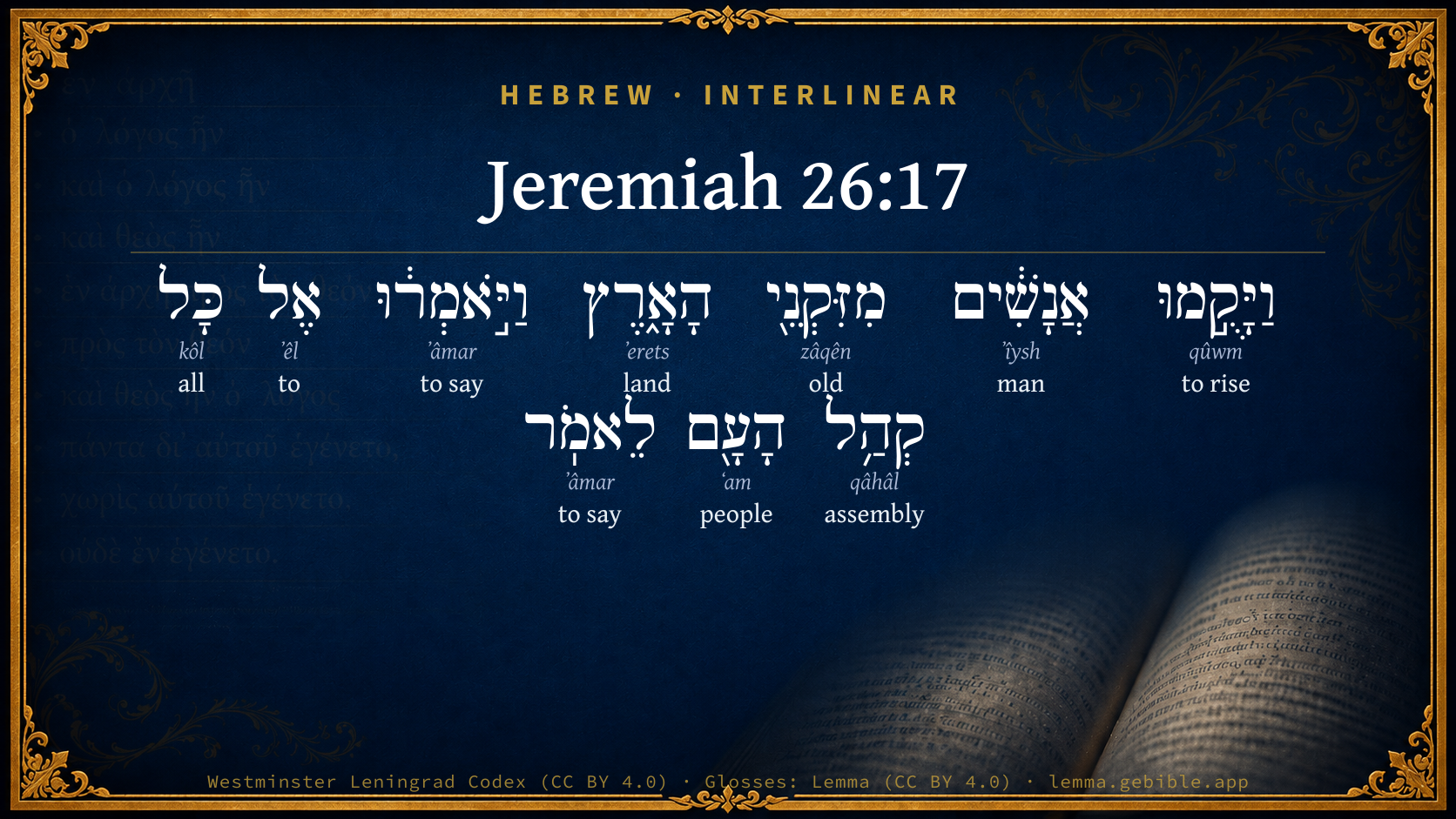
Hebrew (Westminster Leningrad Codex) Jeremiah 26:17 appears in the Hebrew Old Testament. The text above is from the Westminster Leningrad Codex. Each word links to its Strong’s number, a concise gloss, and parsing drawn from the Open Scriptures Hebrew Bible morphology. Click any word for its full Brown-Driver-Briggs (BDB) entry.
Download image
Cite this verse

Jeremiah 26:17 (World English Bible). Public Domain. Lemma interlinear Bible study tool, https://lemma.gebible.app/v/jeremiah/26/17.

Show BibTeX & RIS
BibTeX
RIS
English Translation
Then rose up certain of the elders of the land, and spoke to all the assembly of the people, saying,
World English Bible · Public Domain
Download a study sheet

One document with this verse’s original text, its word-by-word gloss line, the meaning frame, cross-references with their text, attributed commentary, and full source and license credits — printable, and it pastes into notes with its structure intact.

This verse Autodidact and up

Study sheet (.html) Plain text (.txt)

A passage Seminary Student

Up to 50 verses in one chapter. A passage sheet keeps up to 6 commentary sources and 12 cross-references per verse, in the order this page ranks them, and says so on the sheet whenever that leaves anything out. Ask for a single verse and you get the Autodidact verse sheet above.

Everything on this page stays free to read, with no account — the sheet is a download of what is already on screen, not access to it.

Want to remove ads? Support Godless Engineer
Compare translations 3

The same verse in 3 English versions, stacked beneath the original-language interlinear above. Click any original word for its lexicon entry.

Each is an independent rendering of the whole verse — the interlinear is not word-aligned to these translations.

Highlighted words mark where these versions differ — a whole-verse word diff, not a word-by-word alignment.

  • World English Bible Public Domain
    Then rose up certain of the elders of the land, and spoke to all the assembly of the people, saying,
  • King James Version Public Domain
    Then rose up certain of the elders of the land, and spake to all the assembly of the people, saying,
  • unfoldingWord Literal Text CC BY-SA 4.0
    And men from the elders of the land rose up and said to all the assembly of the people, saying,

unfoldingWord Literal Text — © unfoldingWord, licensed CC BY-SA 4.0. Word-aligned USFM3 via Door43 (git.door43.org/unfoldingWord/en_ult).

Versions to compare (up to 4)

3 of 4 selected

Show all 18 translations

Every available English version of this verse, each an independent rendering of the whole verse.

  • World English Bible Public Domain
    Then rose up certain of the elders of the land, and spoke to all the assembly of the people, saying,
  • Berean Standard Bible Public Domain
    Some of the elders of the land stood up and said to the whole assembly of the people,
  • Majority Standard Bible Public Domain
    Some of the elders of the land stood up and said to the whole assembly of the people,
  • King James Version Public Domain
    Then rose up certain of the elders of the land, and spake to all the assembly of the people, saying,
  • American Standard Version (1901) Public Domain
    Then rose up certain of the elders of the land, and spake to all the assembly of the people, saying,
  • Revised Version (1885) Public Domain
    Then rose up certain of the elders of the land, and spake to all the assembly of the people, saying,
  • Geneva Bible (1599) Public Domain
    Then rose vp certaine of the Elders of the lande, and spake to all the assemblie of the people, saying,
  • Douay-Rheims (1899) Public Domain
    And some of the ancients of the land rose up: and they spoke to all the assembly of the people, saying:
  • Young's Literal Translation Public Domain
    And certain of the elders of the land rise up, and speak unto all the assembly of the people, saying,
  • Literal Standard Version CC BY-SA 4.0
    And men from [the] elderly of the land rise up and speak to all the assembly of the people, saying,
  • Unlocked Literal Bible CC BY-SA 4.0
    Then men from the elders of the land rose up and spoke to the entire assembly of the people.
  • unfoldingWord Literal Text CC BY-SA 4.0
    And men from the elders of the land rose up and said to all the assembly of the people, saying,
  • Darby Bible Public Domain
    And there rose up certain of the elders of the land and spoke to all the congregation of the people, saying,
  • World Messianic Bible Public Domain
    Then certain of the elders of the land rose up, and spoke to all the assembly of the people, saying,
  • Webster's Bible Public Domain
    Then arose certain of the elders of the land, and spoke to all the assembly of the people, saying,
  • Free Bible Version CC BY-SA 4.0
    Some of the country's elders stood up and addressed everyone gathered there.
  • Bible in Basic English Public Domain
    Then some of the responsible men of the land got up and said to all the meeting of the people,
  • JPS Tanakh (1917) Public Domain
    Then rose up certain of the elders of the land, and spoke to all the assembly of the people, saying:

Literal Standard Version (2020), Covenant Press — licensed CC BY-SA 4.0. Text via the HelloAO Bible API (eBible.org). Unlocked Literal Bible (unfoldingWord) — licensed CC BY-SA 4.0. Text via the HelloAO Bible API (eBible.org). unfoldingWord Literal Text — © unfoldingWord, licensed CC BY-SA 4.0. Word-aligned USFM3 via Door43 (git.door43.org/unfoldingWord/en_ult). Free Bible Version, Dr. Jonathan Gallagher — licensed CC BY-SA 4.0. Text via the HelloAO Bible API (eBible.org).

Word by word

More ways to search: Search by grammar → Find every occurrence → Compare this word →

Practice this passage: Drill this verse → Learn its vocabulary →

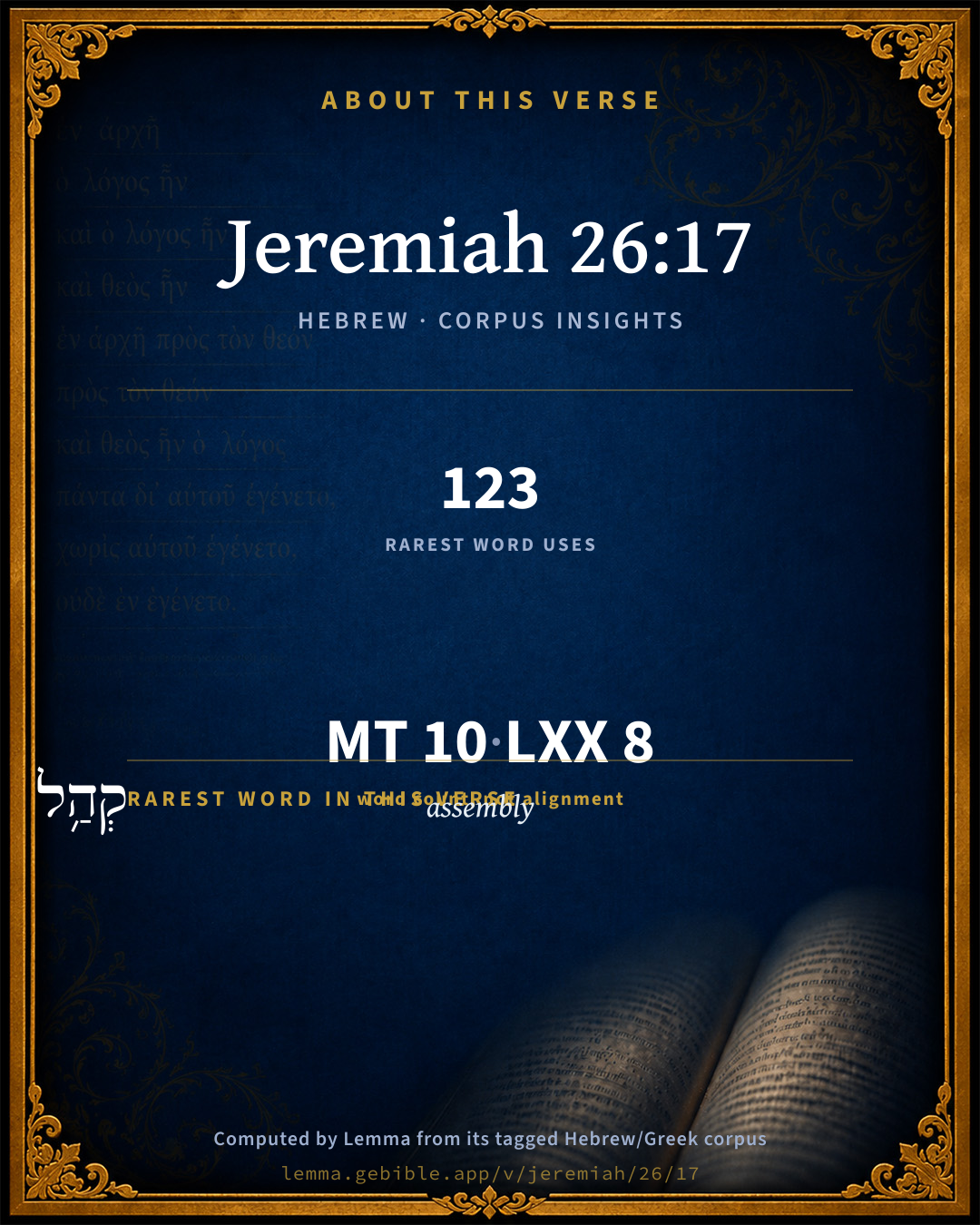
קְהַ֥ל
qâhâl
H6951
“assembly of”
Noun, Common, Masculine, Singular, Construct
Part of Speech
Noun
Type
Common
Gender
Masculine
Number
Singular
State
Construct
Full BDB Definition

Origin: from H6950

TWOT: 1991a

assembly, company, congregation, convocation - assembly - for evil counsel, war or invasion, religious purposes - company (of returning exiles) - congregation - as organised body
  1. וַיָּקֻ֣מוּ qûwm H6965 “and · to rise” Conjunction + Verb, Qal, Sequential Imperfect, 3rd Person, Masculine, Plural
  2. אֲנָשִׁ֔ים ʼîysh H376 “men” Noun, Common, Masculine, Plural, Absolute
  3. מִזִּקְנֵ֖י zâqên H2205 “from · old of” Preposition + Adjective, Adjective, Masculine, Plural, Construct
  4. הָאָ֑רֶץ ʼerets H776 “the · land” Particle, Definite Article + Noun, Common, Both, Singular, Absolute
  5. וַיֹּ֣אמְר֔וּ ʼâmar H559 “and · to say” Conjunction + Verb, Qal, Sequential Imperfect, 3rd Person, Masculine, Plural
  6. אֶל ʼêl H413 “to” Preposition
  7. כָּל kôl H3605 “all of” Noun, Common, Masculine, Singular, Construct
  8. הָעָ֖ם ʻam H5971 “the · people” Particle, Definite Article + Noun, Common, Masculine, Singular, Absolute
  9. לֵאמֹֽר ʼâmar H559 “to say” Preposition + Verb, Qal, Infinitive Construct

About this verse

These counts appear in no published source. They are computed here, from the morphology-tagged text and Lemma’s own curated glosses. What Lemma adds →

10
words
9
distinct lemmas
Prophets
section

Grammatical profile

  • 3 verbs
  • 5 nouns
  • 1 adjective
  • 1 preposition

Verb forms

  • וַיָּקֻ֣מוּ Qal · Sequential Imperfect
  • וַיֹּ֣אמְר֔וּ Qal · Sequential Imperfect
  • לֵאמֹֽר Qal · Infinitive Construct

Repetition

A word recurs within this verse — often emphatic in Hebrew:

  • וַיֹּ֣אמְר֔וּ to say H559 ×2

Hebrew & Septuagint length

In the original languages it is 10 Hebrew tokens and 8 Greek tokens — but the two are counted differently (Hebrew bundles its prefixes and suffixes into one token; the Greek is in lemma form), so that isn’t a like-for-like length.

Cross-references

2

Topical passages linked to Jeremiah 26:17 in the Treasury of Scripture Knowledge — connected by theme and wording, ordered by reader-vote popularity; previews shown in the World English Bible.

  • Acts 5:34 But one stood up in the council, a Pharisee named Gamaliel, a teacher of the law, honored by all the people, and commanded to put the apostles out for a little while.
  • Micah 1:1 The word of Yahweh that came to Micah the Morashtite in the days of Jotham, Ahaz, and Hezekiah, kings of Judah, which he saw concerning Samaria and Jerusalem.

Cross-references courtesy of OpenBible.info (CC BY 4.0).

Hebrew and Greek witnesses Masoretic Hebrew ↔ Greek Septuagint

The same verse in the two great witnesses to the Old Testament, shown verse-for-verse.

These are two independent witnesses, not word-aligned to each other, and the Septuagint is shown in lemma (dictionary) form.

Hebrew Jeremiah 26:17 Masoretic · Westminster Leningrad Codex

וַיָּקֻ֣מוּ אֲנָשִׁ֔ים מִזִּקְנֵ֖י הָאָ֑רֶץ וַיֹּ֣אמְר֔וּ אֶל כָּל קְהַ֥ל הָעָ֖ם לֵאמֹֽר

Then rose up certain of the elders of the land, and spoke to all the assembly of the people, saying,

World English Bible · Public Domain

Greek LXX Structure differs

In the Septuagint, Jeremiah is about an eighth shorter than the Hebrew and arranges its material differently — the Oracles Against the Nations (Hebrew chapters 46–51) appear in the middle of the Greek book, after 25:13. Because the chapter and verse boundaries do not line up, a verse-for-verse comparison with the Hebrew is not shown.

A verse-for-verse comparison isn’t shown here because the chapters and verses don’t line up. Switch to the LXX edition with the MT / LXX toggle above to read the Greek directly.

Hebrew: Westminster Leningrad Codex (CC BY 4.0). Greek: Septuagint (public domain); English from a public-domain English Septuagint. How the Septuagint differs from the Hebrew →

Targum (Aramaic paraphrase)

1

The Targum is the ancient Jewish Aramaic paraphrase of the Hebrew Scriptures — an interpretive translation, not the Hebrew text itself. Onkelos (literal) and Pseudo-Jonathan (expansive) render the Torah, and Jonathan the Prophets. Coverage is partial: where no permissively-licensed English translation exists for a verse, only the Aramaic is shown. This is verse-level text, not a word-by-word alignment to the Hebrew.

  1. Targum Jonathan Prophets (Joshua–Malachi)
    וְקָמוּ גַבְרַיָא מִסָבֵי אַרְעָא וַאֲמָרוּ לְכָל קְהָלָא דְעַמָא לְמֵימָר:

    (no public-domain English translation for this verse)

    Targum Jonathan — Aramaic: “Mikraot Gedolot” (public domain). English: “Sefaria Community Translation” (CC0 1.0 (public-domain dedication)); “London "Chaldee Paraphrase," 1871” (public domain). Text via Sefaria.

Commentary

Notes on Jeremiah 26:17 from classic Christian and Jewish commentators (each source and its license shown beneath its notes). The classic Christian expositions comment on the surrounding passage and are grouped to its opening verse, so a note may address several verses; the Jewish commentaries on the Tanakh (Rashi and others) are per-verse, so they appear only where the commentator wrote on this verse.

Lemma curates 59 commentaries, every one of them public domain or Creative Commons licensed, each selected and text-cleaned for this edition rather than reprinted as found. About our sources →

Trapp's Complete Commentary

John Trapp

Jer 26:17 Then rose up certain of the elders of the land, and spake to all the assembly of the people, saying,

Ver. 17. Then rose up certain of the elders.] Viri illi admodum venerabiles erant, saith Oecolampadius. These were very worthy men, whether princes or pleaders, well read in the annals of the times, as great men ought to be.

John Trapp, A Commentary or Exposition upon All the Books of the Old and New Testament (1647–1656) — public domain. Text from a community e-Sword module.

Joseph Benson's Commentary

Jer 26:17-19. Then rose up certain of the elders — Either the princes before mentioned, or the more intelligent men of the people, stood up, and put the assembly in mind of a former case, as is usual with us in giving judgment, the wisdom of our predecessors being a direction to us. The case referred to is that of Micah, the book of whose prophecies we have among those of the minor prophets. Was it thought strange that Jeremiah prophesied against this city and the temple? Micah did so before him, even in the reign of Hezekiah, that reign of reformation, Jer 26:18. Micah said as publicly, as Jeremiah had now spoken to the same purpose, Zion shall be ploughed like a field — The buildings shall be all destroyed, so that nothing shall hinder but it may be ploughed; Jerusalem shall become heaps — Of ruins; and the mountain of the house — On which the temple is built; shall be as the high places of the forest — Overrun with briers and thorns. This Micah not only spoke, but wrote, and left it upon record, Mic 3:12. Now did Hezekiah and all Judah put him to death? — Did the people come together in a body to accuse Micah, and demand sentence against him, as they had now done in the case of Jeremiah? Did they and their king make an act to silence him, or take away his life? No: on the contrary, they took the warning he gave them. Hezekiah, that renowned prince, set a good example before his successors; for he feared the Lord, as Noah, who, being warned of God of things not seen as yet, was moved with fear. He besought the Lord — To turn away the judgment threatened, and to be reconciled to them; and he found it was not in vain to do so; for the Lord repented him of the evil — Returned in mercy to them, and even sent an angel, who routed the army of the Assyrians that then threatened to destroy Jerusalem. These elders conclude, that it would be of dangerous consequence to the state if they should gratify the importunity of the priests and prophets in putting Jeremiah to death; saying, Thus we might procure great evil against our souls — Observe, reader, it is well to deter ourselves from sin, with the consideration of the mischief we should certainly do to ourselves by it, and the irreparable damage we should thereby bring upon our own souls.

Joseph Benson's Commentary on the Old and New Testaments (1811–1818) — public domain. Text from a community e-Sword module.

Tyndale Open Study Notes

Tyndale Open Resources

26:17-19 Societies in the ancient Near East greatly revered wise old men. Few people survived to old age, and those who did had a valuable store of memory. • Micah of Moresheth had lived during the reign of King Hezekiah (728–686 BC), more than 100 years earlier. Micah had written a small collection of his prophecies, from which the elders quoted a verse (Mic 3:12) that predicted the destruction of Mount Zion and Jerusalem. These elders counseled the people to do as Hezekiah had done when he turned from his sins and worshiped the Lord. Although the people of Judah relinquished their plan to harm Jeremiah, they did not heed the second part of the old men’s counsel.

Tyndale Open Study Notes — © Tyndale Open Resources, licensed CC BY-SA 4.0. Text via the HelloAO Bible API.

Jamieson, Fausset & Brown

Robert Jamieson, A. R. Fausset & David Brown

Compare Gamaliel's interposition (Act 5:34, &c.).

elders--some of the "princes" mentioned (Jer 26:16) those whose age, as well as dignity, would give weight to the precedents of past times which they adduce.

Jamieson, Fausset & Brown — Commentary Critical and Explanatory on the Whole Bible (1871) — public domain (CC PDM 1.0). Text via the HelloAO Bible API.

Adam Clarke's Commentary

Verse 17. Certain of the elders] This is really a fine defense, and the argument was perfectly conclusive. Some think that it was Ahikam who undertook the prophet's defence.

Adam Clarke's Commentary on the Bible (1810–1826) — public domain. Text from a community e-Sword/MySword module.

John Calvin's Commentaries

It is uncertain whether what is here recited was spoken before the acquittal of Jeremiah or not; for the Scripture does not always exactly preserve order in narrating things. It is yet probable, that while they were still deliberating and the minds of the people were not sufficiently pacified, the elders interposed, in order to calm the multitude and to soften their irritated minds, and to reconcile those to Jeremiah who had previously become foolishly incensed against him; for no doubt the priests and the false prophets had endeavored by every artifice to irritate the silly people against the Prophet; and hence more than one kind of remedy was necessary. When therefore the elders saw that wrath was still burning in the people, and that their minds were not disposed to shew kindness, they made use of this discourse. They took their argument from example, — that Jeremiah was not the first witness and herald of dreadful vengeance, for God had before that time, and in time past, been wont to speak by his other prophets against the city and the temple.

The priests and the prophets had indeed charged Jeremiah with novelty, and further pretended that they thus fiercely opposed him on the ground of common justice. Jeremiah had said, that God would spare neither the holy city nor the Temple. This was intolerable, for it had been said of the Temple,

“This is my rest for ever; here will I dwell.” (Psalm 132:14.)

We hence see that Jeremiah was overwhelmed as it were by this one expression, while the priests and the false prophets objected and said,

“Thou then makest void God’s promises; thou regardest as nothing the sanctity of the Temple.”

And they further pretended that not one of the prophets had ever thus spoken. But what do the elders now answer? even that there had been other prophets who had denounced ruin on the city and the Temple, and that, was falsely charged with this disgrace, that he was the first to announce God’s judgment. We now understand the state of the case: Jeremiah is defended, because he had not alone threatened the city and the first, but he had others as the originators, from whose mouths he had spoken, who were also the acknowledged servants of God, from whom credit could not be withholden, such as Micah.

Now, what is here related is found in Micah 3:12. The Prophet Micah had the same contest with the priests and prophets as Jeremiah had; for they said that it was impossible that God should pour his vengeance on the holy city and the Temple. They said,

“Is not Jehovah in the midst of us?”

and they said also, “No evil shall come on us.” They were inebriated with such a security, that they thought themselves beyond the reach of danger; and they disregarded all the threatenings of the prophets, because they imagined that God was bound to them. We indeed know that hypocrites ever relied on that promise, “Here will I dwell;” and they also took and borrowed words from God’s mouth and perverted them like cheats: “God resides in the midst of us; therefore nothing adverse can happen to us.” But the Prophet said, (the same are the words which we have just repeated,)

“For you Sion shall be plowed as a field, and Jerusalem shall become heaps, and the mountain of this house as the heights of a forest.”

But let us now consider each clause. It is first said, that the elders from the people of the land rose up It is probable that they were called elders, not as in other places on account of their office, but of their age. It is indeed certain that they were men of authority; but yet I doubt not but that they were far advanced in years, as they were able to relate to the people what had happened many years before. As it is added, that they spoke to the whole assembly of the people, we may hence deduce what I have already stated, — that the people were so violent, that there was need of a calm discourse to mitigate their ardor; and certainly when once a commotion is raised and rages, it is not an easy matter immediately to allay it. When, therefore, the kind elders saw that the minds of the people were still exasperated, they employed a moderating language, and said, Micah the Morasthite (they named his country) prophesied in the days of Hezekiah, king of Judah, etc

John Calvin's Commentaries (1540-1563) — public domain. Text from the Calvin Translation Society English edition (1840s-50s) via the Christian Classics Ethereal Library (ccel.org). Calvin's coverage is partial (roughly two-thirds of the Bible); uncommented books and verses are honest gaps, never fabricated. The 19th-century editor's footnotes and remarks are omitted so the notes are faithfully Calvin's own voice.

Ellicott's Commentary for English Readers

(17) Certain of the elders of the land.—The word is probably to be taken rather in the literal than in an official sense—or, if officially, then as including the literal meaning also. The elders speaking in the time of Jehoiakim (cir. B.C. 608) remembered the tradition of what had passed, a century or so before, in the reign of Hezekiah (B.C. 726-698), and could appeal to it as a precedent in favour of the prophet. The word for “assembly” (elsewhere rendered “congregation”) corresponds to the Ecclesia of a Greek city.

A Bible Commentary for English Readers, edited by Charles John Ellicott (1878–1897) — public domain. Text from a community e-Sword module.

The Cambridge Bible for Schools and Colleges

gen. ed. J. J. S. Perowne

17. the elders of the land] Certain elders support this proceeding by the precedent of Micah. We find frequent mention of the employment of leading men for administrative or judicial purposes (Deu_19:12; Deu_21:2 ff.; 1Sa_16:4; 1Ki_21:8; 1Ki_21:11), or simply as representatives of the people. See Num_11:16 (C.B.), also Exo_3:16; Exo_3:18; Exo_4:29; Exo_17:5 f., Jer_18:12.

The Cambridge Bible for Schools and Colleges (gen. ed. J. J. S. Perowne; Cambridge University Press, 1878–1918) — public domain. Text from a community e-Sword module.

John Gill's Exposition

Then rose up certain of the elders of the land,.... The same with the princes; some of the court, who rose up as advocates for the prophet:

and spake to all the assembly of the people: to justify the vote of the court, and to confirm the people in a good opinion of it, by giving them examples and instances of the like kind:

saying; as follows:

John Gill's Exposition of the Whole Bible (1746–1763) — public domain (CC PDM 1.0). Text via the HelloAO Bible API.

Albert Barnes' Notes on the Bible

The elders of the land - The heads and spokesmen of the congregation, who added their approval after the princes who represented the king had given their decision.

Albert Barnes' Notes on the Bible (1834–1885) — public domain. Text from a community e-Sword/MySword module.

Haydock's Catholic Bible Commentary

Ancients. They declare what happened about 100 years before, respecting Micheas iii. 12. (Calmet)

George Leo Haydock (1774–1849), Haydock's Catholic Family Bible and Commentary, 1859 edition — public domain. Excludes Psalms (Douay-Rheims chapter numbering differs from Protestant) and Deuterocanonical books (Catholic canon only).

Matthew Poole's English Annotations

Probably these

elders were some of the court, or else advocates, for they were wont to rise up, either to plead or to judge, Isa 3:13; Act 5:34. They rise up and apply themselves to the people to justify their absolutory sentence.

Matthew Poole's English Annotations on the Holy Bible (1683–1685) — public domain. Text from a community e-Sword/MySword module.

Whedon's Commentary on the Bible

Daniel D. Whedon

17. Elders — These represented the assembled congregation, giving voice to the sentiment of the people. The scene was an impressive one. The bold, solitary, suffering prophet, standing almost in the visible shadow of death; the sanctimonious, spiteful, scoffing priests and prophets; the vast congregation of people whose earthly and spiritual hopes were involved in the questions at issue; the grave and reverend judges, visible embodiment of the dread majesty of the law; the place of meeting, being none other than the sanctuary itself, endeared by the holy memories of four centuries; and the clouds of war gathering in the distant horizon — all conspire to the deep and solemn interest of the occasion, and make it one of the notable passages of history.

Daniel D. Whedon (gen. ed.), Commentary on the Old and New Testaments (1874–1909) — public domain. Text from a community e-Sword module.

The Pulpit Commentary

The elders of the land add their voice in favor of Jeremiah, not, however, without first of all consulting the people whose representatives they are. The whole verse is thoroughly technical in its phraseology. The word (qahal ) rendered "assembly" is the traditional legal term for the "congregation of Israel"; (Deu_31:30) comp. ver. 9, where the verb is the corresponding one to qahal. Thus, with all the faults of the government of Judah, which Jeremiah himself reveals to us, it was very far removed from the Oriental despotisms of our day. The "elders" are still an important element in the social system, and form a link with that earlier period in which the family was the leading power in the social organization. Originally the term denoted, strictly and in the full sense, heads of families; they have their analogue in the councils of the Aryan village communities. "References to their parliamentary status (if the phrase may be used) occur in Exo_3:16 2Sa_19:11 1Ki_8:1 1Ki_20:7. The institution lingered on during and after the Babylonian." (Jer_29:1 Eze_14:1 Eze_20:1 Ezr_5:5 Ezr_6:7 Ezr_10:14 Mat_26:3, 47 Mar_14:43 Act_4:5, etc.) We find another reference to their quasi-judicial authority in Deu_21:2.

Vers. 17-23. An argument from history.

A prophet, a king, and a people belonging to a past generation are brought forward to justify the conclusion to which the princes and the people here had come. Here, then, is an eminent instance of what a practical study history may become. One must be so acquainted with the past as to seize just that completed event which will cast light on the duties and necessities of the present.

I AN INSTANCE OF A PROPHET"S UNPALATABLE MESSAGE. No word could have been more provocative of resentment than this. It threatened those to whom it was spoken in the closest possible way. It meant that they were to be subjected to their enemies, driven from their homes, and deprived of their most substantial possessions. The message being such, what comfort Jeremiah might obtain from recollecting that his predecessors treading his thorny path before him were now remembered in such an honorable way! Micah had been faithful to his God, his message, and his audience; and the impression of his faithfulness is still deep when something like a century has elapsed. These people now listening to Jeremiah were thus made responsible for Micah"s words as well as Jeremiah"s. What harmony there is in true prophecy! False prophets, from their very position, cannot be got to agree; but here Jeremiah"s words at once recall to mind Micah"s similar words, and help to drive them with a deeper impression into some at least of this subsequent generation. Thus also, reciprocally, Micah"s words help Jeremiah"s. And not only was there harmony between the prophecies; there was harmony between the characters of the prophets as well. All the prophets would have understood one another perfectly if they had been gathered together in one assembly.

II AN INSTANCE OF HOW A PROPHET SHOULD EVER BE RECEIVED. Jeremiah is able to look back on a man of like spirit with himself in. the prophet Micah, but the present leaders of Israel have their thoughts turned to a very different king from Jehoiakim. We can guess how Hezekiah behaved toward Micah from the way in which he behaved toward Isaiah. The narrative here concerning the fate of Urijah seems to be introduced to show that, though Jeremiah escaped from peril at the hands of these priests and prophets, their nature and the nature of Jehoiakim remained the same. When Hezekiah heard the truth, bitter as it was, he humbled himself and averted doom. But Jehoiakim and his profligate and rapacious circle hated every one who spoke the truth. Hence it was not enough for them that Urijah fled; they followed him and brought him back to suffer their vengeance. Thus it is made evident how Jehoiakim was a man of very different spirit from Hezekiah. Y.

The Pulpit Commentary (1880–1919), ed. H.D.M. Spence-Jones & Joseph S. Exell — public domain. Text from a community e-Sword module.

Lesson kit

Teaching starters — assembled from the data on this page, not authored interpretation. Every prompt links to the verse data it draws on. Edit before teaching.

Jeremiah, in the Prophets, opens this verse with 10 words (9 distinct Hebrew lemmas). Its most distinctive word is qâhâl (“assembly”). A historical commentator’s framing appears above. Read the whole chapter for the surrounding context.

Discussion questions

  1. How does “assembly” (qâhâl) shape what this verse is saying?
  2. How does Acts 5:34, which shares this passage’s theme, read alongside this verse?
  3. What does the repetition of “to say” (2× in this one verse) do in this verse?
  4. The translations on this page render this verse differently — a whole-verse word diff, not a word-by-word alignment. What might account for the different wordings?
  5. «וַיָּקֻ֣מוּ» is a Qal Sequential Imperfect verb. How does that grammatical form shape the action described?
  6. Compare how Trapp's Complete Commentary and Joseph Benson's Commentary read this verse. Where do they agree or differ?

Things to notice

Reading settings

Reading text

Shown beneath each verse's original-language words.

Old Testament
Old Testament edition

Read the OT as the Masoretic Hebrew (MT) or the Greek Septuagint (LXX).

English shown for the Greek Septuagint (in the Hebrew ↔ Greek comparison).

Comparing translations? Open the Compare panel on any verse page to stack up to four side by side.